

|
시장보고서
상품코드
2121885
유전체 편집 : 시장 점유율 분석, 업계 동향과 통계, 성장 예측(2026-2031년)Genome Editing - Market Share Analysis, Industry Trends & Statistics, Growth Forecasts (2026 - 2031) |
||||||
 Mordor Intelligence
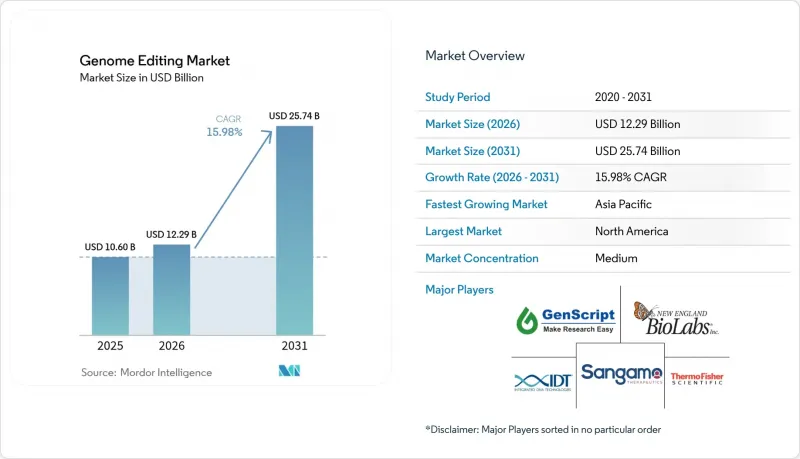
Mordor Intelligence에 의하면, 유전체 편집 시장 규모는 2025년에 106억 달러로 평가되었고, 2026년 122억 9,000만 달러에서 2031년까지 257억 4,000만 달러에 이를 것으로 예측되며, 예측 기간(2026-2031년) CAGR은 15.98%를 기록할 전망입니다.
본 보고서에서는 업계를 기술별(클러스터화된 규칙적 간격을 가진 짧은 회문 반복 서열(CRISPR) 등),전달 방식별(바이러스 벡터 등), 용도별(세포주 공학 등), 최종 사용자별(제약·바이오기술 기업 등), 지역별(북미, 유럽, 아시아태평양 등)로 분류하고 있습니다. 시장 예측은 금액(달러) 기준으로 제시되어 있습니다.
세계 유전체 편집 시장 동향 및 인사이트
임상시험에서 CRISPR-Cas 시스템의 급속한 보급
최초의 CRISPR 치료법이 FDA 승인을 받음에 따라 임상 연구의 폭이 넓어졌으며, 개발 주기를 최대 2년 단축할 수 있는 다군 우산 임상시험이 가능해졌습니다. 혈액학, 안과, 고형암 연구에서 나타난 긍정적인 결과는 이 플랫폼의 범용성을 입증하며 지속적인 자본 유입을 가져오고 있습니다. 대학 및 생명공학 기업들은 단일 유전자 질환 적응증에 그치지 않고, 소화기계 암에서 완전 반응을 달성한 CRISPR-TIL 프로토콜의 확대에 주력하고 있습니다.
기후 변화에 강한 작물에 대한 수요 증가에 따른 농업 생명공학의 발전
유전체 편집 쌀, 가뭄에 강한 옥수수, 내열성 가축 등은 수확량을 유지하면서 기후 변화로 인한 충격을 완화하는 해결책의 좋은 예입니다. 외래 DNA가 잔류하지 않는 16개 관할 구역에서 규제가 면제됨에 따라 상용화가 가속화되고 있으며, 소규모 육종 업체들도 GMO와 관련된 복잡한 장벽을 극복하지 않고도 유전체 편집 시장에 진입할 수 있게 되었습니다. 민관 협력 프로그램에서는 CRISPR 기술을 주곡의 영양 강화에 활용하고 있으며, 개발도상 지역에서 시장 기회를 확대되고 있습니다.
인간을 대상으로 한 장기적인 오프타겟 안전성 프로파일은 불투명
초심도 시퀀싱을 통해 여전히 수백 개의 잠재적 오프타겟 부위가 밝혀지고 있으며, 규제 당국은 후기 임상시험을 진행하기 전에 생체 내 분포 및 지속성에 관한 연구를 확대할 것을 요구하고 있습니다. 고정밀도 Cas 변이체나 프라임 편집 접근법을 통해 위험은 완화되지만, 인간에 대한 장기 데이터가 제한적이기 때문에 특히 EU에서는 시판 후 조사 요건이 여전히 엄격하게 유지되고 있습니다.
부문 분석
2025년, CRISPR은 유전체 편집 시장에서 41.10%의 점유율을 차지했으나, TALEN은 19.49%의 연평균 성장률(CAGR)을 보이며 경쟁 구도를 변화시키고 있습니다. 진화하는 AI 도구는 가이드 RNA의 최적화 주기를 획기적으로 단축하고, 뉴클레아제 설계의 폭을 넓히며, 새로운 서열 상동성을 지닌 Open-CRISPR와 같은 파생 기술을 탄생시키고 있습니다. 베이스 편집 및 프라임 편집 기법은 안전성을 중시하는 대안으로 주목받고 있으며, 특히 이중가닥 절단 위험에 민감한 적응증 분야에서 전용 하위 시장을 개척할 가능성이 있습니다.
한편, 아연 손가락 뉴클레아제는 처리량보다 지적 재산권상의 제약이 없는 것이 우선시되는 극히 특이성이 높은 용도에서 독자적인 틈새 시장을 유지하고 있습니다. 메가뉴클레아제 및 올리고뉴클레오티드 유도형 돌연변이 유발법은 산업용 합성 생물학 워크플로우를 위한 툴킷을 보완하는 것입니다. 그 결과, 플랫폼 제공업체들은 편집 기법을 예측 AI 소프트웨어 및 스크리닝 라이브러리와 결합하는 사례가 늘어나고 있으며, 치료, 농업, 산업 분야의 고객을 대상으로 한 보다 광범위한 솔루션 판매의 기반을 마련하고 있습니다.
바이러스 벡터는 예측 가능한 전이 효율과 충분히 규명된 조절 경로를 통해 2025년 매출의 46.10%를 창출하며, 고부가가치 엑소비보 요법에 대한 지속적인 수요를 보장하고 있습니다. 한편, 전기천공법, 마이크로플루이딕스 압착, 조직 선택적 지질 나노입자와 같은 비바이러스성 물리적 기법은 바이러스 시스템 고유의 면역원성 및 페이로드 크기 제한을 해결하기 위해 연평균 성장률(CAGR) 16.21%로 성장할 전망입니다.
로봇 기반 미세 주입 플랫폼은 배아의 유전체 편집 처리 능력을 4배로 높여, 농업 육종가들의 비바이러스성 프로토콜 대규모 도입을 촉진하고 있습니다. 리보핵단백질 복합체는 적응 면역이 활성화되기 전에 효과가 사라지는 일시적인 유전체 편집을 실현하여, 반복 투여가 필요한 만성 질환 치료 프로그램에 적합합니다. 화학적 운반체는 스크리닝 및 연구 단계에서는 여전히 중요하지만, 임상 현장에서는 보다 효율적인 물리적 도구로 그 자리를 점차 내주고 있습니다.
지역별 분석
북미는 대규모 벤처 자금, 최첨단 임상시험 인프라, 그리고 FDA의 지원 정책에 힘입어 2025년 매출의 40.80%를 차지했습니다. 연방 정부의 바이오경제 이니셔티브에서는 유전체학 연구개발 및 첨단 제조에 수십억 달러 규모의 예산이 배정되어 국내 공급망이 강화되고 있습니다. 그럼에도 불구하고 건설비 급등과 GMP 인력 부족으로 인해 신규 시설의 운영비에는 상승 압력이 가해지고 있습니다.
유럽에서는 세계 최고 수준의 학술 연구가 이루어지고 있는 반면, 규제가 세분화되어 있어 농업 분야의 상용화가 지연되고 있습니다. 유전체 편집 작물의 대부분을 유전자 변형 작물(GMO)로 지정하는 EU의 입장은 영국이나 스위스의 보다 관대한 태도와 대립하고 있어, 정책 조화를 요구하는 목소리가 높아지고 있습니다. 한편, 생명공학 투자 펀드와 ‘호라이즌 유럽(Horizon Europe)’의 보조금을 통해 치료 프로그램에 자원이 투입되고 있어, 무역 정책의 불확실성에도 불구하고 연구 개발이 유지되고 있습니다.
아시아태평양은 연평균 성장률(CAGR) 19.75%로 가장 빠르게 성장하고 있는 지역이며, 중국의 산업 정책에 따른 인센티브, 유전체 편집 식품에 대한 일본의 규제 간소화, 그리고 GDP에 80억 달러를 기여하는 것을 목표로 하는 호주의 ‘RNA 블루프린트’에 의해 주도되고 있습니다. 인도의 위험 단계별 지침은 저위험 편집에 대해 신속한 승인 절차를 마련하여 스타트업 설립을 촉진하고 있습니다. 기술 이전 제한 및 특허 풀에 관한 협상은 해외 기업의 향후 시장 진입 전망을 좌우할 것입니다.
기타 혜택:
- 엑셀 형식 시장 예측(ME) 시트
- 3개월간의 애널리스트 지원
자주 묻는 질문
목차
제1장 서론
제2장 조사 방법
제3장 주요 요약
제4장 시장 구도
제5장 시장 규모와 성장 예측
제6장 경쟁 구도
제7장 시장 기회와 향후 전망
LSH 26.09.09According to Mordor Intelligence, the genome editing market size was valued at USD 10.60 billion in 2025 and estimated to grow from USD 12.29 billion in 2026 to reach USD 25.74 billion by 2031, at a CAGR of 15.98% during the forecast period (2026-2031).
This report Segments the Industry Into by Technology (Clustered Regularly Interspaced Short Palindromic Repeats (CRISPR), and More), Delivery Method (Viral Vectors, and More), Application (Cell Line Engineering, and More), by End User (Pharmaceutical & Biotechnology Companies, and More), and Geography (North America, Europe, Asia-Pacific, and More). The Market Forecasts are Provided in Terms of Value (USD).
Global Genome Editing Market Trends and Insights
Rapid Adoption of CRISPR-Cas Systems in Clinical Trials
FDA approval of the first CRISPR therapy unlocked broader clinical exploration, enabling multi-arm umbrella trials that cut development cycles by up to two years. Positive read-outs from hematology, ophthalmology, and solid-tumor studies underscore platform versatility and attract sustained capital inflows. Universities and biotech firms are scaling CRISPR-TIL protocols that achieved complete responses in gastrointestinal cancers, moving beyond monogenic indications.
Expanding Agricultural Biotechnology Demand for Climate-Resilient Crops
Genome-edited rice, drought-tolerant corn, and heat-resistant livestock exemplify solutions that mitigate climate shocks while maintaining yield. Regulatory exemptions in 16 jurisdictions where no foreign DNA persists accelerate commercialization, allowing small breeders to enter the genome editing market without onerous GMO hurdles. Public-private programs channel CRISPR tools toward nutritional fortification in staple crops, broadening market opportunities in developing regions.
Uncertain Long-Term Off-Target Safety Profile in Humans
Ultra-deep sequencing continues to reveal hundreds of potential off-target sites, prompting regulators to demand expanded biodistribution and durability studies before late-stage trials can proceed. High-fidelity Cas variants and prime-editing approaches lessen risk, but limited long-term human data keep post-marketing surveillance requirements stringent, especially in the EU.
Other drivers and restraints analyzed in the detailed report include:
- Surging VC & IPO Funding for Gene-Editing Start-Ups
- Mainstreaming In-Vivo Gene-Editing Therapeutics for Rare Diseases
- High CAPEX For GMP-Compliant Gene-Editing Manufacturing Suites
For complete list of drivers and restraints, kindly check the Table Of Contents.
Segment Analysis
CRISPR delivered 41.10% genome editing market share in 2025, but TALEN exhibits a 19.49% CAGR that is reshaping the competitive mix. Evolving AI tools dramatically cut guide-RNA optimization cycles and expand the nuclease design space, spawning derivatives such as Open-CRISPR with novel sequence homology. Base- and prime-editing modalities gain traction as safety-oriented alternatives and may carve dedicated submarkets, especially in indication areas sensitive to double-strand break risks.
At the same time, zinc finger nucleases preserve niches in ultra-specific applications where intellectual-property freedom outweighs throughput. Meganucleases and oligonucleotide-directed mutagenesis round out the toolkit for industrial synthetic-biology workflows. Consequently, platform providers increasingly bundle editing modalities with predictive AI software and screening libraries, anchoring broader solution sales across therapeutic, agricultural, and industrial customers.
Viral vectors generated 46.10% of 2025 revenue through predictable transduction efficiency and a well-understood regulatory path, ensuring continued demand in high-value ex-vivo therapies. Yet non-viral physical approaches will expand at 16.21% CAGR as electroporation, microfluidic squeezing, and tissue-selective lipid nanoparticles solve the immunogenicity and payload-size limits inherent to viral systems.
Robotic microinjection platforms quadruple embryo-editing throughput, spurring agricultural breeders to adopt non-viral protocols at scale. Ribonucleoprotein complexes deliver transient editing that fades before adaptive immunity triggers, appealing to chronic-disease programs requiring repeat dosing. Chemical carriers remain relevant for screening and research but cede ground in clinical settings to more efficient physical tools.
Complete Report Scope:
- By Technology
- Clustered Regularly Interspaced Short Palindromic Repeats (CRISPR)
- Transcription Activator-Like Effector Nuclease (TALEN)
- Zinc Finger Nuclease (ZFN)
- Meganucleases
- Oligonucleotide-directed Mutagenesis (ODM)
- Other Technologies
- By Delivery Method
- Viral Vectors
- Non-viral Physical Methods
- Non-viral Chemical Methods
- By Application
- Cell Line Engineering
- Gene & Cell Therapy
- Drug Discovery & Functional Genomics
- Agricultural Crop Engineering
- Diagnostics & Synthetic Biology
- By End User
- Pharmaceutical & Biotechnology Companies
- Academic & Government Research Institutes
- Contract Research Organizations
- Agriculture & Food Companies
- By Geography
- North America
- United States
- Canada
- Mexico
- Europe
- Germany
- United Kingdom
- France
- Italy
- Spain
- Rest of Europe
- Asia-Pacific
- China
- Japan
- India
- Australia
- South Korea
- Rest of Asia-Pacific
- Middle East & Africa
- GCC
- South Africa
- Rest of Middle East & Africa
- South America
- Brazil
- Argentina
- Rest of South America
- North America
Geography Analysis
North America captured 40.80% of 2025 revenue, anchored by deep venture funding, leading clinical-trial infrastructure, and supportive FDA policies. Federal bio-economy initiatives allocate multi-billion-dollar budgets to genomics R&D and advanced manufacturing, reinforcing domestic supply chains. Nonetheless, construction-cost inflation and scarcity of GMP personnel place upward pressure on operating expenses for new facilities.
Europe combines world-class academic research with fragmented regulations that slow agricultural commercialization. The EU's GMO designation for most gene-edited crops conflicts with more permissive stances in the United Kingdom and Switzerland, prompting calls for policy harmonization. Meanwhile, biotech investment funds and Horizon Europe grants channel resources into therapeutic programs, sustaining R&D despite trade-policy uncertainty.
Asia-Pacific is the fastest-growing region at 19.75% CAGR, propelled by Chinese industrial-policy incentives, Japanese regulatory streamlining for genome-edited foods, and Australia's RNA Blueprint aiming for an USD 8 billion contribution to GDP. India's risk-tiered guidelines create an expedited path for low-risk edits, catalyzing start-up formation. Technology-transfer limits and patent-pool negotiations will shape the trajectory of foreign market entrants.
- Thermo Fisher Scientific
- Merck
- CRISPR Therapeutics AG
- Editas Medicine
- Horizon Discovery
- Intellia Therapeutics Inc.
- Beam Therapeutics Inc.
- Sangamo Therapeutics
- Genscript
- Synthego Corporation
- Takara Bio
- Integrated DNA Technologies
- Lonza Group
- New England Biolabs
- OriGene Technologies
- Caribou Biosciences Inc.
- Bluebird Bio
- Bio-Rad Laboratories
- Agilent Technologies
- QIAGEN
Additional Benefits:
- The market estimate (ME) sheet in Excel format
- 3 months of analyst support
TABLE OF CONTENTS
1 Introduction
- 1.1 Study Assumptions & Market Definition
- 1.2 Scope of the Study
2 Research Methodology
3 Executive Summary
4 Market Landscape
- 4.1 Market Overview
- 4.2 Market Drivers
- 4.2.1 Rapid Adoption of CRISPR-Cas Systems in Clinical Trials
- 4.2.2 Expanding Agricultural Biotechnology Demand for Climate-Resilient Crops
- 4.2.3 Surging VC & IPO Funding for Gene-Editing Start-Ups
- 4.2.4 Mainstreaming In-Vivo Gene-Editing Therapeutics for Rare Diseases
- 4.2.5 Automation & AI-Assisted High-Throughput Screening Platforms
- 4.2.6 Government Bio-Economy Roadmaps in Emerging Countries
- 4.3 Market Restraints
- 4.3.1 Uncertain Long-Term Off-Target Safety Profile in Humans
- 4.3.2 High CAPEX For GMP-Compliant Gene-Editing Manufacturing Suites
- 4.3.3 Cross-Border Regulatory Fragmentation for Edited Seeds
- 4.3.4 Talent Shortage in Advanced Molecular Biology Skillsets
- 4.4 Porter's Five Forces Analysis
- 4.4.1 Threat of New Entrants
- 4.4.2 Bargaining Power of Buyers
- 4.4.3 Bargaining Power of Suppliers
- 4.4.4 Threat of Substitutes
- 4.4.5 Competitive Rivalry
5 Market Size & Growth Forecasts (Value in USD)
- 5.1 By Technology
- 5.1.1 Clustered Regularly Interspaced Short Palindromic Repeats (CRISPR)
- 5.1.2 Transcription Activator-Like Effector Nuclease (TALEN)
- 5.1.3 Zinc Finger Nuclease (ZFN)
- 5.1.4 Meganucleases
- 5.1.5 Oligonucleotide-directed Mutagenesis (ODM)
- 5.1.6 Other Technologies
- 5.2 By Delivery Method
- 5.2.1 Viral Vectors
- 5.2.2 Non-viral Physical Methods
- 5.2.3 Non-viral Chemical Methods
- 5.3 By Application
- 5.3.1 Cell Line Engineering
- 5.3.2 Gene & Cell Therapy
- 5.3.3 Drug Discovery & Functional Genomics
- 5.3.4 Agricultural Crop Engineering
- 5.3.5 Diagnostics & Synthetic Biology
- 5.4 By End User
- 5.4.1 Pharmaceutical & Biotechnology Companies
- 5.4.2 Academic & Government Research Institutes
- 5.4.3 Contract Research Organizations
- 5.4.4 Agriculture & Food Companies
- 5.5 By Geography
- 5.5.1 North America
- 5.5.1.1 United States
- 5.5.1.2 Canada
- 5.5.1.3 Mexico
- 5.5.2 Europe
- 5.5.2.1 Germany
- 5.5.2.2 United Kingdom
- 5.5.2.3 France
- 5.5.2.4 Italy
- 5.5.2.5 Spain
- 5.5.2.6 Rest of Europe
- 5.5.3 Asia-Pacific
- 5.5.3.1 China
- 5.5.3.2 Japan
- 5.5.3.3 India
- 5.5.3.4 Australia
- 5.5.3.5 South Korea
- 5.5.3.6 Rest of Asia-Pacific
- 5.5.4 Middle East & Africa
- 5.5.4.1 GCC
- 5.5.4.2 South Africa
- 5.5.4.3 Rest of Middle East & Africa
- 5.5.5 South America
- 5.5.5.1 Brazil
- 5.5.5.2 Argentina
- 5.5.5.3 Rest of South America
- 5.5.1 North America
6 Competitive Landscape
- 6.1 Market Concentration
- 6.2 Market Share Analysis
- 6.3 Company Profiles (includes Global level Overview, Market level overview, Core Segments, Financials as available, Strategic Information, Market Rank/Share for key companies, Products & Services, and Recent Developments)
- 6.3.1 Thermo Fisher Scientific Inc.
- 6.3.2 Merck KGaA (Sigma-Aldrich)
- 6.3.3 CRISPR Therapeutics AG
- 6.3.4 Editas Medicine Inc.
- 6.3.5 Horizon Discovery Group plc
- 6.3.6 Intellia Therapeutics Inc.
- 6.3.7 Beam Therapeutics Inc.
- 6.3.8 Sangamo Therapeutics Inc.
- 6.3.9 GenScript Biotech Corporation
- 6.3.10 Synthego Corporation
- 6.3.11 Takara Bio Inc.
- 6.3.12 Integrated DNA Technologies Inc.
- 6.3.13 Lonza Group AG
- 6.3.14 New England Biolabs Inc.
- 6.3.15 OriGene Technologies Inc.
- 6.3.16 Caribou Biosciences Inc.
- 6.3.17 Bluebird Bio Inc.
- 6.3.18 Bio-Rad Laboratories Inc.
- 6.3.19 Agilent Technologies Inc.
- 6.3.20 QIAGEN N.V.
7 Market Opportunities & Future Outlook
- 7.1 White-space & Unmet-Need Assessment


