|
시장보고서
상품코드
2121892
자동차 클러치 시장 : 시장 점유율 분석, 업계 동향 및 통계, 성장 예측(2026-2031년)Automotive Clutch - Market Share Analysis, Industry Trends & Statistics, Growth Forecasts (2026 - 2031) |
||||||
 Mordor Intelligence
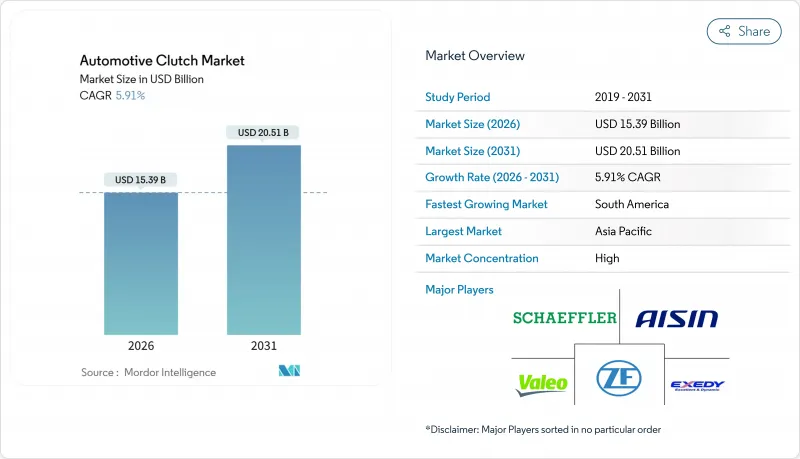
Mordor Intelligence에 의하면, 자동차 클러치 시장 규모는 2026년에 153억 9,000만 달러로 추정되고, 2031년까지 205억 1,000만 달러에 이를 것으로 예측됩니다.
이는 예측 기간(2026-2031년) 동안 연평균 성장률(CAGR)이 5.91%로 성장이 전망되는 수치입니다.
본 보고서는 변속기 유형별(수동, 자동, AMT, DCT, 기타), 차종별(승용차, 소형 상용차 등), 클러치 부품별(디스크·허브, 압력판, 릴리스 베어링, 플라이휠,작동 시스템), 판매 채널별(OEM, 애프터마켓), 지역별(북미, 남미, 유럽, 아시아태평양, 중동 및 아프리카)로 분류되어 있습니다. 시장 예측은 금액(달러) 기준으로 제시되어 있습니다.
세계의 자동차 클러치 시장 동향 및 인사이트
OEM의 듀얼 클러치 및 자동 변속기로의 급속한 전환
유럽 및 중국의 자동차 제조업체들은 풀 하이브리드 차량과 같은 가격 부담 없이 CO₂ 배출량 95 g/km 미만이라는 목표를 달성할 수 있는 습식 클러치 설계를 선호하기 때문에 듀얼 클러치의 보급률이 상승하고 있습니다. 폭스바겐의 MQB 플랫폼 기반 모델에는 기생 저항을 12% 저감하는 전기유압식 DQ381 유닛이 채택된 반면, 중국 자동차 브랜드들은 150-250 kW 플러그인 하이브리드 차량의 성능 향상을 위해 DCT 기술 라이선스를 취득하고 있습니다. 인도의 소형 상용차 부문에서는 오토매틱 매뉴얼의 점유율이 확대되고 있으며, 이튼(Eaton)사의 ‘AutoShift’는 도시 구간에서 연료 소비를 8-10% 절감합니다. 이러한 추세로 인해 싱글 플레이트식 드라이 클러치의 생산량은 감소하는 반면, 멀티 플레이트식 웨트 모듈 및 전자식 작동 기구에 대한 수요는 확대되고 있습니다. 메카트로닉스를 습득한 공급업체는 더 높은 단가를 확보하고 있어, 프리미엄 변속기 분야의 경쟁을 심화시키고 있습니다. 자동변속기 차량 및 듀얼 클러치 차량의 대수 증가에 따라 교체 주기가 길어짐에 따라 애프터마켓 수요는 더욱 안정될 것으로 예상되지만, 수리의 복잡화 및 부품 가격 상승도 우려됩니다.
신흥 경제국에서의 경차 생산 증가
인도, 브라질 및 주요 아세안(ASEAN) 시장에서는 소비자 소득 증가와 유리한 현지 조립 우대 조치에 힘입어 경차 생산이 전반적으로 확대될 것으로 예측됩니다. 이러한 생산량의 급증은 클러치의 기본 생산량을 뒷받침하여, 성숙 시장에서 BEV(배터리 전기자동차)로 인한 수요 감소를 상쇄할 것으로 보입니다. 또한, 신흥 시장에서의 공장 건설로 인해 공급업체들은 프레스 공장과 마찰재 공장을 동일한 거점에 통합하도록 유도되어, 리드타임 단축 및 환율 헤지 효율화가 도모되고 있습니다.
BEV의 보급 확대가 기존 클러치를 대체
2024년 중국의 BEV 점유율은 약 25%에 달했으며, 이로 인해 320만 개의 클러치가 감소했고, 유럽의 21.7% 점유율로 인해 180만 개가 추가로 감소했습니다. 테슬라와 BYD만으로도 480만 세트 수요가 대체되었으며, 이에 따라 폭스바겐은 2025년에 카셀의 드라이 클러치 생산 라인을 중단하기로 했습니다. 각 공급업체들은 전동화 구동계를 위한 디스커넥트 클러치 및 토크 벡터링 클러치로 연구 개발을 전환하고 있지만, 단가는 DCT 모듈보다 40-60% 낮아 그 결과 수익이 압박받고 있습니다.
부문 분석
2025년, 인도, 브라질, 동남아시아의 구매자들이 공장 출고 가격의 저렴함을 중시함에 따라 수동 변속기는 자동차 클러치 시장에서 64.79%의 점유율을 유지했습니다. 그러나 0.2초 미만의 변속과 매끄러운 토크 오버레이를 필요로 하는 유럽 및 중국의 플러그인 하이브리드 차량에 힘입어, 습식 듀얼 클러치 시스템은 2031년까지 연평균 성장률(CAGR) 9.37%로 확대될 것으로 예측됩니다.
변속기에 대한 선호도는 수요 곡선의 양극화를 보여줍니다. 비용을 중시하는 신흥 시장에서는 애프터마켓 가격으로 45-60달러인 싱글 플레이트식 드라이 클러치가 계속해서 선호되고 있으며, 다른 지역에서 전동화가 진행되는 가운데서도 그 판매량은 높은 수준을 유지하고 있습니다. 한편, 유럽의 고급 세단에서는 디젤 가격이 리터당 1.80유로를 넘는 상황에서 토크 컨버터식 자동 변속기에 비해 12%의 연비 향상을 실현하기 위해 2,800유로 상당의 습식 DCT 유닛이 채택되고 있습니다. 볼보의 ‘I-Shift’를 탑재한 트럭은 페달 조작의 부담을 줄여, 스웨덴 차량 플릿에서 운전자의 부상으로 인한 보험 청구 건수를 14% 감소시켰습니다. 이러한 수요의 분화로 인해 수동 클러치의 대량 생산은 유지되는 한편, 기술 선도 기업들은 2031년까지 높은 수익률을 자랑하는 DCT 시장을 확보하게 되었습니다.
2025년, 승용차는 자동차 클러치 시장의 74.23%를 차지했습니다. 그럼에도 불구하고, 중형 및 대형 상용차는 주행 거리를 늘리는 전자상거래 물류와 하루 500km의 장거리 운송 시 피로를 최소화하기 위해 규제 당국이 자동 변속기 도입을 장려하고 있는 것을 배경으로, 2031년까지 연평균 성장률(CAGR) 8.02%라는 가장 높은 성장률을 나타낼 것으로 예측됩니다. 포드 트랜짓 및 스텔란티스 두카토와 같은 밴에는 LuK사의 듀얼 매스 플라이휠이 채택되어, 이를 통해 정비 주기가 18만 km로 연장되었습니다. 한편, 존 디어(John Deere)사는 고출력 콤바인에서 밭에서 기어비 변경이 가능한 습식 클러치식 파워 시프트 변속기의 시험을 진행하고 있습니다.
상용차의 전동화는 수요 양상을 완전히 바꾸고 있습니다. 배터리식 전기 배송 밴에서는 클러치가 필요 없게 되는 반면, 레인지 익스텐더식 하이브리드 차량에서는 발전기를 격리하기 위한 디스커넥트 유닛이 유지되고 있습니다. 아쇼크 레이랜드의 ‘보스 LX’는 ZF사의 ‘트랙슨 AMT’를 채택하고 있으며, 총중량 49톤 차량용으로 정격 1,400 Nm의 듀얼 플레이트 클러치를 탑재하고 있습니다. 또한, 캐터필러의 불도저는 토공 작업 중 발생하는 180 kW의 열을 방출하기 위해 습식 멀티 플레이트 클러치를 채택하고 있습니다. 이러한 다양한 이용 사례의 조합으로 인해 승용차용 BEV가 보급되는 상황에서도 자동차 클러치 시장은 유지되고 있습니다.
지역별 분석
2025년, 아시아태평양은 자동차 클러치 시장에서 49.62%의 점유율을 유지했습니다. 중국에서는 플러그인 하이브리드 SUV에 습식 듀얼 클러치 변속기(DCT)의 채택이 확대됨에 따라 단위당 가치가 상승하고 있습니다. 한편, 인도에서는 수동 변속기의 우위가 지속되어 비용 효율이 뛰어난 건식 클러치에 대한 견조한 수요를 뒷받침하고 있습니다. 일본에서는 무단 변속기(CVT)의 보급이 확대됨에 따라 생산량이 감소하고 있습니다. 그러나 EXEDY나 아이신과 같은 기업들은 경쟁력 있는 비용 구조를 활용하여 유럽 가격보다 낮은 가격을 책정함으로써 수출을 확대하고, 이러한 감소분을 상쇄하고 있습니다. 동남아시아에서는 태국이 부품 분야에 4억 2,000만 달러 규모의 외국인 직접 투자(FDI)를 승인함에 따라, 각 공장이 현지화 노력을 본격화하고 있습니다.
북미 자동차 클러치 시장은 주로 상용차와 고성능 차량에 의해 주도되고 있습니다. 이는 주류 승용차에서 수동 변속기 채택률이 2% 미만으로 떨어졌기 때문입니다. 멕시코산 프리미엄 세단의 수출이 ? DCT 출하 대수를 뒷받침하고 있으며,남미에서는 브라질의 플렉스 연료 하이브리드 차량이 고토크 에탄올 엔진과 수동 변속기를 결합하고 있어, 2031년까지의 연평균 성장률(CAGR)이 6.82%로 가장 높은 성장세를 보이고 있습니다. 중동 및 아프리카에서는 남아프리카공화국의 우대 조치를 배경으로, 사하라 이남 지역으로의 수출용 픽업트럭용 클러치 조립에 대한 투자가 집중되고 있습니다.
기타 혜택 :
- 엑셀 형식 시장 예측(ME) 시트
- 3개월간의 애널리스트 지원
자주 묻는 질문
목차
제1장 서론
제2장 조사 방법
제3장 주요 요약
제4장 시장 구도
제5장 시장 규모 및 성장 예측
제6장 경쟁 구도
제7장 시장 기회 및 향후 전망
AJY 26.09.09According to Mordor Intelligence, the automotive clutch market size is valued at USD 15.39 billion in 2026 and is projected to post USD 20.51 billion by 2031, translating into a 5.91% CAGR over the forecast period (2026-2031).
This report is Segmented by Transmission Type (Manual, Automatic, AMT, DCT, Others), Vehicle Type (Passenger Cars, Light Commercial Vehicles, and More), Clutch Component (Disc & Hub, Pressure Plate, Release Bearing, Flywheel, Actuation Systems), Sales Channel (OEM, Aftermarket), and Geography (North America, South America, Europe, Asia-Pacific, MEA). Market Forecasts are Provided in Terms of Value (USD).
Global Automotive Clutch Market Trends and Insights
Rapid OEM Shift Toward Dual-Clutch and Automated Transmissions
Dual-clutch penetration is rising because European and Chinese automakers favor wet-clutch designs that hit sub-95 g/km CO2 targets without full-hybrid premiums. Volkswagen's MQB-based models deploy electro-hydraulic DQ381 units that cut parasitic drag by 12%, while Chinese brands license DCT technology to enhance 150-250 kW plug-in hybrids. Automated manuals gain share in India's light commercial segment, where Eaton's AutoShift trims fuel use 8-10% on urban routes. The trend reduces single-plate dry-clutch volumes but expands demand for multi-plate wet modules and electronic actuation. Suppliers that master mechatronics capture higher unit value, reinforcing competition in premium transmission tiers. A growing base of automated and dual-clutch vehicles promises steadier aftermarket demand because replacement intervals lengthen, but repair complexity and part pricing rise.
Rising Light-Vehicle Production in Emerging Economies
India, Brazil, and key ASEAN markets are collectively forecast to expand light-vehicle production, supported by growing consumer income and favorable local assembly incentives. The output surge anchors baseline clutch volumes, counterbalancing the losses of mature-market BEVs. Emerging factories also push suppliers to co-locate stamping and friction-material plants, improving lead times and currency hedging.
Escalating BEV Penetration Eliminating Conventional Clutches
China's approximately 25% BEV share in 2024 cut 3.2 million clutch units, and Europe's 21.7% share removed 1.8 million more. Tesla and BYD alone displaced 4.8 million assemblies, prompting Volkswagen to idle its Kassel dry-clutch line in 2025. Suppliers are redirecting R&D toward disconnect and torque-vectoring clutches for electrified drivetrains, but unit prices are 40-60% lower than those of DCT modules, thereby compressing revenue.
Other drivers and restraints analyzed in the detailed report include:
- Stringent CO2 Targets Driving Demand for Fuel-Efficient Clutches
- Adoption of 48-V e-Clutch Systems for Mild-Hybrid Architectures
- Rising Popularity of CVT Powertrains in Entry-Level Cars
For complete list of drivers and restraints, kindly check the Table Of Contents.
Segment Analysis
Manual transmission retained a 64.79% share of the automotive clutch market in 2025 as buyers in India, Brazil, and Southeast Asia prized its lower ex-factory cost. Yet, wet dual-clutch systems are expected to expand at a 9.37% CAGR through 2031, driven by European and Chinese plug-in hybrids that require sub-0.2-second shifts and seamless torque overlay.
Transmission preferences illustrate a bifurcated demand curve. Cost-driven emerging markets continue to favor single-plate dry clutches, which cost USD 45-60 in the aftermarket, thereby maintaining elevated volumes even as electrification gains traction elsewhere. Premium European sedans utilize EUR 2,800 wet DCT units to achieve 12% fuel savings compared to torque-converter automatics, amid diesel prices exceeding EUR 1.80 per liter. Volvo's I-Shift-equipped trucks eliminate pedal effort, resulting in a 14% reduction in driver injury claims in Swedish fleets. The divergence preserves high-volume manual production while giving technology leaders a margin-rich DCT runway through 2031.
Passenger cars generated a 74.23% share of the automotive clutch market in 2025. Still, medium and heavy commercial vehicles are forecast to post the fastest growth rate of 8.02% CAGR through 2031, driven by e-commerce logistics that boost mileage and regulators nudging fleets toward automated gearboxes that minimize fatigue on daily hauls of 500 km. Ford Transit and Stellantis Ducato vans utilize LuK dual-mass flywheels, which extend service intervals to 180,000 km. Meanwhile, John Deere tests wet-clutch power-shift transmissions on high-horsepower combines for in-field ratio changes.
Commercial electrification reshapes demand. Battery-electric delivery vans eliminate clutches, whereas range-extender hybrids retain disconnect units to isolate the generators. Ashok Leyland's Boss LX uses ZF's Traxon AMT with a dual-plate clutch rated 1,400 Nm for 49-ton gross weights, and Caterpillar dozers specify wet multi-plate clutches to dissipate 180 kW of heat during earth-moving. This mix sustains the automotive clutch market across diverse use-cases even as passenger-car BEVs proliferate.
Complete Report Scope:
- By Transmission Type
- Manual Transmission
- Automatic Transmission (Torque-Converter)
- Automated Manual Transmission (AMT)
- Dual-Clutch Transmission (DCT)
- Others (e-Clutch, CVT Clutch Packs, etc.)
- By Vehicle Type
- Passenger Cars
- Light Commercial Vehicles
- Medium and Heavy Commercial Vehicles
- Off-Highway (Agricultural and Construction)
- By Clutch Component
- Clutch Disc and Hub
- Pressure Plate and Cover
- Release Bearing/Slave Cylinder
- Flywheel (Single and Dual-Mass)
- Actuation Systems (Hydraulic, Electro-Hydraulic, Electronic)
- By Sales Channel
- Original Equipment Manufacturer (OEM)
- Aftermarket
- By Geography
- North America
- United States
- Canada
- Rest of North America
- South America
- Brazil
- Argentina
- Rest of South America
- Europe
- Germany
- United Kingdom
- France
- Italy
- Spain
- Russia
- Rest of Europe
- Asia-Pacific
- China
- India
- Japan
- South Korea
- Rest of Asia-Pacific
- Middle East and Africa
- Saudi Arabia
- United Arab Emirates
- South Africa
- Rest of Middle East and Africa
- North America
Geography Analysis
Asia-Pacific maintained a 49.62% share of the automotive clutch market in 2025. In China, the growing adoption of wet dual-clutch transmissions (DCTs) in plug-in hybrid SUVs is pushing up unit values. Meanwhile, in India, the dominance of manual transmissions continues to fuel a robust demand for cost-effective dry clutches. Japan sees a decline in volumes as continuously variable transmissions (CVTs) gain prominence. However, companies like EXEDY and Aisin counterbalance this dip by ramping up exports, leveraging their competitive cost structures to undercut European prices. In Southeast Asia, factories are embarking on localized initiatives, bolstered by Thailand's approval of USD 420 million in foreign direct investment (FDI) for components.
The North American automotive clutch market is primarily driven by commercial vehicles and performance cars, as the manual transmission rate in mainstream passenger models has fallen below 2%. Mexico's premium-sedan exports sustain wet DCT volumes, and South America shows the strongest 6.82% CAGR through 2031, as Brazil's flex-fuel hybrids pair higher-torque ethanol engines with manual gearboxes. The Middle East and Africa, with South African incentives, are drawing investment in pickup clutch assembly for sub-Saharan exports.
- Schaeffler AG
- Valeo SA
- ZF Friedrichshafen AG
- EXEDY Corporation
- Aisin Corporation
- Eaton Corporation plc
- BorgWarner Inc.
- Magneti Marelli SpA
- Continental AG
- WABCO (ZF CV Systems)
- Setco Automotive Ltd.
- FCC Co., Ltd.
- Zhejiang Tieliu Clutch Co., Ltd.
- Nissin Kogyo Co., Ltd.
- Haldex AB
- Twin Disc Inc.
- Transtar Industries Inc.
- Helix Auto Transmission
Additional Benefits:
- The market estimate (ME) sheet in Excel format
- 3 months of analyst support
TABLE OF CONTENTS
1 Introduction
- 1.1 Study Assumptions and Market Definition
- 1.2 Scope of the Study
2 Research Methodology
3 Executive Summary
4 Market Landscape
- 4.1 Market Overview
- 4.2 Market Drivers
- 4.2.1 Rapid OEM Shift Toward Dual-Clutch and Automated Transmissions
- 4.2.2 Rising Light-Vehicle Production in Emerging Economies
- 4.2.3 Stringent CO2 Targets Driving Demand for Fuel-Efficient Clutches
- 4.2.4 Adoption of 48-V E-Clutch Systems for Mild-Hybrid Architectures
- 4.2.5 Lightweight Composite Friction Materials to Meet Fleet-Wide MPG Norms
- 4.2.6 Growing Retrofit Demand in Tier-2/3 Cities for Emission-Compliant Taxis
- 4.3 Market Restraints
- 4.3.1 Escalating BEV Penetration Eliminating Conventional Clutches
- 4.3.2 Rising Popularity of CVT Powertrains in Entry-Level Cars
- 4.3.3 Dual-Mass-Flywheel Reliability Issues Causing Warranty Cost Spikes
- 4.3.4 Upcoming Copper-Free Friction-Material Mandates Disrupting Supply Chains
- 4.4 Value/Supply-Chain Analysis
- 4.5 Regulatory Landscape
- 4.6 Technological Outlook
- 4.7 Porter's Five Forces Analysis
- 4.7.1 Threat of New Entrants
- 4.7.2 Bargaining Power of Buyers/Consumers
- 4.7.3 Bargaining Power of Suppliers
- 4.7.4 Threat of Substitute Products
- 4.7.5 Intensity of Competitive Rivalry
5 Market Size and Growth Forecasts (Value (USD))
- 5.1 By Transmission Type
- 5.1.1 Manual Transmission
- 5.1.2 Automatic Transmission (Torque-Converter)
- 5.1.3 Automated Manual Transmission (AMT)
- 5.1.4 Dual-Clutch Transmission (DCT)
- 5.1.5 Others (e-Clutch, CVT Clutch Packs, etc.)
- 5.2 By Vehicle Type
- 5.2.1 Passenger Cars
- 5.2.2 Light Commercial Vehicles
- 5.2.3 Medium and Heavy Commercial Vehicles
- 5.2.4 Off-Highway (Agricultural and Construction)
- 5.3 By Clutch Component
- 5.3.1 Clutch Disc and Hub
- 5.3.2 Pressure Plate and Cover
- 5.3.3 Release Bearing/Slave Cylinder
- 5.3.4 Flywheel (Single and Dual-Mass)
- 5.3.5 Actuation Systems (Hydraulic, Electro-Hydraulic, Electronic)
- 5.4 By Sales Channel
- 5.4.1 Original Equipment Manufacturer (OEM)
- 5.4.2 Aftermarket
- 5.5 By Geography
- 5.5.1 North America
- 5.5.1.1 United States
- 5.5.1.2 Canada
- 5.5.1.3 Rest of North America
- 5.5.2 South America
- 5.5.2.1 Brazil
- 5.5.2.2 Argentina
- 5.5.2.3 Rest of South America
- 5.5.3 Europe
- 5.5.3.1 Germany
- 5.5.3.2 United Kingdom
- 5.5.3.3 France
- 5.5.3.4 Italy
- 5.5.3.5 Spain
- 5.5.3.6 Russia
- 5.5.3.7 Rest of Europe
- 5.5.4 Asia-Pacific
- 5.5.4.1 China
- 5.5.4.2 India
- 5.5.4.3 Japan
- 5.5.4.4 South Korea
- 5.5.4.5 Rest of Asia-Pacific
- 5.5.5 Middle East and Africa
- 5.5.5.1 Saudi Arabia
- 5.5.5.2 United Arab Emirates
- 5.5.5.3 South Africa
- 5.5.5.4 Rest of Middle East and Africa
- 5.5.1 North America
6 Competitive Landscape
- 6.1 Market Concentration
- 6.2 Strategic Moves
- 6.3 Market Share Analysis
- 6.4 Company Profiles (Includes Global level Overview, Market level overview, Core Segments, Financials as available, Strategic Information, Market Rank/Share, Products and Services, and Recent Developments)
- 6.4.1 Schaeffler AG
- 6.4.2 Valeo SA
- 6.4.3 ZF Friedrichshafen AG
- 6.4.4 EXEDY Corporation
- 6.4.5 Aisin Corporation
- 6.4.6 Eaton Corporation plc
- 6.4.7 BorgWarner Inc.
- 6.4.8 Magneti Marelli SpA
- 6.4.9 Continental AG
- 6.4.10 WABCO (ZF CV Systems)
- 6.4.11 Setco Automotive Ltd.
- 6.4.12 FCC Co., Ltd.
- 6.4.13 Zhejiang Tieliu Clutch Co., Ltd.
- 6.4.14 Nissin Kogyo Co., Ltd.
- 6.4.15 Haldex AB
- 6.4.16 Twin Disc Inc.
- 6.4.17 Transtar Industries Inc.
- 6.4.18 Helix Auto Transmission
7 Market Opportunities and Future Outlook
- 7.1 White-space and Unmet-Need Assessment