

|
시장보고서
상품코드
2121916
열가소성 폴리우레탄(TPU) : 시장 점유율 분석, 업계 동향과 통계, 성장 예측(2026-2031년)Thermoplastic Polyurethane (TPU) - Market Share Analysis, Industry Trends & Statistics, Growth Forecasts (2026 - 2031) |
||||||
 Mordor Intelligence
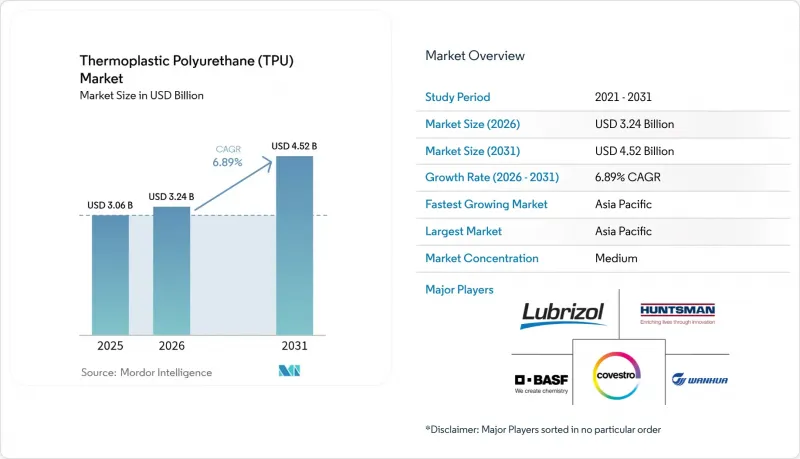
Mordor Intelligence에 따르면 열가소성 폴리우레탄(TPU) 시장 규모는 2025년 30억 6,000만 달러에서 2026년에는 32억 4,000만 달러로 확대하며, 2031년까지 45억 2,000만 달러에 달할 것으로 예상되고 있으며, 2026-2031년에 CAGR 6.89%로 성장할 것으로 전망되고 있습니다.
이 보고서에서는 시장을 제품 유형(폴리에스터 TPU, 폴리에테르 TPU, 폴리카프로락톤 TPU), 용도(압출 성형 제품, 사출성형 제품, 접착제, 기타),최종 용도 산업(신발, 자동차, 기타) 및 지역(아시아태평양, 북미, 유럽, 남미, 중동 및 아프리카)별로 분류하고 있습니다. 시장 예측은 금액(달러) 기준으로 제시되어 있습니다.
전 세계 열가소성 폴리우레탄(TPU) 시장의 동향 및 인사이트
의료용 TPU 수요를 견인하는 웨어러블 의료기기
연속 혈당 모니터 및 스마트 심장 패치의 도입 대수는 400억 달러 규모에 달합니다. 이러한 제품에는 30 MPa를 초과하는 인장 강도와 ISO 10993 규격에 따른 완전한 검증이 요구됩니다. 폴리에테르계 TPU는 뛰어난 내가수분해성으로 시장을 독점하고 있습니다. 애보트(Abbott)의 FreeStyle Libre 3는 굴곡 주기를 견디기 위해 신장률이 500%를 초과하는 맞춤형 폴리에테르계 TPU를 채택했습니다. 기기 제조사는 항균 마스터배치를 2-5% 첨가하고 있으며, 이로 인해 수지 비용은 약 15% 상승하지만, 클래스 II 제품으로서 프리미엄 가격 책정이 가능해졌습니다. 소규모 컨버터 업체들은 클린룸 시설 자금 조달에 어려움을 겪고 있으며, 위탁 컴파운딩 및 규제 관련 서류 제공을 수행하는 수직 통합형 수지 공급업체에 시장 점유율이 집중되고 있습니다.
3D 프린팅용 필라멘트 및 분말이 프로토타이핑의 보급을 가속화
2025년에는 적층 성형 분야에서 필라멘트와 분말을 합쳐 총 1만 2,000톤의 TPU가 소비되었습니다. 자동차 업계의 Tier 1 공급업체는 프로토타입 리드타임을 12주에서 48시간으로 단축하고, 충돌시 에너지 흡수를 조절하는 격자 구조를 채택하고 있습니다. BASF의 Ultrasint TPU 88A는 소수성 처리를 도입하고 분말의 보관 기간을 12개월로 연장함으로써 흡습으로 인한 결함을 해결했습니다. 신발 브랜드는 무게를 약 20% 줄이고 반발력 유지율 55% 이상을 실현하는 미드솔을 3D 프린팅하고 있습니다. 습기에 대한 민감성은 여전히 주요 기술적 과제이며, 프린팅 전에 필라멘트의 수분 함량을 0.02% 미만으로 건조시키지 않으면 수증기로 인한 공극이 발생하게 됩니다.
1,4-BDO 원료의 가격 변동이 폴리에스터/에테르계 TPU의 가격 급등을 초래
2024-2025년에 아시아의 현물 가격은 톤당 1,800-2,400달러 사이에서 변동하며, 비수직 통합형 제조업체의 매출 총이익률을 4-6퍼센트 포인트 하락시켰습니다. BASF와 Wanhua는 후방 통합된 BDO 생산 능력을 보유하고 있으며, 현물 가격 변동으로부터 계약 가격을 보호할 수 있으므로 이점을 누리고 있습니다. 중소 제조업체들은 폴리카프로락톤계 TPU로 배합 변경을 추진하고 있지만, 인장 강도의 저하는 감수할 수밖에 없습니다. 생산 능력은 중국에 집중되어 있으며, 중국은 전 세계 BDO 명목 생산 능력의 68%를 차지하고 있지만, 전력 배급제로 인해 예고 없이 공장이 가동을 중단할 수 있습니다.
부문별 분석
폴리에스터 TPU는 2025년 매출의 40.65%를 차지하고 있으며, 기계적 강도의 균형과 비용 측면에서의 우위를 바탕으로 견고한 성장 궤도를 유지할 전망입니다. 폴리카프로락톤 TPU는 생산량은 적지만, 각 브랜드사가 퇴비화 가능한 포장을 채택함에 따라 7.92%의 속도로 확대되고 있습니다. 의료용 폴리에테르 TPU는 ISO 10993 인증을 획득하여 가격 압박으로부터 보호받고 있습니다. 산업 폐기물 재분쇄 재료를 25% 함유한 Desmopan 2590A를 비롯한 재생 소재 함유 폴리에스터 등급은 경도에 영향을 미치지 않으면서 자발적인 지속가능성 목표를 달성하고 있습니다. 아디핀산 원료는 여전히 중국에 집중되어 있으며, 공급 리스크 프리미엄이 발생하고, 이는 일반 폴리에스터의 장기적인 비용 우위를 훼손할 가능성이 있습니다.
폴리카프로락톤(PCA)계 TPU는 전 세계 생산 능력이 150 kt 미만에 그치는 모노머 공급에 의존하고 있으며, 생산 규모 확대가 제한되고 있습니다. 그러나 일시적인 정형외과용 임플란트 등의 용도에서는 생분해성이 성능상의 부족함을 보완하고 있습니다. 용매를 배제한 수성 TPU 분산액은 코팅 분야에서 주목을 받고 있습니다. 이러한 분산액은 VOC 함량이 50 g/L 미만이며 CARB 1168을 준수하므로, 북미 전역의 건축용 코팅 시장에서 채택될 것으로 예상됩니다.
지역별 분석
아시아태평양은 2025년 매출의 58.72%를 차지하며, 2031년까지 연평균 성장률(CAGR) 7.75%를 기록할 것으로 전망됩니다. 중국에서는 의료용 등급 수지의 현지 생산이 진행되고 있으며, Wanhua, Shandong INO, Miracll이 신발 및 자동차 산업 집적지 인근에 통합형 복합 시설을 운영하고 있습니다. 인도의 생산 연계형 인센티브(PLI) 제도는 신발용 수지에 대한 투자에 대해 15%의 자본 보조금을 제공하고 있지만, 현지 생산 능력은 여전히 부족하여 수입에 의존할 수밖에 없는 상황이며, 이로 인해 입고 비용이 18% 상승하고 있습니다. 일본과 한국은 고급 인테리어용 저VOC 수성 분산액에 주력하고 있는 반면, 아세안(ASEAN) 국가들은 노동 집약적인 신발 조립을 공급하고는 있지만 대규모 컴파운딩 자산을 갖추지 못하고 있습니다.
북미의 시장 점유율은 USMCA(미국·멕시코·캐나다 협정) 규정에 따라 멕시코의 1차 자동차 부품 공급업체가 지원받고 있는 데 힘입어 유지되고 있습니다. 2025년에 14종의 TPU 기반 의료기기가 FDA 승인을 받음에 따라 폴리에테르 수요가 유지될 전망입니다. 캐나다의 저경사 지붕용 방수 시트에서는 -40°C 이하의 열 사이클을 견디기 위해 TPU가 사용되고 있습니다. 유럽에서는 REACH 규정에 따른 디이소시아네이트 관련 교육 이수 의무 준수로 인해 BASF, Covestro, Huntsman 각사의 공급량이 집중되어 있습니다. 독일에서는 전기자동차(EV) 인테리어에 바이오 기반 TPU가 지정된 반면, 북유럽의 경기장에서는 50미터의 기둥 없는 스팬에 반투명 TPU 필름이 채택되고 있습니다.
남미, 중동 및 아프리카에서는 브라질의 신발 수출이 증가하고 있으나, 국내 수지 생산량이 부족하여 아시아로부터의 수입이 필수적입니다. 사우디아라비아에서는 5,000억 달러 규모의 인프라 건설 계획에 따라 낮 최고 기온이 50°C를 넘는 경기장 지붕에 TPU 필름이 채택되고 있습니다. BASF의 아부다비 공장(연산 25 kt)은 2024년에 해당 지역에 공급을 시작하여, 걸프협력회의(GCC) 국가들의 건설 및 자동차 분야 수요를 충족시킬 예정입니다.
기타 혜택:
- 엑셀 형식의 시장 예측(ME) 시트
- 3개월간의 애널리스트 지원
자주 묻는 질문
목차
제1장 서론
제2장 조사 방법
제3장 개요
제4장 시장 구도
제5장 시장 규모와 성장 예측
제6장 경쟁 구도
제7장 시장 기회와 향후 전망
KSA 26.09.04According to Mordor Intelligence, the thermoplastic polyurethane market size is expected to increase from USD 3.06 billion in 2025 to USD 3.24 billion in 2026 and reach USD 4.52 billion by 2031, growing at a CAGR of 6.89% over 2026-2031.
This report Segments the Industry by Product Type (Polyester TPU, Polyether TPU, and Polycaprolactone TPU), Application (Extruded Products, Injection Molded Products, Adhesives, and Others), End-User Industry (Footwear, Automotive, and More), and Geography (Asia-Pacific, North America, Europe, South America, and the Middle East and Africa). The Market Forecasts are Provided in Terms of Value (USD).
Global Thermoplastic Polyurethane (TPU) Market Trends and Insights
Wearable Medical Devices Driving Medical-Grade TPU Demand
Continuous glucose monitors and smart cardiac patches have reached an installed base worth USD 40 billion. They require tensile strength above 30 MPa and full ISO 10993 validation. Polyether TPU dominates due to superior hydrolysis resistance. Abbott's FreeStyle Libre 3 adopted a custom polyether grade with elongation beyond 500% to withstand flex cycling. Device makers add antimicrobial masterbatches at 2-5%, raising resin cost by about 15% yet enabling premium pricing for Class II products. Smaller converters struggle to finance clean-room facilities, concentrating share with vertically integrated resin suppliers that provide toll compounding and regulatory dossiers.
3D-Printing Filaments and Powders Accelerating Prototyping Adoption
Additive manufacturing consumed 12,000 t of TPU in 2025, split between filament and powder. Automotive Tier-1s reduce prototype lead time from 12 weeks to 48 hours and apply lattice structures that tune crash energy absorption. BASF's Ultrasint TPU 88A introduced a hydrophobic treatment that extends powder shelf life to 12 months, solving moisture-uptake failures. Footwear brands print midsoles with weight savings near 20% and rebound retention above 55%. Moisture sensitivity remains the primary technical hurdle; filament must be dried to below 0.02% moisture prior to printing, or steam voids appear.
1,4-BDO Feedstock Volatility Inflating Polyester/Ether TPU Prices
Asian spot values fluctuated between USD 1,800 and USD 2,400 t in 2024-2025, taking 4-6 percentage points off gross margin for non-integrated producers. BASF and Wanhua benefit from backward-integrated BDO capacity that shields contracts from spot swings. Smaller players reformulate toward polycaprolactone TPU but accept lower tensile strength. Capacity is concentrated in China, which holds 68 % of the global BDO nameplate; power rationing can idle plants without notice.
Other drivers and restraints analyzed in the detailed report include:
- Bio-Based Mono-Material Footwear Programs Boosting Consumption
- PVC-to-TPU Shift in Flexible Solar and Architectural Membranes
- Tightening Isocyanate-Exposure Regulations
For complete list of drivers and restraints, kindly check the Table Of Contents.
Segment Analysis
Polyester TPU delivered 40.65% of 2025 revenue and will maintain a healthy trajectory given balanced mechanical strength and cost edge. Polycaprolactone TPU, while small in volume, is expanding at a 7.92% rate as brands adopt compostable packaging. Medical-grade polyether TPU secures ISO 10993 approvals, insulating it from price pressure. Recycled-content polyester grades, including Desmopan 2590A with 25 % post-industrial regrind, meet voluntary sustainability targets without impacting hardness. Adipic-acid feedstock remains concentrated in China, creating supply-risk premiums that could erode the long-run cost advantage of commodity polyester.
Polycaprolactone TPU relies on a monomer base below 150 kt global capacity, constraining scale. Yet in applications such as temporary orthopedic implants, its biodegradability offsets performance gaps. Waterborne TPU dispersions that eliminate solvents are gaining traction in coatings. These dispersions contain less than 50 g/L VOC and comply with CARB 1168, positioning them for architectural coatings across North America.
Complete Report Scope:
- By Product Type
- Polyester TPU
- Polyether TPU
- Polycaprolactone TPU
- By Application
- Extruded Products
- Injection Molded Products
- Adhesives
- Other Applications
- By End-Use Industry
- Footwear
- Automotive
- Medical
- Electrical & Electronics
- Construction
- Heavy Engineering
- Other End-user Industries
- By Geography
- Asia Pacific
- China
- India
- Japan
- South Korea
- ASEAN Countries
- Rest of Asia Pacific
- North America
- United States
- Canada
- Mexico
- Europe
- Germany
- United Kingdom
- France
- Italy
- Spain
- Nordics
- Rest of Europe
- South America
- Brazil
- Argentina
- Chile
- Rest of South America
- Middle East and Africa
- Saudi Arabia
- United Arab Emirates
- South Africa
- Rest of Middle East and Africa
- Asia Pacific
Geography Analysis
Asia-Pacific represented 58.72 % of 2025 revenue and is projected to post a 7.75% CAGR to 2031. China localizes medical-grade resin, with Wanhua, Shandong INOV, and Miracll operating integrated complexes near footwear and automotive clusters. India's Production-Linked Incentive offers 15 % capital subsidy for footwear resin investments, yet local capacity remains thin, forcing imports that lift landed cost by 18 %. Japan and South Korea focus on low-VOC waterborne dispersions for premium interiors, while ASEAN countries supply labor-intensive footwear assembly but lack sizable compounding assets.
North America's market share is buoyed by USMCA rules boosting Mexican Tier-1 automotive suppliers. FDA clearances for 14 TPU-based medical devices in 2025 sustain polyether uptake. Canadian low-slope roofing membranes use TPU for thermal cycling below -40°C. In Europe, compliance with REACH diisocyanate training consolidates volumes among BASF, Covestro, and Huntsman. Germany specifies bio-based TPU for EV interiors, while Nordic arenas adopt translucent TPU membranes for 50-meter column-free spans.
In South America, and Middle East & Africa, Brazil's footwear exports grow, yet domestic resin output is inadequate, mandating Asian imports. Saudi Arabia's USD 500 billion infrastructure pipeline pulls TPU membranes for stadium roofs where daytime highs top 50°C. BASF's Abu Dhabi plant at 25 kt begins regional supply in 2024, serving Gulf Cooperation Council construction and automotive demand.
- BASF
- Avient Corporation
- Coim Group
- Covestro AG
- Dongsung
- Epaflex Polyurethanes SpA
- Hexpol AB
- Huntsman International LLC
- Miracll Chemicals Co. Ltd
- Mitsui Chemicals Inc.
- Novotex Italiana SpA
- Sumei Chemical Co. Ltd
- Suzhou Austen New Mstar Technology Ltd
- Taiwan PU Corporation
- The Lubrizol Corporation
- Tosoh Corporation
- Trinseo
- Wanhua Chemical Group Co. Ltd
Additional Benefits:
- The market estimate (ME) sheet in Excel format
- 3 months of analyst support
TABLE OF CONTENTS
1 Introduction
- 1.1 Study Assumptions & Market Definition
- 1.2 Scope of the Study
2 Research Methodology
3 Executive Summary
4 Market Landscape
- 4.1 Market Overview
- 4.2 Market Drivers
- 4.2.1 Wearable Medical Devices Driving Medical-Grade TPU Demand
- 4.2.2 3D-Printing Filaments & Powders Accelerating Prototyping Adoption
- 4.2.3 Bio-Based Mono-Material Footwear Programs Boosting Consumption
- 4.2.4 PVC-to-TPU Shift in Flexible Solar & Architectural Membranes
- 4.2.5 Solvent-Free Reactive Extrusion Grades Enabling In-Mold EV Interior Decoration
- 4.3 Market Restraints
- 4.3.1 1,4-BDO Feedstock Volatility Inflating Polyester/Ether TPU Prices
- 4.3.2 Tightening Isocyanate-Exposure Regulations
- 4.3.3 Displacement Risk from High-Heat TPEE & TPV in Automotive Applications
- 4.4 Value Chain Analysis
- 4.5 Porter's Five Forces
- 4.5.1 Bargaining Power of Suppliers
- 4.5.2 Bargaining Power of Buyers
- 4.5.3 Threat of New Entrants
- 4.5.4 Threat of Substitutes
- 4.5.5 Competitive Rivalry
5 Market Size & Growth Forecasts (Value)
- 5.1 By Product Type
- 5.1.1 Polyester TPU
- 5.1.2 Polyether TPU
- 5.1.3 Polycaprolactone TPU
- 5.2 By Application
- 5.2.1 Extruded Products
- 5.2.2 Injection Molded Products
- 5.2.3 Adhesives
- 5.2.4 Other Applications
- 5.3 By End-Use Industry
- 5.3.1 Footwear
- 5.3.2 Automotive
- 5.3.3 Medical
- 5.3.4 Electrical & Electronics
- 5.3.5 Construction
- 5.3.6 Heavy Engineering
- 5.3.7 Other End-user Industries
- 5.4 By Geography
- 5.4.1 Asia Pacific
- 5.4.1.1 China
- 5.4.1.2 India
- 5.4.1.3 Japan
- 5.4.1.4 South Korea
- 5.4.1.5 ASEAN Countries
- 5.4.1.6 Rest of Asia Pacific
- 5.4.2 North America
- 5.4.2.1 United States
- 5.4.2.2 Canada
- 5.4.2.3 Mexico
- 5.4.3 Europe
- 5.4.3.1 Germany
- 5.4.3.2 United Kingdom
- 5.4.3.3 France
- 5.4.3.4 Italy
- 5.4.3.5 Spain
- 5.4.3.6 Nordics
- 5.4.3.7 Rest of Europe
- 5.4.4 South America
- 5.4.4.1 Brazil
- 5.4.4.2 Argentina
- 5.4.4.3 Chile
- 5.4.4.4 Rest of South America
- 5.4.5 Middle East and Africa
- 5.4.5.1 Saudi Arabia
- 5.4.5.2 United Arab Emirates
- 5.4.5.3 South Africa
- 5.4.5.4 Rest of Middle East and Africa
- 5.4.1 Asia Pacific
6 Competitive Landscape
- 6.1 Market Concentration
- 6.2 Strategic Moves
- 6.3 Market Share(%)/Ranking Analysis
- 6.4 Company Profiles (includes Global & Market Overview, Core Segments, Financials, Strategy, Products, Recent Developments)
- 6.4.1 BASF
- 6.4.2 Avient Corporation
- 6.4.3 Coim Group
- 6.4.4 Covestro AG
- 6.4.5 Dongsung
- 6.4.6 Epaflex Polyurethanes SpA
- 6.4.7 Hexpol AB
- 6.4.8 Huntsman International LLC
- 6.4.9 Miracll Chemicals Co. Ltd
- 6.4.10 Mitsui Chemicals Inc.
- 6.4.11 Novotex Italiana SpA
- 6.4.12 Sumei Chemical Co. Ltd
- 6.4.13 Suzhou Austen New Mstar Technology Ltd
- 6.4.14 Taiwan PU Corporation
- 6.4.15 The Lubrizol Corporation
- 6.4.16 Tosoh Corporation
- 6.4.17 Trinseo
- 6.4.18 Wanhua Chemical Group Co. Ltd
7 Market Opportunities & Future Outlook
- 7.1 White-Space & Unmet-Need Assessment
- 7.2 Shifting Focus Toward the Development of Bio-based Products


