
|
시장보고서
상품코드
2121932
인도의 내시경 기기 : 시장 점유율 분석, 업계 동향과 통계, 성장 예측(2026-2031년)India Endoscopy Devices - Market Share Analysis, Industry Trends & Statistics, Growth Forecasts (2026 - 2031) |
||||||
 Mordor Intelligence
Mordor Intelligence에 따르면 인도의 내시경 기기 시장 규모는 2025년 14억 9,000만 달러, 2026년 15억 8,000만 달러에서 2031년까지 21억 7,000만 달러로 확대할 것으로 예측되고 있으며, 2026-2031년에 CAGR 6.56%를 기록할 전망입니다.
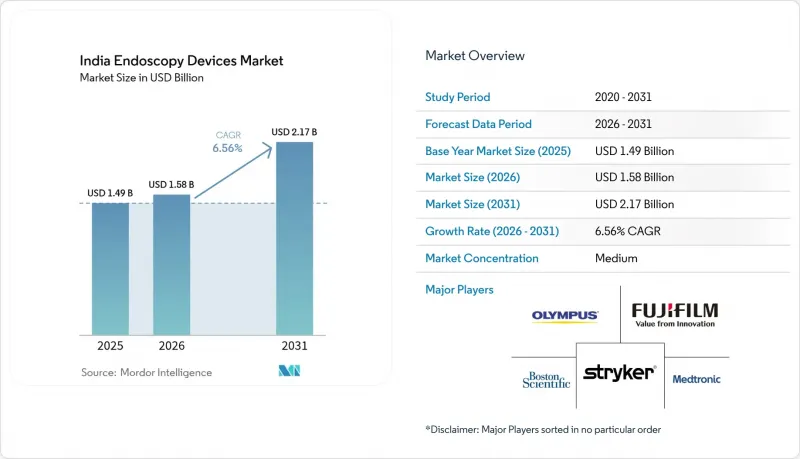
이 보고서는 기기 유형(내시경[경성 내시경 등], 내시경 수술 기기[접근 장치 등], 시각화 장치),용도(소화기 내시경, 복강경 등), 최종사용자(병원, 전문 클리닉 등), 사용 형태(재사용 가능 기기, 일회용 기기)별로 분류되어 있습니다. 시장 예측은 금액(달러) 기준으로 제시되어 있습니다.
인도 내시경 기기 시장의 동향 및 인사이트
소화기 질환 유병률 증가
인도는 전 세계에서 장 감염증의 부담이 가장 큰 국가 중 하나이며, 염증성 장 질환의 사례 수는 2019년 27만 건에서 2050년까지 69% 증가하며 45만 7,000건에 달할 것으로 예측되어, 선별 검사 수요가 확대되고 있습니다. 아유슈만 바라트는 2025년까지 3만 3,000개 병원에 4억 2,000만 장의 건강 카드를 발급하여, 상부 및 하부 소화관 내시경 검사에 대한 농촌 지역의 잠재적 수요를 자극하고 있습니다. 2급 의료기관에서는 현재 비용 상한선에 맞춰 로봇 플랫폼보다 유연성이 높은 내시경을 우선시하는 당일 내시경 검사실이 신설되고 있습니다. 프로토콜에 따른 정기 검진을 의무화하는 전국 암 대책 지침 또한 검사 건수가 많은 의료기관이 내구성이 높고 신속하게 재처리할 수 있는 모델을 요구함으로써 장비 교체 주기를 연장시키고 있습니다.
정부의 의료 지출과 보험 확대
공공 의료 지출은 2004년 GDP 대비 0.9%에서 2023년에는 2.1%로 증가했으며, 2025년도 연방 예산에서는 아유슈만 바라트에 9,406 카롤 인도 루피(11억 3,000만 달러)가 편성되었습니다. PM-JAY에 따른 대장내시경 검사, ERCP, 용종 절제술에 대한 정액 보상 제도는 기준이 되는 검사 건수를 확보하고, 병원의 투자 위험을 경감시키고 있습니다. PM-JAY와 통합된 타밀나두 주의 주 보험은 가족 1인당 최대 50만 인도 루피를 보상하고 있으며, 민간 부문의 내시경 검사 성장을 촉진하고 있습니다. 남부에 비해 병상 밀도가 낮은 북인도에서는 2028 회계연도까지 의료 서비스 제공의 연평균 성장률(CAGR)이 12-14%에 달할 전망이며, 이는 의료기기의 활발한 조달로 이어질 것입니다. 다만, 패키지 가격이 저렴하므로 감염병 유행으로 인해 일회용 제품의 채택이 늘지 않는 한, 의료 기관은 재사용 가능한 내시경을 우선적으로 선택할 수밖에 없는 상황입니다.
첨단 내시경 시스템의 높은 자본 비용
AI 지원 4K 타워형 내시경 시스템은 1,500만-2,500만 인도 루피(18만-30만 달러)가 듭니다. 2024년 3분기 기준 인도내 76개 시설에 도입된 Intuitive Surgical의 da Vinci 5와 같은 로봇 플랫폼은 수백만 달러 규모의 예산이 필요하지만, 대부분의 공립 의료 기관에는 그러한 예산이 없습니다. 주립 병원은 자금 조달 지연과 매출채권 회수 지연으로 어려움을 겪고 있으며, 요금 인하 조치가 시행되고 있음에도 불구하고 고가의 구매를 자제하고 있습니다. 민간 병원은 리스나 성과 연동형 서비스 계약을 통해 위험을 완화하고 있지만, 이러한 방식은 이익률에 대한 압박을 공급업체 측으로 전가하고 있습니다. 그 결과, FTA에 따른 가격 인하 이후에도 많은 구매자들은 고가의 일회용 내시경보다 내구성이 뛰어나고 사양은 낮지만 재사용이 가능한 내시경을 선호하는 경향이 지속되고 있습니다.
부문 분석
영상 장치의 매출은 2026-2031년까지 연평균 성장률(CAGR) 8.55%로 증가할 것으로 예측되며, 2025년 시점에 여전히 인도 내시경 장비 시장 점유율의 61.62%를 차지했던 내시경을 넘어설 것으로 전망됩니다. Stryker의 1788 플랫폼 출시로 병원들은 내시경 전체를 교체하지 않고도 4K 영상 진단 및 형광 진단을 도입할 수 있게 되었습니다. 경성 내시경은 이비인후과 및 정형외과수술에서 주류를 이루는 반면, 연성 내시경은 소화기내과 및 호흡기내과에서 여전히 기초적인 역할을 수행하고 있습니다. 캡슐 내시경은 원격 선별 검진 시범 사업에 활용되고 있으며, 로봇 내시경은 76대라는 틈새 시장 수준의 도입 대수에 그치고 있습니다. 국내에서는 PLI(생산 연계 인센티브) 대상인 조립 업체가 FTA 발효 후 관세 없이 광학 시스템을 수입할 수 있게 되었으며, 이를 통해 2차 구매자에게 중가대의 4K 타워를 공급할 수 있게 되었습니다.
병원에서는 가시화 타워를 전문 분야를 초월한 공유 자산으로 간주하고 있으며, 단일 전문 분야용 로봇보다 빠른 투자 회수(ROI)가 기대됩니다. 화면에 용종 감지 힌트를 표시하는 AI 탑재 프로세서는 선종 감지율을 향상시키고 장비 업그레이드를 촉진합니다. Fujifilm의 360° Tracmotion ESD 장치와 같은 첨단 수술 툴은 치료 분야의 수요 범위를 확대하고 있습니다. 그 결과, 가시화를 최우선으로 한 업그레이드를 통해 재사용 가능한 내시경의 수명이 연장되고, 도입 대수가 확대되며, 공급업체에게는 액세서리를 통한 지속적인 수익이 창출됩니다.
2025년, 인도 내시경 기기 시장에서 소화기 계통 수술이 44.13%를 차지했습니다. 그러나 불임 치료 클리닉이 PCOS(다낭성난소증후군) 및 자궁내막증 치료에 자궁경 검사 및 복강경 검사를 선호하고 있으므로 산부인과 분야는 2031년까지 연평균 성장률(CAGR) 8.97%로 가장 빠른 성장을 기록할 전망입니다. 복강경 검사는 비만 치료 및 종양학 분야에서 여전히 두 번째로 많이 사용되는 용도로 자리 잡고 있습니다. 호흡기 분야의 성장은 COPD 환자의 부담 증가와 일회용 기관지경의 도입과 연동되어 있습니다. 이비인후과 시술 건수는 기능적 내시경 부비동 수술을 중심으로 추이를 보이고 있으며, 비뇨기과는 고령화와 전립선암 진단 건수 증가의 혜택을 받고 있습니다. 순환기 분야에서는 구조적 심장 중재술에 경식도 내시경이 사용되고 있으나, 여전히 틈새 분야에 머물러 있습니다.
2급 도시에서의 불임 치료 센터 확대는 당일 수술 건수를 증가시켜, 장비의 신속한 회전을 가능하게 하는 중견급 4K 시스템에 혜택을 주고 있습니다. 또한 PM-JAY에 기반한 패키지 요금 방식의 보상 제도도 산부인과 부문에서 재사용 가능한 자궁경 채택을 촉진하고 있습니다. 한편, 소화기 분야에서는 고령화, 염증성장질환(IBD)의 증가, 그리고 새로운 선별 검사 프로토콜의 도입으로 수요가 계속해서 급증하고 있습니다. 이러한 두 가지 요인이 시너지 효과를 발휘하여 인도 내시경 장비 시장에서 다양한 비즈니스 기회가 확보되고 있습니다.
기타 혜택:
- 엑셀 형식의 시장 예측(ME) 시트
- 3개월간의 애널리스트 지원
자주 묻는 질문
목차
제1장 서론
제2장 조사 방법
제3장 개요
제4장 시장 구도
제5장 시장 규모와 성장 예측
제6장 경쟁 구도
제7장 시장 기회와 향후 전망
KSAAccording to Mordor Intelligence, the India endoscopy devices market size is projected to expand from USD 1.49 billion in 2025 and USD 1.58 billion in 2026 to USD 2.17 billion by 2031, registering a CAGR of 6.56% between 2026 to 2031.
This report is Segmented by Type of Device (Endoscopes [Rigid Endoscope, and More], Endoscopic Operative Devices [Access Devices, and More], and Visualization Equipment), Application (Gastroenterology, Pulmonology, Cardiology, and More), End-User (Hospitals, Specialty Clinics, and More), Usage (Re-Usable Devices and Single-Use Devices). The Market Forecasts are Provided in Terms of Value (USD).
India Endoscopy Devices Market Trends and Insights
Rising Prevalence of Gastrointestinal Diseases
India carries the world's highest burden of enteric infections, and inflammatory bowel disease cases are projected to jump 69% from 270,000 in 2019 to 457,000 by 2050, expanding screening demand. Ayushman Bharat issued 420 million health cards to 33,000 hospitals by 2025, unlocking latent rural demand for upper and lower GI scopes. Tier-2 facilities now add day-care endoscopy suites that prefer flexible scopes over robotic platforms, aligning with cost ceilings. National cancer-control guidelines that mandate protocol-driven surveillance are also lengthening replacement cycles as high-volume sites seek durable, fast-reprocessing models.
Government Healthcare Expenditure & Insurance Expansion
Public health outlay rose from 0.9% of GDP in 2004 to 2.1% in 2023, and the FY25 Union Budget earmarked INR 9,406 crore (USD 1.13 billion) for Ayushman Bharat. PM-JAY's package-rate reimbursements for colonoscopy, ERCP, and polypectomy assure baseline volumes that de-risk hospital investment. Tamil Nadu's state insurance, integrated with PM-JAY, covers up to INR 500,000 per family member, stimulating private-sector endoscopy growth. North India, where bed density trails the south, is on track for 12-14% healthcare-delivery CAGR to FY28, translating into brisk device procurement. However, lower package prices pressure facilities to prefer reusable scopes unless outbreaks raise single-use uptake.
High Capital Cost of Advanced Endoscopy Systems
AI-ready 4K towers cost INR 15-25 million (USD 180,000-300,000). Robotic platforms such as Intuitive Surgical's da Vinci 5, deployed in 76 Indian installations by Q3 2024, demand multi-million-dollar budgets that most public facilities lack. State hospitals wrestle with staggered funding and delayed receivables, curbing big-ticket purchases despite tariff relief. Private hospitals mitigate risk through leasing and outcome-based service contracts, but these shift margin pressure onto vendors. Consequently, many buyers continue to favor durable, lower-spec reusable scopes over premium disposables even after the FTA price cut.
Other drivers and restraints analyzed in the detailed report include:
- HD/4K, AI & Single-Use/Capsule Endoscopy Innovations
- Expansion of Private Hospitals & ASCs
- Shortage of Trained Endoscopists & Reprocessing Staff
For complete list of drivers and restraints, kindly check the Table Of Contents.
Segment Analysis
Visualization equipment revenue is projected to rise at an 8.55% CAGR from 2026-2031, surpassing endoscopes, which still held 61.62% of India endoscopy devices market share in 2025. The launch of Stryker's 1788 platform lets hospitals install 4K imaging and fluorescence without replacing entire scope fleets. Rigid endoscopes dominate ENT and orthopedic procedures, while flexible scopes remain foundational for GI and pulmonology. Capsule endoscopy serves remote-screening pilots, and robotic scopes remain a niche 76-unit installed base. Domestically, PLI-enabled assemblers can now import zero-duty optics post-FTA, helping them supply mid-range 4K towers to Tier-2 buyers.
Hospitals view visualization towers as a shared asset across specialties, generating quicker ROI than single-discipline robots. AI-enabled processors that overlay polyp-detection prompts raise adenoma-detection rates and drive upgrades. Advanced operative tools, such as Fujifilm's 360° Tracmotion ESD device, expand the therapeutic scope of demand. Net effect: visualization-first upgrades lengthen the life of reusable scopes, widening the installed base and unlocking recurring accessories revenue for suppliers.
Gastrointestinal procedures accounted for 44.13% of India's endoscopy devices market in 2025. Yet gynecology will post the fastest growth, with an 8.97% CAGR through 2031, as fertility clinics favor hysteroscopy and laparoscopy for PCOS and endometriosis. Laparoscopy remains the No. 2 application across bariatrics and oncology. Pulmonology growth is tied to the burden of COPD and the adoption of single-use bronchoscopes. ENT volumes pivot around functional endoscopic sinus surgery; urology benefits from aging demographics and rising prostate cancer diagnoses. Cardiology uses transesophageal scopes for structural heart interventions, but remains a niche.
Fertility-center expansion in Tier-2 hubs creates day-care throughput, rewarding mid-tier 4K systems with rapid instrument turnarounds. Package-rate reimbursements under PM-JAY also encourage gynecology units to adopt reusable hysteroscopes. Meanwhile, GI demand continues to surge thanks to aging, rising IBD, and new screening protocols. The dual-engine effect ensures diversified opportunities within the Indian endoscopy devices market.
Complete Report Scope:
- By Device Type
- Endoscopes
- Rigid Endoscopes
- Flexible Endoscopes
- Capsule Endoscopes
- Robotic-assisted Endoscopes
- Endoscopic Operative Devices
- Irrigation / Suction Systems
- Access Devices
- Wound Protectors
- Other Endoscopic Operative Devices
- Visualization Equipment
- Endoscopes
- By Application
- Gastrointestinal Endoscopy
- Laparoscopy
- Pulmonology / Bronchoscopy
- ENT / Otolaryngology
- Urology
- Gynecology
- Cardiology
- Other Applications
- By Usability
- Reusable Devices
- Single-use / Disposable Devices
- By End-User
- Hospitals
- Diagnostic Centers
- Specialty Clinics
List of Companies Covered in this Report:
- Ambu
- Arthrex
- B. Braun
- Boston Scientific
- Conmed
- Cook Group
- CapsoVision
- FUJIFILM
- HOYA
- IntroMedic Co., Ltd.
- Intuitive Surgical
- Johnson & Johnson
- Karl Storz
- Medtronic
- Olympus
- Richard Wolf
- Smiths Group
- STERIS
- Stryker
Additional Benefits:
- The market estimate (ME) sheet in Excel format
- 3 months of analyst support
TABLE OF CONTENTS
1 Introduction
- 1.1 Study Assumptions & Market Definition
- 1.2 Scope of the Study
2 Research Methodology
3 Executive Summary
4 Market Landscape
- 4.1 Market Overview
- 4.2 Market Drivers
- 4.2.1 Rising Prevalence of Gastrointestinal Diseases
- 4.2.2 Government Healthcare Expenditure & Insurance Expansion
- 4.2.3 HD/4K, AI & Single-Use/Capsule Endoscopy Innovations
- 4.2.4 Expansion of Private Hospitals & ASCs Beyond Tier-1 Cities
- 4.2.5 PLI Incentives & Medtech Parks for Local Manufacturing
- 4.2.6 Medical-Tourism Packages Bundling Advanced Endoscopy
- 4.3 Market Restraints
- 4.3.1 High Capital Cost of Advanced Endoscopy Systems
- 4.3.2 Shortage of Trained Endoscopists & Reprocessing Staff
- 4.3.3 Fragmented Optical/Sensor Supply Chain Limits Localisation
- 4.3.4 Infection-Control Compliance Raises Cost of Reusable Scopes
- 4.4 Regulatory Landscape
- 4.5 Technological Outlook
- 4.6 Porter's Five Forces Analysis
- 4.6.1 Threat of New Entrants
- 4.6.2 Bargaining Power of Buyers
- 4.6.3 Bargaining Power of Suppliers
- 4.6.4 Threat of Substitute Products
- 4.6.5 Intensity of Competitive Rivalry
5 Market Size & Growth Forecasts (Value & Volume)
- 5.1 By Device Type
- 5.1.1 Endoscopes
- 5.1.1.1 Rigid Endoscopes
- 5.1.1.2 Flexible Endoscopes
- 5.1.1.3 Capsule Endoscopes
- 5.1.1.4 Robotic-assisted Endoscopes
- 5.1.2 Endoscopic Operative Devices
- 5.1.2.1 Irrigation / Suction Systems
- 5.1.2.2 Access Devices
- 5.1.2.3 Wound Protectors
- 5.1.2.4 Other Endoscopic Operative Devices
- 5.1.3 Visualization Equipment
- 5.1.1 Endoscopes
- 5.2 By Application
- 5.2.1 Gastrointestinal Endoscopy
- 5.2.2 Laparoscopy
- 5.2.3 Pulmonology / Bronchoscopy
- 5.2.4 ENT / Otolaryngology
- 5.2.5 Urology
- 5.2.6 Gynecology
- 5.2.7 Cardiology
- 5.2.8 Other Applications
- 5.3 By Usability
- 5.3.1 Reusable Devices
- 5.3.2 Single-use / Disposable Devices
- 5.4 By End-User
- 5.4.1 Hospitals
- 5.4.2 Diagnostic Centers
- 5.4.3 Specialty Clinics
6 Competitive Landscape
- 6.1 Market Concentration
- 6.2 Market Share Analysis
- 6.3 Company Profiles (includes Global Level Overview, Market Level Overview, Core Segments, Financials as Available, Strategic Information, Market Rank/Share for Key Companies, Products & Services, and Recent Developments)
- 6.3.1 Ambu A/S
- 6.3.2 Arthrex Inc.
- 6.3.3 B. Braun Melsungen AG
- 6.3.4 Boston Scientific Corporation
- 6.3.5 CONMED Corporation
- 6.3.6 Cook Group Incorporated
- 6.3.7 CapsoVision Inc.
- 6.3.8 Fujifilm Holdings Corporation
- 6.3.9 Hoya Corporation (Pentax Medical)
- 6.3.10 IntroMedic Co., Ltd.
- 6.3.11 Intuitive Surgical Inc.
- 6.3.12 Johnson & Johnson
- 6.3.13 Karl Storz SE & Co. KG
- 6.3.14 Medtronic PLC
- 6.3.15 Olympus Corporation
- 6.3.16 Richard Wolf GmbH
- 6.3.17 Smith & Nephew PLC
- 6.3.18 Steris PLC
- 6.3.19 Stryker Corporation
7 Market Opportunities & Future Outlook
- 7.1 White-space & Unmet-Need Assessment