

|
시장보고서
상품코드
2121954
인슐린 투여 기기 시장 : 시장 점유율 분석, 업계 동향 및 통계, 성장 예측(2026-2031년)Insulin Delivery Devices - Market Share Analysis, Industry Trends & Statistics, Growth Forecasts (2026 - 2031) |
||||||
 Mordor Intelligence
Mordor Intelligence에 의하면, 인슐린 투여 기기 시장 규모는 2025년 319억 2,000만 달러로 평가되었고, 2026년에는 337억 9,000만 달러로 추정되고, 2031년까지 492억 3,000만 달러에 이를 것으로 예상되며, 2026-2031년 CAGR 7.82%로 성장할 전망입니다.
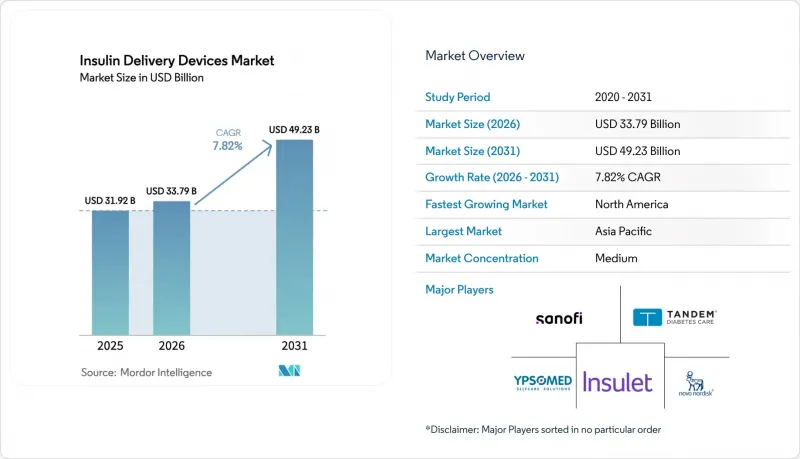
본 보고서는 제품 유형별(인슐린 펜(재사용 가능 펜 등), 인슐린 펌프, 인슐린 주사기 등), 기술 및 연결성별(연결형, 비연결형/기존), 환자 연령대별(소아 등), 유통 채널별(병원 약국 등), 최종 사용자별(재택 간호 등), 지역별로 분류되어 있습니다. 시장 전망은 금액(달러) 기준으로 제시되어 있습니다.
세계의 인슐린 투여 기기 시장 동향 및 인사이트
당뇨병 유병률 증가와 조기 진단
세계 당뇨병 유병률은 계속 증가하고 있지만, 더 두드러진 변화는 증상이 나타난 후 확정 진단까지 걸리는 기간이 단축되고 있다는 점입니다. 미국에서는 현재 35세 이상의 모든 성인에게 HbA1c 검사를 권장하고 있어, 전용 기기가 필요한 기초 및 추가 투여 요법의 대상자가 확대되고 있습니다. 중국에서는 2025년 1월부터 40세 이상 직원에 대한 직장 내 선별 검사가 의무화되어, 지금까지 진단받지 못했던 수백만 명의 성인이 확인되면서 기기 최초 구매가 촉진되고 있습니다. 유럽에서는 2024년 소아 1형 당뇨병의 신규 발병률이 3.4% 상승함에 따라, 저장 용량이 작은 간소화된 인슐린 펌프에 대한 수요가 증가하고 있습니다. 각 제조업체는 색상으로 구분된 펜 캡, 신규 사용자의 숙련 기간을 단축해 주는 사전 설정된 기저 인슐린 프로파일 등을 도입하여 이에 대응하고 있습니다. 따라서 조기 진단은 도입 기반을 확대하고, 투여량 조정을 안내하는 연결형 도구로의 환자 전환을 촉진하고 있습니다.
연결형 스마트 펜 및 애드온 캡의 급속한 보급
블루투스나 근거리 무선 통신(NFC)을 통해 투여 데이터를 기록하는 스마트 펜은 2년 전 예측을 뛰어넘는 속도로 기존 펜을 대체하고 있습니다. Companion Medical의 InPen은 2025년 12월 기준 미국 내 활성 사용자 수가 18만 명에 달하여, 전년 동월의 9만 5,000명에서 증가했습니다. 메디케어·메디케이드 서비스 센터(CMS)는 2025년 1월, 스마트 펜을 내구성 의료장비로 재분류하여 메디케어 파트 B 이용자의 본인 부담금을 줄였습니다. Novo Nordisk는 2025년에 NovoPen 6 및 Echo Plus를 전 세계에 120만 대 출하하여 재사용형 펜 매출 점유율의 18%를 확보했습니다. Bigfoot Biomedical은 2025년 3월 스마트 캡 Unity의 출하를 시작하여, 펌프 도입을 주저하던 환자들에게 더 저렴한 도입 수단을 제공했습니다. 2025년 6월에 개정된 IEEE 11073 표준에서는 종단 간암호화가 의무화되어, 병원 IT 팀이 안고 있던 개인정보 보호에 대한 우려가 완화되었습니다.
연결형 펌프의 사이버 보안 및 데이터 개인정보 보호 위험
연결형 펌프는 블루투스 저에너지(Bluetooth Low Energy)나 셀룰러 회선을 통해 투여 데이터를 전송하기 때문에 악의적인 공격자에게 침입 경로가 될 수 있습니다. 미국 식품의약국(FDA)은 2024년 4월, 구형 펌웨어에 패치가 적용되지 않은 경우 특정 MiniMed 펌프가 무선으로 접근당할 가능성이 있다고 경고했습니다. Insulet은 2025년 6월, Omnipod 5의 중간자 공격 취약점을 발견한 지 72시간 이내에 이를 수정했으나, 이는 신속한 사고 대응을 입증하는 한편 여전히 취약점이 남아 있음을 여실히 드러내기도 했습니다. 유럽연합(EU)의 의료기기 규정에서는 현재 적합성 평가 시 완전한 사이버 보안 위험 문서의 제출을 의무화하고 있으며, 이로 인해 승인까지 소요되는 기간이 최대 9개월 연장되었습니다. 병원 측은 연결형 펌프를 약품 목록에 채택하기 전에 ISO 27001 준수를 요구하고 있으며, 이는 전담 보안 팀을 보유하지 않은 소규모 신생 기업에게는 장벽이 되고 있습니다. 지속적인 뉴스 리스크는 리스크 회피 성향이 강한 클리닉이나 고령 환자의 도입을 지연시킬 가능성이 있습니다.
부문 분석
인슐린 펜은 2025년 매출의 52.44%를 차지했으나, 보험사들이 저혈당 발생률을 낮추는 자동 투여 기능을 높이 평가함에 따라 펌프는 2031년까지 연평균 성장률(CAGR) 11.33%로 더 빠르게 성장할 전망입니다. 펜형 인슐린 제제 판매 중 60%를 재사용 가능한 펜이 차지하고 있으며, 카트리지 재활용이 의무화된 지역에서 선호되고 있습니다. 반면, 콜드체인 용량이 제한된 시장에서는 편의성 때문에 일회용 펜이 나머지 40%를 차지하고 있습니다. 펌프형 제품의 경우, 2025년 매출의 55%를 여전히 테더형 모델이 차지했지만, 튜브가 엉키는 것을 방지하고 눈에 띄지 않게 착용할 수 있는 패치형은 빠르게 보급되고 있습니다. Insulet은 2025년에 Omnipod 5 포드 180만 개를 출하하여 전년 대비 38% 증가를 기록했습니다. 자동 하이브리드 폐쇄 루프 펌프는 2025년 매출 점유율의 22%를 차지했으며, 2031년까지 45%를 나타낼 것으로 예측됩니다. 주사기는 연간 3%의 속도로 감소세를 이어가고 있으며, 현재는 주로 병원 병동이나 저소득 지역에서 사용되고 있습니다. 무바늘 제트 인젝터는 여전히 틈새 시장에 머물러 있으며, 2025년 매출에서 차지하는 비중은 2% 미만이었습니다. 이는 높은 초기 비용과 사용법에 대한 익숙하지 않음이 장벽으로 작용하고 있기 때문입니다. Tandem의 Mobi 펌프는 t slim X2보다 50% 더 소형화되었으며, 2024년 하반기에 시장에 출시되어 눈에 띄지 않는 것을 중요시하는 10대 청소년을 타겟으로 하고 있습니다.
미국 식품의약국(FDA)은 2024년 5월, iLet Bionic Pancreas를 승인하며 사용자의 조작을 최소화하는 알고리즘에 대한 신뢰를 보여주었습니다. 2024년 8월에 승인된 Medtronic의 MiniMed 780G는 하루 최대 288회까지 기저 인슐린 양을 조절할 수 있어, 탄수화물 계산의 부담을 대폭 경감시킵니다. Medtrum과 같은 중국 공급업체들은 현재 스타터 키트 가격을 서유럽 수준의 절반으로 책정하여 중소득 국가에서의 이용 기회를 확대되고 있습니다. 재사용 가능한 펜형 인슐린 주사기는 NFC(근거리 무선 통신)를 통한 투여량 기록 기능의 이점을 누리고 있지만, 지속가능성보다 편의성을 중시하는 2형 당뇨병 환자의 기저 인슐린 단독 요법에서는 일회용 펜형 인슐린 주사기가 여전히 주류를 이루고 있습니다. 제트 주사기는 주사 바늘을 두려워하는 성인들에게 지지를 받고 있지만, 보급을 확대하기 위해서는 보험사의 더 강력한 지원이 필요합니다.
2025년 매출액 중 기존 하드웨어가 여전히 71.45%를 차지하고 있지만, 스마트 펜을 내구소비재로 분류하는 보험사의 정책에 힘입어 연결형 기기는 2031년까지 연평균 성장률(CAGR) 12.77%로 성장할 전망입니다. InPen은 1년도 채 되지 않아 활성 사용자 수를 거의 두 배로 늘리며, CGM(연속 혈당 모니터링) 동향과 연동되는 투여량 기록 기능에 대한 수요를 입증하고 있습니다. Tandem의 t slim X2와 Insulet의 Omnipod 5는 기저 인슐린 및 볼러스 투여 데이터를 클라우드 대시보드로 전송하여 원격 관리를 가능하게 할 뿐만 아니라, 소아 환자에 대한 도입도 확대되고 있습니다. 2025년 6월 IEEE 11073 표준에 암호화 요건이 추가됨에 따라, 병원 IT 부서도 연결형 펌프에 대해 긍정적인 태도를 보이기 시작했습니다.
비용에 민감한 시장에서는 여전히 비연결형 펜이 선호되고 있지만, Bigfoot Unity와 같은 애드온 캡이 더 저렴한 가격대에서 가교 역할을 하고 있습니다. Novo Nordisk의 연결형 펜은 2025년에 전 세계 출하량 120만 개를 기록할 것으로 보이며, 이는 재사용형 펜 출하량의 18%에 해당합니다. 고령층 사이에서 스마트폰 보급이 확대됨에 따라, 연결형 제품의 채택이 증가함에 따라 이러한 격차는 더욱 줄어들 것으로 전망됩니다. 다만, 개인정보 보호에 대한 우려와 펌웨어 업데이트가 필요하다는 점 때문에 향후 10년 동안은 기존 기기도 계속해서 일정한 역할을 수행할 것으로 보입니다.
지역별 분석
북미는 펌프의 높은 보급률과 폭넓은 보험 적용을 바탕으로 2031년까지 연평균 성장률(CAGR) 9.05%를 기록할 전망이며, 지역별로는 가장 높은 성장률을 보일 것으로 예측됩니다. 메디케어가 2024년에 튜브리스형 펌프의 보험 적용을 결정함에 따라, 65세 이상 연령층에서 오랫동안 지속되어 온 격차가 해소되었습니다. 캐나다에서는 2025년에 각 주의 처방약 목록에 연결형 펜이 추가되면서, 스마트 펜의 처방 건수가 52% 증가했습니다. 멕시코의 사회보장 제도는 2025년 2월부터 패치형 펌프에 대한 지원을 시작했으나, 공급 제약으로 인해 초기 보급은 제한적이었습니다. 미국 내 1형 당뇨병 환자의 펌프 보급률은 2025년에 63%에 달했으며, 현재는 2형 당뇨병 환자가 성장의 견인차 역할을 하고 있습니다.
2025년 매출액 중 유럽이 차지하는 비중은 약 28%였습니다. 독일에서는 2025년 1월부터 연결형 펜을 1대당 120유로에 공공 자금으로 지원 대상으로 지정했습니다. 프랑스에서는 CGM과 함께 사용할 경우 스마트 펜 비용을 환급해 주고 있으며, 이로 인해 저혈당 발작이 28% 감소했습니다. 영국은 2024년 6월, 메드트로닉(Medtronic) 및 인슐렛(Insulet)과 1억 8,000만 파운드 규모의 기본 계약을 체결하고, 2026년까지 10만 대의 하이브리드형 폐쇄 루프 펌프를 도입할 예정입니다. 남유럽에서는 보험 환급 제도가 제각각이어서 보급이 더딘 반면, 동유럽에서는 여전히 일회용 펜이 주류를 이루고 있습니다. Ypsomed와 Biocon의 제휴로 인해 이러한 상황에 변화가 나타나기 시작했습니다.
아시아태평양은 보험 적용 범위 확대와 저비용 패치형 펌프의 급속한 보급에 힘입어 2025년 매출의 38.55%를 차지했습니다. 중국에서는 현재 도시 지역 근로자에 대해 펌프 비용의 최대 70%를 보험 적용하고 있으며, 이것이 2025년 Medtrum 펌프 20만 대 출하를 견인하고 있습니다. 인도의 아유슈만 바라트 시범 사업에서는 5개 주에서 펌프가 보험 적용 대상이지만, 임상의 부족이라는 과제에 직면해 있습니다. 일본에서는 주로 펜을 사용하는 1,100만 명의 당뇨병 환자를 지원하기 위해 2024년 4월, 테루모(Terumo)의 투여량 기억 기능이 탑재된 펜이 승인되었습니다. 한국에서는 2024년 8월 하이브리드형 폐쇄 루프 시스템이 보험 적용 목록에 추가되면서 펌프 수요가 41% 증가했습니다. 동남아시아에서는 여전히 주사기 사용이 주류를 이루고 있지만, 도시 지역에서는 온라인 약국을 통해 펜을 쉽게 구할 수 있게 되고 있습니다.
중동 및 아프리카 및 남미를 합치면 2025년 매출의 약 10%를 차지했습니다. 걸프 국가에서는 현재 국민을 대상으로 패치형 펌프에 대한 보조금이 지급되고 있으며, 사우디아라비아에서는 2025년 3월에 보험 적용이 승인되었습니다. 남아프리카공화국에서는 민간 보험이 펌프를 보장하고 있지만, 공적 의료보험 가입 환자들은 주사기에 의존하고 있습니다. 브라질에서는 2025년 중반 두 주요 도시에서 펜형 인슐린 시범 사업을 시작할 예정이며, 2028년까지 1,600만 명의 사용자에게 보급될 가능성이 있습니다. 아르헨티나에서는 통화 평가절하로 인해 수입 가격이 상승하여, 많은 환자들이 다시 주사기를 사용할 수밖에 없는 상황입니다. 사하라 이남 아프리카에서는 콜드체인 부족으로 인해 카트리지 유통이 제한되고 있습니다.
기타 혜택 :
- 엑셀 형식 시장 예측(ME) 시트
- 3개월간의 애널리스트 지원
자주 묻는 질문
목차
제1장 서론
제2장 조사 방법
제3장 주요 요약
제4장 시장 구도
제5장 시장 규모 및 성장 예측
제6장 경쟁 구도
제7장 시장 기회 및 향후 전망
AJY 26.09.09According to Mordor Intelligence, the insulin delivery devices market size is expected to increase from USD 31.92 billion in 2025 to USD 33.79 billion in 2026 and reach USD 49.23 billion by 2031, growing at a CAGR of 7.82% over 2026-2031.
This report is Segmented by Product Type (Insulin Pens [Reusable Pens and More], Insulin Pumps, Insulin Syringes [Tethered Pumps and More], and More), Technology/Connectivity (Connected, Non-Connected), Patient Age Group (Pediatrics, and More), Distribution Channel (Hospital Pharmacies, and More), End User (Homecare, and More), and Geography. Market Forecasts are Provided in Terms of Value (USD).
Global Insulin Delivery Devices Market Trends and Insights
Rising Prevalence of Diabetes and Earlier Diagnosis
Global diabetes prevalence continues to climb, yet the more telling shift is the shorter interval between symptom onset and confirmed diagnosis. The United States now recommends HbA1c screening for every adult over 35, enlarging the pool for basal-bolus regimens that need purpose-built devices. China mandated workplace screening for employees over 40 in January 2025, identifying millions of previously undiagnosed adults and boosting first-time device purchases. Europe recorded a 3.4% rise in pediatric type 1 incidence during 2024, lifting demand for simplified pumps with smaller reservoirs. Manufacturers are answering with color-coded pen caps and pre-set basal profiles that reduce the learning curve for new users. Earlier diagnosis therefore widens the installed base and pushes patients toward connected tools that guide dose titration.
Rapid Uptake of Connected "Smart" Pens and Add-On Caps
Smart pens that log dose data through Bluetooth or near-field communication are displacing conventional pens faster than forecast two years ago. Companion Medical's InPen counted 180,000 active U.S. users in December 2025, up from 95,000 a year earlier. The Centers for Medicare & Medicaid Services reclassified smart pens as durable medical equipment in January 2025, cutting out-of-pocket spending for Medicare Part B users. Novo Nordisk shipped 1.2 million NovoPen 6 and Echo Plus units worldwide in 2025, securing 18% of reusable-pen sales. Bigfoot Biomedical began shipping its Unity smart cap in March 2025, creating a lower-cost entry point for patients hesitant to adopt pumps. Updated IEEE 11073 standards, released in June 2025, now require end-to-end encryption, easing privacy concerns among hospital IT teams.
Cybersecurity and Data-Privacy Risks in Connected Pumps
Connected pumps move dose data over Bluetooth Low Energy and cellular links, creating entry points for malicious actors. The U.S. Food and Drug Administration warned in April 2024 that certain MiniMed pumps could be accessed wirelessly if older firmware remained unpatched. Insulet fixed a man-in-the-middle vulnerability in Omnipod 5 within 72 hours of discovery in June 2025, underscoring strong incident response but highlighting ongoing exposure. The European Union Medical Device Regulation now mandates a full cybersecurity risk file in conformity assessments, adding up to nine months to approval timelines. Hospitals demand ISO 27001 compliance before including connected pumps on formularies, a hurdle for smaller entrants without dedicated security teams. Persistent headline risk can slow adoption among risk-averse clinics and older patients.
Other drivers and restraints analyzed in the detailed report include:
- Reimbursement Expansion for Pen Cartridges and Patch Pumps
- Surge in GLP-1 / Insulin Co-Formulations Requiring Device Redesign
- Global Supply-Chain Pressure on Medical-Grade Plastics and Cannulas
For complete list of drivers and restraints, kindly check the Table Of Contents.
Segment Analysis
Insulin pens commanded 52.44% of 2025 revenue, yet pumps are set to grow faster, with an 11.33% CAGR through 2031 as payers reward automated dosing that lowers hypoglycemia rates. Reusable pens represented 60% of pen sales, favored in regions with cartridge recycling mandates, while disposable pens held the remaining 40% thanks to convenience in markets with limited cold-chain capacity. Within pumps, tethered models still delivered 55% of 2025 pump turnover, but patch designs are advancing quickly because they avoid tubing snags and support discreet wear. Insulet shipped 1.8 million Omnipod 5 pods in 2025, up 38% year-on-year. Automated hybrid closed-loop pumps accounted for 22% of 2025 revenue share and are projected to reach 45% by 2031. Syringes continue to decline at 3% per year and now sit mainly in hospital wards and low-income regions. Needle-free jet injectors remain niche, under 2% of 2025 revenue, limited by high start-up cost and unfamiliar operation. Tandem's Mobi pump, 50% smaller than the t:slim X2, entered the market in late-2024 and targets discretion-minded adolescents.
The U.S. Food and Drug Administration cleared the iLet Bionic Pancreas in May 2024, signaling confidence in algorithms that require minimal user input. Medtronic's MiniMed 780G, approved in August 2024, adjusts basal rates up to 288 times per day and removes much of the carb-count burden. Chinese suppliers such as Medtrum now price starter kits at half Western levels, broadening access in middle-income economies. Reusable pens benefit from NFC-based dose logging, while disposable pens remain the default for basal-only regimens in type 2 patients who value simplicity over sustainability. Jet injectors appeal to needle-phobic adults but need stronger payer support to scale.
Conventional hardware still held 71.45% of 2025 revenue, yet connected devices will grow at a 12.77% CAGR to 2031, bolstered by payer policy that classifies smart pens as durable equipment. InPen almost doubled its active user base within a year, confirming demand for dose-memory that links to CGM trends. Tandem's t:slim X2 and Insulet's Omnipod 5 send basal and bolus data to cloud dashboards, enabling remote care and expanding pediatric adoption. After IEEE 11073 added encryption mandates in June 2025, hospital IT teams warmed to connected pumps.
Cost-sensitive markets still favor non-connected pens, yet add-on caps such as Bigfoot Unity provide a bridge at lower price points. Novo Nordisk's connected pens recorded 1.2 million global shipments in 2025, equal to 18% of reusable-pen volume. As smartphone penetration widens among seniors, connected uptake should further erode the gap. However, privacy concerns and the need to update firmware will keep a role for conventional devices through the decade.
Complete Report Scope:
- By Product Type
- Insulin Pens
- Reusable Pens
- Disposable Pens
- Insulin Pumps
- Tethered Pumps
- Patch / Wearable Pumps
- Automated Hybrid Closed-Loop Systems
- Insulin Syringes
- Needle-Free Injectors
- Jet Injectors
- Others
- Insulin Pens
- By Technology / Connectivity
- Connected (Bluetooth / NFC)
- Non-Connected / Conventional
- By Patient Age Group
- Pediatrics (Less Than 18 yrs)
- Adults (Equal to, More Than 18 yrs)
- Geriatrics (>=65 years+)
- By Distribution Channel
- Hospital Pharmacies
- Retail Pharmacies
- Online Pharmacies
- Diabetes Clinics & Centers
- By End User
- Homecare Settings
- Hospitals & Specialty Clinics
- Ambulatory Surgical Centers
- Others
- By Geography
- North America
- United States
- Canada
- Mexico
- Europe
- Germany
- France
- United Kingdom
- Italy
- Spain
- Rest of Europe
- Asia-Pacific
- China
- Japan
- India
- South Korea
- Australia
- Rest of Asia-Pacific
- Middle East & Africa
- GCC
- South Africa
- Rest of Middle East & Africa
- South America
- Brazil
- Argentina
- Rest of South America
- North America
Geography Analysis
North America is expected to record the highest regional growth at a 9.05% CAGR through 2031 on the back of high pump penetration and broad reimbursement. Medicare's 2024 decision to cover tubeless pumps removed historic delays in the 65-plus cohort. Canada added connected pens to provincial formularies in 2025, lifting smart-pen prescriptions by 52%. Mexico's social-security system started funding patch pumps in February 2025, though supply constraints limited early uptake. U.S. pump penetration in type 1 diabetes reached 63% in 2025; growth now leans on type 2 patients.
Europe held roughly 28% of 2025 turnover. Germany funded connected pens at EUR 120 per unit starting January 2025. France reimburses smart pens when paired with CGM, lowering hypoglycemia events by 28%. The United Kingdom signed a GBP 180 million framework with Medtronic and Insulet in June 2024 to deploy 100,000 hybrid closed-loop pumps by 2026. Southern Europe trails due to mixed reimbursement, while Eastern Europe still favors disposable pens. Ypsomed's alliance with Biocon is beginning to change that dynamic.
Asia-Pacific accounted for 38.55% of 2025 revenue, supported by expanding reimbursement and rapid uptake of lower-cost patch pumps. China now reimburses up to 70% of pump cost for urban employees, driving 200,000 Medtrum shipments in 2025. India's Ayushman Bharat pilot covers pumps in five states but faces clinician shortages. Japan approved Terumo's dose-memory pen in April 2024 to serve 11 million diabetics who mainly use pens. South Korea added hybrid closed-loop systems to its insurance catalog in August 2024, spurring 41% pump growth. Southeast Asia remains syringe-heavy, yet online pharmacies are improving pen access in urban areas.
Middle East and Africa plus South America combined for about 10% of 2025 turnover. Gulf states now fund patch pumps for citizens, with Saudi Arabia approving reimbursement in March 2025. South Africa's private plans cover pumps, but public patients rely on syringes. Brazil began a pen pilot in two major cities in mid-2025 that could reach 16 million users by 2028. Argentina's currency devaluation lifted import prices, forcing many patients back to syringes. Sub-Saharan Africa faces cold-chain gaps that restrict cartridge distribution.
- Beckton Dickinson
- Bigfoot Biomedical
- Biocon
- CeQur Corporation
- Debiotech SA
- Eli Lilly and Company
- Roche
- Insulet
- Jiangsu Delfu Medical Device Co., Ltd.
- Medtronic
- Medtrum Technologies Inc.
- Nipro
- Novo Nordisk
- Owen Mumford
- Sanofi
- Sooil Development Co., Ltd.
- Tandem Diabetes Care
- Terumo
- Valeritas Holdings, Inc.
- Ypsomed
Additional Benefits:
- The market estimate (ME) sheet in Excel format
- 3 months of analyst support
TABLE OF CONTENTS
1 Introduction
- 1.1 Study Assumptions & Market Definition
- 1.2 Scope of the Study
2 Research Methodology
3 Executive Summary
4 Market Landscape
- 4.1 Market Overview
- 4.2 Market Drivers
- 4.2.1 Rising Prevalence of Diabetes and Earlier Diagnosis
- 4.2.2 Shift Toward Convenient, Minimally Invasive Self-Administration Modalities
- 4.2.3 Reimbursement Expansion for Pen Cartridges & Patch Pumps
- 4.2.4 Rapid Uptake of Connected "Smart" Insulin Pens & Add-On Caps
- 4.2.5 Surge In GLP-1/Insulin Co-Formulations That Require Device Redesign
- 4.2.6 Emergence Of Low-Cost Chinese Patch Pumps Targeting Middle-Income Markets
- 4.3 Market Restraints
- 4.3.1 High Device ASPs Vs. MDI in Emerging Countries
- 4.3.2 Needle-Phobia & User-Error Concerns
- 4.3.3 Cyber-Security & Data-Privacy Vulnerabilities in Connected Pumps
- 4.3.4 Global Supply-Chain Pressure on Medical-Grade Plastics & Cannulas
- 4.4 Value / Supply-Chain Analysis
- 4.5 Regulatory Landscape
- 4.6 Technological Outlook
- 4.7 Porter's Five Forces Analysis
- 4.7.1 Threat of New Entrants
- 4.7.2 Bargaining Power of Suppliers
- 4.7.3 Bargaining Power of Buyers
- 4.7.4 Threat of Substitutes
- 4.7.5 Intensity of Competitive Rivalry
5 Market Size & Growth Forecasts (Value in USD)
- 5.1 By Product Type
- 5.1.1 Insulin Pens
- 5.1.1.1 Reusable Pens
- 5.1.1.2 Disposable Pens
- 5.1.2 Insulin Pumps
- 5.1.2.1 Tethered Pumps
- 5.1.2.2 Patch / Wearable Pumps
- 5.1.2.3 Automated Hybrid Closed-Loop Systems
- 5.1.3 Insulin Syringes
- 5.1.4 Needle-Free Injectors
- 5.1.5 Jet Injectors
- 5.1.6 Others
- 5.1.1 Insulin Pens
- 5.2 By Technology / Connectivity
- 5.2.1 Connected (Bluetooth / NFC)
- 5.2.2 Non-Connected / Conventional
- 5.3 By Patient Age Group
- 5.3.1 Pediatrics (Less Than 18 yrs)
- 5.3.2 Adults (Equal to, More Than 18 yrs)
- 5.3.3 Geriatrics (>=65 years+)
- 5.4 By Distribution Channel
- 5.4.1 Hospital Pharmacies
- 5.4.2 Retail Pharmacies
- 5.4.3 Online Pharmacies
- 5.4.4 Diabetes Clinics & Centers
- 5.5 By End User
- 5.5.1 Homecare Settings
- 5.5.2 Hospitals & Specialty Clinics
- 5.5.3 Ambulatory Surgical Centers
- 5.5.4 Others
- 5.6 By Geography
- 5.6.1 North America
- 5.6.1.1 United States
- 5.6.1.2 Canada
- 5.6.1.3 Mexico
- 5.6.2 Europe
- 5.6.2.1 Germany
- 5.6.2.2 France
- 5.6.2.3 United Kingdom
- 5.6.2.4 Italy
- 5.6.2.5 Spain
- 5.6.2.6 Rest of Europe
- 5.6.3 Asia-Pacific
- 5.6.3.1 China
- 5.6.3.2 Japan
- 5.6.3.3 India
- 5.6.3.4 South Korea
- 5.6.3.5 Australia
- 5.6.3.6 Rest of Asia-Pacific
- 5.6.4 Middle East & Africa
- 5.6.4.1 GCC
- 5.6.4.2 South Africa
- 5.6.4.3 Rest of Middle East & Africa
- 5.6.5 South America
- 5.6.5.1 Brazil
- 5.6.5.2 Argentina
- 5.6.5.3 Rest of South America
- 5.6.1 North America
6 Competitive Landscape
- 6.1 Market Concentration
- 6.2 Market Share Analysis
- 6.3 Company Profiles (includes Global level Overview, Market level overview, Core Segments, Financials as available, Strategic Information, Market Rank/Share for key companies, Products and Services, and Recent Developments)
- 6.3.1 Becton, Dickinson and Company
- 6.3.2 Bigfoot Biomedical
- 6.3.3 Biocon Ltd.
- 6.3.4 CeQur Corporation
- 6.3.5 Debiotech SA
- 6.3.6 Eli Lilly and Company
- 6.3.7 F. Hoffmann-La Roche Ltd
- 6.3.8 Insulet Corporation
- 6.3.9 Jiangsu Delfu Medical Device Co., Ltd.
- 6.3.10 Medtronic plc
- 6.3.11 Medtrum Technologies Inc.
- 6.3.12 Nipro Corporation
- 6.3.13 Novo Nordisk A/S
- 6.3.14 Owen Mumford Ltd.
- 6.3.15 Sanofi S.A.
- 6.3.16 Sooil Development Co., Ltd.
- 6.3.17 Tandem Diabetes Care, Inc.
- 6.3.18 Terumo Corporation
- 6.3.19 Valeritas Holdings, Inc.
- 6.3.20 Ypsomed AG
7 Market Opportunities & Future Outlook
- 7.1 White-space & Unmet-Need Assessment


