|
시장보고서
상품코드
2121968
선박용 코팅 시장 : 시장 점유율 분석, 업계 동향 및 통계, 성장 예측(2026-2031년)Marine Coatings - Market Share Analysis, Industry Trends & Statistics, Growth Forecasts (2026 - 2031) |
||||||
 Mordor Intelligence
Mordor Intelligence에 의하면, 선박용 코팅 시장 규모는 2025년 10억 4,000만 리터로 평가되었고, 2026년에는 10억 8,000만 리터로 추정되고, 2031년까지 13억 4,000만 리터에 이를 것으로 예측되며, 2026-2031년 CAGR 4.38%로 성장할 전망입니다.
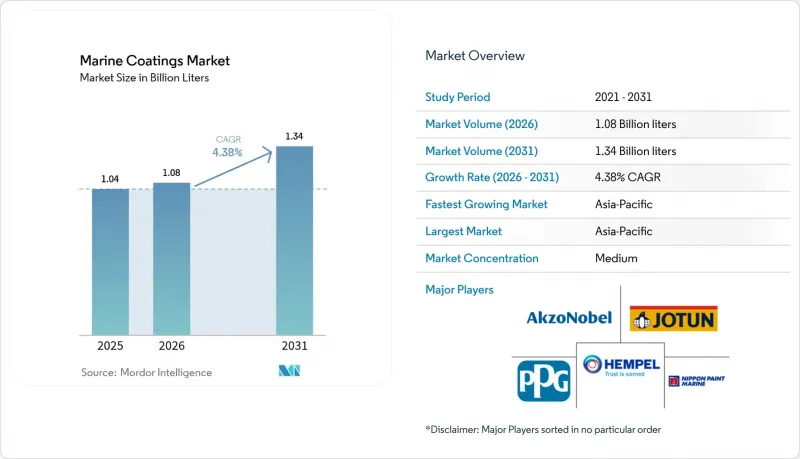
본 보고서는 유형별(부식 방지, 오염 방지 등), 수지별(에폭시, 폴리우레탄, 아크릴 등), 기술별(수성, 용제형, UV 경화, 분체), 용도별(선박 OEM, 선박 애프터마켓), 지역별(북미, 남미, 유럽, 아시아태평양, 중동 및 아프리카)로 분류되어 있습니다. 시장 예측은 판매량(리터) 기준으로 제시되어 있습니다.
세계의 선박용 코팅 시장 동향 및 인사이트
LNG 추진 선박 및 하이브리드 선박의 신조선 수주가 급증
IMO 2030 탄소 배출 목표를 달성하기 위해 조선소들이 이중 연료 선박 및 하이브리드 선박으로의 전환을 추진하는 가운데, LNG 추진은 선박용 코팅 시장을 재편하고 있습니다. DNV의 기록에 따르면, 2025년 상반기에는 총 1,420만 총톤에 해당하는 87척의 LNG 연료선이 발주되어, 이에 따라 극저온 내성 에폭시 탱크 라이닝에 대한 수요가 증가했습니다. 한국 조선사들은 2024년 LNG 계약의 61%를 수주하며, 이 지역에서의 수주량을 공고히 했습니다. 또한, 운항사는 저항을 최소화하기 위해 실리콘계 방오 도료를 지정하고 있으며, 그 대표적인 예로 드라이독 간격을 90개월로 연장해 주는 중국 선박용 코팅의 BIOCLEAN PLUS를 들 수 있습니다. 조기 도입 기업들은 5년간 최대 5%의 연료비 절감을 보고하고 있어, 총 소유 비용(TCO) 측면에서의 이점이 입증되고 있습니다. 이러한 기세가 중기적으로도 선박용 코팅 시장의 확장을 뒷받침하는 안정적인 수주 흐름을 지탱하고 있습니다.
IMO CII 등급 도입 후 도크 입항 빈도 증가
탄소 집약도 지표(CII)는 선박을 매년 A부터 E 등급으로 평가합니다. 3년 연속 D 등급을 받거나 단 한 번이라도 E 등급을 받은 선박은 운항상의 제약을 받게 되므로, 선주는 더 빈번하게 재도장을 실시해야 하는 상황에 놓이게 됩니다. 그 결과, 애프터마켓 수요량은 연평균 5.18% 증가하며 시장 전체 성장률을 상회하고 있습니다. 2025년, 선주들이 A 또는 B 등급을 유지하기 위해 선체 세척을 요구하는 움직임이 확산되면서 싱가포르의 드라이독 처리량은 22% 증가했습니다. Jotun의 디지털 ‘Hull Skating’ 로봇은 선체를 실시간으로 평가할 수 있게 하여 컨테이너 선단 전체의 연료 소비량을 8% 절감합니다. 이러한 도구를 통해 예측 유지보수가 주류가 되면서, 더 긴 주기 동안 매끄러운 표면을 유지하는 고성능 도료에 대한 애프터마켓 수요가 더욱 증가하고 있습니다.
EU 및 미국의 살생물제 승인 기준 강화
유럽화학물질청(ECHA)은 2024년에 아연 피리티온의 사용 승인을 취소하여, 방오 도료의 약 40%에 포함되어 있던 성분이 배제되었습니다. 배합 변경에는 일반적으로 최대 2년이 소요되기 때문에 공급 부족을 초래하고 있습니다. 또한, 미국 환경보호청(EPA)의 선박 우발적 배출법에 따라 구리의 용출률이 더욱 제한되어, 특정 수역에서는 많은 기존 제품을 사실상 사용할 수 없게 되었습니다. 이 두 가지 규제로 인해 기존 도료보다 30%-50% 더 비싼 실리콘계 방오 시스템의 연구개발비가 증가하고 있어, 신흥 시장의 선주들에게는 비용 측면의 장벽이 되고 있습니다. PFAS의 단계적 폐지 가능성까지 더해지면 추가적인 설계 변경 주기가 필요하게 되어, 선박용 코팅 시장의 연평균 성장률(CAGR)에 대한 부정적 영향이 장기화될 우려가 있습니다.
부문 분석
2025년, 선박용 코팅 시장 규모 중 방오 제품은 수량 기준으로 47.28%를 차지했으며, 연료 절약 전략에서 그 중심적인 역할을 입증하고 있습니다. 규제상의 압박으로 인해 선주들은 방오 박리 도료로의 전환을 강요받고 있으며, 이 부문의 연평균 성장률(CAGR)은 4.75%로 가장 빠르게 성장하는 하위 부문이 되고 있습니다. Jotun의 Hull Skating 플랫폼은 실리콘계 방오 화학 기술과 성능 최적화 범위를 관리하는 센서를 결합한 것으로, 새로운 효율성 규제가 요구하는 기술적 도약을 여실히 보여주고 있습니다. 부식 방지 시스템은 특히 아시아의 신조선 프로그램에서 LNG 화물 탱크 및 컨테이너선 선체에 여전히 필수적입니다. 습기 경화형 배합은 습도에 의해 경화되는 특성 덕분에 조선소 수리 시장에서 점유율을 확대하고 있으며, 조선소 입항 일정이 제한된 상황에서도 작업 기간을 단축할 수 있게 해줍니다.
유럽화학물질청(ECHA)에 의한 피리티온 아연의 사용 금지로 인해 시장은 양극화되고 있습니다. 고급 선단은 5%-8%의 연료 절감을 실현하는 실리콘계 방오 도료를 채택하고 있는 반면, 비용을 중시하는 선주는 많은 항로에서 여전히 사용이 허용되고 있는 구리계 시스템에 집착하고 있습니다. 첨단 부식 방지 제품 라인에는 내구 연한을 연장하기 위해 나노 실리카가 첨가되고 있습니다. PPG의 자가 평활화 도료 Sigmaglide 2390은 선체의 거칠기를 6% 개선하여 효율 향상에 기여하고 있습니다. 습기 경화형 도료는 작업 가능 시간(팟 라이프)이 짧아 틈새 시장으로 남아 있지만, 중요한 부분 보수 작업을 해결하며 선박용 코팅 시장의 제품 구성 균형을 유지하고 있습니다.
알키드계 도료는 저렴한 가격과 기존 설비와의 호환성 덕분에 2025년 선박용 코팅 시장 점유율의 54.79%를 차지했습니다. 한편, 폴리우레탄계 도료는 크루즈선 상부 구조물에서 뛰어난 광택 유지력을 발휘함으로써, 2031년까지 연평균 성장률(CAGR)이 4.52%로 가장 높은 성장세를 보이고 있습니다. 에폭시계 도료는 염수 침지 조건에서 뛰어난 접착력을 바탕으로 프라이머 및 극저온 탱크 시장을 장악하고 있는 반면, 규제 당국의 VOC(휘발성 유기 화합물) 배출 규제 강화에 따라 아크릴계 도료는 수성 시스템 분야에서 점유율을 확대되고 있습니다.
크루즈선 운항사는 가격이 20%-30% 더 비싸음에도 불구하고 폴리우레탄을 선호하여 채택하고 있습니다. 이는 로얄 캐리비안이 2027년 이후 인도될 신조선에 대해 15년간의 외관 내구성을 규정하고 있기 때문입니다. 에폭시 수지의 이익률은 비스페놀 A의 가격 변동에 따른 압박을 받고 있지만, 그 뛰어난 성능 덕분에 수요는 견조한 추세를 보이고 있습니다. 틈새 시장인 불소 수지 등급은 화학 탱커의 내화학성을 향상시키고 있지만, PFAS 규제의 도입이 임박함에 따라 연구 개발의 초점은 세라믹 강화 에폭시 수지로 옮겨갈 가능성이 있습니다. 이러한 변화로 인해 선박용 코팅 시장 내 수지 간 경쟁은 앞으로도 활발한 양상을 이어갈 것으로 예측됩니다.
지역별 분석
아시아태평양은 2025년 출하량의 72.17%를 차지했으며, 2031년까지 연평균 성장률(CAGR) 4.82%로 확대되고 있습니다. 이는 중국이 보상 총톤수 기준으로 전 세계 준공 선박의 50.5%를 계속 차지하고 있기 때문입니다. 한국의 조선소는 LNG 운반선을 전문으로 하며, 고부가가치의 친환경 선박이라는 틈새 시장을 장악하고 있습니다. 이 시장에서는 고품질의 극저온 탱크용 도료가 요구됩니다. 일본의 조선사는 규모는 작지만, 코팅의 신뢰성이 최우선으로 요구되는 화학제품 운반선 분야에서 여전히 중요한 역할을 수행하고 있습니다. 중국에서는 현지 규제에 따라 VOC(휘발성 유기 화합물) 함량이 높은 도료에 세금이 부과됨에 따라 수성 도료의 채택이 확대되고 있으며, 이러한 조치가 첨단 배합의 도료에 대한 지역적 수요를 끌어올리고 있습니다.
유럽 수요 동향은 해상 풍력 발전의 기초 구조물과 크루즈선 개조가 주도하고 있습니다. EU의 재생에너지 지침에 따라 2030년까지 76GW 규모의 풍력 터빈 설치가 예정되어 있으며, 이는 수명이 긴 방식 도료의 판매를 뒷받침하고 있습니다. 피리티온 아연의 사용 중단으로 인해 부착 생물 방지 도료의 채택이 가속화되어, 2025년에는 보급률이 38.4%에 달하고, 중국의 3배 수준이 되었습니다. 북미에서는 VOC 규제의 압력 측면에서 유럽과 유사한 상황이 관찰됩니다. VIDA의 시행에 따라 카리브해 항로를 운항하는 크루즈 선사는 속경화형이며 용제 함유량이 적은 시스템으로의 전환을 추진하고 있습니다.
중동에서는 유조선 선단 정비를 위한 신조선소 투자가 진행되고 있어, 내열성 방식 에폭시 수지에 대한 수요가 증가하고 있습니다. 아프리카는 남아프리카의 수리 도크를 제외하면 여전히 발전의 초기 단계에 있습니다. 남미에서는 브라질의 해양 부문에서 국지적인 성장이 나타나고 있으나, 경기 순환의 영향으로 인해 다른 지역에 비해 뒤처져 있습니다. 이러한 지역별 대조적인 상황은 선박용 코팅 시장의 도입 곡선 편차를 뒷받침하고 있습니다.
기타 혜택 :
- 엑셀 형식 시장 예측(ME) 시트
- 3개월간의 애널리스트 지원
자주 묻는 질문
목차
제1장 서론
제2장 조사 방법
제3장 주요 요약
제4장 시장 구도
제5장 시장 규모 및 성장 예측
제6장 경쟁 구도
제7장 시장 기회 및 향후 전망
AJY 26.09.09According to Mordor Intelligence, the marine coatings market size is expected to increase from 1.04 billion liters in 2025 to 1.08 billion liters in 2026 and reach 1.34 billion liters by 2031, growing at a CAGR of 4.38% over 2026-2031.
This report is Segmented by Type (Anti-Corrosion, Antifouling, and More), Resin (Epoxy, Polyurethane, Acrylic, and More), Technology (Water-Borne, Solvent-Borne, UV-Cured, and Powder), Application (Marine OEM, and Marine Aftermarket), and Geography (North America, South America, Europe, Asia Pacific, and Middle East and Africa). The Market Forecasts are Provided in Terms of Volume (Liters).
Global Marine Coatings Market Trends and Insights
Surge in Newbuild Orders for LNG-Powered and Hybrid Vessels
LNG propulsion is reshaping the marine coatings market as shipyards pivot toward dual-fuel and hybrid tonnage to meet IMO 2030 carbon targets. DNV logged 87 LNG-fueled vessels totaling 14.2 million gross tonnes ordered in 1H 2025, which raised demand for cryogenic-resistant epoxy tank linings. South Korean builders captured 61% of 2024 LNG contracts, consolidating regional volume. Operators are also specifying silicone foul-release finishes to minimize drag, exemplified by Chugoku Marine Paints' BIOCLEAN PLUS that extends dry-dock intervals to 90 months. Early adopters report up to 5% fuel savings over five-year spans, reinforcing cost-of-ownership arguments. This momentum underpins a steady stream of orders that keeps the marine coatings market expanding through the medium term.
Rising Dry-Docking Frequency Post-IMO CII Ratings Rollout
The Carbon Intensity Indicator rates ships annually from A to E. Vessels graded D for three consecutive years or E for one face operational curbs, pushing owners to repaint more often. Aftermarket volumes are therefore rising 5.18% yearly, outpacing overall market growth. Singapore's dry-dock throughput climbed 22% in 2025 as operators sought hull cleaning to retain A or B grades. Jotun's digital Hull Skating robot enables real-time hull assessment and trims bunker burn by 8% across container fleets. These tools make predictive maintenance mainstream and amplify aftermarket pull for high-performance coatings that deliver smooth surfaces over longer cycles.
Tightening EU and US Biocide Approvals
The European Chemicals Agency withdrew zinc pyrithione in 2024, removing a component found in roughly 40% of antifouling paints. Reformulation typically needs up to two years, causing supply tension. The U.S. EPA Vessel Incidental Discharge Act further limits copper leach rates, effectively excluding many legacy products in certain waters. These dual rulings lift research and development outlays for silicone foul-release systems that are 30%-50% pricier than traditional coatings, a cost hurdle for owners in emerging markets. The potential PFAS phase-out would add another redesign cycle, extending the negative drag on the marine coatings market CAGR.
Other drivers and restraints analyzed in the detailed report include:
- Accelerating Cruise-Fleet Refurbishment Cycles
- Expansion of Offshore Wind Farm Maintenance Contracts
- Volatile Titanium-Dioxide and Epoxy Feedstock Costs
For complete list of drivers and restraints, kindly check the Table Of Contents.
Segment Analysis
Antifouling products captured 47.28% volume in 2025 within the marine coatings market size, confirming their central role in fuel-saving strategies. Regulatory pressure is pushing owners toward foul-release coatings, whose 4.75% CAGR makes them the fastest expanding sub-segment. Jotun's Hull Skating platform combines silicone foul-release chemistry with sensors that optimize performance windows, illustrating the technology leap demanded by new efficiency rules. Anti-corrosion systems remain vital for LNG cargo tanks and container hulls, especially in Asian newbuild programs. Moisture-cure formulations are gaining share in dockside repairs because they cure via humidity, accelerating turnaround during tight docking slots.
The European Chemicals Agency ban on zinc pyrithione causes a split market. Premium fleets adopt silicone foul-release finishes for 5%-8% fuel savings, while cost-sensitive owners stick to copper systems still allowed in many routes. Advanced anti-corrosion lines now add nano-silica to extend service life. PPG's self-smoothing Sigmaglide 2390 improves hull roughness by 6%, lifting efficiency gains. Moisture-cure coatings stay niche due to short pot life but solve critical spot-repair jobs, balancing the product mix in the marine coatings market.
Alkyds secured 54.79% of the 2025 marine coatings market share because of their low price and compatibility with legacy equipment. Polyurethanes, however, post the highest 4.52% CAGR through 2031 by offering superior gloss retention on cruise topsides. Epoxies dominate primers and cryogenic tanks thanks to outstanding adhesion in saltwater immersion, while acrylics expand inside water-borne systems as regulators cap VOCs.
Cruise operators favor polyurethane despite its 20%-30% price premium because Royal Caribbean specifies 15-year cosmetic durability on newbuilds delivered from 2027 onward. Epoxy margins feel pressure from bisphenol-A volatility, but performance keeps demand steady. Niche fluoropolymer grades improve chemical resistance on chemical tankers, though looming PFAS restrictions could redirect research and development to ceramic-reinforced epoxies. These shifts ensure resin competition stays dynamic in the marine coatings market.
Complete Report Scope:
- By Type
- Anti-corrosion
- Antifouling
- Foul Release
- Mositure Cure
- By Resin
- Epoxy
- Polyurethane
- Acrylic
- Alkyd
- Other (Fluoropolymer, Polyester etc)
- By Technology
- Water-borne
- Solvent-borne
- UV-cured
- Powder
- By Application
- Marine OEM
- Marine Aftermarket
- By Geography
- Asia Pacific
- China
- Japan
- South Korea
- India
- Malaysia
- Vietnam
- Rest of Asia Pacific
- North America
- United States
- Canada
- Mexico
- Europe
- Germany
- United Kingdom
- France
- Italy
- Spain
- Rest of Europe
- South America
- Brazil
- Argentina
- Rest of South America
- Middle East and Africa
- Saudi Arabia
- UAE
- South Africa
- Nigeria
- Rest of Middle east and Africa
- Asia Pacific
Geography Analysis
Asia Pacific accounted for 72.17% of the 2025 volume and is advancing at a 4.82% CAGR through 2031, as China retained 50.5% of global completions by compensated gross tonnage. South Korean yards specialize in LNG carriers, capturing the value-dense eco-ship niche that demands premium cryogenic tank coatings. Japanese builders, while smaller, remain pivotal for chemical tankers where coating reliability is paramount. Water-borne uptake is growing in China because local regulations now tax high-VOC finishes, a step that lifts regional demand for advanced formulations.
Europe's demand profile is led by offshore wind foundations and cruise refurbishments. EU renewable directives keep turbine installations on track for 76 GW by 2030, spurring long-life anti-corrosion sales. Zinc-pyrithione withdrawal accelerated foul-release adoption to 38.4% penetration in 2025, triple China's ratio. North America mirrors Europe on VOC pressure; VIDA implementation steers cruise lines to rapid-cure, low-solvent systems on Caribbean routes.
The Middle East invests in new yards to service oil tanker fleets, raising demand for high-temperature anti-corrosion epoxies. Africa remains nascent apart from South African repair docks. South America sees pockets of growth in Brazil's offshore sector, but lags because of economic cycles. These geographic contrasts affirm divergent adoption curves in the marine coatings market.
- AkzoNobel N.V.
- Jotun
- Chugoku Marine Paints Ltd.
- PPG Industries Inc.
- Hempel A/S
- The Sherwin-Williams Company
- Kansai Paint Marine Co., Ltd.
- Nippon Paint Marine Coatings Co. Ltd.
- Axalta Coating Systems
- BASF SE
- KCC Corporation
- BOERO BARTOLOMEO S.p.A.
- Engineered Marine Coatings LLC
- MCU Coating International
- Pettit Marine Paints
- RPM International Inc.
- Carboline Company
- Sika AG
- Arkema S.A. (Bostik Yacht Coatings)
Additional Benefits:
- The market estimate (ME) sheet in Excel format
- 3 months of analyst support
TABLE OF CONTENTS
1 Introduction
- 1.1 Study Assumptions and Market Definition
- 1.2 Scope of the Study
2 Research Methodology
3 Executive Summary
4 Market Landscape
- 4.1 Market Overview
- 4.2 Market Drivers
- 4.2.1 Surge in newbuild orders for LNG-powered and hybrid vessels
- 4.2.2 Rising dry-docking frequency post-IMO CII ratings rollout
- 4.2.3 Accelerating cruise-fleet refurbishment cycles
- 4.2.4 Expansion of offshore wind farm maintenance contracts
- 4.2.5 Growing ESG-linked ship-financing that rewards low-VOC coatings
- 4.3 Market Restraints
- 4.3.1 Tightening EU and US biocide approvals
- 4.3.2 Volatile titanium-dioxide and epoxy feedstock costs
- 4.3.3 Skilled applicator shortage inflating labor rates
- 4.4 Value Chain Analysis
- 4.5 Regulatory Landscape
- 4.6 Porter's Five Forces
- 4.6.1 Bargaining Power of Suppliers
- 4.6.2 Bargaining Power of Buyers
- 4.6.3 Threat of New Entrants
- 4.6.4 Threat of Substitutes
- 4.6.5 Degree of Competition
5 Market Size and Growth Forecasts (Volume)
- 5.1 By Type
- 5.1.1 Anti-corrosion
- 5.1.2 Antifouling
- 5.1.3 Foul Release
- 5.1.4 Mositure Cure
- 5.2 By Resin
- 5.2.1 Epoxy
- 5.2.2 Polyurethane
- 5.2.3 Acrylic
- 5.2.4 Alkyd
- 5.2.5 Other (Fluoropolymer, Polyester etc)
- 5.3 By Technology
- 5.3.1 Water-borne
- 5.3.2 Solvent-borne
- 5.3.3 UV-cured
- 5.3.4 Powder
- 5.4 By Application
- 5.4.1 Marine OEM
- 5.4.2 Marine Aftermarket
- 5.5 By Geography
- 5.5.1 Asia Pacific
- 5.5.1.1 China
- 5.5.1.2 Japan
- 5.5.1.3 South Korea
- 5.5.1.4 India
- 5.5.1.5 Malaysia
- 5.5.1.6 Vietnam
- 5.5.1.7 Rest of Asia Pacific
- 5.5.2 North America
- 5.5.2.1 United States
- 5.5.2.2 Canada
- 5.5.2.3 Mexico
- 5.5.3 Europe
- 5.5.3.1 Germany
- 5.5.3.2 United Kingdom
- 5.5.3.3 France
- 5.5.3.4 Italy
- 5.5.3.5 Spain
- 5.5.3.6 Rest of Europe
- 5.5.4 South America
- 5.5.4.1 Brazil
- 5.5.4.2 Argentina
- 5.5.4.3 Rest of South America
- 5.5.5 Middle East and Africa
- 5.5.5.1 Saudi Arabia
- 5.5.5.2 UAE
- 5.5.5.3 South Africa
- 5.5.5.4 Nigeria
- 5.5.5.5 Rest of Middle east and Africa
- 5.5.1 Asia Pacific
6 Competitive Landscape
- 6.1 Market Concentration
- 6.2 Strategic Moves
- 6.3 Market Share (%)/Ranking Analysis
- 6.4 Company Profiles (includes Global level Overview, Market level overview, Core Segments, Financials as available, Strategic Information, Products and Services, Recent Developments)
- 6.4.1 AkzoNobel N.V.
- 6.4.2 Jotun
- 6.4.3 Chugoku Marine Paints Ltd.
- 6.4.4 PPG Industries Inc.
- 6.4.5 Hempel A/S
- 6.4.6 The Sherwin-Williams Company
- 6.4.7 Kansai Paint Marine Co., Ltd.
- 6.4.8 Nippon Paint Marine Coatings Co. Ltd.
- 6.4.9 Axalta Coating Systems
- 6.4.10 BASF SE
- 6.4.11 KCC Corporation
- 6.4.12 BOERO BARTOLOMEO S.p.A.
- 6.4.13 Engineered Marine Coatings LLC
- 6.4.14 MCU Coating International
- 6.4.15 Pettit Marine Paints
- 6.4.16 RPM International Inc.
- 6.4.17 Carboline Company
- 6.4.18 Sika AG
- 6.4.19 Arkema S.A. (Bostik Yacht Coatings)
7 Market Opportunities and Future Outlook
- 7.1 White-space and unmet-need assessment