

|
시장보고서
상품코드
2121981
암 진단 : 시장 점유율 분석, 업계 동향과 통계, 성장 예측(2026-2031년)Cancer Diagnostics - Market Share Analysis, Industry Trends & Statistics, Growth Forecasts (2026 - 2031) |
||||||
 Mordor Intelligence
Mordor Intelligence에 따르면 암 진단 시장 규모는 2025년 1,148억 달러, 2026년 1,241억 달러에서 2031년까지 1,835억 3,000만 달러로 확대할 것으로 예측되고 있으며, 2026-2031년까지 연평균 성장률(CAGR)은 8.20%에 달할 전망입니다.
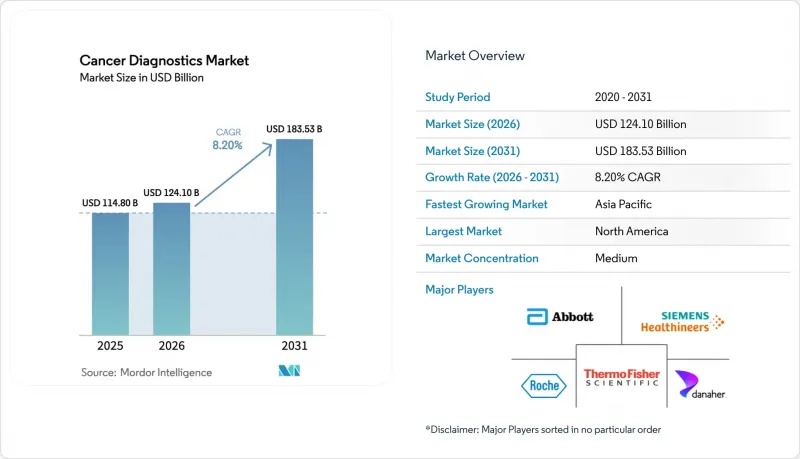
이 보고서는 진단 유형(영상 진단 검사, 생검·세포진 검사 등), 암 유형(유방암, 폐암, 대장암, 자궁경부암 등), 최종사용자(병원, 진단 검사 기관 등) 및 지역(북미, 유럽, 아시아태평양, 중동 및 아프리카, 남미)별로 분류되어 있습니다. 시장 전망은 금액(달러) 기준으로 제시되어 있습니다.
전 세계 암 진단 시장의 동향 및 인사이트
정부 주도의 선별 검사 프로그램 확대
조기 발견을 통해 진행성 암 치료에 비해 치료비를 60-80%나 절감할 수 있으므로 각국 정부는 현재 암 검진을 필수적인 인프라로 간주하고 있습니다. 중국의 ‘건강 중국 2030’ 계획 역시 2030년까지 개인의 의료비 본인 부담률을 25%로 낮추는 것을 권장하며, 국민의 경제적 부담을 경감하는 것을 목표로 하고 있습니다. 이러한 목표를 지원하기 위해 중국은 생명공학 혁신과 디지털 헬스 분야에 막대한 투자를 하고 있으며, 구체적으로는 2030년까지 주민 1,000명당 등록 의사 3명, 등록 간호사 4.7명을 확보하는 것을 목표로 하고 있습니다. 2024년, 미국 보건자원서비스국(HRSA)은 대장암 검진 등 검진 서비스에 대한 접근성을 개선하기 위해 ‘암 검진 촉진(AxCS)’ 프로그램을 통해 18개 보건 센터에 약 900만 달러를 지원했습니다. 인도에서는 2025년 2월 20일부터 2025년 3월 31일까지 구강암, 유방암, 자궁경부암을 포함한 비전염성 질환(NCD)을 대상으로 한 전국적인 검진 캠페인이 시작되었으며, 전국의 30세 이상 개인을 대상으로 하고 있습니다. 또한 2025-26년도 연방 예산에서는 암 의료의 분산화와 접근성 향상을 도모하기 위해 인도 전역의 지역 병원에 200곳의 암 주간 치료 센터를 설립할 계획이 발표되었습니다. 이러한 프로그램들은 종합적으로 볼 때, 검사 기준 건수를 늘리고, 공급업체의 가시성을 높이며, 국가 보건 정보 교환 시스템과의 상호 운용성을 장기 계약의 조건으로 삼는 것입니다.
전 세계 암 발병률 증가와 고령화
2025년에는 미국에서 약 200만 건의 신규 암 사례와 60만 건의 암으로 인한 사망이 발생할 것으로 예측됩니다. 전 세계 인구 중 65세 이상 인구의 비율은 2025년 10%에서 2050년까지 16%로 증가할 것으로 예상되며, 이는 종양 전문의 밀도가 여전히 OECD 기준에 미치지 못하는 지역의 수요를 끌어올릴 것입니다. 일본과 한국에서는 연령 중앙값이 48세를 넘어서고 있으며, 현재 40세 이상 국민을 대상으로 2년마다 시행하는 영상 진단에 더해, 액체생검 패널에 대한 보험 적용을 시행하고 있습니다. 이는 자동화를 통해 전문의 부족을 보완하는 것을 목적으로 하고 있습니다. 중국에서는 종양 전문의와 인구의 비율이 OECD 평균의 절반 수준에 그치고 있으며, 인력 부족에도 불구하고 처리 능력을 유지할 수 있는 AI 지원형 병리 진단 플랫폼이 급속히 도입되고 있습니다. 이러한 인구 동향의 변화에 따라 검사 건수의 지속적인 증가가 예상되는 한편, 병목 현상을 방지하기 위한 의사결정 지원 소프트웨어의 도입이 시급하다는 점도 부각되고 있습니다.
첨단 분자 진단 비용 부담
차세대 염기서열 분석 및 액체생검 검사의 비용은 2,800-5,000달러로 추정되며, 1인당 연간 의료비가 500달러 미만인 지역에서는 감당하기 어려운 수준입니다. 인도에서는 3,500달러에 달하는 게놈 패널 검사가 가구 월 소득 중앙값의 1.4배에 해당하므로 그 이용은 대도시권으로 한정되어 있습니다. 케냐의 공적 보험은 전혈구계수(CBC)에 대해 고작 12달러만 지급할 뿐, 게놈 검사에 대한 급여는 전혀 없습니다. 그 때문에 민간 보험에 가입한 환자는 BRCA 검사 1회에 3개월 치 급여를 지출하게 됩니다. 미국에서도 고액 본인부담형 보험 플랜의 경우 1,000달러 이상의 비용이 환자에게 전가되므로 2025년에는 대상자의 23%가 검사를 포기하게 될 것으로 예상됩니다. 각 제약사는 1,000달러 전후의 가격대로 검사 대상을 좁힌 50개 유전자 패널을 순차적으로 도입하고 있지만, 이러한 검사로는 5건 중 1건 가까운 비율로 치료에 활용할 수 있는 변이를 놓치고 있습니다.
부문 분석
IVD 면역측정법은 시간당 최대 400개의 검체를 처리하며, 단가가 5달러 미만인 고처리량 분석 장치의 지원에 힘입어 2025년 매출의 53.22%를 차지했습니다. 유전체 분석 및 체액 생검 플랫폼은 보험 적용 결정이 증가하고 표준 결과 보고 시간이 48시간 미만으로 단축됨에 따라 2031년까지 연평균 9.29%의 성장률을 보일 것으로 예측됩니다. 영상 진단은 여전히 10%대 중반의 점유율을 유지하고 있으며, 위양성을 22% 감소시키는 AI 알고리즘의 혜택을 받아 방사선과 의사들의 도입을 촉진하고 있습니다. 생검 및 세포진 검사의 검사 건수는 정체되는 추세를 보이고 있습니다. 이는 종양 전문의들이 치료법 선택에 혈액 검사를 활용하게 되면서 조직 검사의 반복이 불필요해졌기 때문입니다. 종양 바이오마커 검사는 지속적인 모니터링에 필수적이지만, 전체 암 진단 시장에 비해 성장 속도는 완만합니다.
이익률 추세에는 큰 편차가 나타납니다. 면역분석법 공급업체는 광범위한 도입 기반을 통해 안정적인 시약 매출을 올리고 있는 반면, 유전체 관련 기업은 지적재산권으로 보호된 데이터 분석에 의존하고 있습니다. 일루미나(Illumina)사의 ‘NovaSeq X’는 게놈당 시퀀싱 비용을 200달러까지 낮춤으로써, 검사 기관이 포괄적인 패널 검사를 1,500달러에 제공하며 40%의 매출총이익률을 확보할 수 있게 했습니다. 써모피셔 사이언티픽(Thermo Fisher Scientific)의 ‘샘플 투 앤서(Sample-to-Answer)’ PCR 장치는 수작업 추출이 필요 없이 4시간 만에 28개 유전자를 검출함으로써, 전문 인력을 보유하지 않은 지역 병원에서도 분자 검사를 이용할 수 있게 했습니다. 규제 당국도 이러한 추세를 지원하고 있습니다. FDA는 2025년에 17개의 획기적인 종양학 플랫폼을 승인했으며, 유럽의약품청(EMA)은 확고한 임상적 근거가 있는 검사에 대해 평균 심사 기간을 9개월 단축했습니다. 그 결과, 면역 분석법이 계속해서 수익의 주축이 되는 한편, 체액 생검이 성장의 대부분을 차지하며 2031년까지 암 진단 시장을 재편하게 될 것입니다.
지역별 분석
북미는 1인당 1만 2,500달러의 의료비 지출과 첨단 진단 기술에 대한 광범위한 보험 적용에 힘입어 2025년 매출의 39.26%를 차지했습니다. 반면, 아시아태평양은 연평균 성장률(CAGR) 8.92%로 성장할 전망이며, 지역별로는 가장 빠른 성장세를 보일 것입니다. 2026년에 다중 암 조기 발견에 대한 메디케어 보험 적용이 시작되어 보험 적용 대상자가 4,100만 명 증가함에 따라 지역별 암 진단 시장은 한 자릿수 중반대의 성장률을 유지할 전망입니다. 반면, 영국에서는 21억 파운드의 자금 부족으로 인해 전국적인 액체생검 도입이 연기되고 있으며, 유럽 각국에서 도입률에 편차가 발생하고 있음을 시사하고 있습니다.
인도의 ‘아유슈만 바라트’ 제도는 50세 이상 5억 5,000만 명의 국민을 대상으로 합니다. 중국의 국내 진단 체인은 현재 1,800개의 검사실을 운영하고 있으며, 이를 통해 현지 조달을 촉진하고 설치 주기를 16주에서 6주로 단축하고 있습니다. 일본에서는 인구 감소 속에서도 1인당 지출이 증가하고 있으며, 정부가 말기 치료 비용 억제를 위해 조기 발견을 우선시한 결과, 2025년에는 6.2%의 증가를 기록했습니다. 한국의 선별검진 프로그램은 2025년에 참여율이 76%에 달해 세계 최고 수준을 기록했습니다. 또한 대장암 생존자에 대한 액체생검을 통한 경과 관찰이 새롭게 보험 적용 대상이 됨에 따라 향후 검사 건수의 증가가 가속화될 것으로 보입니다. 호주는 2025년에 동반 진단의 보험 적용 범위를 확대하여 정밀 종양학에 대한 보험 적용을 향한 지역적 동향을 강화했습니다.
중동 및 아프리카의 시장 점유율은 여전히 한 자릿수 초반에 머물러 있지만, 목표가 명확한 투자가 이루어지고 있습니다. 사우디아라비아는 ‘비전 2030’의 일환으로 12억 달러를 배정하여 45대의 PET-CT 스캐너를 도입하고, 주요 3개 도시에 게놈 검사실을 설치했습니다. 아랍에미리트(UAE)는 의료 관광객에게 서비스를 제공하기 위해 AI 병리 진단을 통합한 암 센터를 설립하고 있습니다. 남미에서는 상황에 따라 차이가 나타납니다. 브라질의 국민의료제도에서는 2024년에 유방촬영술과 대장내시경 검사가 보험 적용 대상에 포함되었으나, 북부 주에서는 여전히 장비 부족이 지속되고 있습니다. 전반적으로 북미와 유럽이 여전히 절대적인 수익을 주도하고 있는 반면, 아시아태평양이 순 신규 지출의 대부분을 차지하게 되어 암 진단 시장내 경쟁의 초점이 재편될 것으로 보입니다.
기타 혜택:
- 엑셀 형식의 시장 예측(ME) 시트
- 3개월간의 애널리스트 지원
자주 묻는 질문
목차
제1장 서론
제2장 조사 방법
제3장 개요
제4장 시장 구도
제5장 시장 규모와 성장 예측
제6장 경쟁 구도
제7장 시장 기회와 향후 전망
KSA 26.09.04According to Mordor Intelligence, the cancer diagnostics market size is projected to expand from USD 114.80 billion in 2025 and USD 124.10 billion in 2026 to USD 183.53 billion by 2031, registering a CAGR of 8.20% between 2026 to 2031.
This report is Segmented by Diagnostic Type (Diagnostic Imaging Tests, Biopsy & Cytology Tests, and More), Cancer Type (Breast Cancer, Lung Cancer, Colorectal Cancer, Cervical Cancer, and More), End User (Hospitals, Diagnostic Laboratories, and More), and Geography (North America, Europe, Asia-Pacific, Middle East & Africa, and South America). The Market Forecasts are Provided in Terms of Value (USD).
Global Cancer Diagnostics Market Trends and Insights
Increasing Government-Funded Screening Programs
Governments now treat cancer screening as essential infrastructure because early detection reduces treatment spending by as much as 60-80% compared with late-stage therapy. China's Healthy China 2030 plan also seeks to alleviate the financial burden on citizens by recommending reducing individual out-of-pocket health costs to 25% by 2030. To support these goals, China is heavily investing in biotech innovation and digital health, specifically targeting 3 registered doctors and 4.7 registered nurses per 1,000 residents by 2030. In 2024, the Health Resources and Services Administration (HRSA) awarded nearly USD 9 million to 18 health centers through the Accelerating Cancer Screening (AxCS) program to improve access to screening services, such as colorectal cancer screening. In India, a nationwide screening campaign for non-communicable diseases (NCDs), including oral, breast, and cervical cancers, was launched from February 20, 2025, to March 31, 2025, targeting individuals aged 30 and above across the country. Furthermore, the Union Budget 2025-26 announced plans to establish 200 Day Care Cancer Centres in district hospitals across India to decentralize cancer care and improve accessibility. Collectively, these programs elevate baseline testing volumes, enhance vendor visibility, and make long-term contracts contingent on interoperability with national health information. exchanges.
Rising Global Cancer Incidence & Aging Population
In 2025, around 2 million new cancer cases and 0.6 million cancer deaths were projected to occur in the United States. The share of the global population aged 65 and older will move from 10% in 2025 to 16% by 2050, pushing demand in regions where oncologist density remains below OECD norms. Japan and South Korea, with median ages above 48, now reimburse liquid-biopsy panels alongside biennial imaging for citizens over 40, aiming to offset specialist shortages through automation. China's oncologist-to-population ratio is half the OECD average, prompting rapid adoption of AI-assisted pathology platforms that maintain throughput despite workforce gaps. The demographic trajectory ensures sustained test volume growth, but it also underscores the urgency of decision-support software to prevent bottlenecks.
High Cost of Advanced Molecular Diagnostics
Next-generation sequencing and liquid-biopsy assays list between USD 2,800 and USD 5,000, a level unaffordable in regions where annual health spending per capita is below USD 500. In India, a USD 3,500 genomic panel equals 1.4 times the median monthly household income, restricting uptake to metropolitan centers. Kenya's public insurance pays only USD 12 for a complete blood count and offers no coverage for genomic tests, leaving private patients to spend three months' wages on a single BRCA assay. Even in the United States, high-deductible plans shift USD 1,000 or more to patients, leading 23% of eligible individuals to forego testing in 2025. Manufacturers are rolling out slimmed-down 50-gene panels priced near USD 1,000, but these miss actionable mutations in almost one in five cases.
Other drivers and restraints analyzed in the detailed report include:
- Rapid Adoption of Liquid-Biopsy & ctDNA Tests
- Expansion of Point-of-Care Imaging & Diagnostics
- Limited Reimbursement in Low-Income Nations
For complete list of drivers and restraints, kindly check the Table Of Contents.
Segment Analysis
IVD immunoassays contributed 53.22% to 2025 revenue, supported by high-throughput analyzers that process up to 400 samples an hour at unit costs below USD 5. Genomic and liquid-biopsy platforms are projected to expand at 9.29% yearly through 2031 as coverage decisions proliferate and standard turnaround time drops to under 48 hours. Diagnostic imaging retains a mid-teens share and benefits from AI algorithms that reduce false positives by 22%, encouraging radiologist adoption. Biopsy and cytology test volumes are plateauing because oncologists now use blood-based assays for therapy selection, eliminating repeat tissue procedures. Tumor biomarker tests remain indispensable for ongoing monitoring, but grow more slowly than the overall cancer diagnostics market.
Margin profiles vary widely. Immunoassay vendors earn stable reagent revenue from broad installed bases, while genomic firms rely on intellectual-property-protected data analytics. Illumina's NovaSeq X lowered sequencing cost per genome to USD 200, enabling laboratories to price comprehensive panels at USD 1,500 with 40% gross margins. Thermo Fisher Scientific's sample-to-answer PCR unit delivers 28-gene detection in four hours without manual extraction, opening molecular testing to community hospitals lacking specialist staff. Regulators reinforce momentum; the FDA cleared 17 breakthrough oncology platforms in 2025, and the European Medicines Agency cut nine months off average review timelines for assays with strong clinical evidence. Consequently, immunoassays will continue to anchor revenue, but liquid biopsies will capture most incremental growth, reshaping the cancer diagnostics market by 2031.
Complete Report Scope:
- By Diagnostic Type
- Diagnostic Imaging Tests
- Biopsy & Cytology Tests
- Tumor Biomarkers
- Genomic / Liquid-Biopsy Tests
- IVD Immunoassays
- Other Diagnostic Types
- By Cancer Type
- Breast Cancer
- Lung Cancer
- Colorectal Cancer
- Cervical Cancer
- Prostate Cancer
- Kidney Cancer
- Liver Cancer
- Pancreatic Cancer
- Ovarian Cancer
- Other Cancer Types
- By End User
- Hospitals
- Diagnostic Laboratories
- Academic & Research Institutes
- POC / Ambulatory Centres
- By Geography
- North America
- United States
- Canada
- Mexico
- Europe
- Germany
- United Kingdom
- France
- Italy
- Spain
- Rest of Europe
- Asia-Pacific
- China
- Japan
- India
- South Korea
- Australia
- Rest of Asia-Pacific
- Middle East & Africa
- GCC
- South Africa
- Rest of Middle East & Africa
- South America
- Brazil
- Argentina
- Rest of South America
- North America
Geography Analysis
North America accounted for 39.26% of sales in 2025, underpinned by USD 12,500 per capita health spending and broad coverage for advanced diagnostics, whereas Asia-Pacific is set to rise at an 8.92% CAGR, the fastest regional pace. The regional cancer diagnostics market will sustain mid-single-digit growth as Medicare coverage for multi-cancer early detection took effect in 2026, adding 41 million reimbursed lives. The United Kingdom delayed the national liquid biopsy rollout due to a GBP 2.1 billion funding gap, signaling divergent adoption rates across Europe.
India's Ayushman Bharat scheme covers 550 million citizens aged 50 and older. China's domestic diagnostic chains now run 1,800 labs, driving local procurement and shortening installation cycles from 16 to six weeks. Japan's shrinking population masks rising per-capita spending, which climbed 6.2% in 2025 after the government prioritized early detection to control late-stage therapy costs. South Korea's screening program reached 76% participation in 2025, the highest globally, and newly reimbursed liquid-biopsy monitoring for colorectal survivors will support future test volumes. Australia expanded companion-diagnostic coverage in 2025, reinforcing a regional trend toward precision oncology reimbursement.
The Middle East and Africa remain a low-single-digit share but show targeted investment. Saudi Arabia allocated USD 1.2 billion under Vision 2030 to install 45 PET-CT scanners and set up genomic labs in three major cities. The United Arab Emirates is establishing oncology centers that integrate AI pathology, aiming to serve medical tourists. South America presents mixed signals; Brazil's national system added mammography and colonoscopy to coverage in 2024, yet equipment shortages persist in northern states. Overall, while North America and Europe still drive absolute revenue, Asia-Pacific will contribute most net new spending, reshaping competitive focus within the cancer diagnostics market.
- Abbott Laboratories
- Agilent Technologies
- Beckton Dickinson
- bioMerieux
- Bio-Rad Laboratories
- Danaher
- Exact Sciences
- Roche
- Foundation Medicine
- GE Healthcare
- Guardant Health
- Hologic
- Illumina
- Myriad Genetics
- NanoString Technologies
- Natera
- NeoGenomics Inc.
- PerkinElmer
- QIAGEN
- Siemens Healthineers
- Sysmex
- Thermo Fisher Scientific
Additional Benefits:
- The market estimate (ME) sheet in Excel format
- 3 months of analyst support
TABLE OF CONTENTS
1 Introduction
- 1.1 Study Assumptions & Market Definition
- 1.2 Scope of the Study
2 Research Methodology
3 Executive Summary
4 Market Landscape
- 4.1 Market Overview
- 4.2 Market Drivers
- 4.2.1 Increasing Government-Funded Screening Programs
- 4.2.2 Rising Global Cancer Incidence & Aging Population
- 4.2.3 Rapid Adoption of Liquid-Biopsy & ctDNA Tests
- 4.2.4 Expansion of Point-Of-Care Imaging & Diagnostics
- 4.2.5 Ai-Driven Multi-Omics Early Detection Platforms
- 4.2.6 Decentralized Microfluidic Sample-To-Answer Systems
- 4.3 Market Restraints
- 4.3.1 High Cost of Advanced Molecular Diagnostics
- 4.3.2 Limited Reimbursement in Low-Income Nations
- 4.3.3 Shortage Of Trained Molecular Pathologists
- 4.3.4 Data-Privacy Concerns in AI Cloud Workflows
- 4.4 Supply-Chain Analysis
- 4.5 Regulatory Landscape
- 4.6 Technological Outlook
- 4.7 Porter's Five Forces
- 4.7.1 Threat of New Entrants
- 4.7.2 Bargaining Power of Buyers
- 4.7.3 Bargaining Power of Suppliers
- 4.7.4 Threat of Substitute Products
- 4.7.5 Intensity of Competitive Rivalry
5 Market Size & Growth Forecasts (Value, USD)
- 5.1 By Diagnostic Type
- 5.1.1 Diagnostic Imaging Tests
- 5.1.2 Biopsy & Cytology Tests
- 5.1.3 Tumor Biomarkers
- 5.1.4 Genomic / Liquid-Biopsy Tests
- 5.1.5 IVD Immunoassays
- 5.1.6 Other Diagnostic Types
- 5.2 By Cancer Type
- 5.2.1 Breast Cancer
- 5.2.2 Lung Cancer
- 5.2.3 Colorectal Cancer
- 5.2.4 Cervical Cancer
- 5.2.5 Prostate Cancer
- 5.2.6 Kidney Cancer
- 5.2.7 Liver Cancer
- 5.2.8 Pancreatic Cancer
- 5.2.9 Ovarian Cancer
- 5.2.10 Other Cancer Types
- 5.3 By End User
- 5.3.1 Hospitals
- 5.3.2 Diagnostic Laboratories
- 5.3.3 Academic & Research Institutes
- 5.3.4 POC / Ambulatory Centres
- 5.4 By Geography
- 5.4.1 North America
- 5.4.1.1 United States
- 5.4.1.2 Canada
- 5.4.1.3 Mexico
- 5.4.2 Europe
- 5.4.2.1 Germany
- 5.4.2.2 United Kingdom
- 5.4.2.3 France
- 5.4.2.4 Italy
- 5.4.2.5 Spain
- 5.4.2.6 Rest of Europe
- 5.4.3 Asia-Pacific
- 5.4.3.1 China
- 5.4.3.2 Japan
- 5.4.3.3 India
- 5.4.3.4 South Korea
- 5.4.3.5 Australia
- 5.4.3.6 Rest of Asia-Pacific
- 5.4.4 Middle East & Africa
- 5.4.4.1 GCC
- 5.4.4.2 South Africa
- 5.4.4.3 Rest of Middle East & Africa
- 5.4.5 South America
- 5.4.5.1 Brazil
- 5.4.5.2 Argentina
- 5.4.5.3 Rest of South America
- 5.4.1 North America
6 Competitive Landscape
- 6.1 Market Concentration
- 6.2 Market Share Analysis
- 6.3 Company Profiles (includes Global level Overview, Market level overview, Core Segments, Financials as available, Strategic Information, Market Rank/Share for key companies, Products & Services, and Recent Developments)
- 6.3.1 Abbott Laboratories
- 6.3.2 Agilent Technologies
- 6.3.3 Becton, Dickinson and Company
- 6.3.4 bioMerieux SA
- 6.3.5 Bio-Rad Laboratories
- 6.3.6 Danaher Corporation (Cepheid)
- 6.3.7 Exact Sciences Corporation
- 6.3.8 F. Hoffmann-La Roche Ltd
- 6.3.9 Foundation Medicine
- 6.3.10 GE HealthCare
- 6.3.11 Guardant Health
- 6.3.12 Hologic Inc.
- 6.3.13 Illumina Inc.
- 6.3.14 Myriad Genetics
- 6.3.15 NanoString Technologies
- 6.3.16 Natera Inc.
- 6.3.17 NeoGenomics Inc.
- 6.3.18 PerkinElmer
- 6.3.19 Qiagen
- 6.3.20 Siemens Healthineers
- 6.3.21 Sysmex Corporation
- 6.3.22 Thermo Fisher Scientific
7 Market Opportunities & Future Outlook
- 7.1 White-Space & Unmet-Need Assessment


