

|
시장보고서
상품코드
2121982
차세대 메모리 : 시장 점유율 분석, 업계 동향과 통계, 성장 예측(2026-2031년)Next Generation Memory - Market Share Analysis, Industry Trends & Statistics, Growth Forecasts (2026 - 2031) |
||||||
 Mordor Intelligence
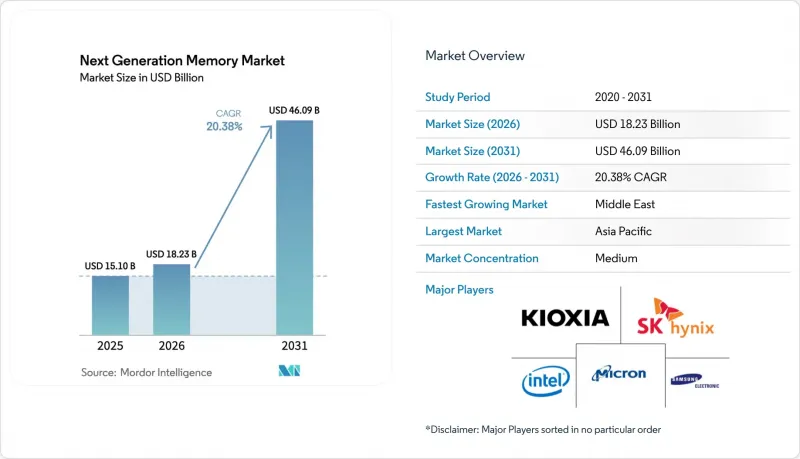
Mordor Intelligence에 따르면 차세대 메모리 시장 규모는 2025년 151억 달러, 2026년 182억 3,000만 달러에서 2031년까지 460억 9,000만 달러로 확대할 것으로 예측되고 있으며, 2026-2031년까지 연평균 성장률(CAGR)은 20.38%에 달할 전망입니다.
이 보고서는 기술별(비휘발성, 휘발성), 메모리 인터페이스별(DDR/LPDDR, PCIe/NVMe, SATA 등),최종 용도 기기(소비자용 전자기기, 기업 스토리지 및 데이터센터, 자동차용 전자기기 및 ADAS, 산업용 IoT, 항공우주·방위, 기타), 웨이퍼 크기(200mm 이하, 300mm, 450mm) 및 지역별로 분류되어 있습니다. 시장 전망은 금액(달러) 기준으로 제시되어 있습니다.
글로벌 차세대 메모리 시장 동향 및 인사이트
하이퍼스케일 데이터센터에서의 AI 주도형 HBM 수요
생성형 AI 클러스터는 GDDR6의 대역폭 한계에 도달하고 있으며, 각 하이퍼스케일러 기업은 패키지당 최대 819 GB/s를 실현하는 HBM3E 스택으로의 전환을 추진하고 있습니다. SK하이닉스는 2024년에 12층 HBM3E의 양산을 시작했으나, 주요 외주 조립 업체들의 첨단 패키징 생산 능력은 2026년 중반까지 예약으로 완전히 채워져 있습니다. NVIDIA의 ‘Blackwell’ 및 AMD의 ‘MI300’ 시리즈는 각각 8개의 HBM3E 스택을 통합하여 가속기 1대당 메모리 용량을 192GB로 끌어올렸습니다. 디스크리트 GDDR 모듈에 비해 최대 40%의 전력 절감 효과를 실현함으로써 데이터센터의 지속가능성 노력이 지원되고, HBM 채택 추세가 더욱 가속화되고 있습니다. 그 결과, 차세대 메모리 시장 전체의 연평균 성장률(CAGR)이 6.2포인트 상승할 것으로 예상됩니다.
자동차용 L4 ADAS에서 인스턴트 온(Instant-on)형 퍼시스턴트 메모리의 필요성
레벨 4 자율주행 사양에서는 시스템 시작 지연 시간을 100밀리초 이내로 억제해야 하지만, 이는 NAND 기반 부트 경로로는 달성할 수 없는 목표입니다. STT-MRAM은 DRAM에 필적하는 읽기 속도와 비휘발성을 겸비하고 있으며, 컨트롤러가 센서 퓨전을 즉시 재개할 수 있게 해줍니다. Everspin사는 2025년에 자동차용 인증 MRAM을 100만개 이상 출하할 예정이며, STMicroelectronics사는 2026년형 차량을 위해 28nm 임베디드 PCM의 양산을 시작했습니다. UNECE WP.29와 같은 규제 프레임워크는 변조 방지 기능을 갖춘 로깅을 의무화함으로써 비즈니스 사례를 강화하고 있습니다. 이러한 요인들로 인해 차세대 메모리 시장의 연평균 성장률(CAGR)은 4.8포인트 상승할 것입니다.
450mm 웨이퍼 도입 지연이 ReRAM의 규모 확대를 제약
300mm 웨이퍼에서 450mm 웨이퍼로의 전환으로 인해 다이 생산량이 2.25배로 대폭 증가할 것으로 예상되며, 이로 인해 생산 효율이 크게 향상되고 비용 절감이 이루어질 가능성이 있습니다. 그러나 ASML은 현재 이러한 대형 기판에 대응하도록 설계된 상용 EUV 플랫폼을 보유하고 있지 않아, 이 전환에 필요한 기술 인프라에 심각한 공백이 발생하고 있습니다. 28nm 이하 노드에 크게 의존하고 있는 ReRAM 공급업체들은 이러한 비용 면에서의 우위를 활용하지 못하고 있으며, NAND 기술과 대등한 수준을 달성하는 능력이 현저히 저해되고 있습니다. 이러한 기술적 제약은 성장 전망에 현저한 영향을 미치고 있습니다. 그 영향은 450mm 웨이퍼 기술에 대한 투자를 미루기로 선택한 지역에서 특히 두드러지며, 이러한 지역의 기술 발전을 더욱 정체시키고 있습니다.
부문 분석
2025년, 휘발성 메모리는 차세대 메모리 시장 점유율의 52.14%를 확보하며, AI 가속기를 위한 우선 스택으로서의 역할을 반영하고 있습니다. 삼성이 1.5 TB/s의 대역폭을 가진 24층 HBM4 프로토타입을 준비 중이라는 점에서 휘발성 기술의 차세대 메모리 시장 규모는 계속해서 높은 수준을 유지하고 있습니다. 한편, 스핀 전이 토크 MRAM은 자동차 및 산업 분야 구매자들이 ‘인스턴트 온’ 기능과 내방사선성을 중시함에 따라 2031년까지 연평균 성장률(CAGR)이 23.03%에 달할 전망입니다.
상변화 메모리, 토글 MRAM, 저항변화 메모리(ReRAM)와 같은 비휘발성 메모리는 2025년에 총 약 12%를 차지하며, 임베디드형 ReRAM은 결제 카드 및 생체인식 모듈에 대한 채택이 진행되고 있습니다. 강유전체 RAM은 초저전력 산업용 센서에서 여전히 필수적인 반면, NanoRAM은 우주용 시스템 분야에서 진전을 보이고 있습니다. 2024년 인텔 옵티언의 생산 중단으로 생긴 공백을 STT-MRAM 공급업체들이 활용하여, 기업용 스토리지 시장에서 점유율을 확대하고 있습니다.
2025년에는 DDR 및 LPDDR 인터페이스가 하위 호환성과 폭넓은 컨트롤러 지원이라는 강점을 바탕으로 매출의 46.51%라는 압도적인 점유율을 차지했습니다. 이러한 인터페이스는 기존 시스템과의 원활한 통합이 가능하며, 광범위한 컨트롤러와의 호환성을 갖추고 있으며, 메모리 시장의 기반이 되고 있습니다. Compute Express Link(CXL)와 관련된 차세대 메모리 시장은 4,096대의 디바이스 간 일관된 공유를 가능하게 하는 CXL 3.0의 기능에 힘입어 연평균 성장률(CAGR) 22.16%라는 견고한 성장세를 보일 것으로 전망됩니다. 이러한 성장은 고성능 컴퓨팅 및 데이터 집약적 애플리케이션을 지원할 수 있는 첨단 메모리 솔루션에 대한 수요가 증가하고 있음을 여실히 보여줍니다.
PCIe와 NVMe가 매출의 약 3분의 1을 차지했으나, 신기술의 등장으로 시장 환경은 변화하고 있습니다. 하이퍼스케일 기업의 구매 담당자들은 용량 활용 효율을 최적화하고 미활용 메모리로 인한 비효율성을 줄이기 위해 랙스케일 메모리 패브릭으로의 전환을 가속화하고 있습니다. 인텔의 제온 6(Xeon 6)과 AMD의 EPYC Genoa가 네이티브 CXL 2.0 컨트롤러를 통합함에 따라 생태계는 2026년까지 성숙할 전망이며, 미래 애플리케이션을 위한 더욱 견고하고 확장 가능한 인프라가 확보될 것입니다. 자동차용 독자적인 직렬 링크는 여전히 특정 분야에서 일정한 입지를 유지하고 있지만, JEDEC이 자동차용 CXL 확장 기능의 표준화를 추진하고 있으며, 그 시장 점유율은 축소되는 추세입니다. 이러한 표준화를 통해 자동차 분야의 혁신과 보급이 촉진되어, 메모리 시장의 경쟁 구조가 더욱 변화할 것으로 예상됩니다.
지역별 분석
2025년에는 아시아태평양이 매출의 56.43%라는 압도적인 점유율을 차지하며 시장을 주도했습니다. 이러한 탁월한 시장 주도력은 생산 능력 강화와 기술 발전을 목표로 한 한국의 첨단 메모리 생산 라인에 대한 26조 원(190억 달러)이라는 막대한 투자에 힘입은 결과였습니다. 또한 중국의 창신 메모리 테크놀러지(Changxin Memory Technologies)가 500억 위안(70억 달러) 규모의 확장을 단행함으로써 제조 능력과 세계 시장에서의 경쟁력을 높여, 해당 지역의 입지를 더욱 공고히 했습니다. 한편, 대만과 일본의 견고한 파운드리 생태계는 해당 지역의 우위를 지원하는 데 매우 중요한 역할을 했습니다. 이러한 생태계는 시제품 개발부터 양산에 이르는 과정을 효율화하고 시장 출시 기간을 단축하는 동시에, 공급망 전반에 걸친 혁신을 촉진하고 있습니다.
북미는 2025년 차세대 메모리 시장의 약 23%를 차지했습니다. 이는 산업을 지속적으로 혁신하고 첨단 메모리 솔루션에 대한 수요를 창출하고 있는 대규모 하이퍼스케일 AI 도입에 힘입은 결과입니다. 이 지역은 또한 390억 달러 규모의 ‘CHIPS법’ 보조금으로부터도 큰 혜택을 받았습니다. 이 보조금은 국내 반도체 제조 및 연구 역량을 강화하기 위한 중요한 자금을 제공했습니다. 이러한 전략적 투자를 통해 북미는 세계 메모리 시장의 주요 주자로서의 입지를 확고히 하고, 그 경쟁력과 회복력을 확보했습니다. 시장 점유율 12%를 차지하는 유럽은 임베디드 메모리 연구개발에 할당된 EU 칩스법에 따른 430억 유로(470억 달러)라는 막대한 보조금을 활용했습니다. 특히 독일과 프랑스는 수입 의존도를 낮추고 보다 자립적인 반도체 생태계를 구축하기 위해 파일럿 라인에 대한 공동 출자로 협력했습니다. 이러한 노력은 기술 인프라 강화와 메모리 시장내 혁신 촉진을 향한 유럽의 결의를 반영하고 있습니다.
규모는 작지만, 중동은 연평균 성장률(CAGR) 21.65%를 기록할 것으로 예상되며, 차세대 메모리 시장에서 가장 빠르게 성장하는 지역으로 주목받고 있습니다. 이러한 인상적인 성장은 주로 사우디아라비아와 아랍에미리트가 야심 찬 스마트 시티 구상에 온디바이스 추론을 통합하고 있기 때문입니다. 이러한 노력은 도시 인프라 강화와 도시 운영 효율화를 목적으로 하며, 첨단 메모리 기술에 대한 수요를 견인하고 있습니다. 대조적으로, 남미와 아프리카는 시장 점유율 합계가 5% 미만에 그치며 뒤처지고 있습니다. 이 지역들의 성장은 제조 인프라 부족으로 인해 저해받고 있으며, 세계적 차원의 경쟁력이 제한되고 있습니다. 그러나 브라질의 자동차 부문은 해당국이 이 전문 분야에서 역량 개발을 지속하고 있으며, 자동차용 MRAM에 있으며, 유망한 틈새 시장 기회를 제시하고 있습니다. 이 틈새 시장은 해당 지역의 메모리 기술 분야에서 더 큰 발전을 이룰 수 있는 발판이 될 가능성이 있습니다.
기타 혜택:
- 엑셀 형식의 시장 예측(ME) 시트
- 3개월간의 애널리스트 지원
자주 묻는 질문
목차
제1장 서론
제2장 조사 방법
제3장 개요
제4장 시장 구도
제5장 시장 규모와 성장 예측
제6장 경쟁 구도
제7장 시장 기회와 향후 전망
KSA 26.09.04According to Mordor Intelligence, the next-generation memory market size is projected to expand from USD 15.10 billion in 2025 and USD 18.23 billion in 2026 to USD 46.09 billion by 2031, registering a CAGR of 20.38% between 2026 to 2031.
This report is Segmented by Technology (Non-Volatile, and Volatile), Memory Interface (DDR/LPDDR, PCIe/NVMe, SATA, and More), End-Use Device (Consumer Electronics, Enterprise Storage and Data Centers, Automotive Electronics and ADAS, Industrial IoT, Aerospace and Defense, and More), Wafer Size (Up To 200mm, 300mm, and 450mm), and Geography. The Market Forecasts are Provided in Terms of Value (USD).
Global Next Generation Memory Market Trends and Insights
AI-Driven Demand for HBM in Hyperscale Data Centers
Generative-AI clusters are breaching GDDR6 bandwidth ceilings, and hyperscalers have moved to HBM3E stacks that deliver up to 819 GB/s per package. SK Hynix began mass production of 12-layer HBM3E in 2024, yet advanced-packaging capacity at leading outsourced assembly houses remains fully booked through mid-2026. NVIDIA's Blackwell and AMD's MI300 lines each integrate eight HBM3E stacks, lifting per-accelerator memory content to 192 GB. Power savings of up to 40% versus discrete GDDR modules support data-center sustainability pledges, reinforcing HBM adoption momentum. The consequence is a 6.2-point uplift to the overall CAGR of the next generation memory market.
Automotive L4 ADAS Need for Instant-On Persistent Memory
Level 4 autonomy specifications cap system-start latency at 100 ms, a target unreachable with NAND-based boot paths. STT-MRAM delivers DRAM-like read speed with non-volatility, enabling controllers to resume sensor fusion instantly. Everspin shipped more than 1 million automotive-qualified MRAM units in 2025, and STMicroelectronics entered volume production of 28 nm embedded PCM for 2026 vehicles. Regulatory frameworks such as UNECE WP.29 strengthen the business case by requiring tamper-proof logging. These forces add 4.8 points to the CAGR of the next generation memory market.
450 mm Wafer Delay Constraining ReRAM Scale-Up
Transitioning from 300 mm to 450 mm wafers promises a significant 2.25X increase in die output, which could substantially enhance production efficiency and reduce costs. However, ASML currently lacks a commercial EUV platform designed to accommodate these larger substrates, creating a critical gap in the technological infrastructure required for this transition. Vendors of ReRAM, who are heavily reliant on sub-28 nm nodes, are unable to leverage these cost advantages, which significantly hinders their ability to achieve parity with NAND technology. This technological limitation has a notable impact on growth expectations. The effect is particularly pronounced in regions that have chosen to delay their investments in 450 mm wafer technology, further stalling advancements in these areas.
Other drivers and restraints analyzed in the detailed report include:
- Smartphone Migration to LPDDR5X and Embedded ReRAM
- National Memory Localization Programs
- High Per-Bit MRAM Cost Versus NAND
For complete list of drivers and restraints, kindly check the Table Of Contents.
Segment Analysis
Volatile secured 52.14% of the next generation memory market share in 2025, reflecting its role as the preferred stack for AI accelerators. The next-generation memory market size for volatile technologies stays elevated as Samsung prepares a 24-layer HBM4 prototype with 1.5 TB/s bandwidth. Spin-Transfer-Torque MRAM, however, is on track for a 23.03% CAGR through 2031 as automotive and industrial buyers prioritize instant-on and radiation-tolerant features.
Non-volatile alternatives such as phase-change memory, toggle MRAM, and resistive RAM collectively accounted for roughly 12% in 2025, with embedded ReRAM moving into payment cards and biometric modules. Ferroelectric RAM remains essential in ultra-low-power industrial sensors, while NanoRAM is advancing in space-grade systems. Discontinuation of Intel Optane in 2024 created a vacuum that STT-MRAM suppliers are exploiting to capture enterprise storage slots.
In 2025, DDR and LPDDR interfaces commanded a dominant 46.51% share of the revenue, leveraging their backward compatibility and widespread controller support. These interfaces have become a cornerstone in the memory market due to their ability to seamlessly integrate with existing systems and their compatibility with a broad range of controllers. The market for next-generation memory, linked to Compute Express Link, is set to surge at a robust 22.16% CAGR, driven by CXL 3.0's capability to facilitate coherent sharing among 4,096 devices. This growth highlights the increasing demand for advanced memory solutions that can support high-performance computing and data-intensive applications.
While PCIe and NVMe accounted for roughly a third of the revenues, the landscape is shifting as new technologies emerge. Hyperscale buyers are increasingly turning to rack-scale memory fabrics to optimize capacity usage and reduce inefficiencies caused by stranded memory. With Intel's Xeon 6 and AMD's EPYC Genoa integrating native CXL 2.0 controllers, the ecosystem is poised for maturity by 2026, ensuring a more robust and scalable infrastructure for future applications. Although proprietary automotive serial links maintain a specialized foothold, their market share is dwindling as JEDEC moves to standardize CXL extensions for vehicles. This standardization is expected to drive innovation and adoption in the automotive sector, further transforming the competitive dynamics of the memory market.
Complete Report Scope:
- By Technology
- Non-Volatile
- Phase-Change Memory (PCM)
- Spin-Transfer MRAM (STT-MRAM)
- Toggle MRAM
- Resistive RAM (ReRAM)
- 3D XPoint / Optane
- Ferroelectric RAM (FeRAM)
- NanoRAM
- Volatile
- High-Bandwidth Memory (HBM)
- Hybrid Memory Cube (HMC)
- Low-Power DDR5 / LPDDR5X
- Non-Volatile
- By Memory Interface
- DDR / LPDDR
- PCIe / NVMe
- SATA
- Others, Memory Interface
- By End-Use Device
- Consumer Electronics
- Enterprise Storage and Data Centers
- Automotive Electronics and ADAS
- Industrial IoT and Manufacturing Automation
- Aerospace and Defense
- Healthcare and Medical Devices
- Others, End-Use Device
- By Wafer Size
- Up to 200 mm
- 300 mm
- 450 mm
- By Geography
- North America
- United States
- Canada
- Mexico
- South America
- Brazil
- Argentina
- Rest of South America
- Europe
- Germany
- United Kingdom
- France
- Italy
- Spain
- Rest of Europe
- Asia Pacific
- China
- Japan
- South Korea
- India
- Australia
- New Zealand
- Rest of Asia-Pacific
- Middle East and Africa
- Middle East
- United Arab Emirates
- Saudi Arabia
- Turkey
- Rest of Middle East
- Africa
- South Africa
- Nigeria
- Kenya
- Rest of Africa
- Middle East
- North America
Geography Analysis
In 2025, Asia-Pacific dominated the revenue landscape with a commanding 56.43% share. This significant market leadership was bolstered by South Korea's substantial KRW 26 trillion (USD 19 billion) investment in advanced memory lines, aimed at enhancing production capabilities and technological advancements. Additionally, China's CNY 50 billion (USD 7 billion) expansion at Changxin Memory Technologies further strengthened the region's position by increasing its manufacturing capacity and competitiveness in the global market. Meanwhile, Taiwan and Japan's robust foundry ecosystems played a pivotal role in supporting the region's dominance. These ecosystems streamline the journey from prototype development to mass production, enabling faster time-to-market cycles and fostering innovation across the supply chain.
North America secured approximately 23% of the next-generation memory market in 2025, driven by expansive hyperscale AI deployments that continue to transform industries and create demand for advanced memory solutions. The region also benefited significantly from the USD 39 billion CHIPS Act subsidy, which provided critical funding to bolster domestic semiconductor manufacturing and research capabilities. This strategic investment has positioned North America as a key player in the global memory market, ensuring its competitiveness and resilience. Europe, with a 12% market share, leveraged the EU Chips Act's generous grants of EUR 43 billion (USD 47 billion), which were directed towards embedded memory research and development. Notably, Germany and France collaborated to co-fund pilot lines, aiming to reduce their reliance on imports and establish a more self-sufficient semiconductor ecosystem. These efforts reflect Europe's commitment to strengthening its technological infrastructure and fostering innovation in the memory market.
Though modest in size, the Middle East is making waves with a projected 21.65% CAGR, marking it as the fastest-growing region in the next-generation memory market. This impressive growth is largely attributed to Saudi Arabia and the United Arab Emirates integrating on-device inference into their ambitious smart-city initiatives. These initiatives are designed to enhance urban infrastructure and improve the efficiency of city operations, driving demand for advanced memory technologies. In contrast, South America and Africa lag behind with a combined market share of under 5%. Their growth is stunted by a lack of fabrication infrastructure, which limits their ability to compete on a global scale. However, Brazil's automotive sector presents a promising niche opportunity for automotive-grade MRAM, as the country continues to develop its capabilities in this specialized area. This niche market could serve as a stepping stone for further advancements in the region's memory technology landscape.
- Samsung Electronics Co., Ltd.
- SK Hynix Inc.
- Micron Technology, Inc.
- Kioxia Holdings Corporation
- Intel Corporation
- Western Digital Corporation
- Everspin Technologies, Inc.
- Crossbar Inc.
- Avalanche Technology Inc.
- Spin Memory, Inc.
- Nantero Inc.
- Weebit Nano Ltd.
- Renesas Electronics Corporation
- Infineon Technologies AG
- NXP Semiconductors N.V.
- Changxin Memory Technologies (CXMT)
- Taiwan Semiconductor Manufacturing Co. Ltd.
- GlobalFoundries Inc.
- Winbond Electronics Corporation
- Macronix International Co., Ltd.
- Nanya Technology Corporation
- Advanced Semiconductor Engineering Inc.
- Powerchip Semiconductor Manufacturing Corp.
- Yangtze Memory Technologies Co.
- Microchip Technology Inc.
Additional Benefits:
- The market estimate (ME) sheet in Excel format
- 3 months of analyst support
TABLE OF CONTENTS
1 INTRODUCTION
- 1.1 Study Assumptions and Market Definition
- 1.2 Scope of the Study
2 RESEARCH METHODOLOGY
3 EXECUTIVE SUMMARY
4 MARKET LANDSCAPE
- 4.1 Market Overview
- 4.2 Market Drivers
- 4.2.1 AI-Driven Demand for HBM in Hyperscale Data Centers
- 4.2.2 Automotive L4 ADAS Need for Instant-On Persistent Memory
- 4.2.3 Smartphone Migration to LPDDR5X and Embedded ReRAM
- 4.2.4 National Memory Localization Programs
- 4.2.5 Industrial Edge-IoT Requiring Ultra-Low-Power FRAM
- 4.2.6 Data-Privacy-Driven Persistent In-Memory Databases Using 3D XPoint
- 4.3 Market Restraints
- 4.3.1 450 mm Wafer Delay Constraining ReRAM Scale-Up
- 4.3.2 High Per-Bit MRAM Cost Versus NAND
- 4.3.3 Thermal Stability Failures of Automotive-Grade PCM
- 4.3.4 Foundry Concentration for Sub-28 nm STT-MRAM
- 4.4 Industry Value Chain Analysis
- 4.5 Regulatory Landscape
- 4.6 Technological Outlook
- 4.7 Porter's Five Forces Analysis
- 4.7.1 Bargaining Power of Buyers
- 4.7.2 Bargaining Power of Suppliers
- 4.7.3 Threat of New Entrants
- 4.7.4 Threat of Substitutes
- 4.7.5 Competitive Rivalry
5 MARKET SIZE AND GROWTH FORECASTS (VALUE)
- 5.1 By Technology
- 5.1.1 Non-Volatile
- 5.1.1.1 Phase-Change Memory (PCM)
- 5.1.1.2 Spin-Transfer MRAM (STT-MRAM)
- 5.1.1.3 Toggle MRAM
- 5.1.1.4 Resistive RAM (ReRAM)
- 5.1.1.5 3D XPoint / Optane
- 5.1.1.6 Ferroelectric RAM (FeRAM)
- 5.1.1.7 NanoRAM
- 5.1.2 Volatile
- 5.1.2.1 High-Bandwidth Memory (HBM)
- 5.1.2.2 Hybrid Memory Cube (HMC)
- 5.1.2.3 Low-Power DDR5 / LPDDR5X
- 5.1.1 Non-Volatile
- 5.2 By Memory Interface
- 5.2.1 DDR / LPDDR
- 5.2.2 PCIe / NVMe
- 5.2.3 SATA
- 5.2.4 Others, Memory Interface
- 5.3 By End-Use Device
- 5.3.1 Consumer Electronics
- 5.3.2 Enterprise Storage and Data Centers
- 5.3.3 Automotive Electronics and ADAS
- 5.3.4 Industrial IoT and Manufacturing Automation
- 5.3.5 Aerospace and Defense
- 5.3.6 Healthcare and Medical Devices
- 5.3.7 Others, End-Use Device
- 5.4 By Wafer Size
- 5.4.1 Up to 200 mm
- 5.4.2 300 mm
- 5.4.3 450 mm
- 5.5 By Geography
- 5.5.1 North America
- 5.5.1.1 United States
- 5.5.1.2 Canada
- 5.5.1.3 Mexico
- 5.5.2 South America
- 5.5.2.1 Brazil
- 5.5.2.2 Argentina
- 5.5.2.3 Rest of South America
- 5.5.3 Europe
- 5.5.3.1 Germany
- 5.5.3.2 United Kingdom
- 5.5.3.3 France
- 5.5.3.4 Italy
- 5.5.3.5 Spain
- 5.5.3.6 Rest of Europe
- 5.5.4 Asia Pacific
- 5.5.4.1 China
- 5.5.4.2 Japan
- 5.5.4.3 South Korea
- 5.5.4.4 India
- 5.5.4.5 Australia
- 5.5.4.6 New Zealand
- 5.5.4.7 Rest of Asia-Pacific
- 5.5.5 Middle East and Africa
- 5.5.5.1 Middle East
- 5.5.5.1.1 United Arab Emirates
- 5.5.5.1.2 Saudi Arabia
- 5.5.5.1.3 Turkey
- 5.5.5.1.4 Rest of Middle East
- 5.5.5.2 Africa
- 5.5.5.2.1 South Africa
- 5.5.5.2.2 Nigeria
- 5.5.5.2.3 Kenya
- 5.5.5.2.4 Rest of Africa
- 5.5.5.1 Middle East
- 5.5.1 North America
6 COMPETITIVE LANDSCAPE
- 6.1 Market Concentration
- 6.2 Strategic Moves
- 6.3 Market Share Analysis
- 6.4 Company Profiles (includes Global Level Overview, Market Level Overview, Core Segments, Financials as available, Strategic Information, Market Rank/Share, Products and Services, Recent Developments)
- 6.4.1 Samsung Electronics Co., Ltd.
- 6.4.2 SK Hynix Inc.
- 6.4.3 Micron Technology, Inc.
- 6.4.4 Kioxia Holdings Corporation
- 6.4.5 Intel Corporation
- 6.4.6 Western Digital Corporation
- 6.4.7 Everspin Technologies, Inc.
- 6.4.8 Crossbar Inc.
- 6.4.9 Avalanche Technology Inc.
- 6.4.10 Spin Memory, Inc.
- 6.4.11 Nantero Inc.
- 6.4.12 Weebit Nano Ltd.
- 6.4.13 Renesas Electronics Corporation
- 6.4.14 Infineon Technologies AG
- 6.4.15 NXP Semiconductors N.V.
- 6.4.16 Changxin Memory Technologies (CXMT)
- 6.4.17 Taiwan Semiconductor Manufacturing Co. Ltd.
- 6.4.18 GlobalFoundries Inc.
- 6.4.19 Winbond Electronics Corporation
- 6.4.20 Macronix International Co., Ltd.
- 6.4.21 Nanya Technology Corporation
- 6.4.22 Advanced Semiconductor Engineering Inc.
- 6.4.23 Powerchip Semiconductor Manufacturing Corp.
- 6.4.24 Yangtze Memory Technologies Co.
- 6.4.25 Microchip Technology Inc.
7 MARKET OPPORTUNITIES AND FUTURE OUTLOOK
- 7.1 White-Space and Unmet-Need Assessment


