
|
시장보고서
상품코드
2121989
종이 포장 시장 : 점유율 분석, 업계 동향과 통계, 성장 예측(2026-2031년)Paper Packaging - Market Share Analysis, Industry Trends & Statistics, Growth Forecasts (2026 - 2031) |
||||||
 Mordor Intelligence
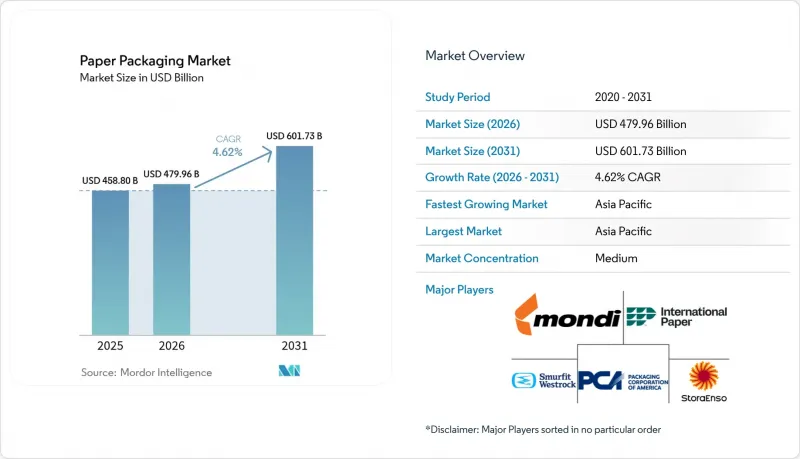
Mordor Intelligence에 의하면, 종이 포장 시장 규모는 2025년에 4,588억 달러로 평가되었고 2026년 4,799억 6,000만 달러에서 2031년까지 6,017억 3,000만 달러에 이를 것으로 예측되며, 예측 기간(2026-2031년) CAGR은 4.62%를 나타낼 전망입니다.
본 보고서는 등급(골판지 원지(고형 표백 황산 펄프 등) 및 컨테이너보드(화이트탑 크라프트 라이너 등)),제품(접이식 카톤, 골판지 상자 등), 최종 사용자 산업(식품, 음료, 헬스케어, 퍼스널케어, 가정용품 등), 포장 형태(경질, 반경질, 연질 등), 지역별로 분류되어 있습니다. 시장 예측은 금액(달러) 기준으로 제시되어 있습니다.
전 세계 종이 포장 시장 동향 및 인사이트
배리어 코팅이 적용된 판지 솔루션의 개발이 프리미엄 용도를 주도
바이오폴리머 및 나노셀룰로오스를 기반으로 한 첨단 수분·산소·유지 배리어 코팅을 통해 종이의 재활용성을 유지하면서 그 성능이 향상되고 있습니다. 실험실 테스트에 따르면, 나노셀룰로오스 피브리일 코팅은 코팅되지 않은 판지에 비해 산소 투과율을 90% 이상 감소시키고, 굽힘 내구성을 2배 향상시키는 것으로 나타났습니다. 미국 식품의약국(FDA)은 PFAS를 함유한 내유제가 식품 접촉 시장에서 철수했음을 확인했으며, 수요는 보다 안전한 화학 물질로 이동하고 있습니다. 유럽에서는 여러 가공업체들이 강력한 수증기 차단 성능을 갖추고 퇴비화 기준을 충족하는 붕산 가교 폴리(비닐 알코올) 코팅의 산업 생산을 급속도로 추진하고 있습니다. 브랜드 소유자들이 유통 기한을 저해하지 않으면서 플라스틱 대체재를 모색하는 가운데, 고품질 배리어 코팅이 적용된 판지는 즉석 식품, 냉동 식품 및 퍼스널케어 제품의 선물용 패키지에서 표준적인 선택지가 되어가고 있으며, 이는 종이 포장 시장의 가치 확대를 뒷받침하고 있습니다.
전자상거래로 인한 골판지 수요 급증으로 생산 우선순위가 재편되고 있습니다.
세계 온라인 소매는 오프라인 매장 채널을 능가하는 성장을 이어가고 있으며, 각 소포에는 자동 이송을 견딜 수 있는 보호 기능과 적층이 가능한 외부 포장이 필요합니다. 현재 전자상거래 발송량의 약 80%를 골판지 상자가 차지하고 있어, 라스트 마일 물류의 주축으로서의 역할을 확고히 하고 있습니다. 중국과 인도를 중심으로 한 아시아의 거대 시장에서는 2024년에 100억 개 단위의 소포가 증가할 전망이며, 이에 따라 골판지 공장 확장 및 온라인 쇼핑몰용 대량 생산에 특화된 고속 디지털 인쇄 라인 도입이 진행되고 있습니다. 생산 구성은 운송 비용을 절감하면서도 압축 강도를 유지할 수 있는 경량 플루트 형태로 전환되고 있으며, 통합형 제조업체들은 전자상거래 수요 증가에 대응하기 위해 그래픽 용지 등급보다 골판지 원지 생산량 확대를 우선시하고 있습니다. 이러한 수요 기반은 성숙 시장과 신흥 경제권 모두에서 종이 포장 시장의 꾸준한 생산량 증가를 뒷받침하고 있습니다.
산림 파괴에 대한 감시가 기존 공급망 구조에 과제를 안겨주고 있다.
EU의 산림 파괴 규제에 따라 수입업체는 2025년 말까지 모든 목재계 원자재에 대해 구획 수준의 추적 가능성을 증명해야 할 의무가 있습니다. EU 특수 등급 수입량의 60%를 차지하는 미국의 크라프트 펄프에는 제3자 기관에 의해 검증된 지리적 좌표의 기재가 필수화되었습니다. 위성 모니터링 및 CoC(생산 이력) 감사 실시로 인해 조달 비용 상승과 출하 지연의 위험이 발생합니다. 첨단 데이터 시스템을 갖추지 못한 중소 제지 공장은 인증받은 산림을 보유한 수직 통합형 대기업에 시장 점유율을 빼앗길 가능성이 있어, 종이 포장 시장 내의 경쟁 균형이 변화할 우려가 있습니다. 장기적으로는 원산지 관련 규제가 강화됨에 따라 수입 펄프에 의존하는 시장에서 공급이 부족해져, 해당 부문의 성장 가능성이 억제될 수 있습니다.
부문 분석
컨테이너보드는 잘 갖춰진 골판지 인프라와 전자상거래 배송에서 차지하는 핵심적인 역할에 힘입어, 2025년에는 종이 포장 시장에서 54.12%의 점유율을 차지했습니다. 한편, 카톤보드는 연평균 성장률(CAGR) 7.05%로 성장을 지속하고, 있으며, 이는 각 섬유 등급 중 가장 높은 성장률입니다. 식품 및 퍼스널케어 제품의 슬리브에 고급 제품이 침투하고 있는 추세를 반영하여, 카톤보드 용도의 종이 포장 시장 규모는 확대될 것으로 예측됩니다. 가공업체들은 유휴 상태인 그래픽 용지 제조 기계를 고체 표백 황산 펄프(SBS) 및 접이식 상자용 판지 생산에 적합한 코팅 헤드로 개조하여 설비 가동률을 높이고 있습니다. 접이식 상자용 판지는 고해상도 디지털 인쇄와의 호환성을 통해 매장 내 어필력을 높이고 있으며, 분산 차단 기능의 향상으로 냉장 식품 분야로의 진출도 가능해졌습니다. 동시에 컨테이너보드 제조업체들은 운송 중량을 줄이고 지속가능성 평가를 높이기 위해 경량 크라프트 라이너에 대한 투자를 추진하고 있습니다. 버진 펄프와 재생 펄프의 혼합은 강도 대 중량 비율을 최적화하고 컨테이너 보드의 경쟁력을 유지함으로써, 종이 포장 시장에서 양적 핵심으로서의 입지를 공고히 하고 있습니다.
골판지 판지의 성장 전망은 유럽 및 북미의 급속한 생산 능력 확장을 위한 자본을 유치하고 있으며, 2026년까지 신규 가동 분의 생산량은 100만 톤을 넘어설 전망입니다. 식품 접촉 적합 인증 및 의약품용 클린룸 준수 요건은 특히 고형 표백 등급에서 톤당 가치를 높이고 있습니다. EU 일부 국가에서 검은색 플라스틱이 규제에 의해 금지됨에 따라, 고급 과자 및 화장품 포장이 흰색 골판지로 전환되면서 수요를 더욱 끌어올리고 있습니다. 나노클레이와 같은 성능 향상 첨가제는 재활용성을 저해하지 않으면서 방습성을 발휘하여 플라스틱 필름에 대한 의존도를 낮춥니다. 소매 브랜드들이 품질과 지속가능성을 전달하는 단일 소재 포장을 추구하는 가운데, 골판지는 종이 포장 시장에서 가장 큰 수혜자로 부상하고 있습니다.
골판지 상자는 운송, 산업, 식료품 유통 채널에서 타의 추종을 불허하는 보호 강도와 다용도성을 갖추고 있어, 2025년에는 종이 포장 시장의 61.48%를 차지했습니다. 한편, 접이식 골판지 상자는 개인화된 그래픽, 신속한 대응이 요구되는 시즌 한정 캠페인, 소량 생산을 배경으로 연평균 성장률(CAGR) 5.12%로 확대되어 전체 시장 성장률을 상회할 것으로 예측됩니다. 다이 커터에 통합된 디지털 프린트 헤드는 설비 전환 시간을 단축하고, 고가의 재고를 보유하지 않고도 대량 맞춤화를 실현할 수 있는 길을 열어주고 있습니다. 고급 화장품, 영양 보조 식품, 식물성 식품 분야에서는 미적 유연성과 매장 진열에 적합한 형태로 인해 접이식 카톤이 선호되고 있습니다.
골판지 제조업체들은 브랜딩의 호소력을 유지하기 위해 내부 인쇄나 높은 발색 기능으로 대응하고 있지만, 접이식 골판지 상자는 질감 마감이나 엠보싱 가공 측면에서 여전히 우위를 점하고 있습니다. 가전 액세서리 분야에서는 플라스틱 재질의 클램쉘 패키지에서 성형 섬유 인서트를 결합한 보강 골판지 상자로의 전환이 진행되고 있으며, 이는 지속가능성을 중시하는 소비자들의 관심을 끌고 있습니다. 플렉서블 파우치에서 도입한 참신한 ‘티어 스트립(절취선)’을 통한 개봉 기능은 편의성을 한층 더 높이고 있습니다. 이러한 디자인과 기술의 발전이 종이 포장 시장 전체에서 꾸준한 시장 점유율 이동을 뒷받침하고 있습니다.
지역별 분석
아시아태평양은 2025년에 매출 점유율 47.62%로 종이 포장 시장을 주도하며, 2031년까지 연평균 성장률(CAGR) 5.51%를 나타낼 것으로 예측됩니다. 급속한 도시화, 중산층의 구매력 확대, 그리고 대규모 음식 배달 생태계가 남아시아 및 동남아시아의 섬유 수요 기반을 형성하고 있습니다. 이 지역의 기업들은 조림지와 자체 가공 시설을 결합한 비용 효율적인 통합 공장을 활용하여 수출 지향적인 고객에 대한 리드타임을 단축하고 있습니다. 지방 자치 단체는 에너지 효율이 높은 기계에 대한 관세 환급을 통해 지속 가능한 포장에 대한 투자를 장려하고 있으며, 이로 인해 생산 능력 확대가 더욱 가속화되고 있습니다.
북미는 여전히 혁신의 중심지로서, 디지털 인쇄의 보급을 주도하는 동시에 나노셀룰로오스의 시범적 상용화를 이끌고 있습니다. 일부 주에서 매립 규제가 강화됨에 따라 가정 쓰레기로 재활용 가능한 포장에 대한 수요가 증가하여, 국내 컨테이너보드 수요를 뒷받침하고 있습니다. 미국은 풍부한 침엽수 자원을 보유하고 있어, 수입된 폐지(OCC)와 혼합하기 위한 버진 펄프의 안정적인 공급이 확보되어 있습니다. 한편, 유럽에서는 엄격한 재활용 가능성 목표와 확대되는 생산자 책임 확대 제도(EPR)의 도입으로, 설비의 지속적인 갱신을 뒷받침하는 예측 가능한 정책 환경이 형성되고 있습니다. 독일과 스칸디나비아 국가의 제지 공장에서는 화석 연료 보일러에서 바이오매스 보일러로의 전환이 진행되고 있어, 에너지 가격의 급등에도 불구하고 Scope 1 배출량을 감축하고 비용 경쟁력을 높이고 있습니다.
라틴아메리카, 중동 및 아프리카는 현재 합계로 볼 때 미미한 점유율만을 차지하고 있지만, 두 지역 모두 세계 평균을 상회하는 성장률을 기록하고 있습니다. 브라질의 펄프 생산자들은 원자재 가격 변동 위험을 완화하기 위해 다운스트림 공정인 판지 제조로 사업을 통합하고 있습니다. 한편, 걸프협력회의(GCC) 회원국에서는 확대되는 전자상거래 거점에 대응하기 위해 골판지 생산 능력을 강화하고 있습니다. 아프리카에서는 수거 네트워크가 미비하여 재생 섬유 공급이 저해되고 있지만, 국제적인 개발 프로그램을 통해 시범적인 자원 회수 시설에 자금이 지원되면서 미래의 순환형 사회를 향한 기반이 마련되고 있습니다. 이러한 지역별 동향은 종이 포장 시장의 장기적인 회복력을 뒷받침하는 다양한 수요 기반을 강화하는 것입니다.
기타 혜택:
- 엑셀 형식 시장 예측(ME) 시트
- 3개월간의 애널리스트 지원
자주 묻는 질문
목차
제1장 서론
제2장 조사 방법
제3장 주요 요약
제4장 시장 구도
제5장 시장 규모와 성장 예측
제6장 경쟁 구도
제7장 시장 기회와 향후 전망
JHSAccording to Mordor Intelligence, the paper packaging market size was valued at USD 458.8 billion in 2025 and estimated to grow from USD 479.96 billion in 2026 to reach USD 601.73 billion by 2031, at a CAGR of 4.62% during the forecast period (2026-2031).
This report is Segmented by Grade (Cartonboard [Solid Bleached Sulphate, and More], and Containerboard [White-Top Kraftliner, and More]), Product (Folding Cartons, Corrugated Boxes, and More), End-User Industry (Food, Beverage, Healthcare, Personal Care, Household Care, and More), Packaging Format (Rigid, Semi-Rigid, Flexible, and More), and Geography. The Market Forecasts are Provided in Terms of Value (USD).
Global Paper Packaging Market Trends and Insights
Development of Barrier-Coated Paperboard Solutions Drive Premium Applications
Advanced water-, oxygen-, and grease-barrier coatings based on bio-polymers and nano-cellulose are elevating paper's performance while preserving its recyclability. Laboratory trials show that cellulose nanofibril coatings can reduce oxygen transmission by more than 90% and double folding endurance compared with uncoated board. The U.S. Food & Drug Administration confirmed that grease-proofing agents containing PFAS have exited the food-contact market, shifting demand toward safer chemistries. In Europe, several converters are fast-tracking industrial runs of boric-acid-cross-linked poly(vinyl alcohol) coatings that deliver robust water vapor protection and meet compostability standards. As brand owners pursue plastic replacement without compromising shelf life, premium barrier-coated board is becoming the default for ready-to-eat foods, frozen meals, and personal-care gift packs, boosting value growth in the paper packaging market.
E-Commerce Corrugated Demand Surge Reshapes Production Priorities
Global online retail continues to outperform brick-and-mortar channels, and each parcel requires protective, stackable outer packaging that can withstand automated handling. Corrugated cases now account for an estimated 80% of e-commerce shipments, cementing their role as the workhorse for last-mile logistics. Asian mega-markets led by China and India added double-digit billions of parcels in 2024, prompting box-plant expansions and high-speed digital print lines dedicated to web-shop volumes. The production mix is shifting toward lightweight fluting profiles that cut freight costs yet retain compression strength, and integrated producers are prioritizing incremental containerboard tonnage over graphic paper grades to keep pace with e-commerce pull-through. This demand foundation underpins steady volume growth for the paper packaging market in both mature and emerging economies.
Deforestation Scrutiny Challenges Traditional Supply-Chain Structures
The EU Deforestation Regulation obliges importers to demonstrate plot-level traceability for all wood-based inputs by the end of 2025. U.S. Kraft pulp, representing 60% of EU specialty-grade imports, must now carry geo-coordinates verified by third parties. Implementing satellite monitoring and chain-of-custody audits raises procurement costs and risks of shipment delays. Smaller mills lacking sophisticated data systems may cede share to vertically integrated majors with certified forests, altering competitive balances within the paper packaging market. Over time, tighter provenance rules could squeeze supply and curb the sector's growth potential in markets that rely on imported fiber.
Other drivers and restraints analyzed in the detailed report include:
- Brand-Owner Migration Toward Mono-Material Packaging Architectures
- Extended Producer Responsibility Mandates Accelerate Market Transformation
- Volatile Recycled-Fiber Pricing Creates Margin Compression Pressures
For complete list of drivers and restraints, kindly check the Table Of Contents.
Segment Analysis
Containerboard held a 54.12% paper packaging market share in 2025, supported by deep corrugated infrastructure and its central role in e-commerce shipping. Meanwhile, cartonboard is registering a 7.05% CAGR, the fastest among fiber grades. The paper packaging market size for cartonboard applications is projected to rise, reflecting premium penetration in food and personal-care sleeves. Converters are refitting idle graphic-paper machines with coating heads suited to Solid Bleached Sulfate and Folding Boxboard production, improving asset utilization. Folding Boxboard's compatibility with high-definition digital print elevates shelf appeal, while dispersion-barrier upgrades enable chilled-food entry. At the same time, containerboard producers are investing in lightweight kraftliner to cut shipping mass, enhancing sustainability credentials. Virgin-recycled blends optimize strength-to-weight ratios and keep containerboard competitive, ensuring it remains the volume backbone of the paper packaging market.
Cartonboard's growth profile attracts capital for rapid European and North American capacity expansions, with start-ups exceeding 1 million tons by 2026. Food-contact certification and pharmaceutical clean-room compliance boost value per ton, particularly for solid-bleached grades. Regulatory bans on black plastics in several EU countries redirect premium confectionery and cosmetic packs to white cartonboard formats, lifting demand further. Performance-enhancing additives such as nano-clays deliver moisture barriers without compromising recyclability, reducing reliance on plastic films. As retail brands demand mono-material packs that convey quality and sustainability, cartonboard emerges as the prime beneficiary within the paper packaging market.
Corrugated boxes occupied 61.48% of the paper packaging market in 2025 owing to their unmatched protective strength and versatility across shipping, industrial, and grocery channels. Folding cartons, however, are forecast to outpace overall growth, expanding at a 5.12% CAGR on the back of personalized graphics, quick-response seasonal campaigns, and smaller lot sizes. Digital printheads integrated into die-cutters reduce changeover times, paving the way for mass-customization without costly inventories. Premium beauty, nutraceuticals, and plant-based foods all favor folding cartons for their aesthetic flexibility and shelf-ready formats.
Corrugated producers respond with inside-print and high-color capabilities to keep hold of branding real estate, but folding cartons maintain an edge in tactile finishes and embossing. Consumer-electronics accessories increasingly shift from plastic clamshells to reinforced cartons married with molded-fiber inserts, capturing sustainability-minded shoppers. Novel tear-strip opening features borrowed from flexible pouches further boost convenience. These design and technology advances underpin steady share migration within the broader paper packaging market.
Complete Report Scope:
- By Grade
- Cartonboard
- Solid Bleached Sulphate (SBS)
- Solid Unbleached Sulphate (SUS)
- Folding Boxboard (FBB)
- Coated Recycled Board (CRB)
- Uncoated Recycled Board (URB)
- Other Cartonboard Grades
- Containerboard
- White-top Kraftliner
- Other Kraftliners
- White-top Testliner
- Other Testliners
- Semi-chemical Fluting
- Recycled Fluting
- Cartonboard
- By Product
- Folding Cartons
- Corrugated Boxes
- Other Products
- By End-User Industry
- Food
- Beverage
- Healthcare
- Personal Care
- Household Care
- Electrical and Electronics
- Other End-User Industries
- By Packaging Format
- Rigid (Corrugated, Solid Board)
- Semi-rigid (Folding Cartons)
- Flexible Paper (Sachets, Wraps)
- Molded Fibre and Pulp
- By Geography
- North America
- United States
- Canada
- Mexico
- South America
- Brazil
- Argentina
- Rest of South America
- Europe
- United Kingdom
- Germany
- France
- Italy
- Spain
- Russia
- Rest of Europe
- Asia Pacific
- China
- Japan
- India
- South Korea
- Australia
- Rest of Asia Pacific
- Middle East and Africa
- Middle East
- United Arab Emirates
- Saudi Arabia
- Turkey
- Rest of Middle East
- Africa
- South Africa
- Nigeria
- Rest of Africa
- Middle East
- North America
Geography Analysis
Asia-Pacific led the paper packaging market with a 47.62% revenue share in 2025 and is projected to record a 5.51% CAGR to 2031. Rapid urbanization, expanding middle-class purchasing power, and large-scale food-delivery ecosystems underpin fiber demand in South and Southeast Asia. Regional players leverage cost-efficient integrated mills that pair plantation forests with in-house converting, shortening lead times for export-oriented customers. Local governments incentivize sustainable-pack investments through duty rebates on energy-efficient machinery, further accelerating capacity additions.
North America remains an innovation nucleus, driving digital-print adoption and spearheading nano-cellulose pilot commercialization. Tightening landfill legislation in several states spurs demand for curbside-recyclable packs, bolstering domestic containerboard offtake. The United States also benefits from abundant softwood resources, ensuring steady virgin-fiber availability to blend with imported OCC. Meanwhile, Europe's stringent recyclability targets and EPR rollouts create a predictable policy environment that favors continuous equipment upgrades. German and Scandinavian mills transition from fossil to biomass boilers, reducing Scope 1 emissions and sharpening cost competitiveness despite high energy prices.
Latin America and the Middle East and Africa collectively hold modest shares today, yet both regions register above-global average growth. Brazilian pulp producers integrate downstream into cartonboard to mitigate commodity cycles, while Gulf Cooperation Council economies add corrugated capacity to serve expanding e-commerce hubs. Africa's underdeveloped collection network hinders recycled-fiber supply, but international development programs are funding pilot materials-recovery facilities, laying groundwork for future circularity. Collectively, these regional trajectories reinforce the diversified demand base that supports the long-term resilience of the paper packaging market.
- International Paper Company
- Smurfit Westrock plc
- Mondi plc
- Packaging Corporation of America
- Stora Enso Oyj
- Graphic Packaging International, LLC
- Nippon Paper Industries Co. Ltd.
- Sonoco Products Company
- Oji Holdings Corporation
- Georgia-Pacific LLC
- Nine Dragons Paper Holdings
- Lee & Man Paper Manufacturing
- Sappi Limited
- Ilim Group
- Klabin S.A.
- Asia Pulp & Paper (APP)
Additional Benefits:
- The market estimate (ME) sheet in Excel format
- 3 months of analyst support
TABLE OF CONTENTS
1 INTRODUCTION
- 1.1 Study Assumptions and Market Definition
- 1.2 Scope of the Study
2 RESEARCH METHODOLOGY
3 EXECUTIVE SUMMARY
4 MARKET LANDSCAPE
- 4.1 Market Overview
- 4.2 Market Drivers
- 4.2.1 Development of barrier-coated paperboard solutions
- 4.2.2 Rise in e-commerce corrugated demand
- 4.2.3 Brand-owner shift toward mono-material packs
- 4.2.4 Extended Producer Responsibility (EPR) mandates
- 4.2.5 Nano-cellulose barrier breakthroughs
- 4.2.6 Converting-plant on-site digital printing economics
- 4.3 Market Restraints
- 4.3.1 Deforestation and fibre-supply scrutiny
- 4.3.2 Volatile recycled-fibre pricing
- 4.3.3 PFAS "forever-chemicals" phase-out costs
- 4.3.4 Limited recovery logistics in emerging markets
- 4.4 Industry Value Chain Analysis
- 4.5 Regulatory Landscape
- 4.6 Technological Outlook
- 4.7 Porter's Five Forces Analysis
- 4.7.1 Bargaining Power of Suppliers
- 4.7.2 Bargaining Power of Buyers
- 4.7.3 Threat of New Entrants
- 4.7.4 Threat of Substitutes
- 4.7.5 Intensity of Competitive Rivalry
- 4.8 Global Recovered Paper Production Statistics
- 4.8.1 Recovered Paper - Production Quantity
- 4.8.2 Recovered Paper - Import Value and Quantity
- 4.8.3 Recovered Paper - Export Value and Quantity
- 4.8.4 Recovered Paper Production - Leading Countries
- 4.9 Cartonboard EXIM Scenario
- 4.9.1 Exports (Value and Volume)
- 4.9.2 Imports (Value and Volume)
5 MARKET SIZE AND GROWTH FORECASTS (VALUE)
- 5.1 By Grade
- 5.1.1 Cartonboard
- 5.1.1.1 Solid Bleached Sulphate (SBS)
- 5.1.1.2 Solid Unbleached Sulphate (SUS)
- 5.1.1.3 Folding Boxboard (FBB)
- 5.1.1.4 Coated Recycled Board (CRB)
- 5.1.1.5 Uncoated Recycled Board (URB)
- 5.1.1.6 Other Cartonboard Grades
- 5.1.2 Containerboard
- 5.1.2.1 White-top Kraftliner
- 5.1.2.2 Other Kraftliners
- 5.1.2.3 White-top Testliner
- 5.1.2.4 Other Testliners
- 5.1.2.5 Semi-chemical Fluting
- 5.1.2.6 Recycled Fluting
- 5.1.1 Cartonboard
- 5.2 By Product
- 5.2.1 Folding Cartons
- 5.2.2 Corrugated Boxes
- 5.2.3 Other Products
- 5.3 By End-User Industry
- 5.3.1 Food
- 5.3.2 Beverage
- 5.3.3 Healthcare
- 5.3.4 Personal Care
- 5.3.5 Household Care
- 5.3.6 Electrical and Electronics
- 5.3.7 Other End-User Industries
- 5.4 By Packaging Format
- 5.4.1 Rigid (Corrugated, Solid Board)
- 5.4.2 Semi-rigid (Folding Cartons)
- 5.4.3 Flexible Paper (Sachets, Wraps)
- 5.4.4 Molded Fibre and Pulp
- 5.5 By Geography
- 5.5.1 North America
- 5.5.1.1 United States
- 5.5.1.2 Canada
- 5.5.1.3 Mexico
- 5.5.2 South America
- 5.5.2.1 Brazil
- 5.5.2.2 Argentina
- 5.5.2.3 Rest of South America
- 5.5.3 Europe
- 5.5.3.1 United Kingdom
- 5.5.3.2 Germany
- 5.5.3.3 France
- 5.5.3.4 Italy
- 5.5.3.5 Spain
- 5.5.3.6 Russia
- 5.5.3.7 Rest of Europe
- 5.5.4 Asia Pacific
- 5.5.4.1 China
- 5.5.4.2 Japan
- 5.5.4.3 India
- 5.5.4.4 South Korea
- 5.5.4.5 Australia
- 5.5.4.6 Rest of Asia Pacific
- 5.5.5 Middle East and Africa
- 5.5.5.1 Middle East
- 5.5.5.1.1 United Arab Emirates
- 5.5.5.1.2 Saudi Arabia
- 5.5.5.1.3 Turkey
- 5.5.5.1.4 Rest of Middle East
- 5.5.5.2 Africa
- 5.5.5.2.1 South Africa
- 5.5.5.2.2 Nigeria
- 5.5.5.2.3 Rest of Africa
- 5.5.5.1 Middle East
- 5.5.1 North America
6 COMPETITIVE LANDSCAPE
- 6.1 Market Concentration
- 6.2 Strategic Moves
- 6.3 Market Share Analysis
- 6.4 Company Profiles (includes Global level Overview, Market level overview, Core Segments, Financials as available, Strategic Information, Market Rank/Share, Products and Services, Recent Developments)
- 6.4.1 International Paper Company
- 6.4.2 Smurfit Westrock plc
- 6.4.3 Mondi plc
- 6.4.4 Packaging Corporation of America
- 6.4.5 Stora Enso Oyj
- 6.4.6 Graphic Packaging International, LLC
- 6.4.7 Nippon Paper Industries Co. Ltd.
- 6.4.8 Sonoco Products Company
- 6.4.9 Oji Holdings Corporation
- 6.4.10 Georgia-Pacific LLC
- 6.4.11 Nine Dragons Paper Holdings
- 6.4.12 Lee & Man Paper Manufacturing
- 6.4.13 Sappi Limited
- 6.4.14 Ilim Group
- 6.4.15 Klabin S.A.
- 6.4.16 Asia Pulp & Paper (APP)
7 MARKET OPPORTUNITIES AND FUTURE OUTLOOK
- 7.1 White-space and Unmet-Need Assessment