
|
시장보고서
상품코드
2121994
자동 창고 시스템(ASRS) : 시장 점유율 분석, 업계 동향과 통계, 성장 예측(2026-2031년)Automated Storage And Retrieval System (ASRS) - Market Share Analysis, Industry Trends & Statistics, Growth Forecasts (2026 - 2031) |
||||||
 Mordor Intelligence
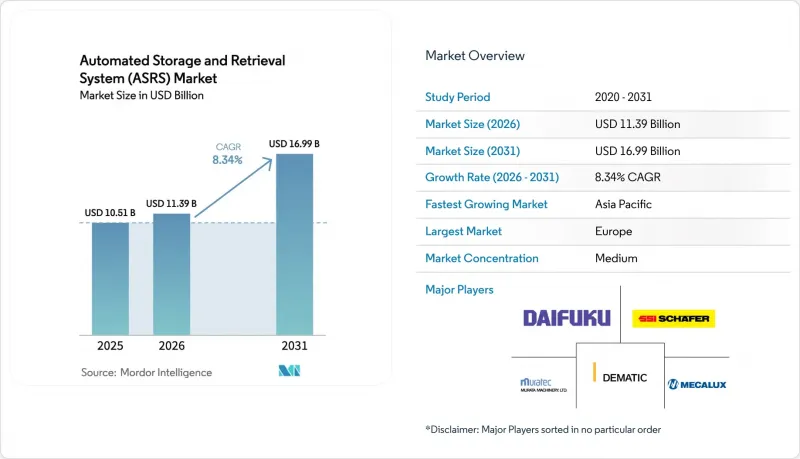
Mordor Intelligence에 따르면 자동 창고 시스템(ASRS) 시장 규모는 2025년에 105억 1,000만 달러로 평가되며, 2026년 113억 9,000만 달러에서 2031년까지 169억 9,000만 달러에 달할 것으로 예측되고 있으며, 예측 기간(2026-2031년)에 CAGR은 8.34%에 달할 전망입니다.
이 보고서에서는 업계를 제품 유형(고정 통로식 크레인 시스템, 셔틀식 시스템, 수직 리프트 모듈(VLM) 등), 적재 유형(유닛 로드, 팔레트 로드 셔틀, 미니 로드, 미드 로드, 토트/카톤 등), 용도(보관·버퍼링,Goods-To-Person 방식의 주문 피킹, 키팅 및 시퀀싱 등), 최종사용자 산업(제조업 및 비제조업), 그리고 지역별로 분류하고 있습니다.
전 세계 자동 창고 시스템(ASRS) 시장의 동향 및 인사이트
E-Commerce 주문 처리(fulfillment)의 압박
2025년 중반까지 아마존이 100만 대의 로봇을 도입한 것은 시간당 300건에 육박하는 주문량에 대해 수작업 피킹만으로는 감당할 수 없음을 여실히 보여주는 사례가 되었습니다. 이에 반해, 동종 업계의 소매 기업은 주문 처리 시간을 몇 시간에서 몇 분으로 단축하는 ‘큐브’ 및 ‘셔틀’ 프로젝트를 급속도로 추진하며 자동 창고 시스템(ASRS) 시장의 수주를 가속화했습니다. 의류 및 전자제품의 반품률 상승으로 인해 정확성에 대한 관심이 높아졌습니다. AI를 탑재한 그리퍼는 현재 99%를 넘는 품목 인식 정확도를 달성하여, 비용이 많이 드는 재발송을 줄이고 있습니다. 또한 풀필먼트 사업자는 로봇 도입을 통해 지게차 이동 및 조명의 필요성을 줄임으로써, 주문당 에너지 비용을 8% 절감할 수 있는 것으로 밝혀졌습니다.
인건비 급등과 안전 규제 강화
2024년 창고내 사망 사고의 대부분은 지게차로 인한 것이었으며, 미국에서 매주 8,400만 달러의 상해 배상 청구가 발생했습니다. 2025년에 발효된 OSHA(미국 직업안전보건청)의 새로운 지침에 따라 고용주의 책임 범위가 변경됨에 따라 인파가 붐비는 통로에서 작업자를 배제하는 ‘상품에서 사람으로(Goods-to-Person)’ 방식의 셀로의 전환이 가속화되었습니다. 2028년까지 기술자가 20% 부족할 것으로 예상되는 자동차 정비 공장에서는 미니 로드 시스템을 도입하여 부족한 인력을 상품 출고 작업에서 진단 업무로 재배치했습니다. 이러한 동향들이 맞물려 중기적으로는 자동 창고 시스템(ASRS) 시장의 성장률을 2퍼센트 포인트 이상 끌어올릴 전망입니다.
높은 초기 설비 투자(CAPEX)와 긴 회수 기간
7만 달러에서 300만 달러에 달하는 턴키 프로젝트는 비용 절감 가능성이 입증되었음에도 불구하고 많은 소규모 유통업체에게는 장벽이 되어 왔습니다. TCO(총 소유 비용) 모델에 따르면 소프트웨어, 시운전 및 교육 비용이 정가에 40%가량 추가로 부과되는 경우가 많으며, 거시경제의 불확실성이 높아지는 시기에는 투자 회수 기간이 CFO가 허용할 수 있는 범위를 초과하게 된다는 사실이 밝혀졌습니다. 구독형 ‘피킹 건당 과금’ 모델을 통해 초기 비용 부담이 줄어들기 시작했으나, 현재로서는 특정 대량 사용 사례로 한정되어 있습니다.
부문 분석
2025년에도 고정 통로식 크레인 설비는 여전히 전 세계 매출의 37.65%를 차지하고 있으며, 그 기반은 예측 가능한 물류 흐름으로 인해 고층 랙 구조의 도입이 정당화되는 자동차 및 대량 소비재 제조 공장에 있습니다. 이러한 설비는 역사적으로 자동 창고 시스템(ASRS) 시장의 설계 템플릿을 확립해 왔지만, 사용자를 특정 통로 폭이나 처리 능력의 상한선에 묶어두게 됩니다. 큐브 기반 그리드 및 로봇식 보관 라인은 보관 밀도를 60% 향상시키고 출고 시간을 70초 미만으로 단축함으로써 성장세를 가속화하며 연평균 성장률(CAGR) 11.92%를 견인하고 있으며, 10년이 끝나기 전에 매출 구성이 변화할 것으로 전망됩니다. AutoStore 및 DSV와 같은 주요 3PL 기업은 9개국에서 큐브형 시스템 도입을 확대하며, 그 다목적 적응성을 부각시키고 있습니다. 셔틀 기반 시스템은 중간 위치를 차지하고 있으며, 모듈식 셔틀 레인을 통해 기업은 대규모 건물 개조 없이도 단계적으로 확장할 수 있습니다. 이러한 유연성은 자동 창고 시스템(ASRS) 시장에 대한 투자를 연간 수요 변동에 맞춰 조정하고자 하는 급성장 중인 소매업체에게 매력적입니다.
수직 리프트 모듈(VLM) 및 캐러셀 솔루션은 매출 점유율이 10% 미만으로 여전히 틈새 시장으로 남아 있지만, 바닥 면적이 제한적이고 부품의 무결성이 최우선으로 요구되는 상황에서는 중요한 가치를 제공합니다. 예를 들어 의료기기 조립 제조업체에서는 VLM을 사용하여 미세한 기계 부품을 오염으로부터 보호하면서 99.9% 이상의 피킹 정확도를 달성하고 있습니다. 하이브리드형 시설에서는 크레인, 셔틀, 큐브를 조합하는 사례가 증가하고 있으며, 이러한 아키텍처는 자동 창고 시스템(ASRS) 시장이 단일 기술에 대한 의존에서 벗어나 맞춤형 생태계로 진화했음을 여실히 보여줍니다. Kardex와 Berkshire Grey의 제휴를 통해 VLM 라인에 AI 비전 피킹 셀이 통합되어 99.99%의 정확도를 달성했을 뿐만 아니라, 현대 창고 설계를 형성하는 기술 간의 상호 융합이라는 추세를 더욱 공고히 했습니다.
유닛 로드·팔레트 시스템은 자동차용 하위 어셈블리, 음료 팔레타이징, 그리고 각 보관 장소에 동종 품목이 보관되는 기타 벌크 흐름을 기반으로 하여 2025년 매출의 41.92%를 차지했습니다. 그러나 E-Commerce에서 SKU가 폭발적으로 증가함에 따라 유닛 로드 크레인으로는 비용 효율적에 대응할 수 없는 토트 단위 출고 수요가 발생하여, 연평균 성장률(CAGR) 11.08%로 성장하는 미니 로드 시스템에 대한 수요가 확대되고 있습니다. 미니로드 토트 솔루션을 위한 자동 창고 시스템(ASRS) 시장 규모는 한 바구니당 온라인 주문 품목이 평균 35개에 달하는 옴니채널 식료품 분야에서 더욱 빠르게 확대될 것으로 예측됩니다. 하나의 미니로드 통로에서 시간당 최대 1,200회의 토트 사이클을 처리할 수 있으므로, 동일한 설치 면적 내에서 매장 보충 및 클릭 앤 콜렉트(Click & Collect) 주문 이동을 가능하게 합니다.
팔레트 셔틀 서브시스템은 높은 처리량의 팔레트 보관과 선택적 접근 요구 사항을 결합하여, 밀도와 속도의 균형을 맞출 수 있도록 구성 가능한 깊이를 실현합니다. 미드로드 용도는 표면적인 수치상 규모가 작고, 전자기기나 자동차 애프터마켓 부품과 같이 취급하기 까다로운 중형 부품을 다루는 것으로, 프로젝트 범위 설정시 간과되기 쉽지만 엔드투엔드 흐름에서 매우 중요한 기능을 수행합니다. 운영자들은 통합된 소프트웨어 플랫폼 내에서 화물 유형을 통합하는 경향이 강해지고 있으며, 이를 통해 WMS는 고정되고 사일로화된 구역이 아닌 이동별 실시간 비용을 기반으로 피킹을 지시할 수 있게 되어, 자동 창고 시스템(ASRS) 시장의 미묘한 성숙도를 보여주고 있습니다.
지역별 분석
유럽은 2025년 전 세계 매출의 33.42%를 차지하며 지역별 최대 점유율을 유지했습니다. 시간당 28달러를 초과하는 높은 인건비와 엄격한 산업안전법 규제로 인해 자동화는 경제적으로 매력적인 선택지가 되었습니다. 또한 EU의 지속가능성 관련 규정에서는 고밀도 큐브 그리드가 건물의 에너지 발자국을 줄이는 수단으로 인정되었습니다. 독일의 ‘하이테크 전략 2025’에서는 로봇 공학 연구개발에 3억 6,920만 달러를 배정하여 솔루션 제공업체를 육성하는 상업적 생태계를 강화했습니다. 스칸디나비아의 한 소매업체는 기존 6곳의 창고를 하나의 자동화 시설로 통합하여, 배송 건당 CO₂ 배출량을 35% 감축했습니다.
아시아태평양은 연평균 성장률(CAGR) 11.67%를 기록하며 가장 빠른 성장을 이루었습니다. 중국에서는 1조 위안 규모의 로봇 공학 메가 프로젝트가 공장 자동화에 대한 국가 차원의 노력을 보여주는 한편, 일본에서는 오사카와 도쿄를 연결하는 총 길이 500킬로미터의 컨베이어 벨트 네트워크가 제안되어, 높은 처리량을 자랑하는 분류 거점에 대한 수요가 발생했습니다. 한국에서는 스마트 공장 도입에 대해 1억 2,800만 달러의 보조금이 정책 인센티브로 추가되었으며, 인도에서는 다이후쿠가 2025년에 공장을 개설함에 따라 지역 고객에 대한 리드타임이 단축되어, 인도는 생산 거점이 되었습니다. 따라서 아시아태평양의 자동 창고 시스템(ASRS) 시장은 내수와 현지 생산 능력 모두의 혜택을 받고 있습니다.
북미는 여전히 혁신의 중심지이며, 세계의 벤치마크가 되는 하이퍼스케일 E-Commerce의 실증장이 되고 있습니다. 아마존은 AI 기반 모델을 도입하여 군집 로봇(스웜 로봇)의 경로를 재설정함으로써 에너지 효율을 향상시키는 동시에 시간당 피킹 수를 늘렸습니다. 이는 동종 업계 경쟁사들이 채택하는 설계 사양에 직접적인 영향을 미치고 있습니다. 뉴햄프셔주에 위치한 오토스토어의 새 본사에는 기술자를 양성하는 아카데미가 병설되어 있으며, 기술 격차라는 제약에 대처하는 동시에 2026년 말까지 해당 지역내 도입 건수가 300건을 넘어설 것이라는 회사의 전망을 지원하고 있습니다. 라틴아메리카, 중동 및 아프리카는 신흥 성장 지역으로 부상하고 있습니다. 사우디아라비아의 의약품 도매업체는 2024년에 반자동 주문 처리 시범 운영을 시작했으며, 브라질의 3PL 기업은 자본재에 대한 세제 혜택의 혜택을 받고 있으며, 이 두 지역은 향후 5년 동안 성장 여지가 큰 시장으로 평가받고 있습니다.
기타 혜택:
- 엑셀 형식의 시장 예측(ME) 시트
- 3개월간의 애널리스트 지원
목차
제1장 서론
제2장 조사 방법
제3장 개요
제4장 시장 구도
제5장 시장 세분화
제6장 경쟁 구도
제7장 시장 기회와 향후 전망
KSAAccording to Mordor Intelligence, the automated storage and retrieval system market size was valued at USD 10.51 billion in 2025 and estimated to grow from USD 11.39 billion in 2026 to reach USD 16.99 billion by 2031, at a CAGR of 8.34% during the forecast period (2026-2031).
This report Segments the Industry Into by Product Type (Fixed-Aisle Crane Systems, Shuttle-Based Systems, Vertical Lift Modules (VLM), and More), Load Type (Unit Load, Pallet Load Shuttle, Mini Load, Mid Load, and Tote / Carton and Others), Application (Storage and Buffering, Goods-To-Person Order Picking, Kitting and Sequencing, and More), End-User Industry (Manufacturing, and Non-Manufacturing), and Geography.
Global Automated Storage And Retrieval System (ASRS) Market Trends and Insights
E-commerce fulfillment pressure
By mid-2025, Amazon's deployment of 1 million robots served as visible proof that manual picking cannot sustain order profiles approaching 300 lines per hour. Peer retailers responded by fast-tracking cube and shuttle projects that shrink order cycle times from hours to minutes, driving accelerated bookings for the automated storage and retrieval system market. Higher return rates in apparel and electronics sharpened the focus on accuracy; AI-enhanced grippers now achieve item recognition accuracy above 99%, cutting costly reships. Fulfillment operators also discovered that robotics lowered energy cost per order by 8% by limiting forklift movements and lighting requirements.
Rising labor costs and safety mandates
Forklift incidents accounted for most fatal warehouse accidents in 2024, costing USD 84 million in weekly injury claims across the United States. New OSHA guidelines issued in 2025 shifted employer liability, prompting accelerated conversion to goods-to-person cells that remove humans from high-traffic aisles. Automotive maintenance depots suffering a projected 20% technician shortfall by 2028 adopted mini-load systems to reassign scarce labor from retrieval to diagnostic roles. Collectively, these dynamics add more than two percentage points to automated storage and retrieval system market growth over the mid-term.
High initial CAPEX and extended payback periods
Turnkey projects ranging from USD 70,000 to USD 3 million deterred many small distributors despite demonstrable cost-out potential. TCO models reveal software, commissioning, and training often add another 40% to sticker price, stretching payback beyond CFO comfort zones during periods of macro uncertainty. Subscription-based "pay-per-pick" models started to mitigate upfront expense, though current availability is limited to select high-volume use cases.
Other drivers and restraints analyzed in the detailed report include:
- Shift toward micro-fulfillment centers
- Deep-freeze warehouse automation
- Cyber-security vulnerabilities threaten connected ASRS operations
For complete list of drivers and restraints, kindly check the Table Of Contents.
Segment Analysis
Fixed-aisle crane installations still delivered 37.65% of global revenue in 2025, anchored in automotive and bulk consumer-goods plants where predictable flows justify tall rack structures. These installations historically set the design template for the automated storage and retrieval system market, yet they lock users into specific aisle widths and throughput ceilings. Cube-based grids and robotic storage lines gained momentum by raising storage density 60% and slashing retrieval times to under 70 seconds, driving a 11.92% CAGR that will shift the revenue mix before decade-end. AutoStore and populous 3PLs such as DSV scaled cube deployments across nine countries, underscoring multipurpose adaptability. Shuttle-based systems occupy a middle ground; modular shuttle lanes allow firms to expand incrementally without major building retrofits. That flexibility appeals to fast-growing retailers who want automated storage and retrieval system market investments aligned with year-to-year demand swings.
Vertical lift modules (VLMs) and carousel solutions remain niche at under 10% revenue share, yet they add critical value where floor area is scarce and parts integrity is paramount. Medical-device assemblers, for example, use VLMs to protect micro-mechanical parts from contamination while achieving pick accuracies above 99.9%. Hybrid facilities increasingly mix cranes, shuttles, and cubes, an architecture that exemplifies how the automated storage and retrieval system market evolved toward tailored ecosystems rather than single-technology bets. Kardex's collaboration with Berkshire Grey incorporated AI vision pick cells into VLM lines, attaining 99.99% accuracy and reinforcing the cross-pollination trend shaping modern warehouse design.
Unit-load pallet systems captured 41.92% of 2025 revenue, powered by automotive subassemblies, beverage palletizing, and other bulk flows where each storage location houses homogenous items. Yet the SKU explosion in e-commerce drove tote-level retrieval rates that unit-load cranes cannot satisfy cost-effectively, opening demand for mini-load systems advancing at 11.08% CAGR. The automated storage and retrieval system market size for mini-load tote solutions is projected to expand even faster in omnichannel grocery, where online order lines per basket average 35. A single mini-load aisle can process up to 1,200 tote cycles per hour, enabling store replenishment and click-and-collect fulfillment from one footprint.
Pallet shuttle subsystems bridge high-throughput pallet storage with selective access demands, permitting configurable depth that balances density and speed. Mid-load applications, though smaller in headline numbers, handle awkward medium-sized components in electronics and aftermarket auto parts, functions often overlooked in project scoping yet critical to end-to-end flow. Operators increasingly blend load types inside unified software platforms so that WMS directs picks based on real-time cost per move, rather than rigid siloed zones, signaling a nuanced maturity within the automated storage and retrieval system market.
Complete Report Scope:
- By Product Type
- Fixed-Aisle Crane Systems
- Shuttle-Based Systems
- Vertical Lift Modules (VLM)
- Carousel Modules (Vertical and Horizontal)
- Cube-Based / Robotic Cube Storage
- By Load Type
- Unit Load
- Pallet Load Shuttle
- Mini Load
- Mid Load
- Tote / Carton and Others
- By Application
- Storage and Buffering
- Goods-to-Person Order Picking
- Kitting and Sequencing
- Assembly / Production Support
- Cold-Storage and Deep-Freeze Handling
- By End-user Industry
- Manufacturing
- Automotive
- Food and Beverages
- Pharmaceuticals and Life Sciences
- Electronics and Semiconductor
- Metals and Machinery
- Non-manufacturing
- E-commerce and Retail
- Third-Party Logistics (3PL) and Warehousing
- Airports and Baggage Handling
- Defense and Government Stores
- Manufacturing
- By Geography
- North America
- United States
- Canada
- Mexico
- South America
- Brazil
- Argentina
- Rest of South America
- Europe
- Germany
- United Kingdom
- France
- Italy
- Russia
- Rest of Europe
- Asia-Pacific
- China
- Japan
- South Korea
- India
- ASEAN
- Rest of Asia-Pacific
- Middle East and Africa
- Middle East
- Saudi Arabia
- United Arab Emirates
- Turkey
- Rest of Middle East
- Africa
- South Africa
- Nigeria
- Rest of Africa
- Middle East
- North America
Geography Analysis
Europe retained the largest regional contribution at 33.42% of 2025 global revenue. High labor costs exceeding USD 28 per hour and stringent worker-safety legislation made automation financially compelling, while EU sustainability rules recognized high-density cube grids as a path to lower building energy footprint. Germany's High-Tech Strategy 2025 earmarked USD 369.2 million for robotics R&D, reinforcing commercial ecosystems that nurture solution providers. Scandinavian retailers compressed six conventional warehouses into a single automated facility and cut CO2 per shipped order by 35%.
Asia-Pacific delivered the fastest growth at 11.67% CAGR. China's trillion-yuan robotics megaproject signaled state-level commitment to factory automation, while Japan proposed a 500-kilometer conveyor belt network linking Osaka and Tokyo, creating demand for high-throughput sortation nodes. Korean policy incentives added USD 128 million in grants for smart-factory deployments, and India became a production hub following Daifuku's 2025 plant opening that lowers lead times for regional customers. The automated storage and retrieval system market in Asia-Pacific therefore benefits from both domestic demand and localized manufacturing capacity.
North America remains innovation center, with hyperscale e-commerce proving grounds that set global benchmarks. Amazon introduced AI foundation models to re-route swarm robots, improving energy efficiency while increasing picks per hour, which directly influences design specifications adopted by peers. AutoStore's new headquarters in New Hampshire houses an academy that trains technicians, addressing the skill-gap restraint and underscoring the company's forecast to surpass 300 regional installations by late-2026. Latin America and Middle East and Africa are emerging corridors; Saudi pharmaceutical distributors piloted semi-automated fulfillment in 2024, and Brazilian 3PLs benefitted from tax breaks on capital goods, positioning both regions as growth white space over the next five years.
- Daifuku Co., Ltd.
- Schaefer Systems International GmbH (SSI SCHAEFER)
- Dematic Corp. (KION Group AG)
- Murata Machinery, Ltd.
- Mecalux, S.A.
- Honeywell Intelligrated, Inc.
- KUKA AG
- KNAPP AG
- Kardex Holding AG
- Toyota Industries Corporation
- Viastore Systems GmbH
- AutoStore Holdings Ltd.
- Swisslog Holding AG
- Vanderlande Industries B.V.
- Bastian Solutions LLC
- System Logistics S.p.A.
- Hanel Storage Systems
- Modula S.p.A.
- TGW Logistics Group GmbH
- BEUMER Group GmbH & Co. KG
- Stocklin Logistik AG
- Godrej Korber Supply Chain Ltd.
- Westfalia Technologies, Inc.
- Shanghai Jingxing Logistics Equipment Engineering Co., Ltd.
- Unitechnik Systems GmbH
Additional Benefits:
- The market estimate (ME) sheet in Excel format
- 3 months of analyst support
TABLE OF CONTENTS
1 INTRODUCTION
- 1.1 Study Assumptions and Market Definition
- 1.2 Scope of the Study
2 RESEARCH METHODOLOGY
3 EXECUTIVE SUMMARY
4 MARKET LANDSCAPE
- 4.1 Market Overview
- 4.2 Market Drivers
- 4.2.1 E-commerce fulfillment pressure
- 4.2.2 Rising labor-cost and workplace-safety mandates
- 4.2.3 Shift toward micro-fulfillment / urban DCs (under-the-radar)
- 4.2.4 Deep-freeze warehouse automation for cold-chain (under-the-radar)
- 4.2.5 Predictive-maintenance analytics boosting ROI (under-the-radar)
- 4.2.6 Industrial-policy incentives in APAC and Europe
- 4.3 Market Restraints
- 4.3.1 High initial CAPEX and long pay-back
- 4.3.2 Scarcity of ASRS-skilled technicians
- 4.3.3 Integration complexity with legacy WMS
- 4.3.4 Cyber-security vulnerabilities in connected ASRS (under-the-radar)
- 4.4 Evaluation of Critical Regulatory Framework
- 4.5 Value Chain Analysis
- 4.6 Technological Outlook
- 4.7 Porter's Five Forces
- 4.7.1 Bargaining Power of Suppliers
- 4.7.2 Bargaining Power of Buyers
- 4.7.3 Threat of New Entrants
- 4.7.4 Threat of Substitutes
- 4.7.5 Competitive Rivalry
- 4.8 Impact Assessment of Key Stakeholders
- 4.9 Key Use Cases and Case Studies
- 4.10 Impact on Macroeconomic Factors of the Market
- 4.11 Investment Analysis
5 MARKET SEGMENTATION
- 5.1 By Product Type
- 5.1.1 Fixed-Aisle Crane Systems
- 5.1.2 Shuttle-Based Systems
- 5.1.3 Vertical Lift Modules (VLM)
- 5.1.4 Carousel Modules (Vertical and Horizontal)
- 5.1.5 Cube-Based / Robotic Cube Storage
- 5.2 By Load Type
- 5.2.1 Unit Load
- 5.2.2 Pallet Load Shuttle
- 5.2.3 Mini Load
- 5.2.4 Mid Load
- 5.2.5 Tote / Carton and Others
- 5.3 By Application
- 5.3.1 Storage and Buffering
- 5.3.2 Goods-to-Person Order Picking
- 5.3.3 Kitting and Sequencing
- 5.3.4 Assembly / Production Support
- 5.3.5 Cold-Storage and Deep-Freeze Handling
- 5.4 By End-user Industry
- 5.4.1 Manufacturing
- 5.4.1.1 Automotive
- 5.4.1.2 Food and Beverages
- 5.4.1.3 Pharmaceuticals and Life Sciences
- 5.4.1.4 Electronics and Semiconductor
- 5.4.1.5 Metals and Machinery
- 5.4.2 Non-manufacturing
- 5.4.2.1 E-commerce and Retail
- 5.4.2.2 Third-Party Logistics (3PL) and Warehousing
- 5.4.2.3 Airports and Baggage Handling
- 5.4.2.4 Defense and Government Stores
- 5.4.1 Manufacturing
- 5.5 By Geography
- 5.5.1 North America
- 5.5.1.1 United States
- 5.5.1.2 Canada
- 5.5.1.3 Mexico
- 5.5.2 South America
- 5.5.2.1 Brazil
- 5.5.2.2 Argentina
- 5.5.2.3 Rest of South America
- 5.5.3 Europe
- 5.5.3.1 Germany
- 5.5.3.2 United Kingdom
- 5.5.3.3 France
- 5.5.3.4 Italy
- 5.5.3.5 Russia
- 5.5.3.6 Rest of Europe
- 5.5.4 Asia-Pacific
- 5.5.4.1 China
- 5.5.4.2 Japan
- 5.5.4.3 South Korea
- 5.5.4.4 India
- 5.5.4.5 ASEAN
- 5.5.4.6 Rest of Asia-Pacific
- 5.5.5 Middle East and Africa
- 5.5.5.1 Middle East
- 5.5.5.1.1 Saudi Arabia
- 5.5.5.1.2 United Arab Emirates
- 5.5.5.1.3 Turkey
- 5.5.5.1.4 Rest of Middle East
- 5.5.5.2 Africa
- 5.5.5.2.1 South Africa
- 5.5.5.2.2 Nigeria
- 5.5.5.2.3 Rest of Africa
- 5.5.5.1 Middle East
- 5.5.1 North America
6 COMPETITIVE LANDSCAPE
- 6.1 Market Concentration
- 6.2 Strategic Moves
- 6.3 Market Share Analysis
- 6.4 Company Profiles {(includes Global level Overview, Market level overview, Core Segments, Financials as available, Strategic Information, Market Rank/Share for key companies, Products and Services, and Recent Developments)}
- 6.4.1 Daifuku Co., Ltd.
- 6.4.2 Schaefer Systems International GmbH (SSI SCHAEFER)
- 6.4.3 Dematic Corp. (KION Group AG)
- 6.4.4 Murata Machinery, Ltd.
- 6.4.5 Mecalux, S.A.
- 6.4.6 Honeywell Intelligrated, Inc.
- 6.4.7 KUKA AG
- 6.4.8 KNAPP AG
- 6.4.9 Kardex Holding AG
- 6.4.10 Toyota Industries Corporation
- 6.4.11 Viastore Systems GmbH
- 6.4.12 AutoStore Holdings Ltd.
- 6.4.13 Swisslog Holding AG
- 6.4.14 Vanderlande Industries B.V.
- 6.4.15 Bastian Solutions LLC
- 6.4.16 System Logistics S.p.A.
- 6.4.17 Hanel Storage Systems
- 6.4.18 Modula S.p.A.
- 6.4.19 TGW Logistics Group GmbH
- 6.4.20 BEUMER Group GmbH & Co. KG
- 6.4.21 Stocklin Logistik AG
- 6.4.22 Godrej Korber Supply Chain Ltd.
- 6.4.23 Westfalia Technologies, Inc.
- 6.4.24 Shanghai Jingxing Logistics Equipment Engineering Co., Ltd.
- 6.4.25 Unitechnik Systems GmbH
7 MARKET OPPORTUNITIES AND FUTURE OUTLOOK
- 7.1 White-space and Unmet-Need Assessment