|
시장보고서
상품코드
2122003
미용성형 및 미용의학 서비스 : 시장 점유율 분석, 업계 동향과 통계, 성장 예측(2026-2031년)Cosmetic Surgery And Services - Market Share Analysis, Industry Trends & Statistics, Growth Forecasts (2026 - 2031) |
||||||
 Mordor Intelligence
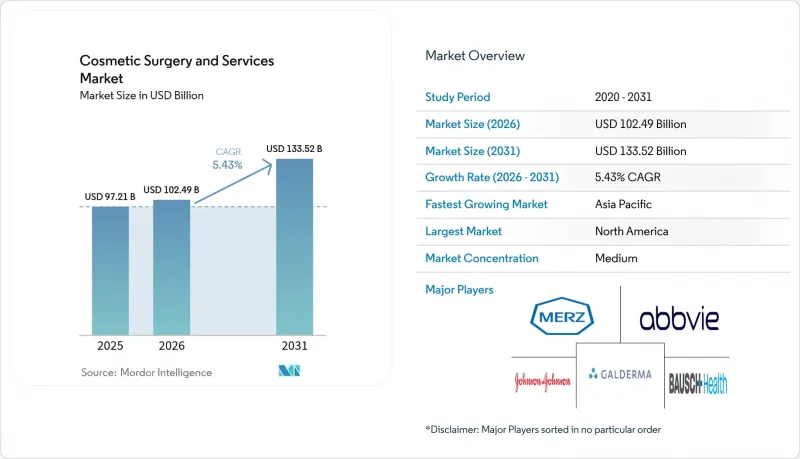
Mordor Intelligence에 따르면 미용성형·미용의학 서비스 시장 규모는 2025년에 972억 1,000만 달러로 평가되며, 2026년 1,024억 9,000만 달러에서 2031년까지 1,335억 2,000만 달러에 달할 것으로 예측되고 있으며, 예측 기간(2026-2031년)에 CAGR은 5.43%에 달할 전망입니다.
이 보고서는 시술 유형(외과적 및 비외과적), 성별(여성 및 남성), 연령대(18-34세 및 그 이상), 최종사용자(병원·전문 클리닉, 기타), 시술 부위(얼굴·두부, 유방, 몸·사지),및 지역(북미, 유럽, 아시아태평양, 중동 및 아프리카, 남미)별로 분류되어 있습니다. 시장 전망은 금액(달러) 기준으로 제시되어 있습니다.
전 세계 성형·메디컬 에스테틱 서비스 시장의 동향 및 인사이트
저침습 및 비침습 시술에 대한 수요 증가가 치료 패러다임을 새롭게 바꾸고 있습니다.
현재 비수술적 시술은 안면 성형 수술 전체의 80%를 차지하고 있으며, 신경독소 및 더말 필러는 모든 연령대에서 선호되고 있습니다. 프랙셔널 레이저, 고주파 마이크로니들링, 고강도 집속 초음파의 뛰어난 효과로 인해 회복 기간이 단축되었고, 그 결과 환자의 처리 능력과 클리닉의 시간당 수익이 향상되고 있습니다. 젊은 소비자들은 주사제를 교정 의료가 아닌 예방 의료로 인식하고 있으며, 이로 인해 환자의 수명주기이 장기화되고 지속적인 수입원이 안정화되고 있습니다. 성형·메디컬 에스테틱 서비스 시장은 품질 기준을 높이고 새로운 치료 적응증을 정당화하는 개정된 FDA 지침과 같은 규제 프레임워크의 혜택을 받고 있습니다. 보톡스와 필러의 병용 요법에 이어 광에너지를 이용한 피부 재생 시술 등을 시행하는 등 복합 프로토콜의 통합으로 인해 비수술적 시술의 연평균 성장률(CAGR)은 수술적 시술을 능가하는 기세로 계속 증가하고 있으며, 시술 구성에 있으며, 구조적인 변화가 더욱 강화되고 있습니다.
에너지 기반 기기의 기술적 진보가 새로운 수입원을 창출하고 있습니다.
AI가 탑재된 피부 분석 장치, 로봇 주사기, 정밀 에너지 플랫폼은 기존에는 수술실에서만 가능했던 치료 성과를 가져오고 있습니다. 소프트웨어 알고리즘을 통한 맞춤형 치료는 만족도 향상과 입소문으로 인한 소개로 이어지며, 그 결과 환자 유치 비용 절감에 기여하고 있습니다. 고주파 마이크로니들링 및 프랙셔널 CO₂ 시스템은 회복 기간을 단축하면서 눈에 띄는 콜라겐 재구성을 실현함으로써 프리미엄 가격대를 확립하고 있습니다. 각 기기 제조사들은 재생 의학과 에너지 조사를 융합한 엑소좀 강화 프로토콜을 공동 개발하고 있으며, 가격 차별화를 지원하는 하이브리드 치료를 창출하고 있습니다. 아시아태평양의 혁신 허브에서는 제품의 반복적인 업데이트가 가속화되고 있으며, 전 세계 시장 출시 주기가 단축되고, 성형·메디컬 에스테틱 서비스 시장의 잠재 고객 기반이 확대되고 있습니다.
규제 승인의 복잡성이 시장 진입 장벽을 조성하고 있습니다.
영국에서 검토되고 있는 라이선싱 제도의 근본적인 재검토는 보다 엄격한 자격 인증, 시설 기준 및 광고 규제를 요구하는 전 세계적인 움직임을 상징하며, 이는 진입 장벽과 운영 비용을 높일 것입니다. 미국에서는 새로운 진피 필러에 대한 FDA 심사 기간이 길어지면서, 제조사 입장에서는 시장 출시까지의 리스크가 높아지고 수익 창출이 지연되고 있습니다. 유럽의 의료기기 규정(MDR)은 엄격한 임상 증거 제출을 의무화하고 있으며, 중소기업에게는 과도한 부담이 되고 있으며, 자금력이 있는 기존 기업에 경쟁 우위가 쏠리고 있습니다. 이러한 조치들이 맞물려 제품의 시장 출시를 지연시키고, 제공업체의 사업 확장을 제한함으로써 성형·메디컬 에스테틱 서비스 시장의 성장 궤도를 둔화시키고 있습니다.
부문 분석
2025년, 외과적 시술은 재건 수술에 대한 보험 환급 지원과 비교적 지속성이 높은 치료 효과에 힘입어, 성형·메디컬 에스테틱 서비스 시장에서 57.92%의 점유율을 유지했습니다. 그러나 전신 마취나 장기간의 회복 기간 없이도 외과적 수술에 준하는 결과를 가져다주는 주사제 및 에너지 기기에 힘입어, 비수술적 시술 부문은 연평균 성장률(CAGR) 7.28%로 급성장하고 있습니다.
눈꺼풀 수술이나 지방 흡입은 여전히 주요 외과적 시술이지만, 유방 확대 수술 건수가 둔화되고 있는 것은 환자들이 침습성이 낮은 시술로 전환하고 있음을 시사합니다. 한편, 보툴리눔 독소 시술 횟수는 790만 회를 넘었고, 히알루론산 필러 주입 횟수는 630만 회에 달하며, 구독형 방식으로 반복 이용이 가능하고 단기간에 효과가 나타나는 시술이 성형·메디컬 에스테틱 서비스 시장의 규모를 재편하는 추세에 있음을 여실히 보여주고 있습니다.
2025년에도 여성 환자가 성형·메디컬 에스테틱 서비스 시장 규모의 68.05%를 차지하며, 계속해서 수요의 주축이 되고 있습니다. 그러나 직장 문화의 변화로 인해 남성들 사이에서도 외모에 대한 투자가 당연시되고 있는 만큼, 남성의 시술 이용률은 2031년까지 연평균 성장률(CAGR) 6.88%로 상승할 것으로 예측됩니다.
남성 환자 수에서는 모발 이식이 가장 큰 비중을 차지하고 있지만, 제품의 메시지가 ‘눈에 띄지 않으면서도 남성다운 결과’로 바뀌어 감에 따라 보톡스, 필러, 턱 라인 성형 시술에 대한 수요도 확대되고 있습니다. 각 클리닉 업체들은 성형·메디컬 에스테틱 서비스 시장에서 이러한 증가분을 확보하기 위해 직원들을 대상으로 한 남성 안면 해부학 재교육 및 전문가 네트워크를 통한 마케팅에 주력하고 있습니다.
지역별 분석
북미는 총 시술 건수가 620만 건에 달한 점과 특정 재건 수술에 대한 보험 적용이 배경이 되어, 2025년 미용 성형·메디컬 에스테틱 서비스 시장에서 42.13%의 점유율을 유지했습니다. 활발한 임상 연구와 정교한 규제 환경이 첨단 의료기기 및 주입제의 조기 도입을 촉진하여 고가 가격대를 유지하는 데 기여하고 있습니다.
유럽은 세분화되어 있지만, 큰 비즈니스 기회를 내포하고 있습니다. 독일이나 프랑스 등 서유럽 시장에서는 안정적인 시술 건수와 의료 관광의 확대가 나타나고 있습니다. 영국에서 예정된 면허 제도 개혁은 시술자의 질을 향상시키는 한편, 자금력이 약한 클리닉에는 부담이 될 것입니다. 동유럽에서는 가처분 소득의 증가와 국경을 초월한 시술 패키지의 이용 편의성으로 인해 평균을 상회하는 성장이 예상됩니다.
아시아태평양은 중국의 두 자릿수 성장, 일본의 비수술적 치료에 대한 높은 수용성, 그리고 미용 혁신의 세계적 허브로서 한국의 위상에 힘입어 6.18%라는 가장 높은 연평균 성장률(CAGR)을 기록하고 있습니다. 국내 의료기기 제조의 강점으로 인해 투입 비용이 절감되고, 치열한 가격 경쟁이 촉진되며, 접근성이 확대되고 있습니다. 호주의 새로운 안전 기준은 소비자의 신뢰를 높이고, 오세아니아의 성형 및 메디컬 에스테틱 서비스 시장을 강화할 것으로 예측됩니다.
남미 및 중동 및 아프리카는 새로운 성장 동력으로 부상하고 있습니다. 브라질에서는 240만 건의 외과수술이 시행되고 있으며, 성형 수술에 대한 문화적 친화도가 높음을 입증하고 있습니다. 또한 화장품 등록에 관한 규제가 강화됨에 따라 공급망의 투명성이 향상되고 있습니다. 걸프 국가들은 의료 관광 회랑과 높은 1인당 소득을 활용하고 있지만, 지정학적 불확실성으로 인해 단기적인 투자 의욕은 억제되고 있습니다.
기타 혜택:
- 엑셀 형식의 시장 예측(ME) 시트
- 3개월간의 애널리스트 지원
목차
제1장 서론
제2장 조사 방법
제3장 개요
제4장 시장 구도
제5장 시장 규모와 성장 예측
제6장 경쟁 구도
제7장 시장 기회와 향후 전망
KSAAccording to Mordor Intelligence, the cosmetic surgery & services market size was valued at USD 97.21 billion in 2025 and estimated to grow from USD 102.49 billion in 2026 to reach USD 133.52 billion by 2031, at a CAGR of 5.43% during the forecast period (2026-2031).
This report is Segmented by Procedure Type (Surgical and Non-Surgical), Gender (Female and Male), Age Group (18-34 Years, and More), End User (Hospitals & Specialty Clinics, and More), Body Area (Face & Head, Breast, and Body & Extremities), and Geography (North America, Europe, Asia-Pacific, Middle East & Africa, and South America). The Market Forecasts are Provided in Terms of Value (USD).
Global Cosmetic Surgery And Services Market Trends and Insights
Growing Demand for Minimally & Non-Invasive Procedures Reshapes Treatment Paradigms
Non-surgical modalities now constitute 80% of all facial plastic procedures, with neurotoxins and dermal fillers favored across every age group. Superior efficacy of fractional lasers, radiofrequency microneedling, and high-intensity focused ultrasound is shortening recovery windows, thereby elevating patient throughput and revenue per clinic hour. Younger consumers regard injectables as preventive care rather than corrective medicine, which is lengthening patient lifecycles and stabilizing recurring revenue streams. The cosmetic surgery & services market is benefiting from regulatory frameworks such as updated FDA guidance that raise quality thresholds and legitimize new treatment indications. Integration of combination protocols-for example toxin-filler pairings followed by light energy resurfacing-is further pushing the non-surgical CAGR beyond its surgical counterpart, reinforcing a structural shift in the procedure mix.
Technological Advances in Energy-Based Devices Create New Revenue Streams
AI-enabled skin analyzers, robotic injectors, and precision energy platforms are delivering outcomes historically limited to operating rooms. Treatment customization driven by software algorithms translates into higher satisfaction scores and word-of-mouth referrals, thus compressing patient acquisition costs. Radiofrequency microneedling and fractional CO2 systems are capturing premium price points due to visible collagen remodeling within abbreviated downtime windows. Device manufacturers are co-developing exosome-enhanced protocols that merge regenerative medicine with energy delivery, producing hybrid treatments that support price differentiation. Asia-Pacific innovation hubs are accelerating iterative product updates, shortening global launch cycles and broadening the cosmetic surgery & services market addressable base.
Regulatory Approval Complexity Creates Market Access Barriers
The United Kingdom's pending licensing overhaul illustrates a global push for stricter credentialing, facility standards, and advertising controls that will raise entry barriers and operational costs. In the United States, extended FDA review periods for new dermal fillers add time-to-market risk for manufacturers and delay revenue realization. Europe's Medical Device Regulation imposes rigorous clinical evidence obligations that smaller firms find onerous, tipping competitive advantage toward well-capitalized incumbents. Collectively, these measures temper the growth trajectory of the cosmetic surgery & services market by slowing product roll-outs and limiting provider expansion.
Other drivers and restraints analyzed in the detailed report include:
- Social Media Influence Drives Unprecedented Procedure Consideration Rates
- GLP-1 Weight-Loss Medications Generate Unexpected Aesthetic Demand
- Safety Concerns and Counterfeit Product Infiltration Threaten Market Confidence
For complete list of drivers and restraints, kindly check the Table Of Contents.
Segment Analysis
Surgical interventions retained a 57.92% cosmetic surgery & services market share in 2025, buoyed by reimbursement support for reconstructive indications and relatively durable outcomes. Yet non-surgical categories are accelerating at 7.28% CAGR, propelled by injectables and energy devices that deliver quasi-surgical results without general anesthesia or extended downtime.
Eyelid surgery and liposuction remain top surgical procedures, but slowing breast augmentation volumes hint at a patient shift toward less invasive enhancement. Conversely, botulinum toxin surpassed 7.9 million sessions and hyaluronic acid fillers reached 6.3 million injections, underlining the momentum that is re-shaping the cosmetic surgery & services market size calculus in favor of quick-turn treatments with subscription-style repeat rates.
Female patients continued to anchor demand at 68.05% of the cosmetic surgery & services market size in 2025. Male participation, however, is climbing with a projected 6.88% CAGR to 2031 as evolving workplace culture normalizes appearance investment among men.
Hair transplantation commands the largest male volume, yet uptake of neurotoxins, fillers, and jawline contouring solutions is expanding as product messaging pivots toward discreet, masculine outcomes. Clinics are retraining staff on male facial anatomy and marketing through professional networking channels to seize this incremental share of the cosmetic surgery & services market.
Complete Report Scope:
- By Procedure Type
- Surgical
- Non-surgical
- By Gender
- Female
- Male
- By Age Group
- 18-34 years
- 35-50 years
- 51 years and above
- By End User
- Hospitals & Specialty Clinics
- Ambulatory Surgical Centres
- Medical Spas / Aesthetic Clinics
- By Body Area
- Face & Head
- Breast
- Body & Extremities
- Geography
- North America
- United States
- Canada
- Mexico
- Europe
- Germany
- United Kingdom
- France
- Italy
- Spain
- Rest of Europe
- Asia-Pacific
- China
- Japan
- India
- Australia
- South Korea
- Rest of Asia-Pacific
- Middle East & Africa
- GCC
- South Africa
- Rest of Middle East & Africa
- South America
- Brazil
- Argentina
- Rest of South America
- North America
Geography Analysis
North America retained 42.13% share of the cosmetic surgery & services market in 2025 on the back of 6.2 million total procedures and payer support for select reconstructive cases. Clinical research density and a sophisticated regulatory environment stimulate early adoption of advanced devices and injectables, sustaining premium pricing.
Europe presents a fragmented yet significant opportunity set, with Western markets like Germany and France combining stable procedure volumes and growing medical tourism. Upcoming U.K. licensing reforms are poised to elevate operator quality while pressuring under-capitalized clinics. Eastern Europe offers above-average growth as disposable incomes rise and cross-border procedure packages become more accessible.
Asia-Pacific posts the fastest 6.18% CAGR, driven by China's double-digit expansion, Japan's high acceptance of non-surgical treatments, and South Korea's status as a global hub for aesthetic innovation. Domestic device manufacturing advantages reduce input costs, facilitating aggressive price competition and broadening access. Australia's new safety standards are projected to heighten consumer confidence and fortify the cosmetic surgery & services market in Oceania.
South America and the Middle East & Africa are emerging growth engines. Brazil's 2.4 million surgical procedures affirm deep cultural affinity for aesthetic enhancement, while stricter cosmetics registration protocols are improving supply-chain transparency. Gulf economies leverage medical tourism corridors and high per-capita income, although geopolitical uncertainty tempers near-term investment appetites.
- Abbvie
- Bausch Health
- Candela Medical
- Cynosure Technologies
- Cutera
- Daewoong Pharmaceutical
- Evolus Inc.
- Fotona d.o.o.
- Galderma
- GC Aesthetics
- Hugel Inc.
- Ipsen
- Johnson & Johnson (Mentor)
- Lumenis
- Medytox
- Merz Pharma
- Revance Therapeutics
- Sientra
- Sinclair Pharma
- Teoxane Laboratories
Additional Benefits:
- The market estimate (ME) sheet in Excel format
- 3 months of analyst support
TABLE OF CONTENTS
1 Introduction
- 1.1 Study Assumptions & Market Definition
- 1.2 Scope of the Study
2 Research Methodology
3 Executive Summary
4 Market Landscape
- 4.1 Market Overview
- 4.2 Market Drivers
- 4.2.1 Growing demand for minimally & non-invasive procedures
- 4.2.2 Technological advances in energy-based & injectable devices
- 4.2.3 Rising social-media-led beauty consciousness
- 4.2.4 GLP-1 weight-loss drugs boosting post-loss contouring demand
- 4.2.5 Private-equity roll-ups creating clinic capacity & marketing muscle
- 4.2.6 AI-driven outcome simulation increasing first-time conversions
- 4.3 Market Restraints
- 4.3.1 Stringent regulatory approvals & practitioner-licensing gaps
- 4.3.2 Post-procedure side-effects & safety worries
- 4.3.3 Tariff-driven cost spikes for imported injectables/fillers
- 4.3.4 Rising counterfeit product infiltration via e-commerce
- 4.4 Value / Supply-Chain Analysis
- 4.5 Regulatory Landscape
- 4.6 Technological Outlook
- 4.7 Porter's Five Forces
- 4.7.1 Threat of New Entrants
- 4.7.2 Bargaining Power of Buyers
- 4.7.3 Bargaining Power of Suppliers
- 4.7.4 Threat of Substitutes
- 4.7.5 Competitive Rivalry
5 Market Size & Growth Forecasts (Value, USD)
- 5.1 By Procedure Type
- 5.1.1 Surgical
- 5.1.2 Non-surgical
- 5.2 By Gender
- 5.2.1 Female
- 5.2.2 Male
- 5.3 By Age Group
- 5.3.1 18-34 years
- 5.3.2 35-50 years
- 5.3.3 51 years and above
- 5.4 By End User
- 5.4.1 Hospitals & Specialty Clinics
- 5.4.2 Ambulatory Surgical Centres
- 5.4.3 Medical Spas / Aesthetic Clinics
- 5.5 By Body Area
- 5.5.1 Face & Head
- 5.5.2 Breast
- 5.5.3 Body & Extremities
- 5.6 Geography
- 5.6.1 North America
- 5.6.1.1 United States
- 5.6.1.2 Canada
- 5.6.1.3 Mexico
- 5.6.2 Europe
- 5.6.2.1 Germany
- 5.6.2.2 United Kingdom
- 5.6.2.3 France
- 5.6.2.4 Italy
- 5.6.2.5 Spain
- 5.6.2.6 Rest of Europe
- 5.6.3 Asia-Pacific
- 5.6.3.1 China
- 5.6.3.2 Japan
- 5.6.3.3 India
- 5.6.3.4 Australia
- 5.6.3.5 South Korea
- 5.6.3.6 Rest of Asia-Pacific
- 5.6.4 Middle East & Africa
- 5.6.4.1 GCC
- 5.6.4.2 South Africa
- 5.6.4.3 Rest of Middle East & Africa
- 5.6.5 South America
- 5.6.5.1 Brazil
- 5.6.5.2 Argentina
- 5.6.5.3 Rest of South America
- 5.6.1 North America
6 Competitive Landscape
- 6.1 Market Concentration
- 6.2 Market Share Analysis
- 6.3 Company Profiles (includes Global level Overview, Market level overview, Core Segments, Financials as available, Strategic Information, Market Rank/Share, Products & Services, Recent Developments)
- 6.3.1 AbbVie Inc.
- 6.3.2 Bausch Health Companies Inc.
- 6.3.3 Candela Medical
- 6.3.4 Cynosure Technologies
- 6.3.5 Cutera Inc.
- 6.3.6 Daewoong Pharmaceutical
- 6.3.7 Evolus Inc.
- 6.3.8 Fotona d.o.o.
- 6.3.9 Galderma SA
- 6.3.10 GC Aesthetics
- 6.3.11 Hugel Inc.
- 6.3.12 Ipsen Pharma
- 6.3.13 Johnson & Johnson (Mentor)
- 6.3.14 Lumenis Ltd.
- 6.3.15 Medytox Inc.
- 6.3.16 Merz Pharma GmbH & Co. KGaA
- 6.3.17 Revance Therapeutics
- 6.3.18 Sientra Inc.
- 6.3.19 Sinclair Pharma PLC
- 6.3.20 Teoxane Laboratories
7 Market Opportunities & Future Outlook
- 7.1 White-space & Unmet-need Assessment