|
시장보고서
상품코드
2122023
UV 안정제 : 시장 점유율 분석, 업계 동향과 통계, 성장 예측(2026-2031년)UV Stabilizers - Market Share Analysis, Industry Trends & Statistics, Growth Forecasts (2026 - 2031) |
||||||
 Mordor Intelligence
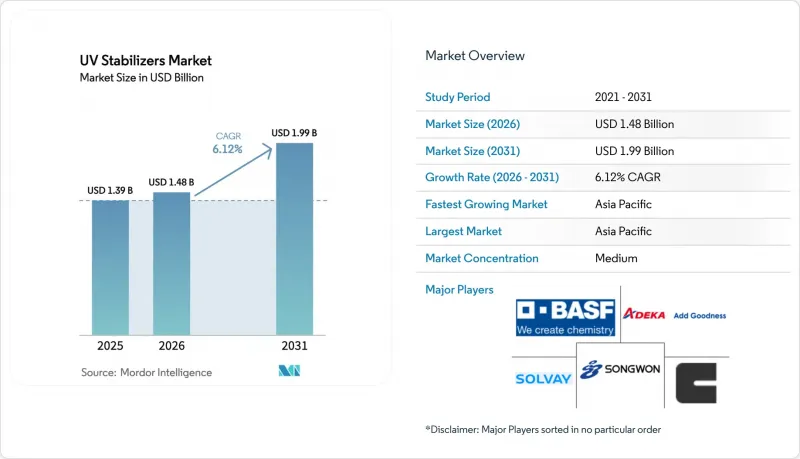
Mordor Intelligence에 의하면, UV 안정제 시장 규모는 2025년에 13억 9,000만 달러로 평가되었고, 2026년 14억 8,000만 달러에서 2031년까지 19억 9,000만 달러에 이를 것으로 예측되며, 예측 기간(2026-2031년) CAGR은 6.12%를 기록할 전망입니다.
본 보고서는 유형별(HALS, UV 흡수제, 퀀처, 산화방지제), 최종 이용 산업별(포장, 자동차, 농업, 건축 및 건설 등), 폴리머 유형별(폴리올레핀, PVC, 폴리우레탄, 엔지니어링 플라스틱, 기타), 형태(액체, 분말, 비즈/과립), 지역(아시아태평양, 북미, 기타)별로 분류되어 있습니다. 시장 예측은 금액(달러) 기준으로 제시되어 있습니다.
세계 UV 안정제 시장 동향 및 인사이트
아시아 산업용 포장 시장에서 UV 안정화 폴리올레핀 필름의 급속한 보급
중국과 인도에서는 전자상거래 거점에서 인장 강도를 저하시키지 않으면서도 실외 보관을 견딜 수 있는 스트레치 후드 필름 및 수축 랩 필름에 대한 수요가 증가하고 있습니다. 광산화를 방지하고 멀티모달 운송 중에도 인쇄된 그래픽이 식별 가능하도록 보장하기 위해, 각 컴파운더들은 HALS의 배합량을 늘리고 있습니다. 인도의 연포장 시장은 UV 안정화 필름으로 전환되고 있습니다. 이러한 필름은 몬순 기간 동안 장기간 노출되는 농업 자재용 봉투에서 특히 수요가 높아지고 있습니다. 한편, 중국에서는 각 컨버터 업체들이 수출용으로 HALS를 다량 함유한 필름의 사전 인증을 추진하고 있습니다. 이러한 움직임은 재활용 공정에서 엄격한 순도 기준을 요구하는 고객의 요구에 부응하는 것이며, 그 결과 지역적 수요를 끌어올리고 있습니다. 동남아시아의 창고 운영사는 현재 팔레트에 적재된 상품을 실외에 보관하고 있습니다. 이러한 변화로 인해 내후성 폴리올레핀 필름의 채택이 가속화되고 있습니다. 그 결과, 첨가제의 총 소비량은 현저히 증가하고 있는 반면, 동시에 필름 두께를 줄이는 추세도 진행되고 있습니다.
유럽에서의 저VOC·수성 목재용 도료로의 전환
EU 지침 2004/42/EC의 시행에 따라 허용 VOC 함유량이 낮아지면서, 배합 제조업체들은 용제계 시스템에서 가수분해에 안정적인 UV 흡수제가 필요한 수성 코팅으로 전환하고 있습니다. 벤조트리아졸계 화합물은 수성 매질에서 용출되므로, 제조업체들은 추출에 내성이 있는 트리아진계 UV 흡수제나 고분자 HALS로 전환하고 있습니다. 독일과 북유럽 국가들은 2025년에 가장 먼저 도입을 추진했으나, 건축 기준의 엄격화에 따라 남유럽 국가들도 그 격차를 좁혀가고 있습니다. 공급업체는 기존 제품 라인을 재조제하여 새로운 수지 플랫폼과의 적합성을 검증하는 동시에, 자외선 차단제, 살균제, 유변학 조절제를 단일 마스터배치에 통합해야 합니다. 재조성에는 단기적인 비용이 소요되지만, 실외 목재 파사드에서 최소 5년간의 색상 안정성을 보장하는 턴키형 첨가제 패키지를 통해 프리미엄 가격 책정의 기회가 생깁니다.
원자재 가격 변동
2024년부터 2025년에 걸쳐 벤젠과 프탈산 무수물의 가격이 변동하면서, 장기 석유화학 계약을 맺지 않은 배합 제조업체들의 이익 마진이 압박을 받았습니다. 아시아태평양의 현물 구매자들은 가장 현저한 가격 변동을 경험한 반면, 유럽의 생산자들은 높은 에너지 요금에 직면하여 방향족 중간체의 비용 상승을 초래했습니다. 그 결과, 중소규모 기업들은 생산 능력 확대를 연기하고 연구개발 예산을 삭감하고 있으며, 이는 첨단 UV 안정제의 상용화를 방해하고 있습니다. 반면, 수직 통합형 대기업들은 파생상품 거래나 후방 통합을 통해 위험을 완화하고 있지만, 업계 전체적으로는 지정학적 혼란이나 원자재 비용 급등을 초래할 수 있는 임박한 탄소 가격 정책의 영향을 받기 쉬운 상황이 지속되고 있습니다.
부문 분석
2025년 기준, 힌더드 아민계 광안정제(HALS)는 UV 안정제 시장 점유율의 65.22%를 차지하고 있으며,NOR-HALS 등급이 실외용 플라스틱의 수명을 10년 이상 연장함에 따라, 이 부문은 2031년까지 연평균 성장률(CAGR) 6.35%를 나타낼 것으로 전망됩니다. 반면, UV 흡수제는 박막에서의 효과가 제한적일 뿐만 아니라 휘발성이나 이행성 등의 문제로 인해 성장 속도가 둔화되고 있습니다. 그럼에도 불구하고 UV 흡수제는 투명 코팅이나 폴리카보네이트 유리에는 여전히 필수적입니다. 반면, 퀀처와 산화 방지제는 틈새 시장을 담당하며, 시너지 효과가 있는 블렌드에서 균형을 유지하고 있습니다. BASF가 2025년에 ‘Tinuvin NOR 600’을 출시한 것은 업계 동향을 여실히 보여줍니다. 즉, 배합 제조업체들은 NOR-HALS, 특히 짙은 색상의 자동차 부품에서 발생하는 헤이즈를 최소화하는 제품에 대해 높은 가격을 지불할 의향이 있다는 뜻입니다.
특정 폴리머에 맞춘 첨가제 패키지에 대한 수요가 증가하고 있습니다. 예를 들어, 폴리우레탄 분산액에서는 알칼리성 환경을 견딜 수 있는 2차 HALS가 채택되고 있습니다. 마찬가지로, 3D 프린팅에 사용되는 필라멘트의 경우, 폴리아미드 12와 호환성이 좋은 하이드록시페닐트리아진계 첨가제로의 전환이 진행되고 있습니다. 유럽에서는 REACH 규제로 인해 니켈계 퀀처에 대한 감시가 강화되고 있어, 유기계 대체품으로의 단계적 전환이 진행되고 있습니다. 또한, HALS, UV 흡수제, 산화 방지제를 통합한 첨가제 패키지는 배합 공정을 효율화할 뿐만 아니라 성분 간의 상쇄 작용을 완화합니다. 이러한 추세에 따라 다양한 제품 포트폴리오를 보유한 공급업체는 시장 평균을 상회하는 성장을 이룰 것입니다.
폴리올레핀은 포장용 필름, 농업용 커버, 자동차 부품에 힘입어 2025년 수요의 52.13%를 차지하고 있지만, 필름의 박형화와 단층 배리어 소재의 보급으로 인해 안정제 사용량이 감소하고 있어 그 성장세는 둔화되고 있습니다. 폴리우레탄은 스프레이 폼 단열재 및 자동차 시트 폼 분야에서 황변을 방지하고 유연성을 유지하는 첨가제에 대한 수요가 증가하고 있어, 2031년까지 연평균 성장률(CAGR) 6.48%를 기록할 전망입니다. PVC는 창틀 및 사이딩 분야에서 대체 소재와의 경쟁으로 인해 성장이 둔화되고 있습니다. 대조적으로, 폴리카보네이트나 폴리아미드 등의 엔지니어링 플라스틱은 자동차 경량화 추세와 3D 프린팅의 부상으로 인해 시장을 확대되고 있습니다.
폴리우레탄의 성장은 에너지 효율이 높은 단열재와 차량 중량을 줄일 수 있는 경량 시트 솔루션의 도입 의무화에 힘입어 가속화되고 있습니다. 시공 시, 스프레이 폼 시공 업체는 자외선 저항성이 입증된 HALS(무할로겐 광안정제)를 선택하는 반면, 시트 공급업체는 이소시아네이트의 화학적 특성에 적합한 흡수제를 선정합니다. 스티렌계 수지와 엘라스토머는 틈새 시장에 머물러 있지만, BASF는 전략적인 동향을 보이고 있습니다. 이 회사는 2026년 멕시코 푸에블라에서 확장 계획을 추진 중이며, 이는 특히 폴리우레탄 및 엔지니어링 플라스틱 분야의 고객을 대상으로 하며, 산화 방지제와 자외선 안정제에 중점을 둔 것입니다.
지역별 분석
아시아태평양은 2025년에 전 세계 매출의 54.34%를 차지할 것으로 보이며, 2031년까지 연평균 성장률(CAGR) 6.61%로 성장할 전망입니다. 2025년, 중국의 연포장 부문은 이 지역 안정제 판매량의 대부분을 차지했습니다. 이러한 급증은 유럽의 재활용 기준을 준수하는 자외선 차단 필름에 대한 수출업체들 수요에 의해 주도되었습니다. 한편, 2025년에는 인도가 온실 재배에 대한 보조금을 지급함에 따라 HALS가 배합된 폴리에틸렌 필름 수요가 급증했습니다. 일본과 한국은 자동차 및 전자기기 수출에 필수적인 엔지니어링 플라스틱 부품을 공급하며 시장 평균을 상회하는 성장을 달성했습니다. 급증하는 국내 및 수출 수요에 대응하기 위해 BASF는 난징 공장의 HALS 생산 능력을 확대했습니다.
2025년, 북미는 세계 시장 가치에서 상당한 점유율을 차지했으며, 2031년까지 꾸준한 성장이 예상됩니다. 이 지역의 성장은 자동차 산업의 국내 복귀와 적층 가공의 급증에 힘입어, 내후성 열가소성 올레핀 및 UV 안정화 필라멘트에 대한 수요를 끌어올리고 있습니다. 캐나다에서는 건설 업계가 적설 하중을 견디기 위해 자외선 안정화 폴리카보네이트 지붕재를 채택하고 있습니다. 동시에 멕시코 푸에블라에서의 생산 확대를 통해 첨가제의 지역적 안정 공급이 확보되고 있습니다. 유럽은 성장 궤도에 올라 있으며, 이는 성숙한 건설 시장이 규제에 힘입어 견조한 도료 수요와 균형을 이루고 있기 때문입니다. 특히 독일, 프랑스, 영국, 이탈리아는 지침 2004/42/EC 준수가 주요 요인으로 작용하여 유럽 매출의 상당 부분을 차지하고 있습니다.
남미는 브라질의 열대 농업과 아르헨티나의 PVC 건축에 대한 집중으로 성장이 예상됩니다. 중동 및 아프리카는 현재 시장 점유율이 작지만 빠르게 확대되고 있습니다. 이러한 성장은 사우디아라비아와 아랍에미리트(UAE)의 보호 농업에 대한 투자에 힘입고 있습니다. 또한, 남아프리카공화국의 자동차 수출 의지가 자외선 저항성 열가소성 올레핀(TPO) 수요를 끌어올리고 있습니다. 이처럼 아시아태평양의 판매량 증가부터 북미의 수익성 높은 자동차 업그레이드, 중동의 급성장하는 온실 산업에 이르기까지 지역별 비즈니스 기회는 매우 다양합니다.
기타 혜택:
- 엑셀 형식 시장 예측(ME) 시트
- 3개월간의 애널리스트 지원
자주 묻는 질문
목차
제1장 서론
제2장 조사 방법
제3장 주요 요약
제4장 시장 구도
제5장 시장 규모와 성장 예측
제6장 경쟁 구도
제7장 시장 기회와 향후 전망
LSH 26.09.10According to Mordor Intelligence, the UV stabilizers market size was valued at USD 1.39 billion in 2025 and is estimated to grow from USD 1.48 billion in 2026 to reach USD 1.99 billion by 2031, at a CAGR of 6.12% during the forecast period (2026-2031).
This report is Segmented by Type (HALS, UV Absorbers, Quenchers, and Antioxidants), End-Use Industry (Packaging, Automotive, Agriculture, Building and Construction, and More), Polymer Type (Polyolefins, PVC, Polyurethane, Engineering Plastics, and Others), Form (Liquid, Powder, and Bead/Granule), and Geography (Asia-Pacific, North America, and More). Market Forecasts are Provided in Terms of Value (USD).
Global UV Stabilizers Market Trends and Insights
Rapid Penetration of UV-Stable Polyolefin Films in Asian Industrial Packaging
In China and India, e-commerce hubs are increasingly demanding stretch-hood and shrink-wrap films that can endure outdoor storage without compromising tensile strength. To combat photo-oxidation and ensure printed graphics remain legible during multimodal transport, compounders are increasing HALS loading. India's flexible-packaging market is pivoting towards UV-stable films. These films are particularly sought after for agricultural-input bags that face extended exposure during the monsoon. Meanwhile, in China, converters are pre-qualifying HALS-rich films for export. This move caters to customers who demand stringent recycling-stream purity standards, thereby boosting regional demand. Southeast Asian warehouse operators are now storing palletized goods outdoors. This shift has hastened the adoption of weatherable polyolefin films. Consequently, while there's a notable increase in overall additive consumption, it's happening alongside a trend of film gauge reductions.
Shift Toward Low-VOC, Water-Borne Wood Coatings in Europe
Implementation of EU Directive 2004/42/EC lowered permissible VOC content, steering formulators away from solvent-borne systems toward water-based coatings that require hydrolytically stable UV absorbers. Benzotriazole chemistries leach out of aqueous media, so producers have migrated to triazine UV absorbers and polymeric HALS that resist extraction. Germany and Nordic countries pioneered adoption in 2025, but Southern Europe is closing the gap as building codes tighten. Suppliers must reformulate legacy lines and validate compatibility with new resin platforms, embedding UV protection, biocides, and rheology modifiers into single masterbatches. While reformulation incurs short-term cost, it opens premium pricing opportunities for turnkey additive packages that guarantee color stability on exterior wood facades for at least five years.
Volatility in Feedstock Prices
During 2024-2025, costs for benzene and phthalic anhydride fluctuated, tightening margins for formulators lacking long-term petrochemical contracts. Spot buyers in the Asia-Pacific experienced the most pronounced price swings, while producers in Europe contended with high energy tariffs, driving up costs for aromatic intermediates. As a result, smaller firms are postponing capacity expansions and cutting back on research and development budgets, which is hindering the commercialization of advanced UV stabilizers. While integrated major companies are mitigating risks through derivatives trading and backward integration, the entire sector remains susceptible to geopolitical upheavals and impending carbon-pricing initiatives that threaten to escalate feedstock costs.
Other drivers and restraints analyzed in the detailed report include:
- Growing Adoption of Weather-Resistant 3D-Printed Plastics in North America
- Surge in UV-Stabilized Greenhouse Films Across the Middle East
- Supply-Chain Disruptions in HALS Intermediates
For complete list of drivers and restraints, kindly check the Table Of Contents.
Segment Analysis
Hindered amine light stabilizers controlled 65.22% of the UV stabilizers market share in 2025, and the segment will post a 6.35% CAGR to 2031 as NOR-HALS grades extend exterior plastic life beyond 10 years. UV absorbers face slower growth due to their limited efficacy in thin films, a challenge posed by volatility and migration. Nonetheless, UV absorbers remain crucial for clear coatings and polycarbonate glazing. Meanwhile, quenchers and antioxidants play niche roles, balancing the equation in synergistic blends. BASF's 2025 introduction of Tinuvin NOR 600 underscores the industry's trend: formulators are willing to pay a premium for NOR-HALS, especially those that minimize haze in dark automotive components.
There's a growing demand for packages tailored to specific polymers. For instance, polyurethane dispersions are now opting for secondary HALS that can endure alkaline settings. Similarly, filaments used in 3D printing are turning to hydroxyphenyltriazines, which are compatible with polyamide 12. In Europe, nickel-based quenchers are under heightened scrutiny due to REACH regulations, leading to a gradual pivot towards organic substitutes. Furthermore, integrated additive packages that merge HALS, UV absorbers, and antioxidants not only streamline the formulation process but also mitigate antagonistic interactions. This trend positions suppliers with diverse portfolios for growth that outpaces the market average.
Polyolefins represented 52.13% of 2025 demand, supported by packaging films, agricultural covers, and automotive parts, yet their growth moderates as thinner films and monolayer barriers reduce stabilizer intensity. Polyurethanes will post a 6.48% CAGR through 2031 as spray-foam insulation and automotive seating foams demand additives that prevent yellowing and maintain flexibility. PVC is witnessing slower growth due to competition from alternative materials in window profiles and siding. In contrast, engineering plastics like polycarbonate and polyamide are expanding, driven by trends in automotive lightweighting and the rise of 3D printing.
Gains in polyurethane are fueled by mandates for energy-efficient insulation and lightweight seating solutions, which can reduce a vehicle's mass. During installation, spray-foam installers opt for HALS, known for their UV resistance, while seating suppliers choose absorbers that align with isocyanate chemistries. Although styrenics and elastomers occupy a niche space, BASF is making strategic moves. Their 2026 expansion in Puebla, Mexico, is set to cater specifically to customers in polyurethane and engineering plastics, focusing on antioxidants and UV stabilizers.
Complete Report Scope:
- By Type
- Hindered Amine Light Stabilizers (HALS)
- UV Absorbers
- Quenchers
- Antioxidants
- By End-Use Industry
- Packaging
- Automotive
- Agriculture
- Building and Construction
- Adhesives and Sealants
- Other End-user Industries (Electrical and Electronics, etc.)
- By Polymer Type
- Polyolefins (PE, PP)
- PVC
- Polyurethane
- Engineering Plastics (PC, PA, PET)
- Others (Styrenics and Rubber and Elastomers)
- By Form
- Liquid
- Powder
- Bead/Granule
- By Geography
- Asia-Pacific
- China
- India
- Japan
- South Korea
- Rest of Asia-Pacific
- North America
- United States
- Canada
- Mexico
- Europe
- Germany
- United Kingdom
- France
- Italy
- Rest of Europe
- South America
- Brazil
- Argentina
- Rest of South America
- Middle-East and Africa
- Saudi Arabia
- South Africa
- Rest of Middle-East and Africa
- Asia-Pacific
Geography Analysis
Asia-Pacific held 54.34% of global revenue in 2025 and will expand at a 6.61% CAGR through 2031. In 2025, China's flexible-packaging sector accounted for a significant portion of the regional stabilizer volume. This surge was driven by exporters' demand for UV-resistant films that align with European recycling standards. Meanwhile, in 2025, India subsidized greenhouses, fueling a spike in demand for polyethylene films infused with HALS loading. Japan and South Korea outpaced the market, supplying engineering-plastic components pivotal for automotive and electronics exports. In response to the burgeoning local and export demand, BASF expanded its HALS capacity at the Nanjing plant.
In 2025, North America claimed a notable share of the global market value and is projected to grow steadily through 2031. The region's growth is bolstered by automotive reshoring and a surge in additive manufacturing, driving up demand for weatherable thermoplastic olefins and UV-stabilized filaments. In Canada, the construction sector is turning to UV-stable polycarbonate roofing to withstand snow loads. Simultaneously, Mexico's Puebla expansion is ensuring a steady regional supply of additives. Europe is on a growth trajectory, attributed to mature construction markets balancing out the robust, regulation-driven demand for coatings. Notably, Germany, France, the UK, and Italy collectively account for a significant portion of Europe's revenue, largely due to adherence to Directive 2004/42/EC.
South America is set to rise, thanks to Brazil's tropical agriculture and Argentina's focus on PVC construction. The Middle East and Africa, while currently representing a smaller share, are expanding rapidly. This growth is spurred by Saudi Arabia and the UAE's investments in protected agriculture. Additionally, South Africa's ambitions in automotive exports are driving up the demand for UV-stable thermoplastic olefins. Thus, regional opportunities are diverse, spanning from Asia-Pacific's volume growth and North America's lucrative automotive upgrades to the Middle East's burgeoning greenhouse industry.
- 3V Sigma S.p.A.
- ADEKA Corporation
- Altana AG
- BASF SE
- Chitec Technology Co., Ltd.
- Clariant
- Eastman Chemical Company
- Everlight Chemical Industrial Co.
- Evonik Industries AG
- Kaneka Corporation
- Lycus Ltd. LLC
- Mayzo Inc.
- Rianlon Corporation
- SABO S.p.A.
- SI Group Inc.
- Solvay
- Songwon
- SUQIAN UNITECH CORP..LTD
- Tianjin Baofeng Chemical Co., Ltd.
- Wanhua
Additional Benefits:
- The market estimate (ME) sheet in Excel format
- 3 months of analyst support
TABLE OF CONTENTS
1 Introduction
- 1.1 Study Assumptions and Market Definition
- 1.2 Scope of the Study
2 Research Methodology
3 Executive Summary
4 Market Landscape
- 4.1 Market Overview
- 4.2 Market Drivers
- 4.2.1 Rapid penetration of UV-stable polyolefin films in Asian industrial packaging
- 4.2.2 Shift toward low-VOC, water-borne wood coatings in Europe
- 4.2.3 Growing adoption of weather-resistant 3-D-printed plastics in North America
- 4.2.4 Surge in UV-stabilised greenhouse films across the Middle East
- 4.2.5 OEM mandates for long-life exterior automotive plastics
- 4.3 Market Restraints
- 4.3.1 Volatility in feed-stock prices
- 4.3.2 Supply-chain disruptions in HALS intermediates
- 4.3.3 Uptake of high-barrier monolayer films reducing stabiliser demand
- 4.4 Value Chain Analysis
- 4.5 Porter's Five Forces
- 4.5.1 Bargaining Power of Suppliers
- 4.5.2 Bargaining Power of Consumers
- 4.5.3 Threat of New Entrants
- 4.5.4 Threat of Substitutes
- 4.5.5 Degree of Competition
5 Market Size and Growth Forecasts (Value)
- 5.1 By Type
- 5.1.1 Hindered Amine Light Stabilizers (HALS)
- 5.1.2 UV Absorbers
- 5.1.3 Quenchers
- 5.1.4 Antioxidants
- 5.2 By End-Use Industry
- 5.2.1 Packaging
- 5.2.2 Automotive
- 5.2.3 Agriculture
- 5.2.4 Building and Construction
- 5.2.5 Adhesives and Sealants
- 5.2.6 Other End-user Industries (Electrical and Electronics, etc.)
- 5.3 By Polymer Type
- 5.3.1 Polyolefins (PE, PP)
- 5.3.2 PVC
- 5.3.3 Polyurethane
- 5.3.4 Engineering Plastics (PC, PA, PET)
- 5.3.5 Others (Styrenics and Rubber and Elastomers)
- 5.4 By Form
- 5.4.1 Liquid
- 5.4.2 Powder
- 5.4.3 Bead/Granule
- 5.5 By Geography
- 5.5.1 Asia-Pacific
- 5.5.1.1 China
- 5.5.1.2 India
- 5.5.1.3 Japan
- 5.5.1.4 South Korea
- 5.5.1.5 Rest of Asia-Pacific
- 5.5.2 North America
- 5.5.2.1 United States
- 5.5.2.2 Canada
- 5.5.2.3 Mexico
- 5.5.3 Europe
- 5.5.3.1 Germany
- 5.5.3.2 United Kingdom
- 5.5.3.3 France
- 5.5.3.4 Italy
- 5.5.3.5 Rest of Europe
- 5.5.4 South America
- 5.5.4.1 Brazil
- 5.5.4.2 Argentina
- 5.5.4.3 Rest of South America
- 5.5.5 Middle-East and Africa
- 5.5.5.1 Saudi Arabia
- 5.5.5.2 South Africa
- 5.5.5.3 Rest of Middle-East and Africa
- 5.5.1 Asia-Pacific
6 Competitive Landscape
- 6.1 Market Concentration
- 6.2 Strategic Moves
- 6.3 Market Share(%)/Ranking Analysis
- 6.4 Company Profiles (includes Global-level Overview, Market-level Overview, Core Segments, Financials as available, Strategic Information, Products and Services, Recent Developments)
- 6.4.1 3V Sigma S.p.A.
- 6.4.2 ADEKA Corporation
- 6.4.3 Altana AG
- 6.4.4 BASF SE
- 6.4.5 Chitec Technology Co., Ltd.
- 6.4.6 Clariant
- 6.4.7 Eastman Chemical Company
- 6.4.8 Everlight Chemical Industrial Co.
- 6.4.9 Evonik Industries AG
- 6.4.10 Kaneka Corporation
- 6.4.11 Lycus Ltd. LLC
- 6.4.12 Mayzo Inc.
- 6.4.13 Rianlon Corporation
- 6.4.14 SABO S.p.A.
- 6.4.15 SI Group Inc.
- 6.4.16 Solvay
- 6.4.17 Songwon
- 6.4.18 SUQIAN UNITECH CORP..LTD
- 6.4.19 Tianjin Baofeng Chemical Co., Ltd.
- 6.4.20 Wanhua
7 Market Opportunities and Future Outlook
- 7.1 White-Space and Unmet-Need Assessment