|
시장보고서
상품코드
2122025
프랑스의 내시경 기기 : 시장 점유율 분석, 업계 동향과 통계, 성장 예측(2026-2031년)France Endoscopy Devices - Market Share Analysis, Industry Trends & Statistics, Growth Forecasts (2026 - 2031) |
||||||
 Mordor Intelligence
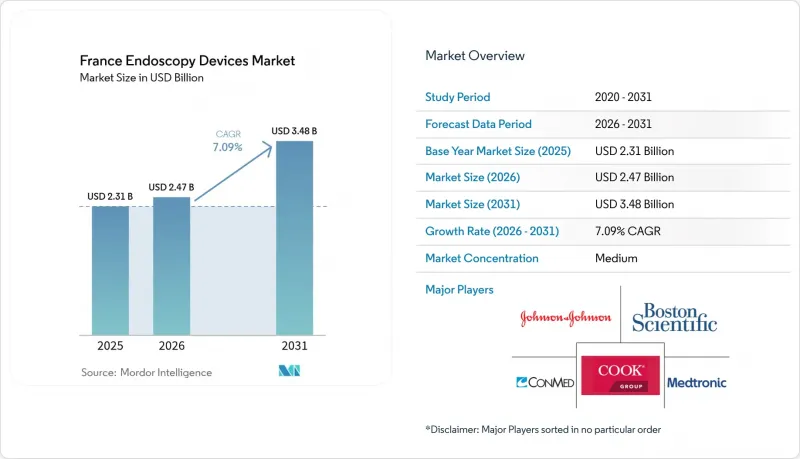
Mordor Intelligence에 따르면 프랑스의 내시경 기기 시장 규모는 2025년에 23억 1,000만 달러로 평가되며, 2026년 24억 7,000만 달러에서 2031년까지 34억 8,000만 달러에 달할 것으로 예측되고 있으며, 예측 기간(2026-2031년)에 CAGR은 7.09%에 달할 전망입니다.
이 보고서는 기기 유형(내시경, 영상 진단 장치, 수술용 기기, 부속품·소모품),용도(소화기내과, 호흡기내과, 순환기내과, 이비인후과, 산부인과, 신경내과 등), 최종사용자(공립 병원, 사립 병원·클리닉 등), 사용 형태(재처리 가능한 내시경 등)별로 분류되어 있습니다. 시장 예측은 금액(달러) 기준으로 제시되어 있습니다.
프랑스 내시경 기기 시장의 동향 및 인사이트
정부의 암 예방 전략이 진단용 내시경 수요를 견인
프랑스의 2025-2030년 암 대책 계획에서는 조기 발견이 우선시되고 있으며, 이에 따라 병원에서는 영상 진단 플랫폼의 업그레이드와 소장 캡슐 내시경 검사 프로그램의 확대가 진행되고 있습니다. 현재 연간 2만 4,000건 이상의 캡슐 내시경 검사가 시행되고 있으며, 치료의 범용성보다는 진단 정확도가 중시되고 있음을 알 수 있습니다. 가치 기반 조달 기준에서는 발견부터 치료까지의 기간을 단축하는 시스템이 높이 평가되며, 예산은 병변 누락률을 낮추는 AI 지원 대장내시경 검사에 배정되고 있습니다. 제품 포트폴리오를 선별 프로토콜에 부합시킨 공급업체는 입찰 승인을 더 신속하게 얻을 수 있으며, 이를 통해 고해상도 영상 진단 기술의 전국적인 보급이 촉진되고 있습니다. 도시 지역의 종양학 거점에서는 지방 거점에 비해 장비 교체 주기가 2년 더 짧은 것으로 보고되고 있으며, 이는 예방 중심의 의료 경로에서 프랑스 내시경 장비 시장을 지원하는 표적형 자금 지원을 반영한 것입니다.
민간 의료보험 보급률 상승이 고가 기기 구매를 촉진
현재 보완보험은 국민 의료비의 14%를 부담하고 있으며, 이에 따라 민간 의료기관은 4K 내시경 타워나 클라우드 기반 분석 스위트를 우선적으로 도입할 수 있게 되었습니다. 민간 의료 기관의 AI 강화 시스템 도입률은 공공 의료 기관의 2.3배에 달하며, 제조사가 자금 조달 모델에 따라 제품을 세분화하는 ‘양극화된 시장’이 형성되고 있습니다. 환자 선호도 조사에 따르면 AI를 활용한 진단을 받기 위해 먼 곳까지 방문하려는 의향이 높아지고 있으며, 민간 투자의 기세를 더욱 지원하고 있습니다. 이에 반해, 공공 구매 기관은 지불을 진단 성과에 연동시키는 위험 분담 계약을 협상함으로써 대응하고 있으며, 기술 격차는 서서히 줄어들고 있습니다. 상환 인센티브와 의료기관의 차별화 사이의 선순환이 프랑스 내시경 기기 시장 전체의 프리미엄 성장을 지원하고 있습니다.
국가 예산 압박 하에 있는 높은 자본 비용과 운영 비용
2025년 진단 관련 그룹(DRG) 요금 개정은 의료기기의 물가 상승률을 따라가지 못해, 공립 병원은 기기의 수명을 2.3년 연장할 수밖에 없게 되었습니다. 이에 대응하여 41%의 의료기관은 자원을 효율적으로 활용하기 위해 검사 적응 기준을 엄격화했습니다. 이로 인해 도입된 기기의 노후화가 장기화되고, AI 대응 플랫폼 도입이 더뎌지면서 민간 자금을 활용한 의료기관과의 기술 격차가 발생하고 있습니다. 공급업체 측은 모듈식 업그레이드나 검사 건수에 따라 비용을 분산시키는 사용량 기반 금융을 제공함으로써 대응하고 있습니다. 그러나 지속적인 재정적 압박으로 인해 프랑스 내시경 기기 시장에서 자본 집약형 타워형 장치의 단기적인 상승 여력은 제한적입니다.
부문 분석
2025년, 프랑스 내시경 기기 시장에서 내시경 카테고리는 시장의 40.72%를 차지했습니다. 이는 소화기 및 호흡기 계통 시술에서의 광범위한 사용에 힘입은 결과입니다. 감염 예방의 우선순위가 높은 단가를 상쇄함에 따라 일회용 내시경은 현재 17.2%의 연평균 성장률(CAGR)을 기록하며 재사용 가능한 모델을 크게 앞지르고 있습니다. 조사에 따르면 지침을 준수하고 있음에도 불구하고 재처리된 내시경의 30%에서 잔류 생물 부하가 확인되어, 멸균 포장된 대체 제품에 대한 수요가 증가하고 있습니다. 시각화 기기는 매출 기준 2위를 차지하고 있으며, 병변 특성 평가를 자동화하고 지속적인 학습 알고리즘을 구동하는 데이터 레이크에 데이터를 공급하는 AI 오버레이 모듈에 힘입고 있습니다. 수술용 기기는 Micro-Tech사가 Creo Medical사의 자산을 인수하여 에너지 기반 절제 툴 라인업을 확충함에 따라 성장세를 보이고 있습니다. 부속품 및 소모품은 안정적이고 지속적인 수입원이 되고 있으며, 2024년 공공 입찰에서는 소화기 내시경용 일회용 제품에 273만 유로가 배정되었습니다. 이는 2024년 평균 유로-달러 환율을 적용해 환산하면 295만 달러에 해당합니다. 캡슐 내시경 플랫폼은 연간 약 2만 4,000건의 시술 건수를 기록하고 있으며, 틈새 시장이지만 착실히 보급이 진행되고 있음을 보여줍니다. 프랑스 내시경 기기 시장 규모는 일회용 제품의 보급이 가속화되고, 규모의 경제에 따라 비용 격차가 축소됨에 따라 확대될 것으로 예측됩니다.
수요의 가속화는 재사용과 일회용 제품 라인을 모두 보유한 제조사에 유리하게 작용하며, 병원이 진료 내용에 따라 장비 구성을 최적화할 수 있게 해줍니다. 올림푸스와 후지필름은 AI 클라우드와 연동된 하이엔드 타워형 내시경에 주력하고 있는 반면, 앰브와 펜탁스는 재활용 노력과 연계한 일회용 제품 라인업을 확대하고 있습니다. 지속가능성에 대한 우려로 인해 탄소발자국을 비교하는 수명 주기 분석이 진행되고 있으며, 최근 조사 결과에 따르면 일회용 위내시경은 주로 제조 단계에서 재사용 가능한 제품에 비해 2.5배 더 많은 CO₂를 배출하는 것으로 밝혀졌습니다. 이에 따라 시장을 선도하는 기업은 환경적 비판을 완화할 수 있는 바이오 기반 핸들 및 폐쇄형 재활용 시범 사업을 추진하고 있습니다. 이러한 변화들은 종합적으로 볼 때, 감염 예방, 데이터 통합, 친환경 설계가 어우러져 프랑스 내시경 기기 시장의 다음 장을 이끌어 갈 것임을 시사합니다.
2025년, 프랑스 내시경 기기 시장 규모의 54.12%를 소화기내과 분야가 차지하고 있으며, 이는 대장암 검진 건수가 많고 치료적 개입이 확대되고 있음을 반영합니다. AI를 활용한 용종 탐지 모듈의 조기 도입으로 선종 발견률이 향상되었으며, 이는 병원의 고해상도 대장내시경 투자를 촉진했습니다. 2024년 4월 ASGE-ESGE 지침에 따라 BMI가 30kg/m² 이상인 환자에 대한 적응 범위가 확대됨에 따라 비만·대사 내시경 검사가 탄력을 받고 있으며, 이는 내시경 타워의 이용 증가를 촉진하고 있습니다. 호흡기 분야의 용도는 첨단 기관지경 내비게이션, 냉동 생검, 그리고 말초 병변 치료를 대상으로 하는 로봇 플랫폼을 통해 연평균 성장률(CAGR) 8.72%라는 가장 빠른 성장 궤적을 기록하고 있습니다. 국제 조사에 따르면 중재적 호흡기 전문의의 58%가 2년 이내에 새로운 기관지경 기술을 도입할 의사를 보이고 있으며, 견실한 파이프라인이 부각되고 있습니다.
대장암 검진 분야에서는 대변 면역화학 검사에서 양성 판정을 받은 환자에게 30일 이내에 대장내시경 검사를 받도록 권장하는 전국적인 캠페인의 혜택을 받아, 외래 진료 시설의 검사 처리 능력이 향상되고 있습니다. 비뇨기과 분야는 Ambu사가 멸균 워크플로우를 간소화하는 일회용 요관경 및 방광경을 출시함에 따라 시장이 확대되고 있습니다. 이비인후과 및 산부인과는 규모는 작지만 안정적이며, 진료소 환경에서도 뛰어난 해상도를 구현하는 소형 비디오 칩에 의해 지원되고 있습니다. 프랑스의 내시경 기기 시장에서 소화기내과가 차지하는 점유율은 호흡기내과 및 비만 치료의 적응증이 확대됨에 따라 점차 축소될 전망이지만, 소화기 내시경 검사의 절대적인 시행 건수는 계속해서 증가하고 있습니다.
기타 혜택:
- 엑셀 형식의 시장 예측(ME) 시트
- 3개월간의 애널리스트 지원
자주 묻는 질문
목차
제1장 서론
제2장 조사 방법
제3장 개요
제4장 시장 구도
제5장 시장 규모와 성장 예측
제6장 경쟁 구도
제7장 시장 기회와 향후 전망
KSA 26.09.03According to Mordor Intelligence, the France endoscopy devices market size was valued at USD 2.31 billion in 2025 and estimated to grow from USD 2.47 billion in 2026 to reach USD 3.48 billion by 2031, at a CAGR of 7.09% during the forecast period (2026-2031).
This report is Segmented by Device Type (Endoscopes, Visualization Equipment, Operative Devices, and Accessories & Consumables), Application (Gastroenterology, Pulmonology, Cardiology, ENT Surgery, Gynecology, Neurology, and More), End User (Public Hospitals, Private Hospitals & Clinics, and More), Usage (Reprocessable Endoscopes, and More). The Market Forecasts are Provided in Terms of Value (USD).
France Endoscopy Devices Market Trends and Insights
Government Cancer-Prevention Strategy Elevating Demand for Diagnostic Endoscopy
France's 2025-2030 cancer plan prioritizes early detection, prompting hospitals to upgrade visualization platforms and expand small-bowel capsule programs. More than 24,000 capsule procedures are now performed annually, underscoring a preference for diagnostic accuracy over therapeutic versatility. Value-based procurement criteria reward systems that shorten detection-to-treatment intervals, redirecting budgets toward AI-assisted colonoscopy that cuts missed-lesion rates. Vendors that align portfolios with screening protocols gain faster tender approvals, reinforcing the nationwide rollout of high-definition imaging. Urban oncology hubs report equipment renewal cycles two years shorter than rural peers, reflecting targeted financing that supports the France endoscopy devices market in prevention-led pathways.
Rising Private Health-Insurance Penetration Fuelling Premium Device Purchases
Complementary insurance now covers 14% of national health spending, enabling private facilities to prioritize 4K endoscopy towers and cloud-based analytics suites. Acquisition rates for AI-enhanced systems in private centers outpace the public sector by 2.3:1, creating a two-speed market where manufacturers segment offerings by funding model. Patient preference surveys show a growing willingness to travel for AI-guided diagnostics, reinforcing private investment momentum. Public purchasers respond by negotiating risk-sharing contracts that tie payments to diagnostic yield, gradually narrowing the technology gap. The virtuous cycle between reimbursement incentives and facility differentiation anchors premium growth across the France endoscopy devices market.
High Capital & Operating Costs Under National Budget Pressure
The 2025 Diagnosis Related Group tariff update trailed device inflation, forcing public hospitals to prolong equipment life cycles by 2.3 years. Forty-one percent of facilities responded by tightening procedural appropriateness thresholds to stretch resources. This prolongs installed-base aging and slows uptake of AI-ready platforms, creating a technology gap against privately funded peers. Suppliers counter by offering modular upgrades and usage-based financing that spread cost over procedure volume. Sustained fiscal pressure nevertheless caps near-term upside for capital-intensive towers within the France endoscopy devices market.
Other drivers and restraints analyzed in the detailed report include:
- Migration of Elective Procedures to Outpatient & Day-Surgery Settings
- Technological Convergence of HD Imaging, Robotics & AI Elevating Clinical Outcomes
- Lengthy EU-MDR Regulatory Pathway Slowing Market Entry
For complete list of drivers and restraints, kindly check the Table Of Contents.
Segment Analysis
The endoscopes category accounted for 40.72% of the France endoscopy devices market in 2025, anchored by widespread use in digestive and respiratory procedures. Disposable scopes now record a 17.2% CAGR, well ahead of reusable models, as infection-control priorities outweigh unit-price premiums. Studies revealed residual bioburden on 30% of reprocessed scopes despite guideline adherence, intensifying calls for sterile-packed alternatives. Visualization equipment ranks second in revenue, buoyed by AI overlay modules that automate lesion characterization and feed data lakes powering continuous-learning algorithms. Operative devices enjoy momentum after Micro-Tech's purchase of Creo Medical assets, which broadened its energy-based resection tools. Accessories and consumables provide stable recurring streams, with public tenders allocating EUR 2.73 million for digestive endoscopy disposables in 2024, equal to USD 2.95 million using the 2024 average EUR-USD rate. Capsule platforms complete the mix with roughly 24,000 annual procedures, underscoring niche yet steady adoption. The France endoscopy devices market size for endoscopes is projected to widen as single-use uptake accelerates, narrowing cost differentials via economies of scale.
Demand acceleration favors manufacturers that control both reusable and disposable lines, enabling hospitals to tailor fleets by service mix. Olympus and Fujifilm focus on high-end towers linked to AI clouds, whereas Ambu and Pentax expand single-use catalogs paired with recycling initiatives. Sustainability concerns prompt life-cycle analyses comparing carbon footprints; recent findings note single-use gastroscopes emit 2.5 times more CO2 than reusable counterparts, mainly in the production phase. Market leaders therefore pilot bio-based handles and closed-loop recycling that could offset environmental criticism. Cumulatively, these shifts underscore how infection prevention, data integration and eco-design will jointly steer the next chapter of the France endoscopy devices market.
Gastroenterology controlled 54.12% of the France endoscopy devices market size in 2025, reflecting high colorectal cancer screening volumes and expanded therapeutic interventions. Early adoption of AI polyp-detection modules increased adenoma-find rates, reinforcing hospital investment in high-resolution colonoscopes. Bariatric and metabolic endoscopy gains traction under April 2024 ASGE-ESGE guidelines that widened eligibility to patients with BMI >= 30 kg/m2, fueling incremental tower utilization. Pulmonology applications record the fastest trajectory at a 8.72% CAGR as advanced bronchoscopic navigation, cryobiopsy and robotic platforms target peripheral lesions. An international survey showed 58% of interventional pulmonologists intend to acquire new bronchoscopic technology within two years, highlighting a robust pipeline.
Colorectal cancer screening benefits from national campaigns that push fecal immunochemical test positives to colonoscopy within thirty days, hiking procedural throughput at ambulatory units. Urology broadens as Ambu launches single-use ureteroscopes and cystoscopes that simplify sterile workflow. ENT and gynecology remain smaller but stable, supported by compact video chips that deliver superior image resolution in office settings. The France endoscopy devices market share held by gastroenterology will gradually erode as pulmonology and bariatric indications expand, yet absolute volume in digestive endoscopy continues to rise.
Complete Report Scope:
- By Device Type
- Endoscopes
- Rigid Endoscopes
- Flexible Endoscopes
- Capsule Endoscopes
- Disposable / Single-Use Endoscopes
- Robot-Assisted Endoscopes
- Visualization Equipment
- Endoscopy Cameras
- Image Processors & Light Sources
- 3-D / 4-K Display & Recording Systems
- Operative Devices
- Endotherapy & Energy Systems
- Insufflators & Irrigation Pumps
- Accessories & Consumables
- Endoscopes
- By Application
- Gastroenterology
- Pulmonology
- Orthopedic (Arthroscopy)
- Cardiology
- ENT Surgery
- Gynecology
- Neurology
- Urology
- Bariatric & Colorectal Cancer Screening
- Other Applications
- By End User
- Hospitals
- Ambulatory Surgery Centres
- Out-Patient Diagnostic Facilities
- By Usage
- Reusable / Reprocessable Endoscopes
- Single-Use / Disposable Endoscopes
- Reprocessing Equipment & Consumables
List of Companies Covered in this Report:
- Olympus
- Karl Storz
- Boston Scientific
- FUJIFILM
- Medtronic
- Johnson & Johnson
- Stryker
- Conmed
- Cook Group
- Smith + Nephew plc
- Ambu
- Pentax Medical
- Richard Wolf
- B. Braun
- Zimmer Biomet
- Arthrex
- Cantel Medical
- EndoMedical Innovations SA
- Laborie Medical Technologies
- Erbe Elektromedizin
Additional Benefits:
- The market estimate (ME) sheet in Excel format
- 3 months of analyst support
TABLE OF CONTENTS
1 Introduction
- 1.1 Study Assumptions & Market Definition
- 1.2 Scope of the Study
2 Research Methodology
3 Executive Summary
4 Market Landscape
- 4.1 Market Overview
- 4.2 Market Drivers
- 4.2.1 Government Cancer-Prevention Strategy Elevating Demand for Diagnostic Endoscopy
- 4.2.2 Rising Private Health-Insurance Penetration Fuelling Premium Device Purchases
- 4.2.3 Migration of Elective Procedures to Outpatient & Day-Surgery Settings
- 4.2.4 Technological Convergence of HD Imaging, Robotics & AI Elevating Clinical Outcomes
- 4.2.5 Ageing Demographics & Burden of Chronic GI and Respiratory Diseases
- 4.3 Market Restraints
- 4.3.1 High Capital & Operating Costs Under National Budget Pressure
- 4.3.2 Lengthy EU-MDR Regulatory Pathway Slowing Market Entry
- 4.3.3 Preference for Refurbished Equipment in Secondary Hospitals
- 4.4 Regulatory Outlook
- 4.5 Porter's Five Forces
- 4.5.1 Threat of New Entrants
- 4.5.2 Bargaining Power of Buyers
- 4.5.3 Bargaining Power of Suppliers
- 4.5.4 Threat of Substitutes
- 4.5.5 Competitive Rivalry
5 Market Size & Growth Forecasts (Value, USD)
- 5.1 By Device Type
- 5.1.1 Endoscopes
- 5.1.1.1 Rigid Endoscopes
- 5.1.1.2 Flexible Endoscopes
- 5.1.1.3 Capsule Endoscopes
- 5.1.1.4 Disposable / Single-Use Endoscopes
- 5.1.1.5 Robot-Assisted Endoscopes
- 5.1.2 Visualization Equipment
- 5.1.2.1 Endoscopy Cameras
- 5.1.2.2 Image Processors & Light Sources
- 5.1.2.3 3-D / 4-K Display & Recording Systems
- 5.1.3 Operative Devices
- 5.1.3.1 Endotherapy & Energy Systems
- 5.1.3.2 Insufflators & Irrigation Pumps
- 5.1.4 Accessories & Consumables
- 5.1.1 Endoscopes
- 5.2 By Application
- 5.2.1 Gastroenterology
- 5.2.2 Pulmonology
- 5.2.3 Orthopedic (Arthroscopy)
- 5.2.4 Cardiology
- 5.2.5 ENT Surgery
- 5.2.6 Gynecology
- 5.2.7 Neurology
- 5.2.8 Urology
- 5.2.9 Bariatric & Colorectal Cancer Screening
- 5.2.10 Other Applications
- 5.3 By End User
- 5.3.1 Hospitals
- 5.3.2 Ambulatory Surgery Centres
- 5.3.3 Out-Patient Diagnostic Facilities
- 5.4 By Usage
- 5.4.1 Reusable / Reprocessable Endoscopes
- 5.4.2 Single-Use / Disposable Endoscopes
- 5.4.3 Reprocessing Equipment & Consumables
6 Competitive Landscape
- 6.1 Market Concentration
- 6.2 Market Share Analysis
- 6.3 Company Profiles (includes Global level Overview, Market level overview, Core Business Segments, Financials, Headcount, Key Information, Market Rank, Market Share, Products and Services, and analysis of Recent Developments)
- 6.3.1 Olympus Corporation
- 6.3.2 Karl Storz SE & Co. KG
- 6.3.3 Boston Scientific Corporation
- 6.3.4 Fujifilm Holdings Corporation
- 6.3.5 Medtronic plc
- 6.3.6 Johnson & Johnson (Ethicon)
- 6.3.7 Stryker Corporation
- 6.3.8 Conmed Corporation
- 6.3.9 Cook Medical LLC
- 6.3.10 Smith + Nephew plc
- 6.3.11 Ambu A/S
- 6.3.12 Pentax Medical (Hoya)
- 6.3.13 Richard Wolf GmbH
- 6.3.14 B. Braun Melsungen AG
- 6.3.15 Zimmer Biomet Holdings Inc.
- 6.3.16 Arthrex Inc.
- 6.3.17 Cantel Medical (Steris)
- 6.3.18 EndoMedical Innovations SA
- 6.3.19 Laborie Medical Technologies
- 6.3.20 Erbe Elektromedizin GmbH
7 Market Opportunities & Future Outlook
- 7.1 White-Space & Unmet-Need Assessment