|
시장보고서
상품코드
2122169
에너지 저장 : 시장 점유율 분석, 업계 동향과 통계, 성장 예측(2026-2031년)Energy Storage - Market Share Analysis, Industry Trends & Statistics, Growth Forecasts (2026 - 2031) |
||||||
 Mordor Intelligence
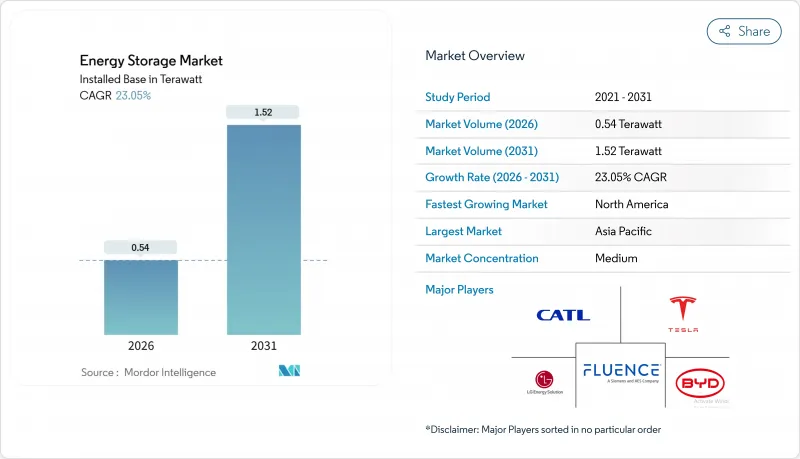
Mordor Intelligence에 따르면 설치 기반에서 에너지 저장 시장 규모는 2026년 0.54 테라와트에서 2031년까지 1.52 테라와트로 확대하며, 예측 기간(2026-2031년)에 CAGR은 23.05%에 달할 것으로 전망되고 있습니다.
이 보고서는 기술별(배터리, 양수 발전, 열 에너지 저장, 압축 공기 에너지 저장, 액체 공기/극저온 저장, 플라이휠 에너지 저장 등),연결 형태별(계통 연계형 및 독립형), 용도별(그리드 규모 전력 사업, 주거용 계량기 후방 시스템 등), 그리고 지역별(북미, 유럽, 아시아태평양, 남미, 중동 및 아프리카)로 분류되어 있습니다.
세계 에너지 저장 시장의 동향 및 인사이트
LFP 배터리의 급격한 비용 하락이 6시간 이상의 BESS 도입을 촉진
2025년 말에는 고정형 리튬철인산염(LFP) 배터리의 가격이 전년의 1kWh당 115달러에서 70달러로 하락했습니다. 이로 인해 피크 시간대와 비피크 시간대의 가격 차이가 1MWh당 40달러를 초과하는 지역에서는 6시간 및 8시간 저장 시스템이 비용 면에서 천연가스 피크 발전보다 더 유리해졌습니다. 2025년 CATL이 나트륨 이온 배터리의 상용 판매를 시작하면서, 한랭 지역용 저비용 대안이 전력 회사에 제공되어 가격 압박이 더욱 가중되었습니다. 캘리포니아주의 전력 회사들은 상원 법안 100(Senate Bill 100)의 목표에 따라 노후화된 가스터빈 발전소를 대체하기 위해 2025년 중 3.2GW 규모의 6시간형 에너지 저장 시스템 계약을 체결했습니다. 텍사스주 ERCOT에서는 2025년에 2.1 GW 규모의 머천트형 에너지 저장 설비가 상업 운전(COD)을 시작했습니다. 이는 1 MWh당 200달러를 초과하는 여름철 가격 급등을 활용하기 위한 것입니다. IEC 62619 안전 인증과 관련된 준수 비용은 1kWh당 5-8달러가 추가되지만, 수익을 창출할 수 있는 시간이 4시간에서 6시간으로 확대됨에 따라 이익률은 여전히 견고합니다.
그리드 규모의 인센티브 제도(IRA, EU RED III, 중국의 장시간 에너지 저장 의무화)
2032년까지 유효한 미국 ‘인플레이션 억제법(IRA)’의 독립형 에너지 저장 시스템에 대한 30% 투자 세액 공제(ITC)에 힘입어, 2025년에는 텍사스주,애리조나주, 네바다주의 프로젝트를 필두로, 유틸리티 규모의 자금 조달에서 120억 달러가 동원되었습니다. 2025년 중반까지 각국의 국내법에 반영된 유럽의 RED III 지침은 2030년까지 재생에너지 비중을 42.5%로 높이기 위해 회원국들에게 계통 유연성 자산을 확보할 것을 의무화하고 있습니다. 독일만 해도 10GW의 설비 확충을 위해 5억 유로(5억 4,500만 달러)를 예산에 편성했습니다. 중국은 2027년까지 180GW 규모의 장기 에너지 저장 설비 도입을 의무화하고 있으며, 2024년 말 기준으로 73.76GW가 가동 중이었으나 106GW의 격차가 남아 있으며, 이것이 압축 공기식, 양수 발전 및 수소 프로젝트를 추진하는 원동력이 되고 있습니다.
적절한 저수지 부지 부족으로 신규 양수 발전 제한
유럽과 일본에서는 지형 및 환경적 장벽이 새로운 양수 발전 프로젝트의 확장을 방해하고 있으며, 2020-2025년에 EU 전체의 신규 도입량은 고작 1.2기가와트에 그친 반면, 축전지는 28기가와트 증가했습니다. ‘나투라 2000’에 따른 서식지 보호, 지진 위험 지역 지정, 그리고 10년에 달하는 허가 절차의 장기화가 투자자들을 압축 공기나 수소와 같은 대체 기술로 돌리고 있습니다. 미국에서는 연방에너지규제위원회(FERC)가 2024-2025년에 접수한 허가 신청 건수가 고작 12건에 그쳤습니다. 이는 12년 전 40건에 비해 대폭 감소한 수치입니다. 호주의 ‘스노위 2.0’ 프로젝트에서는 2025년에 20억 호주 달러(13억 달러)의 예산 초과가 발생하며, 터널 굴착에 수반되는 위험이 부각되었습니다.
부문별 분석
2025년 에너지 저장 시장 규모 중 53.84%를 배터리가 차지했습니다. 이는 LFP(인산철리튬) 및 증가 추세를 보이는 나트륨 이온 배터리의 출하량이 주도한 결과입니다. 한편, 전력 회사들이 100시간의 계절 조정용 자원을 필요로 하고 있으며, 수소 저장 시장은 2031년까지 연평균 성장률(CAGR) 38.50%로 확대될 것으로 예측됩니다. 양수 발전, 용융염 축열 탱크, 압축 공기, 액체 공기, 플라이휠, 중력식 시스템은 합쳐서 46.16%의 점유율을 차지하고 있으며, 수일 단위의 기술이 비용 격차를 좁혀가고 있음에도 불구하고 전기화학식 축전 시스템이 단기 사이클의 수익을 주도하고 있습니다.
고체 리튬 배터리는 여전히 시범 생산 단계에 머물러 있으며, 납축전지는 통신 분야 및 가정용 백업 시장에서 점유율이 하락하고 있습니다. 또한 플로우 배터리는 전해액의 휘발성 문제로 인해 시장 침투율이 3% 미만을 기록하는 상황이 지속되고 있습니다. 미쓰비시 전력의 유타주 수소 저장 동굴과 하이뷰 파워의 극저온 플랜트는 상업적 실현 가능성을 보여주고 있으나, kWh당 400달러를 초과하는 높은 자본 집약도로 인해 주류로 보급되는 데는 한계가 있습니다. 그럼에도 규모 확대가 진행됨에 따라 누적 비용 곡선은 수렴하고 있으며, 2031년 이후에는 장시간 축전 기술의 경쟁 제품들이 에너지 저장 시장에서 더 큰 점유율을 확보할 것으로 전망됩니다.
지역별 분석
2025년, 아시아태평양은 중국의 73.76GW 도입 실적에 힘입어 전 세계 용량의 45.11%를 차지했으나, 정책의 중점이 단순한 용량 확대에서 이용 효율로 전환됨에 따라 성장은 둔화되고 있습니다. 2025년 인도의 4.2GW 신규 도입은 8 GW의 태양광발전과 2GW의 4시간 에너지 저장 시스템을 세트로 한 입찰에 의한 것이었습니다. 한편, 일본과 한국은 부지가 제한된 시장에서 주파수 조절이라는 틈새 분야에 주력했습니다.
북미는 성장 속도 면에서 선두를 달리고 있으며, ‘인플레이션 억제법’과 각 주의 규제가 시너지 효과를 발휘하는 가운데 2031년까지 연평균 성장률(CAGR) 33.47%로 확대될 것으로 예측됩니다. 미국에서는 2025년에 9.4GW가 증설될 예정이며, 그 총량의 75% 가까이를 텍사스주와 캘리포니아주가 차지하고, 캐나다의 앨버타주와 온타리오주도 그 뒤를 잇고 있습니다. 멕시코의 1.2GW 태양광발전 및 에너지 저장 입찰은 현재 규제 당국의 심사를 받고 있으나, 정책이 명확해지면 잠재적인 성장 여지가 있음을 시사합니다.
유럽에서는 2025년에 5.1GW가 도입되었습니다. 이는 독일의 5억 유로 규모 연방 보조금 프로그램과 영국의 저장 시장내 15년 계약이 지원한 결과입니다. 스페인과 프랑스는 재생에너지 입찰에 에너지 저장 시스템을 포함시켰으며, 북유럽 국가들은 주파수 안정화 서비스를 수익화하기 위해 확장되는 데이터센터 클러스터에 BESS(배터리 에너지 저장 시스템)를 도입했습니다. 중동 및 아프리카는 1.6GW를 기여했으며, UAE와 사우디아라비아가 사막 기후에 적합한 열식 및 압축 공기식 에너지 저장 기술을 우선적으로 도입하는 데 앞장섰습니다. 남미에서는 주로 브라질과 칠레에서 1.3GW가 도입되었으며, 안정적인 공급 능력을 조건으로 하는 입찰 체계가 이 지역의 주요 추진력으로 자리 잡고 있음을 보여줍니다.
기타 혜택:
- 엑셀 형식의 시장 예측(ME) 시트
- 3개월간의 애널리스트 지원
자주 묻는 질문
목차
제1장 서론
제2장 조사 방법
제3장 개요
제4장 시장 구도
제5장 시장 규모와 성장 예측
제6장 경쟁 구도
제7장 시장 기회와 향후 전망
KSA 26.09.04According to Mordor Intelligence, the energy storage market size in terms of installed base is expected to grow from 0.54 Terawatt in 2026 to 1.52 Terawatt by 2031, at a CAGR of 23.05% during the forecast period (2026-2031).
This report is Segmented by Technology (Batteries, Pumped-Storage Hydroelectricity, Thermal Energy Storage, Compressed Air Energy Storage, Liquid Air/Cryogenic Storage, Flywheel Energy Storage, and More), Connectivity (On-Grid and Off-Grid), Application (Grid-Scale Utility, Residential Behind-The-Meter, and More), and Geography (North America, Europe, Asia-Pacific, South America, and Middle East and Africa).
Global Energy Storage Market Trends and Insights
Rapid LFP Battery Cost Declines Driving above 6-Hour BESS Adoption
Stationary-grade lithium-iron-phosphate cell prices slid to USD 70 per kWh in late 2025, down from USD 115 a year earlier, enabling six-hour and eight-hour installations to beat natural-gas peakers wherever peak-to-off-peak spreads exceed USD 40 per MWh. CATL's commercial launch of sodium-ion cells in 2025 added extra price pressure by offering utilities a lower-cost option for cold-weather regions. California utilities awarded 3.2 GW of six-hour contracts during 2025 to replace retiring gas turbines under Senate Bill 100 targets. Texas ERCOT saw 2.1 GW of merchant storage reach COD in 2025, aimed at exploiting summer price spikes that crest above USD 200 per MWh. Compliance costs tied to IEC 62619 safety certification add USD 5-8 per kWh, yet margins remain robust because the revenue window has widened from four to six hours.
Grid-Scale Incentive Schemes (IRA, EU RED III, China Long-Duration Mandate)
The U.S. Inflation Reduction Act's 30% standalone storage ITC, in force through 2032, unlocked USD 12 billion of utility-scale financing in 2025, led by projects in Texas, Arizona, and Nevada. Europe's RED III directive, transposed into national law by mid-2025, obliges member states to secure grid-flexibility assets to reach a 42.5% renewables share by 2030; Germany alone earmarked EUR 500 million (USD 545 million) for a 10 GW build-out. China mandated 180 GW of long-duration storage by 2027 and had 73.76 GW online at end-2024, leaving a 106 GW gap that is propelling compressed-air, pumped-hydro, and hydrogen projects.
Scarcity of Suitable Reservoir Sites Limiting New Pumped Hydro
Europe and Japan face topographical and environmental hurdles that curtail new pumped-hydro projects, holding additions to just 1.2 GW across the EU between 2020 and 2025, while batteries added 28 GW. Natura 2000 habitat protections, seismic risk zoning, and decade-long permitting cycles are steering investors toward compressed-air and hydrogen alternatives. In the U.S., the Federal Energy Regulatory Commission received only 12 license applications during 2024-2025 versus 40 twelve years earlier. Australia's Snowy 2.0 overrun of AUD 2 billion (USD 1.3 billion) in 2025 underscored tunneling risks.
Other drivers and restraints analyzed in the detailed report include:
- Mandatory GCC Renewable-Integration Targets Boosting Thermal & CAES
- Data-Center Power-Quality Demands Spurring Flywheel & BESS
- Vanadium/Zinc Electrolyte Supply Volatility Hindering Flow-Battery Scale-Up
For complete list of drivers and restraints, kindly check the Table Of Contents.
Segment Analysis
Batteries accounted for 53.84% of the 2025 energy storage market size, anchored by LFP and growing sodium-ion volumes, while hydrogen storage is forecast to expand at a 38.50% CAGR through 2031 as utilities seek 100-hour seasonal balancing resources. Pumped hydro, thermal molten-salt tanks, compressed-air, liquid-air, flywheel, and gravity systems collectively held a 46.16% share, positioning electrochemical providers to dominate short-cycle revenues even as multi-day technologies close the cost gap.
Solid-state lithium remains confined to pilot lines, lead-acid is losing share in telecom and residential backup, and flow batteries languish below 3% market penetration because of electrolyte volatility. Mitsubishi Power's Utah hydrogen cavern and Highview Power's cryogenic plant showcase commercial viability, but capital intensity above USD 400 per kWh limits mainstream uptake. Nonetheless, cumulative cost curves are converging as scale-up proceeds, suggesting long-duration challengers will secure greater energy storage market share beyond 2031.
Complete Report Scope:
- By Technology
- Batteries (Lithium-ion, Solid-State Li, Sodium-ion, Lead-acid, Sodium-Sulfur, and Flow Batteries (Vanadium, Zinc-Bromine))
- Pumped-Storage Hydroelectricity
- Thermal Energy Storage (Sensible Heat (Molten Salt, Water), Latent Heat (Phase-Change Materials), Thermochemical)
- Compressed Air Energy Storage
- Liquid Air/Cryogenic Storage
- Flywheel Energy Storage
- Gravity-Based Storage
- Hydrogen-Based Storage (Power-to-H2-to-Power)
- Other Emerging Technologies (Iron-Air, Zinc-Air)
- By Connectivity
- On-Grid
- Off-Grid
- By Application
- Grid-Scale Utility (Front-of-Meter)
- Residential Behind-the-Meter
- Commercial and Industrial Behind-the-Meter
- Data Centers and Critical Facilities
- Remote and Off-Grid/Microgrids
- Others (Transportation and Rail Electrification, EV-Charging Infrastructure, Transmission and Distribution Deferral)
- By Geography
- North America
- United States
- Canada
- Mexico
- Europe
- United Kingdom
- Germany
- France
- Spain
- Nordic Countries
- Russia
- Rest of Europe
- Asia-Pacific
- China
- India
- Japan
- South Korea
- ASEAN Countries
- Rest of Asia-Pacific
- South America
- Brazil
- Argentina
- Colombia
- Rest of South America
- Middle East and Africa
- United Arab Emirates
- Saudi Arabia
- South Africa
- Egypt
- Rest of Middle East and Africa
- North America
Geography Analysis
Asia-Pacific possessed 45.11% of global capacity in 2025 owing to China's 73.76 GW installed base, yet growth is moderating as policy emphasis migrates from pure capacity to utilization efficiency. India's 4.2 GW of 2025 additions stemmed from tenders that bundled eight GW of solar with two GW of four-hour storage, while Japan and South Korea focused on frequency-regulation niches within land-constrained markets.
North America is the velocity leader, forecast to advance at a 33.47% CAGR through 2031 as the Inflation Reduction Act and state mandates converge. The United States added 9.4 GW in 2025, with Texas and California accounting for nearly 75% of that total, and Canada's Alberta and Ontario provinces following suit. Mexico's 1.2 GW solar-plus-storage tender remains in regulatory review, signaling latent upside once policy clarity improves.
Europe installed 5.1 GW in 2025, spurred by Germany's EUR 500 million federal grant program and the UK capacity market's 15-year contracts. Spain and France integrated storage into renewable auctions, and Nordic countries embedded BESS in expanding data-center clusters to monetize frequency-containment services. The Middle East and Africa contributed 1.6 GW, with the UAE and Saudi Arabia leading deployments that favor thermal and compressed-air chemistries suited for desert climates. South America's 1.3 GW, mostly in Brazil and Chile, shows that auction frameworks contingent on firm capacity are becoming the region's primary accelerator.
- Contemporary Amperex Technology Co. Ltd. (CATL)
- LG Energy Solution Ltd.
- Tesla Inc.
- BYD Co. Ltd.
- Fluence Energy Inc.
- Wartsila Energy
- Siemens Gamesa Renewable Energy
- GS Yuasa Corporation
- NGK Insulators Ltd.
- Samsung SDI Co. Ltd.
- General Electric (Vernova)
- ABB Ltd.
- Hitachi Energy Ltd.
- Eaton Corporation
- Mitsubishi Power Americas
- AES Corporation
- Voith Hydro GmbH
- ANDRITZ AG
- Hydrostor Inc.
- Highview Powe
- Amber Kinetics Inc
Additional Benefits:
- The market estimate (ME) sheet in Excel format
- 3 months of analyst support
TABLE OF CONTENTS
1 Introduction
- 1.1 Study Assumptions & Market Definition
- 1.2 Scope of the Report
2 Research Methodology
3 Executive Summary
4 Market Landscape
- 4.1 Market Overview
- 4.2 Market Drivers
- 4.2.1 Rapid LFP Battery Cost Declines Driving >6-Hour BESS Adoption (Asia-Pacific)
- 4.2.2 Grid-Scale Incentive Schemes (IRA-US, EU RED III, China) Long-Duration Mandate
- 4.2.3 Mandatory GCC Renewable-Integration Targets Boosting Thermal & CAES
- 4.2.4 Data-Center Power-Quality Demands Spurring Flywheel & BESS (NA, Nordics)
- 4.2.5 EV-Charging Corridor Build-outs Requiring Stationary Storage
- 4.2.6 Corporate PPA Surge Triggering Behind-the-Meter Storage (EU, AUS)
- 4.3 Market Restraints
- 4.3.1 Scarcity of Suitable Reservoir Sites Limiting New Pumped Hydro (EU, JP)
- 4.3.2 Vanadium/Zinc Electrolyte Supply Volatility Hindering Flow-Battery Scale-up
- 4.3.3 Stringent Fire Codes (NFPA 855, IEC 62933) Raising Urban BESS CAPEX
- 4.3.4 Revenue-Stacking Uncertainty in Emerging Markets
- 4.4 Supply-Chain Analysis
- 4.5 Government Policies & Regulations
- 4.6 Technological Outlook
- 4.7 Energy Storage Price Trends & Forecast
- 4.8 Installed Capacity & Deployment Analysis
- 4.9 Porter's Five Forces
- 4.9.1 Bargaining Power of Suppliers
- 4.9.2 Bargaining Power of Buyers
- 4.9.3 Threat of New Entrants
- 4.9.4 Threat of Substitutes
- 4.9.5 Intensity of Competitive Rivalry
5 Market Size & Growth Forecasts
- 5.1 By Technology
- 5.1.1 Batteries (Lithium-ion, Solid-State Li, Sodium-ion, Lead-acid, Sodium-Sulfur, and Flow Batteries (Vanadium, Zinc-Bromine))
- 5.1.2 Pumped-Storage Hydroelectricity
- 5.1.3 Thermal Energy Storage (Sensible Heat (Molten Salt, Water), Latent Heat (Phase-Change Materials), Thermochemical)
- 5.1.4 Compressed Air Energy Storage
- 5.1.5 Liquid Air/Cryogenic Storage
- 5.1.6 Flywheel Energy Storage
- 5.1.7 Gravity-Based Storage
- 5.1.8 Hydrogen-Based Storage (Power-to-H2-to-Power)
- 5.1.9 Other Emerging Technologies (Iron-Air, Zinc-Air)
- 5.2 By Connectivity
- 5.2.1 On-Grid
- 5.2.2 Off-Grid
- 5.3 By Application
- 5.3.1 Grid-Scale Utility (Front-of-Meter)
- 5.3.2 Residential Behind-the-Meter
- 5.3.3 Commercial and Industrial Behind-the-Meter
- 5.3.4 Data Centers and Critical Facilities
- 5.3.5 Remote and Off-Grid/Microgrids
- 5.3.6 Others (Transportation and Rail Electrification, EV-Charging Infrastructure, Transmission and Distribution Deferral)
- 5.4 By Geography
- 5.4.1 North America
- 5.4.1.1 United States
- 5.4.1.2 Canada
- 5.4.1.3 Mexico
- 5.4.2 Europe
- 5.4.2.1 United Kingdom
- 5.4.2.2 Germany
- 5.4.2.3 France
- 5.4.2.4 Spain
- 5.4.2.5 Nordic Countries
- 5.4.2.6 Russia
- 5.4.2.7 Rest of Europe
- 5.4.3 Asia-Pacific
- 5.4.3.1 China
- 5.4.3.2 India
- 5.4.3.3 Japan
- 5.4.3.4 South Korea
- 5.4.3.5 ASEAN Countries
- 5.4.3.6 Rest of Asia-Pacific
- 5.4.4 South America
- 5.4.4.1 Brazil
- 5.4.4.2 Argentina
- 5.4.4.3 Colombia
- 5.4.4.4 Rest of South America
- 5.4.5 Middle East and Africa
- 5.4.5.1 United Arab Emirates
- 5.4.5.2 Saudi Arabia
- 5.4.5.3 South Africa
- 5.4.5.4 Egypt
- 5.4.5.5 Rest of Middle East and Africa
- 5.4.1 North America
6 Competitive Landscape
- 6.1 Market Concentration
- 6.2 Strategic Moves (M&A, Partnerships, PPAs)
- 6.3 Market Share Analysis (Market Rank/Share for key companies)
- 6.4 Company Profiles (includes Global level Overview, Market level overview, Core Segments, Financials as available, Strategic Information, Products & Services, and Recent Developments)
- 6.4.1 Contemporary Amperex Technology Co. Ltd. (CATL)
- 6.4.2 LG Energy Solution Ltd.
- 6.4.3 Tesla Inc.
- 6.4.4 BYD Co. Ltd.
- 6.4.5 Fluence Energy Inc.
- 6.4.6 Wartsila Energy
- 6.4.7 Siemens Gamesa Renewable Energy
- 6.4.8 GS Yuasa Corporation
- 6.4.9 NGK Insulators Ltd.
- 6.4.10 Samsung SDI Co. Ltd.
- 6.4.11 General Electric (Vernova)
- 6.4.12 ABB Ltd.
- 6.4.13 Hitachi Energy Ltd.
- 6.4.14 Eaton Corporation
- 6.4.15 Mitsubishi Power Americas
- 6.4.16 AES Corporation
- 6.4.17 Voith Hydro GmbH
- 6.4.18 ANDRITZ AG
- 6.4.19 Hydrostor Inc.
- 6.4.20 Highview Powe
- 6.4.21 Amber Kinetics Inc
7 Market Opportunities & Future Outlook
- 7.1 White-space & Unmet-Need Assessment