|
시장보고서
상품코드
2122172
엔진오일 : 시장 점유율 분석, 업계 동향 및 통계, 성장 예측(2026-2031년)Engine Oil - Market Share Analysis, Industry Trends & Statistics, Growth Forecasts (2026 - 2031) |
||||||
 Mordor Intelligence
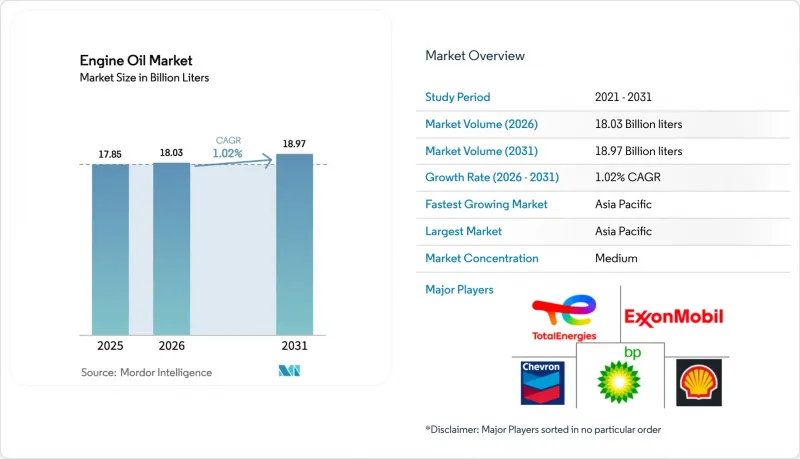
Mordor Intelligence에 의하면, 엔진오일 시장 규모는 2025년 178억 5,000만 리터로 평가되었습니다. 2026년에는 180억 3,000만 리터로 확대되어 2031년까지 189억 7,000만 리터에 이를 것으로 예상되고 2026년부터 2031년에 걸쳐 CAGR 1.02%로 성장할 전망입니다.

본 보고서는 기유 유형(광유, 반합성유, 완전합성유, 바이오베이스), 차종(승용차, 소형 상용차, 대형 트럭·버스, 오토바이·스쿠터, 오프로드 차량·건설기계), 최종 사용자 산업(자동차 및 운송, 기타),및 지역(아시아태평양, 기타)별로 분류되어 있습니다. 시장 전망은 판매량(리터) 기준으로 제시되어 있습니다.
세계의 엔진오일 시장 동향 및 인사이트
신흥국에서의 자동차 생산 증가
2024년, 전 세계 경차 생산 대수는 증가했으며, 아시아가 총 생산 대수에 크게 기여했습니다. 중국은 생산을 확대한 반면, 인도는 SUV 수요의 급증에 힘입어 구자라트주와 타밀나두주의 수출 거점에 힘입어 현저한 성장을 이루었습니다. 멕시코는 북미에서 세 번째 주요 국가로서의 입지를 공고히 하며, 남미로의 재수출 거점 역할을 수행하고 있습니다. 이러한 생산 능력 확대는 공장 출고 시 충전량을 늘릴 뿐만 아니라, 특히 정비 주기가 1만킬로미터 미만인 지역에서 애프터마켓을 통한 안정적인 보충을 보장합니다. 미래를 내다보면, OICA는 2028년까지 아시아태평양이 세계 생산량의 큰 비중을 차지하게 될 것으로 예측하고 있으며, 이는 비용 중심의 광물유 및 반합성 윤활유 등급에 대한 수요가 계속해서 견조할 것임을 시사합니다.
고성능 합성 윤활유 수요 증가
자동차 제조업체들이 연비 기준을 충족하기 위해 저점도 오일로 전환을 추진함에 따라, 세계 시장에서 완전 합성 엔진오일의 점유율은 확대되고 있습니다. 북미 및 유럽에서는 현재 그룹 III 기유가 공급의 대부분을 차지하며, 기존의 그룹 I 기유를 꾸준히 대체하고 있습니다. 2028년에 도입될 예정인 ILSAC GF-8A 규격에서는 0W-8 오일의 경우 고온 고전단 점도를 2.6 센티포이즈로 유지해야 할 의무가 부과되어 있어, 이로 인해 합성 윤활유에 대한 수요가 더욱 견고해지고 있습니다. 엑슨모빌의 ‘모빌 1’과 쉘의 ‘헬릭스 울트라’는 혼다, 도요타, 폭스바겐과 같은 대형 자동차 제조업체들로부터 OEM 공동 인증을 획득한 것을 발판으로 눈부신 성공을 거두고 있습니다.
OEM 공장 충전용 롱라이프 오일을 통한 오일 교환 주기 연장
북미에서는 자동차 제조업체들이 정비 주기를 연장하고 있는 반면, 유럽에서는 더 긴 주기가 설정되어 있습니다. 이러한 연장은 공장 충전용 오일에 산화 방지제나 마찰 조절제를 배합함으로써 실현되었으며, 이를 통해 최대 2년 동안 점도를 유지할 수 있게 되었습니다. 0W-16 오일을 채택한 토요타의 ‘캠리 하이브리드’는 특정 교환 일정을 준수하고 있습니다. 대조적으로, 혼다의 0W-20 순정 엔진오일은 더 짧은 교환 주기를 채택하고 있습니다. 제너럴 모터스는 Dexos1 Gen 3에서 몰리브덴 및 붕소 성분을 배합함으로써 내구성에 중점을 두고 있습니다.
부문별 분석
바이오 오일은 엔진오일 시장에서 가장 빠르게 성장하는 분야로, 2031년까지 매년 2.80%의 성장률이 예상됩니다. 다만, 2025년 시점에서는 광물성 오일이 여전히 56.18%의 점유율을 차지하며 시장을 독점했습니다. 유럽연합(EU)의 ‘에코라벨’은 재생 가능 탄소를 최소 25% 함유할 것을 의무화하고, 28일 이내에 60% 이상의 생분해성을 달성하도록 규정하고 있습니다. 이러한 움직임에 따라 정부 차량 함대는 식물 유래 에스테르 블렌드로의 전환이 진행되고 있습니다. 마찬가지로, 미국의 ‘BioPreferred’ 프로그램도 탄력을 받고 있으며, 인증된 바이오 함유량을 기준으로 연방 정부 계약이 수여되고 있습니다. 독일에서는 RAVENOL사가 2024년에 ‘BioSyntoLub’를 출시할 예정입니다. 이 제품은 ACEA C3 규격을 준수하기 위해 유채 및 해바라기 에스테르와 그룹 III 베이스 오일을 혼합한 것입니다. 이는 업계가 공공 조달 예산 확보를 목표로 하고 있음을 뒷받침합니다.
가격에 대한 민감성 때문에 특히 남아시아 및 동남아시아에서는 광물유 카테고리가 여전히 지배적인 점유율을 유지하고 있습니다. 그룹 III 또는 IV 성분을 포함하는 반합성 블렌드는 주류 세단을 대상으로 API SN Plus 규격을 목표로 하고 있습니다. 주로 폴리아알파올레핀 유래의 완전 합성유는 OEM으로부터 높은 평가를 받고 있습니다. 그러나 저점도화 요구에 따라 배합 제조업체들이 그룹 III+의 개량형 옵션으로 전환할 수밖에 없는 상황에 놓여 있으며, 이로 인해 원가 상승이라는 과제에 직면해 있습니다. 바이오 엔진오일 시장은 현재로서는 규모가 작지만, 규제 영향과 기업의 탄소 배출 목표를 고려할 때 2031년까지 상당한 성장세가 예상됩니다.
지역별 분석
아시아태평양은 2025년에 세계 수요의 58.17%를 차지했으며, 연평균 성장률(CAGR) 1.30%를 나타낼 것으로 예측됩니다. 이러한 성장은 중국의 생산량, 인도의 생산량, 그리고 아세안(ASEAN) 국가들의 조립 생산량 합계에 의해 뒷받침되고 있습니다. 2024년 중국 전역에 ‘중국 VI-b 기준’이 도입됨에 따라, 저SAPS SAE 0W-20 및 5W-30 오일 수요가 급증했습니다. 한편, 인도에서는 이륜차의 보급과 견고한 소매 네트워크에 힘입어 윤활유 소비량이 증가했습니다.
북미에서는 2025년 판매 구성에 전기차(EV)가 도입됨에 따라 연간 기준 시장 규모가 축소되었습니다. 그럼에도 불구하고, 프리미엄 합성 블렌드 제품은 가치 점유율을 유지하는 데 성공했습니다. EPA(미국 환경보호청)의 2024년 황 규제로 인해 첨가제의 재조성이 필요하게 되었지만, 이러한 움직임은 엑슨모빌, 셰브론, 발보린과 같은 공급업체에 이익을 가져다주었습니다. 캐나다 연방 정부의 제로 배출 의무화로 인해 브리티시컬럼비아주와 퀘벡주에서는 수요가 둔화되고 있지만, 멕시코의 생산량은 Dexos 1 및 Motorcraft 인증 오일의 공장 충전 수요를 충족시키고 있습니다.
유럽에서는 연중 내내 감소세가 보였으며, 노르웨이와 네덜란드 등에서는 전기차(EV) 점유율이 크게 상승했습니다. 유로 7, ACEA 규격, 각국의 CO2 세금 등에 이르는 이 지역의 복잡한 규제로 인해 배합 비용이 상승하고, 사업은 통합형 대기업으로 이동하고 있습니다. 2027년까지 독일 연방자동차교통청은 시판 윤활유를 사용한 크랭크케이스 배기가스 시험을 의무화할 예정이며, 이로 인해 인증 비용이 증가할 가능성이 있습니다. 영국에서는 Safety-Kleen사와 Fuchs Petrolub사의 폐쇄형 루프 프로그램을 통한 노력이 재정제 기유의 점유율 확대에 기여하고 있습니다.
남미에서는 부식 방지 오일이 필요한 브라질의 플렉스 연료 차량이 주도하여 연간 완만한 성장이 나타났습니다. 페트로브라스의 ‘루브랙스(Lubrax)’ 브랜드는 자사 직영 주유소와 독립 판매점 네트워크를 활용하여 애프터마켓에서 압도적인 점유율을 확보했습니다. 아르헨티나의 YPF는 전략적 조치로 메르코수르(Mercosur) 수출과 국내 농업 기계 부문 모두를 아우르는 블렌딩 시설을 개설했습니다.
중동 및 아프리카에서는 연간 성장이 기록되었습니다. 수요는 사우디아라비아의 PIF가 자금을 지원한 조립 합작 사업과 남아프리카공화국의 견조한 광산용 차량에 힘입어 뒷받침되었습니다. 2024년,아람코의 루베레프(Luberef)는 인도 및 동아프리카 시장에 초점을 맞추어 그룹 II 제품의 생산을 확대했습니다. 동시에 엥겐(Engen)은 남부아프리카개발공동체(SADC) 지역 전역의 대형 트럭을 대상으로 ACEA E9 인증을 받은 10W-40 오일을 출시했습니다.
기타 혜택 :
- 엑셀 형식 시장 예측(ME) 시트
- 3개월간의 애널리스트 지원
자주 묻는 질문
목차
제1장 서론
제2장 조사 방법
제3장 주요 요약
제4장 시장 구도
제5장 시장 규모 및 성장 예측
제6장 경쟁 구도
제7장 시장 기회 및 향후 전망
KTH 26.09.04According to Mordor Intelligence, the engine oil market size is expected to increase from 17.85 Billion liters in 2025 to 18.03 Billion liters in 2026 and reach 18.97 Billion liters by 2031, growing at a CAGR of 1.02% over 2026-2031.
This report is Segmented by Base-Oil Type (Mineral, Semi-Synthetic, Fully-Synthetic, and Bio-Based), Vehicle Type (Passenger Cars, Light Commercial Vehicles, Heavy-Duty Trucks and Buses, Motorcycles and Scooters, and Off-Road/Construction), End-User Industry (Automotive and Transportation, and More), and Geography (Asia-Pacific, and More). The Market Forecasts are Provided in Terms of Volume (Liters).
Global Engine Oil Market Trends and Insights
Increasing Automotive Production in Emerging Economies
In 2024, global light-vehicle production increased, with Asia contributing significantly to the total output. China ramped up its production, while India, driven by a surge in SUV demand and bolstered by export hubs in Gujarat and Tamil Nadu, experienced notable growth. Mexico solidifies its position as the third key player in North America and acts as a re-export conduit to South America. This added capacity not only boosts factory-fill volumes but also ensures a robust aftermarket replenishment, especially in regions with service intervals under 10,000 kilometers. Looking to the future, the OICA projects that by 2028, the Asia-Pacific region will account for a significant share of the global output, signaling a continued strong demand for cost-sensitive mineral and semi-synthetic lubricant grades.
Rising Demand for High-Performance Synthetic Lubricants
As automakers increasingly turn to low-viscosity fluids to comply with fuel-economy standards, the share of fully synthetic engine oils in the global market has grown. In North America and Europe, Group III base oils now account for a significant portion of the supply, steadily displacing the older Group I stocks. The upcoming ILSAC GF-8A standard, set for 2028, mandates 0W-8 oils to maintain a high-temperature high-shear viscosity of 2.6 centipoise, further solidifying the demand for synthetics. Mobil 1 from ExxonMobil and Shell's Helix Ultra have achieved notable success, bolstered by securing OEM co-approvals from automotive giants like Honda, Toyota, and Volkswagen.
Extended Drain Intervals via OEM Factory-Fill Long-Life Oils
In North America, automakers have extended service windows, while in Europe, the limit is set at longer intervals. This extension is achieved by infusing factory fills with antioxidants and friction modifiers, ensuring they maintain viscosity for up to two years. Toyota's Camry Hybrid, using 0W-16 oil, adheres to a specific schedule. In contrast, Honda's 0W-20 Genuine Motor Oil follows a shorter interval. General Motors, with its Dexos1 Gen 3, focuses on endurance by incorporating molybdenum and boron chemistry.
Other drivers and restraints analyzed in the detailed report include:
- Growing Average Vehicle Age and Miles-Driven
- Stricter CO2/Fuel-Economy Norms Favoring Low-Viscosity Oils
- Accelerating EV Penetration
For complete list of drivers and restraints, kindly check the Table Of Contents.
Segment Analysis
Bio-based oils are the fastest-growing slice of the engine oil market, advancing 2.80% each year through 2031, even though mineral oils still dominate with 56.18% volume in 2025. The European Union's Ecolabel mandates a minimum of 25% renewable carbon and stipulates that biodegradability must exceed 60% within 28 days. This move is steering government fleets towards plant-ester blends. Similarly, the United States BioPreferred program is gaining traction, awarding federal contracts based on certified bio content. In Germany, RAVENOL is set to launch its 2024 BioSyntoLub, blending rapeseed and sunflower esters with Group III stock to align with ACEA C3 standards. This underscores the industry's pursuit of public-procurement budgets.
Price sensitivity maintains the mineral category's dominant share, particularly in South and Southeast Asia. Semi-synthetic blends, containing Group III or IV content, target API SN Plus standards for mainstream sedans. Fully synthetic oils, primarily derived from polyalphaolefin, enjoy premium OEM endorsements. However, they grapple with rising costs as mandates for low viscosity drive formulators towards enhanced Group III+ options. While the market for bio-based engine oils is currently modest, regulatory influences and corporate carbon objectives indicate a significant upward trend by 2031.
Complete Report Scope:
- By Base-Oil Type
- Mineral
- Semi-Synthetic
- Fully-Synthetic
- Bio-based
- By Vehicle Type
- Passenger Cars
- Light Commercial Vehicles
- Heavy-Duty Trucks and Buses
- Motorcycles and Scooters
- Off-Road / Construction
- By End-user Industry
- Automotive and Transportation
- Power Generation
- Heavy Equipment and Mining
- Metallurgy / Metalworking
- Chemical Manufacturing
- Other Industries
- By Geography
- Asia-Pacific
- China
- India
- Japan
- South Korea
- ASEAN Countries
- Rest of Asia-Pacific
- North America
- United States
- Canada
- Mexico
- Europe
- Germany
- United Kingdom
- France
- Italy
- Spain
- NORDIC Countries
- Rest of Europe
- South America
- Brazil
- Argentina
- Rest of South America
- Middle-East and Africa
- Saudi Arabia
- South Africa
- Rest of Middle-East and Africa
- Asia-Pacific
Geography Analysis
Asia-Pacific delivered 58.17% of global demand in 2025 and is projected to grow at a 1.30% CAGR. This growth is bolstered by China's production, India's output, and ASEAN's combined assemblies. China's nationwide rollout of the China VI-b standard in 2024 led to a surge in demand for low-SAPS SAE 0W-20 and 5W-30 oils. Meanwhile, in India, lubricant consumption increased, driven by the proliferation of two-wheelers and a robust retail network.
North America experienced an annual contraction, coinciding with the adoption of electric vehicles (EVs) in the 2025 sales mix. Despite this, premium synthetic blends managed to maintain their value share. The EPA's 2024 sulfur cap necessitated additive reformulations, a move that benefitted suppliers like ExxonMobil, Chevron, and Valvoline. While Canada's federal zero-emission mandate has dampened demand in British Columbia and Quebec, Mexico's output is meeting the factory-fill needs for Dexos1 and Motorcraft-approved oils.
Europe saw an annual contraction, with countries like Norway and the Netherlands elevating their EV shares significantly. The region's regulatory intricacies - spanning Euro 7, ACEA sequences, and national CO2 taxes - have escalated formulation costs, steering business towards integrated majors. By 2027, Germany's Federal Motor Transport Authority will mandate crankcase-emission testing with market lubricants, potentially increasing certification expenses. In the UK, initiatives by Safety-Kleen and Fuchs Petrolub's closed-loop programs have bolstered the share of re-refined base oils.
South America saw modest annual growth, spearheaded by Brazil's flex-fuel fleet, which necessitates corrosion-resistant oils. Petrobras' Lubrax brand, leveraging a network of company stations and independents, secured a dominant share in the aftermarket. In a strategic move, Argentina's YPF inaugurated a blending facility, catering to both Mercosur exports and the domestic agricultural machinery sector.
The Middle East and Africa recorded yearly growth. Demand was bolstered by assembly ventures funded by Saudi Arabia's PIF and a robust mining fleet in South Africa. In 2024, Aramco's Luberef expanded its Group II output, with a focus on markets in India and East Africa. Concurrently, Engen introduced its ACEA E9-approved 10W-40 oil, targeting heavy-duty trucks across the Southern African Development Community (SADC) region.
- AMSOIL INC
- Bharat Petroleum Corporation Limited
- BP p.l.c
- Chevron Corporation
- China Petrochemical Corporation
- Eni SPA
- Exxon Mobil Corporation
- FUCHS
- Gazpromneft - Lubricants, Ltd
- Gulf Oil International
- Hindustan Petroleum Corporation Limited
- Idemitsu Kosan Co.,Ltd
- Illinois Tool Works Inc.
- Indian Oil Corporation Ltd
- JX Nippon Oil & Gas Exploration Corporation
- Liqui Moly GmbH
- LUKOIL
- Motul
- Petrobras
- PETRONAS Lubricants International
- Phillips 66 Company
- PT Pertamina Lubricants
- Repsol
- Shell PLC
- SK Enmove CO., Ltd
- Tide Water Oil Co. (India) Ltd
- TotalEnergies
- Valvoline Cummins Pvt. Ltd.
Additional Benefits:
- The market estimate (ME) sheet in Excel format
- 3 months of analyst support
TABLE OF CONTENTS
1 Introduction
- 1.1 Study Assumptions and Market Definition
- 1.2 Scope of the Study
2 Research Methodology
3 Executive Summary
4 Market Landscape
- 4.1 Market Overview
- 4.2 Market Drivers
- 4.2.1 Increasing automotive production in emerging economies
- 4.2.2 Rising demand for high-performance synthetic lubricants
- 4.2.3 Growing average vehicle age and miles-driven
- 4.2.4 Stricter CO2 / fuel-economy norms favouring low-viscosity oils
- 4.2.5 Emergence of micro-mobility maintenance ecosystems
- 4.3 Market Restraints
- 4.3.1 Extended drain intervals via OEM factory-fill long-life oils
- 4.3.2 Accelerating EV penetration
- 4.3.3 OEM move toward sealed-for-life lubrication systems
- 4.4 Value Chain Analysis
- 4.5 Porter's Five Forces
- 4.5.1 Bargaining Power of Suppliers
- 4.5.2 Bargaining Power of Buyers
- 4.5.3 Threat of New Entrants
- 4.5.4 Threat of Substitutes
- 4.5.5 Degree of Competition
5 Market Size and Growth Forecasts (Volume)
- 5.1 By Base-Oil Type
- 5.1.1 Mineral
- 5.1.2 Semi-Synthetic
- 5.1.3 Fully-Synthetic
- 5.1.4 Bio-based
- 5.2 By Vehicle Type
- 5.2.1 Passenger Cars
- 5.2.2 Light Commercial Vehicles
- 5.2.3 Heavy-Duty Trucks and Buses
- 5.2.4 Motorcycles and Scooters
- 5.2.5 Off-Road / Construction
- 5.3 By End-user Industry
- 5.3.1 Automotive and Transportation
- 5.3.2 Power Generation
- 5.3.3 Heavy Equipment and Mining
- 5.3.4 Metallurgy / Metalworking
- 5.3.5 Chemical Manufacturing
- 5.3.6 Other Industries
- 5.4 By Geography
- 5.4.1 Asia-Pacific
- 5.4.1.1 China
- 5.4.1.2 India
- 5.4.1.3 Japan
- 5.4.1.4 South Korea
- 5.4.1.5 ASEAN Countries
- 5.4.1.6 Rest of Asia-Pacific
- 5.4.2 North America
- 5.4.2.1 United States
- 5.4.2.2 Canada
- 5.4.2.3 Mexico
- 5.4.3 Europe
- 5.4.3.1 Germany
- 5.4.3.2 United Kingdom
- 5.4.3.3 France
- 5.4.3.4 Italy
- 5.4.3.5 Spain
- 5.4.3.6 NORDIC Countries
- 5.4.3.7 Rest of Europe
- 5.4.4 South America
- 5.4.4.1 Brazil
- 5.4.4.2 Argentina
- 5.4.4.3 Rest of South America
- 5.4.5 Middle-East and Africa
- 5.4.5.1 Saudi Arabia
- 5.4.5.2 South Africa
- 5.4.5.3 Rest of Middle-East and Africa
- 5.4.1 Asia-Pacific
6 Competitive Landscape
- 6.1 Market Concentration
- 6.2 Strategic Moves
- 6.3 Market Share(%)/Ranking Analysis
- 6.4 Company Profiles (includes Global level Overview, Market level overview, Core Segments, Financials as available, Strategic Information, Products and Services, and Recent Developments)
- 6.4.1 AMSOIL INC
- 6.4.2 Bharat Petroleum Corporation Limited
- 6.4.3 BP p.l.c
- 6.4.4 Chevron Corporation
- 6.4.5 China Petrochemical Corporation
- 6.4.6 Eni SPA
- 6.4.7 Exxon Mobil Corporation
- 6.4.8 FUCHS
- 6.4.9 Gazpromneft - Lubricants, Ltd
- 6.4.10 Gulf Oil International
- 6.4.11 Hindustan Petroleum Corporation Limited
- 6.4.12 Idemitsu Kosan Co.,Ltd
- 6.4.13 Illinois Tool Works Inc.
- 6.4.14 Indian Oil Corporation Ltd
- 6.4.15 JX Nippon Oil & Gas Exploration Corporation
- 6.4.16 Liqui Moly GmbH
- 6.4.17 LUKOIL
- 6.4.18 Motul
- 6.4.19 Petrobras
- 6.4.20 PETRONAS Lubricants International
- 6.4.21 Phillips 66 Company
- 6.4.22 PT Pertamina Lubricants
- 6.4.23 Repsol
- 6.4.24 Shell PLC
- 6.4.25 SK Enmove CO., Ltd
- 6.4.26 Tide Water Oil Co. (India) Ltd
- 6.4.27 TotalEnergies
- 6.4.28 Valvoline Cummins Pvt. Ltd.
7 Market Opportunities and Future Outlook
- 7.1 White-space and Unmet-Need Assessment
- 7.2 Growing Innovation in Bio-based Engine Oil