|
시장보고서
상품코드
2122182
캐리어 스크리닝 : 시장 점유율 분석, 업계 동향 및 통계, 성장 예측(2026-2031년)Carrier Screening - Market Share Analysis, Industry Trends & Statistics, Growth Forecasts (2026 - 2031) |
||||||
 Mordor Intelligence
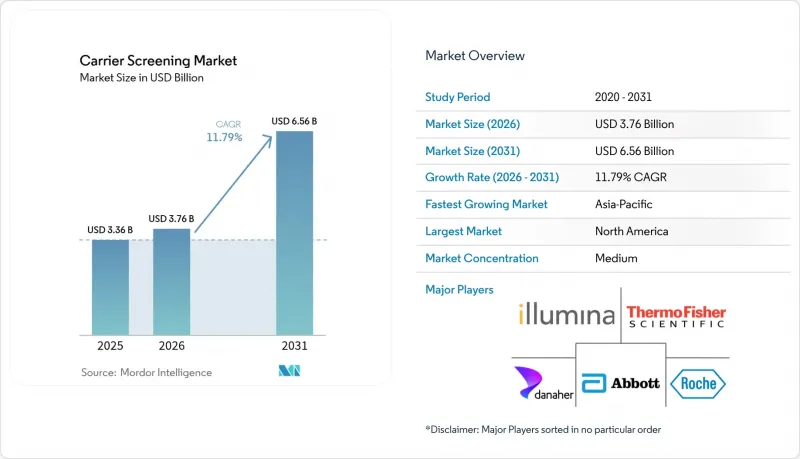
Mordor Intelligence에 의하면, 2026년 세계의 캐리어 스크리닝 시장 규모는 37억 6,000만 달러로 추정되고 2025년 33억 6,000만 달러에서 확대해, 2031년에는 65억 6,000만 달러에 이를 것으로 예측됩니다.
2026년부터 2031년까지 연평균 성장률(CAGR) 11.79%로 성장할 것으로 전망됩니다.
본 보고서는 검사 유형(분자 스크리닝 검사 및 생화학적 스크리닝 검사), 질환 유형(낭포성 섬유증, 테이-삭스병 등), 패널 유형(표적 단일 유전자 패널, 민족별 패널 등), 기술(NGS, PCR 등),최종 사용자(병원 및 진료소, 진단 검사 기관 등), 지역별로 분류되어 있습니다. 시장 전망은 금액(달러) 기준으로 제시되어 있습니다.
세계의 캐리어 스크리닝 시장 동향 및 인사이트
질병의 조기 발견 및 예방에 대한 중요성 증대
보험사 및 공중보건 기관은 종합적인 유전체 선별 검사를 단순한 선택적 서비스가 아닌 비용 절감 수단으로 인식하기 시작했습니다. 호주가 569가지 열성 유전 질환을 대상으로 실시한 마이크로 시뮬레이션에 따르면, 검사 수검률이 50%일 경우 2,067명의 환자 출생을 예방할 수 있을 것으로 예측되며, 이는 제한적인 패널을 통한 성과를 훨씬 능가하는 수치입니다. 영국과 뉴욕시에서 20만 명의 영아를 대상으로 실시한 대규모 신생아 선별 검사는 예방 유전체학으로의 전환을 더욱 부각시키고 있습니다. 가이징거(Geisinger)의 ‘MyCode’ 프로그램에서는 참가자 30명 중 1명에게서 임상적으로 대응 가능한 결과가 확인되었으며, 그 대다수는 유전적 위험을 인식하지 못하고 있었습니다. 이러한 임상적 및 재정적 가치의 입증은 광범위한 다유전자 보균자 선별 검사의 보급을 촉진하고, 예방 유전학을 일상적인 의료로 정착시키고 있습니다.
맞춤형 생식 의학에 대한 수요 증가
현재 보조생식기술에서는 파트너 양측에 대한 유전학적 검사가 표준이 되었습니다. 존스 홉킨스 불임 치료 센터에서는 조상의 유래와 관계없이 모든 환자에게 400개 이상의 열성 질환을 포괄하는 확장 패널을 권장하고 있습니다. 비침습적 배아 검사를 통해 생검에 따른 생존율에 대한 우려 없이 착상 전 유전자 평가가 가능해져, 환자들의 수용도도 높아지고 있습니다. 호주 메디케어(Medicare)가 생식 관련 캐리어 스크리닝를 보험 적용 대상으로 지정한 것은 이러한 미래 지향적인 계획에 대한 공공 지원이 뒷받침되고 있음을 보여줍니다. 현재 부부들은 임신 전에 유전 정보를 명확히 파악하기를 원하고 있으며, 이에 따라 클리닉들은 보균자 검사를 일반적인 불임 치료 워크플로우에 포함하도록 권장받고 있어, 보균자 스크리닝 시장의 검사 건수가 증가하고 있습니다.
고액의 비용과 일관성 없는 보험 적용
유나이티드 헬스케어는 메디케어 어드밴티지 적용 범위에서 보인자 검사를 명시적으로 제외하고 있으며, CPT 코드 제한으로 인해 새로운 검사 패널에 대한 보험 청구 절차가 복잡해지고 있습니다. 벨기에에서는 신생아 1인당 유전체 검사 비용이 365유로로 기록되었는데, 이는 기존 선별 검사 비용을 훨씬 상회하는 금액으로 의료 시스템 예산에 부담을 주고 있습니다. 정책의 파편화로 인해 저소득 지역에서의 종합적인 선별 검사 보급이 지연되고 있습니다.
부문별 분석
분자 검사는 2025년 매출의 62.74%를 차지하며 연평균 성장률(CAGR) 12.98%로 확대되었으며, 민감도와 다중 분석 범위 면에서 생화학적 기법을 능가하고 있습니다. 이러한 우위가 캐리어 스크리닝 시장을 견인하고 있으며, 의료 서비스 제공업체들은 간접적인 대사 산물 지표보다 직접적인 돌연변이 검출을 선호하는 경향이 있습니다. 중국 남부의 ‘지중해빈혈 대립유전자 종합적 분석’ 프로토콜은 보균자 유병률이 16%를 초과하는 지역에서 초고속 시퀀싱의 유효성을 입증하고 있습니다.
생화학적 선별 검사는 여전히 효소 및 단백질 관련 질환에서 중요하며, 벨기에의 ‘BabyDetect’와 같은 신생아 선별 검사 프로그램에서는 유전체 검사와 잘 결합되어 있습니다. 경제적 분석을 통해 특정 대사 질환 시나리오에서 탠덤 질량 분석법의 가치가 확인되었으며, 분자 검사의 확대와 병행하여 다양한 검사 메뉴가 유지될 것이 보장되고 있습니다.
낭포성 섬유증은 보편적인 지침과 보험사의 높은 인지도 덕분에 2025년에도 58.96%의 점유율을 유지하며, 보균자 선별 검사 시장에서 큰 점유율을 확보했습니다. 100개의 변이체를 포함하는 확장된 CFTR 패널은 다민족 집단에서 검출률을 향상시키고 있습니다.
척수성 근위축증은 연평균 성장률(CAGR) 12.41%로 예측되며, 획기적인 치료법의 등장과 대부분의 신생아 선별 검사 패널에 포함된 덕분에 혜택을 보고 있습니다. 테이-삭스병, 고셰병, 겸상적혈구증을 대상으로 한 조상 정보를 활용한 프로그램은 계속되고 있는 한편, 시퀀싱 비용의 하락에 따라 희귀 상염색체 열성 질환에 대한 선별 검사도 확대되고 있습니다.
지역별 분석
북미는 고용주가 제공하는 유전자 검사 복리후생, 탄탄한 상담 네트워크, 그리고 감독과 혁신의 균형을 유지한 FDA의 규제 체계를 배경으로 2025년에는 매출의 43.88%를 차지했습니다. 가이징거(Gajinger)사의 ‘MyCode’ 등록자 수는 17만 5,000명을 넘어섰으며, 이는 집단 유전체학에 대한 수요가 증가하고 있음을 보여줍니다. 사우스캐롤라이나주의 ‘In Our DNA’ 이니셔티브는 목표인 10만 명 중 5만 명의 참가자를 모집하며 주 차원에서의 추진력을 강화하고 있습니다.
아시아태평양은 연평균 성장률(CAGR) 13.32%로 가장 강력한 성장세를 보이고 있습니다. 중국의 ‘iHope’ 프로젝트는 2024년 중반까지 513가구의 희귀질환 가족을 지원하고, 2026년까지 1,800가구를 지원하는 것을 목표로 하고 있습니다. 한편, 전국적인 지중해빈혈 선별 검사에서는 남부 지방에서 최대 24%에 달하는 보균자 비율에 대한 대응이 진행되고 있습니다. 호주 메디케어(Medicare)가 자금을 지원하는 검사 패널은 의료비 환급에 관한 지역적 선례를 확립했습니다.
유럽에서는 균형 잡힌 확대가 이루어지고 있습니다. 영국은 신생아 10만 명의 유전체 시퀀싱을 목표로 하고 있으며, 벨기에에서는 신생아 유전체 선별 검사에 대한 보호자의 동의율이 90%에 달하고, 국민의 신뢰를 얻고 있습니다. 이스라엘 보건부는 290개의 유전자로 구성된 650가지 변이를 포괄하는 프로그램에 자금을 지원하고 있으며, 광범위한 패널 검사에 대한 정부의 지원이 강조되고 있습니다.
기타 혜택 :
- 엑셀 형식 시장 예측(ME) 시트
- 3개월간의 애널리스트 지원
자주 묻는 질문
목차
제1장 서론
제2장 조사 방법
제3장 주요 요약
제4장 시장 구도
제5장 시장 규모 및 성장 예측
제6장 경쟁 구도
제7장 시장 기회 및 향후 전망
KTH 26.09.04According to Mordor Intelligence, the global carrier screening market size in 2026 is estimated at USD 3.76 billion, growing from 2025 value of USD 3.36 billion with 2031 projections showing USD 6.56 billion, growing at 11.79% CAGR over 2026-2031.
This report is Segmented by Test Type (Molecular Screening Test and Biochemical Screening Test), Disease Type (Cystic Fibrosis, Tay-Sachs Disease and More), Panel Type (Targeted Single-Gene Panels, Ethnicity-Specific Panels and More), Technology (NGS, PCR and More), End User (Hospitals & Clinics, Diagnostic Laboratories and More) and Geography. The Market Forecasts are Provided in Terms of Value (USD).
Global Carrier Screening Market Trends and Insights
Increasing Emphasis on Early Disease Detection and Prevention
Payers and public-health agencies increasingly see comprehensive genomic screening as a cost-saving path rather than a discretionary service. Australia's microsimulation of 569 recessive disorders predicted 2,067 affected births avoided at 50% test uptake, dwarfing outcomes from limited panels.Large newborn initiatives in the United Kingdom and New York City covering 200,000 infants further spotlight the pivot toward preventive genomics.Geisinger's MyCode program found clinically actionable results in 1 in 30 participants, most of whom were unaware of inherited risks. These demonstrations of clinical and fiscal value propel wider adoption of broad multi-gene carrier screening, cementing preventive genomics as routine care.
Rising Demand for Personalized Reproductive Medicine
Assisted reproduction now defaults to genetic scrutiny for both partners. Johns Hopkins Fertility Center recommends expanded panels covering more than 400 recessive conditions for every patient regardless of ancestry. Non-invasive embryo assays allow preimplantation genetic assessment without biopsy-related viability concerns, easing patient acceptance. Australia's Medicare reimbursement for reproductive carrier screening underscores official endorsement of such proactive planning. Couples now desire genomic clarity before pregnancy, pushing clinics to embed carrier testing into routine fertility workflows and lifting test volumes within the carrier screening market.
High Costs and Inconsistent Reimbursement
UnitedHealthcare explicitly excludes carrier tests from Medicare Advantage coverage, and limited CPT codes complicate claims for novel panels. Belgium recorded EUR 365 per newborn genomic test, well above conventional screens, challenging health-system budgets. Fragmented policies slow the spread of comprehensive screening in lower-income regions.
Other drivers and restraints analyzed in the detailed report include:
- Declining NGS Costs Enabling Expanded Panels
- Integration of Carrier Screening in IVF and ART Protocols
- Limited Genetic-Counseling Workforce Capacity
For complete list of drivers and restraints, kindly check the Table Of Contents.
Segment Analysis
Molecular assays commanded 62.74% of 2025 revenue and are advancing at 12.98% CAGR, eclipsing biochemical methods in sensitivity and multiplexing scope. This dominance propels the carrier screening market as providers prefer direct variant detection over indirect metabolite proxies. The Comprehensive Analysis of Thalassemia Alleles protocol in southern China illustrates the efficacy of ultra-high-throughput sequencing where carrier prevalence exceeds 16%.
Biochemical screens still matter for enzyme or protein conditions and blend well with genomic assays in newborn programs such as Belgium's BabyDetect. Economic analyses confirm tandem mass spectrometry's value in certain metabolic scenarios, ensuring that diversified testing menus persist alongside molecular expansion.
Cystic fibrosis retained 58.96% share in 2025 thanks to universal guidelines and payer familiarity, securing a large slice of the carrier screening market share. Expanded 100-variant CFTR panels raise detection rates in multiethnic populations.
Spinal muscular atrophy, projected at 12.41% CAGR, benefits from transformative therapies and inclusion in most newborn panels. Ancestry-driven programs for Tay-Sachs, Gaucher, and sickle cell disease continue, while rare autosomal recessive conditions gain traction as sequencing costs fall.
Complete Report Scope:
- By Test Type
- Molecular Screening Tests
- Biochemical Screening Tests
- By Disease Type
- Cystic Fibrosis
- Tay-Sachs Disease
- Gaucher Disease
- Sickle Cell Disease
- Spinal Muscular Atrophy
- Other Autosomal Recessive Disorders
- By Panel Type
- Targeted Single-Gene Panels
- Ethnicity-Specific Panels
- Expanded Multi-Gene Panels
- By Technology
- Next-Generation Sequencing (NGS)
- Polymerase Chain Reaction (PCR)
- Microarrays
- Others
- By End-User
- Hospitals & Clinics
- Diagnostic Laboratories
- Physician Offices & IVF Centers
- Academic & Research Institutes
- By Geography
- North America
- United States
- Canada
- Mexico
- Europe
- Germany
- United Kingdom
- France
- Italy
- Spain
- Rest of Europe
- Asia-Pacific
- China
- Japan
- India
- Australia
- South Korea
- Rest of Asia-Pacific
- Middle East and Africa
- GCC
- South Africa
- Rest of Middle East and Africa
- South America
- Brazil
- Argentina
- Rest of South America
- North America
Geography Analysis
North America secured 43.88% revenue in 2025 on the strength of employer genetic benefits, robust counseling networks, and an FDA framework that balances oversight with innovation. Geisinger's MyCode enrollment surpassed 175,000 individuals, evidencing appetite for population genomics. South Carolina's In Our DNA initiative recruited 50,000 participants toward a 100,000 goal, reinforcing state-level momentum.
Asia-Pacific exhibits the strongest growth at 13.32% CAGR. China's iHope project assisted 513 rare-disease families by mid-2024 and targets 1,800 by 2026, while national thalassemia screening addresses carrier rates up to 24% in southern provinces. Australia's Medicare-funded panels set a regional precedent for reimbursement.
Europe records balanced expansion. The UK aims to sequence 100,000 newborn genomes, while Belgium's 90% parental acceptance rates for genomic newborn screening prove public trust. Israel's Ministry of Health funds a 650-variant program comprising 290 genes, underlining governmental support for broad panels.
- Abbott Laboratories
- Roche
- Danaher Corp (Cepheid)
- Thermo Fisher Scientific
- Illumina
- Laboratory Corp of America Holdings (LabCorp)
- Myriad Genetics
- Natera
- Invitae
- Revvity
- Eurofins
- BGI Genomics Co. Ltd.
- Fulgent Genetics Inc.
- 23andMe Holding Co.
- Centogene
- Quest Diagnostics
- Color Health
- GeneDx LLC (Sema4)
- Baylor Genetics
- The Cooper Companies
- AutoGenomics Inc.
Additional Benefits:
- The market estimate (ME) sheet in Excel format
- 3 months of analyst support
TABLE OF CONTENTS
1 Introduction
- 1.1 Study Assumptions and Market Definition
- 1.2 Scope of the Study
2 Research Methodology
3 Executive Summary
4 Market Landscape
- 4.1 Market Overview
- 4.2 Market Drivers
- 4.2.1 Increasing Emphasis On Early Disease Detection & Prevention
- 4.2.2 Rising Demand For Personalized Reproductive Medicine
- 4.2.3 Declining NGS Costs Enabling Expanded Panels
- 4.2.4 Integration Of Carrier Screening In IVF / ART Protocols
- 4.2.5 Employer-Sponsored Genetic-Benefit Programs
- 4.2.6 Payer Mandates Tied To Population-Screening Pilots
- 4.3 Market Restraints
- 4.3.1 High Costs & Inconsistent Reimbursement
- 4.3.2 Ethical & Psychosocial Concerns Over Incidental Findings
- 4.3.3 Limited Genetic-Counseling Workforce Capacity
- 4.3.4 Data-Privacy Regulations Limiting Secondary Data Use
- 4.4 Value / Supply-Chain Analysis
- 4.5 Regulatory Landscape
- 4.6 Technology Outlook
- 4.7 Porter's Five Forces Analysis
- 4.7.1 Bargaining Power of Suppliers
- 4.7.2 Bargaining Power of Buyers
- 4.7.3 Threat of New Entrants
- 4.7.4 Threat of Substitutes
- 4.7.5 Intensity of Competitive Rivalry
5 Market Size and Growth Forecasts (Value-USD)
- 5.1 By Test Type
- 5.1.1 Molecular Screening Tests
- 5.1.2 Biochemical Screening Tests
- 5.2 By Disease Type
- 5.2.1 Cystic Fibrosis
- 5.2.2 Tay-Sachs Disease
- 5.2.3 Gaucher Disease
- 5.2.4 Sickle Cell Disease
- 5.2.5 Spinal Muscular Atrophy
- 5.2.6 Other Autosomal Recessive Disorders
- 5.3 By Panel Type
- 5.3.1 Targeted Single-Gene Panels
- 5.3.2 Ethnicity-Specific Panels
- 5.3.3 Expanded Multi-Gene Panels
- 5.4 By Technology
- 5.4.1 Next-Generation Sequencing (NGS)
- 5.4.2 Polymerase Chain Reaction (PCR)
- 5.4.3 Microarrays
- 5.4.4 Others
- 5.5 By End-User
- 5.5.1 Hospitals & Clinics
- 5.5.2 Diagnostic Laboratories
- 5.5.3 Physician Offices & IVF Centers
- 5.5.4 Academic & Research Institutes
- 5.6 By Geography
- 5.6.1 North America
- 5.6.1.1 United States
- 5.6.1.2 Canada
- 5.6.1.3 Mexico
- 5.6.2 Europe
- 5.6.2.1 Germany
- 5.6.2.2 United Kingdom
- 5.6.2.3 France
- 5.6.2.4 Italy
- 5.6.2.5 Spain
- 5.6.2.6 Rest of Europe
- 5.6.3 Asia-Pacific
- 5.6.3.1 China
- 5.6.3.2 Japan
- 5.6.3.3 India
- 5.6.3.4 Australia
- 5.6.3.5 South Korea
- 5.6.3.6 Rest of Asia-Pacific
- 5.6.4 Middle East and Africa
- 5.6.4.1 GCC
- 5.6.4.2 South Africa
- 5.6.4.3 Rest of Middle East and Africa
- 5.6.5 South America
- 5.6.5.1 Brazil
- 5.6.5.2 Argentina
- 5.6.5.3 Rest of South America
- 5.6.1 North America
6 Competitive Landscape
- 6.1 Market Concentration
- 6.2 Market Share Analysis
- 6.3 Company profiles (includes Global level Overview, Market level overview, Core Segments, Financials as available, Strategic Information, Market Rank/Share for key companies, Products and Services, and Recent Developments)
- 6.3.1 Abbott Laboratories
- 6.3.2 F. Hoffmann-La Roche AG
- 6.3.3 Danaher Corp (Cepheid)
- 6.3.4 Thermo Fisher Scientific Inc.
- 6.3.5 Illumina Inc.
- 6.3.6 Laboratory Corp of America Holdings (LabCorp)
- 6.3.7 Myriad Genetics Inc.
- 6.3.8 Natera Inc.
- 6.3.9 Invitae Corp.
- 6.3.10 Revvity
- 6.3.11 Eurofins Scientific SE
- 6.3.12 BGI Genomics Co. Ltd.
- 6.3.13 Fulgent Genetics Inc.
- 6.3.14 23andMe Holding Co.
- 6.3.15 Centogene N.V.
- 6.3.16 Quest Diagnostics Inc.
- 6.3.17 Color Health Inc.
- 6.3.18 GeneDx LLC (Sema4)
- 6.3.19 Baylor Genetics
- 6.3.20 CooperSurgical Inc.
- 6.3.21 AutoGenomics Inc.
7 Market Opportunities and Future Outlook
- 7.1 White-Space and Unmet-Need Assessment