

|
시장보고서
상품코드
2122188
너스콜 시스템 : 시장 점유율 분석, 업계 동향과 통계, 성장 예측(2026-2031년)Nurse Call Systems - Market Share Analysis, Industry Trends & Statistics, Growth Forecasts (2026 - 2031) |
||||||
 Mordor Intelligence
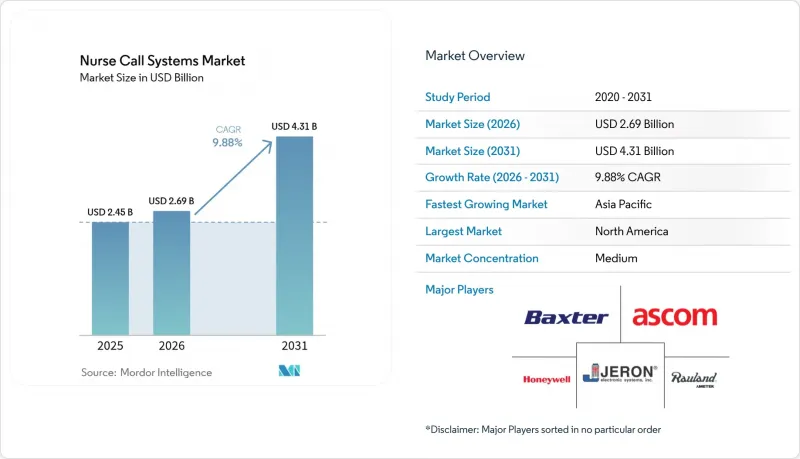
Mordor Intelligence에 따르면 너스콜 시스템 시장 규모는 2025년 24억 5,000만 달러에서 2026년에는 26억 9,000만 달러로 확대하며, 2026-2031년에 CAGR 9.88%로 추이하며, 2031년에는 43억 1,000만 달러에 달할 것으로 예측됩니다.
이 보고서는 제품별(간호사 호출 버튼 등), 통신 방식별(유선 및 무선), 용도별(긴급 통보, 워크플로우 최적화, 낙상 감지, 배회 방지),최종사용자별(병원, 장기 요양 시설, 양로원, 재택 의료) 및 지역별(북미, 유럽, 아시아태평양, 중동 및 아프리카, 남미)로 분류되어 있습니다. 시장 예측은 금액(달러) 기준으로 제시되어 있습니다.
전 세계 간호 호출 시스템 시장의 동향 및 인사이트
고령 인구 증가와 만성질환 부담의 확대
60세 이상 고령 인구는 2050년까지 21억 명으로 두 배로 증가할 것이며, 그 중 80%는 병상 수가 여전히 부족한 저·중소득 국가에 거주하게 될 것입니다. 일본에서는 임금 상승에도 불구하고 2025년까지 27만 명의 간호 인력이 부족할 것으로 예상되며, 이로 인해 병원들은 경보를 자동으로 분류하는 센서 기반 호출 시스템을 도입해야 할 압박을 받고 있습니다. 다중 질환은 기존 하드웨어에 추가적인 부담을 주고 있습니다. 3개 이상의 만성질환을 앓고 있는 환자의 경우, 일반 내과·외과 병동에 비해 호출 버튼 작동 횟수가 4.2배나 높습니다. 메디케어는 현재 낙상 건수가 하위 4분의 1에 속하는 병원에 벌금을 부과하고 있으며, 이로 인해 낙상을 예측하는 감지 모듈에 대한 수요가 증가하고 있습니다. 웨어러블 펜던트의 가속도 센서 데이터를 통합하는 공급업체는 사고 발생 최대 30초 전에 예방적 경고를 발령할 수 있으며, 가치 기반 구매(VBP)와 연계된 이익률을 유지할 수 있습니다.
병원의 디지털화 및 스마트 인프라 투자 가속화
미국 병원의 IT 예산은 2019-2023년까지 연평균 18.3% 증가했으며, 2024년에는 커넥티드 인프라에 대한 지출이 2배인 128억 달러에 달했습니다. EHR 벤더는 현재 FHIR 준수 알람 라우팅을 필수로 하고 있으며, 이로 인해 시스템 업데이트 주기가 2-3년 앞당겨지고 있습니다. 400병상 규모의 시설에서 너스콜 시스템과 RTLS를 통합한 결과, 평균 응답 시간이 4.2분에서 1.8분으로 단축되어 12,000시간의 간호사 근무 시간을 확보하고 140만 달러의 초과 근무 수당을 절감했습니다. 그러나 완전한 IP 백본 도입에 드는 자본 비용은 여전히 50만-200만 달러 범위에 머물러 있으며, 많은 지방 병원들은 무선 오버레이나 병상당 월 8-15달러의 5년 계약으로 눈을 돌리고 있습니다.
기존 시설의 IP 전환에 따른 고액의 설비 투자
300병상 규모의 병원을 개조하는 데는 120만-180만 달러의 비용이 소요되며, 병동 운영에 최대 9개월 동안 차질이 발생할 수 있습니다. 미국 지방 병원의 이익률은 평균 2% 미만이므로, 보조금이나 채권을 통한 자금 조달 없이는 완전한 전환이 현실적으로 어렵습니다. 유럽의 공립 의료 기관에서는 예산 수준이 여전히 팬데믹 이전 기준치보다 8-12% 낮은 상태이며, 1990년대의 유선 시스템 운영 기간이 연장되고 있습니다. 배터리 구동식 무선 오버레이를 도입하면 200병상 규모의 시설에서 총 비용을 30만-50만 달러로 억제할 수 있지만, 전자건강기록(EHR) 및 실시간 위치 정보 시스템(RTLS)과의 긴밀한 통합이 희생됩니다. 구독 방식은 설비 투자 부담을 줄여주지만, 감가상각 가능한 자산을 선호하는 재무 부서의 저항에 직면해 있습니다.
부문 분석
클라우드 지원 제품군은 연평균 성장률(CAGR) 11.54%로 확대되고 있으며, 2031년까지 너스콜 시스템 시장에서 16억 달러를 돌파할 전망입니다. IP 기반 시스템은 RTLS 배지 및 EHR 워크플로우에 알림 기능을 통합하고 있으며, 2025년 기준 매출의 34.65%를 차지하고 있지만, 그 도입은 여전히 대학 부속 병원에 집중되어 있습니다. 메디케이드 보상률이 민간 보험에 뒤처지는 장기 요양 시설에서는 기본적인 음성·영상 하드웨어가 여전히 주류를 이루고 있습니다. 인터컴 제품은 모바일 단말기 사용이 제한된 행동 관리 병동에서 활용되고 있습니다.
설비 투자(CapEx) 제한과 시스템 통합 수요 간의 균형을 맞추려는 병원에서는 하이브리드 모델로의 전환이 진행되고 있습니다. 구체적으로는 온프레미스 서버가 실시간 라우팅을 관리하고, 분석 기능은 클라우드에 배치되는 모델입니다. Ascom사의 ‘Telligence 7’은 이러한 중간적 접근 방식을 구현하고 있는 반면, TekTone사의 ‘Tek-CARE300III’는 완전한 IP 전환 비용의 3분의 1 수준에서 기존 유선 회선 위에 무선 버튼을 중첩하여 도입하는 방식을 채택하고 있습니다. 구독 서비스의 보급률은 여전히 20% 미만이지만, 재무 부서가 영업 비용으로 처리하는 데 익숙해지고, 벤더가 낮은 고객 이탈률을 입증함에 따라 그 확대가 가속화될 전망입니다.
2025년에는 무선 플랫폼이 매출의 62.65%를 차지하며, 연평균 성장률(CAGR) 11.67%로 확대될 전망입니다. 개조 속도가 빠르고 네트워크 재배선을 피할 수 있다는 점에서 노후화된 시설이나 외래 수술 센터에서는 무선 플랫폼이 표준적인 선택지가 되고 있습니다. 그러나 일반적인 300병상 규모의 병원의 경우, 배터리 관리에 연간 1만 8,000달러와 600시간의 간호 업무가 필요하지만, 유선 PoE를 도입하면 이러한 비용을 절감할 수 있습니다.
사이버 보안은 의사결정의 핵심 요소로서 그 중요성이 커지고 있습니다. 2024년 Change Healthcare 행사에서는 보안 조치가 적용되지 않은 IoT 노드가 위험 확대를 초래할 수 있는 실제 사례가 제시되었습니다. 현재 각 벤더사는 AES-256 암호화 및 SOC 2 Type II 인증을 ‘필수 요건’으로 내세우고 있으며, 이로 인해 개발 비용이 증가하여 중소규모 진입 기업에게는 부담이 커지고 있습니다. 또한 무선 기술은 메디케어 어드밴티지를 통해 환자 1인당 월 50-65달러의 환급 대상이 되는 재택 모니터링을 가능하게 하여 새로운 수입원을 개발하고 있습니다.
지역별 분석
북미는 조인트 커미션(Joint Commission)의 의무화 및 CMS의 제재에 힘입어 2025년 매출의 41.43%를 차지했습니다. 진행 중인 디지털화로 인해 이 지역은 얼리 어답터로서의 우위를 확보하고 있지만, 기기 교체 주기가 절대적인 성장을 둔화시키고 있습니다. 아시아태평양은 2025년 중국의 의료 지출이 1조 2,000억 달러에 달하고, 일본의 고령 인구가 현재 전체 인구의 29%를 차지함에 따라 세계 최고 수준인 연평균 성장률(CAGR) 10.43%를 기록할 전망입니다. 27만 명을 넘는 간호사 부족으로 인해 일본은 중증도에 따른 트라이아지로 전환하고 있으며, 이는 첨단 너스콜 시스템 도입을 촉진하고 있습니다.
인도의 ‘아유슈만 바라트’ 보험 프로그램에서는 지정 병원에 기능적인 너스콜 시스템 도입이 의무화되어 있으며, 안정적인 기초 수요를 창출하고 있습니다. 호주의 2025년판 EQuIP 개정안에서는 대기열 상황을 시각화하는 것이 의무화되어 있으며, 이에 따라 공립 병원 전체에서 RTLS(실시간 위치 정보 시스템)와 연동된 시스템으로의 업그레이드가 진행되고 있습니다.
유럽에서의 보급은 공공 예산이 팬데믹 이전 수준보다 8-12% 낮은 상태를 유지하고 있으며, 뒤처지고 있습니다. 중동에서는 양극화가 나타나고 있습니다. 걸프 국가들은 경제 다각화 계획의 일환으로 스마트 병원에 자금을 지원하고 있는 반면, 사하라 이남 아프리카는 제한된 자본으로 어려움을 겪고 있습니다. 남미 역시 양극화되어 있으며, 브라질은 SUS 인증 시설에 호출 시스템 도입을 의무화했으나, 아르헨티나에서는 2024년 인플레이션율이 200%에 달함에 따라 대부분의 자본 지출이 동결되었습니다.
기타 혜택:
- 엑셀 형식의 시장 예측(ME) 시트
- 3개월간 애널리스트 지원
자주 묻는 질문
목차
제1장 서론
제2장 조사 방법
제3장 개요
제4장 시장 구도
제5장 시장 규모와 성장 예측
제6장 경쟁 구도
제7장 시장 기회와 향후 전망
KSA 26.09.04According to Mordor Intelligence, the nurse call systems market size is expected to grow from USD 2.45 billion in 2025 to USD 2.69 billion in 2026 and is forecast to reach USD 4.31 billion by 2031 at 9.88% CAGR over 2026-2031.
This report is Segmented by Product (Nurse Call Buttons, and More), Modality (Wired and Wireless), Application (Emergency Alarms, Workflow Optimization, Fall Detection, and Wanderer Control), End User (Hospitals, Long-Term Care, Nursing Homes, and Home Healthcare), and Geography (North America, Europe, Asia-Pacific, MEA, and South America). Market Forecasts are Provided in Terms of Value (USD).
Global Nurse Call Systems Market Trends and Insights
Growing Geriatric Population and Rising Chronic Disease Burden
The number of people aged 60 and above will double to 2.1 billion by 2050, with 80% living in low- and middle-income countries where bed capacity remains low. Japan already faces a projected nursing shortfall of 270,000 by 2025 despite wage increases, driving hospitals to deploy sensor-based call systems that automatically triage alerts. Multimorbidity further strains legacy hardware: patients with three or more chronic conditions trigger 4.2-times more call-button activations than general med-surg wards. Medicare now penalizes hospitals in the worst quartile for falls, intensifying demand for predictive fall-detection modules. Vendors integrating accelerometer data from wearable pendants can issue pre-emptive alerts up to 30 seconds before an incident, protecting margins tied to value-based purchasing.
Accelerating Hospital Digitalization and Smart Infrastructure Spending
U.S. hospital IT budgets expanded 18.3% per year from 2019-2023, doubling connected-infrastructure outlays to USD 12.8 billion in 2024. EHR vendors now require FHIR-compliant alarm routing, pulling forward refresh cycles by two to three years. A 400-bed site that unified nurse call with RTLS shaved average response times from 4.2 to 1.8 minutes, translating into 12,000 recaptured nurse-hours and USD 1.4 million in avoided overtime. Yet capital for full IP backbones still ranges from USD 500,000 to USD 2 million, pushing many rural hospitals toward wireless overlays or five-year subscription contracts priced at USD 8-15 per bed per month.
High Capital Expenditure for IP Conversions in Legacy Facilities
Retrofitting a 300-bed hospital costs USD 1.2-1.8 million and may disrupt wards for up to nine months. Margins at rural U.S. hospitals average below 2%, rendering full migrations unrealistic without grants or bond financing. European public facilities face budget levels still 8-12% below pre-pandemic baselines, extending the life of 1990s wired systems. Battery-powered wireless overlays cut headline costs to USD 300,000-500,000 for a 200-bed site but sacrifice deep EHR and RTLS integration. Subscription pricing eases cap-ex yet meets resistance from finance teams that prefer depreciable assets.
Other drivers and restraints analyzed in the detailed report include:
- Regulatory Push for Patient Safety and Rapid Response Metrics
- Convergence of Nurse Call with Unified Clinical Communication Platforms
- Interoperability and Data Integration Challenges Across Vendor Systems
For complete list of drivers and restraints, kindly check the Table Of Contents.
Segment Analysis
Cloud-enabled suites are advancing at a 11.54% CAGR and are on track to eclipse USD 1.6 billion in the nurse call systems market by 2031. IP-based systems still accounted for 34.65% of revenue in 2025 because they embed alerts into RTLS badges and EHR workflows, but adoption remains concentrated in academic medical centers. Basic audio-visual hardware persists in long-term care where Medicaid rates lag private pay. Intercom products serve behavioral units that restrict mobile devices.
Hospitals balancing cap-ex limits and integration demands are shifting toward hybrid models: on-premise servers manage real-time routing while analytics reside in the cloud. Ascom's Telligence 7 represents this middle path, whereas TekTone's Tek-CARE300III overlays wireless buttons on existing wires at one-third the cost of full IP migration. Subscription penetration, still below 20%, should accelerate as finance teams acclimate to operating expense treatment and vendors demonstrate lower churn.
Wireless platforms accounted for 62.65% revenue in 2025 and will climb at 11.67% CAGR. Retrofit speed and network-rewiring avoidance make them the default for aging facilities and ambulatory surgery centers. Yet battery logistics add USD 18,000 and 600 nursing hours per year for a typical 300-bed hospital, a cost that wired PoE installations avoid.
Cybersecurity has risen in the decision matrix: the 2024 Change Healthcare event illustrated how unsecured IoT nodes can escalate risk exposure. Vendors now tout AES-256 encryption and SOC 2 Type II attestations as table stakes, increasing development costs that smaller entrants struggle to absorb. Wireless also enables at-home monitoring reimbursed by Medicare Advantage at USD 50-65 per patient monthly, opening an adjacent revenue stream.
Complete Report Scope:
- By Product
- Nurse Call Buttons
- Intercom Nurse Call Systems
- Basic Audio/Visual Systems
- IP-Based Nurse Call Systems
- Mobile & Cloud-Enabled Platforms
- By Modality
- Wired Systems
- Wireless Systems
- By Application
- Emergency Medical Alarms
- Workflow & Staff Optimisation
- Fall Detection & Prevention
- Wanderer Control & Dementia Care
- By End User
- Hospitals & Specialty Clinics
- Long-Term Care Facilities
- Nursing Homes
- Home-Healthcare Settings
- Geography
- North America
- United States
- Canada
- Mexico
- Europe
- Germany
- United Kingdom
- France
- Italy
- Spain
- Rest of Europe
- Asia-Pacific
- China
- Japan
- India
- Australia
- South Korea
- Rest of Asia-Pacific
- Middle East & Africa
- GCC
- South Africa
- Rest of Middle East & Africa
- South America
- Brazil
- Argentina
- Rest of South America
- North America
Geography Analysis
North America delivered 41.43% of 2025 revenue, buoyed by Joint Commission mandates and CMS penalties. Ongoing digitization grants the region an early-adopter edge, yet replacement cycles slow absolute growth. Asia-Pacific will record a 10.43% CAGR, the fastest worldwide, as China's 2025 health spend reached USD 1.2 trillion and Japan's seniors now constitute 29% of its population. Nurse shortages exceeding 270,000 have pushed Japan toward acuity-based triage, benefiting advanced call suites.
India's Ayushman Bharat insurance program stipulates the installation of functional nurse call systems in empaneled hospitals, creating a steady baseline demand. Australia's 2025 EQuIP update, which mandates queue-depth visibility, has translated into RTLS-linked upgrades across public hospitals.
Europe's expansion lags because public budgets remain 8-12% below pre-pandemic levels. The Middle East shows a two-speed pattern: Gulf states fund smart hospitals as part of diversification plans, whereas sub-Saharan Africa struggles with limited capital. South America is similarly split; Brazil mandated call coverage for SUS-accredited sites, but Argentina's 200% inflation in 2024 froze most capital spending.
- Accutech Healthcare
- Alpha Communications
- Ascom
- Austco Healthcare
- Baxter
- BEC Integrated Solutions LLC
- Caretronic
- Cornell Communications
- Critical Alert
- Fujian Huanyutong Technology Co.
- Honeywell International
- IndigoCare
- Intercall Systems
- Jeron Electronic Systems Inc.
- Momentum Healthcare
- Rauland-Borg Corporation
- Siemens Healthineers
- Systems Technologies
- TekTone Sound & Signal Mfg. Inc.
- Tunstall Healthcare Group
- Vigil Health Solutions Inc.
- West-Com Nurse Call Systems Inc.
Additional Benefits:
- The market estimate (ME) sheet in Excel format
- 3 months of analyst support
TABLE OF CONTENTS
1 Introduction
- 1.1 Study Assumptions & Market Definition
- 1.2 Scope Of The Study
2 Research Methodology
3 Executive Summary
4 Market Landscape
- 4.1 Market Overview
- 4.2 Market Drivers
- 4.2.1 Growing Geriatric Population and Rising Chronic Disease Burden
- 4.2.2 Accelerating Hospital Digitalization and Smart Infrastructure Spending
- 4.2.3 Regulatory Push for Patient Safety and Rapid Response Metrics
- 4.2.4 Convergence of Nurse Call With Unified Clinical Communication Platforms
- 4.2.5 Expansion of Home Health and Remote Patient Monitoring Ecosystems
- 4.2.6 Transition From Capex To Subscription-Based "Nurse Call As A Service" Models
- 4.3 Market Restraints
- 4.3.1 High Capital Expenditure for IP Conversions In Legacy Facilities
- 4.3.2 Interoperability and Data Integration Challenges Across Vendor Systems
- 4.3.3 Escalating Cybersecurity and Privacy Compliance Costs
- 4.3.4 Workforce Shortages Limiting Effective Utilization of Advanced Features
- 4.4 Value / Supply-Chain Analysis
- 4.5 Regulatory Landscape
- 4.6 Technological Outlook
- 4.7 Porter's Five Forces Analysis
- 4.7.1 Threat Of New Entrants
- 4.7.2 Bargaining Power Of Buyers
- 4.7.3 Bargaining Power Of Suppliers
- 4.7.4 Threat Of Substitutes
- 4.7.5 Intensity Of Competitive Rivalry
5 Market Size & Growth Forecasts (Value, USD)
- 5.1 By Product
- 5.1.1 Nurse Call Buttons
- 5.1.2 Intercom Nurse Call Systems
- 5.1.3 Basic Audio/Visual Systems
- 5.1.4 IP-Based Nurse Call Systems
- 5.1.5 Mobile & Cloud-Enabled Platforms
- 5.2 By Modality
- 5.2.1 Wired Systems
- 5.2.2 Wireless Systems
- 5.3 By Application
- 5.3.1 Emergency Medical Alarms
- 5.3.2 Workflow & Staff Optimisation
- 5.3.3 Fall Detection & Prevention
- 5.3.4 Wanderer Control & Dementia Care
- 5.4 By End User
- 5.4.1 Hospitals & Specialty Clinics
- 5.4.2 Long-Term Care Facilities
- 5.4.3 Nursing Homes
- 5.4.4 Home-Healthcare Settings
- 5.5 Geography
- 5.5.1 North America
- 5.5.1.1 United States
- 5.5.1.2 Canada
- 5.5.1.3 Mexico
- 5.5.2 Europe
- 5.5.2.1 Germany
- 5.5.2.2 United Kingdom
- 5.5.2.3 France
- 5.5.2.4 Italy
- 5.5.2.5 Spain
- 5.5.2.6 Rest of Europe
- 5.5.3 Asia-Pacific
- 5.5.3.1 China
- 5.5.3.2 Japan
- 5.5.3.3 India
- 5.5.3.4 Australia
- 5.5.3.5 South Korea
- 5.5.3.6 Rest of Asia-Pacific
- 5.5.4 Middle East & Africa
- 5.5.4.1 GCC
- 5.5.4.2 South Africa
- 5.5.4.3 Rest of Middle East & Africa
- 5.5.5 South America
- 5.5.5.1 Brazil
- 5.5.5.2 Argentina
- 5.5.5.3 Rest of South America
- 5.5.1 North America
6 Competitive Landscape
- 6.1 Market Concentration
- 6.2 Market Share Analysis
- 6.3 Company Profiles {(Includes Global Level Overview, Market Level Overview, Core Segments, Financials as Available, Strategic Information, Market Rank/Share for Key Companies, Products & Services, and Recent Developments)}
- 6.3.1 Accutech Healthcare
- 6.3.2 Alpha Communications
- 6.3.3 Ascom Holding AG
- 6.3.4 Austco Healthcare
- 6.3.5 Baxter International (Hillrom)
- 6.3.6 BEC Integrated Solutions LLC
- 6.3.7 Caretronic
- 6.3.8 Cornell Communications
- 6.3.9 Critical Alert
- 6.3.10 Fujian Huanyutong Technology Co.
- 6.3.11 Honeywell International Inc.
- 6.3.12 IndigoCare
- 6.3.13 Intercall Systems
- 6.3.14 Jeron Electronic Systems Inc.
- 6.3.15 Momentum Healthware
- 6.3.16 Rauland-Borg Corporation
- 6.3.17 Siemens Healthineers
- 6.3.18 Systems Technologies
- 6.3.19 TekTone Sound & Signal Mfg. Inc.
- 6.3.20 Tunstall Healthcare Group
- 6.3.21 Vigil Health Solutions Inc.
- 6.3.22 West-Com Nurse Call Systems Inc.
7 Market Opportunities & Future Outlook
- 7.1 White-Space & Unmet-Need Assessment


