

|
시장보고서
상품코드
2122189
차세대 시퀀싱(NGS) 인포매틱스 : 시장 점유율 분석, 업계 동향 및 통계, 성장 예측(2026-2031년)Next-Generation Sequencing Informatics - Market Share Analysis, Industry Trends & Statistics, Growth Forecasts (2026 - 2031) |
||||||
 Mordor Intelligence
Mordor Intelligence에 의하면, 차세대 시퀀싱(NGS) 인포매틱스 시장 규모는 2025년 26억 4,000만 달러로 평가되었습니다. 2026년에는 30억 1,000만 달러로 확대되어 2026년부터 2031년에 걸쳐 CAGR 13.95%로 성장을 지속하여, 2031년에는 57억 8,000만 달러에 이를 것으로 예측됩니다.
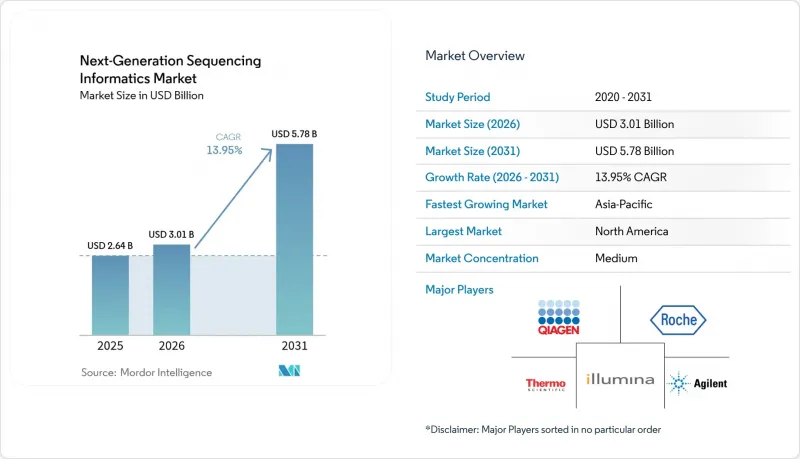
본 보고서는 제공 형태(NGS 인포매틱스 소프트웨어, NGS 인포매틱스 서비스, NGS 인포매틱스 플랫폼), 도입 형태(클라우드 기반 등), 용도(신약 개발 등), 최종 사용자(병원 등),지역(북미, 유럽, 아시아태평양, 중동 및 아프리카, 남미)별로 분류되어 있습니다. 시장 예측은 금액(달러) 기준으로 제시되어 있습니다.
세계의 차세대 시퀀싱(NGS) 인포매틱스 시장 동향 및 인사이트
유전체학의 임상 및 연구 분야에서의 활용 사례 확대
현재 종양학 프로그램에서는 환자를 표적 치료법에 매칭시키는 종합적인 패널이 활용되고 있으며, 이러한 변화로 인해 2030년까지 정밀 의학 시장의 매출은 연평균 성장률(CAGR) 16.4%로 확대될 것으로 전망됩니다. 프레데릭 헬스(Frederick Health)에서는 GenomOncology사의 플랫폼을 Expanse Genomics에 통합한 결과, 96명의 환자에 대해 치료법이 조정되었으며, 6개월 동안 임상시험 의뢰 건수가 28배 증가했습니다. 희귀질환 진단에는 롱 리드 시퀀싱이 활용되고 있으며, 아젠타(Azent)사의 임상적으로 검증된 검사를 통해 숏 리드 워크플로우에서는 간과되기 쉬운 구조적 변이가 밝혀지고 있습니다. 학술 컨소시엄도 규모를 확대되고 있습니다. ‘Alliance for Genomic Discovery’는 25만 건의 전체 유전체 분석을 완료하고, 신약 개발 표적 식별을 위한 훈련 데이터 세트를 확충했습니다. 이러한 프로그램이 확대됨에 따라, 병원 및 바이오의약품 기업들은 복잡한 데이터 세트를 임상 현장의 의사 결정에 연결해 줄 정보 분석 플랫폼을 요구하고 있으며, 차세대 시퀀싱 정보 분석 시장 전체에서 지속 가능한 수익 모델이 강화되고 있습니다.
유전체당 시퀀싱 비용의 지속적인 하락
Ultima Genomics 및 Roche SBX의 플랫폼은 샘플당 비용을 100달러대로 낮추고, 처리량을 시간당 30X 유전체 7개로 향상시켰습니다. 진입 비용의 하락으로 대규모 프로젝트가 실현 가능해졌으며, 싱가포르의 국가 정밀의료 로드맵과 인도의 ‘GenomeIndia’ 이니셔티브에서는 수만 건의 신규 유전체 분석이 의뢰되기에 이르렀습니다. 콜드체인 물류 체계가 갖춰지지 않은 연구소를 위해 설계된 일루미나(Illumina)사의 MiSeq i100 시스템은 신흥국 시장에서 보급을 확대되고 있습니다. 시퀀싱의 자본 집약도가 낮아짐에 따라, 리드 생성보다 데이터 분석 능력이 주요 병목 현상으로 대두되고 있으며, 차세대 시퀀싱(NGS) 인포매틱스 시장에서 예산 배분이 소프트웨어 구독 및 관리형 서비스로 전환되고 있습니다.
분열된 세계의 데이터 개인정보 보호 및 주권에 관한 규제
미국 법무부는 현재 지정된 ‘우려 국가’로의 유전체 데이터 일괄 수출을 제한하고 있으며, 기업들에게 기술적 안전 대책 도입과 2025년 10월부터의 연례 감사 보고서 제출을 의무화하고 있습니다. 유럽의 GDPR(EU 개인정보보호규정)에서는 이미 2차 이용에 대한 명시적 동의가 의무화되어 있으며, 아시아태평양의 일부 국가에서는 다기관 공동 연구를 복잡하게 만드는 데이터 현지화 조항이 도입되었습니다. 따라서 제공업체는 지역별로 분리된 클라우드를 구축하거나, 연합 학습 모델을 채택해야 합니다. 이러한 조치는 규정 준수에 드는 비용을 두 자릿수 수준으로 증가시켜 차세대 시퀀싱(NGS) 인포매틱스 시장의 도입 주기를 지연시킬 가능성이 있습니다.
부문별 분석
NGS 정보학 소프트웨어는 2025년에 차세대 시퀀싱(NGS) 인포매틱스 시장 점유율의 57.45%를 유지하며, 대부분의 1차 및 3차 워크플로우를 지원했습니다. Illumina의 DRAGEN과 Emedgene의 설명 가능한 AI가 정확도의 점진적인 향상을 주도하고 있습니다. 맞춤형 플러그인 생태계, 시맨틱 검색 모듈, AI 지원 큐레이션 엔진을 통해 정적인 변이 파일이 몇 분 이내에 대화형 임상 보고서로 변환됩니다. 클라우드 네이티브 플랫폼은 현재 규모는 작지만 연평균 성장률(CAGR) 15.55%로 확대되고 있으며, 워크플로우 관리, 규정 준수 대시보드, 종량제 컴퓨팅 기능을 통합된 작업 공간에 모아, 사내에 바이오인포매틱스 담당자가 제한적인 검사실에게 매력적인 솔루션이 되고 있습니다.
관리형 분석 업체에서 맞춤형 파이프라인 개발 업체에 이르기까지, 서비스 제공업체는 사내에 전문가를 보유하지 않은 조직에 여전히 필수적인 존재입니다. 임상 및 검사 기준 협회(CLSI)의 구조화된 워크시트가 현재 검증 지침으로 사용되고 있지만, 많은 병원 검사실에서는 여전히 3차 해석 업무를 외부에 위탁하고 있습니다. 플랫폼이 드래그 앤 드롭 인터페이스와 컨테이너 오케스트레이션을 통합함에 따라 기존의 사일로화가 더욱 해소되고, 차세대 시퀀싱(NGS) 인포매틱스 시장의 총 잠재 시장 규모가 확대되고 있습니다.
2025년에는 자본 지출 없이 수만 CPU 시간을 확보해야 할 필요성에 힘입어, 클라우드 도입이 차세대 시퀀싱(NGS) 인포매틱스 시장의 63.40%를 차지했습니다. Google Cloud와 같은 공급업체는 페타바이트 규모의 오브젝트 스토리지와 통합된 AI 모델 허브를 갖춘 턴키 방식의 유전체학 워크벤치를 제공하며, 이를 통해 멀티오믹스 쿼리의 평균 응답 시간이 단축되고 있습니다.
방화벽 외부로 데이터를 반출할 수 없는 환경에서는 여전히 On-Premise형 클러스터가 사용되고 있지만, 설비의 점진적인 감가상각과 에너지 비용 상승으로 인해 하이브리드 환경으로의 전환이 진행되고 있습니다. 하이브리드 모델은 원시 읽기 데이터(raw reads)를 사내의 안전한 스토리지에 보관하면서 2차 분석을 클라우드에서 수행함으로써, 새로운 데이터 주권 관련 법규 준수를 확보하면서도 확장성을 유지할 수 있게 합니다. 이러한 구성은 2031년까지 연평균 성장률(CAGR) 15.1%를 나타낼 것으로 예측되며, 전 세계 도입 솔루션에서 차세대 시퀀싱(NGS) 인포매틱스 시장 규모를 확대할 것으로 전망됩니다.
지역별 분석
북미는 풍부한 연구 예산, 성숙한 지불자 체계, 그리고 임상 유전체학 분야에서 적응형 AI를 장려하는 FDA의 입장에 힘입어 2025년 매출의 41.70%를 차지했습니다. 기술 제휴도 활발해지고 있으며, NVIDIA, IQVIA, 메이요 클리닉은 공동으로 페타바이트 규모의 다중 모드 환자 데이터를 처리하여 임상시험 매칭을 가속화하는 기반 모델을 훈련하고 있습니다. 한편, Tempus사는 3,000개 이상의 의료 기관에 걸쳐 있는 Epic사의 Genomics 모듈에 구조화된 체세포 변이 검사 결과를 직접 통합한 최초의 검사 기관이 되어, 국내 분석 벤더에 크게 의존하는 임상 워크플로우를 확립했습니다.
아시아태평양은 싱가포르의 10개년 정밀의료 로드맵, 호주의 PrOSPeCT 암 프로그램,그리고 한국의 K-MASTER 이니셔티브에 힘입어 각각 수만 건의 유전체 시퀀싱을 수행하고 있는 만큼, 2031년까지 연평균 14.21%의 복합 성장률로 확대될 것으로 전망됩니다. 연평균 10.75%로 성장하고 있는 인도의 수탁 연구(CRO) 부문은 장비 보급을 뒷받침하고 있습니다. 일루미나(Illumina)사의 MiSeq i100은 콜드체인 운송 환경이 갖춰지지 않은 연구소를 명확한 타겟으로 삼고 있으며, 2급 도시에서 현지 워크플로우를 실현합니다. 이러한 움직임들이 맞물려 해당 지역의 차세대 시퀀싱(NGS) 인포매틱스 시장 점유율을 확대하고, 각국의 데이터 보호법을 준수한 클라우드 네이티브 협업의 기반을 마련하고 있습니다.
유럽은 호라이즌 계획의 자금 지원과 2025년 이후 공중보건 연구소에 병원체 감시를 위한 전장 유전체 시퀀싱 도입을 의무화하는 유럽위원회의 신규 규제를 배경으로 확고한 입지를 유지하고 있습니다. 일루미나(Illumina)와 세켄티아 바이오테크(Sequentia Biotech)와 같은 파트너십은 식품 안전 분야에서의 실용화 진전을 보여주고 있습니다. 중동 및 아프리카 및 남미는 아직 발전 단계에 있지만, 미래가 기대되는 시장입니다. ‘쿼드 암 문샷(Quad Cancer Moonshot)’과 같은 이니셔티브는 유전체 인프라를 구축하고, 차세대 시퀀싱(NGS) 인포매틱스 시장에서 신흥 시장의 성장을 목표로 하는 벤더들에게 초기 발판을 마련해 주고 있습니다.
기타 혜택 :
- 엑셀 형식 시장 예측(ME) 시트
- 3개월간의 애널리스트 지원
자주 묻는 질문
목차
제1장 서론
제2장 조사 방법
제3장 주요 요약
제4장 시장 구도
제5장 시장 규모 및 성장 예측
제6장 경쟁 구도
제7장 시장 기회 및 향후 전망
KTH 26.09.04According to Mordor Intelligence, the next-generation sequencing informatics market size is expected to grow from USD 2.64 billion in 2025 to USD 3.01 billion in 2026 and is forecast to reach USD 5.78 billion by 2031 at 13.95% CAGR over 2026-2031.
This report is Segmented by Offering (NGS Informatics Software, NGS Informatics Services, and NGS Informatics Platforms), Deployment Mode (Cloud-Based, and More), Application (Drug Discovery, and More), End User (Hospitals, and More), Geography (North America, Europe, Asia-Pacific, The Middle East and Africa, and South America). The Market Forecasts are Provided in Terms of Value (USD).
Global Next-Generation Sequencing Informatics Market Trends and Insights
Widening Clinical & Research Use-Cases of Genomics
Oncology programs now rely on comprehensive panels that match patients to targeted therapies, a shift that is propelling precision-medicine revenues at a 16.4% CAGR through 2030. In Frederick Health, embedding GenomOncology's platform inside Expanse Genomics triggered therapy adjustments for 96 patients and multiplied clinical-trial referrals by 28-fold within six months. Rare-disease diagnostics are benefiting from long-read sequencing, and Azenta's clinically validated test is uncovering structural variants most short-read workflows miss. Academic consortia are also scaling: the Alliance for Genomic Discovery has completed 250,000 whole genomes, enlarging training sets for drug-target identification. As these programs expand, hospitals and biopharma alike demand informatics platforms that translate complex datasets into bedside decisions, reinforcing recurrent-revenue models across the next-generation sequencing informatics market.
Sustained Decline in Sequencing Cost per Genome
Platforms from Ultima Genomics and Roche SBX are pushing per-sample costs toward USD 100 and raising throughput to seven 30X genomes per hour, respectively. Lower entry costs have unlocked population-scale projects, leading Singapore's national precision-medicine roadmap and India's GenomeIndia effort to commission tens of thousands of new genomes. Illumina MiSeq i100 systems, tailored for laboratories that lack cold-chain logistics, are widening uptake in emerging economies. As sequencing capital intensity wanes, data-analysis capacity rather than read generation is becoming the primary bottleneck, shifting budget allocations toward software subscriptions and managed services inside the next-generation sequencing informatics market.
Fragmented Global Data-Privacy & Sovereignty Regulations
The U.S. Department of Justice now restricts bulk genomic exports to designated "countries of concern," compelling enterprises to install technical safeguards and submit annual audits starting October 2025. Europe's GDPR already mandates explicit consent for secondary use, and several APAC nations have introduced data-localization clauses that complicate multi-center studies. Providers must therefore build region-segregated clouds or pursue federated-learning models, steps that inflate compliance overheads by double digits and may slow deployment cycles inside the next-generation sequencing informatics market.
Other drivers and restraints analyzed in the detailed report include:
- Mainstream Adoption of Cloud & Hybrid Compute Architectures
- Convergence of AI/ML with Genomic Data Pipelines
- Shortage of Clinically-Trained Bioinformaticians & Validation Experts
For complete list of drivers and restraints, kindly check the Table Of Contents.
Segment Analysis
NGS informatics software maintained 57.45% of next-generation sequencing informatics market share in 2025 and anchors most primary and tertiary workflows, with Illumina DRAGEN and Emedgene Explainable AI driving incremental accuracy gains. Custom plug-in ecosystems, semantic-search modules and AI-assisted curation engines transform static variant files into interactive clinical reports within minutes. Cloud-native platforms, though smaller today, are expanding at a 15.55% CAGR, bundling workflow management, compliance dashboards and pay-as-you-go compute into unified workspaces that appeal to laboratories with limited in-house bioinformatics staff.
Service providers-ranging from managed-analysis shops to bespoke pipeline developers-remain indispensable for organizations lacking internal specialists. The Clinical and Laboratory Standards Institute's structured worksheets now guide validation, yet many hospital labs still outsource tertiary-interpretation tasks. As platforms integrate drag-and-drop interfaces and container orchestration, they further erode traditional silos and enlarge the total addressable segment of the next-generation sequencing informatics market.
Cloud installations accounted for 63.40% of the next-generation sequencing informatics market in 2025, fueled by the need to spin up tens of thousands of CPU-hours without capital expenditure. Providers such as Google Cloud offer turnkey genomics workbenches with petabyte-scale object stores and integrated AI model hubs that reduce the mean time-to-answer for multi-omics queries.
On-premise clusters persist where data cannot leave firewalls, but steady equipment depreciation and rising energy costs are prompting a migration to hybrid set-ups. The hybrid model combines in-house secure storage for raw reads with cloud-based secondary analysis, allowing compliance with emerging sovereignty statutes while maintaining elasticity. These configurations are expected to post a 15.1% CAGR to 2031, expanding the footprint of the next-generation sequencing informatics market size for deployment solutions worldwide.
Complete Report Scope:
- By Offering
- NGS Informatics Software
- Primary Data Analysis Tools
- Secondary Analysis (Alignment, Assembly, Variant Calling)
- Tertiary Analysis & Interpretation
- NGS Informatics Services
- Managed & Hosted Services
- Custom Bioinformatics & Pipeline Development
- Training & Support Services
- NGS Informatics Platforms
- NGS Informatics Software
- By Deployment Mode
- Cloud-based
- On-premise
- Hybrid
- By Application
- Drug Discovery
- Genetic Screening
- Precision Medicine
- Other Applications
- By End User
- Hospitals and Clinics
- Academics and Research Institutes
- Pharmaceuticals Companies
- Other End Users
- Geography
- North America
- United States
- Canada
- Mexico
- Europe
- Germany
- United Kingdom
- France
- Italy
- Spain
- Rest of Europe
- Asia-Pacific
- China
- Japan
- India
- Australia
- South Korea
- Rest of Asia-Pacific
- Middle East & Africa
- GCC
- South Africa
- Rest of Middle East & Africa
- South America
- Brazil
- Argentina
- Rest of South America
- North America
Geography Analysis
North America retained 41.70% of 2025 turnover, underpinned by deep research budgets, mature payer frameworks and an FDA stance that encourages adaptive AI in clinical genomics. Technology alliances are flourishing: NVIDIA, IQVIA and Mayo Clinic jointly train foundation models that crunch petabytes of multimodal patient data to accelerate trial matching. Tempus, meanwhile, became the first laboratory to feed structured somatic-variant results directly into Epic's Genomics module across more than 3,000 institutions, cementing clinical workflows that lean heavily on domestic analytics vendors.
Asia Pacific is projected to compound at 14.21% a year to 2031, propelled by Singapore's 10-year precision-medicine roadmap, Australia's PrOSPeCT cancer program and South Korea's K-MASTER initiative, each sequencing tens of thousands of genomes. India's contract-research sector, growing at 10.75%, complements device uptake; Illumina's MiSeq i100 aims squarely at labs lacking cold-chain shipping, enabling localized workflows in tier-2 cities. These moves collectively enlarge the region's slice of the next-generation sequencing informatics market size and lay a foundation for cloud-native collaborations that respect sovereign data laws.
Europe retains a solid foothold on the back of Horizon funding and a new European Commission regulation that obliges public-health labs to adopt whole-genome sequencing for pathogen surveillance starting 2025. Partnerships like Illumina-Sequentia Biotech showcase translational uptake in food safety. Middle East & Africa and South America remain nascent but promising; initiatives such as the Quad Cancer Moonshot inject genomic infrastructure and establish early footholds for vendors courting frontier-market growth across the next-generation sequencing informatics market.
- Illumina
- Thermo Fisher Scientific
- QIAGEN
- Roche
- Agilent Technologies
- DNAnexus Inc.
- Fabric Genomics Inc.
- Partek
- PerkinElmer
- Eagle Genomics Ltd.
- DNASTAR
- SoftGenetics LLC
- Sapio Sciences LLC
- PierianDx Inc.
- BGI Shenzhen (MGI Tech)
- Oxford Nanopore Technologies plc (Epi2Me)
- Seven Bridges Genomics Inc.
- Geneious Biologics (Biomatters Ltd.)
Additional Benefits:
- The market estimate (ME) sheet in Excel format
- 3 months of analyst support
TABLE OF CONTENTS
1 Introduction
- 1.1 Study Assumptions & Market Definition
- 1.2 Scope of the Study
2 Research Methodology
3 Executive Summary
4 Market Landscape
- 4.1 Market Overview
- 4.2 Market Drivers
- 4.2.1 Widening Clinical & Research Use-Cases of Genomics
- 4.2.2 Sustained Decline in Sequencing Cost per Genome
- 4.2.3 Mainstream Adoption of Cloud & Hybrid Compute Architectures
- 4.2.4 Convergence of AI/ML with Genomic Data Pipelines
- 4.2.5 Regulatory Recognition of Genomic Software as Medical Device (SaMD)
- 4.2.6 Integration of Genomic Insights into EHR & Precision-Medicine Workflows
- 4.3 Market Restraints
- 4.3.1 Fragmented Global Data-Privacy & Sovereignty Regulations
- 4.3.2 Shortage of Clinically-Trained Bioinformaticians & Validation Experts
- 4.3.3 Escalating Long-Term Storage & Compute Costs for Genomic Datasets
- 4.3.4 Lack of Interoperability Among Legacy LIMS/EHR & Modern Pipelines
- 4.4 Regulatory & Technological Outlook
- 4.5 Porter's Five Forces Analysis
- 4.5.1 Threat of New Entrants
- 4.5.2 Bargaining Power of Buyers
- 4.5.3 Bargaining Power of Suppliers
- 4.5.4 Threat of Substitutes
- 4.5.5 Intensity of Competitive Rivalry
5 Market Size & Growth Forecasts (Value, USD)
- 5.1 By Offering
- 5.1.1 NGS Informatics Software
- 5.1.1.1 Primary Data Analysis Tools
- 5.1.1.2 Secondary Analysis (Alignment, Assembly, Variant Calling)
- 5.1.1.3 Tertiary Analysis & Interpretation
- 5.1.2 NGS Informatics Services
- 5.1.2.1 Managed & Hosted Services
- 5.1.2.2 Custom Bioinformatics & Pipeline Development
- 5.1.2.3 Training & Support Services
- 5.1.3 NGS Informatics Platforms
- 5.1.1 NGS Informatics Software
- 5.2 By Deployment Mode
- 5.2.1 Cloud-based
- 5.2.2 On-premise
- 5.2.3 Hybrid
- 5.3 By Application
- 5.3.1 Drug Discovery
- 5.3.2 Genetic Screening
- 5.3.3 Precision Medicine
- 5.3.4 Other Applications
- 5.4 By End User
- 5.4.1 Hospitals and Clinics
- 5.4.2 Academics and Research Institutes
- 5.4.3 Pharmaceuticals Companies
- 5.4.4 Other End Users
- 5.5 Geography
- 5.5.1 North America
- 5.5.1.1 United States
- 5.5.1.2 Canada
- 5.5.1.3 Mexico
- 5.5.2 Europe
- 5.5.2.1 Germany
- 5.5.2.2 United Kingdom
- 5.5.2.3 France
- 5.5.2.4 Italy
- 5.5.2.5 Spain
- 5.5.2.6 Rest of Europe
- 5.5.3 Asia-Pacific
- 5.5.3.1 China
- 5.5.3.2 Japan
- 5.5.3.3 India
- 5.5.3.4 Australia
- 5.5.3.5 South Korea
- 5.5.3.6 Rest of Asia-Pacific
- 5.5.4 Middle East & Africa
- 5.5.4.1 GCC
- 5.5.4.2 South Africa
- 5.5.4.3 Rest of Middle East & Africa
- 5.5.5 South America
- 5.5.5.1 Brazil
- 5.5.5.2 Argentina
- 5.5.5.3 Rest of South America
- 5.5.1 North America
6 Competitive Landscape
- 6.1 Market Concentration
- 6.2 Market Share Analysis
- 6.3 Company Profiles (includes Global level Overview, Market level overview, Core Business Segments, Financials, Headcount, Key Information, Market Rank, Market Share, Products and Services, and analysis of Recent Developments)
- 6.3.1 Illumina Inc.
- 6.3.2 Thermo Fisher Scientific Inc.
- 6.3.3 QIAGEN N.V.
- 6.3.4 F. Hoffmann-La Roche Ltd.
- 6.3.5 Agilent Technologies Inc.
- 6.3.6 DNAnexus Inc.
- 6.3.7 Fabric Genomics Inc.
- 6.3.8 Partek Incorporated
- 6.3.9 PerkinElmer Inc.
- 6.3.10 Eagle Genomics Ltd.
- 6.3.11 DNASTAR Inc.
- 6.3.12 SoftGenetics LLC
- 6.3.13 Sapio Sciences LLC
- 6.3.14 PierianDx Inc.
- 6.3.15 BGI Shenzhen (MGI Tech)
- 6.3.16 Oxford Nanopore Technologies plc (Epi2Me)
- 6.3.17 Seven Bridges Genomics Inc.
- 6.3.18 Geneious Biologics (Biomatters Ltd.)
7 Market Opportunities & Future Outlook
- 7.1 White-space & Unmet-Need Assessment


