|
시장보고서
상품코드
2122190
마이크로바이옴 시퀀싱 서비스 : 시장 점유율 분석, 업계 동향과 통계, 성장 예측(2026-2031년)Microbiome Sequencing Services - Market Share Analysis, Industry Trends & Statistics, Growth Forecasts (2026 - 2031) |
||||||
 Mordor Intelligence
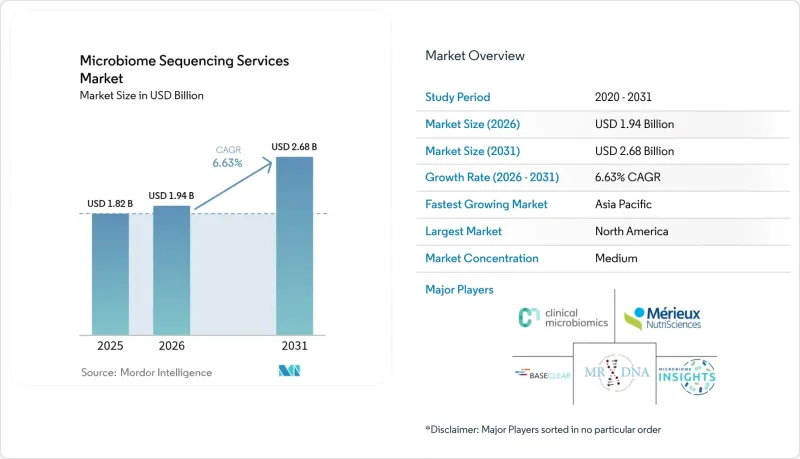
Mordor Intelligence에 따르면 2026년 마이크로바이옴 시퀀싱 서비스 시장의 규모는 19억 4,000만 달러로 추정되고 있으며, 2025년 18억 2,000만 달러에서 확대하며, 2031년에는 26억 8,000만 달러에 달할 것으로 예측됩니다.
2026-2031년까지 연평균 성장률(CAGR) 6.63%로 성장할 것으로 전망됩니다.
이 보고서는 시퀀싱 서비스 유형(16S rRNA 유전자 시퀀싱 등), 기술(라이게이션법을 이용한 시퀀싱 등), 용도(소화기 질환, 감염증 등), 최종사용자(학술·연구 기관 등) 및 지역(북미, 유럽, 아시아태평양 등)별로 분류되어 있습니다. 시장 규모 및 전망은 금액(달러) 기준으로 제시되어 있습니다.
글로벌 마이크로바이옴 시퀀싱 서비스 시장의 동향 및 인사이트
전문 마이크로바이옴 CRO에 대한 임상시험 아웃소싱의 급증
제약 개발 기업은 여전히 사내에서 확보하기 어려운 샘플링, 배양 및 생물정보학에 관한 전문 지식을 CRO가 보유하고 있으므로 복잡한 마이크로바이옴 관련 업무 프로세스를 계약 연구 기관(CRO)에 이관하고 있습니다. 미국 FDA의 REBYOTA 및 VOWST 승인은 규제 승인 경로를 확립하고, 더 대규모의 후기 임상 시험 파이프라인의 길을 열어주며, 일정을 단축하고 프로토콜 표준화를 관리할 수 있는 기업으로의 추가적인 아웃소싱을 촉진하고 있습니다. 여러 스폰서의 프로젝트를 통합하고 규모의 경제를 활용할 수 있는 CRO는 2030년까지 연평균 성장률(CAGR) 7.55%로 성장하여, 현재 가장 빠르게 확대되고 있는 최종사용자층이 되고 있습니다. 시료 물류, ? 랩 워크플로우, 제출 준비가 완료된 보고서 작성에 이르기까지 포괄하는 CRO의 통합 서비스는 비용이 많이 드는 2상 및 3상 임상시험에서 특히 매력적입니다. 이러한 임상시험에서는 속도와 재현성이 실질적인 비용 절감으로 이어집니다. 대형 CRO와 시퀀싱 기술 공급업체 간의 전략적 제휴는 시장 진출을 확대할 뿐만 아니라, 미생물군집 시퀀싱 서비스 시장 전체의 연평균 성장률(CAGR)을 1.8% 끌어올리는 원동력이 되는 아웃소싱의 선순환을 강화하고 있습니다.
1Gb당 NGS 비용의 하락
인간 게놈 시퀀싱 비용은 2001년 1억 달러에서 2023년에는 500달러 가까이까지 급락했으며, 전문적인 연구개발 환경에서는 10달러 미만이 될 것이라는 예측도 현실성을 띠고 있습니다. 이러한 비용 감소로 인해 샷건법이나 롱 리드 메타게놈 분석이 널리 보급되면서, 중소 바이오기술 기업부터 대규모 학술 컨소시엄에 이르기까지 마이크로바이옴 시퀀싱 서비스 시장에 진입할 수 있게 되었습니다. 그러나 원시 시퀀싱이 상품화되고 이익률이 축소됨에 따라 각 제공업체들은 첨단 분석, 품질관리 및 엔드투엔드 워크플로우 통합을 통해 차별화를 꾀할 수밖에 없게 되었습니다. 멀티오믹스 분석 및 임상 등급 보고서 작성에 주력하는 기업은 프리미엄 가격을 유지할 수 있는 반면, 순수한 ‘1Gb당’ 가격 정책을 적용하는 공급업체는 가격 압박이 커지고 있습니다. 그 결과, 비용 감소는 시장의 연평균 성장률(CAGR)에 1.5%포인트의 긍정적 영향을 미치겠지만, 저비용 데이터 생성 및 부가가치 분석을 결합한 공급업체만이 그 혜택을 충분히 누릴 수 있을 것입니다.
인간 마이크로바이옴 데이터의 소유권을 둘러싼 윤리적·법적 과제
개인과 관련된 미생물의 유전 물질이 생의학적 개인정보 보호법의 적용 대상인 개인 데이터에 해당하는지 여부에 대해서는 관할권에 따라 견해가 다릅니다. 중국의 인간 유전 자원 관련 규정에서는 국내 처리를 의무화하고 있는 반면, 나고야 의정서는 출처가 국경을 넘어갈 가능성이 있는 미생물에 대해서도 접근 및 이익 공유(ABS)를 적용하고 있습니다. 미국 법무부는 마이크로바이옴 데이터를 규제 대상 범주로 지정할 것을 제안하고 있으며, 이로 인해 적대국으로 간주되는 국가에서의 클라우드 처리가 제한될 가능성이 있습니다. 이러한 각기 다른 차이점들은 로컬 서버 설치부터 상세한 동의서 작성에 이르기까지 규정 준수상의 부담을 가중시키며, 중소규모 제공업체에 과도한 부담을 안겨주고 있습니다. 시료가 여러 규제 체제를 가로지르는 국경을 넘는 임상 시험에서는 현재 지연이나 추가적인 법적 비용이 발생하고 있으며, 이로 인해 마이크로바이옴 시퀀싱 서비스 시장의 연평균 성장률(CAGR)이 추정치로 1.2포인트 하락하고 있습니다.
부문 분석
2025년, 샷건형 메타게놈 시퀀싱은 마이크로바이옴 시퀀싱 서비스 시장 점유율의 42.98%를 차지하며, 균주 수준 및 기능적 특성 평가에서 주요 기법으로서의 위상을 강조했습니다. 이 기법은 내성 유전자, 병원성 인자, 대사 경로를 규명하는 광범위한 데이터세트를 생성하여 신약 스크리닝 및 바이오마커 식별을 지원합니다. 지속적인 비용 절감과 자동화로 처리 시간이 단축됨에 따라 탐색적 연구와 규제 대상 프로젝트 모두에서 샷건 방식의 매력이 높아지고 있습니다. 그러나 비용 중심의 진단이나 분류학적 포괄성이 충분한 대규모 역학 스크리닝의 경우, 타깃형 16S rRNA 시퀀싱이 여전히 일정한 위치를 유지하고 있습니다. 따라서 성장은 서비스 번들링을 통해 실현되고 있으며, 제공업체들은 초기 16S 스크리닝에 완전한 샷건 프로파일링을 추가하여 제공하고 있습니다.
전체 게놈 및 메타트랜스크립톰 시퀀싱은 치료법 설계 및 규제 당국에 대한 신청에서 기능 오믹스에 대한 수요에 힘입어 연평균 성장률(CAGR) 7.48%로 증가할 것으로 예측됩니다. 스폰서들이 분류학을 넘어선 메커니즘에 대한 인사이트를 추구하는 가운데, DNA/RNA와 대사 산물을 결합한 복합 워크플로우를 제공하는 업체들은 수익성이 높은 프로젝트를 수주하고 있습니다. 타겟 패널 시퀀싱은 항생제 내성 감시 등 전문적인 요구를 충족시키는 한편, 공간 마이크로바이오믹스와 같은 다른 혁신적인 서비스들은 외과 종양학 및 피부과 분야에서 등장하고 있습니다. 이러한 일련의 동향은 마이크로바이옴 시퀀싱 서비스 시장의 꾸준한 다각화를 지원하며, 제공업체들이 특정 단일 방식에 따른 이익률 하락으로부터 보호받을 수 있게 해줍니다.
2025년, 마이크로바이옴 시퀀싱 서비스 시장의 매출 중 합성형 시퀀싱(Sequencing-by-synthesis)이 40.78%를 차지했습니다. 이는 대규모 임상 코호트에 적합한 높은 정확도와 처리량을 실현하는 확립된 화학 기술의 혜택을 받은 결과입니다. 이 플랫폼을 활용하는 서비스 제공업체들은 성숙한 시약 공급망과 소프트웨어 생태계의 이점을 누리고 있으며, 규제 대상 업무에서 합성형 시퀀싱은 사실상 표준이 되었습니다. 그럼에도 불구하고 라이게이션 방식에 의한 시퀀싱은 주로 해당 화학 기술이 분변이나 환경 시료에서 흔히 발견되는 단편화되거나 손상된 DNA를 처리할 수 있다는 점 덕분에 7.38%라는 가장 높은 연평균 성장률(CAGR)을 기록할 것으로 예상됩니다. 라이게이션 기반 플랫폼의 속도와 처리 능력이 향상됨에 따라 공급업체들은 높은 정밀도가 요구되는 용도에는 합성법을, 처리가 더 어려운 매트릭스에는 라이게이션법을 결합한 하이브리드 구성을 채택하고 있습니다.
나노포어 시퀀싱은 실시간 롱 리드 능력으로 주목을 받고 있으며, 병원체의 신속한 검출과 구조적 변이 분석을 가능하게 합니다. 정확도 측면의 과제는 여전히 남아 있지만, 기공 설계의 개선과 기계학습을 활용한 염기 식별 기술 덕분에 그 격차는 점차 좁혀지고 있습니다. 그 밖에도 단일 분자법이나 반도체 검출기도 계속 발전하고 있지만, 마이크로바이옴에 대한 응용은 여전히 틈새 분야에 머물러 있습니다. 그 결과, 서비스 제공업체들은 멀티 기술 대응 연구소를 운영하며, 샘플 유형별로 최적의 플랫폼을 선택함으로써 경쟁이 치열해지는 마이크로바이옴 시퀀싱 서비스 시장에서 고객 유지를 도모하고 있습니다.
지역별 분석
북미는 2025년에도 FDA가 승인한 규제 경로, 밀집된 제약 클러스터, 그리고 수년에 걸친 NIH의 자금 지원에 힘입어 매출에서 42.31%의 선두를 유지했습니다. 생물제제의 승인, 벤더와의 제휴, 벤처 캐피털 자금 유입이 맞물려, 비용 압박으로 인해 전문 CRO 허브로의 아웃소싱이 진행되는 상황에서도 샘플 수는 높은 수준을 유지하고 있습니다. 미생물군집 데이터를 기밀 정보로 분류하는 미국의 규정안은 해외에서의 분석을 제한할 가능성이 있지만, 한편으로는 국내 공급업체에 대해 안전한 클라우드 환경 및 FedRAMP 준수 파이프라인에 대한 투자를 촉진하고 있으며, 이를 통해 현지 분석 역량이 더욱 공고해지고 있습니다.
유럽에서는 EU 전역에 걸친 규제 조화와 각국 차원의 바이오뱅크 프로그램이 결합되어, 학술, 임상, 상업 각 분야에 걸쳐 다양한 수요가 유지되고 있습니다. 인간 유래 물질(인간 마이크로바이옴을 명시적으로 포함)에 관한 새로운 규제는 ISO 20387 바이오뱅크 인증을 취득한 제공업체에게 규정 준수 업무와 시장 기회 모두를 가져다줍니다. 이 지역의 엄격한 데이터 보호 체계는 지역내 분석을 촉진하고 있으며, GDPR을 준수하는 시설과 견고한 동의 관리 시스템을 갖춘 공급자에게 이익을 가져다주고 있습니다.
아시아태평양은 연평균 성장률(CAGR) 7.56%로 가장 빠른 성장세를 보이고 있으며, 이는 중국의 대규모 유전체 연구 투자와 일본의 체계적인 국가 마이크로바이옴 데이터베이스 구축을 반영한 것입니다. 데이터 주권에 관한 제약으로 인해 국경을 넘는 시퀀싱은 복잡해지고 있지만, BGI, MGI 및 현지 CRO의 국내 처리 능력에 대한 투자로 인해 프로젝트의 모멘텀은 계속해서 견고하게 유지되고 있습니다. 한국, 싱가포르, 호주의 각 정부도 정밀 의료 예산을 확대하고 있으며, 지역내 시퀀싱 센터로 업무를 유도하는 종단적 마이크로바이옴 프로젝트를 지원하고 있습니다. 제공업체는 다양한 규제에 대응해야 하지만, 성공적인 현지화 전략을 통해 미개발된 거대한 샘플 풀을 개발할 수 있게 됩니다.
중동 및 아프리카, 남미는 아직 발전 단계에 있지만, 미래가 기대되는 시장입니다. 시퀀싱 인프라와 자금 부족이 당분간 이용 확대를 저해하고 있지만, 국가 차원의 마이크로바이옴 관련 시범 사업이나 테크노파크에 대한 투자는 관심이 높아지고 있음을 시사합니다. 현지 대학 및 공중보건 기관과 제휴하는 서비스 제공업체는 조기에 입지를 다지고, 향후 규제 기준을 형성할 수 있습니다. 이러한 지역들은 전반적으로 전 세계 마이크로바이옴 시퀀싱 서비스 시장에 추가적인 수요를 창출하며, 시장의 다각화와 지속가능한 장기 성장의 기반을 마련하고 있습니다.
기타 혜택:
- 엑셀 형식의 시장 예측(ME) 시트
- 3개월간의 애널리스트 지원
자주 묻는 질문
목차
제1장 서론
제2장 조사 방법
제3장 개요
제4장 시장 구도
제5장 시장 규모와 성장 예측
제6장 경쟁 구도
제7장 시장 기회와 향후 전망
KSA 26.09.04According to Mordor Intelligence, microbiome sequencing services market size in 2026 is estimated at USD 1.94 billion, growing from 2025 value of USD 1.82 billion with 2031 projections showing USD 2.68 billion, growing at 6.63% CAGR over 2026-2031.
This report is Segmented by Sequencing Service Type (16S RRNA Gene Sequencing, and More), Technology (Sequencing by Ligation, and More), Application (Gastrointestinal Diseases, Infectious Diseases, and More), End User (Academic & Research Institutes and More), and Geography (North America, Europe, Asia-Pacific, and More). The Market and Forecasts are Provided in Terms of Value (USD).
Global Microbiome Sequencing Services Market Trends and Insights
Surge in Clinical-Trial Outsourcing to Specialized Microbiome CROs
Pharmaceutical developers are transferring complex microbiome workstreams to contract research organizations because CROs retain specialized sampling, engraftment, and bioinformatic expertise that remains scarce in-house. The U.S. FDA's approvals of REBYOTA and VOWST validated regulatory pathways and unlocked bigger late-phase pipelines, encouraging further outsourcing to firms that can compress timelines and manage protocol standardization. CROs, able to pool projects across sponsors and leverage economies of scale, now represent the fastest-rising end-user cohort at a 7.55% CAGR to 2030. Their integrated offerings-spanning sample logistics, wet-lab workflows, and submissions-ready reporting-are particularly attractive during costly Phase 2 and Phase 3 studies, where speed and reproducibility translate into material savings . Strategic alliances between big CROs and sequencing technology vendors also amplify market reach, reinforcing the outsourcing cycle that underpins a +1.8% boost to the overall microbiome sequencing services market CAGR.
Declining NGS Cost per Gb
The cost of sequencing a human genome has collapsed from USD 100 million in 2001 to near-USD 500 by 2023, with sub-USD 10 projections now credible in specialized R&D environments . Such decline democratizes shotgun and long-read metagenomic studies, making the microbiome sequencing services market accessible to smaller biotechnology firms and large academic consortia alike. Yet as raw sequencing becomes commoditized and margins tighten, providers are compelled to differentiate via advanced analytics, quality management, and end-to-end workflow integration. Those focusing on multi-omic interpretation and clinical-grade reporting sustain premium pricing, whereas pure "per-Gb" providers encounter mounting price pressure. Consequently, cost deflation contributes a positive 1.5 percentage-point effect on the market CAGR, but only vendors that couple low-cost generation with value-added interpretation will fully capture the upside.
Ethical & Legal Issues Around Human Microbiome Data Ownership
Jurisdictions differ on whether microbial genetic material associated with a person constitutes personal data subject to biomedical privacy laws. China's human-genetic resource rules demand in-country processing, while the Nagoya Protocol extends access-and-benefit-sharing to microorganisms whose provenance may span borders. The U.S. Department of Justice has proposed labeling microbiomic data as a controlled category, potentially limiting cloud processing with perceived-adversary nations. Each divergence imposes compliance overhead-from local servers to granular consent forms-that disproportionately burdens small and mid-size providers. Cross-border clinical trials, where samples traverse multiple regulatory regimes, now incur delays and incremental legal costs that subtract an estimated 1.2 percentage points from the microbiome sequencing services market CAGR.
Other drivers and restraints analyzed in the detailed report include:
- Growing Venture-Capital Funding in Microbiome-Based Therapeutics
- Pharmaceutical Demand for Microbiome-Based Companion Diagnostics
- Shortage of Bioinformaticians Skilled in Multi-Omic Integration
For complete list of drivers and restraints, kindly check the Table Of Contents.
Segment Analysis
Shotgun metagenomic sequencing held 42.98% of the microbiome sequencing services market share in 2025, underscoring its status as the primary method for strain-level and functional characterization. The approach generates expansive datasets that reveal resistance genes, virulence factors, and metabolic pathways, thereby supporting drug-discovery screens and biomarker identification. Continued cost declines and automation improve turnaround times, reinforcing shotgun's appeal for both exploratory and regulated projects. Yet targeted 16S rRNA sequencing retains a foothold in cost-sensitive diagnostics and large epidemiological screens where taxonomic breadth suffices. Growth therefore materializes from service bundling, where providers layer full shotgun profiling onto initial 16S screens.
Whole-genome and metatranscriptomic sequencing is projected to rise at a 7.48% CAGR, driven by functional-omics demand in therapeutic design and regulatory submissions. As sponsors seek mechanistic insight beyond taxonomy, providers offering combined DNA/RNA and metabolite workflows capture higher-margin engagements. Targeted panel sequencing serves specialized needs such as antimicrobial-resistance surveillance, while other innovative services like spatial microbiomics emerge in surgical oncology and dermatology. Cumulatively, these trends support steady diversification of the microbiome sequencing services market, ensuring providers hedge against any single modality's margin erosion.
Sequencing-by-synthesis accounted for 40.78% of the microbiome sequencing services market revenue in 2025, benefiting from established chemistry that delivers high accuracy and throughput suitable for large clinical cohorts. Providers leveraging this platform enjoy mature reagent supply chains and software ecosystems, making synthesis a de-facto standard for regulated work. Nonetheless, sequencing-by-ligation is expected to record the fastest 7.38% CAGR, mainly because its chemistry handles fragmented or damaged DNA prevalent in fecal and environmental samples. As ligation-based platforms improve speed and output, providers are adopting hybrid fleets that pair synthesis for high-accuracy needs with ligation for more challenging matrices.
Nanopore sequencing gains mindshare for its real-time long-read capability, enabling rapid pathogen detection and structural-variant analysis. While still facing accuracy hurdles, iterative pore designs and machine-learning base-calling are narrowing the gap. Elsewhere, single-molecule methods and semiconductor detectors continue to advance, though their microbiome applications remain niche. Providers consequently operate multi-technology laboratories, selecting the optimal platform per sample type to sustain client retention amid an increasingly competitive microbiome sequencing services market.
Complete Report Scope:
- By Sequencing Service Type
- 16S rRNA Gene Sequencing
- Shotgun Metagenomic Sequencing
- Targeted Gene Panel Sequencing
- Whole Genome and Metatranscriptomic Sequencing
- Other Services
- By Technology
- Sequencing by Synthesis
- Nanopore Sequencing
- Sequencing by Ligation
- Others
- By Application
- Gastrointestinal Diseases
- Infectious Diseases
- Oncology
- CNS and Neurodegenerative Disorders
- Others
- By End User
- Academic & Research Institutes
- Pharmaceutical & Biotechnology Companies
- Contract Research Organizations (CROs)
- Hospitals & Diagnostic Laboratories
- Others
- By Geography
- North America
- United States
- Canada
- Mexico
- Europe
- Germany
- United Kingdom
- France
- Italy
- Spain
- Rest of Europe
- Asia-Pacific
- China
- Japan
- India
- Australia
- South Korea
- Rest of Asia-Pacific
- Middle East and Africa
- GCC
- South Africa
- Rest of Middle East and Africa
- South America
- Brazil
- Argentina
- Rest of South America
- North America
Geography Analysis
North America sustained its 42.31% revenue lead in 2025, anchored by FDA-recognized regulatory pathways, dense pharmaceutical clusters, and long-standing NIH funding streams. Live-biotherapeutic approvals, vendor collaborations, and venture-capital inflows all converge to keep sample volumes high, even as cost pressures encourage outsourcing to specialized CRO hubs. Proposed U.S. rules classifying microbiomic data as sensitive may constrain offshore analytics but are also prompting domestic providers to invest in secure cloud environments and FedRAMP-aligned pipelines, further entrenching local capacity.
Europe combines pan-EU regulatory harmonization with national-level biobank programs, sustaining diversified demand across academic, clinical, and commercial settings. New regulations on substances of human origin, which expressly include human microbiomes, create both compliance work and market opportunities for providers equipped with ISO 20387 biobank certification. The region's tradition of rigorous data-protection frameworks incentivizes in-region analysis, benefiting providers with GDPR-compliant facilities and robust consent-management systems.
Asia-Pacific offers the fastest growth at 7.56% CAGR, reflecting China's large-scale genomics investments and Japan's structured national microbiome databases. Although data-sovereignty constraints complicate cross-border sequencing, domestic capacity investments by BGI, MGI, and local CROs keep project momentum strong. Governments in South Korea, Singapore, and Australia also expand precision-medicine budgets, underwriting longitudinal microbiome projects that funnel work to regional sequencing centers. Providers must navigate heterogeneous regulations, but successful localization strategies unlock large, under-served sample pools.
The Middle East, Africa, and South America present nascent yet promising landscapes. Limited sequencing infrastructure and funding hamper immediate uptake; however, pilot national microbiome initiatives and technology park investments suggest growing interest. Providers partnering with local universities and public-health agencies can establish early footholds and shape future regulatory standards. Collectively, these geographies contribute incremental volumes that diversify the global microbiome sequencing services market and position it for sustained long-term growth.
- Illumina
- Baseclear
- CosmosID
- Zymo Research Corp.
- Clinical Microbiomics A/S
- Microba Life Sciences
- Microbiome Insights
- MR DNA (Molecular Research LP)
- Novogene Co., Ltd.
- BGI
- Pacific Bioscience
- Oxford Nanopore Technologies
- Rancho Biosciences
- Metabiomics Corp.
- Locus Biosciences
- uBiome Legacy Assets (Psomagen)
- ZIFO RnD Solutions
- Norgen Biotek
- Shanghai Realbio Technology Co., Ltd.
- Eurofins
- Merieux Nutrisciences
Additional Benefits:
- The market estimate (ME) sheet in Excel format
- 3 months of analyst support
TABLE OF CONTENTS
1 Introduction
- 1.1 Study Assumptions & Market Definition
- 1.2 Scope of the Study
2 Research Methodology
3 Executive Summary
4 Market Landscape
- 4.1 Market Overview
- 4.2 Market Drivers
- 4.2.1 Surge in clinical trial outsourcing to specialized microbiome CROs
- 4.2.2 Declining NGS cost per Gb
- 4.2.3 Growing venture capital funding in microbiome-based therapeutics
- 4.2.4 Pharmaceutical demand for microbiome-based companion diagnostics
- 4.2.5 National biobank programs adding longitudinal microbiome arms
- 4.2.6 Growing Prevalence of Chronic and Infectious Diseases
- 4.3 Market Restraints
- 4.3.1 Ethical & legal issues around human microbiome data ownership
- 4.3.2 Shortage of bioinformaticians skilled in multi-omic integration
- 4.3.3 High failure rate of probiotic therapeutic pipelines reducing service demand volatility
- 4.3.4 Data-sovereignty laws restricting cross-border sample export
- 4.4 Porters Five Forces Analysis
- 4.4.1 Threat of New Entrants
- 4.4.2 Bargaining Power of Buyers
- 4.4.3 Bargaining Power of Suppliers
- 4.4.4 Threat of Substitutes
- 4.4.5 Intensity of Competitive Rivalry
5 Market Size & Growth Forecasts (Value, USD)
- 5.1 By Sequencing Service Type
- 5.1.1 16S rRNA Gene Sequencing
- 5.1.2 Shotgun Metagenomic Sequencing
- 5.1.3 Targeted Gene Panel Sequencing
- 5.1.4 Whole Genome and Metatranscriptomic Sequencing
- 5.1.5 Other Services
- 5.2 By Technology
- 5.2.1 Sequencing by Synthesis
- 5.2.2 Nanopore Sequencing
- 5.2.3 Sequencing by Ligation
- 5.2.4 Others
- 5.3 By Application
- 5.3.1 Gastrointestinal Diseases
- 5.3.2 Infectious Diseases
- 5.3.3 Oncology
- 5.3.4 CNS and Neurodegenerative Disorders
- 5.3.5 Others
- 5.4 By End User
- 5.4.1 Academic & Research Institutes
- 5.4.2 Pharmaceutical & Biotechnology Companies
- 5.4.3 Contract Research Organizations (CROs)
- 5.4.4 Hospitals & Diagnostic Laboratories
- 5.4.5 Others
- 5.5 By Geography
- 5.5.1 North America
- 5.5.1.1 United States
- 5.5.1.2 Canada
- 5.5.1.3 Mexico
- 5.5.2 Europe
- 5.5.2.1 Germany
- 5.5.2.2 United Kingdom
- 5.5.2.3 France
- 5.5.2.4 Italy
- 5.5.2.5 Spain
- 5.5.2.6 Rest of Europe
- 5.5.3 Asia-Pacific
- 5.5.3.1 China
- 5.5.3.2 Japan
- 5.5.3.3 India
- 5.5.3.4 Australia
- 5.5.3.5 South Korea
- 5.5.3.6 Rest of Asia-Pacific
- 5.5.4 Middle East and Africa
- 5.5.4.1 GCC
- 5.5.4.2 South Africa
- 5.5.4.3 Rest of Middle East and Africa
- 5.5.5 South America
- 5.5.5.1 Brazil
- 5.5.5.2 Argentina
- 5.5.5.3 Rest of South America
- 5.5.1 North America
6 Competitive Landscape
- 6.1 Market Concentration
- 6.2 Market Share Analysis
- 6.3 Company Profiles (includes Global level Overview, Market level overview, Core Segments, Financials as available, Strategic Information, Market Rank/Share for key companies, Products & Services, and Recent Developments)
- 6.3.1 Illumina Inc.
- 6.3.2 Baseclear BV
- 6.3.3 CosmosID
- 6.3.4 Zymo Research Corp.
- 6.3.5 Clinical Microbiomics A/S
- 6.3.6 Microba Life Sciences
- 6.3.7 Microbiome Insights Inc.
- 6.3.8 MR DNA (Molecular Research LP)
- 6.3.9 Novogene Co., Ltd.
- 6.3.10 BGI Genomics
- 6.3.11 Pacific Biosciences of California, Inc.
- 6.3.12 Oxford Nanopore Technologies
- 6.3.13 Rancho Biosciences
- 6.3.14 Metabiomics Corp.
- 6.3.15 Locus Biosciences
- 6.3.16 uBiome Legacy Assets (Psomagen)
- 6.3.17 ZIFO RnD Solutions
- 6.3.18 Norgen Biotek Corp.
- 6.3.19 Shanghai Realbio Technology Co., Ltd.
- 6.3.20 Eurofins Genomics
- 6.3.21 Merieux Nutrisciences Corporations
7 Market Opportunities & Future Outlook
- 7.1 White-space & unmet-need assessment