
|
시장보고서
상품코드
2122199
행동 및 정신건강용 소프트웨어 : 시장 점유율 분석, 업계 동향과 통계, 성장 예측(2026-2031년)Behavioral And Mental Health Software - Market Share Analysis, Industry Trends & Statistics, Growth Forecasts (2026 - 2031) |
||||||
 Mordor Intelligence
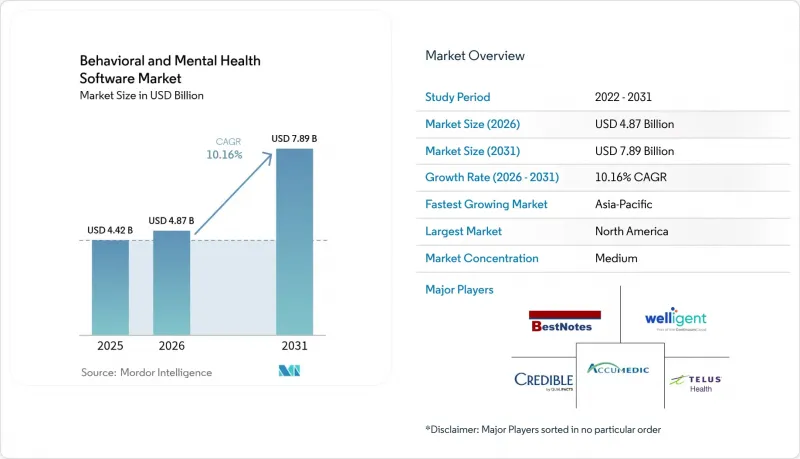
Mordor Intelligence에 따르면 행동·정신건강용 소프트웨어 시장 규모는 2025년 44억 2,000만 달러에서 2026년에는 48억 7,000만 달러로 확대하며, 2026-2031년에 CAGR 10.16%로 추이하며, 2031년에는 78억 9,000만 달러에 달할 것으로 예측됩니다.
이 보고서는 기능별(임상 기능[전자차트 등], 관리 기능 등), 솔루션별(소프트웨어 및 서비스), 배포 방식별(클라우드형 및 온프레미스형), 최종사용자별(지역 진료소, 병원 등), 지역별(북미, 유럽, 아시아태평양 등)로 분류되어 있습니다. 시장 규모 및 전망은 금액(달러)으로 표시되어 있습니다.
전 세계 행동·정신건강 소프트웨어 시장의 동향 및 인사이트
스트레스와 관련된 정신건강 질환의 증가
미국 성인의 26% 이상이 매년 진단 가능한 정신 질환을 앓고 있는 것으로 보고되고 있으며, 이러한 유병률은 현재 일부 유럽 국가에서도 유사한 추세를 보이고 있으며, 의료 제공자들은 확장성이 뛰어난 디지털 선별 및 치료 안내 툴의 도입을 서두르고 있습니다. 소프트웨어 공급업체들은 기후 변화로 인한 불안, 직장에서의 번아웃, 소셜미디어로 인한 스트레스 등의 위험을 감지하는 400개 이상의 표준화된 평가 툴와 실시간 분석 기능을 패키지로 제공하고 있습니다. 아시아에서는 정신 장애로 인한 장애 조정 생존 연수(DALY)가 1990-2019년 사이 4,390만에서 6,900만으로 급증함에 따라 농촌 지역의 대규모 인구를 대상으로 초기 선별 검사가 가능한 다국어 지원 모바일 앱에 대한 수요가 높아지고 있습니다. 인터마운틴 헬스(Intermountain Health)가 도입한 뉴로플로우(NeuroFlow)의 AI 위험 모델은 일상적인 1차 진료 과정에서 자살 충동을 식별함으로써, 예측 점수가 개입까지 걸리는 시간을 단축하는 방법을 보여줍니다. 이러한 모듈은 핵심 전자건강기록(EHR) 워크플로우와 원활하게 통합되므로, 대규모 의료 시스템에서 개인 개업의에 이르기까지 도입이 가속화되고 있습니다. 이러한 역학적 동향과 기술적 동향이 결합되어 행동 및 정신건강용 소프트웨어의 잠재적 시장 규모가 확대되고 있습니다.
행동 건강 관련 정부 자금 및 EHR 인센티브
미국의 ‘행동 건강 정보 기술 접근성 개선법(Improving Access to Behavioral Health Information Technology Act)’은 CMS가 인증된 EHR 도입에 대해 심리학자, 정신과 병원 및 지역 정신건강 센터에 보상을 지급할 수 있는 길을 열었습니다. 또 다른 ONC 프로그램에서는 행동 건강 워크플로우에 2,000만 달러가 배정된 반면, SAMHSA 자금은 위기 대응 및 원격 행동 건강 기능을 지원하는 소프트웨어에 대해 주 메디케이드 매칭 자금을 확대하고 있습니다. 이러한 노력들이 결합되면서, 전문 행동 의료 시설의 EHR 이용률이 6%에 불과한 반면, 병원의 이용률은 97%에 달하는 등 오랫동안 지속되어 온 디지털 격차가 줄어들고 있습니다. 소규모 진료소도 대상별 보조금 외에도, 벤더 평가 및 변경 관리를 효율화하는 기술 지원 허브를 이용할 수 있게 되었습니다. 자금이 유입됨에 따라 공급업체에는 사상 최대 규모의 RFP가 접수되고 있으며, 이는 행동·정신건강용 소프트웨어 시장의 성장을 지원하고 있습니다.
데이터 개인정보 보호 및 사이버 보안 과제
행동 데이터는 편향을 유발할 위험이 높기 때문에 정보 유출이 발생하면 규제상의 제재나 평판 하락과 같은 과도한 처벌이 부과됩니다. FTC(연방거래위원회)가 Cerebral사에 취한 조치는 추적 픽셀의 부정 사용에 대한 관심을 불러일으켰으며, 벤더들에게 기기내 분석, 지오펜스를 통한 동의 획득, 제로 트러스트 아키텍처 채택을 촉구했습니다. EU의 GDPR(일반 데이터 보호 규정)은 국경을 초월한 도입을 더욱 복잡하게 만들었으며, 세밀한 데이터 최소화 및 ‘잊혀질 권리’에 대응하는 워크플로우를 의무화하고 있습니다. 많은 중소규모 진료소에서는 연중무휴 24시간 감시를 수행할 사이버 보안 예산이 부족하여, 기밀성이 높은 진료 기록을 클라우드 환경으로 이전하는 것을 주저하고 있습니다. 그 결과, 개인정보 보호에 대한 우려가 해소되지 않은 지역에서는 행동 및 정신건강 관련 소프트웨어 시장의 단기적인 성장이 둔화되고 있습니다.
부문 분석
임상 모듈은 2025년 매출의 54.78%를 차지하며, 오늘날 모든 도입 결정의 기반이 되고 있습니다. 이러한 압도적인 점유율은 임상의들이 매일 의존하고 있는 전자의무기록, 처방 세트, 통합 치료 계획에서 기인합니다. Oracle Health의 앰비언트 문서화(Ambient Documentation)는 기록 작성 시간을 40% 단축하고 있으며, 이는 의료 제공자들이 플랫폼 선정 기준을 임상 기능의 충실도에 두고 있는 이유를 여실히 보여줍니다. 진료소가 자동화된 환자 접수, 의뢰처 배정, 사전 승인 확인을 요구하는 가운데, 관리용 애드온은 연평균 성장률(CAGR) 11.02%로 가장 빠르게 성장하고 있습니다. 수익 주기 위젯은 정확한 청구율을 추구하는 구매자들의 관심을 더욱 끌고 있습니다. 포괄적인 제품군이 현재 진료 기록, 접수 설문지, 청구 편집 기능을 통합하고 있으므로 행동 및 정신건강 소프트웨어 시장 전체에서 교차 판매 성장은 계속해서 견고한 모습을 보이고 있습니다.
인라인 분석과 AI 기반 트리아지는 임상적 가치를 한층 더 높이고 있습니다. NeuroFlow의 리스크 엔진은 PHQ-9, 활력 징후, 사회적 결정 요인을 통합하여 자살 위험을 식별함으로써, 치료팀이 조기에 개입할 수 있도록 지원합니다. 인구 건강 대시보드는 우편번호별 우울증 유병률을 시각화하여 보조금 신청의 지침이 됩니다. 정밀한 측정이 보상 지급과 연동됨에 따라 2031년까지 행동 및 정신건강 소프트웨어 시장 규모의 절반 이상을 임상 기능이 계속 차지할 것으로 전망됩니다. 한편, 관리 업무의 자동화는 스프레드시트에서 벗어나려는 충분한 서비스를 받지 못하는 개인 개업의들에게 새로운 수익을 가져다주고 있습니다.
의료 시스템이 통합된 기술 스택을 표준화하는 가운데, 2025년 지출의 63.08%를 소프트웨어가 차지했습니다. 구매자들은 포인트 솔루션을 통합하고 API 유지 관리를 불필요하게 만드는 단일 벤더의 제품군을 선호합니다. 그럼에도 불구하고 워크플로우 재설계 수요와 규제 보고 체계 구축에 힘입어 전문 서비스 매출 동향은 연평균 성장률(CAGR) 10.88%를 기록하고 있습니다. 각 벤더는 DSM-5 템플릿을 FHIR 리소스에 매핑하거나, 직원을 교육하거나, 클라우드 구성의 보안을 확보하는 컨설팅 업무를 통해 수익을 창출하고 있습니다.
모바일 앱은 진료소의 범위를 넘어 치료를 확장함으로써 고객 유지율을 높이고 있습니다. 질환 특화 툴은 매일 CBT(인지행동치료)를 촉진하는 한편, 측정 일지 데이터는 임상의의 대시보드에 직접 반영되어 적시 개입을 가능하게 합니다. 고객 성공 팀이 참여도 텔레메트리를 최적화함으로써 구독 갱신률이 상승하고, 총 계약 가치(TCV)가 확대되고 있습니다. 그 결과, 소프트웨어와 서비스를 결합한 하이브리드형 번들이 RFP(제안 요청서) 평가에서 주도적인 위치를 차지하게 되었으며, 행동 및 정신건강 소프트웨어 업계 전체에서의 시장 점유율이 더욱 확대되고 있습니다.
지역별 분석
북미는 연방 정부의 상환 기준 명확화와 지속적인 보조금 파이프라인에 힘입어 2025년 매출의 41.86%를 차지했습니다. CMS의 2025년 의사 보수 일정에 따라 새로운 케어 조정 수식어가 도입되었으며, 소프트웨어 플랫폼이 이를 자동화함으로써 청구 규정 준수가 보장되고 있습니다. 메디케이드 매칭 비율 인상을 활용하는 각 주에서는 위기 대응 핫라인의 분류 툴와 실시간 병상 등록 시스템을 도입하여 공공 네트워크 전반에 소프트웨어를 통합하고 있습니다. 오라클이 내슈빌에 건설한 120만 제곱피트 규모의 캠퍼스는 지역 디지털 헬스케어 수요에 대한 주요 기술 기업의 장기적인 투자 의지를 보여줍니다.
아시아태평양은 2031년까지 연평균 성장률(CAGR) 11.18%를 기록하며 가장 빠르게 성장하는 지역입니다. 정신 장애로 인한 DALY(장애 조정 생명년)는 1990년 이후 57% 급증했으며, 치료되지 않은 질환이 GDP에 미치는 부정적인 영향은 2030년까지 인도와 중국에서 9조 달러를 넘어설 가능성이 있습니다. 각국 정부는 ‘모바일 퍼스트’ 프레임워크로 대응하고 있으며, APEC 디지털 허브는 FHIR에 기반한 1차 진료 통합을 추진하고 선별 검사 프로토콜의 보급을 도모하고 있습니다. 8개 카테고리로 분류되는 정신건강용 모바일 앱이 지역별 다운로드 순위를 휩쓸고 있으며, 이는 언어적·문화적 적응 요구를 반영하고 있습니다. COVID-19로 인해 원격의료의 보급이 가속화되었으나, 접근성 격차는 여전히 존재하며, 저대역폭 지역에서는 오프라인 지원 앱이나 SMS를 통한 체크인이 요구되고 있습니다. 행동 및 정신건강 관련 소프트웨어 시장이 지역별로 심화되는 가운데, UX를 현지화하고 통신 사업자와 제휴하는 벤더들이 시장 점유율을 확보하고 있습니다.
유럽에서는 꾸준하지만 완만한 보급세가 나타나고 있습니다. GDPR은 ‘프라이버시 바이 디자인(Privacy by Design)’을 의무화하여 동의 관리의 복잡성을 높이는 한편, 최종사용자 간의 신뢰를 확립하고 있습니다. 일부 국가의 보건 서비스는 단계적 치료형 디지털 치료제를 재정 지원하고 있으며, 벤더들이 동료 심사를 거친 증거를 공개하도록 장려하고 있습니다. 다국어 지원 구축 및 엄격한 CE 마크 획득 절차로 인해 시장 출시까지의 기간은 길어지지만, 일단 승인되면 의료비 상환이 일괄적으로 인정되어 지속적인 수익을 가져다줍니다. 중동 및 아프리카에서는 걸프 국가들을 중심으로 정신건강 관련 예산이 증가하는 한편, 남미에서는 클라우드 플랫폼을 활용하여 자본 인프라의 격차를 극복하려는 노력이 진행되고 있습니다. 전반적으로 지역적 분산화를 통해 행동·정신건강용 소프트웨어 시장 전체의 환율 위험 및 정책 위험이 완화됩니다.
기타 혜택:
- 엑셀 형식의 시장 예측(ME) 시트
- 3개월간 애널리스트 지원
자주 묻는 질문
목차
제1장 서론
제2장 조사 방법
제3장 개요
제4장 시장 구도
제5장 시장 규모와 성장 예측
제6장 경쟁 구도
제7장 시장 기회와 향후 전망
KSA 26.09.04According to Mordor Intelligence, the behavioral and mental health software market size is expected to grow from USD 4.42 billion in 2025 to USD 4.87 billion in 2026 and is forecast to reach USD 7.89 billion by 2031 at 10.16% CAGR over 2026-2031.
This report is Segmented by Function (Clinical Functionality [Electronic Health Records, and More], Administrative Functionality, and More), Solution (Software and Services), Deployment Mode (Cloud-Based and On-Premise) End-User (Community Clinics, Hospitals, and More), and Geography (North America, Europe, Asia-Pacific, and More). The Market and Forecasts are Provided in Terms of Value (USD).
Global Behavioral And Mental Health Software Market Trends and Insights
Increasing Stress-Related Mental-Health Conditions
More than 26% of U.S. adults report a diagnosable mental condition each year, a prevalence now mirrored across several European countries, pushing providers toward scalable digital screening and care-navigation tools . Software vendors are packaging over 400 standardized assessments and real-time analytics that flag risk for climate anxiety, workplace burnout, and social-media-induced stress. In Asia, disability-adjusted life years tied to mental disorders jumped from 43.9 million to 69 million between 1990 and 2019, steering demand for multilingual mobile apps that can triage large rural populations. Intermountain Health's deployment of NeuroFlow's AI risk models illustrates how predictive scoring cuts time to intervention by identifying suicidal ideation within routine primary-care encounters. As these modules integrate seamlessly with core EHR workflows, adoption accelerates across both enterprise health systems and solo practices. Together, these epidemiologic and technology trends enlarge the addressable behavioral and mental health software market.
Government Funding & EHR Incentives for Behavioral Health
The U.S. Improving Access to Behavioral Health Information Technology Act cleared the path for CMS to reimburse psychologists, psychiatric hospitals, and community mental-health centers for certified EHR adoption. Separate ONC programs earmarked USD 20 million for behavioral workflows, while SAMHSA funds extend state Medicaid matches for software that supports crisis response and tele-behavioral capabilities. Collectively, these initiatives shrink the historic digital divide where only 6% of specialty behavioral facilities used EHRs versus 97% of hospitals. Smaller practices now access targeted grants plus technical-assistance hubs that streamline vendor evaluation and change management . As dollars flow, vendors see record inbound RFP volume, fueling growth in the behavioral and mental health software market.
Data-Privacy & Cybersecurity Gaps
Behavioral data carry heightened stigma risk, so breaches prompt outsized regulatory and reputational penalties. The FTC's enforcement against Cerebral spotlighted tracking-pixel misuse, pushing vendors to adopt on-device analytics, geofenced consent, and zero-trust architectures. EU GDPR rules further complicate cross-border deployments, forcing granular data-minimization and "right to be forgotten" workflows. Many small practices lack cyber budgets for 24/7 monitoring, making them hesitant to migrate sensitive charts to cloud stacks. As a result, near-term behavioral and mental health software market expansion slows where privacy doubts remain unresolved.
Other drivers and restraints analyzed in the detailed report include:
- Payer Acceptance & Reimbursement for Tele-Mental-Health
- AI-Powered Clinical Decision Support Improves Outcomes
- Continued Use of Paper Workflows Among Small Providers
For complete list of drivers and restraints, kindly check the Table Of Contents.
Segment Analysis
Clinical modules captured 54.78% of 2025 revenue, underpinning every modern deployment decision. This dominance stems from electronic charting, order sets, and integrated care plans that clinicians rely on daily. Oracle Health's ambient documentation reduces note time by 40%, illustrating why providers anchor platform selection on clinical depth. Administrative add-ons are heating fastest with an 11.02% CAGR as practices seek automated intake, referral routing, and prior-auth checks. Revenue-cycle widgets further entice buyers chasing clean-claim rates. Because comprehensive suites now marry progress notes with intake questionnaires and billing edits, cross-sell uplift remains strong across the behavioral and mental health software market.
Inline analytics and AI triage heighten clinical value further. NeuroFlow's risk engines synthesize PHQ-9, vital signs, and social determinants to flag suicidality, letting care teams intervene earlier. Population-health dashboards map depression prevalence by zip code, guiding grant applications. As precision measurement becomes reimbursement-linked, clinical functionality's share will hold above half of the behavioral and mental health software market size through 2031. Administrative automation meanwhile pulls new dollars from underserved solo practices transitioning away from spreadsheets.
Software sustained 63.08% of 2025 spend as health systems standardized on unified tech stacks. Buyers favor single-vendor suites that collapse point solutions and eliminate API maintenance. Still, professional services revenue is trending at an 10.88% CAGR, fueled by workflow redesign demands and regulatory reporting setup. Vendors monetize advisory engagements that map DSM-5 templates to FHIR resources, train staff, and secure cloud configurations.
Mobile apps add stickiness by extending care outside clinic walls. Condition-specific tools push daily CBT nudges, whereas measurement diaries feed directly into clinician dashboards for just-in-time interventions. As customer success teams optimize engagement telemetry, subscription renewals climb, enlarging total contract value. Consequently, blended software-plus-services bundles now dominate RFP scoring, deepening wallet share throughout the behavioral and mental health software industry.
Complete Report Scope:
- By Function
- Clinical Functionality
- Electronic Health Records
- Clinical Decision Support
- Care Plans / Population Health
- Other Clinical Functions
- Administrative Functionality
- Patient Scheduling
- Case Management
- Other Administrative Functions
- Financial Functionality
- Revenue Cycle Management
- Accounts Payable / General Ledger
- Other Financial Functions
- Clinical Functionality
- By Solution
- Software
- Integrated Suites
- Stand-alone Modules
- Mobile Apps
- Services
- Software
- By Deployment Mode
- Cloud-based
- On-premise
- By End-user
- Community Clinics
- Hospitals
- Private Practices
- Others
- By Geography
- North America
- United States
- Canada
- Mexico
- Europe
- Germany
- United Kingdom
- France
- Italy
- Spain
- Rest of Europe
- Asia-Pacific
- China
- Japan
- India
- Australia
- South Korea
- Rest of Asia-Pacific
- Middle East and Africa
- GCC
- South Africa
- Rest of Middle East and Africa
- South America
- Brazil
- Argentina
- Rest of South America
- North America
Geography Analysis
North America commanded 41.86% of 2025 revenue, anchored by federal reimbursement clarity and sustained grant pipelines. CMS's 2025 Physician Fee Schedule unlocked new care-coordination modifiers that software platforms automate for billing compliance. States tapping enhanced Medicaid match rates deploy crisis-line triage tools and real-time bed registries, embedding software across public networks. Oracle's 1.2 million-sq-ft Nashville campus signals tech giants' long-term bet on regional digital-health demand.
Asia-Pacific is the fastest-expanding territory at 11.18% CAGR through 2031. Mental-disorder DALYs surged 57% since 1990, and GDP drag from untreated conditions could top USD 9 trillion in India and China by 2030. Governments respond with mobile-first frameworks; the APEC Digital Hub promotes FHIR-based primary-care integration to spread screening protocols. Eight categories of mental-health mobile apps dominate regional download charts, reflecting linguistic and cultural tailoring needs. COVID-19 accelerated tele-health normalization, yet access inequities persist, requiring offline-capable apps and SMS check-ins for low-bandwidth zones. Vendors that localize UX and partner with telecoms capture share as the behavioral and mental health software market deepens regionally.
Europe exhibits steady but moderate uptake. GDPR mandates privacy-by-design, elevating consent orchestration complexity but also establishing trust among end users. Several national health services fund stepped-care digital therapeutics, spurring vendors to publish peer-reviewed evidence. Multi-language build-outs and stringent CE-marking processes elongate launch timelines, yet once approved, reimbursement clears in bulk, yielding durable revenue. The Middle East and Africa see rising mental-health budgets in Gulf states, whereas South America leverages cloud platforms to leapfrog capital infrastructure gaps. Collectively, geographic diversification cushions currency and policy risk across the behavioral and mental health software market.
- Oracle
- Netsmart Technologies
- Epic Systems
- Qualifacts Systems
- AdvancedMD
- Valant Medical
- Welligent
- Accumedic Computer Systems
- BestNotes
- Planet DDS (NXGN)
- CloudMD Software
- TELUS Health
- Psyquel
- Behave
- Kareo Inc.
- TheraNest (Counsol.com)
- SimplePractice
- Streamline Healthcare Solutions
- MindLinc (Duke)
- Allscripts
Additional Benefits:
- The market estimate (ME) sheet in Excel format
- 3 months of analyst support
TABLE OF CONTENTS
1 Introduction
- 1.1 Study Assumptions & Market Definition
- 1.2 Scope of the Study
2 Research Methodology
3 Executive Summary
4 Market Landscape
- 4.1 Market Overview
- 4.2 Market Drivers
- 4.2.1 Increasing Stress-Related Mental-Health Conditions
- 4.2.2 Government Funding & EHR Incentives for Behavioral Health
- 4.2.3 Payer Acceptance & Reimbursement for Tele-Mental-Health
- 4.2.4 AI-Powered Clinical Decision Support Improves Outcomes
- 4.2.5 Climate-Anxiety Boosts Demand for Digital Self-Help Tools
- 4.2.6 Employer-Sponsored Mental-Health Platforms Surge
- 4.3 Market Restraints
- 4.3.1 Data-Privacy & Cybersecurity Gaps
- 4.3.2 Continued Use of Paper Workflows Among Small Providers
- 4.3.3 Interoperability Gaps Between General & BH-Specific Ehrs
- 4.3.4 Uncertain Parity Laws for Digital Therapeutics Reimbursement
- 4.4 Technological Outlook
- 4.5 Porters Five Forces Analysis
- 4.5.1 Threat of New Entrants
- 4.5.2 Bargaining Power of Buyers
- 4.5.3 Bargaining Power of Suppliers
- 4.5.4 Threat of Substitutes
- 4.5.5 Intensity of Competitive Rivalry
5 Market Size & Growth Forecasts (Value, USD)
- 5.1 By Function
- 5.1.1 Clinical Functionality
- 5.1.1.1 Electronic Health Records
- 5.1.1.2 Clinical Decision Support
- 5.1.1.3 Care Plans / Population Health
- 5.1.1.4 Other Clinical Functions
- 5.1.2 Administrative Functionality
- 5.1.2.1 Patient Scheduling
- 5.1.2.2 Case Management
- 5.1.2.3 Other Administrative Functions
- 5.1.3 Financial Functionality
- 5.1.3.1 Revenue Cycle Management
- 5.1.3.2 Accounts Payable / General Ledger
- 5.1.3.3 Other Financial Functions
- 5.1.1 Clinical Functionality
- 5.2 By Solution
- 5.2.1 Software
- 5.2.1.1 Integrated Suites
- 5.2.1.2 Stand-alone Modules
- 5.2.1.3 Mobile Apps
- 5.2.2 Services
- 5.2.1 Software
- 5.3 By Deployment Mode
- 5.3.1 Cloud-based
- 5.3.2 On-premise
- 5.4 By End-user
- 5.4.1 Community Clinics
- 5.4.2 Hospitals
- 5.4.3 Private Practices
- 5.4.4 Others
- 5.5 By Geography
- 5.5.1 North America
- 5.5.1.1 United States
- 5.5.1.2 Canada
- 5.5.1.3 Mexico
- 5.5.2 Europe
- 5.5.2.1 Germany
- 5.5.2.2 United Kingdom
- 5.5.2.3 France
- 5.5.2.4 Italy
- 5.5.2.5 Spain
- 5.5.2.6 Rest of Europe
- 5.5.3 Asia-Pacific
- 5.5.3.1 China
- 5.5.3.2 Japan
- 5.5.3.3 India
- 5.5.3.4 Australia
- 5.5.3.5 South Korea
- 5.5.3.6 Rest of Asia-Pacific
- 5.5.4 Middle East and Africa
- 5.5.4.1 GCC
- 5.5.4.2 South Africa
- 5.5.4.3 Rest of Middle East and Africa
- 5.5.5 South America
- 5.5.5.1 Brazil
- 5.5.5.2 Argentina
- 5.5.5.3 Rest of South America
- 5.5.1 North America
6 Competitive Landscape
- 6.1 Market Concentration
- 6.2 Market Share Analysis
- 6.3 Company Profiles (includes Global level Overview, Market level overview, Core Segments, Financials as available, Strategic Information, Market Rank/Share for key companies, Products & Services, and Recent Developments)
- 6.3.1 Oracle (Cerner)
- 6.3.2 Netsmart Technologies
- 6.3.3 Epic Systems
- 6.3.4 Qualifacts Systems
- 6.3.5 AdvancedMD
- 6.3.6 Valant Medical
- 6.3.7 Welligent Inc.
- 6.3.8 Accumedic Computer Systems
- 6.3.9 BestNotes
- 6.3.10 Planet DDS (NXGN)
- 6.3.11 CloudMD Software
- 6.3.12 TELUS Health
- 6.3.13 Psyquel
- 6.3.14 Behave Inc.
- 6.3.15 Kareo Inc.
- 6.3.16 TheraNest (Counsol.com)
- 6.3.17 SimplePractice
- 6.3.18 Streamline Healthcare Solutions
- 6.3.19 MindLinc (Duke)
- 6.3.20 Allscripts Healthcare Solutions
7 Market Opportunities & Future Outlook
- 7.1 White-space & Unmet-need Assessmen