
|
시장보고서
상품코드
2122201
환자 포털 : 시장 점유율 분석, 업계 동향과 통계, 성장 예측(2026-2031년)Patient Portal - Market Share Analysis, Industry Trends & Statistics, Growth Forecasts (2026 - 2031) |
||||||
 Mordor Intelligence
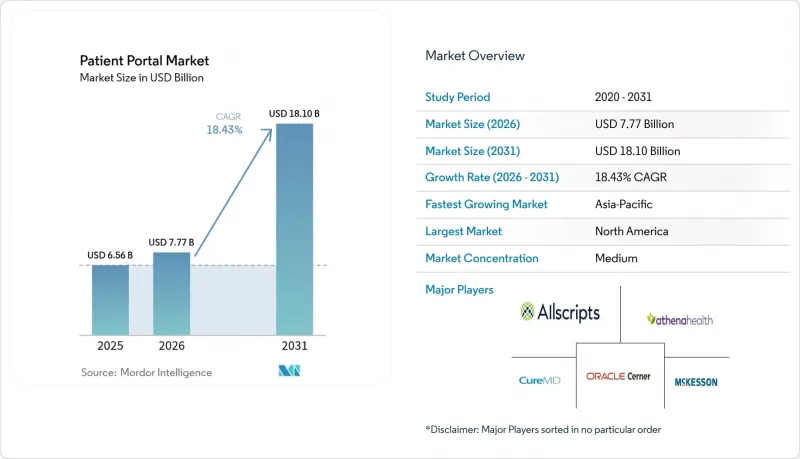
Mordor Intelligence에 따르면 환자 포털 시장 규모는 2025년 65억 6,000만 달러, 2026년 77억 7,000만 달러에서 2031년까지 181억 달러로 확대할 것으로 예측되고 있으며, 2026-2031년까지 연평균 성장률(CAGR)은 18.43%에 달할 전망입니다.
이 보고서는 포털 유형(통합형 포털 및 독립형 포털), 배포 방식(웹/온프레미스 및 클라우드 기반), 최종사용자(의료 제공자, 보험사, 약국·소매 의료, 기타 최종사용자), 지역(북미, 유럽, 아시아태평양, 중동 및 아프리카, 남미)별로 분류되어 있습니다. 시장 전망은 금액(달러) 기준으로 제시되어 있습니다.
글로벌 환자 포털 시장의 동향 및 인사이트
정부의 상호운용성 규제
미국의 ‘Trusted Exchange Framework’ 및 ‘Common Agreement’, EU의 ‘European Health Data Space’와 같은 국가적 프레임워크에서는 인증된 전자건강기록(EHR)에 대해 별도의 번거로움 없이 임상 데이터를 공개할 수 있는 표준화된 API의 제공이 의무화되어 있습니다. 각 벤더사는 현재 데이터 접근이 상품화되고 있는 상황에 직면해 있으며, 분석 기능과 사용자 경험을 통해 차별화를 꾀해야 합니다. API 대응 능력이 부족한 중소 공급업체들은 시장에서 철수하거나 합병되고 있는 반면, Epic Systems와 Oracle Health는 기존 FHIR 인프라를 활용하여 고급 분석 모듈의 업셀링을 도모하고 있습니다. 보험사들은 투명성이 높은 데이터 흐름을 점점 더 많이 활용하고 있으며, 미국의 한 대형 보험사는 오픈 API를 통해 사전 승인을 자동화한 결과, 3억 4,000만 달러의 관리 비용을 절감했습니다.
디지털 헬스케어 접근에 대한 소비자의 수요
스마트폰을 중심으로 한 행동 양식이 서비스의 새로운 기준을 정립하고 있습니다. 2025년 퓨 리서치 센터(Pew Research Center)의 조사에 따르면 50세 미만 미국 성인의 68%가 모바일 앱을 통해 당일 예약이나 처방전의 실시간 업데이트를 기대하고 있는 것으로 확인되었습니다. 인도의 ‘아유슈만 바라트 디지털 미션’에는 전국 건강 식별 번호와 연동된 포털에 접속하는 4억 5,000만 명의 등록 사용자가 있으며, 정부의 정책이 소비자의 기대와 어떻게 부합하고 있는지를 보여주고 있습니다. 이에 대응해 소매 약국 체인들은 풀서비스 포털 사이트를 도입하고 있으며, 디지털 참여도는 전년 대비 19% 증가하여 기존 진료소에 대한 환자의 충성도를 서서히 잠식하고 있습니다.
데이터 보안 및 개인정보 보호에 대한 우려
미국 보건복지부는 2024년에 725건의 대규모 정보 유출을 기록했으며, 그중 18%는 크레덴셜 스태핑이나 세션 하이재킹을 통해 포털이 연루된 사례였습니다. 유럽의 NIS2 지침에서는 사고 발생 후 24시간 이내에 보고할 의무가 있으며, 전 세계 매출의 최대 2%에 해당하는 벌금이 부과되므로 벤더의 규정 준수 비용이 증가하고 있습니다. 2025년 하반기에 Epic이 도입한 FaceID 인증은 계정 탈취를 34% 줄여주지만, 소규모 공급업체에게는 개발의 복잡성이 가중되고 있습니다. 2025년 카이저 조사에 따르면 성인의 41%가 개인정보 보호에 대한 우려로 포털 사용을 기피하고 있으며, 주요 계층에서의 보급이 둔화되고 있습니다.
부문 분석
2025년, 통합형 솔루션은 환자 포털 시장의 62.88%를 차지했습니다. 이는 대규모 의료 시스템이 EHR 라이선스 비용에 포털이 포함되어 있는 것을 수용하고 있기 때문입니다. 통합형 솔루션 환자 포털 시장 규모는 기동성이 뛰어난 독립형 신규 진입 업체에 상대적인 점유율을 내주면서도, 절대적인 수익은 높은 수준을 유지할 것으로 예측됩니다. 연평균 성장률(CAGR) 20.54%가 예상되는 독립형 포털은 FHIR 기반 데이터 교환의 혜택을 받고 있으며, 이를 통해 벤더 전환의 장벽이 되었던 기존의 과제들이 해소되고 있습니다. 외래 수술 센터, 전문 클리닉, 소매 체인에서는 청구 투명성, 실시간 보험 적격성 확인, 신속한 가동 시작을 우선시하는 모듈형 포털을 채택하는 움직임이 확대되고 있습니다. 그 결과, 경쟁 구도는 양극화되고 있습니다. 대규모 통합 의료 네트워크는 번들 계약을 확대하는 한편, 소규모 조직은 베스트 오브 브리드(Best-of-Breed) 앱을 도입하고 있습니다.
독립형 제공업체들은 전문화에 대한 수요를 지원하고 있습니다. Cedar사는 투명한 견적과 유연한 플랜을 도입하여 지불 주기를 단축했으며, Phreesia사는 접수 및 환자 수용 과정을 자동화하여 프론트 데스크의 처리 능력을 18% 향상시켰습니다. 이러한 특화형 성공 사례는 투자자를 끌어들이며 총 잠재 시장 규모를 확대하고 있습니다. 이는 임상 차트 관리를 위해 통합 포털을 유지하면서, 수익 사이클 및 환자 접수 워크플로우를 위해 독립형 애플리케이션을 병행하고 있는 병원에서도 마찬가지입니다. 규제 당국의 오픈 API 도입 요청은 독자적인 데이터의 ‘장벽’을 약화시켜, 환자 포털 시장 내에서 ‘광범위성’과 ‘전문화’ 간의 경쟁이 지속될 것임을 확실히 하고 있습니다.
지역별 분석
2025년, 북미는 전 세계 매출의 44.32%를 차지했습니다. 이는 메디케어와 민간 보험사가 디지털 접근 지표를 보상 계약에 포함시켜 포털 활용을 수입원으로 전환하고 있기 때문입니다. 참여도가 상위 4분위에 속하는 의료 기관은 하위 4분위에 속하는 의료 기관에 비해 매년 4만 8,000달러 더 많은 품질 보너스를 받고 있습니다. 캐나다에서도 유사한 인센티브가 시범적으로 도입되고 있으며, 멕시코의 공적 보험사는 설립 첫해에 1,800만 명의 사용자를 확보했으나 지방 지역에서의 보급에는 어려움을 겪고 있습니다.
아시아태평양은 2031년까지 연평균 성장률(CAGR) 19.65%를 기록하며 가장 빠르게 성장하는 지역이 될 전망입니다. 인도의 국가 미션에 따라 등록된 모든 병원은 유니버설 헬스 식별자(UHI)로 연결된 포털을 유지해야 할 의무가 있으며, 이는 대규모 클라우드 네이티브 도입을 촉진하고 있습니다. 중국에서는 포털을 사회신용시스템 및 환급 시스템과 통합하여 청구 처리 주기를 30일에서 3일로 단축했습니다. 호주에서는 2,400만 명의 시민을 지원하는 정부 핵심 시스템이 운영되고 있으나, 2024년에 발생한 정보 유출로 인해 신규 등록이 주춤했습니다. 한국에서는 3차 의료기관을 대상으로 2026년까지 FHIR 준수 포털을 도입하도록 기한을 정하고 있으며, 지역 차원의 표준 규격 추진 노력이 반영되고 있습니다.
유럽에서는 GDPR(일반 데이터 보호 규정) 준수로 인해 개발 비용이 증가하고, 의료 시스템이 여전히 분절되어 있으며, 도입 속도는 중간 수준에 머물고 있습니다. ‘유럽 건강 데이터 공간(European Health Data Space)’은 국경을 초월한 접근을 표준화하고 있지만, 보험 환급 제도의 불균일성으로 인해 전국적인 확산이 지연되고 있습니다. 유럽 이외의 지역에서는 걸프협력회의(GCC) 회원국들이 포털을 스마트 시티 구상에 통합하고 있는 반면, 브라질의 국가 시스템은 1억 5,000만 명의 사용자를 등록하고 있음에도 데이터 품질의 편차라는 과제에 직면해 있습니다.
기타 혜택:
- 엑셀 형식의 시장 예측(ME) 시트
- 3개월간의 애널리스트 지원
자주 묻는 질문
목차
제1장 서론
제2장 조사 방법
제3장 개요
제4장 시장 구도
제5장 시장 규모와 성장 예측
제6장 경쟁 구도
제7장 시장 기회와 향후 전망
KSA 26.09.04According to Mordor Intelligence, the patient portal market size is projected to expand from USD 6.56 billion in 2025 and USD 7.77 billion in 2026 to USD 18.10 billion by 2031, registering a CAGR of 18.43% between 2026 to 2031.
This report is Segmented by Portal Type (Integrated Portals and Stand-Alone Portals), Deployment Mode (Web/On-Premise and Cloud-Based), End User (Providers, Payers, Pharmacies & Retail Health, and Other End Users), and Geography (North America, Europe, Asia-Pacific, Middle East & Africa, and South America). The Market Forecasts are Provided in Terms of Value (USD).
Global Patient Portal Market Trends and Insights
Government Interoperability Regulations
Nationwide frameworks such as the Trusted Exchange Framework and Common Agreement in the United States and the European Health Data Space in the EU require certified EHRs to publish standardized APIs that expose clinical data without special effort. Vendors now face commoditized data access and must differentiate on analytics or user experience. Smaller suppliers lacking API capacity are exiting or merging, whereas Epic Systems and Oracle Health leverage existing FHIR infrastructure to upsell advanced analytics modules. Payers increasingly exploit transparent data flows; one leading U.S. insurer realized USD 340 million in administrative savings after automating prior authorizations through open APIs.
Consumer Demand for Digital Healthcare Access
Smartphone-centric behavior is setting new service benchmarks. A 2025 Pew survey confirmed that 68% of U.S. adults under 50 expect same-day appointment booking and real-time prescription refills via mobile apps. India's Ayushman Bharat Digital Mission has 450 million registered users who access portals tied to a national health identifier, illustrating how government mandates align with consumer expectations. Retail pharmacy chains respond by embedding full-service portals that boosted digital engagement 19% year over year, eroding patient loyalty to traditional practices.
Data Security and Privacy Concerns
The U.S. Department of Health and Human Services logged 725 large-scale breaches in 2024, with portals implicated in 18% due to credential stuffing and session hijacking. Europe's NIS2 Directive requires 24-hour incident reporting and imposes fines up to 2% of global revenue, increasing vendor compliance costs. FaceID authentication, introduced by Epic in late 2025, reduces account takeovers by 34% but increases development complexity for smaller providers. A 2025 Kaiser survey indicates that 41% of adults avoid portals due to privacy concerns, slowing adoption among key demographics.
Other drivers and restraints analyzed in the detailed report include:
- Cloud Adoption in Healthcare IT Systems
- Shift Toward Value-Based Reimbursement Models
- Digital Divide Among Elderly and Rural Populations
For complete list of drivers and restraints, kindly check the Table Of Contents.
Segment Analysis
Integrated offerings commanded 62.88% of the patient portal market in 2025 as enterprise health systems accept bundled portals within EHR license fees. The patient portal market size for integrated solutions is forecast to maintain high absolute revenue, even as it cedes relative share to nimble standalone entrants. Standalone portals, projected to deliver a 20.54% CAGR, benefit from FHIR-based data exchange, which removes historical barriers to vendor swaps. Ambulatory surgery centers, specialty clinics, and retail chains increasingly adopt modular portals that prioritize billing clarity, real-time eligibility checks, and rapid go-live cycles. As a result, the competitive landscape bifurcates: large integrated delivery networks extend bundled contracts, whereas smaller organizations adopt best-of-breed apps.
Standalone suppliers validate demand for specialization. Cedar shortens payment cycles by embedding transparent estimates and flexible plans, while Phreesia automates check-in and intake to lift front-desk throughput 18%. These focused wins attract investors and expand total addressable opportunities, even in hospitals that retain integrated portals for clinical charts but overlay standalone applications for revenue-cycle or intake workflows. Regulatory insistence on open APIs erodes proprietary data moats, ensuring ongoing contest between breadth and specialization inside the patient portal market.
Complete Report Scope:
- By Portal Type
- Integrated Portals
- Stand-Alone Portals
- By Deployment Mode
- Web / On-Premise
- Cloud-Based
- By End User
- Providers (Hospitals, Clinics, IDNs)
- Payers
- Pharmacies & Retail Health
- Other End Users
- Geography
- North America
- United States
- Canada
- Mexico
- Europe
- Germany
- United Kingdom
- France
- Italy
- Spain
- Rest of Europe
- Asia-Pacific
- China
- Japan
- India
- Australia
- South Korea
- Rest of Asia-Pacific
- Middle East & Africa
- GCC
- South Africa
- Rest of Middle East & Africa
- South America
- Brazil
- Argentina
- Rest of South America
- North America
Geography Analysis
North America generated 44.32% of global revenue in 2025 as Medicare and commercial insurers embed digital access metrics into reimbursement contracts, transforming portal activation into a revenue lever. Practices achieving top-quartile engagement receive USD 48,000 more in quality bonuses each year than bottom-quartile peers. Canada pilots similar incentives, while Mexico's public insurer enrolled 18 million users within its first year but struggles with rural adoption.
Asia-Pacific is set to be the fastest expanding region at 19.65% CAGR through 2031. India's national mission compels every empaneled hospital to maintain a portal connected to a universal health identifier, driving large-scale, cloud-native implementations. China integrates portals with social-credit and reimbursement systems, reducing claim cycles from 30 days to 3 days. Australia operates a government backbone that supports 24 million citizens, although a 2024 breach dampened new registrations. South Korea sets a 2026 deadline for tertiary hospitals to adopt FHIR-compliant portals, reflecting regional commitment to standards.
Europe faces moderate momentum because GDPR compliance elevates development expense and health systems remain fragmented. The European Health Data Space standardizes cross-border access, but disparate reimbursement structures slow nationwide deployments. Outside Europe, Gulf Cooperation Council states weave portals into smart-city agendas, while Brazil's national system enrolls 150 million users yet contends with data-quality variability.
- Allscripts Healthcare Solutions (Altera)
- Athenahealth
- Cedar
- eClinicalWorks
- Epic Systems Corp.
- GE Healthcare
- GetWellNetwork
- Greenway Health
- InteliChart
- Luma Health
- McKesson Corp.
- Meditech
- MyHealthONE (HCA Healthcare)
- NextGen Healthcare
- Omada Health
- Oracle Health (Cerner)
- Phreesia
- Koninklijke Philips
- Teladoc Health
- Weave Communications
Additional Benefits:
- The market estimate (ME) sheet in Excel format
- 3 months of analyst support
TABLE OF CONTENTS
1 Introduction
- 1.1 Study Assumptions & Market Definition
- 1.2 Scope of the Study
2 Research Methodology
3 Executive Summary
4 Market Landscape
- 4.1 Market Overview
- 4.2 Market Drivers
- 4.2.1 Government Interoperability Regulations
- 4.2.2 Consumer Demand for Digital Healthcare Access
- 4.2.3 Cloud Adoption in Healthcare IT Systems
- 4.2.4 Shift Toward Value-Based Reimbursement Models
- 4.2.5 Artificial Intelligence Enabled Patient Engagement
- 4.2.6 Open APIs and Health Data Standards Adoption
- 4.3 Market Restraints
- 4.3.1 Data Security and Privacy Concerns
- 4.3.2 Digital Divide Among Elderly and Rural Populations
- 4.3.3 Provider Workflow Burden and Alert Fatigue
- 4.3.4 Uncertain Reimbursement for Virtual Care Services
- 4.4 Value / Supply-Chain Analysis
- 4.5 Regulatory Landscape
- 4.6 Technological Outlook
- 4.7 Porter's Five Forces Analysis
- 4.7.1 Threat of New Entrants
- 4.7.2 Bargaining Power of Suppliers
- 4.7.3 Bargaining Power of Buyers
- 4.7.4 Threat of Substitute Products
- 4.7.5 Competitive Rivalry
5 Market Size & Growth Forecasts (Value, USD)
- 5.1 By Portal Type
- 5.1.1 Integrated Portals
- 5.1.2 Stand-Alone Portals
- 5.2 By Deployment Mode
- 5.2.1 Web / On-Premise
- 5.2.2 Cloud-Based
- 5.3 By End User
- 5.3.1 Providers (Hospitals, Clinics, IDNs)
- 5.3.2 Payers
- 5.3.3 Pharmacies & Retail Health
- 5.3.4 Other End Users
- 5.4 Geography
- 5.4.1 North America
- 5.4.1.1 United States
- 5.4.1.2 Canada
- 5.4.1.3 Mexico
- 5.4.2 Europe
- 5.4.2.1 Germany
- 5.4.2.2 United Kingdom
- 5.4.2.3 France
- 5.4.2.4 Italy
- 5.4.2.5 Spain
- 5.4.2.6 Rest of Europe
- 5.4.3 Asia-Pacific
- 5.4.3.1 China
- 5.4.3.2 Japan
- 5.4.3.3 India
- 5.4.3.4 Australia
- 5.4.3.5 South Korea
- 5.4.3.6 Rest of Asia-Pacific
- 5.4.4 Middle East & Africa
- 5.4.4.1 GCC
- 5.4.4.2 South Africa
- 5.4.4.3 Rest of Middle East & Africa
- 5.4.5 South America
- 5.4.5.1 Brazil
- 5.4.5.2 Argentina
- 5.4.5.3 Rest of South America
- 5.4.1 North America
6 Competitive Landscape
- 6.1 Market Concentration
- 6.2 Market Share Analysis
- 6.3 Company Profiles {(Includes Global Level Overview, Market Level Overview, Core Segments, Financials As Available, Strategic Information, Market Rank/Share For Key Companies, Products & Services, And Recent Developments)}
- 6.3.1 Allscripts Healthcare Solutions (Altera)
- 6.3.2 athenahealth Inc.
- 6.3.3 Cedar
- 6.3.4 eClinicalWorks
- 6.3.5 Epic Systems Corp.
- 6.3.6 GE HealthCare
- 6.3.7 GetWellNetwork
- 6.3.8 Greenway Health
- 6.3.9 InteliChart
- 6.3.10 Luma Health
- 6.3.11 McKesson Corp.
- 6.3.12 MEDITECH
- 6.3.13 MyHealthONE (HCA Healthcare)
- 6.3.14 NextGen Healthcare
- 6.3.15 Omada Health
- 6.3.16 Oracle Health (Cerner)
- 6.3.17 Phreesia
- 6.3.18 Philips Healthcare
- 6.3.19 Teladoc Health
- 6.3.20 Weave Communications
7 Market Opportunities & Future Outlook
- 7.1 White-Space & Unmet-Need Assessment