

|
시장보고서
상품코드
2122202
의료기기 접속 : 시장 점유율 분석, 업계 동향과 통계, 성장 예측(2026-2031년)Medical Device Connectivity - Market Share Analysis, Industry Trends & Statistics, Growth Forecasts (2026 - 2031) |
||||||
 Mordor Intelligence
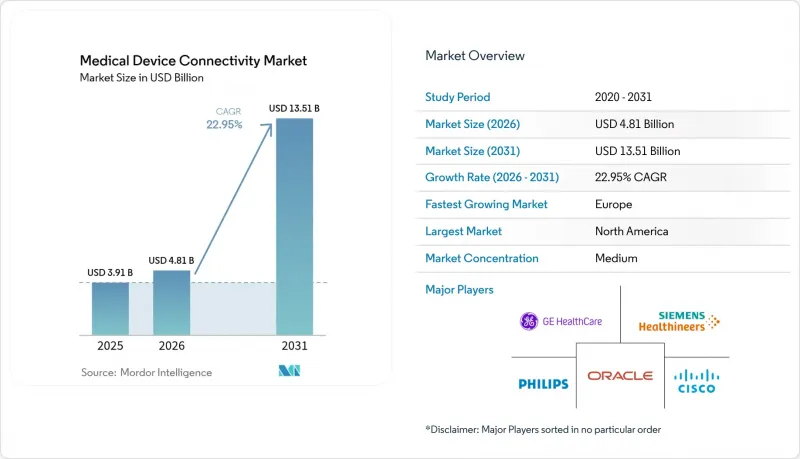
에 따르면 세계의 의료기기 접속 시장 규모는 2025년에 39억 1,000만 달러로 평가되며, 2026년 48억 1,000만 달러에서 2031년까지 135억 1,000만 달러에 달할 것으로 예측되고 있으며, 예측 기간(2026-2031년)에 CAGR은 22.95%에 달할 전망입니다.
이 보고서는 구성 요소(연결 솔루션[디바이스 인터페이스 모듈 등] 및 연결 서비스[도입·통합 등]), 기술(유선 등), 용도(환자의 지속적 모니터링 등), 최종사용자(병원·진료소 등), 지역(북미, 유럽 등)별로 분류되어 있습니다. 시장 전망은 금액(달러) 단위로 제시되어 있습니다.
전 세계 의료기기 연결 시장의 동향 및 인사이트
EMR 상호운용성 의무화 및 디지털 헬스 정책
'21세기 치료법(21st Century Cures Act)'에 의해 의무화된 표준화된 API로 인해 독자적인 프로토콜에서 FHIR 기반의 데이터 교환으로의 전환이 시급해지고 있습니다. 규정 준수 프로그램을 완료한 의료 시스템에서는 문서 작성 시간을 13% 단축하고 진료 연계성을 개선하고 있으며, 이를 통해 연결 엔진의 더 광범위한 도입이 촉진되고 있습니다. 기기 제조업체들은 현재 비용이 많이 드는 개조 주기를 피하고, 연결성에 대한 안전 조치를 점점 더 중시하게된 FDA의 승인 절차를 가속화하기 위해 신제품에 상호 운용성을 통합하여 설계하고 있습니다.
실시간 데이터가 필요한 성과 연계형 보상 제도
CMS(미국 의료보험서비스센터)의 대체 지불 모델은 수익을 임상 결과에 연동시키는 것으로, 병원에 대해 환자 상태 악화를 조기에 감지하는 지속적인 모니터링 및 엣지 분석 기능을 병상에 도입하도록 장려하고 있습니다. 연결형 RPM(원격 환자 모니터링) 플랫폼을 활용하는 의료 기관에서는 심부전으로 인한 재입원율이 24% 감소한 것으로 보고되어, 경제적 인센티브와 품질 향상을 위한 인센티브가 일치하고 있습니다. 이 비즈니스 사례는 예방 가능한 유해 사건에 대해 엄격한 처벌이 부과되는 중환자실, 뇌졸중 병동 및 암 치료 주사 센터에서 가장 설득력이 있습니다.
데이터 표준이 없고 이종 기기가 혼재된 레거시 장비군
병원에서는 수명 주기가 8년을 넘는 주입 펌프, 인공호흡기, 모니터가 종종 운영되고 있으며, 이들 중 상당수는 패치 적용이 가능한 운영 체제를 갖추고 있지 않습니다. 인터페이스 엔진은 벤더 고유의 프로토콜을 변환해야 하므로 프로젝트 리드 타임이 길어지고 지속적인 유지 관리가 필요합니다. 격리 네트워크는 취약한 엔드포인트를 보호하지만, 중복된 배선은 확장 프로젝트에 비용과 복잡성을 가중시킵니다.
부문 분석
2025년 매출의 63.12%를 차지한 연결 솔루션은 이종 혼합 의료기기 데이터를 표준화하고, 급속히 진화하는 상호 운용성 규칙을 적용하기 위한 기반으로 자리 잡았습니다. 이러한 플랫폼은 HL7v2, FHIR 및 독점 프로토콜의 데이터 스트림을 임상 의사결정 지원 엔진에 공급되는 EHR 호환 페이로드로 변환합니다. Mirth Connect와 같은 벤더 중립형 게이트웨이는 오픈소스의 유연성을 제공하는 반면, 기업 제품군은 의료기기 라이브러리, 경보 관리 및 분석 모듈을 통합하고 있습니다. 의료 기관에서는 긴급도가 높은 병동에서 다운타임을 거의 제로로 줄이기 위해 이중화된 서버 클러스터를 도입하고 있습니다. 업데이트 주기가 가속화되는 가운데, 의료기기 연결 시장에서는 주입 펌프, 마취기, 무선 원격 측정 팩을 위한 ‘개봉 후 즉시 사용’형 어댑터를 제공하는 솔루션이 점점 더 많은 지지를 얻고 있습니다.
병원이 도입, 유지보수, 사이버 보안 패치 적용을 외부에 위탁함에 따라 연결 서비스는 연평균 25.30%의 성장이 예상됩니다. 관리형 서비스 계약은 가동 시간을 보장하고, 의료 서비스 제공자를 인력 부족으로부터 보호하며, 규정 준수 문서를 최신 상태로 유지합니다. 중소규모 시설에서는 자본 지출을 예측 가능한 운영 비용으로 전환할 수 있는 구독 모델이 선택되고 있습니다. 서비스 기업은 멀티 벤더 환경 전반에 걸친 인터페이스 조정, 연중무휴 24시간 모니터링, 변경 관리 거버넌스를 하나의 패키지로 제공하고 있습니다. 이러한 추세에 따라 서비스 하위 부문은 의료기기 연결 시장 전체에서 중요한 수익 확대 요인으로 자리매김하고 있습니다.
유선 연결은 2025년 매출의 57.35%를 차지했으며, 그 중심은 중환자실 및 수술실의 차폐 이더넷 백본이었습니다. 실시간 파형 충실도와 알려진 지연 프로파일 덕분에 유선 네트워크는 높은 대역폭이 필요한 생명 유지 장치에 있으며, 여전히 필수적인 요소로 남아 있습니다. 수술실의 배선 변경은 임상 업무의 효율을 저해하고 엄격한 검증이 필요하므로 업데이트 주기가 느려지고 있습니다. 그럼에도 불구하고 Power-over-Ethernet(PoE)를 지원하기 위해 코어 스위치를 업그레이드하는 병원들은 추가 콘센트 없이도 향후 의료기기 등급을 지원할 수 있게 되어, 의료기기 연결 시장에서 유선 인프라의 중요성을 더욱 높이고 있습니다.
무선 기술은 5G로의 업그레이드와 1밀리초 미만의 지연을 약속하는 향후 6G 연구를 배경으로 연평균 성장률(CAGR) 24.95%로 확대될 것으로 예상됩니다. 일반 병동에서는 텔레메트리 벨트, 웨어러블 심전도 패치, 자세 및 낙상 데이터를 전송하는 스마트 침대를 지원하기 위해 액세스 포인트 밀도가 높아지고 있습니다. Wi-Fi 6E의 도입으로 기존 간섭의 영향을 받지 않는 새로운 주파수 대역이 확보되는 한편, 프라이빗 5G 슬라이스는 이동식 CT 스캐너나 응급 대응용 카트에 대해 확정적 품질 보증(QoS)을 제공합니다. 병원 측에서는 수액 펌프가 자동으로 SSID를 전환함으로써 병동 경계에서 수동으로 재연결할 필요가 없어져 환자 이송이 더욱 원활해졌다는 보고가 접수되고 있습니다. 이러한 혁신을 통해 무선 기술이 의료기기 연결 시장의 모빌리티를 이끄는 원동력임이 입증되고 있습니다.
지역별 분석
북미는 EHR(전자 건강 기록)의 보급이 진행되고 있으며, 상호 운용성에 대한 엄격한 시행 및 엣지 분석의 조기 도입으로 인해 2025년 매출의 38.10%를 차지했습니다. 정보 차단에 대한 CMS(미국 의료보험 및 의료서비스 센터)의 제재 및 새로운 API 의무화로 인해 의료 제공자들은 병상 옆 기기와 보험사 포털을 원활하게 연결하는 표준 기반 게이트웨이를 도입할 수밖에 없게 되었습니다. 대학 부속 병원에서는 지속적인 모니터링과 예측 점수 산정을 융합한 AI 기반 감시 시스템의 시범 운영이 진행되고 있으며, 이로 인해 고처리량 연결 허브의 도입이 가속화되고 있습니다. 디지털 헬스 분야 스타트업에 대한 벤처 투자는 의료기기 연결 시장의 지역적 확장을 더욱 촉진하고 있습니다.
아시아태평양은 2026-2031년까지 연평균 25.90%의 성장률이 예상되며, 이는 세계에서 가장 빠른 성장률입니다. 중국에서는 프라이빗 5G, 로봇 공학, 클라우드 PACS의 통합을 특징으로 하는 스마트 병원 청사진이 확대되고 있는 반면, 인도에서는 생산 연계형 인센티브 제도를 통해 개발 초기부터 개방형 표준 인터페이스를 탑재한 국산 의료기기 제조업체가 육성되고 있습니다. 일본에서는 암호화된 VPN을 통한 현을 넘나드는 원격 진료에 대해 정부가 비용을 상환하는 인센티브 정책을 활용하여, 원격 뇌졸중 네트워크를 통해 지방 진료소를 현대화하고 있습니다. 한국과 호주는 데이터 중심 의료 시범 사업에 인센티브를 제공함으로써 무선 원격 측정 및 AI 분류 알고리즘을 위한 비옥한 토대를 마련하고 있습니다. 이러한 동향에 따라 해당 지역은 의료기기 연결 시장의 중요한 성장 동력으로서의 위상을 확립해 가고 있습니다.
유럽에서는 의료기기 규정(MDR)과 일반 데이터 보호 규정(GDPR)이 상호 운용성과 사이버 보안 수준을 공동으로 높이고 있는 것을 배경으로, 연평균 성장률(CAGR)이 21.05%에 달할 것으로 예측됩니다. 독일에서는 ‘병원의 미래법’에 따라 병원의 디지털 성숙도 향상을 위한 업그레이드에 보조금을 지급하고 있으며, HL7-FHIR 게이트웨이 도입을 가속화하고 있습니다. 영국에서는 NHS 트러스트(국민보건서비스 신탁)에 대해 디지털 성숙도 평가가 의무화되어 있으며, 이를 통해 안전한 의료기기 도입을 위한 자금이 확보되고 있습니다. 북유럽 국가들은 임상용 6G 연구 테스트베드를 선도적으로 구축하고 있으며, EU 차원의 노력으로 ‘유럽 건강 데이터 공간(European Health Data Space)’을 통한 국경을 초월한 데이터 교환이 촉진되고 있습니다. 개인정보 보호와 보안에 대한 높은 관심이 공급업체 선정에 영향을 미치고 있으며, 병원 측은 제로 트러스트 설계와 세밀한 동의 관리 기능을 갖춘 플랫폼을 선호하여 도입하고 있습니다. 이를 통해 의료기기 연결 시장에서 유럽의 입지가 더욱 공고해지고 있습니다.
기타 혜택:
- 엑셀 형식의 시장 예측(ME) 시트
- 3개월간 애널리스트의 지원
자주 묻는 질문
목차
제1장 서론
제2장 조사 방법
제3장 개요
제4장 시장 구도
제5장 시장 규모와 성장 예측
제6장 경쟁 구도
제7장 시장 기회와 향후 전망
KSA 26.09.04According to Mordor Intelligence, the global medical device connectivity market size was valued at USD 3.91 billion in 2025 and estimated to grow from USD 4.81 billion in 2026 to reach USD 13.51 billion by 2031, at a CAGR of 22.95% during the forecast period (2026-2031).
This report is Segmented by Component (Connectivity Solutions [Device Interface Modules and More] and Connectivity Services [Implementation & Integration and More]), Technology (Wired and More), Application (Continuous Patient Monitoring and More), End-User (Hospitals & Clinics and More) and Geography (North America, Europe, and More). The Market Forecasts are Provided in Terms of Value (USD).
Global Medical Device Connectivity Market Trends and Insights
EMR interoperability mandates and digital-health policies
Standardized APIs mandated by the 21st Century Cures Act are forcing a shift from proprietary protocols to FHIR-based exchanges. Health systems completing compliance programs have cut documentation time by 13% and improved care coordination, encouraging broader deployment of connectivity engines. Device makers now design interoperability into new products to avoid costly retrofit cycles and to accelerate FDA clearance processes that increasingly weigh connectivity safeguards.
Outcome-based reimbursement demanding real-time data
CMS alternative payment models link revenue to clinical outcomes, pushing hospitals to instrument beds with continuous monitoring and edge analytics that flag patient deterioration early. Health systems using connected RPM platforms have reported 24% lower readmissions for heart failure, aligning financial and quality incentives. This business case is strongest in intensive care units, stroke wards, and oncology infusion centers, where preventable adverse events carry steep penalties.
Heterogeneous legacy device fleets without data standards
Hospitals often operate infusion pumps, ventilators, and monitors with life cycles exceeding eight years, many of which lack patchable operating systems. Interface engines must translate vendor-specific protocols, increasing project timelines and demanding continuous maintenance. Isolation networks protect vulnerable endpoints, yet duplicative wiring adds cost and complexity to expansion projects.
Other drivers and restraints analyzed in the detailed report include:
- Convergence of IoT cybersecurity frameworks
- Cloud-native analytics enabling predictive clinical insights
- High upfront integration and interface-engine costs
For complete list of drivers and restraints, kindly check the Table Of Contents.
Segment Analysis
Connectivity solutions held 63.12% of 2025 revenue, establishing them as the backbone for normalizing heterogeneous device data and enforcing rapidly evolving interoperability rules. These platforms translate HL7v2, FHIR, and proprietary streams into EHR-ready payloads that feed clinical decision support engines. Vendor neutral gateways such as Mirth Connect provide open-source flexibility, while enterprise suites bundle device libraries, alarm management, and analytics modules. Health systems deploy redundant server clusters to maintain near-zero downtime for high-acuity wards. As refresh cycles accelerate, the medical device connectivity market increasingly favors solutions offering out-of-the-box adapters for infusion pumps, anesthesia machines, and wireless telemetry packs.
Connectivity services are forecast to grow 25.30% annually as hospitals outsource implementation, maintenance, and cybersecurity patching. Managed-service contracts guarantee uptime, shield providers from staffing shortages, and ensure compliance documentation stays current. Small and mid-size facilities choose subscription models that convert capital expenditure into predictable operating costs. Service firms bundle interface tuning, 24 X 7 monitoring, and change-control governance across multi-vendor estates. This trend positions the services sub-segment as a key revenue accelerator within the broader medical device connectivity market.
Wired links represented 57.35% of 2025 sales, anchored by shielded Ethernet backbones in critical care and surgical suites. Real-time waveform fidelity and known latency profiles keep hard-wired networks indispensable for high-bandwidth, life-support devices. Replacement cycles are slow because rewiring operating theatres disrupts clinical throughput and requires rigorous validation. Even so, hospitals upgrading core switches to support power-over-Ethernet enable future device classes without additional outlets, extending the relevance of wired infrastructure within the medical device connectivity market.
Wireless technologies are expected to rise 24.95% CAGR on the back of 5G upgrades and forthcoming 6G research that promises sub-millisecond latency. Access point density is increasing in general wards to support telemetry belts, wearable ECG patches, and smart beds transmitting posture and falls data. Wi-Fi 6E deployments carve new spectrum free of legacy interference, while private 5G slices offer deterministic quality of service for mobile CT scanners and rapid response carts. Hospitals report smoother patient transfers when IV pumps automatically switch SSIDs, eliminating manual reconnection at ward boundaries. These innovations confirm wireless as the mobility engine of the medical device connectivity market.
Complete Report Scope:
- By Component
- Connectivity Solutions
- Interface Engines & Integration Platforms
- Connectivity Hubs & Gateways
- Device Interface Modules
- Connectivity Services
- Implementation & Integration
- Support & Maintenance
- Consulting & Training
- Connectivity Solutions
- By Technology
- Wired
- Wireless
- Hybrid
- By Application
- Continuous Patient Monitoring
- Tele-ICU & Tele-Stroke
- Imaging & PACS Connectivity
- Medication Administration & Smart IV Pumps
- Anesthesia & Ventilator
- Other Applications
- By End-User
- Hospitals & Clinics
- Ambulatory Surgery & Specialty Centers
- Home Healthcare Settings
- Other End-Users
- By Geography (Value)
- North America
- United States
- Canada
- Mexico
- Europe
- Germany
- United Kingdom
- France
- Italy
- Spain
- Rest of Europe
- Asia-Pacific
- China
- India
- Japan
- Australia
- South Korea
- Rest of Asia-Pacific
- Middle East & Africa
- GCC
- South Africa
- Rest of Middle East & Africa
- South America
- Brazil
- Argentina
- Rest of South America
- North America
Geography Analysis
North America held 38.10% of 2025 revenue due to mature EHR penetration, strict interoperability enforcement, and early adoption of edge analytics. CMS penalties for information blocking and new API mandates compel providers to deploy standards-based gateways that seamlessly connect bedside devices with payer portals. Academic medical centers pilot AI-augmented surveillance that merges continuous monitoring with predictive scoring, accelerating procurement of high-throughput connectivity hubs. Venture investment in digital health startups further expands the regional footprint of the medical device connectivity market.
Asia Pacific is forecast to expand 25.90% annually between 2026-2031, the fastest worldwide. China scales smart hospital blueprints featuring private 5G, robotics, and cloud PACS integration, while India's production-linked incentive schemes nurture indigenous device manufacturers embedding open-standard interfaces from inception. Japan upgrades rural clinics with tele-stroke networks, leveraging government stimulus that reimburses cross-prefecture consults over encrypted VPNs. South Korea and Australia incentivize data-centric healthcare pilots, creating fertile ground for wireless telemetry and AI triage algorithms. These dynamics are positioning the region as a critical growth engine of the medical device connectivity market.
Europe grows at a projected 21.05% CAGR, supported by the Medical Device Regulation and General Data Protection Regulation, which jointly elevate interoperability and cybersecurity bars. Germany subsidizes hospital digital maturity upgrades under its Hospital Futures Act, accelerating HL7-FHIR gateway procurements. The United Kingdom mandates digital maturity assessments for NHS trusts, unlocking funding for secure device onboarding. Nordic countries pioneer 6G research testbeds for clinical use, and pan-EU initiatives encourage cross-border data exchange via the European Health Data Space. Strong attention to privacy and security shapes vendor selection, with hospitals favoring platforms offering zero-trust designs and granular consent management, reinforcing Europe's stature within the medical device connectivity market.
- Ascom
- Baxter
- Cisco Systems
- Digi International Inc.
- Dragerwerk
- GE HealthCare Technologies Inc.
- Honeywell International
- ICU Medical
- Koninklijke Philips
- Lantronix Inc.
- Masimo
- Medtronic
- Mindray
- NantHealth
- Nihon Kohden
- Oracle
- S3 Connected Health
- Siemens Healthineers
- Spectrum Medical Ltd
- Stryker
Additional Benefits:
- The market estimate (ME) sheet in Excel format
- 3 months of analyst support
TABLE OF CONTENTS
1 Introduction
- 1.1 Study Assumptions & Market Definition
- 1.2 Scope of the Study
2 Research Methodology
3 Executive Summary
4 Market Landscape
- 4.1 Market Overview
- 4.2 Market Drivers
- 4.2.1 EMR interoperability mandates and digital-health policies
- 4.2.2 Outcome-based reimbursement demanding real-time data
- 4.2.3 Expansion of remote and home-based chronic-care monitoring
- 4.2.4 Convergence of IoT cybersecurity frameworks
- 4.2.5 Proliferation of multi-parameter wearable & implantable devices
- 4.2.6 Cloud-native analytics enabling predictive clinical insights
- 4.3 Market Restraints
- 4.3.1 Heterogeneous legacy device fleets without data standards
- 4.3.2 High upfront integration and interface-engine costs
- 4.3.3 Persistent cybersecurity and patient-privacy vulnerabilities
- 4.3.4 Limited workflow alignment causing clinician resistance
- 4.4 Technological Outlook
- 4.5 Porter's Five Forces Analysis
- 4.5.1 Threat of New Entrants
- 4.5.2 Bargaining Power of Buyers
- 4.5.3 Bargaining Power of Suppliers
- 4.5.4 Threat of Substitutes
- 4.5.5 Intensity of Competitive Rivalry
5 Market Size & Growth Forecasts (Value)
- 5.1 By Component
- 5.1.1 Connectivity Solutions
- 5.1.1.1 Interface Engines & Integration Platforms
- 5.1.1.2 Connectivity Hubs & Gateways
- 5.1.1.3 Device Interface Modules
- 5.1.2 Connectivity Services
- 5.1.2.1 Implementation & Integration
- 5.1.2.2 Support & Maintenance
- 5.1.2.3 Consulting & Training
- 5.1.1 Connectivity Solutions
- 5.2 By Technology
- 5.2.1 Wired
- 5.2.2 Wireless
- 5.2.3 Hybrid
- 5.3 By Application
- 5.3.1 Continuous Patient Monitoring
- 5.3.2 Tele-ICU & Tele-Stroke
- 5.3.3 Imaging & PACS Connectivity
- 5.3.4 Medication Administration & Smart IV Pumps
- 5.3.5 Anesthesia & Ventilator
- 5.3.6 Other Applications
- 5.4 By End-User
- 5.4.1 Hospitals & Clinics
- 5.4.2 Ambulatory Surgery & Specialty Centers
- 5.4.3 Home Healthcare Settings
- 5.4.4 Other End-Users
- 5.5 By Geography (Value)
- 5.5.1 North America
- 5.5.1.1 United States
- 5.5.1.2 Canada
- 5.5.1.3 Mexico
- 5.5.2 Europe
- 5.5.2.1 Germany
- 5.5.2.2 United Kingdom
- 5.5.2.3 France
- 5.5.2.4 Italy
- 5.5.2.5 Spain
- 5.5.2.6 Rest of Europe
- 5.5.3 Asia-Pacific
- 5.5.3.1 China
- 5.5.3.2 India
- 5.5.3.3 Japan
- 5.5.3.4 Australia
- 5.5.3.5 South Korea
- 5.5.3.6 Rest of Asia-Pacific
- 5.5.4 Middle East & Africa
- 5.5.4.1 GCC
- 5.5.4.2 South Africa
- 5.5.4.3 Rest of Middle East & Africa
- 5.5.5 South America
- 5.5.5.1 Brazil
- 5.5.5.2 Argentina
- 5.5.5.3 Rest of South America
- 5.5.1 North America
6 Competitive Landscape
- 6.1 Market Concentration
- 6.2 Competitive Benchmarking
- 6.3 Market Share Analysis
- 6.4 Company Profiles (includes Global level Overview, Market level overview, Core Segments, Financials as available, Strategic Information, Market Rank/Share for key companies, Products & Services, and Recent Developments)
- 6.4.1 Ascom Holding AG
- 6.4.2 Baxter International Inc
- 6.4.3 Cisco Systems Inc.
- 6.4.4 Digi International Inc.
- 6.4.5 Dragerwerk AG & Co. KGaA
- 6.4.6 GE HealthCare Technologies Inc.
- 6.4.7 Honeywell International Inc.
- 6.4.8 ICU Medical
- 6.4.9 Koninklijke Philips N.V.
- 6.4.10 Lantronix Inc.
- 6.4.11 Masimo Corporation
- 6.4.12 Medtronic plc
- 6.4.13 Mindray Medical International Limited
- 6.4.14 NantHealth, Inc.
- 6.4.15 Nihon Kohden Corporation
- 6.4.16 Oracle Corporation
- 6.4.17 S3 Connected Health
- 6.4.18 Siemens Healthineers AG
- 6.4.19 Spectrum Medical Ltd
- 6.4.20 Stryker Corporation
7 Market Opportunities & Future Outlook
- 7.1 White-space & Unmet-Need Assessment


