

|
시장보고서
상품코드
2122210
니켈 합금 : 시장 점유율 분석, 업계 동향 및 통계, 성장 예측(2026-2031년)Nickel Alloys - Market Share Analysis, Industry Trends & Statistics, Growth Forecasts (2026 - 2031) |
||||||
 Mordor Intelligence
Mordor Intelligence에 의하면, 니켈 합금 시장 규모는 2025년 471.13 킬로톤으로 평가되었습니다. 2026년에는 500.07 킬로톤으로 확대되어 2031년까지 646.51 킬로톤에 이를 것으로 예상되고 2026년부터 2031년에 걸쳐 CAGR 5.27%로 성장할 전망입니다.
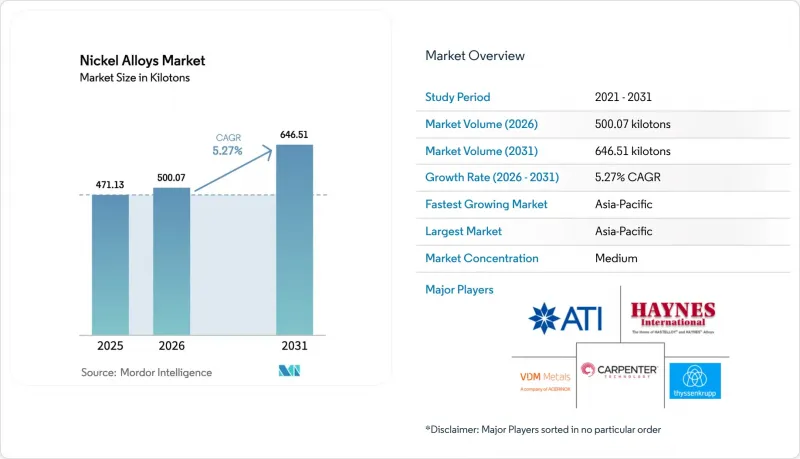
본 보고서는 합금 유형(내열성, 내식성, 전기 저항성 등), 니켈 유형(니켈·크롬·철, 니켈·구리, 니켈·철 등), 최종 이용 산업(항공우주, 전기 및 전자, 석유 및 가스 등), 지역(아시아태평양, 북미, 유럽 등)별로 분류되어 있습니다. 시장 전망은 수량(톤) 기준으로 제시되어 있습니다.
세계의 니켈 합금 시장 동향 및 인사이트
항공우주용 초합금 수요 급증
2024년, 민간 항공기 수주 잔고는 1만 4,000대를 초과하며, 향후 10년 동안 약 28만 메트르톤의 니켈 기반 초합금 수요가 예상됩니다. 엔진 제조업체들은 1,650°C를 초과하는 온도 범위에서 작동하는 고압축비 아키텍처를 채택하고 있으며, 이 온도 범위에서는 매우 엄격한 화학 조성 범위가 요구되는 단결정 르네(Rene) 및 인코넬(Inconel) 주조재가 필수적입니다. 미국 공군의 ‘차세대 공중 우세(Next Generation Air Dominance)’ 전투기 등 국방 프로그램에서는 -55°C에서 1,200°C 사이를 밀리초 단위로 오가는 내열성을 갖춘 합금이 요구됩니다. 적층 가공 기술로 터빈 부품의 무게는 최대 25%까지 줄었지만, 분말 원료 비용은 단조 봉재의 3-4배 수준에 머물러 있습니다. 이러한 항공우주 분야의 동향으로 인해, 적어도 향후 10년 동안은 니켈 합금 시장에서 지속적이고 고부가가치 수요가 예상됩니다.
EV용 양극재에서의 배터리 등급 니켈로의 전환
니켈 함량이 높은 NMC 811 및 NMC 9-5-5 계열의 화학 조성은 현재 250 Wh/kg을 초과하는 에너지 밀도를 실현하고 있으며, 기존의 532 계열 배합을 대체하고 있습니다. 중국 이외의 자동차 제조업체들은 저탄소 클래스 1 공급을 확보하기 위해 수년에 걸친 공급 계약을 체결하고 있습니다. 제너럴 모터스(GM)는 니켈 1톤당 10톤 미만의 CO2 배출량이라는 탄소 기준치를 조건으로, 2026년부터 2030년에 걸쳐 7만 5,000메트르톤을 조달하겠다고 약속했습니다. 유럽연합(EU)의 배터리 규제에서는 2030년부터 탄소 발자국 상한선이 의무화되어, 책임 있게 조달된 원료에 대한 수요가 더욱 높아질 것으로 예측됩니다. 2025년에는 중국의 LFP(인산철리튬) 급증으로 니켈 집약도가 낮아졌음에도 불구하고, 전 세계 배터리용 니켈 총량은 여전히 증가하고 있어 니켈 합금 시장에 있어 매우 중요한 성장 동력이 확고히 자리 잡고 있습니다.
니켈 공급망의 지정학적 리스크
인도네시아의 광석 수출 금지 조치 및 하류 부문에 대한 규제로 인해 유입되는 외국인 직접 투자(FDI)의 68%가 중국계 합작 기업으로 흘러들어가면서 공급이 집중되는 한편, 서방 국가들의 안보에 대한 우려가 커지고 있습니다. 미국은 ‘국방생산법’을 발동하여 타마락 프로젝트를 신속히 추진했으나, 인허가 관련 과제는 여전히 남아 있습니다. 2024년 11월 불리한 판정에 대해 자카르타 정부가 WTO에 항소한 탓에 불확실성이 장기화되고 있으며, 항공우주 업계의 주요 제조업체들은 대체 원료에 대한 재인증을 받아야 하는 상황에 처해 있습니다. 이 재인증에는 등급별로 최대 500만 달러의 비용이 소요됩니다. 이러한 불확실성으로 인해 니켈 합금 시장의 단기적인 공급량 확대는 제한되고 있습니다.
부문별 분석
2025년, 초합금을 비롯한 내열 니켈 합금은 47.76%의 점유율을 차지하며 니켈 합금 시장을 주도했습니다. 이러한 주도적 지위는 고온·고응력 환경에서 필수적인 역할을 수행하고 있기 때문입니다. 고급 석출 경화형 슈퍼합금 및 방향성 응고형 슈퍼합금은 항공기 엔진의 고온부, 산업용 가스 터빈, 1,000°C를 초과하는 온도에서 가동되는 수소 연료 발전소 등 중요한 용도에 선호되어 채택되고 있습니다. 민간 항공기 기단 확대, 정비 주기 연장, 그리고 LNG 및 수소 인프라 개발로 인해 단조 디스크, 터빈 블레이드, 연소실에 대한 수요가 견조하게 유지되고 있습니다. 또한, 열효율 향상을 위한 발전 시스템 개조에 따라 더 높은 크리프 강도를 가진 합금의 사용이 증가하고 있어 장기적인 소비를 뒷받침하고 있습니다.
내열 니켈 합금(슈퍼 합금 포함) 역시 가장 빠르게 성장하는 부문으로, 적층 가공 및 차세대 추진 프로그램의 견인 아래 2026년부터 2031년까지 연평균 성장률(CAGR) 6.26%를 나타낼 것으로 전망됩니다. 레이저 및 전자빔을 이용한 분말 침적 용융 기술로 인해 복잡한 냉각로와 경량 부품의 제조가 가능해짐에 따라, 슈퍼합금 분말 수요가 증가하는 동시에 항공우주 공급망 전반에 걸쳐 재료 이용 효율이 향상되고 있습니다. 열 차단 코팅이 적용된 초합금은 소형 모듈형 원자로 및 집광형 태양열 발전의 수신기에서 보급이 확대되고 있는 반면, 첨단 코팅 기술은 고부하 터빈의 점검 주기를 연장하고 있습니다. 설계 최적화를 통해 엔진 1대당 재료 효율은 향상되고 있지만, 엔진 생산 대수 증가, 오버홀 주기의 단축, 그리고 고온 산업용 기기에 대한 수요 증가가 이러한 효율화 성과를 상쇄하고 있습니다. 전동화의 진전에 따라 금속 수요가 기존 합금에서 점차 이동하고 있지만, 내열성 니켈 초합금은 구조상 여전히 필수적이며, 니켈 합금 시장에서 안정적이고 성능 주도형 성장을 보장하고 있습니다.
지역별 분석
아시아태평양은 2025년 매출의 49.62%를 차지했으며, 2031년까지 연평균 7.56%의 성장률을 보일 것으로 전망되는데, 이는 모든 지역 중 가장 높은 성장률입니다. 인도네시아는 2024년에 180만 톤의 니켈 광석을 생산하며, 배터리 등급의 매트와 스테인리스용 선철을 모두 공급하는 23개의 HPAL 및 RKEF 시설을 가동하고 있습니다. 중국은 2024년에 3,300만 톤을 생산하여 여전히 최대의 스테인리스 스틸 생산국이며, 약 150만 톤의 니켈을 소비하고 있지만, 200계 등급으로의 전환에 따라 톤당 니켈 소비량은 감소 추세를 보이고 있습니다. 인도에서는 방위 관련 설비 확충으로 인해 2024년에 힌두스탄 에어로노틱스(Hindustan Aeronautics)로부터 인코넬(Inconel) 단조품에 대한 국내 수주가 증가했습니다.
북미에서는 ‘인플레이션 감축법(Inflation Reduction Act)’에 따른 배터리 부품에 대한 30% 세액 공제 및 ‘CHIPS법’에 따른 초저팽창 합금에 의존하는 반도체 팹에 대한 520억 달러의 지출 혜택을 받고 있습니다. ATI사가 펜실베이니아주에서 시행하는 1억 4,000만 달러 규모의 확장 계획은 항공우주용 초합금 및 첨단 전기강판 수요를 목표로 하고 있습니다. 유럽에서는 탄소국경조정메커니즘(CBAM)에 따른 탄소 내재 관세가 부과되고 있으며, 인도네시아산 니켈의 경우 톤당 2,000유로를 초과할 가능성이 있어, 이에 따라 구매자들은 탄소 발자국이 낮은 캐나다나 핀란드공급업체로 전환하고 있습니다.
남미는 여전히 틈새 시장에 머물러 있지만, 수심 2,000미터에서 200 MPa의 내압 성능을 갖춘 내식성 해저 장비가 필요한 브라질의 프레솔트층 해양 유전이 수요를 견인하고 있습니다. 중동 및 아프리카에서는 프로젝트 주도형 수요가 나타나고 있습니다. 대표적인 예로 사우디아라비아의 70억 달러 규모의 NEOM 산업 클러스터와, 황산 침출 회로에 니켈 기 합금을 지정하고 있는 남아프리카공화국의 백금 가공 설비 업그레이드를 들 수 있습니다. 이러한 지역적 요인들이 결합되어 니켈 합금 시장에는 균형 잡힌 수요 기반이 형성되어 있으며, 특정 소비 지역에 대한 과도한 의존도를 완화하고 있습니다.
기타 혜택 :
- 엑셀 형식 시장 예측(ME) 시트
- 3개월간의 애널리스트 지원
자주 묻는 질문
목차
제1장 서론
제2장 조사 방법
제3장 주요 요약
제4장 시장 구도
제5장 시장 규모 및 성장 예측
제6장 경쟁 구도
제7장 시장 기회 및 향후 전망
KTH 26.09.04According to Mordor Intelligence, the nickel alloys market size is expected to increase from 471.13 kilotons in 2025 to 500.07 kilotons in 2026 and reach 646.51 kilotons by 2031, growing at a CAGR of 5.27% over 2026-2031.
This report is Segmented by Alloy Type (Heat-Resistant, Corrosion-Resistant, Electrical-Resistance, and More), Nickel Type (Nickel-Chromium-Iron, Nickel-Copper, Nickel-Iron, and More), End-Use Industry (Aerospace, Electrical and Electronics, Oil and Gas, and More), and Geography (Asia-Pacific, North America, Europe, and More). The Market Forecasts are Provided in Terms of Volume (Tons).
Global Nickel Alloys Market Trends and Insights
Aerospace Super-Alloys Demand Surge
Commercial backlogs exceeded 14,000 aircraft in 2024, translating to an estimated 280,000 metric tons of nickel-based super-alloy demand over the next decade. Engine makers are adopting higher-pressure-ratio architectures that operate beyond 1,650 °C, a regime that mandates single-crystal Rene and Inconel castings with exceptionally tight chemistry windows. Defense programs such as the U.S. Air Force Next Generation Air Dominance fighter require alloys that cycle between -55 °C and 1,200 °C within milliseconds. Additive manufacturing is reducing weight by up to 25% on turbine components although powder feedstock remains three to four times costlier than wrought bar. These aerospace dynamics ensure sustained, high-value pull on the nickel alloys market for at least another decade.
Battery-Grade Nickel Shift in EV Cathodes
High-nickel NMC 811 and NMC 9-5-5 chemistries now deliver energy densities above 250 Wh kg-1, displacing earlier 532 formulations. Automakers outside China are signing multi-year offtake contracts to secure low-carbon Class 1 supply; General Motors committed to 75,000 metric tons from 2026-2030, subject to carbon thresholds below 10 tons CO2 per ton nickel. The European Union Battery Regulation will impose mandatory carbon-footprint ceilings from 2030, reinforcing demand for responsibly sourced feedstock. While China's LFP surge diluted nickel intensity in 2025, global battery-grade nickel tonnage still rose on aggregate, locking in a pivotal growth vector for the nickel alloys market.
Nickel Supply-Chain Geopolitical Risk
Indonesia's ore-export ban and downstream mandates have routed 68% of incoming FDI to Chinese-controlled joint ventures, centralizing supply but elevating Western security concerns. The United States invoked the Defense Production Act to fast-track the Tamarack project, yet permitting challenges persist. Jakarta's WTO appeal against an unfavorable November 2024 ruling prolongs uncertainty, compelling aerospace primes to requalify alternative feedstocks, a process costing up to USD 5 million per grade. This uncertainty tempers near-term volume expansion in the nickel alloys market.
Other drivers and restraints analyzed in the detailed report include:
- Small-Modular Nuclear Reactors Build-Out
- Hydrogen Turbine Retrofits
- Volatile LME Pricing and Hedging Costs
For complete list of drivers and restraints, kindly check the Table Of Contents.
Segment Analysis
In 2025, Heat-Resistant Nickel Alloys, including superalloys, dominated the nickel alloys market with a 47.76% share. Their leadership stems from their indispensable role in high-temperature, high-stress environments. Advanced precipitation-hardened superalloys and directionally solidified variants are preferred for critical applications such as aero-engine hot sections, industrial gas turbines, and hydrogen-fueled power plants operating above 1,000 °C. The expansion of commercial aviation fleets, increasing maintenance cycles, and the development of LNG and hydrogen infrastructures drive consistent demand for forged disks, turbine blades, and combustors. Additionally, retrofitting power generation systems for improved thermal efficiency is boosting the use of higher-creep-strength alloys, supporting long-term consumption.
Heat-Resistant Nickel Alloys (including superalloys) is also the fastest-growing segment, with a projected 6.26% CAGR from 2026 to 2031, driven by additive manufacturing and next-generation propulsion programs. Laser and electron-beam powder-bed fusion enable intricate cooling channels and lighter components, increasing superalloy powder demand and improving material utilization across aerospace supply chains. Thermal-barrier-coated superalloys are gaining traction in small modular reactors and concentrated solar power receivers, while advanced coatings extend service intervals in heavy-duty turbines. Although design optimizations are improving material efficiency per engine, rising engine production, overhaul cycles, and demand for high-temperature industrial equipment offset these gains. As electrification shifts metal demand from traditional alloys, heat-resistant nickel superalloys remain structurally essential, ensuring stable, performance-driven growth in the nickel alloys market.
Complete Report Scope:
- By Alloy Type
- Heat-Resistant Nickel Alloys
- Corrosion-Resistant Nickel Alloys
- Electrical-Resistance Nickel Alloys
- Low-Expansion Nickel Alloys
- Shape-Memory and High-Strength Alloys
- By Nickel Type
- Nickel-Chromium-Iron Alloys
- Nickel-Copper Alloys
- Nickel-Iron Alloys
- Nickel-Chromium-Molybdenum Alloys
- Other Types
- By End-use Industry
- Aerospace
- Electrical and Electronics
- Oil and Gas
- Chemical Processing
- Automotive
- Other End-user Industries
- By Geography
- Asia-Pacific
- China
- Japan
- India
- South Korea
- ASEAN Countries
- Rest of Asia-Pacific
- North America
- United States
- Canada
- Mexico
- Europe
- Germany
- United Kingdom
- France
- Italy
- Russia
- Rest of Europe
- South America
- Brazil
- Argentina
- Rest of South America
- Middle East and Africa
- Saudi Arabia
- South Africa
- Rest of Middle-East and Africa
- Asia-Pacific
Geography Analysis
Asia-Pacific commanded 49.62% of 2025 revenue and is forecast to advance 7.56% annually to 2031, the fastest among all regions. Indonesia produced 1.8 million tons of nickel ore in 2024 and operates 23 HPAL and RKEF facilities that feed both battery-grade matte and stainless pig iron. China remains the largest stainless producer at 33 million tons in 2024, consuming roughly 1.5 million tons of nickel though the shift toward 200-series grades is lowering intensity per ton. India's defense build-out lifted domestic orders for Inconel forgings awarded by Hindustan Aeronautics in 2024.
North America benefits from the Inflation Reduction Act's 30% tax credits for battery components and the CHIPS Act's USD 52 billion outlay for semiconductor fabs that rely on ultra-low-expansion alloys. ATI's USD 140 million Pennsylvania expansion targets aerospace super-alloy demand and advanced electrical steels. Europe faces embedded-carbon tariffs under the Carbon Border Adjustment Mechanism that could exceed EUR 2,000 per ton for Indonesian nickel, redirecting buyers to Canadian or Finnish suppliers with lower footprints.
South America remains niche, driven by Brazilian offshore pre-salt fields requiring corrosion-resistant subsea hardware rated to 200 MPa at 2,000 m depths. The Middle East and Africa show project-driven demand, epitomized by Saudi Arabia's USD 7 billion NEOM industrial cluster and South Africa's platinum processing upgrades that specify nickel-based alloys for sulfuric-acid leaching circuits. Collectively, these geographic vectors give the nickel alloys market a balanced demand base and mitigate over-reliance on any single consuming region.
- ATI
- Haynes International
- VDM Metals
- thyssenkrupp Materials NA, Inc.
- CRS Holdings, LLC.
- Precision Castparts Corp.
- NeoNickel
- Sandvik AB
- voestalpine Specialty Metals
- SANYO SPECIAL STEEL Co., Ltd.
- Nippon Yakin Kogyo
- JLC Electromet Pvt. Ltd.
- Berkshire Hathaway Inc.
- Kennametal Inc.
- Proterial, Ltd.
- Alloys International, Inc.
- Eramet
- Arconic
- Outokumpu
- GLENCORE
Additional Benefits:
- The market estimate (ME) sheet in Excel format
- 3 months of analyst support
TABLE OF CONTENTS
1 Introduction
- 1.1 Study Assumptions and Market Definition
- 1.2 Scope of the Study
2 Research Methodology
3 Executive Summary
4 Market Landscape
- 4.1 Market Overview
- 4.2 Market Drivers
- 4.2.1 Aerospace super-alloys demand surge
- 4.2.2 Battery-grade nickel shift in EV cathodes
- 4.2.3 Small-modular nuclear reactors build-out
- 4.2.4 Hydrogen turbine retrofits
- 4.2.5 Defense hypersonics and space launch vehicles
- 4.3 Market Restraints
- 4.3.1 Nickel supply-chain geopolitical risk
- 4.3.2 Volatile LME nickel pricing and hedging costs
- 4.3.3 High lifecycle CO2 footprint vs. green-steel options
- 4.4 Value Chain Analysis
- 4.5 Porter's Five Forces Analysis
- 4.5.1 Bargaining Power of Suppliers
- 4.5.2 Bargaining Power of Buyers
- 4.5.3 Threat of New Entrants
- 4.5.4 Threat of Substitutes
- 4.5.5 Competitive Rivalry
5 Market Size and Growth Forecasts (Volume)
- 5.1 By Alloy Type
- 5.1.1 Heat-Resistant Nickel Alloys
- 5.1.2 Corrosion-Resistant Nickel Alloys
- 5.1.3 Electrical-Resistance Nickel Alloys
- 5.1.4 Low-Expansion Nickel Alloys
- 5.1.5 Shape-Memory and High-Strength Alloys
- 5.2 By Nickel Type
- 5.2.1 Nickel-Chromium-Iron Alloys
- 5.2.2 Nickel-Copper Alloys
- 5.2.3 Nickel-Iron Alloys
- 5.2.4 Nickel-Chromium-Molybdenum Alloys
- 5.2.5 Other Types
- 5.3 By End-use Industry
- 5.3.1 Aerospace
- 5.3.2 Electrical and Electronics
- 5.3.3 Oil and Gas
- 5.3.4 Chemical Processing
- 5.3.5 Automotive
- 5.3.6 Other End-user Industries
- 5.4 By Geography
- 5.4.1 Asia-Pacific
- 5.4.1.1 China
- 5.4.1.2 Japan
- 5.4.1.3 India
- 5.4.1.4 South Korea
- 5.4.1.5 ASEAN Countries
- 5.4.1.6 Rest of Asia-Pacific
- 5.4.2 North America
- 5.4.2.1 United States
- 5.4.2.2 Canada
- 5.4.2.3 Mexico
- 5.4.3 Europe
- 5.4.3.1 Germany
- 5.4.3.2 United Kingdom
- 5.4.3.3 France
- 5.4.3.4 Italy
- 5.4.3.5 Russia
- 5.4.3.6 Rest of Europe
- 5.4.4 South America
- 5.4.4.1 Brazil
- 5.4.4.2 Argentina
- 5.4.4.3 Rest of South America
- 5.4.5 Middle East and Africa
- 5.4.5.1 Saudi Arabia
- 5.4.5.2 South Africa
- 5.4.5.3 Rest of Middle-East and Africa
- 5.4.1 Asia-Pacific
6 Competitive Landscape
- 6.1 Market Concentration
- 6.2 Strategic Moves
- 6.3 Market Share/Ranking Analysis
- 6.4 Company Profiles (includes Global level Overview, Market level overview, Core Segments, Financials, Strategic Information, Market Rank/Share, Products and Services, Recent Developments)
- 6.4.1 ATI
- 6.4.2 Haynes International
- 6.4.3 VDM Metals
- 6.4.4 thyssenkrupp Materials NA, Inc.
- 6.4.5 CRS Holdings, LLC.
- 6.4.6 Precision Castparts Corp.
- 6.4.7 NeoNickel
- 6.4.8 Sandvik AB
- 6.4.9 voestalpine Specialty Metals
- 6.4.10 SANYO SPECIAL STEEL Co., Ltd.
- 6.4.11 Nippon Yakin Kogyo
- 6.4.12 JLC Electromet Pvt. Ltd.
- 6.4.13 Berkshire Hathaway Inc.
- 6.4.14 Kennametal Inc.
- 6.4.15 Proterial, Ltd.
- 6.4.16 Alloys International, Inc.
- 6.4.17 Eramet
- 6.4.18 Arconic
- 6.4.19 Outokumpu
- 6.4.20 GLENCORE
7 Market Opportunities and Future Outlook
- 7.1 White-space and Unmet-Need Assessment


