

|
시장보고서
상품코드
2122223
마이크로파 디바이스 시장 : 시장 점유율 분석, 업계 동향 및 통계, 성장 예측(2026-2031년)Microwave Devices - Market Share Analysis, Industry Trends & Statistics, Growth Forecasts (2026 - 2031) |
||||||
 Mordor Intelligence
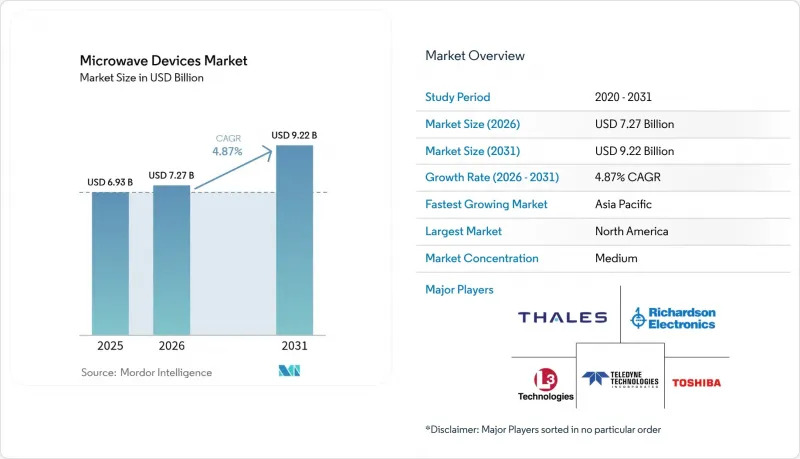
Mordor Intelligence에 의하면, 2026년 마이크로파 디바이스 시장 규모는 72억 7,000만 달러로 추정되고, 2025년 69억 3,000만 달러에서 확대해, 2031년에는 92억 2,000만 달러에 이를 것으로 예측됩니다.
2026-2031년 연평균 성장률(CAGR) 4.87%로 성장할 것으로 전망됩니다.
본 보고서는 디바이스 유형별(능동형(고체, 진공 전자) 및 수동형(필터, 커플러 등)), 주파수 대역별(L대역 및 S대역, C대역 및 X대역 등), 용도별(우주·통신, 국방(레이더, 전자전, 지향성 에너지 무기), 의료(절제술, 영상진단) 등) 및 지역별로 분류되어 있습니다.
세계의 마이크로파 디바이스 시장 동향 및 인사이트
안전한 군용 위성통신(SATCOM) 수요의 급증
현대 군용 네트워크에는 방해에 강한 통신 링크와 다중 대역 대응의 범용성이 요구되고 있습니다. L3Harris사와의 6,000만 달러 규모의 계약을 바탕으로 한 미 육군의 최근 모듈형 VSAT 단말기 배치는 높은 데이터 전송 속도와 신속한 전개를 모두 충족하는 소형 시스템으로의 전환을 보여줍니다. GaN 증폭기는 현재 규정된 전력 수준과 대역폭을 실현하여 진공관의 단계적 폐지를 가속화하고 있습니다. 한편, 중국의 기가와트급 고출력 마이크로파(HPM) 무기에 대한 병행 투자는 방위 조달 파이프라인을 활발하게 유지하는 기술 경쟁을 부추기고 있습니다.
E-밴드 및 V-밴드에서의 5G 및 FWA 백홀 도입
고정 무선 백홀은 광섬유 비용이 여전히 터무니없이 높은 지역에서 기가비트급 처리량을 제공합니다. FCC(연방통신위원회)의 ‘미국 농촌 지역 5G 기금’(90억 달러)은 E-밴드 및 V-밴드 링크에 대한 단기적인 수요 기반을 형성하고 있습니다. 위성도 수요를 뒷받침하고 있습니다. 스페이스X(SpaceX)로부터 E대역용 고체 전력 증폭기에 대한 1,970만 달러 규모의 수주는 고주파 마이크로파 페이로드의 상용 규모 배치를 뒷받침하는 것입니다.
광대역 갭 소자의 높은 연구개발비용
GaN 및 SiC용 에피택셜 리액터는 수,000만 달러 규모에 달하고, 진입 장벽이 높습니다. 주요 공급업체들은 매출의 15-20%를 공정 최적화에 할애하고 있으며, 이 장벽을 극복할 수 있는 신규 진출기업은 거의 없습니다.
부문 분석
2025년 시점에서 마이크로파 디바이스 시장 중 능동 소자가 61.75%를 차지했으며, 2031년까지 연평균 성장률(CAGR) 7.42%로 성장할 전망입니다. 크기, 무게, 신뢰성 면에서의 우위 덕분에 진공 전자 소자에서 GaN 고체 전력 증폭기로의 대체가 가속화되고 있습니다. 마이크로파 디바이스 시장에서 능동 소자 시장 규모는 2031년까지 65억 6,000만 달러에 달할 전망입니다. 집적화 추세에 따라 빔 포밍 및 이득 제어 로직이 증폭기 다이(die)에 통합되어 소프트웨어 정의 무선(SDR) 플랫폼의 구현이 가능해졌습니다. 진공관 제품은 여전히 초고출력 레이더에 사용되고 있지만, 국방 프로그램에서 고체 모듈이 표준화됨에 따라 시장 점유율을 점차 내주고 있습니다.
이차적인 영향은 수동 부품 부문으로도 파급되고 있으며, 기능이 온칩화됨에 따라 디스크리트형 필터와 커플러는 가격 면에서 압박을 받고 있습니다. 의료용 절제 플랫폼에서는 밀리초 단위의 출력 변조가 가능한 능동형 솔루션이 선호되고 있어, 이 부문의 장기적인 성장 궤도가 더욱 견고해지고 있습니다. 제품 파이프라인을 살펴보면, 신흥 5G 매크로 무선 아키텍처에 대응하는 24V 및 28V GaN 디바이스에 대한 수요가 증가하고 있음을 알 수 있습니다.
지역별 분석
북미는 2025년에도 37.60%의 점유율을 유지했습니다. 이는 90억 달러에 달하는 연방 정부의 5G 보조금과 견조한 미국 국방 예산에 힘입은 결과입니다. 마이크로파 디바이스 시장은 지향성 에너지 무기 프로그램과 지방의 광대역 인프라 구축의 혜택을 지속적으로 받고 있습니다. 수출 허가 준수는 비용 측면에서 마찰을 야기하지만, 입지를 굳힌 주요 기업들은 공급 차질을 완화하기 위한 현지 조달 전략을 유지하고 있습니다.
아시아태평양은 2031년까지 7.01%라는 가장 높은 연평균 성장률(CAGR)을 달성할 전망입니다. 중국은 채굴되는 갈륨의 98%를 장악하고 있어, 이에 따라 국내 팹은 비용 면에서 우위를 확보할 수 있는 반면, 해외 시스템 통합사업자들은 가격 변동 위험에 노출되어 있습니다. 이 지역 각국 정부는 300mm 파워 반도체 팹에 자금을 지원하고 있으며, 인도에 새로 설립된 설계 회사는 RF 프런트엔드 혁신을 위한 인재 풀을 확대되고 있습니다. 한국과 일본은 첨단 테스트 및 패키징 역량을 제공하여 자립적인 밸류체인을 강화하고 있습니다.
유럽에서는 국방상의 필요와 상용 통신의 확대 사이에서 균형을 맞추고 있습니다. EU의 정책 인센티브는 GaN 에피택시 및 패키징 역량의 현지화를 목표로 하고 있습니다. 대서양을 가로지르는 파트너십을 통해, 유럽의 RF 설계는 북미 팹에서 시범 생산된 후 양산 물량은 국내 생산 라인으로 돌아오게 되어 지정학적 위험이 완화됩니다. 지속가능성 관련 지침에 따라 네트워크 사업자들은 새로운 5G 및 향후 6G 노드에서 에너지 효율이 높은 GaN 플랫폼으로의 전환을 더욱 촉진하고 있습니다.
기타 혜택 :
- 엑셀 형식 시장 예측(ME) 시트
- 3개월간의 애널리스트 지원
자주 묻는 질문
목차
제1장 서론
제2장 조사 방법
제3장 주요 요약
제4장 시장 구도
제5장 시장 규모 및 성장 예측
제6장 경쟁 구도
제7장 시장 기회 및 향후 전망
AJY 26.09.07According to Mordor Intelligence, microwave devices market size in 2026 is estimated at USD 7.27 billion, growing from 2025 value of USD 6.93 billion with 2031 projections showing USD 9.22 billion, growing at 4.87% CAGR over 2026-2031.
This report is Segmented by Device Type (Active [Solid-State, Vacuum Electron] and Passive [Filters, Couplers, Etc. ]), Frequency Band (L and S, C and X, and More), Application (Space and Communication, Defense [Radar, EW, DEW], , Medical [Ablation, Imaging] and More), and Geography.
Global Microwave Devices Market Trends and Insights
Surge in Secure Military SATCOM Demand
Modern armed-forces networks require jam-resilient links and multi-band versatility. Recent U.S. Army fielding of modular VSAT terminals, backed by a USD 60 million contract with L3Harris, illustrates the shift toward compact systems that merge high data rates with quick deployment. GaN amplifiers enable the power levels and bandwidth now specified, speeding the retirement of vacuum tubes. Parallel Chinese investment in gigawatt-class high-power microwave (HPM) weapons fuels a technology race that keeps defense procurement pipelines active.
5G and FWA Backhaul Deployment in E- and V-Bands
Fixed-wireless backhaul offers gigabit-class throughput where fiber costs remain prohibitive. The FCC's USD 9 billion 5G Fund for Rural America anchors near-term demand for E- and V-band links. Satellites add another pull: a USD 19.7 million order from SpaceX for E-band solid-state power amplifiers affirms commercial scale for high-frequency microwave payloads.
High R&D Cost of Wide-Bandgap Devices
Epitaxial reactors for GaN and SiC run into the tens of millions of dollars, creating high entry barriers. Leading suppliers devote 15-20% of turnover to process optimization, a hurdle few new entrants can clear.
Other drivers and restraints analyzed in the detailed report include:
- Medical Microwave Ablation Adoption
- GaN-Based Solid-State PA Cost Declines
- Export Controls on Critical RF Components
For complete list of drivers and restraints, kindly check the Table Of Contents.
Segment Analysis
Active devices accounted for 61.75% of the microwave devices market in 2025 and advanced at a 7.42% CAGR to 2031. Size, weight, and reliability advantages are accelerating the swap from vacuum electron devices to GaN solid-state power amplifiers. The Microwave devices market size for active devices is on track to reach USD 6.56 billion by 2031. Integration trends fold beam-forming and gain-control logic into the amplifier die, enabling software-defined radio platforms. Vacuum tube products still serve ultra-high-power radar, but cede volume share as defense programs standardize on solid-state modules.
Second-level effects cascade into the passive segment, where discrete filters and couplers face pricing pressure as functions move on-chip. Medical ablation platforms prefer active solutions for millisecond-scale power modulation, reinforcing the segment's long-term growth trajectory. Product pipelines show rising demand for 24 V and 28 V GaN devices that align with emerging 5G macro radio architectures.
Complete Report Scope:
- By Device Type
- Active (Solid-state, Vacuum Electron)
- Passive (Filters, Couplers, etc.)
- By Frequency Band
- L and S
- C and X
- Ku and Ka
- V and E (mmWave)
- By Application
- Space and Communication
- Defense (Radar, EW, DEW)
- Medical (Ablation, Imaging)
- Commercial and Industrial Heating
- By Geography
- North America
- United States
- Canada
- Mexico
- South America
- Brazil
- Argentina
- Rest of South America
- Europe
- United Kingdom
- France
- Germany
- Italy
- Rest of Europe
- Asia Pacific
- China
- Japan
- India
- South Korea
- Rest of Asia Pacific
- Middle East and Africa
- United Arab Emirates
- Saudi Arabia
- South Africa
- Rest of Middle East and Africa
- North America
Geography Analysis
North America retained a 37.60% stake in 2025, anchored by USD 9 billion in federal 5G subsidies and strong U.S. defense budgets. The microwave devices market continues to benefit from directed-energy weapon programs and rural broadband build-outs. Export-license compliance introduces cost friction, but established primes sustain local sourcing strategies that cushion supply disruptions.
Asia Pacific delivers the highest 7.01% CAGR to 2031. China controls 98% of mined gallium, giving domestic fabs cost leverage while exposing foreign integrators to price volatility. Regional governments fund 300 mm power-semiconductor fabs, and India's newly opened design houses add talent depth for RF front-end innovation. South Korea and Japan supply advanced test and packaging capacity, reinforcing a self-contained value chain.
Europe balances sovereign defense needs with commercial telecom expansion. EU policy incentives aim to localize GaN epitaxy and packaging capacity. Cross-Atlantic partnerships send European RF designs to North American fabs for pilot runs, then bring volume back to domestic lines, mitigating geopolitical risk. Sustainability directives further nudge network operators toward energy-efficient GaN platforms in new 5G and future 6G nodes.
- Communications and Power Industries (CPI)
- Teledyne Technologies
- Thales Group
- L3Harris Technologies
- Toshiba Corporation
- Qorvo Inc.
- Analog Devices Inc.
- Keysight Technologies
- TMD Technologies Ltd.
- Richardson Electronics Ltd.
- Northrop Grumman
- Raytheon Technologies
- MACOM Technology
- Microchip Technology
- Cobham Advanced Electronic Solutions
- NXP Semiconductors
- API Technologies (AEA Investors LP)
- Smiths Interconnect
- Ampleon
- MicroWave Technology Inc.
Additional Benefits:
- The market estimate (ME) sheet in Excel format
- 3 months of analyst support
TABLE OF CONTENTS
1 INTRODUCTION
- 1.1 Study Assumptions and Market Definition
- 1.2 Scope of the Study
2 RESEARCH METHODOLOGY
3 EXECUTIVE SUMMARY
4 MARKET LANDSCAPE
- 4.1 Market Overview
- 4.2 Market Drivers
- 4.2.1 Surge in secure military SATCOM demand
- 4.2.2 5G and FWA backhaul deployment in E- and V-bands
- 4.2.3 Medical microwave ablation adoption
- 4.2.4 GaN-based solid-state PA cost declines
- 4.2.5 Regulatory incentives for rural broadband
- 4.2.6 Demand for high-power DEW systems
- 4.3 Market Restraints
- 4.3.1 High RandD cost of wide-bandgap devices
- 4.3.2 Export controls on critical RF components
- 4.3.3 Thermal management limits at >100 GHz
- 4.3.4 Competition from photonic links in X-haul
- 4.4 Value Chain Analysis
- 4.5 Regulatory Landscape
- 4.6 Technological Outlook
- 4.7 Porter's Five Forces Analysis
- 4.7.1 Threat of New Entrants
- 4.7.2 Bargaining Power of Buyers
- 4.7.3 Bargaining Power of Suppliers
- 4.7.4 Threat of Substitutes
- 4.7.5 Competitive Rivalry
5 MARKET SIZE AND GROWTH FORECASTS (VALUE)
- 5.1 By Device Type
- 5.1.1 Active (Solid-state, Vacuum Electron)
- 5.1.2 Passive (Filters, Couplers, etc.)
- 5.2 By Frequency Band
- 5.2.1 L and S
- 5.2.2 C and X
- 5.2.3 Ku and Ka
- 5.2.4 V and E (mmWave)
- 5.3 By Application
- 5.3.1 Space and Communication
- 5.3.2 Defense (Radar, EW, DEW)
- 5.3.3 Medical (Ablation, Imaging)
- 5.3.4 Commercial and Industrial Heating
- 5.4 By Geography
- 5.4.1 North America
- 5.4.1.1 United States
- 5.4.1.2 Canada
- 5.4.1.3 Mexico
- 5.4.2 South America
- 5.4.2.1 Brazil
- 5.4.2.2 Argentina
- 5.4.2.3 Rest of South America
- 5.4.3 Europe
- 5.4.3.1 United Kingdom
- 5.4.3.2 France
- 5.4.3.3 Germany
- 5.4.3.4 Italy
- 5.4.3.5 Rest of Europe
- 5.4.4 Asia Pacific
- 5.4.4.1 China
- 5.4.4.2 Japan
- 5.4.4.3 India
- 5.4.4.4 South Korea
- 5.4.4.5 Rest of Asia Pacific
- 5.4.5 Middle East and Africa
- 5.4.5.1 United Arab Emirates
- 5.4.5.2 Saudi Arabia
- 5.4.5.3 South Africa
- 5.4.5.4 Rest of Middle East and Africa
- 5.4.1 North America
6 COMPETITIVE LANDSCAPE
- 6.1 Market Concentration
- 6.2 Strategic Moves
- 6.3 Market Share Analysis
- 6.4 Company Profiles (includes Global level Overview, Market level overview, Core Segments, Financials as available, Strategic Information, Market Rank/Share for key companies, Products and Services, and Recent Developments)
- 6.4.1 Communications and Power Industries (CPI)
- 6.4.2 Teledyne Technologies
- 6.4.3 Thales Group
- 6.4.4 L3Harris Technologies
- 6.4.5 Toshiba Corporation
- 6.4.6 Qorvo Inc.
- 6.4.7 Analog Devices Inc.
- 6.4.8 Keysight Technologies
- 6.4.9 TMD Technologies Ltd.
- 6.4.10 Richardson Electronics Ltd.
- 6.4.11 Northrop Grumman
- 6.4.12 Raytheon Technologies
- 6.4.13 MACOM Technology
- 6.4.14 Microchip Technology
- 6.4.15 Cobham Advanced Electronic Solutions
- 6.4.16 NXP Semiconductors
- 6.4.17 API Technologies (AEA Investors LP)
- 6.4.18 Smiths Interconnect
- 6.4.19 Ampleon
- 6.4.20 MicroWave Technology Inc.
7 MARKET OPPORTUNITIES AND FUTURE OUTLOOK
- 7.1 White-space and Unmet-need Assessment


