

|
시장보고서
상품코드
2122224
국토안보 및 긴급사태 관리 : 시장 점유율 분석, 업계 동향과 통계, 성장 예측(2026-2031년)Homeland Security And Emergency Management - Market Share Analysis, Industry Trends & Statistics, Growth Forecasts (2026 - 2031) |
||||||
 Mordor Intelligence
Mordor Intelligence에 따르면 2026년 국토안보 및 긴급사태 관리 시장의 규모는 40억 9,000만 달러로 추정되고 있으며, 2025년 38억 2,000만 달러에서 확대하며, 2031년에는 57억 7,000만 달러에 달할 것으로 예측됩니다.
2026-2031년까지의 연평균 성장률(CAGR)은 7.12%에 달할 것으로 전망됩니다.
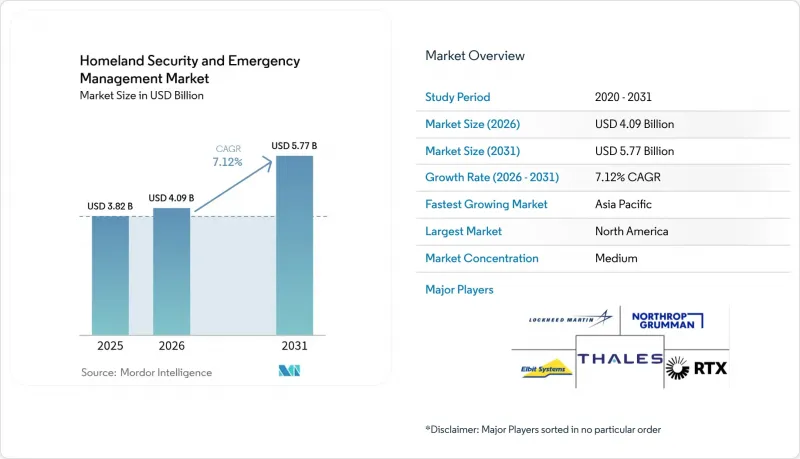
이 보고서는 솔루션 유형(핵심 인프라 보안 등), 기술(AI 및 기계학습 등), 최종 용도 산업(군사·방위 등), 지역(북미, 유럽 등)별로 분류되어 있습니다. 시장 전망은 금액(달러) 기준으로 제시되어 있습니다.
전 세계 국토 안보 및 비상사태 관리 시장의 동향과 인사이트
핵심 인프라를 겨냥한 국가 주도의 사이버 공격 심화
국가 주도의 그룹은 정보 수집에서 전력망, 항만, 상수도 시스템 내에 휴면 상태의 악성코드를 심는 방식으로 전환하고 있습니다. FBI는 ‘Volt Typhoon’이 5년 이상 미국 교통망에 대한 비밀 접근 권한을 유지해 왔으며, 분쟁 발생시 파괴적인 행동을 취할 가능성이 있었다고 밝혔습니다. 이에 따라 사업자들은 모든 기기와 사용자를 지속적으로 검증하는 제로 트러스트 모델을 채택하고, 경계 중심의 방어 체계를 단계적으로 폐지하고 있습니다. 전력 사업자들은 운영 기술(OT) 네트워크를 세분화하고 있으며, 공항에서는 행동 분석을 활용하여 의심스러운 횡방향 이동을 탐지하고 있습니다. 이러한 대책으로 인해 사이버 보안 지출은 ID 관리, 암호화된 산업용 프로토콜 및 지속적인 네트워크 모니터링으로 전환되고 있습니다. 랜섬웨어가 지정학적 동기에 의한 파괴 활동과 겹치면서 보험료가 상승하고 있으며, 이로 인해 ‘무대응으로 인한 총비용’이 증가함에 따라 추가적인 보안 대책 도입이 촉진되고 있습니다.
NG911/EU-112 공공 경보 시스템의 필수 준수 기한
미국 및 유럽연합(EU)의 규제 일정에 따르면 차세대 긴급 통화 라우팅, 3미터 이내의 위치 정확도, 그리고 지휘관과 최초 대응자 간의 멀티미디어 통신이 의무화되어 있습니다. 규정 준수 프로젝트에는 클라우드 기반 통화 처리, 이중화된 광섬유 백본, 그리고 NIST 및 ETSI 표준을 준수하는 사이버 보안 인증이 필요합니다. 이미 업그레이드를 완료한 카운티에서는 통화 끊김률이 감소하고, 다수의 부상자가 발생하는 사건의 분류가 신속해지고 있다고 보고되고 있습니다. IP 코어 서비스, 지리 공간 분석, 사이버 보안 조치가 적용된 무선 게이트웨이를 제공하는 벤더는 직접적인 혜택을 받는 한편, 시스템 통합사업자는 장기 유지보수 계약을 확보하고 있습니다. 공공 경보 시스템은 민간 통신 네트워크와 연동되어야 하므로 국경을 초월한 표준이 엄격해지고 있으며, 대륙 간 플랫폼 통합이 가속화되고 있습니다.
분산된 여러 관할 구역에 걸친 조달
비상 대응 기관은 종종 서로 다른 보조금 프로그램 하에서 무전기, 센서, 분석 플랫폼을 구매하고 있으며, 호환되지 않는 데이터 스키마가 발생하고 상호 원조를 저해하고 있습니다. 미국 정부감사원(GAO)은 중복되는 국토안보 관련 계약을 제거함으로써 수억 달러를 절감할 수 있을 것으로 추정하고 있습니다. 유사한 과제가 유럽에서도 드러나고 있으며, 지방 자치 단체의 감시 소프트웨어가 국가 국경 관리 시스템과의 통합에 어려움을 겪는 경우가 있습니다. 공급업체는 독자적인 형식 간 변환을 수행하는 미들웨어를 제공해야 하지만, 이러한 추가 엔지니어링 비용이 도입 일정을 지연시키고 프로젝트 총 비용을 증가시켜 단기적인 성장을 둔화시키고 있습니다.
부문 분석
2025년에는 중요 인프라 보안이 가장 큰 매출 점유율을 차지하며, 전력, 상수도, 교통 인프라의 회복력에 대한 우려가 커지고 있음을 여실히 드러내고 있습니다. 이 부문이 국토 안보 및 비상 관리 시장에서 차지하는 21.15%의 점유율은 철도 신호 시스템 및 파이프라인 감시 네트워크에 대한 공격 시도가 공개된 데 따른 결과로 확대되었습니다. 이에 대응하여 공공사업자들은 감시 제어 및 데이터 수집(SCADA) 트래픽의 세분화, 변전소에 침입 탐지 시스템 도입, 연방 퓨전 센터와 사고 대응 매뉴얼을 통합하는 등의 조치를 취했습니다. 이 부문의 국토 안보 및 비상 사태 관리 시장 규모는 지속적인 보조금 배분, 사이버 사고 보고 의무화, 그리고 예측 정비를 가능하게 하는 디지털 트윈 도입에 힘입어 꾸준히 확대될 것으로 예상됩니다.
절대값은 작지만, 해상 및 항만 보안 시장은 2031년까지 연평균 성장률(CAGR) 8.05%로 성장할 것으로 예측됩니다. 이는 해상 무역로의 전략적 가치, NATO의 ‘발틱 센트리(Baltic Sentinel)’ 드론 함대, 그리고 신고된 항로를 이탈한 선박을 탐지하는 상용 AI 시스템이 해양 영역 인식에 대한 보다 광범위한 노력을 부각시키고 있음을 반영합니다. 항만에서는 광섬유 케이블 인근의 무단 잠수부를 탐지하기 위해 수상 레이더와 수중 음향 장비를 결합하고 있습니다. 보험사가 파괴 공작의 위험을 보장하기 위해 견고한 감시 체계를 요구하는 가운데, 자율 순찰선 및 AI 기반 위험 평가 대시보드의 도입이 가속화되고 있습니다. 그 밖의 성장 요인으로는 새로운 배출량 추적 센서가 필요한 탈탄소화 의무화가 꼽히며, 이로 인해 국토 안보 및 비상 사태 관리 시장에서 솔루션의 범위가 더욱 확대되고 있습니다.
다른 솔루션 분야인 CBRNE(화학·생물·방사성 물질·핵·폭발물) 탐지, 주변 경비, 항공 보안 및 위험·비상 대응 서비스는 위협의 모든 영역에 걸쳐 중복성을 높이고 있습니다. 그 점유율은 변동적이지만, 통합된 지휘통제 플랫폼을 통해 각 기관은 모든 하위 시스템의 경보를 단일 화면에서 시각화할 수 있으며, 사고 대응 조정이 간소화됩니다.
지역별 분석
북미는 2025년에 36.45%의 점유율로 1위를 차지했습니다. 이는 중요 인프라 방어에 대한 연방 정부의 견실한 예산 배정과 정부 기관 및 민간 사업자 간의 광범위한 협력에 힘입은 결과입니다. 로스앤젤레스 항구는 2024년에 7억 5,000만 건의 해킹 공격을 차단했으며, 이는 이러한 공격의 규모가 조달 우선순위를 좌우하고 있음을 보여줍니다. 제로 트러스트 도입률은 다른 지역을 상회하고 있으며, ‘인프라 투자 및 고용법(IIJA)’ 등의 보조금 체계를 통해 회복력 강화를 위한 자금이 투입되고 있습니다.
아시아태평양은 성장의 원동력이며, 연평균 성장률(CAGR) 8.79%로 확대되고 있습니다. 급속한 도시화와 메가시티에 대한 투자가 AI를 활용한 감시 시스템, 스마트 대피 경로, 내결함성이 높은 통신 백본의 도입에 유리한 조건을 제공하고 있습니다. 2024년 노토 반도 지진은 센서 커버리지의 미비점을 드러내며 통합 경보 플랫폼의 긴급 조달을 촉진했습니다. 한편, 대만과 한국에서 증가하는 반도체 제조 공장에서는 엄격한 보안 경계와 에어갭 방식의 사이버 방어가 요구되고 있으며, 지역 전체의 지출을 끌어올리고 있습니다.
유럽은 엄격한 규제 요건과 공동 국경 관리 구상을 통해 여전히 큰 존재감을 유지하고 있습니다. 베이루트 라피크 하릴리 국제공항의 생체인식 시스템 업그레이드 등의 프로젝트는 유럽의 기준이 대륙 밖으로까지 수출되고 있음을 보여줍니다. EU 내부 안보 기금의 자금 지원이 국경을 초월한 데이터 공유 허브를 지원하고 있습니다.
중동에서는 석유 수입을 공항, 에너지 시설, 공공 시설의 다층적 방어 시스템에 지속적으로 투자하고 있습니다. 아프리카와 라틴아메리카에서는 진전이 완만하지만, 허리케인이나 사이클론의 피해를 입기 쉬운 연안 도시에서 해상 방어 능력과 재난 대응 능력을 우선적으로 강화하고 있습니다.
기타 혜택:
- 엑셀 형식의 시장 예측(ME) 시트
- 3개월간의 애널리스트 지원
자주 묻는 질문
목차
제1장 서론
제2장 조사 방법
제3장 개요
제4장 시장 구도
제5장 시장 규모와 성장 예측
제6장 경쟁 구도
제7장 시장 기회와 향후 전망
KSA 26.09.04According to Mordor Intelligence, the homeland security and emergency management market size in 2026 is estimated at USD 4.09 billion, growing from 2025 value of USD 3.82 billion with 2031 projections showing USD 5.77 billion, growing at 7.12% CAGR over 2026-2031.
This report is Segmented by Solution Type (Critical Infrastructure Security, and More), Technology (AI and Machine Learning, and More), End-Use Vertical (Military and Defense, and More), and Geography (North America, Europe, and More). The Market Forecasts are Provided in Terms of Value (USD).
Global Homeland Security And Emergency Management Market Trends and Insights
Escalating State-Sponsored Cyberattacks on Critical Infrastructure
Nation-state groups have shifted from intelligence gathering to the placement of dormant malware within electric grids, ports, and water systems. The FBI disclosed that Volt Typhoon maintained covert access to US transport networks for over five years and could launch disruptive actions during conflict events. Operators are therefore retiring perimeter-centric defenses in favor of zero-trust models that continuously validate every device and user. Energy utilities segment operational-technology networks, while airports apply behavioral analytics to spot suspicious lateral movement. These measures have pushed cybersecurity spending toward identity management, encrypted industrial protocols, and continuous network monitoring. As ransomware overlaps with geopolitically motivated sabotage, insurance premiums have risen, elevating the total cost of inaction and spurring additional safeguards.
Mandatory NG911 / EU-112 Public Warning System Compliance Deadlines
Regulatory calendars in the United States and European Union mandate next-generation emergency call routing, location precision under three meters, and multimedia exchange between dispatchers and first responders. Compliance projects require cloud-based call handling, redundant fiber backbones, and cybersecurity certification aligned with NIST and ETSI standards. Counties already upgraded report lower call abandonment rates and faster triage of multi-casualty events. Vendors supplying IP core services, geospatial analytics, and cyber-hardened radio gateways benefit directly, while system integrators capture extended maintenance contracts. Because public warning systems must interface with private telecom networks, cross-border standards are tightening, accelerating platform convergence across continents.
Fragmented Multi-Jurisdiction Procurement
Emergency agencies often buy radios, sensors, and analytics platforms under separate grant programs, creating incompatible data schemas obstructing mutual aid. The US Government Accountability Office estimates that eliminating duplicated homeland security contracts could save hundreds of millions. Parallel challenges surface in Europe, where municipal surveillance software can struggle to integrate with national border systems. Vendors must provide middleware that translates between proprietary formats, but the additional engineering cost slows rollout schedules and increases total project price, tempering near-term growth.
Other drivers and restraints analyzed in the detailed report include:
- AI-Enabled Video Analytics Roll-outs in GCC and Asian Megacities
- 5G Private Network Adoption Inside Military Bases
- Litigation and Moratoria on Facial-Recognition Surveillance
For complete list of drivers and restraints, kindly check the Table Of Contents.
Segment Analysis
Critical infrastructure security generated the largest revenue slice in 2025, underscoring heightened concern over the resilience of electricity, water, and transportation assets. The segment's 21.15% homeland security and emergency management market share arose after publicized attempts to compromise rail signaling and pipeline monitoring networks. Utilities responded by segmenting supervisory control and data acquisition (SCADA) traffic, deploying intrusion detection at substations, and integrating incident-response playbooks with federal fusion centers. This segment's homeland security and emergency management market size is forecast to rise steadily on continued grant allocations, mandatory cyber incident reporting rules, and the incorporation of digital twins that enable predictive maintenance.
Although smaller in absolute terms, maritime and port security are projected to expand at 8.05% CAGR through 2031, reflecting the strategic value of seaborne trade lanes, NATO's Baltic Sentry drone flotilla, and commercial AI systems that flag vessels deviating from declared routes highlight a broader commitment to maritime domain awareness. Ports pair surface radars with underwater acoustics to detect unauthorized divers near fiber cables. As insurance underwriters demand robust monitoring to cover sabotage risks, procurement of autonomous patrol boats and AI-scored risk dashboards accelerates. Additional growth drivers include decarbonization mandates that require new emission-tracking sensors, further widening the solution scope within the homeland security and emergency management market.
Other solution lines, CBRNE detection, perimeter protection, aviation security, and risk and emergency services, add redundancy across the threat spectrum. While their share fluctuates, integrated command-and-control platforms allow agencies to visualize alerts from all subsystems in a single pane, simplifying incident orchestration.
Complete Report Scope:
- By Solution Type
- Critical Infrastructure Security
- CBRNE Detection and Protection
- Perimeter and Physical Security
- Cybersecurity
- Border Security and Immigration Control
- Maritime and Port Security
- Aviation Security
- Risk and Emergency Services
- By Technology
- AI and Machine Learning
- IoT and Smart Sensors
- Big-Data Analytics
- 5G and Secure Communications
- Cloud Security Platforms
- Biometric Identification
- By End-Use Vertical
- Government and Public Sector
- Critical Infrastructure (Energy, Utilities)
- Military and Defense
- Transportation (Aviation, Maritime, Rail)
- Commercial and Industrial Facilities
- Healthcare and Emergency Medical Services
- By Geography
- North America
- United States
- Canada
- Mexico
- Europe
- United Kingdom
- France
- Germany
- Italy
- Rest of Europe
- Asia-Pacific
- China
- India
- Japan
- South Korea
- Rest of Asia-Pacific
- South America
- Brazil
- Argentina
- Rest of South America
- Middle East and Africa
- Middle East
- Saudi Arabia
- United Arab Emirates
- Israel
- Rest of Middle East
- Africa
- South Africa
- Egypt
- Rest of Africa
- Middle East
- North America
Geography Analysis
North America led with a 36.45% share in 2025, supported by robust federal appropriations for critical-infrastructure defense and extensive collaboration between agencies and private operators. The Port of Los Angeles blocked 750 million hacking attempts in 2024, illustrating the attack volume shaping purchasing priorities. Zero-trust adoption rates outpace other regions, and grant frameworks such as the Infrastructure Investment and Jobs Act funnel funds toward resilience upgrades.
Asia-Pacific is the growth engine, expanding at 8.79% CAGR. Rapid urbanization and megacity investments create fertile ground for AI-enabled surveillance, smart evacuation corridors, and resilient telecom backbones. The 2024 Noto Peninsula earthquake exposed gaps in sensor coverage and spurred fast-track procurement of integrated warning platforms. Meanwhile, rising semiconductor fabs across Taiwan and South Korea require strict security perimeters and air-gap cyber defenses, intensifying regional spend.
Europe maintains a sizeable position through stringent regulatory mandates and joint border-management initiatives. Projects such as the biometric upgrade at Beirut-Rafic Hariri International Airport demonstrate the export of European standards beyond the continent. Funding from the EU Internal Security Fund underpins cross-border data-sharing hubs.
The Middle East continues to direct oil revenues toward layered airport, energy-facility, and public-venue protection systems. Africa and Latin America advance more slowly but prioritize maritime and disaster-response capabilities in coastal cities prone to hurricanes and cyclones.
- Lockheed Martin Corporation
- Northrop Grumman Corporation
- RTX Corporation
- General Dynamics Information Technology, Inc. (General Dynamics Corporation)
- Thales Group
- International Business Machines Corporation (IBM)
- Honeywell International, Inc.
- BAE Systems plc
- Elbit Systems Ltd.
- Cisco Systems, Inc.
- Airbus SE
- Leonardo S.p.A.
- Booz Allen Hamilton, Inc.
- Palantir Technologies Inc.
- Fortinet, Inc.
- Esri Global, Inc.
- MOOG Inc.
- AT&T Inc.
- Accenture plc
Additional Benefits:
- The market estimate (ME) sheet in Excel format
- 3 months of analyst support
TABLE OF CONTENTS
1 INTRODUCTION
- 1.1 Study Assumptions and Market Definition
- 1.2 Scope of the Study
2 RESEARCH METHODOLOGY
3 EXECUTIVE SUMMARY
4 MARKET LANDSCAPE
- 4.1 Market Overview
- 4.2 Market Drivers
- 4.2.1 Escalating state-sponsored cyberattacks on critical infrastructure globally
- 4.2.2 Mandatory NG911 / EU-112 public warning system compliance deadlines
- 4.2.3 AI-enabled video analytics roll-outs in GCC and Asian megacity/smart-city projects
- 4.2.4 5G private network adoption inside military bases elevating cutting edge-security demand
- 4.2.5 Maritime chokepoint disruptions boosting integrated maritime domain awareness spend
- 4.2.6 Climate-driven severe weather events driving mobile emergency operation centers
- 4.3 Market Restraints
- 4.3.1 Fragmented multi-jurisdiction procurement slowing platform standardization
- 4.3.2 Litigation and moratoria on facial-recognition surveillance in EU and US cities
- 4.3.3 Cyber-talent shortages creating greater than 20% vacancies in government SOCs
- 4.3.4 Emerging-economy budget reallocations away from capital-intensive CBRNE systems
- 4.4 Value Chain Analysis
- 4.5 Regulatory Outlook
- 4.6 Technological Outlook
- 4.7 Porter's Five Forces Analysis
- 4.7.1 Bargaining Power of Buyers/Consumers
- 4.7.2 Bargaining Power of Suppliers
- 4.7.3 Threat of New Entrants
- 4.7.4 Threat of Substitute Products
- 4.7.5 Intensity of Competitive Rivalry
5 MARKET SIZE AND GROWTH FORECASTS (VALUE)
- 5.1 By Solution Type
- 5.1.1 Critical Infrastructure Security
- 5.1.2 CBRNE Detection and Protection
- 5.1.3 Perimeter and Physical Security
- 5.1.4 Cybersecurity
- 5.1.5 Border Security and Immigration Control
- 5.1.6 Maritime and Port Security
- 5.1.7 Aviation Security
- 5.1.8 Risk and Emergency Services
- 5.2 By Technology
- 5.2.1 AI and Machine Learning
- 5.2.2 IoT and Smart Sensors
- 5.2.3 Big-Data Analytics
- 5.2.4 5G and Secure Communications
- 5.2.5 Cloud Security Platforms
- 5.2.6 Biometric Identification
- 5.3 By End-Use Vertical
- 5.3.1 Government and Public Sector
- 5.3.2 Critical Infrastructure (Energy, Utilities)
- 5.3.3 Military and Defense
- 5.3.4 Transportation (Aviation, Maritime, Rail)
- 5.3.5 Commercial and Industrial Facilities
- 5.3.6 Healthcare and Emergency Medical Services
- 5.4 By Geography
- 5.4.1 North America
- 5.4.1.1 United States
- 5.4.1.2 Canada
- 5.4.1.3 Mexico
- 5.4.2 Europe
- 5.4.2.1 United Kingdom
- 5.4.2.2 France
- 5.4.2.3 Germany
- 5.4.2.4 Italy
- 5.4.2.5 Rest of Europe
- 5.4.3 Asia-Pacific
- 5.4.3.1 China
- 5.4.3.2 India
- 5.4.3.3 Japan
- 5.4.3.4 South Korea
- 5.4.3.5 Rest of Asia-Pacific
- 5.4.4 South America
- 5.4.4.1 Brazil
- 5.4.4.2 Argentina
- 5.4.4.3 Rest of South America
- 5.4.5 Middle East and Africa
- 5.4.5.1 Middle East
- 5.4.5.1.1 Saudi Arabia
- 5.4.5.1.2 United Arab Emirates
- 5.4.5.1.3 Israel
- 5.4.5.1.4 Rest of Middle East
- 5.4.5.2 Africa
- 5.4.5.2.1 South Africa
- 5.4.5.2.2 Egypt
- 5.4.5.2.3 Rest of Africa
- 5.4.5.1 Middle East
- 5.4.1 North America
6 COMPETITIVE LANDSCAPE
- 6.1 Market Concentration
- 6.2 Strategic Moves
- 6.3 Market Share Analysis
- 6.4 Company Profiles (includes Global-level Overview, Market-level Overview, Core Segments, Financials as available, Strategic Information, Market Rank/Share, Products and Services, Recent Developments)
- 6.4.1 Lockheed Martin Corporation
- 6.4.2 Northrop Grumman Corporation
- 6.4.3 RTX Corporation
- 6.4.4 General Dynamics Information Technology, Inc. (General Dynamics Corporation)
- 6.4.5 Thales Group
- 6.4.6 International Business Machines Corporation (IBM)
- 6.4.7 Honeywell International, Inc.
- 6.4.8 BAE Systems plc
- 6.4.9 Elbit Systems Ltd.
- 6.4.10 Cisco Systems, Inc.
- 6.4.11 Airbus SE
- 6.4.12 Leonardo S.p.A.
- 6.4.13 Booz Allen Hamilton, Inc.
- 6.4.14 Palantir Technologies Inc.
- 6.4.15 Fortinet, Inc.
- 6.4.16 Esri Global, Inc.
- 6.4.17 MOOG Inc.
- 6.4.18 AT&T Inc.
- 6.4.19 Accenture plc
7 MARKET OPPORTUNITIES AND FUTURE OUTLOOK
- 7.1 White-Space and Unmet-Need Assessment


