

|
시장보고서
상품코드
2122236
두개 악안면 고정 디바이스 : 시장 점유율 분석, 업계 동향과 통계, 성장 예측(2026-2031년)Craniomaxillofacial Fixation Devices - Market Share Analysis, Industry Trends & Statistics, Growth Forecasts (2026 - 2031) |
||||||
 Mordor Intelligence
Mordor Intelligence에 따르면 두개 악안면 고정 디바이스 시장 규모는 2025년에 19억 7,000만 달러로 평가되며, 2026년 20억 8,000만 달러에서 2031년까지 26억 9,000만 달러에 달할 것으로 예측되고 있으며, 예측 기간(2026-2031년)에 CAGR은 5.35%에 달할 전망입니다.
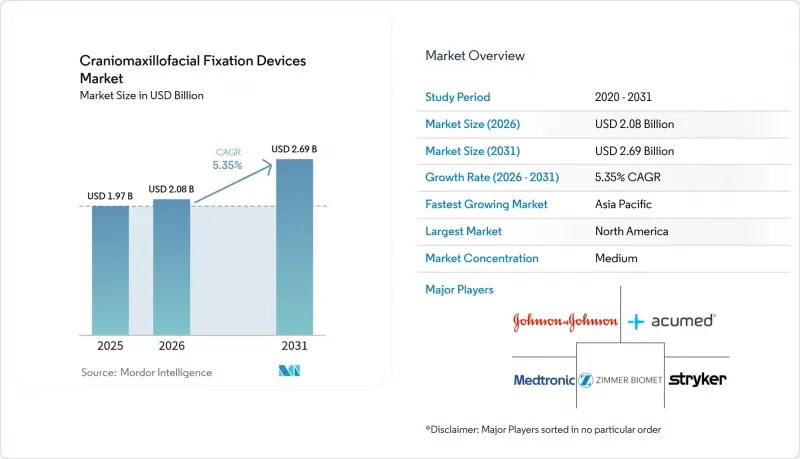
이 보고서는 방식별(두개골 피판 고정, CMF 견인, 턱관절 치환 등), 소재별(티타늄 및 티타늄 합금 등), 용도별(신경외과 및 이비인후과 등), 지역별(북미, 유럽, 아시아태평양, 중동 및 아프리카, 남미)로 분류되어 있습니다. 시장 전망은 금액(달러) 기준으로 제시되어 있습니다.
전 세계 두개악안면 고정 장치 시장의 동향 및 인사이트
두개안면 외상 발생률 증가
도시화, 도로 교통량 증가, 접촉 스포츠 참여로 인해 안면 외상의 발생률은 계속 증가하고 있으며, 하악골 골절이 고정 플레이트의 가장 빈번한 적응증이 되고 있습니다. 선진국의 고령화에 따라 낙상으로 인한 외상이 증가하는 한편, 다발성 외상 사례에서는 여러 부위의 고정이 필요하므로 단일 구성이 아닌 폭넓은 시스템 라인업이 요구되고 있습니다. 외과의사들은 중안면, 하악, 두개골 복원을 하나의 멸균 트레이로 해결할 수 있는 모듈형 세트를 점점 더 많이 채택하고 있으며, 이로 인해 평균 판매 가격이 상승하고 있습니다. 병원 측은 수술 회전 시간을 단축하는 완벽한 키트를 중시하고 있으며, 이에 따라 나사, 플레이트, 흡수성 재료를 통일된 호환성 보증 하에 묶어 제공할 수 있는 제조사가 우선시되는 추세가 강해지고 있습니다. 이러한 추세로 인해 성숙한 지역에서도 수술 건수의 기준선이 안정적으로 유지되고 있으며, 두개악안면 고정 장치 시장은 의료기기 투자의 주기적인 변동으로부터 보호받고 있습니다.
저침습 수술 기술의 보급 확대
구강내 견인 장치 및 은폐형 상악 견인 장치는 뼈로의 혈류를 유지하면서 눈에 보이는 흉터를 방지함으로써, 소아 및 성인 환자 모두에게 매우 중요한 심미적 치료 결과를 향상시킵니다. CT 데이터로 생성된 래피드 프로토타입 가이드 플레이트는 정밀한 골절술을 가능하게 하여 수술 시간을 단축하는 동시에, 수술 중 영상 진단으로 인한 방사선 피폭을 줄여줍니다. 외과 의사의 자신감이 높아짐에 따라 저침습 프로토콜은 대체 수단이 아닌 첫 번째 선택이 되고 있으며, 더 작은 절개 부위를 통해 삽입 가능한 얇은 플레이트와 저두 나사로의 재설계가 진행되고 있습니다. 장비 제조업체들은 광범위한 노출 없이 설치할 수 있는 인체공학적 기구와 워크플로우를 효율화하는 색상 구분 키트를 통해 차별화를 꾀하고 있습니다. 이러한 변화는 기계적 강도와 콤팩트한 하드웨어를 모두 갖춘 공급업체에게 유리하게 작용합니다.
불리한 환급 및 보험 적용 정책
특정 CPT 코드에 대한 메디케어의 보상 삭감(최대 20%)은 병원의 이익률을 압박하고 있으며, 구매 부서는 건당 임플란트 지출에 상한선을 설정하도록 압박받고 있습니다. 민간 보험사는 광범위한 사전 승인을 요구하고 있으며, 수술이 지연되고, 외과의사는 미적 이점을 넘어서는 기능적 필요성을 문서화해야만 합니다. 단일 지불자 제도에서는 처방약 리스트에서 브랜드의 혁신적인 제품보다 제네릭 제품이 우선시되는 경우가 많아, 뛰어난 치료 성과에도 불구하고 고가의 흡수성 임플란트 채택이 제한되고 있습니다. 이에 대해 제조사 측은 제거 수술을 피함으로써 발생하는 비용 절감을 보여주는 비용-효과성 연구를 발표하고 있지만, 지급 기관은 장기적인 증거를 요구하고 있습니다. 단기적으로는 이러한 제약으로 인해 가치 기반 데이터가 축적될 때까지 두개악안면 고정 장치 시장의 성장은 둔화될 것입니다.
부문 분석
두개악안면 견인 장치는 2031년까지 연평균 성장률(CAGR) 7.25%를 기록할 것으로 예측되며, 이는 두개악안면 고정 장치 시장 전체의 성장률을 크게 상회하는 수치입니다. 이 기법은 현재 기도 폐쇄를 동반한 신생아의 하악 연장술에서 표준 치료법으로 자리 잡고 있으며, 다기관 공동 데이터에 따르면 기관 절개술을 피하는 성공률은 91.3%에 달합니다. MF 플레이트 및 나사 고정은 여전히 주력 제품이며, 외과의들이 익숙한 조작성과 즉각적인 하중 내구성을 신뢰하고 있으며, 2025년에는 47.98%의 시장 점유율을 유지할 것으로 전망됩니다. 수술법 선택은 외과의사의 선호도보다 환자의 연령이나 결손의 복잡성에 따라 결정되는 경향이 강해지고 있으며, 2차 기구 제거가 필요하지 않다는 점에서 생체흡수성 견인 시스템이 소아 분야에서 지지를 얻고 있습니다. 두개악안면 고정 장치 시장내 견인 시스템 시장 규모는 2031년까지 6억 9,600만 달러에 달할 것으로 예측되며, 이는 두개골 피판 전용 세트와의 수익 격차가 확대될 것임을 시사합니다.
외과의사들 사이에서는 견인과 내비게이션 가이드를 결합한 하이브리드 솔루션에 대한 수요가 증가하고 있으며, 이에 따라 나사식 견인기와 환자별로 사전에 굽혀진 가이드를 통합하는 기업에게 비즈니스 기회가 생기고 있습니다. 핀 삽입 부위의 감염을 방지하는 내부 시스템이 외부 장치를 대체하고 있으며, 의료진 사이에서 수술에 대한 수용성이 더욱 높아지고 있습니다. 한편, 턱관절 치환술은 맞춤형 인공관절 구성 요소에 힘입어 꾸준히 성장하고 있지만, 두개악안면 고정 장치 시장 전체에서 차지하는 점유율은 여전히 미미한 수준입니다. 보험사 측이 장기적인 기도 확보 및 안면 대칭성 개선과 같은 이점을 인정함에 따라 도입 장벽이 낮아지고, 이 부문의 호조세가 더욱 강화되고 있습니다.
지역별 분석
북미는 보전 제도가 잘 갖춰진 외상 치료와 소아 두개안면 질환에 대한 높은 인지도에 힘입어 2025년 전 세계 매출의 40.02%를 차지했습니다. 수술 건수의 증가세는 인구 증가와 거의 비슷한 수준으로 정체되어 있지만, 흡수성 임플란트 및 환자 맞춤형 임플란트의 급속한 보급으로 인해 평균 판매 가격(ASP)은 세계 최고 수준을 유지하고 있습니다. 유럽은 완만하지만 안정적인 성장을 이어가고 있습니다. 엄격한 의료기기 규정(MDR)에 따른 문서화 요건이 시장 진입 비용을 끌어올리며, 성숙한 임상 근거를 보유한 기존 기업에 경쟁 우위가 쏠리고 있습니다. 이 지역의 병원에서는 환경 영향 평가서 제출을 요구하는 사례가 늘어나고 있으며, 재활용 가능한 수술 기구 트레이의 조기 시범 도입이 진행되고 있습니다.
아시아태평양은 중국의 3급 외상 센터 급속한 확충과 인도의 의료 보험 적용 범위 확대에 힘입어 연평균 성장률(CAGR) 6.21%로 가장 큰 성장세를 보이고 있습니다. 표준 외상용 플레이트의 경우 국내 기업이 시장 점유율을 확대하고 있지만, 고난도 소아 사례에서는 수입 생체흡수성 임플란트가 주류를 이루고 있습니다. 각국 정부는 국내 3D 프린팅 활동을 장려하고 있지만, 외과의사들은 복잡한 재건 수술에서 여전히 미국이나 독일산 계획용 소프트웨어에 의존하고 있으며, 국경을 초월한 공급망이 유지되고 있습니다. 현재의 판매 추세가 지속된다면, 2028년까지 아시아태평양의 두개악안면 고정 장치 시장 규모는 유럽을 추월할 가능성이 있습니다.
라틴아메리카 및 중동 및 아프리카는 의료 관광의 거점으로 자리매김한 민간 병원 체인의 견인 아래 소규모 기반에서 성장하고 있습니다. 그러나 환율 변동으로 인해 고액의 설비 투자가 억제되고 있으며, 완전 소유보다는 위탁 재고가 선호되고 있습니다. 공급업체는 이러한 지역에 진출하기 위해 환자별 임플란트에 대한 종량제 요금제 등 유연한 지불 모델을 제공해야 합니다. 전반적으로 지역적 분산화를 통해 성숙 시장에서 발생하는 보험 급여 삭감의 영향을 완화할 수 있습니다.
기타 혜택:
- 엑셀 형식의 시장 예측(ME) 시트
- 3개월간의 애널리스트 지원
자주 묻는 질문
목차
제1장 서론
제2장 조사 방법
제3장 개요
제4장 시장 구도
제5장 시장 규모와 성장 예측
제6장 경쟁 구도
제7장 시장 기회와 향후 전망
KSA 26.09.04According to Mordor Intelligence, the craniomaxillofacial fixation devices market size was valued at USD 1.97 billion in 2025 and estimated to grow from USD 2.08 billion in 2026 to reach USD 2.69 billion by 2031, at a CAGR of 5.35% during the forecast period (2026-2031).
This report is Segmented by Technique (Cranial Flap Fixation, CMF Distraction, TMJ Replacement, and More), Material (Titanium & Titanium Alloys, and More), Application (Neurosurgery & ENT, and More), and Geography (North America, Europe, Asia-Pacific, Middle East & Africa, South America). The Market Forecasts are Provided in Terms of Value (USD).
Global Craniomaxillofacial Fixation Devices Market Trends and Insights
Increasing Incidence of Craniofacial Trauma
Urbanization, higher road traffic density and contact-sport participation continue to elevate facial injury rates, making mandibular fractures the most frequent indication for fixation plates. Aging in developed economies adds fall-related injuries, while polytrauma cases demand multi-site fixation, thus requiring broad system portfolios rather than single configurations. Surgeons increasingly adopt modular sets that cover midface, mandible and cranial repairs in one sterile tray, which raises average selling prices. Hospitals value complete kits that shorten turnover time, reinforcing manufacturer preference for players able to bundle screws, plates and resorbables under unified compatibility guarantees. The trend sustains steady baseline procedure volume even in mature regions, protecting the craniomaxillofacial fixation devices market from cyclical capital-equipment swings.
Rising Adoption of Minimally Invasive Surgical Techniques
Intraoral distraction devices and concealed maxillary distractors avoid visible scarring while preserving bone blood supply, improving cosmetic outcomes that matter strongly to pediatric and adult patients alike. Rapid-prototype guide plates generated from CT data enable precise osteotomies, cutting operating room time and reducing radiation exposure from intra-operative imaging. As surgeons gain confidence, minimally invasive protocols become first-line choice rather than alternative, prompting redesigns toward slimmer plate profiles and low-head screws that fit through smaller incisions. Device makers differentiate through ergonomic instrumentation that permits placement without wide exposure, and through color-coded kits that streamline workflow. This shift favors suppliers able to align mechanical strength with smaller footprint hardware.
Unfavorable Reimbursement and Coverage Policies
Medicare fee-cuts of up to 20% on selected CPT codes erode hospital margins, pushing purchasing departments to cap implant spend per procedure. Private insurers request extensive pre-authorization, delaying surgeries and forcing surgeons to document functional necessity beyond aesthetic benefit. In single-payer systems, formularies often prefer generic plates over branded innovations, limiting uptake of premium resorbables despite superior outcomes. Manufacturers respond by publishing cost-utility studies that show savings from avoiding removal surgeries, yet payers demand longitudinal evidence. Near-term, this restraint tempers the craniomaxillofacial fixation devices market growth until value-based data accumulate.
Other drivers and restraints analyzed in the detailed report include:
- Continuous Technological Advancements in Fixation Devices
- Growing Utilization of Patient-Specific and 3D-Printed Implants
- High Procedural Costs and Price Pressure
For complete list of drivers and restraints, kindly check the Table Of Contents.
Segment Analysis
CMF distraction devices are forecast to log a 7.25% CAGR through 2031, well above the overall craniomaxillofacial fixation devices market growth rate. The method is now standard for mandibular lengthening in neonates with airway obstruction, achieving 91.3% success in averting tracheostomy according to multicenter data. MF plate & screw fixation remains the workhorse, holding 47.98% market share in 2025 as surgeons rely on its familiarity and immediate load-bearing strength. Technique selection increasingly turns on patient age and defect complexity rather than surgeon preference, with bio-resorbable distraction systems gaining pediatric favor for eliminating secondary hardware removal. The craniomaxillofacial fixation devices market size for distraction systems is projected to reach USD 696 million by 2031, implying a widening revenue gap over cranial flap-only sets.
Surgeons demand hybrid solutions that pair distraction with navigation guidance, creating opportunities for firms that integrate threaded distractors with pre-bent patient-matched guides. External devices lose ground to internal systems that avoid pin-site infections, furthering procedure acceptance among caregivers. Meanwhile, temporomandibular joint replacement grows steadily, supported by custom alloplastic components but remains a smaller share of the craniomaxillofacial fixation devices market. As payers acknowledge long-term airway and facial symmetry benefits, adoption barriers lessen, reinforcing the segment's outperformance.
Complete Report Scope:
- By Technique
- Cranial Flap Fixation
- CMF Distraction
- Temporomandibular Joint (TMJ) Replacement
- MF Plate & Screw Fixation
- Bio-Resorbable Fixation
- Others
- By Material
- Titanium & Titanium Alloys
- Stainless Steel
- Bio-Resorbable Polymers (PLA, PGA, PDO)
- Bio-Ceramics (Hydroxyapatite, Tricalcium Phosphate)
- Patient-Specific 3-D Printed Composites
- By Application
- Neurosurgery & ENT
- Orthognathic & Dental Surgery
- Plastic & Aesthetic Surgery
- Paediatric Craniosynostosis Repair
- Others
- Geography
- North America
- United States
- Canada
- Mexico
- Europe
- Germany
- United Kingdom
- France
- Italy
- Spain
- Rest of Europe
- Asia-Pacific
- China
- Japan
- India
- Australia
- South Korea
- Rest of Asia-Pacific
- Middle East & Africa
- GCC
- South Africa
- Rest of Middle East & Africa
- South America
- Brazil
- Argentina
- Rest of South America
- North America
Geography Analysis
North America generated 40.02% of global 2025 revenue, anchored by well-reimbursed trauma care and high awareness of pediatric craniofacial conditions. Procedure growth plateaus near population growth, but ASPs remain the highest worldwide thanks to rapid uptake of resorbables and patient-specific implants. Europe follows with subdued but stable expansion; strict MDR documentation raises cost of market entry, tilting competitive balance toward established firms with mature clinical evidence dossiers. Hospitals there increasingly request environmental impact statements, prompting early trials of recyclable instrument trays.
Asia-Pacific exhibits the most momentum at a 6.21% CAGR, led by China's fast build-out of tier-III trauma centers and India's expansion of medical insurance coverage. Domestic companies gain share in standard trauma plates, yet imported bio-resorbables dominate premium pediatric cases. Governments encourage local 3D-printing initiatives, but surgeons still rely on U.S. or German planning software for complex reconstructions, maintaining cross-border supply chains. The craniomaxillofacial fixation devices market size in Asia-Pacific could surpass that of Europe by 2028 if current volume trends hold.
Latin America and the Middle East & Africa grow from a small base, driven mainly by private hospital chains positioning as medical-tourism hubs. Exchange-rate volatility, however, dampens large capital purchases and favors consignment stocking over outright ownership. Vendors must offer flexible payment models such as pay-per-use for patient-specific implants to penetrate these regions. Overall, geographic diversification mitigates exposure to reimbursement cuts in mature markets.
- Stryker
- Johnson & Johnson
- Zimmer Biomet
- Metallos Integra LifeSciences
- Medtronic
- KLS Martin Group
- Medartis
- OsteoMed (Colson Associates)
- B. Braun SE (Aesculap)
- Smith+Nephew Plc
- Acumed
- Orthofix
- MicroPort Scientific Corp.
- Xilloc Medical BV
- Osteopore Ltd.
- Leica Biomaterials AG
- GPC Medical Ltd.
- Cardinal Health (Kanghui CMF)
- Lepu Medical
- HumanTech Surgical
Additional Benefits:
- The market estimate (ME) sheet in Excel format
- 3 months of analyst support
TABLE OF CONTENTS
1 Introduction
- 1.1 Study Assumptions & Market Definition
- 1.2 Scope Of The Study
2 Research Methodology
3 Executive Summary
4 Market Landscape
- 4.1 Market Overview
- 4.2 Market Drivers
- 4.2.1 Increasing Incidence of Craniofacial Trauma
- 4.2.2 Rising Adoption of Minimally Invasive Surgical Techniques
- 4.2.3 Continuous Technological Advancements in Fixation Devices
- 4.2.4 Growing Utilization of Patient-Specific and 3D-Printed Implants
- 4.2.5 Expansion of Healthcare Infrastructure and Procurement Initiatives in Emerging Markets
- 4.2.6 Integration of Navigation and Augmented Reality Systems
- 4.3 Market Restraints
- 4.3.1 Unfavorable Reimbursement and Coverage Policies
- 4.3.2 High Procedural Costs and Price Pressure
- 4.3.3 Stringent Regulatory Compliance and Certification Requirements
- 4.3.4 Limited Access to Specialized CMF Surgeons in Rural Regions
- 4.4 Regulatory Landscape
- 4.5 Porter's Five Forces Analysis
- 4.5.1 Threat Of New Entrants
- 4.5.2 Bargaining Power Of Buyers
- 4.5.3 Bargaining Power Of Suppliers
- 4.5.4 Threat Of Substitutes
- 4.5.5 Competitive Rivalry
5 Market Size & Growth Forecasts (Value, USD)
- 5.1 By Technique
- 5.1.1 Cranial Flap Fixation
- 5.1.2 CMF Distraction
- 5.1.3 Temporomandibular Joint (TMJ) Replacement
- 5.1.4 MF Plate & Screw Fixation
- 5.1.5 Bio-Resorbable Fixation
- 5.1.6 Others
- 5.2 By Material
- 5.2.1 Titanium & Titanium Alloys
- 5.2.2 Stainless Steel
- 5.2.3 Bio-Resorbable Polymers (PLA, PGA, PDO)
- 5.2.4 Bio-Ceramics (Hydroxyapatite, Tricalcium Phosphate)
- 5.2.5 Patient-Specific 3-D Printed Composites
- 5.3 By Application
- 5.3.1 Neurosurgery & ENT
- 5.3.2 Orthognathic & Dental Surgery
- 5.3.3 Plastic & Aesthetic Surgery
- 5.3.4 Paediatric Craniosynostosis Repair
- 5.3.5 Others
- 5.4 Geography
- 5.4.1 North America
- 5.4.1.1 United States
- 5.4.1.2 Canada
- 5.4.1.3 Mexico
- 5.4.2 Europe
- 5.4.2.1 Germany
- 5.4.2.2 United Kingdom
- 5.4.2.3 France
- 5.4.2.4 Italy
- 5.4.2.5 Spain
- 5.4.2.6 Rest of Europe
- 5.4.3 Asia-Pacific
- 5.4.3.1 China
- 5.4.3.2 Japan
- 5.4.3.3 India
- 5.4.3.4 Australia
- 5.4.3.5 South Korea
- 5.4.3.6 Rest of Asia-Pacific
- 5.4.4 Middle East & Africa
- 5.4.4.1 GCC
- 5.4.4.2 South Africa
- 5.4.4.3 Rest of Middle East & Africa
- 5.4.5 South America
- 5.4.5.1 Brazil
- 5.4.5.2 Argentina
- 5.4.5.3 Rest of South America
- 5.4.1 North America
6 Competitive Landscape
- 6.1 Market Concentration
- 6.2 Market Share Analysis
- 6.3 Company Profiles (includes Global level Overview, Market level overview, Core Business Segments, Financials, Headcount, Key Information, Market Rank, Market Share, Products and Services, and analysis of Recent Developments)
- 6.3.1 Stryker Corporation
- 6.3.2 Johnson and Johnson
- 6.3.3 Zimmer Biomet Holdings Inc.
- 6.3.4 Metallos Integra LifeSciences
- 6.3.5 Medtronic Plc
- 6.3.6 KLS Martin Group
- 6.3.7 Medartis AG
- 6.3.8 OsteoMed (Colson Associates)
- 6.3.9 B. Braun SE (Aesculap)
- 6.3.10 Smith+Nephew Plc
- 6.3.11 Acumed LLC
- 6.3.12 Orthofix Medical Inc.
- 6.3.13 MicroPort Scientific Corp.
- 6.3.14 Xilloc Medical BV
- 6.3.15 Osteopore Ltd.
- 6.3.16 Leica Biomaterials AG
- 6.3.17 GPC Medical Ltd.
- 6.3.18 Cardinal Health (Kanghui CMF)
- 6.3.19 Lepu Medical Technology
- 6.3.20 HumanTech Surgical
7 Market Opportunities & Future Outlook
- 7.1 White-Space & Unmet-Need Assessment


