|
시장보고서
상품코드
2122238
척추고정술용 기기 : 시장 점유율 분석, 업계 동향과 통계, 성장 예측(2026-2031년)Global Spinal Fusion Devices - Market Share Analysis, Industry Trends & Statistics, Growth Forecasts (2026 - 2031) |
||||||
 Mordor Intelligence
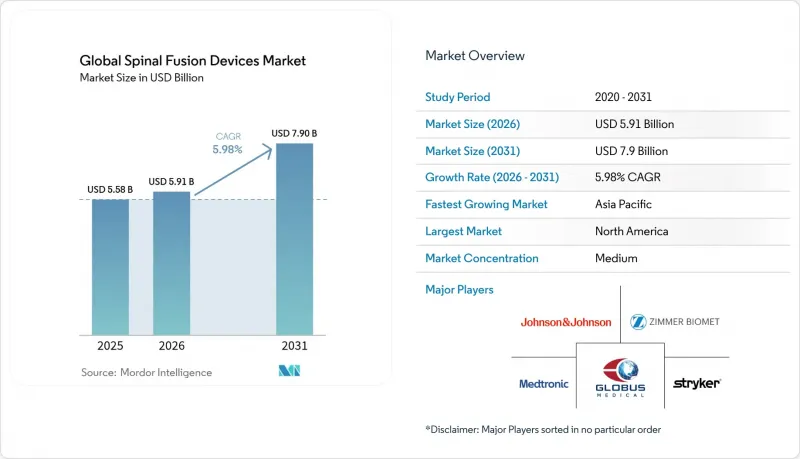
Mordor Intelligence에 따르면 2026년 척추고정술용 기기 시장 규모는 59억 1,000만 달러로 추정되고 있으며, 2025년 55억 8,000만 달러에서 확대하며, 2031년에는 79억 달러에 달할 것으로 예측됩니다.
2026-2031년까지 연평균 성장률(CAGR) 5.98%로 성장할 것으로 전망됩니다.
이 보고서는 제품 유형(경추 고정용 기기, 흉추 고정용 기기 등), 수술 유형(개복 척추 수술 및 최소 침습 척추 수술), 수술 접근법(TLIF, PLF, 기타 접근법), 최종사용자(병원 등), 지역(북미, 유럽,아시아태평양 등)별로 분류되어 있습니다. 시장 전망은 금액(달러) 기준으로 제시되어 있습니다.
전 세계 척추고정술용 기기 시장의 동향 및 인사이트
저침습 고정술로의 전환
저침습 척추 수술은 동등한 유합 성공률을 유지하면서 입원 기간 단축, 절개 부위 축소, 합병증 발생률 감소를 실현함으로써, 오랫동안 이어져 온 개방 수술의 상식을 뒤집고 있습니다. 경추간공 요추 체간 고정술에 관한 메타분석에 따르면 수혈 필요성이 적고 합병증 발생률은 4.83%인 반면, 개방 수술에서는 14.97%에 달합니다. 로봇 내비게이션을 통해 스크류 삽입 정확도는 96%를 초과하며, 이에 따라 의료기기 제조사들은 임플란트, 내비게이션, 수술 중 영상 진단을 세트로 판매하고 있습니다. 펠로우십 프로그램에서는 현재 이러한 기술이 우선시되고 있으며, 로봇 보조 워크플로우에 정통한 외과의사 양성이 확실히 이루어지고 있습니다. 또한 병원 측에서도 환자의 빠른 회복을 활용하여 병상 회전율을 향상시키고, 임상 성과를 가치 기반 구매(VBP)와 직접 연계하고 있습니다.
척추 퇴행성 질환 유병률의 급증
앉아 있는 생활 습관, 비만, 그리고 진단 기술의 정교화로 인해 60세 이상 인구의 요추 추간판 퇴행 유병률은 90% 이상으로 상승했습니다. 조기 영상 진단을 통해 적시에 외과적 치료로 의뢰할 수 있게 되어, 다중 추간 병변으로의 진행을 미연에 방지할 수 있습니다. 의료 경제 분석에 따르면 조기 척추 고정술이 만성 통증과 관련된 의료비를 절감한다는 사실이 입증되었으며, 보험사들도 이에 따라 보험 적용 범위를 확대하고 있습니다. 임상 레지스트리에 따르면 조기 단일 추간 요추 고정술은 재수술 빈도를 낮추고, 질 조정 생존년(QALY)을 향상시키는 것으로 확인되었습니다. 이에 따라 의료기기 제조사들은 단일 추간 병변에 최적화된 확장형 케이지 및 바이오소재 제품 라인업을 확충하고 있습니다.
높은 임플란트 비용 대비 가치를 기반으로 한 의료 지불 모델
일괄 지급 제도의 시범 사업에서는 치료 과정 전체 비용에 상한선이 설정되어 있으며, 의료 제공자는 임플란트의 성능과 가격을 저울질할 수밖에 없습니다. 경추 고정술의 수술 중 비용은 7,574달러에 달하며, 그 중 69%가 임플란트 관련 비용입니다. 병원들은 대량 계약을 재협상하고, 재수술 위험을 최소화하는 플랫폼을 우선시하고 있습니다. 각 제조사는 현재 고가 책정을 정당화하기 위해 QALY(질 조정 생존년)당 비용이 10만 달러 미만임을 보여주는 증거 자료를 제시하고 있습니다. 가치를 명확히 설명하지 못하는 기업은 척추고정술용 기기 시장에서의 점유율 축소 위험에 직면해 있습니다.
부문 분석
요추 고정용 기기는 2025년 척추고정술용 기기 시장 점유율의 43.02%를 차지하며, 척추 전방 전위증 및 추간판 퇴행증에 대한 주력 솔루션으로서의 입지를 공고히 하고 있습니다. 척추고정술용 기기 시장 규모는 입원 환자 및 외래 환자 양쪽 채널에서 수요가 지속되고 있으며, 연평균 성장률(CAGR) 5.6%로 확대될 것으로 예측됩니다. 특히 인터바디 케이지는 3D 프린팅된 티타늄 격자 구조를 통해 97%의 고정 성공률을 달성하고 있으며, 6.79%라는 높은 성장률을 보이고 있습니다. 외과의사들은 과도한 신경 견인을 유발하지 않으면서 추간판의 높이와 시상면 균형을 회복시켜 주는 확장형 케이지를 선호하여 사용하고 있습니다. 경추용 플레이트 및 스크류는 오랜 기간의 안전 실적을 바탕으로 전방 경추 추간판 절제술 및 고정술에서 안정적인 채택률을 유지하고 있습니다. 흉추용 시스템은 외상이나 변형과 같은 틈새 수요를 충족시키고 있으나, 재고 효율화를 위해 모듈식 구조로의 전환이 진행되고 있습니다. 척추경 나사의 혁신은 현재 내비게이션을 이용한 삽입과 토크 제한 드라이버에 초점이 맞춰져 있으며, 위치 오차를 줄이고 있습니다. 세포성 골 동종 이식편을 포함한 생체 유래 이식편 대체재는 98.5%의 골유합률을 달성하여, 장골능 자가골 이식에 대한 의존도를 낮추고 있습니다.
재료 과학의 지속적인 발전으로 다공성 PEEK 및 마그네슘 합금이 활용되고 있으며, 이들은 골유합을 촉진함과 동시에 스트레스 실드 현상을 완화합니다. 며칠 만에 제조되는 환자 맞춤형 임플란트는 종판 피복 범위와 하중 분산 특성을 개별적으로 최적화합니다. 각 공급업체는 케이지와 이식재의 세트 판매를 늘려 외래 수술 센터(ASC)의 물류를 간소화하고 있습니다. 그럼에도 불구하고 가치 분석 위원회는 단가를 면밀히 검토하고 있으며, 병원 측에 임상적 우위와 비용 효율성을 모두 갖춘 플랫폼의 도입을 권장하고 있습니다. 바로 이러한 균형이 척추고정술용 기기 시장의 승자를 결정짓는 요인이 될 것입니다.
2025년에는 최소 침습 수술이 척추고정술용 기기 시장의 62.05%를 차지하며, 영상 진단, 내비게이션 및 튜브형 리트랙터의 융합을 통해 조직 손상이 완화됨에 따라 2031년까지 연평균 성장률(CAGR) 6.12%를 기록할 전망입니다. 개복 수술은 중증 변형 교정에서 여전히 중요한 역할을 하고 있지만, 로봇 안내를 통해 숙련 곡선이 단축됨에 따라 그 점유율은 축소되는 추세입니다. 실시간 3D 영상 진단을 통해 경피적 척추경 나사의 경로 편차를 2mm 미만으로 억제할 수 있게 되어 신경학적 위험이 경감되고 있습니다. 한편, 단일 체위를 이용한 척추 수술법은 환자의 체위 전환을 최소화하고 마취 시간을 단축합니다. 병원들은 이러한 효율화를 활용하여 외래 퇴원이 가능한 증례를 늘리고, ASC(외래 수술 센터) 도입을 촉진하는 동시에 보험 지급 체계를 재구축하고 있습니다.
척추고정술용 기기 시장에서는 ASC의 처리 능력에 맞춘 소형 수술 기구 세트, 멸균 팩에 포장된 임플란트, 일회용 내비게이션 어레이 등이 제공되고 있습니다. 연수 센터에서는 혼합 현실(MR) 시뮬레이터를 시체 해부 실습에 도입하여 외과 의사의 기술 향상을 가속화하고 있습니다. 보험사는 합병증 발생률이 낮다는 조건을 전제로, 포괄적인 보수 인상을 통해 최소 침습 치료를 장려하고 있습니다. 증거가 축적됨에 따라 규제 당국은 안전성 향상이 입증된 키트에 대해 승인 절차를 단축해 줄 가능성이 있으며, 이를 통해 최소 침습적 접근법이 척추 의료의 주류로 더욱 자리 잡게 될 것입니다.
지역별 분석
북미는 2025년에 전 세계 매출의 45.88%를 차지하며, 고성능 로봇 기술과 3D 프린팅 임플란트가 입원 및 외래 진료 현장 모두에 보급됨에 따라 2031년까지 연평균 성장률(CAGR) 5.21%로 성장할 것으로 전망됩니다. 메디케어의 ASC(외래 수술 센터) 적용 대상인 58개의 척추 수술 코드는 외래 수술 센터의 연간 수술 건수를 15.7% 증가시키는 데 기여하고 있으며, 이는 저비용 의료 제공 거점으로의 전환이라는 척추고정술용 기기 시장의 동향을 지원하고 있습니다. FDA의 ‘브레이크스루(Breakthrough)’ 지정은 상품화를 가속화하며, 해당 지역의 혁신 리더십을 강화하고 있습니다.
아시아태평양은 병원 인프라 확충, 가처분 소득 증가, 펠로우십 연수를 수료한 척추 외과 의사의 기반 확대를 배경으로 2031년까지 연평균 성장률(CAGR) 6.72%라는 가장 빠른 성장을 달성하고 있습니다. 중국의 Class III 등록 요건은 시간이 걸리지만, 현지 파트너십을 통해 시장 진입이 용이해지고 있으며, 각 성의 입찰에서는 비용 대비 효과가 높고 기술적으로 첨단인 국산 임플란트가 우선적으로 선정되는 경향이 있습니다. 일본과 한국에서는 고령화를 배경으로 시장 규모가 확대되고 있는 반면, 인도의 민간 병원 체인은 의료 관광을 유치하기 위해 내비게이션 시스템 도입을 추진하고 있습니다.
유럽의 연평균 성장률(CAGR) 5.64%는 MDR(의료기기 규정) 준수 비용으로 인해 신제품 출시가 다소 지연되고 있음에도 불구하고 균형 잡힌 성장을 보이고 있습니다. 특히 북유럽 국가들과 독일에서는 국민건강보험 서비스가 외래 진료로의 전환을 촉진하고 있지만, 가격 규제가 프리미엄 의료기기의 이익률을 압박하고 있습니다. 남미는 브라질과 아르헨티나가 3차 의료기관의 설비를 현대화하고 최소 침습 수술법을 도입함에 따라 연평균 성장률(CAGR) 5.97%로 확대되고 있습니다. 중동 및 아프리카는 걸프 국가들의 전문 병원 투자에 힘입어 연평균 성장률(CAGR) 6.29%를 기록하고 있으나, 외과 의사 부족으로 인해 지역 전체적인 보급이 저해되고 있습니다. 전반적으로 척추고정술용 기기 시장은 전 세계에서 확대되고 있으나, 그 성장 추세는 보험 환급 환경, 외과의사 밀도, 규제 발전 속도에 따라 현저히 다릅니다.
기타 혜택:
- 엑셀 형식의 시장 예측(ME) 시트
- 3개월간의 애널리스트 지원
자주 묻는 질문
목차
제1장 서론
제2장 조사 방법
제3장 개요
제4장 시장 구도
제5장 시장 규모와 성장 예측
제6장 경쟁 구도
제7장 시장 기회와 향후 전망
KSA 26.09.04According to Mordor Intelligence, the spinal fusion devices market size in 2026 is estimated at USD 5.91 billion, growing from 2025 value of USD 5.58 billion with 2031 projections showing USD 7.9 billion, growing at 5.98% CAGR over 2026-2031.
This report is Segmented by Product Type (Cervical Fusion Devices, Thoracic Fusion Devices, and More), Type of Surgery (Open Spine Surgery and Minimally Invasive Spine Surgery), Surgical Approcah (TLIF, PLF, and Other Approaches), End-User (Hospitals and More), and Geography (North America, Europe, Asia-Pacific, and More). The Market Forecasts are Provided in Terms of Value (USD).
Global Spinal Fusion Devices Market Trends and Insights
Shift toward minimally invasive fusion techniques
Minimally invasive spine surgery is overturning long-standing open procedures by delivering shorter hospital stays, smaller incisions, and lower complication rates while maintaining equal fusion success. Meta-analyses of transforaminal lumbar interbody fusion confirm fewer transfusions and a 4.83% complication rate versus 14.97% for open surgery. Robotic navigation drives screw accuracy beyond 96%, prompting device manufacturers to bundle implants, navigation, and intra-operative imaging. Fellowship programs now prioritize these techniques, ensuring a pipeline of surgeons fluent in robot-assisted workflows. Hospitals also leverage the faster patient recovery to improve bed turnover, directly aligning clinical performance with value-based purchasing.
Escalating prevalence of degenerative spine disorders
Sedentary lifestyles, obesity, and greater diagnostic scrutiny have raised lumbar disc degeneration incidence to more than 90% in individuals past 60 years. Earlier imaging enables timely surgical referral, averting progression to multilevel disease. Health-economic analyses prove that early fusion lowers chronic pain expenditure, and payers are expanding coverage accordingly. Clinical registries confirm that early single-level lumbar fusion reduces re-operation frequency and boosts quality-adjusted life years. Device makers respond by broadening portfolios of expandable cages and biologics optimized for single-level pathology.
High implant costs vs. value-based-care payment models
Bundled-payment pilots cap total episode cost, forcing providers to weigh implant performance against price. Cervical fusion intra-operative expenses reach USD 7,574, with 69% tied to hardware. Hospitals renegotiate volume contracts, favoring platforms that minimize re-operation liability. Manufacturers now issue evidence dossiers showing cost per quality-adjusted life year below USD 100,000 to defend premium tags. Firms unable to articulate value risk share erosion in the spinal fusion devices market.
Other drivers and restraints analyzed in the detailed report include:
- Growing geriatric population & life-expectancy gains
- Increasing reimbursement coverage for outpatient spine procedures
- Rising scrutiny on adjacent-segment disease outcomes
For complete list of drivers and restraints, kindly check the Table Of Contents.
Segment Analysis
Lumbar fusion devices generated 43.02% of the 2025 spinal fusion devices market share, cementing their role as workhorse solutions for spondylolisthesis and disc degeneration. The spinal fusion devices market size for lumbar instrumentation is projected to expand at a 5.6% CAGR as demand persists across both inpatient and outpatient channels. Interbody cages stand out with a 6.79% growth rate thanks to 3-D-printed titanium lattices that secure 97% fusion success. Surgeons favor expandable cages that restore disc height and sagittal balance without excessive nerve retraction. Cervical plates and screws maintain consistent uptake for anterior cervical discectomy and fusion, underscored by their long safety record. Thoracic systems meet niche trauma and deformity needs but are turning to modular constructs for inventory efficiency. Pedicle screw innovation now focuses on navigated insertion and torque-limiting drivers, reducing mal-position. Biologic graft substitutes, including cellular bone allografts, realize 98.5% fusion, narrowing reliance on iliac crest autografts.
Continued material science advances exploit porous PEEK and magnesium alloys that encourage osteointegration while dampening stress shielding. Patient-specific implants, produced in days, personalize endplate coverage and load-sharing characteristics. Vendors increasingly package cage-graft bundles, simplifying logistics for ASCs. Still, value-analysis committees scrutinize unit price, steering hospitals toward platforms demonstrating both clinical superiority and cost-effectiveness, a balance that will define winners across the spinal fusion devices market.
Minimally invasive procedures held 62.05% spinal fusion devices market size in 2025, posting a 6.12% CAGR through 2031 as imaging, navigation, and tubular retractors converge to curtail tissue disruption. Open surgery retains a role in severe deformity corrections yet faces shrinking share as robotic guidance abbreviates learning curves. Real-time 3-D imaging permits percutaneous pedicle screw trajectories with sub-2 mm deviation, lessening neurologic risk. Meanwhile, single-position spine techniques limit patient flips, shaving anesthesia time. Hospitals harness these efficiencies to qualify more cases for outpatient discharge, buoying ASC adoption and reshaping reimbursement dynamics.
The spinal fusion devices market responds with compact instrument suites, sterile-packed implants, and disposable navigation arrays tailored to ASC throughput. Training centers augment cadaveric labs with mixed-reality simulators, accelerating surgeon competency. Payers reward minimally invasive pathways via bundled reimbursement uplift for low complication incidence. As evidence matures, regulators may green-light shorter clearance paths for kits demonstrably improving safety, further embedding minimally invasive approaches into mainstream spine care.
Complete Report Scope:
- By Product Type
- Cervical Fusion Devices
- Thoracic Fusion Devices
- Lumbar Fusion Devices
- Interbody Cages
- Pedicle Screw Systems
- Bone Graft Substitutes and Others
- By Type of Surgery
- Open Spine Surgery
- Minimally Invasive Spine Surgery
- By Surgical Approach
- Transforaminal Lumbar Interbody Fusion (TLIF)
- Posterolateral Fusion (PLF)
- Other Approaches
- By End-User
- Hospitals
- Ambulatory Surgery Centers (ASCs)
- Specialty & Orthopedic Clinics
- By Geography
- North America
- United States
- Canada
- Mexico
- Europe
- Germany
- United Kingdom
- France
- Italy
- Spain
- Rest of Europe
- Asia-Pacific
- China
- India
- Japan
- Australia
- South Korea
- Rest of Asia-Pacific
- Middle East and Africa
- GCC
- South Africa
- Rest of Middle East and Africa
- South America
- Brazil
- Argentina
- Rest of South America
- North America
Geography Analysis
North America contributed 45.88% to global revenue in 2025 and should grow at 5.21% CAGR through 2031 as premium robotics and 3-D-printed implants penetrate both inpatient and outpatient settings. Medicare's 58 ASC-eligible spine codes have catalyzed a 15.7% annual procedure rise in ambulatory centers, underpinning the spinal fusion devices market trend toward lower-cost sites of care. FDA breakthrough designations expedite commercialization, reinforcing the region's innovation leadership.
Asia-Pacific is the swiftest climber with a 6.72% CAGR to 2031, leveraging hospital infrastructure upgrades, rising disposable incomes, and an expanding base of fellowship-trained spine surgeons. China's Class III registration requirements are lengthy, yet local partnerships ease market access, and provincial tenders often favor cost-effective, yet technologically advanced, domestically produced implants. Japan and South Korea add volume through aging demographics, while India's private hospital chains import navigated systems to capture medical tourism.
Europe's 5.64% CAGR reflects balanced growth moderated by MDR compliance costs that slightly slow new-product launches. National health services encourage outpatient migration, particularly in the Nordics and Germany, but pricing controls challenge premium device margins. South America advances at 5.97% CAGR as Brazil and Argentina upgrade tertiary centers and adopt minimally invasive techniques. Middle East and Africa post 6.29% CAGR on the back of Gulf States' specialist hospital investments, although surgeon shortages restrain broader regional uptake. Overall, the spinal fusion devices market is expanding worldwide, yet growth vectors differ markedly by reimbursement climate, surgeon density, and regulatory velocity.
- Alphatec Spine
- B. Braun
- Baumer S.A.
- Camber Spine
- CoreLink Surgical
- Globus Medical
- HighRidge Inc.
- Johnson & Johnson
- KYOCERA Medical Technologies, Inc.
- Matrix Meditec
- Medacta International
- Medtronic
- NAKASHIMA HEALTHFORCE CO., LTD.
- Orthofix
- RTI Surgical
- SpineWave
- Stryker
- Vincula Biomedica
- Xtant Medical
- Zimmer Biomet
Additional Benefits:
- The market estimate (ME) sheet in Excel format
- 3 months of analyst support
TABLE OF CONTENTS
1 Introduction
- 1.1 Study Assumptions & Market Definition
- 1.2 Scope of the Study
2 Research Methodology
3 Executive Summary
4 Market Landscape
- 4.1 Market Overview
- 4.2 Market Drivers
- 4.2.1 Shift toward minimally invasive fusion techniques
- 4.2.2 Escalating prevalence of degenerative spine disorders
- 4.2.3 Growing geriatric population & life-expectancy gains
- 4.2.4 Increasing reimbursement coverage for outpatient spine procedures
- 4.2.5 AI-guided robotic navigation improves fusion accuracy
- 4.2.6 Emerging 3-D printed patient-specific cages boost adoption
- 4.3 Market Restraints
- 4.3.1 High implant costs vs. value-based-care payment models
- 4.3.2 Rising scrutiny on adjacent-segment disease outcomes
- 4.3.3 Stringent FDA & MDR approval timelines
- 4.3.4 Shortage of fellowship-trained spine surgeons in emerging markets
- 4.4 Supply Chain Analysis
- 4.5 Regulatory Landscape
- 4.6 Technological Outlook
- 4.7 Porter's Five Forces Analysis
- 4.7.1 Bargaining Power of Buyers/Consumers
- 4.7.2 Bargaining Power of Suppliers
- 4.7.3 Threat of New Entrants
- 4.7.4 Threat of Substitute Products
- 4.7.5 Intensity of Competitive Rivalry
5 Market Size & Growth Forecasts (Value)
- 5.1 By Product Type
- 5.1.1 Cervical Fusion Devices
- 5.1.2 Thoracic Fusion Devices
- 5.1.3 Lumbar Fusion Devices
- 5.1.4 Interbody Cages
- 5.1.5 Pedicle Screw Systems
- 5.1.6 Bone Graft Substitutes and Others
- 5.2 By Type of Surgery
- 5.2.1 Open Spine Surgery
- 5.2.2 Minimally Invasive Spine Surgery
- 5.3 By Surgical Approach
- 5.3.1 Transforaminal Lumbar Interbody Fusion (TLIF)
- 5.3.2 Posterolateral Fusion (PLF)
- 5.3.3 Other Approaches
- 5.4 By End-User
- 5.4.1 Hospitals
- 5.4.2 Ambulatory Surgery Centers (ASCs)
- 5.4.3 Specialty & Orthopedic Clinics
- 5.5 By Geography
- 5.5.1 North America
- 5.5.1.1 United States
- 5.5.1.2 Canada
- 5.5.1.3 Mexico
- 5.5.2 Europe
- 5.5.2.1 Germany
- 5.5.2.2 United Kingdom
- 5.5.2.3 France
- 5.5.2.4 Italy
- 5.5.2.5 Spain
- 5.5.2.6 Rest of Europe
- 5.5.3 Asia-Pacific
- 5.5.3.1 China
- 5.5.3.2 India
- 5.5.3.3 Japan
- 5.5.3.4 Australia
- 5.5.3.5 South Korea
- 5.5.3.6 Rest of Asia-Pacific
- 5.5.4 Middle East and Africa
- 5.5.4.1 GCC
- 5.5.4.2 South Africa
- 5.5.4.3 Rest of Middle East and Africa
- 5.5.5 South America
- 5.5.5.1 Brazil
- 5.5.5.2 Argentina
- 5.5.5.3 Rest of South America
- 5.5.1 North America
6 Competitive Landscape
- 6.1 Market Concentration
- 6.2 Competitive Benchmarking
- 6.3 Market Share Analysis
- 6.4 Company Profiles (includes Global level Overview, Market level overview, Core Segments, Financials as available, Strategic Information, Market Rank/Share for key companies, Products & Services, and Recent Developments)
- 6.4.1 Alphatec Spine
- 6.4.2 B. Braun Melsungen AG
- 6.4.3 Baumer S.A.
- 6.4.4 Camber Spine
- 6.4.5 CoreLink Surgical
- 6.4.6 Globus Medical
- 6.4.7 HighRidge Inc.
- 6.4.8 Johnson & Johnson Services, Inc.
- 6.4.9 KYOCERA Medical Technologies, Inc.
- 6.4.10 Matrix Meditec Pvt Ltd
- 6.4.11 Medacta International
- 6.4.12 Medtronic plc
- 6.4.13 NAKASHIMA HEALTHFORCE CO., LTD.
- 6.4.14 Orthofix Medical Inc.
- 6.4.15 RTI Surgical
- 6.4.16 SpineWave
- 6.4.17 Stryker Corporation
- 6.4.18 Vincula Biomedica
- 6.4.19 Xtant Medical
- 6.4.20 Zimmer Biomet Holdings
7 Market Opportunities & Future Outlook
- 7.1 White-space & Unmet-need Assessment