|
시장보고서
상품코드
2122242
슬관절 치환술 : 시장 점유율 분석, 업계 동향과 통계, 성장 예측(2026-2031년)Knee Replacement - Market Share Analysis, Industry Trends & Statistics, Growth Forecasts (2026 - 2031) |
||||||
 Mordor Intelligence
Mordor Intelligence에 따르면 슬관절 치환술 시장 규모는 2025년에 123억 1,000만 달러로 평가되며, 2026년 128억 5,000만 달러에서 2031년까지 159억 2,000만 달러에 달할 것으로 예측되고 있으며, 예측 기간(2026-2031년)에 CAGR은 4.38%에 달할 전망입니다.
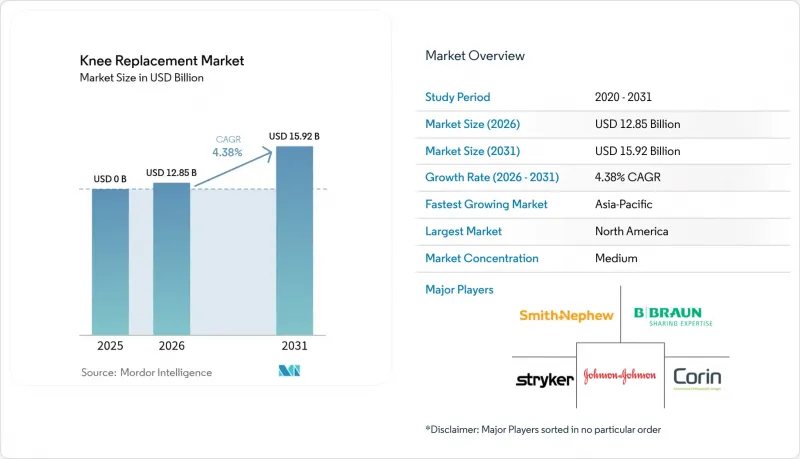
이 보고서는 제품별(전치환술, 부분 치환술, 슬개대퇴 관절 치환술 등), 수술 기술별(수동, 로봇 보조 등), 최종사용자별(병원, 외래 수술 센터(ASC) 등) 및 지역별(북미, 유럽,아시아태평양, 중동 및 아프리카, 남미)로 분류되어 있습니다. 시장 예측은 금액(달러) 기준으로 제시되어 있습니다.
전 세계 무릎 관절 치환술 시장의 동향 및 인사이트
고령화 및 비만 인구 증가
평균 수명의 연장과 앉아 있는 생활 습관이 맞물려 퇴행성 무릎 관절염의 유병률이 높아지고, 무릎 관절 치환술 수요가 가속화되고 있으며, 이는 무릎 관절 치환술 시장의 장기적인 성장을 지원하고 있습니다. 수술 건수는 65-74세 연령대에서 여전히 가장 많으며, 75-84세 연령대가 가장 빠른 성장세를 보이고 있습니다. 고소득 시장에서는 여성이 남성에 비해 9배 더 많은 비율로 인공 무릎 관절 전치환술을 받고 있습니다. 임플란트의 내구성이 향상됨에 따라 50대 초반 환자도 시술이 가능해지면서 대상 환자층이 확대되는 한편, 재치환 수술의 부담이 미래로 미뤄지고 있습니다.
로봇 보조 인공 무릎 관절 전치환술의 급속한 보급
임상 연구를 통해 로봇 지원이 인대 균형의 정밀화, 정렬 이상치의 감소, 그리고 수술 후 초기 단계에서 환자 보고 결과(PRO) 점수의 상승으로 이어진다는 사실이 밝혀지면서, 무릎 관절 치환술 시장에서 이 기술의 역할이 더욱 강화되고 있습니다. 스트라이커(Stryker)사의 ‘Mako’ 플랫폼은 누적 수술 건수가 150만 건을 돌파했으며, 조사 대상 외과의사의 95%가 수술 중 확신이 높아졌다고 밝혔습니다. 존슨앤드존슨(Johnson & Johnson)의 ‘VELYS’ 시스템은 2024년 CT를 이용한 계획 없는 단일실형 무릎 관절 치환술에 대해 FDA 승인을 획득하여, 기존 기업의 우위에 도전하는 동시에 워크플로우 통합과 비용 효율성을 중심으로 한 기술 경쟁을 가속화하고 있습니다.
중국 및 인도의 가격 상한 규제
중국의 수량 기반 조달 체계로 인해 인공 무릎 관절의 평균 가격이 50% 인하되었으며, 의료기기가 입원 환자의 총 의료비 절감액의 93.21%를 차지했습니다. 인도의 국가 의약품 가격 관리국이 연구개발비에 비해 과도하다고 판단되는 가격 상한선을 부과함에 따라 현재도 무역 분쟁이 지속되고 있습니다. 각 제조사들은 현재 전 세계 인공 무릎 관절 시장에서 강제적인 가격 인하로부터 혁신 예산을 보호하기 위해 제품 포트폴리오를 ‘프리미엄’과 ‘밸류’의 두 가지 계층으로 분류하고 있습니다.
부문 분석
2025년에는 전체 무릎 관절 치환술이 시장 점유율의 70.63%를 차지함과 동시에, 2031년까지 연평균 성장률(CAGR) 5.54%로 성장을 주도하며, 지배적인 부문이 시장 확대를 이끄는 이례적인 시장 역학을 만들어내고 있습니다. 이러한 현상은 다양한 병태에 대응할 수 있는 이 수술의 범용성과 임플란트 설계 및 수술 기술 분야의 지속적인 혁신을 반영하고 있습니다. 로봇 보조 기술로 인해 정확도와 치료 성과가 향상됨에 따라 부분 무릎 관절 치환술에 대한 수요가 증가하고 있습니다. 존슨앤드존슨의 ‘VELYS’ 시스템은 2024년에 단일 챔버 치환술에 대해 FDA 승인을 획득하여, 그동안 충분히 활용되지 못했던 골 보존 수술을 시행할 수 있게 되었습니다.
슬개대퇴 관절 치환술은 무릎 관절 치환술 시장에서 틈새 시장이지만 성장하고 있는 부문으로, 특히 고립성 전방 무릎 통증을 가진 젊은 환자를 대상으로 합니다. 한편, 초기에 이식된 임플란트의 기반이 노후화됨에 따라 재치환술이나 복잡한 무릎 관절 치환술에 대한 수요도 증가하고 있습니다. 재치환 부문은 골량 감소 관리나 구성품 적합성 문제 등 특유의 과제에 직면해 있으며, 이는 모듈형 임플란트 시스템 및 맞춤형 3D 프린팅 솔루션의 혁신을 촉진하고 있습니다. 지머 바이오메트(Zimmer Biomet)사의 ‘옥스포드 무시멘트 부분 무릎 관절 치환 시스템’은 2024년 미국에서 유일한 무시멘트 부분 무릎 관절 임플란트로 FDA 승인을 획득했으며, 10년 후 임플란트 생존율은 94.1%를 기록하여,부분 무릎 관절 치환술의 평균적인 성과 지표를 크게 상회하고 있습니다.
지역별 분석
2025년, 북미는 무릎 관절 치환술 시장을 주도하며 매출의 40.62%를 차지했습니다. 이는 미국내 연간 79만 건 이상의 수술 건수, 기술의 적극적인 도입, 그리고 민간 보험에 의한 넉넉한 급여가 지원된 결과입니다. 캐나다의 공적 의료제도에는 대기 기간이라는 제약이 있으며, 이로 인해 미국이나 멕시코의 의료 기관으로의 의료 관광이 촉진되고 있습니다. 멕시코는 이러한 흐름을 활용하여 미국에서 연수를 받은 외과 의사나 로봇 수술 패키지를 홍보하며 민간 정형외과 시설을 확대하고 있습니다. 보험사들의 입원 기간 단축 압력이 강해지는 가운데, 가치 기반 구매에 대한 관심이 높아지고 있지만, 의료기기에 대한 물품세에 대해서는 여전히 입법 심의가 진행 중입니다.
유럽은 성숙 단계에 접어들고 있지만, 그 상황은 국가마다 제각각입니다. 독일은 여전히 가장 많은 수술 건수를 유지하고 있지만, 프랑스에서는 환급액 삭감으로 인해 임플란트 가격이 25% 인하되어 의료 제공자의 이익률이 압박받고 있으며, 프리미엄 제품의 도입이 주춤하고 있습니다. 영국의 국민보건서비스(NHS)에서는 예정 수술의 적체가 문제로 대두되고 있으며, 활동 목표를 달성하기 위해 민간 병원과의 계약이 촉진되고 있습니다. 남유럽 국가들은 유럽투자은행의 자금 지원을 받아 수술실 현대화를 추진하고 있지만, 비용 절감을 위해 인공관절 채택 품목을 최소한으로 제한하고 있습니다. 동유럽 시장은 낮은 기준선에서 출발하고 있지만, EU의 결속 기금 및 기술 이전 파트너십을 통해 정형외과 병동 개보수가 가속화되고 있습니다. 스칸디나비아에서 선구적으로 도입된 탄소발자국 공개와 같은 친환경 조달 기준은 국경을 넘어 확산되고 있으며, 공급업체의 자격 기준을 재편할 가능성이 있습니다.
아시아태평양은 연평균 성장률(CAGR) 14.62%라는 가장 높은 성장률을 보이고 있으며, 2031년까지 전 세계 무릎 관절 치환술 시장을 크게 변화시킬 전망입니다. 중국에서는 수량 기반 조달로 인해 의료기기 가격이 절반으로 줄었으나, 수술 건수에는 영향을 미치지 않았습니다. 대신 병원 측은 이익률 하락을 만회하기 위해 수술 건수 증가를 추구하고 있습니다. 일본에서는 연간 8만 2,304건의 초회 무릎 관절 치환술이 시행되고 있으며, 금속 이온에 대한 문화적 기피감으로 인해 세라믹 대 세라믹 베어링이 채택되고 있습니다. 한국에서는 국민건강보험과 최소 침습 수술법에 대한 적극적인 마케팅에 힘입어 지난 10년간 수술 건수가 407% 증가했습니다. 인도에서는 급증하는 수요와 가격 상한선 간의 균형을 모색하고 있으며, 혁신 예산은 제한적이지만 국내 임플란트 제조가 촉진되고 있습니다. 호주의 남성 10만 명당 부상 발생률은 83.9건으로, 스포츠와 관련된 무릎 외상이 증가하고 있음이 부각되고 있으며, 정부의 비용 억제 조치가 강화되는 상황에서도 파이프라인 수요를 지원하고 있습니다.
기타 혜택:
- 엑셀 형식의 시장 예측(ME) 시트
- 3개월간의 애널리스트 지원
자주 묻는 질문
목차
제1장 서론
제2장 조사 방법
제3장 개요
제4장 시장 구도
제5장 시장 규모와 성장 예측
제6장 경쟁 구도
제7장 시장 기회와 향후 전망
KSA 26.09.04According to Mordor Intelligence, the knee replacement market size was valued at USD 12.31 billion in 2025 and estimated to grow from USD 12.85 billion in 2026 to reach USD 15.92 billion by 2031, at a CAGR of 4.38% during the forecast period (2026-2031).
This report is Segmented by Product (Total Knee Replacement, Partial Knee Replacement, Patellofemoral Replacement, and More), Surgical Technology (Manual, Robotic-Assisted, and More), End User (Hospitals, Ambulatory Surgical Centres (ASC), and More), and Geography (North America, Europe, Asia-Pacific, Middle East and Africa, South America). The Market Forecasts are Provided in Terms of Value (USD).
Global Knee Replacement Market Trends and Insights
Ageing and Obese Population Growth
Rising life expectancy is intersecting with sedentary lifestyles to boost osteoarthritis incidence and accelerate knee arthroplasty demand, reinforcing long-term expansion in the knee replacement market. Utilization remains highest in the 65-74 cohort, yet the 75-84 group records the fastest growth, while women in high-income markets undergo total knee procedures at rates nine times higher than men. Increasing implant durability now supports interventions in patients in their early 50s, enlarging the addressable pool and shifting revision surgery burdens further into the future.
Rapid Adoption of Robotic-Assisted Total Knee Replacement
Clinical studies now link robotic assistance to tighter ligament balancing, fewer alignment outliers, and higher early-stage patient-reported outcome scores, strengthening the technology's role within the knee replacement market.. Stryker's Mako platform has surpassed 1.5 million cumulative procedures, with 95% of surveyed surgeons citing enhanced intra-operative confidence. Johnson & Johnson's VELYS system secured FDA clearance in 2024 for unicompartmental knees without CT-based planning, challenging incumbent dominance and spurring a technology race centered on workflow integration and cost-effectiveness.
Price-Cap Regulations in China and India
China's volume-based procurement framework cut average knee implant prices by 50%, with devices accounting for 93.21% of total inpatient savings. India's National Pharmaceutical Pricing Authority imposed caps deemed misaligned with R&D costs, prompting ongoing trade disputes. Manufacturers now segment portfolios into premium and value tiers to shield innovation budgets against mandated markdowns in the global knee replacement market.
Other drivers and restraints analyzed in the detailed report include:
- Expansion of Outpatient (ASC) Reimbursement Programs
- Arthroplasty Capacity Expansion in Emerging Markets
- Economic Burden of Revision Surgeries
For complete list of drivers and restraints, kindly check the Table Of Contents.
Segment Analysis
Total knee replacement procedures command 70.63% market share in 2025 while simultaneously leading growth at 5.54% CAGR through 2031, creating a rare market dynamic where the dominant segment also drives expansion. This phenomenon reflects the procedure's versatility in addressing various pathologies and the continuous innovation in implant design and surgical techniques. Partial knee replacement procedures are gaining traction as robotic assistance improves precision and outcomes, with Johnson & Johnson's VELYS system receiving FDA clearance for unicompartmental procedures in 2024, addressing the historical underutilization of bone-preserving techniques.
Patellofemoral replacement represents a niche but growing segment within the knee replacement market, particularly for younger patients with isolated anterior knee pain, while revision and complex knee replacement procedures are experiencing increased demand as the installed base of primary implants ages. The revision segment faces unique challenges, including bone loss management and component compatibility issues, driving innovation in modular implant systems and custom 3D-printed solutions. Zimmer Biomet's Oxford Cementless Partial Knee, approved by the FDA in 2024 as the only cementless partial knee implant in the United States, demonstrates 94.1% implant survival at 10 years, significantly exceeding average partial knee performance metrics.
Complete Report Scope:
- By Product
- Total Knee Replacement
- Partial Knee Replacement
- Patellofemoral Replacement
- Revision / Complex Knee Replacement
- By Surgical Technology
- Manual
- Robotic-Assisted
- Patient-Specific Instrumentation (PSI)
- Computer-Navigated
- By End User
- Hospitals
- Ambulatory Surgical Centres (ASC)
- Orthopaedic Specialty Clinics
- By Geography
- North America
- United States
- Canada
- Mexico
- Europe
- Germany
- United Kingdom
- France
- Italy
- Spain
- Rest of Europe
- Asia-Pacific
- China
- Japan
- India
- Australia
- South Korea
- Rest of Asia-Pacific
- Middle East & Africa
- GCC
- South Africa
- Rest of Middle East & Africa
- South America
- Brazil
- Argentina
- Rest of South America
- North America
Geography Analysis
North America led the knee replacement market with 40.62% revenue in 2025, driven by more than 790,000 annual procedures in the United States, strong technology adoption, and robust private-payer coverage. Canada's publicly funded system introduces wait-time constraints, prompting outbound medical travel to U.S. and Mexican facilities. Mexico capitalizes on that flow, expanding private orthopedic institutes that market US-trained surgeons and bundled robotics packages. Payer pressure to curtail inpatient lengths of stay is sharpening focus on value-based purchasing, while device excise taxes remain under legislative review.
Europe displays a mature yet heterogeneous profile. Germany retains the highest procedure volume, but reimbursement cuts in France trimmed implant prices by 25%, squeezing provider margins and slowing premium adoption. The United Kingdom's NHS elective backlog spurs contracting with private hospitals to reach activity targets. Southern European nations, helped by European Investment Bank funding, modernize operating theaters but run lean implant formularies to control costs. Eastern European markets start from lower baselines; EU cohesion funds and skill-transfer partnerships speed orthopedic ward upgrades. Environmental procurement criteria such as carbon-footprint disclosures, pioneered in Scandinavia, are gaining cross-border traction and could reshape vendor qualification standards.
Asia-Pacific contributes the highest growth at a 14.62% CAGR and is set to transform the global knee replacement market by 2031. China's volume-based procurement halved device prices yet did not dent procedure uptake; hospitals instead chase throughput to offset lower margins. Japan registers 82,304 annual primary knees, with ceramic-on-ceramic bearings reflecting cultural aversion to metal ions. South Korea's procedure rate grew 407% over the past decade, supported by national insurance and aggressive marketing of minimally invasive methods. India balances burgeoning demand against price caps, stimulating domestic implant manufacture albeit with constrained innovation budgets. Australia's injury incidence of 83.9 per 100,000 males illuminates rising sports-related knee trauma, feeding pipeline demand even as government cost-containment tightens.
- Zimmer Biomet
- Stryker
- Johnson & Johnson
- Smiths Group
- B. Braun (Aesculap)
- Exactech
- Medacta Group
- MicroPort Orthopedics
- Medtronic
- Corin Group
- Conformis Inc.
- THINK Surgical
- Waldemar Link GmbH
- DJO Global
- United Orthopedic Corp.
- LimaCorporate
- Amplitude SAS
- Auxein Medical
- Arthrex
- SurgTech
Additional Benefits:
- The market estimate (ME) sheet in Excel format
- 3 months of analyst support
TABLE OF CONTENTS
1 Introduction
- 1.1 Study Assumptions & Market Definition
- 1.2 Scope of the Study
2 Research Methodology
3 Executive Summary
4 Market Landscape
- 4.1 Market Overview
- 4.2 Market Drivers
- 4.2.1 Ageing and Obese Population Growth
- 4.2.2 Rapid Adoption of Robotic-Assisted Total Knee Replacement (TKR)
- 4.2.3 Expansion of Outpatient (ASC) Reimbursement Programs
- 4.2.4 Arthroplasty Capacity Expansion in Emerging Markets
- 4.2.5 Customised, 3D-Printed Implant Technologies
- 4.2.6 Breakthroughs in Military-Grade Polyethylene Longevity
- 4.3 Market Restraints
- 4.3.1 Price-Cap Regulations in China and India
- 4.3.2 Economic Burden of Revision Surgeries
- 4.3.3 Environmental Scrutiny of Implant Metals' Carbon Footprint
- 4.3.4 Legal Risks Related to Intellectual Property for Custom Implants
- 4.4 Technological Outlook
- 4.5 Porter's Five Forces Analysis
- 4.5.1 Threat of New Entrants
- 4.5.2 Bargaining Power of Buyers/Consumers
- 4.5.3 Bargaining Power of Suppliers
- 4.5.4 Threat of Substitute Products
- 4.5.5 Intensity of Competitive Rivalry
5 Market Size & Growth Forecasts (Value in USD)
- 5.1 By Product
- 5.1.1 Total Knee Replacement
- 5.1.2 Partial Knee Replacement
- 5.1.3 Patellofemoral Replacement
- 5.1.4 Revision / Complex Knee Replacement
- 5.2 By Surgical Technology
- 5.2.1 Manual
- 5.2.2 Robotic-Assisted
- 5.2.3 Patient-Specific Instrumentation (PSI)
- 5.2.4 Computer-Navigated
- 5.3 By End User
- 5.3.1 Hospitals
- 5.3.2 Ambulatory Surgical Centres (ASC)
- 5.3.3 Orthopaedic Specialty Clinics
- 5.4 By Geography
- 5.4.1 North America
- 5.4.1.1 United States
- 5.4.1.2 Canada
- 5.4.1.3 Mexico
- 5.4.2 Europe
- 5.4.2.1 Germany
- 5.4.2.2 United Kingdom
- 5.4.2.3 France
- 5.4.2.4 Italy
- 5.4.2.5 Spain
- 5.4.2.6 Rest of Europe
- 5.4.3 Asia-Pacific
- 5.4.3.1 China
- 5.4.3.2 Japan
- 5.4.3.3 India
- 5.4.3.4 Australia
- 5.4.3.5 South Korea
- 5.4.3.6 Rest of Asia-Pacific
- 5.4.4 Middle East & Africa
- 5.4.4.1 GCC
- 5.4.4.2 South Africa
- 5.4.4.3 Rest of Middle East & Africa
- 5.4.5 South America
- 5.4.5.1 Brazil
- 5.4.5.2 Argentina
- 5.4.5.3 Rest of South America
- 5.4.1 North America
6 Competitive Landscape
- 6.1 Market Concentration
- 6.2 Market Share Analysis
- 6.3 Company Profiles (includes Global level Overview, Market level overview, Core Segments, Financials as available, Strategic Information, Market Rank/Share for key companies, Products & Services, and Recent Developments)
- 6.3.1 Zimmer Biomet
- 6.3.2 Stryker Corporation
- 6.3.3 Johnson & Johnson (DePuy Synthes)
- 6.3.4 Smith & Nephew plc
- 6.3.5 B. Braun (Aesculap)
- 6.3.6 Exactech Inc.
- 6.3.7 Medacta Group
- 6.3.8 MicroPort Orthopedics
- 6.3.9 Medtronic plc
- 6.3.10 Corin Group
- 6.3.11 Conformis Inc.
- 6.3.12 THINK Surgical
- 6.3.13 Waldemar Link GmbH
- 6.3.14 DJO Global (Enovis)
- 6.3.15 United Orthopedic Corp.
- 6.3.16 LimaCorporate
- 6.3.17 Amplitude SAS
- 6.3.18 Auxein Medical
- 6.3.19 Arthrex Inc.
- 6.3.20 SurgTech Inc.
7 Market Opportunities & Future Outlook
- 7.1 White-space & Unmet-Need Assessment