|
시장보고서
상품코드
2122243
분류 시스템 : 시장 점유율 분석, 업계 동향과 통계, 성장 예측(2026-2031년)Sortation Systems - Market Share Analysis, Industry Trends & Statistics, Growth Forecasts (2026 - 2031) |
||||||
 Mordor Intelligence
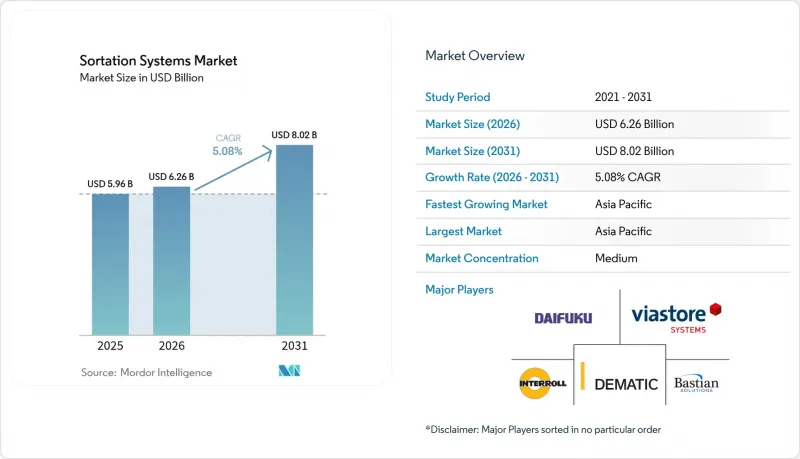
Mordor Intelligence에 따르면 분류 시스템 시장 규모는 2025년 59억 6,000만 달러에서 2026년에는 62억 6,000만 달러로 확대하며, 2026-2031년에 CAGR 5.08%로 추이하며, 2031년에는 80억 2,000만 달러에 달할 것으로 예측됩니다.
이 보고서는 분류기 유형(크로스벨트식 분류기, 틸트 트레이식 분류기, 슬라이딩 슈식 분류기 등), 최종사용자 산업(우편·소포, E-Commerce 및 옴니채널 소매, 공항 등),제공 형태(하드웨어 및 소프트웨어), 처리 능력(저속, 중속 등), 그리고 지역별로 분류되어 있습니다. 시장 예측은 금액(달러) 기준으로 제시되어 있습니다.
글로벌 분류 시스템 시장의 동향 및 인사이트
E-Commerce 소포의 급증
소포의 증가로 인해 용량 계획 방식이 변화하고 있습니다. 미국의 연간 소포 처리량은 2028년까지 280억 개에 달할 것으로 예측되며, 이는 연평균 5% 증가에 해당합니다. 중국의 크로스보더 판매업체들은 디지털화를 가속화하고 생성형 AI를 활용하여 수요 예측의 정확도를 높이고 있으며, 이를 통해 시설은 사후 대응형 피크 대응에서 예측에 기반한 부하 분산으로 전환할 수 있게 되었습니다. 처리량의 급증에 자동으로 적응하고, 라우팅 규칙을 즉시 변경할 수 있는 분류기가 현재 성수기의 업무 연속성을 지원하고 있습니다.
인건비 급등과 인력 부족
창고 인건비 급등과 기술자 부족으로 인해 도입 일정이 압박받고 있습니다. 사업자의 63%가 숙련된 인력 부족을 가장 큰 장애물로 꼽고 있으며, 2020년대 중반까지 공급망 기술자 구인 건수가 77만 건에 달할 것으로 예상됩니다. 조달 기준에서는 명목상의 처리 능력과 마찬가지로 원격 진단 및 간소화된 유지보수가 중요시되고 있습니다.
고액의 설비 투자와 ROI의 불확실성
본격적인 선별기를 도입하려면 수백만 달러 규모의 지출에 더해 시설 개조도 필요합니다. 18-24개월 내에 투자 회수를 원하는 사업자들은 도입을 미루는 경우가 많으며, ROI 기간을 늘릴 수는 있지만 장기적인 효율성을 저해하는 모듈식 추가 장비를 선호하는 경향이 있습니다. 고객 이탈 감소나 고객 충성도 향상과 같이 정량화하기 어려운 ‘소프트한 수익’을 수치화하는 것은 여전히 어려운 과제입니다.
부문 분석
2025년에는 크로스 벨트식 유닛이 매출의 37.60%를 차지하고 연간 7.52%의 성장이 예상되며, 이 분류기 등급은 분류 시스템 시장에서 가장 크고 가장 빠른 성장 궤도에 올라 있습니다. 시설 측에서는 속도를 늦추지 않고 불규칙한 형태의 화물을 처리할 수 있는 능력이 높이 평가되고 있습니다. 틸트 트레이 방식이나 슬라이딩 슈 방식의 설비는 파손되기 쉬운 상품 및 균일한 크기의 골판지 상자가 주를 이루는 현장에서 여전히 중요한 역할을 하고 있습니다. 나로우벨트 방식의 도입은 바닥 면적이 제한된 구식 건물에서 계속해서 이루어지고 있습니다. 운영자가 더 높은 유연성과 가동률을 추구함에 따라 팝업 휠 및 다이버터 시스템은 계속해서 감소 추세를 보이고 있습니다.
크로스 벨트 플랫폼 분류 시스템 시장 규모는 2031년까지 31억 5,000만 달러를 넘어설 것으로 예측되며, 이는 틈새 시장에서 주류 시장으로의 확고한 전환을 반영하고 있습니다. 한편, 슬라이딩 슈 제품은 분류 시스템 시장에서 중간 한 자릿수 점유율을 차지하고 있으며, 완만한 흐름 제어가 요구되는 의류 및 소포 허브 시설에서의 적합성을 유지하고 있으며, 낮은 한 자릿수의 성장세를 보이고 있습니다.
E-Commerce 및 옴니채널 소매업체는 2025년 매출의 40.70%를 차지하고 있으며, 연평균 7.18%의 속도로 증가하고 있습니다. 우편 및 소포 사업자는 여전히 2위 규모를 차지하고 있지만, 이익률 압박으로 인해 자동화는 성장의 촉매라기보다는 비용 절감 수단이 되고 있습니다. 공항에서는 허브 공항이 수하물 루프 현대화를 추진함에 따라 프로젝트 기반의 안정적인 비즈니스 기회가 창출되고 있습니다. 식품, 음료, 의약품 업계에서는 규정 준수를 위해 고정밀 분류가 채택되고 있으며, 이는 다수의 센서가 탑재된 크로스 벨트식 및 고속 트레이식 유닛의 도입을 촉진하고 있습니다.
2031년까지 E-Commerce 분야는 분류 시스템 시장 규모 중 32억 7,000만 달러 이상을 차지할 것으로 예상됩니다. 공항 관련 프로젝트는 변동성이 큰 요인과 여객 및 화물에 대한 투자가 맞물려 연평균 성장률(CAGR)이 한 자릿수 중반에 달할 가능성이 있습니다.
지역별 분석
아시아태평양(APAC)은 2025년 시장 점유율 35.90%로 분류 시스템 시장을 독점하고 있으며, 연평균 성장률(CAGR) 8.25%로 확대되고 있습니다. 중국의 물류 업계에서는 AI를 활용하여 집하 효율을 30%, 배송 효율을 35% 향상시키고 있으며, 이로 인해 지능형 분류기의 추가 도입이 촉진되고 있습니다. 인도의 자동화 추진은 생산의 현지화와 리드타임 단축을 목적으로 설계된 다이후쿠(Daifuku)사의 2025년 제조 복합 단지에 잘 드러나 있습니다. 동남아시아의 E-Commerce 성장 또한 도시 지역의 마이크로 풀필먼트 거점에 대한 유연한 분류 시스템 투자를 지원하고 있습니다.
북미는 공항 수하물 처리 시스템의 재구축과 지속적인 소포 센터 업그레이드를 통해 여전히 수익의 핵심을 이루고 있습니다. 1차 시설의 상당수가 이미 자동화되어 있으므로 성장률은 4%대 중반으로 둔화되었으며, 지출은 기존 설비의 개보수, 소프트웨어 및 지속가능성 향상을 위한 투자로 전환되고 있습니다. 유럽에서는 환경 규제와 성능 간의 균형이 이루어지고 있습니다. 사업자들은 EU의 순환 경제 목표에 부합하기 위해 에너지 효율이 높은 모터와 재활용 가능한 벨트 소재를 선호하여 채택하고 있습니다.
중동 및 아프리카에서는 걸프 국가들의 공항이 허브 기능에 대한 투자를 확대하고 있으며, 아프리카의 E-Commerce가 기존 소매업을 비약적으로 추월함에 따라 수요는 초기 단계이긴 하지만 증가세를 보이고 있습니다. 남미에서는 소포 처리량과 인건비 상승이 설비 투자를 정당화하는 대도시권에서 선별기가 선택적으로 도입되고 있습니다. 브라질과 칠레의 정책 입안자들은 통관 절차의 효율화를 도모하겠다는 의향을 보이고 있으며, 이로 인해 수출 지향형 물류 단지에 선별기 도입이 간접적으로 촉진되고 있습니다.
기타 혜택:
- 엑셀 형식의 시장 예측(ME) 시트
- 3개월간의 애널리스트 지원
자주 묻는 질문
목차
제1장 서론
제2장 조사 방법
제3장 개요
제4장 시장 구도
제5장 시장 규모와 성장 예측
제6장 경쟁 구도
제7장 시장 기회와 향후 전망
KSA 26.09.04According to Mordor Intelligence, the sortation systems market size is expected to grow from USD 5.96 billion in 2025 to USD 6.26 billion in 2026 and is forecast to reach USD 8.02 billion by 2031 at 5.08% CAGR over 2026-2031.
This report is Segmented by Sorter Type (Cross-Belt Sorters, Tilt-Tray Sorters, Sliding-Shoe Sorters, and More), by End-User Industry (Post and Parcel, E-Commerce and Omnichannel Retail, Airport, and More), by Offering (Hardware, and Software), by Throughput Rate (Low-Speed, Medium-Speed, and More), and by Geography. The Market Forecasts are Provided in Terms of Value (USD).
Global Sortation Systems Market Trends and Insights
E-commerce parcel surge
Parcel growth reshapes capacity planning. United States annual parcel flow is forecast to hit 28 billion by 2028, a 5% yearly increase. Chinese cross-border sellers accelerate digitalisation and employ generative AI to improve demand forecasting, allowing facilities to move from reactive peaks to predictive load balancing.Sorters that self-adjust to volume spikes and shift routing rules on the fly now underpin peak-season resilience.
Labor-cost escalation & scarcity
Warehouse payroll inflation and technician shortages compress deployment timelines. A 63% majority of operators cite skilled labour gaps as the top obstacle, while 770,000 supply-chain technician vacancies are expected by mid-decade. Procurement criteria now weigh remote diagnostics and simplified maintenance as heavily as nominal throughput.
High capex & ROI uncertainty
Full-scale sorters require multimillion-dollar outlays plus facility remodelling. Operators demanding 18-24-month payback often delay adoption, favouring modular add-ons that can stretch ROI but impair long-term efficiency. Quantifying soft returns such as reduced churn and customer loyalty remains challenging.
Other drivers and restraints analyzed in the detailed report include:
- SKU proliferation demands accuracy
- Airport baggage-handling upgrades
- AI-vision powered dynamic sorters
- Sustainability-driven energy savings
- Skilled-technician shortage
For complete list of drivers and restraints, kindly check the Table Of Contents.
Segment Analysis
Cross-belt units generated 37.60% revenue in 2025 and are set to rise 7.52% annually, giving the sorter class the largest and fastest path within the sortation systems market. Facilities prefer its capability to handle irregular packages without speed loss. Tilt-tray and sliding-shoe equipment stay relevant where either fragile goods or uniform cartons dominate. Narrow-belt installations persist in legacy buildings with limited floor plates. Pop-up wheel and diverter systems continue to fade as operators pursue higher flexibility and uptime.
The sortation systems market size for cross-belt platforms is projected to exceed USD 3.15 billion by 2031, reflecting entrenched migration from niche to mainstream. Meanwhile, sliding-shoe products hold a mid-single-digit sortation systems market share and show low-single-digit expansion as they retain fit in apparel and parcel hubs demanding gentle flow control.
E-commerce and omnichannel retailers captured 40.70% of 2025 turnover and are increasing 7.18% annually. Post-and-parcel operators remain the second-largest cohort, yet margin pressure converts automation into a cost-containment lever rather than growth catalyst. Airports contribute stable, project-based opportunities as hubs modernise baggage loops. Food, beverage and pharma lines embrace high-accuracy sorting to honour compliance, fuelling adoption of sensor-laden cross-belt and high-speed tray units.
By 2031, the e-commerce segment is expected to command more than USD 3.27 billion of the sortation systems market size. Airport programmes, though lumpy, could achieve mid-single-digit CAGR on the back of combined passenger and cargo investments.
Complete Report Scope:
- By Sorter Type
- Cross-belt Sorters
- Tilt-tray Sorters
- Sliding-shoe Sorters
- Narrow-belt Sorters
- Push-tray / Split-tray Sorters
- Pop-up Wheel & Diverter Sorters
- By End-user Industry
- Post & Parcel Operators
- E-commerce & Omnichannel Retail
- Airports (Baggage Handling)
- Food & Beverages
- Pharmaceuticals & Healthcare
- 3PL & Contract Logistics
- Automotive & Industrial Manufacturing
- By Offering
- Hardware
- Software
- Services (Installation, MRO)
- By Throughput Rate
- Low-speed (<3k)
- Medium-speed (3k-10k)
- High-speed (10k-25k)
- Ultra High-speed (>25k)
- By Geography
- North America
- United States
- Canada
- Mexico
- South America
- Brazil
- Argentina
- Rest of South America
- Europe
- Germany
- United Kingdom
- France
- Italy
- Spain
- Netherlands
- Rest of Europe
- APAC
- China
- Japan
- India
- South Korea
- Australia & New Zealand
- Southeast Asia
- Rest of APAC
- Middle East & Africa
- GCC (ex-Saudi)
- Saudi Arabia
- Turkey
- South Africa
- Israel
- Rest of Middle East & Africa
- North America
Geography Analysis
APAC dominated the sortation systems market with 35.90% 2025 share and is expanding at 8.25% CAGR. China's logistics sector uses AI to lift collection efficiency 30% and delivery 35%, spurring further adoption of intelligent sorters. India's automation drive is illustrated by Daifuku's 2025 manufacturing complex designed to localise production and lower lead times. Southeast Asian e-commerce growth also channels investment into flexible sorting in urban micro-fulfilment nodes.
North America remains a core revenue pillar through airport baggage rebuilds and ongoing parcel-centre upgrades. Growth moderates to a mid-4% rate as many first-wave facilities are already automated, causing spend to pivot towards retrofits, software, and sustainability upgrades. Europe balances green mandates with performance. Operators favour energy-efficient motors and recyclable belt materials to align with EU circularity targets.
Middle East and Africa present nascent but rising demand as Gulf airports invest in hub capability and African e-commerce leapfrogs conventional retail. South America exhibits selective uptake in metropolitan corridors where parcel volumes and labour inflation justify capital outlays. Policymakers in Brazil and Chile have signalled intent to streamline customs processes, indirectly supporting sorter adoption in export-oriented logistics parks.
- Daifuku Co., Ltd.
- Vanderlande Industries
- Honeywell Intelligrated
- Siemens Logistics
- Beumer Group GmbH
- Interroll Holding AG
- Dematic Corporation (KION Group)
- Murata Machinery Ltd.
- KNAPP AG
- Bastian Solutions
- Viastore Systems Gmbh
- SSI Schaefer
- TGW Logistics
- Fives Intralogistics
- BOWE SYSTEC
- Pitney Bowes
- Equinox MHE
- Falcon Autotech
- GBI Intralogistics
- OPEX Corporation
- Okura Yusoki
- Zebra Technologies (Fetch Robotics)
Additional Benefits:
- The market estimate (ME) sheet in Excel format
- 3 months of analyst support
TABLE OF CONTENTS
1 INTRODUCTION
- 1.1 Study Assumptions and Market Definition
- 1.2 Scope of the Study
2 RESEARCH METHODOLOGY
3 EXECUTIVE SUMMARY
4 MARKET LANDSCAPE
- 4.1 Market Overview
- 4.2 Market Drivers
- 4.2.1 E-commerce parcel surge
- 4.2.2 Labor-cost escalation & scarcity
- 4.2.3 SKU proliferation demands accuracy
- 4.2.4 Airport baggage-handling upgrades
- 4.2.5 AI-vision powered dynamic sorters
- 4.2.6 Sustainability-driven energy savings
- 4.3 Market Restraints
- 4.3.1 High capex & ROI uncertainty
- 4.3.2 Skilled-technician shortage
- 4.3.3 Software-layer interoperability gaps
- 4.3.4 Urban-noise compliance limits
- 4.4 Value / Supply-Chain Analysis
- 4.5 Regulatory Landscape
- 4.6 Technological Outlook
- 4.7 Porter's Five Forces
- 4.7.1 Bargaining Power of Suppliers
- 4.7.2 Bargaining Power of Buyers
- 4.7.3 Threat of New Entrants
- 4.7.4 Threat of Substitutes
- 4.7.5 Competitive Rivalry
5 MARKET SIZE AND GROWTH FORECASTS (VALUE)
- 5.1 By Sorter Type
- 5.1.1 Cross-belt Sorters
- 5.1.2 Tilt-tray Sorters
- 5.1.3 Sliding-shoe Sorters
- 5.1.4 Narrow-belt Sorters
- 5.1.5 Push-tray / Split-tray Sorters
- 5.1.6 Pop-up Wheel & Diverter Sorters
- 5.2 By End-user Industry
- 5.2.1 Post & Parcel Operators
- 5.2.2 E-commerce & Omnichannel Retail
- 5.2.3 Airports (Baggage Handling)
- 5.2.4 Food & Beverages
- 5.2.5 Pharmaceuticals & Healthcare
- 5.2.6 3PL & Contract Logistics
- 5.2.7 Automotive & Industrial Manufacturing
- 5.3 By Offering
- 5.3.1 Hardware
- 5.3.2 Software
- 5.3.3 Services (Installation, MRO)
- 5.4 By Throughput Rate
- 5.4.1 Low-speed (<3k)
- 5.4.2 Medium-speed (3k-10k)
- 5.4.3 High-speed (10k-25k)
- 5.4.4 Ultra High-speed (>25k)
- 5.5 By Geography
- 5.5.1 North America
- 5.5.1.1 United States
- 5.5.1.2 Canada
- 5.5.1.3 Mexico
- 5.5.2 South America
- 5.5.2.1 Brazil
- 5.5.2.2 Argentina
- 5.5.2.3 Rest of South America
- 5.5.3 Europe
- 5.5.3.1 Germany
- 5.5.3.2 United Kingdom
- 5.5.3.3 France
- 5.5.3.4 Italy
- 5.5.3.5 Spain
- 5.5.3.6 Netherlands
- 5.5.3.7 Rest of Europe
- 5.5.4 APAC
- 5.5.4.1 China
- 5.5.4.2 Japan
- 5.5.4.3 India
- 5.5.4.4 South Korea
- 5.5.4.5 Australia & New Zealand
- 5.5.4.6 Southeast Asia
- 5.5.4.7 Rest of APAC
- 5.5.5 Middle East & Africa
- 5.5.5.1 GCC (ex-Saudi)
- 5.5.5.2 Saudi Arabia
- 5.5.5.3 Turkey
- 5.5.5.4 South Africa
- 5.5.5.5 Israel
- 5.5.5.6 Rest of Middle East & Africa
- 5.5.1 North America
6 COMPETITIVE LANDSCAPE
- 6.1 Market Concentration
- 6.2 Strategic Moves
- 6.3 Market Share Analysis
- 6.4 Company Profiles (includes Global level Overview, Market level overview, Core Segments, Financials as available, Strategic Information, Market Rank/Share, Products & Services, Recent Developments)
- 6.4.1 Daifuku Co., Ltd.
- 6.4.2 Vanderlande Industries
- 6.4.3 Honeywell Intelligrated
- 6.4.4 Siemens Logistics
- 6.4.5 Beumer Group GmbH
- 6.4.6 Interroll Holding AG
- 6.4.7 Dematic Corporation (KION Group)
- 6.4.8 Murata Machinery Ltd.
- 6.4.9 KNAPP AG
- 6.4.10 Bastian Solutions
- 6.4.11 Viastore Systems Gmbh
- 6.4.12 SSI Schaefer
- 6.4.13 TGW Logistics
- 6.4.14 Fives Intralogistics
- 6.4.15 BOWE SYSTEC
- 6.4.16 Pitney Bowes
- 6.4.17 Equinox MHE
- 6.4.18 Falcon Autotech
- 6.4.19 GBI Intralogistics
- 6.4.20 OPEX Corporation
- 6.4.21 Okura Yusoki
- 6.4.22 Zebra Technologies (Fetch Robotics)
7 MARKET OPPORTUNITIES AND FUTURE OUTLOOK
- 7.1 White-space & Unmet-need Assessment