

|
시장보고서
상품코드
2122248
허니콤 코어 재료 : 시장 점유율 분석, 업계 동향과 통계, 성장 예측(2026-2031년)Honeycomb Core Materials - Market Share Analysis, Industry Trends & Statistics, Growth Forecasts (2026 - 2031) |
||||||
 Mordor Intelligence
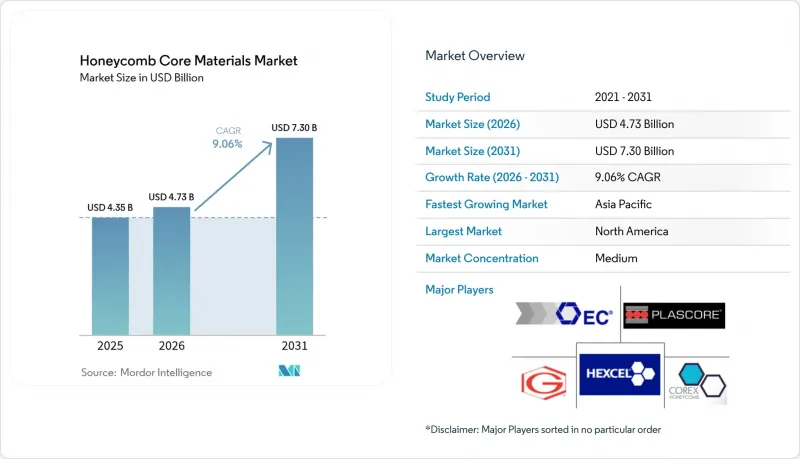
Mordor Intelligence에 따르면 허니콤 코어 재료 시장 규모는 2025년 43억 5,000만 달러에서 2026년에는 47억 3,000만 달러로 확대하며, 2026-2031년에 CAGR 9.06%로 추이하며, 2031년에는 73억 달러에 달할 것으로 예측됩니다.
이 보고서는 제품 유형(노멕스, 알루미늄, 열가소성 수지, 기타), 최종사용자 산업(항공우주, 방위, 기타),제조 기술(팽창 성형, 골판지 성형, 기타), 용도(복합재 샌드위치 패널, 비복합재 인서트 및 스페이서) 및 지역(아시아태평양, 북미, 기타)별로 분류되어 있습니다. 시장 전망은 금액(달러) 기준으로 제시되어 있습니다.
글로벌 허니콤 코어 재료 시장의 동향 및 인사이트
차세대 단일 통로형 항공기의 경량화에 대한 수요 증가
2025년, A320neo의 월간 생산 대수가 사상 최고치를 기록하며, 바닥 패널 및 실내 칸막이에 사용되는 알루미늄 및 노멕스 코어 소재의 수요를 끌어올렸습니다. 보잉사가 제너레이티브 디자인을 적용한 파티션을 채택함에 따라 패널의 무게가 대폭 감소하여, 질량을 늘리지 않고도 탑재되는 각 코어 소재의 가치가 높아졌습니다. 일본의 공급업체들이 시장을 장악하고 있으며, 전 세계에 탄소섬유를 공급하는 동시에 복합재료를 많이 사용하는 기체용 프레임의 원자재 공급망에서 확고한 입지를 다지고 있습니다. 헥셀(Hexel)사가 모로코의 생산 능력을 두 배로 늘리고, 에어버스(Airbus)의 최종 조립 라인에 더 가까운 위치에 거점을 두기로 결정한 것은 물류 위험을 경감하기 위한 현지화를 업계가 중시하고 있음을 보여줍니다. 이러한 동향을 종합적으로 볼 때, 향후 수년간 단일 통로 항공기 부문에서 허니콤 코어 소재에 대한 수요가 안정될 것으로 보입니다.
기체에서의 복합재 샌드위치 패널로의 전환
각 OEM 업체들은 샌드위치 구조의 적용 범위를 2차 페어링에서 하중을 지탱하는 리브 및 프레임으로 확대하고 있으며, 코어 소재의 압축 강도에 대한 요구 수준이 높아지고 있습니다. 헥셀(Hexel)사의 HRH-302 중온용 코어 소재는 MQ-25 프로그램 인증을 획득함으로써, 알루미늄으로는 대응할 수 없는 나셀 및 고온 영역에 적용할 수 있게 되었습니다. 도레이의 새로운 400°C 프레스기는 PEEK 오가노시트와 허니컴의 동시 경화를 가능하게 하여, 스크랩과 노동력을 모두 절감합니다. 경화 사이클 단축으로 인한 열 구배의 심화에 대처하기 위해, 각 공급업체들은 현재 오토클레이브에서 온도가 상승할 때 찌그러짐을 방지하는 밀도 구배 코어를 제공하고 있습니다. 허니콤 코어 재료 시장에서는 중온 등급의 가격 프리미엄이 수지 및 에너지 비용 상승을 상쇄하여 이익률을 유지하고 있습니다.
습기 침투 및 면외 강도 저하
고습도 환경에 노출되면 코어의 에너지 흡수 능력이 현저히 저하되어 접착면에서 부식을 유발할 가능성이 있습니다. 배리어 필름이나 독립 기포 코팅은 이러한 위험을 완화하지만, 한편으로는 비용을 상승시키고 생산성을 저하시키는 요인이 되기도 합니다. 선박용 패널은 가장 가혹한 조건을 견뎌야 함에도 불구하고 IMO(국제해사기구) 규정에 따라 허니컴 사용이 의무화되어 있으며, 추가적인 보호 비용이 발생하고 있습니다. 내습성 시험은 인증 획득까지의 기간을 연장시켜 OEM과 공급업체 양측의 자본을 묶어두게 됩니다. 허니콤 코어 소재 시장은 내구성과 시장 출시 속도의 균형을 맞추는 과제에 직면해 있습니다.
부문 분석
2025년, 알루미늄 코어는 허니콤 코어 소재 시장에서 38.28%의 점유율을 차지하며, 항공우주기 내장재 및 제어 면에서 확고한 우위를 확립했습니다. 한편, 열가소성 폴리프로필렌 코어는 낮은 흡습성과 재활용성이라는 장점 덕분에 연평균 성장률(CAGR) 10.98%를 기록할 것으로 예측됩니다. 초합금 코어는 초음속 용도를 위한 특수한 틈새 시장을 개발하고 있으며, 종이 코어는 비용 효율적인 포장에 대한 수요를 충족시키고 있습니다.
폴리프로필렌의 고유한 특성 덕분에 PEKK 페이스 시트와 그 자리에서 융합이 가능해져, 습기를 가두는 원인이 되는 접착제 이음매를 제거할 수 있습니다. EconCore사의 ThermHex 시리즈는 특히 자동차 분야의 대량 생산에서 기존의 팽창 성형법과 경쟁할 수 있는 규모의 경제를 실현하고 있습니다. 콜로라도주에서는 토레이의 열가소성 테이프 생산 확대가 수명 주기 종료시 재활용성을 고려하여 설계된 공동 압축 철도용 패널의 길을 열어주고 있습니다. 각 OEM 업체들이 순환형 경제를 점점 더 중시하는 가운데, 열가소성 플라스틱의 보급이 진행되고 있으며, 이는 허니콤 코어 재료 시장에서 알루미늄의 우위가 서서히 약화되고 있음을 보여줍니다.
항공우주 분야는 2025년 수요의 62.89%를 차지하며 허니콤 코어 재료 시장의 규모를 지탱하고 있지만, 비용 곡선이 하락함에 따라 다른 산업 분야에서도 연평균 11.27%의 성장이 예상됩니다. 철도 차량, 선박의 격벽, 전기자동차(EV)용 배터리 케이스의 경우, 총비용 절감이라는 관점만으로도 샌드위치 패널의 채택이 정당화되고 있습니다.
포장 및 건설 부문 모두 비용 대비 효과가 높은 대안을 모색하며, 종이 및 열가소성 수지 코어에 주목하고 있습니다. 중국과 유럽에서는 철도 관련 규제로 인해 바닥 및 지붕 자재의 대체가 진행되고 있으며, 불과 2년 만에 투자 회수가 가능해졌습니다. 선박 제조업체들은 IMO의 방화 규정을 준수하는 것을 우선시하며, 고밀도 소재를 선택하는 동시에 가격 프리미엄을 수용하고 있습니다. 한편, 방위 관련 프로젝트는 산발적이긴 하지만 초합금 코어 소재에 대해 고액 계약을 가져오고 있습니다. 이러한 동향들이 맞물리면서 업계의 항공우주 분야에 대한 의존도가 낮아지고, 허니콤 코어 소재 시장의 수입원이 다각화되고 있습니다.
지역별 분석
북미는 항공우주 분야의 공급망이 깊게 뿌리내리고 있으며, 극비 초음속 기술에 대한 자금 지원도 이루어지고 있으며, 2025년에는 매출의 35.21%를 차지했습니다. 에어버스에 제품을 공급하는 헥셀(Hexel)사의 모로코 공장은 2026년 말까지 직원을 배치할 예정입니다. 미국의 2023 회계연도 예산에서는 초음속 기술의 연구개발에 막대한 예산이 배정되어 있으며, 이것이 초합금 코어 소재에 대한 수요를 지원하고 있습니다. 캐나다와 멕시코는 자동차 및 산업용 조립을 통해 추가 성장을 주도하고 있습니다.
아시아태평양은 연평균 성장률(CAGR) 11.10%로 확대될 것으로 예상되며, 지역별로는 가장 빠른 성장세를 보일 것입니다. 중국의 고속철도 중량 규제로 인해 CRH5형 객차의 바닥 중량이 감소하면서 코어 소재 소비량이 급증했습니다. 일본은 전 세계 탄소섬유의 대부분을 공급하며, 복합재료 공급에서 확고한 입지를 다지고 있습니다. 한국, 인도 및 아세안(ASEAN) 국가들은 전투기 및 철도 프로그램을 위해 허니콤 구조의 현지 생산을 추진하고 있습니다. 중국의 국내 공급업체들은 인코넬(Inconel) 코어의 역설계를 수행하고 있으나, 인증 획득은 수입품에 비해 수년 뒤처져 있습니다.
유럽은 에어버스 생산에서 여전히 큰 점유율을 유지하고 있으며, 페놀 수지나 아라미드 수지 코어를 권장하는 철도 규격 EN 45545도 채택되어 있습니다. 그러나 에너지 비용과 규정 준수 비용의 상승으로 인해 경쟁력이 저하되고 있습니다. 독일의 자동차 제조사들은 2028년까지 재활용 소재 함유율을 25%로 높이기 위해 전기자동차용 배터리 팩에 폴리프로필렌 코어 소재의 시범 도입을 추진하고 있습니다. 북유럽의 조선소에서는 한랭 해역용 요트를 위해 내습성 코어 소재를 구매하고 있습니다. 남미와 중동은 현재로서는 시장 규모가 작지만, 사우디아라비아의 ‘NEOM’ 프로젝트나 엠브라에르의 공급망과 같은 프로젝트를 통해 허니콤 코어 소재의 지역 시장이 부분적으로 개발될 가능성이 있습니다.
기타 혜택:
- 엑셀 형식의 시장 예측(ME) 시트
- 3개월간의 애널리스트 지원
자주 묻는 질문
목차
제1장 서론
제2장 조사 방법
제3장 개요
제4장 시장 구도
제5장 시장 규모와 성장 예측
제6장 경쟁 구도
제7장 시장 기회와 향후 전망
KSA 26.09.07According to Mordor Intelligence, the honeycomb core materials market size is expected to grow from USD 4.35 billion in 2025 to USD 4.73 billion in 2026 and is forecast to reach USD 7.30 billion by 2031 at 9.06% CAGR over 2026-2031.
This report is Segmented by Product Type (Nomex, Aluminum, Thermoplastic, and Other Product Types), End-User Industry (Aerospace, Defense, and More), Manufacturing Technology (Expansion, Corrugation, and More), Application (Composite Sandwich Panels and Non-Composite Inserts and Spacers), and Geography (Asia-Pacific, North America, and More). The Market Forecasts are Provided in Terms of Value (USD).
Global Honeycomb Core Materials Market Trends and Insights
Growing Demand for Lightweighting in Next-Gen Single-Aisle Aircraft
In 2025, A320neo production hit record monthly rates, driving up demand for aluminum and Nomex cores used in floor panels and interior partitions. Boeing's adoption of generative-design partitions slashed panel weight, boosting the value of each installed core without adding mass. Japanese suppliers dominate the scene, providing the world's carbon fiber and solidifying their role in the feedstock chain for composite-heavy airframes. Hexcel's decision to double its Moroccan capacity, positioning it closer to Airbus's final assembly lines, underscores the industry's emphasis on localization to mitigate logistics risks. These developments collectively suggest a stable demand for honeycomb core materials in the single-aisle segment over the next few years.
Shift to Composite Sandwich Panels in Airframes
OEMs are shifting sandwich construction from secondary fairings to load-bearing ribs and frames, raising the bar for core compression strength. Hexcel's HRH-302 mid-temperature core, now qualified for the MQ-25 program, opens up nacelle and hot-zone applications that aluminum cannot fulfill. Toray's new 400 °C press enables simultaneous co-curing of PEEK organosheets and honeycomb, reducing both scrap and labor. To counter intensified thermal gradients from quicker cure cycles, suppliers are now providing graded-density cores that prevent crushing during autoclave ramps. In the Honeycomb core materials market, price premiums on mid-temperature grades are balancing out the increased costs of resin and energy, thus safeguarding profit margins.
Moisture Ingress and Out-of-Plane Strength Loss
High humidity exposure can significantly reduce core energy absorption and instigate corrosion at bond lines. While barrier films and closed-cell coatings mitigate these risks, they also inflate costs and decelerate throughput. Marine panels, despite enduring the harshest conditions, are still mandated by IMO rules to use honeycomb, incurring additional protection expenses. Hygric testing can prolong certification, immobilizing capital for both OEMs and suppliers. The Honeycomb core materials market grapples with the challenge of balancing durability and speed to market.
Other drivers and restraints analyzed in the detailed report include:
- Weight-Reduction Mandates in Inter-City High-Speed Rail Coaches
- Adoption of Polypropylene Cores in EV Battery Enclosures
- Persistent Price Volatility in Aramid-Paper Supply Chain
For complete list of drivers and restraints, kindly check the Table Of Contents.
Segment Analysis
Aluminum cores held a 38.28% Honeycomb core materials market share in 2025, firmly establishing their dominance in aerospace interiors and control surfaces. Meanwhile, thermoplastic polypropylene cores are forecast to post a 10.98% CAGR, thanks to their moisture uptake and recyclability benefits. Super-alloy cores carve out a specialized niche for hypersonic applications, while paper cores cater to the demand for cost-effective packaging.
Polypropylene's unique property allows it to fuse in situ with PEKK face sheets, eliminating adhesive lines that can trap moisture. EconCore's ThermHex line has achieved scale economies that compete with traditional expansion methods, particularly for automotive volumes. In Colorado, Toray's expansion of thermoplastic tape paves the way for co-consolidated rail panels, designed for recyclability at the end of their lifecycle. With OEMs increasingly emphasizing circularity, the penetration of thermoplastics is on the rise, signaling a gradual reduction in aluminum's lead in the honeycomb core materials market.
Aerospace contributed 62.89% of the 2025 demand, anchoring the Honeycomb core materials market size, yet other industries are set to expand 11.27% annually as cost curves fall. Rail coaches, marine bulkheads, and EV battery enclosures now justify sandwich panels on total-cost savings alone.
Both the packaging and construction sectors are eyeing paper and thermoplastic cores, seeking cost-effective options. In China and Europe, rail mandates are pushing for floor and roof substitutions, achieving energy paybacks in just two years. Marine builders, prioritizing IMO fire compliance, are opting for higher densities and accepting margin premiums. Meanwhile, defense programs, though sporadic, are offering lucrative contracts for super-alloy cores. Collectively, these trends are reducing the industry's reliance on aerospace, diversifying the revenue streams of the Honeycomb core materials market.
Complete Report Scope:
- By Product Type
- Nomen
- Aluminum
- Thermoplastic
- Other Product Types (Paper, Super-alloy)
- By End-user Industry
- Aerospace
- Defense
- Marine
- Other End-user Industries (Transportation, Packaging, etc.)
- By Manufacturing Technology
- Expansion
- Corrugation
- Extrusion/Lamination
- 3-D Printing/Additive Core Building
- By Application
- Composite Sandwich Panels
- Non-Composite Inserts and Spacers
- By Geography
- Asia-Pacific
- China
- Japan
- India
- South Korea
- ASEAN Countries
- Rest of Asia-Pacific
- North America
- United States
- Canada
- Mexico
- Europe
- Germany
- United Kingdom
- France
- Italy
- Spain
- Russia
- NORDIC Countries
- Rest of Europe
- South America
- Brazil
- Argentina
- Rest of South America
- Middle-East and Africa
- Saudi Arabia
- South Africa
- Rest of Middle-East and Africa
- Asia-Pacific
Geography Analysis
North America controlled 35.21% of revenue in 2025 due to deep aerospace supply chains and classified hypersonic funding. Hexcel's Moroccan plant, supplying Airbus, will staff workers by late 2026. The U.S. FY 2023 budget earmarked significant amounts for hypersonic research and development, underpinning demand for super-alloy cores. Canada and Mexico add incremental growth through automotive and industrial assemblies.
Asia-Pacific is forecast to expand at an 11.10% CAGR, the quickest regional pace. China's high-speed rail weight rules drove floor mass cuts in CRH5 coaches, sharply boosting core consumption. Japan supplies the majority of global carbon fiber, cementing its role in composite supply. South Korea, India, and ASEAN nations are localizing honeycomb fabrication for fighter and rail programs. Domestic Chinese suppliers are reverse-engineering Inconel cores, but certification lags imported grades by several years.
Europe maintains a substantial share of Airbus output and EN 45545 rail standards that favor phenolic and aramid cores. However, higher energy and compliance costs trim competitiveness. German automakers test polypropylene cores in EV packs to reach 25% recycled content by 2028. Nordic shipyards buy moisture-resistant cores for cold-water yachts. South America and the Middle East remain small today, yet projects like Saudi Arabia's NEOM and Embraer's supply chain could open localized Honeycomb core materials market pockets.
- Alucoil
- Argosy International Inc.
- Axiom Materials.
- Corex Honeycomb
- Corint Group
- EconCore
- Euro-Composites
- Grigeo Group AB
- Hangzhou Holycore Composite Material Co.,Ltd
- Hexcel Corporation
- Plascore
- Schutz GmbH & Co. KGaA.
- The Gill Corporation
- TORAY INDUSTRIES, INC.
- Tubus Bauer GmbH
- Yamaton Honicore B.V.
Additional Benefits:
- The market estimate (ME) sheet in Excel format
- 3 months of analyst support
TABLE OF CONTENTS
1 Introduction
- 1.1 Study Assumptions and Market Definition
- 1.2 Scope of the Study
2 Research Methodology
3 Executive Summary
4 Market Landscape
- 4.1 Market Overview
- 4.2 Market Drivers
- 4.2.1 Growing demand for lightweighting in next-gen single-aisle aircraft
- 4.2.2 Shift to composite sandwich panels in airframes
- 4.2.3 Weight-reduction mandates in inter-city high-speed rail coaches
- 4.2.4 Adoption of polypropylene cores in EV battery enclosures
- 4.2.5 Defense push for high-temperature super-alloy honeycomb in hypersonics
- 4.3 Market Restraints
- 4.3.1 Moisture ingress and out-of-plane strength loss
- 4.3.2 Persistent price volatility in the aramid-paper supply chain
- 4.3.3 Limited large-format 3-D-printing capacity for complex cores
- 4.4 Value Chain Analysis
- 4.5 Porter's Five Forces
- 4.5.1 Bargaining Power of Suppliers
- 4.5.2 Bargaining Power of Buyers
- 4.5.3 Threat of New Entrants
- 4.5.4 Threat of Substitutes
- 4.5.5 Competitive Rivalry
5 Market Size and Growth Forecasts (Value)
- 5.1 By Product Type
- 5.1.1 Nomen
- 5.1.2 Aluminum
- 5.1.3 Thermoplastic
- 5.1.4 Other Product Types (Paper, Super-alloy)
- 5.2 By End-user Industry
- 5.2.1 Aerospace
- 5.2.2 Defense
- 5.2.3 Marine
- 5.2.4 Other End-user Industries (Transportation, Packaging, etc.)
- 5.3 By Manufacturing Technology
- 5.3.1 Expansion
- 5.3.2 Corrugation
- 5.3.3 Extrusion/Lamination
- 5.3.4 3-D Printing/Additive Core Building
- 5.4 By Application
- 5.4.1 Composite Sandwich Panels
- 5.4.2 Non-Composite Inserts and Spacers
- 5.5 By Geography
- 5.5.1 Asia-Pacific
- 5.5.1.1 China
- 5.5.1.2 Japan
- 5.5.1.3 India
- 5.5.1.4 South Korea
- 5.5.1.5 ASEAN Countries
- 5.5.1.6 Rest of Asia-Pacific
- 5.5.2 North America
- 5.5.2.1 United States
- 5.5.2.2 Canada
- 5.5.2.3 Mexico
- 5.5.3 Europe
- 5.5.3.1 Germany
- 5.5.3.2 United Kingdom
- 5.5.3.3 France
- 5.5.3.4 Italy
- 5.5.3.5 Spain
- 5.5.3.6 Russia
- 5.5.3.7 NORDIC Countries
- 5.5.3.8 Rest of Europe
- 5.5.4 South America
- 5.5.4.1 Brazil
- 5.5.4.2 Argentina
- 5.5.4.3 Rest of South America
- 5.5.5 Middle-East and Africa
- 5.5.5.1 Saudi Arabia
- 5.5.5.2 South Africa
- 5.5.5.3 Rest of Middle-East and Africa
- 5.5.1 Asia-Pacific
6 Competitive Landscape
- 6.1 Market Concentration
- 6.2 Strategic Moves
- 6.3 Market Share(%)/Ranking Analysis
- 6.4 Company Profiles (includes Global level Overview, Market level overview, Core Segments, Financials as available, Strategic Information, Products and Services, Recent Developments)
- 6.4.1 Alucoil
- 6.4.2 Argosy International Inc.
- 6.4.3 Axiom Materials.
- 6.4.4 Corex Honeycomb
- 6.4.5 Corint Group
- 6.4.6 EconCore
- 6.4.7 Euro-Composites
- 6.4.8 Grigeo Group AB
- 6.4.9 Hangzhou Holycore Composite Material Co.,Ltd
- 6.4.10 Hexcel Corporation
- 6.4.11 Plascore
- 6.4.12 Schutz GmbH & Co. KGaA.
- 6.4.13 The Gill Corporation
- 6.4.14 TORAY INDUSTRIES, INC.
- 6.4.15 Tubus Bauer GmbH
- 6.4.16 Yamaton Honicore B.V.
7 Market Opportunities and Future Outlook
- 7.1 White-space and Unmet-need Assessment
- 7.2 Bio-based and Fully Recyclable Thermoplastic Cores


