

|
시장보고서
상품코드
2122250
레이더 센서 : 시장 점유율 분석, 업계 동향과 통계, 성장 예측(2026-2031년)Radar Sensors - Market Share Analysis, Industry Trends & Statistics, Growth Forecasts (2026 - 2031) |
||||||
 Mordor Intelligence
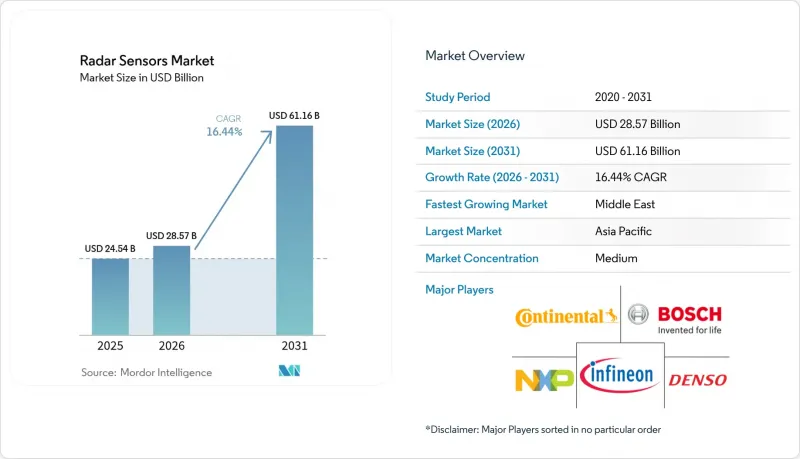
Mordor Intelligence에 따르면 레이더 센서 시장 규모는 2025년 245억 4,000만 달러에서 2026년에는 285억 7,000만 달러로 확대하며, 2031년까지 611억 6,000만 달러에 달할 것으로 예상되고 있으며, 2026-2031년에 CAGR 16.44%로 성장할 것으로 전망되고 있습니다.
이 보고서는 유형별(이미징 레이더, 비이미징 레이더), 주파수 대역별(10 GHz 미만, 24GHz, 60-64GHz, 77-81 GHz, 94GHz 이상),탐지 거리(단거리 레이더 센서, 중거리 레이더 센서, 장거리 레이더 센서), 기술(펄스 레이더 등), 최종사용자(자동차, 항공우주·방위 등) 및 지역별로 분류되어 있습니다. 시장 전망은 금액(달러) 기준으로 제시되어 있습니다.
글로벌 레이더 센서 시장의 동향 및 인사이트
자동차 안전 시스템에서 77-81 GHz 레이더의 채택 확대
Euro NCAP의 2025년 프로토콜에서는 야간에 취약한 도로 이용자를 감지할 수 있는 차량이 평가 대상이 됩니다. 이러한 시나리오를 실현하기 위해서는 상승각 분해능이 1도 미만인 레이더가 필요합니다. 이에 따라 각 부품 제조사들은 기존 24GHz 대역 세트에 비해 10배 더 높은 거리 분해능을 제공하는 77-81 GHz 주파수 변조 연속파(FMCW) 설계를 표준화하고 있습니다. 2026년 1월 중국에서 시행될 자동긴급제동 의무화에 따라 모든 신형 승용차에 최소 3개의 코너 레이더와 1개의 전방 이미징 유닛을 장착해야 하며, 이에 따라 즉시 양산이 시작될 전망입니다. 국제전기통신연합(ITU)에 의한 76-81 GHz 대역의 전 세계적 일관된 할당은 규제상의 확실성을 제공하고, 웨이퍼 팹 투자를 촉진하는 동시에 단위당 비용을 절감하고 있습니다. Mobileye사가 유럽의 주요 자동차 제조사와 체결한 여러 모델에 걸친 계약은 레이더,라이더, 카메라 데이터를 단일 소프트웨어 플랫폼에 통합하는 추세를 더욱 시사하고 있습니다. 이러한 요인들이 복합적으로 작용하여 2025-2027년에 자동차 1대당 센서 탑재 대수가 1.8개에서 2.6개로 증가할 것으로 예측됩니다.
드론을 활용한 지형 매핑 분야에서 소형 이미징 레이더 수요 급증
소형 무인 항공기에 탑재된 4차원 이미징 레이더는 연기, 울창한 수목, 폭우를 뚫고 라이더로는 유사한 조건에서 구현할 수 없는 센티미터 수준의 고도 모델을 생성할 수 있습니다. HiRain사의 LRR615 모듈은 30fps로 프레임당 2,000회의 감지를 수행하여 자율 착륙 및 산불 평가 임무를 위한 실시간 지형 분류를 실현합니다. 2025년에 발주요 미국 지질조사국(USGS) 계약을 통해 헬리콥터 탑재형 LiDAR에 비해 조사 비용이 90% 이상 절감되어, 정부 대상 서비스를 통한 지속적인 수입원이 열렸습니다. Ambarella사의 가상 조리개 기술 덕분에 드론의 탑재 하중이 40% 감소하여, 표준 리튬 폴리머 배터리 팩으로 비행 시간을 40분 이상으로 연장할 수 있게 되었습니다. 유럽의 ‘호라이즌(Horizon)’ 프로젝트는 토양 수분 및 작물 스트레스를 추적하는 농업용 추가 탑재체에 자금을 지원하고 있으며, 이를 통해 상용 드론 서비스 제공업체들이 다중 스펙트럼 카메라와 함께 이미징 레이더를 표준 센서로 채택하게 될 것임을 시사하고 있습니다.
10 GHz 미만 대역의 주파수 할당 제약
모바일 네트워크 규제 당국이 3.3-3.8 GHz 대역을 5G용으로 재할당함에 따라 기존의 S-밴드 기상 레이더는 간섭 가능성을 감수하거나 더 높은 주파수 대역으로 전환할 수밖에 없게 되었습니다. FCC의 2025년 제안에서는 9.3GHz 트럭용 시스템이 선박에 탑재된 X-밴드 디스플레이에 간섭을 일으킨다는 해운 업계 관계자들의 불만을 받아들여, 10 GHz 미만 자동차용 레이더의 사용을 긴급 차량으로 제한하고 있습니다. ETSI는 24GHz 단거리 레이더의 출력을 20 dBm으로 제한하고 있으며, 유효 사거리를 30 m로 제한함으로써 공급업체들이 더 비싼 77 GHz 칩으로 전환하도록 압박하고 있습니다. 인도의 2025년 주파수 경매에서는 공항 감시용 대역폭이 축소되었으며, 4,200 카롤 인도 루피(5억 달러) 상당의 업그레이드가 의무화되었습니다. 규제 차이로 인해 일본은 79 GHz 대역에서 4GHz의 대역폭을 제공하는 반면, 한국은 고작 1 GHz만 할당하고 있으며, 자동차 제조사들은 지역별로 서로 다른 하드웨어 버전을 유지할 수밖에 없는 실정입니다.
부문 분석
2025년, 이미징 레이더는 레이더 센서 시장 점유율의 49.46%를 차지했으며, 자동차 제조사들이 LiDAR에 필적하는 점군 인식 기술을 그 10분의 1의 비용으로 채택함에 따라 2031년까지 연평균 성장률(CAGR) 16.83%로 확대되고 있습니다. 2026년 1월 Zadar Labs가 Fusionride를 인수한 것은 하드웨어 변경 없이 무선으로 알고리즘 업데이트를 가능하게 하는 소프트웨어 정의 스택에 대한 투자가 증가하고 있음을 보여줍니다. 2025년에는 고도 데이터가 필요 없는 기상 감시 및 항공 교통 관제 분야에서 오랜 기간 실적을 쌓아온 펄스 도플러 방식이 여전히 표준으로 자리 잡고 있으며, 비이미징 시스템은 50.54%의 점유율을 유지했습니다. 그러나 현재 하이브리드차량 아키텍처에서는 1개의 이미징 유닛과 4개의 비이미징 모듈을 조합하여 Euro NCAP의 5성급 기준을 충족하는 동시에 차량 1대당 센서 부품 비용을 180달러 이하로 억제하고 있습니다. 그 결과, 전방 지향 모듈 1개당 양산 단가가 45달러 미만으로 떨어짐에 따라 2028년까지 이미징 레이더의 매출이 기존 설계를 능가할 것으로 예측됩니다.
이러한 성장세는 칩셋의 혁신에서도 기인합니다. Arbe Robotics사의 가상 개구 합성 기술을 통해 프레임당 2,000건 이상의 검출이 가능해졌으며, 기존 주파수 변조 연속파(FMCW) 시스템의 64건과 비교하여 야간에도 신뢰성 높은 보행자 분류를 실현하고 있습니다. 자동차 제조사들은 판매 후 고급 자율주행 기능을 이용할 수 있게 해주는 구독 서비스를 통해 이러한 해상도를 수익화하고 있으며, 레이더를 일회성 하드웨어 비용에서 지속적인 수익을 창출하는 소프트웨어 플랫폼으로 전환하고 있습니다. 그러나 77-81 GHz 대역에서 대기 감쇠로 인해 신호 대 잡음비가 저하되므로, 250 m를 초과하면 이미징 레이더의 우위는 약해집니다. 따라서 화물 트럭 OEM 업체들은 하루 5시간을 초과하는 어댑티브 크루즈 컨트롤(ACC) 가동 주기에서는 여전히 비이미징형 장거리 모듈을 선호하여 채택하고 있습니다. 전반적으로 예측 기간이 끝날 무렵에는 이미징 솔루션이 레이더 센서 시장에서 가장 큰 점유율을 차지할 것으로 전망됩니다.
77-81 GHz 대역은 국제전기통신연합(ITU)이 자동차용 단거리 레이더의 세계 표준으로 지정하고 있으며, 실리콘-게르마늄 칩 생산에서 규모의 경제를 지원하고 있으므로 2025년 매출의 43.89%를 차지했습니다. 텍사스 인스트루먼트(Texas Instruments)의 AWR2944 제품군은 10 GHz의 순간 대역폭을 갖춘 94GHz 작동으로의 로드맵을 제시하고 있으며, 이는 2031년까지 W-밴드 부문의 연평균 성장률(CAGR)을 17.41%로 끌어올리는 원동력이 되고 있습니다. 지하 투과 및 벽을 뚫는 이미징에 중요한 서브 10 GHz 레이더는 연평균 성장률(CAGR) 15.2%로 성장하고 있지만, 확대되는 5G 서비스로 인한 간섭에 직면해 있으며, 토목 측량 분야의 수요가 있음에도 불구하고 시장 점유율은 축소되고 있습니다. 규제 변경으로 인해 공급업체들은 이미 24GHz 자동차용 설계에서 전환을 강요받거나 감지 범위를 30 m로 제한하는 것을 수용할 수밖에 없게 되어, 77-81 GHz 플랫폼으로의 전환이 가속화되고 있습니다.
자동차 분야 이외에서는 60-64GHz 대역의 면허가 필요 없는 장치가 스마트 빌딩의 재실 감지 분야에서 급증하고 있습니다. 인피니언(Infineon)의 BGT60TR13C는 석고보드 너머 최대 10m 거리에서 호흡을 감지하여, 시범 개조 프로젝트에서 HVAC 에너지 사용량을 18% 절감했습니다. 방위 분야의 시스템 통합사업자들은 소형 시커 헤드를 위해 94GHz에 주목하고 있습니다. 이는 더 넓은 스윕 폭을 통해 대 UAS(무인 항공기) 임무에 필요한 서브 센티미터급 해상도를 실현할 수 있기 때문입니다. 이러한 배경으로, 파운드리 각사가 질화갈륨 공정의 양산을 확대함에 따라 W-밴드용 실리콘 가격은 2029년까지 35% 하락할 것으로 예측되며, 94GHz 대역은 2031년까지 레이더 센서 시장 규모의 12% 이상을 차지할 전망입니다.
지역별 분석
아시아태평양은 2025년에 레이더 센서 시장 점유율의 34.59%를 차지하며, 연평균 성장률(CAGR) 16.8%로 확대되고 있습니다. 이는 중국의 레벨 2+ 규제로 인해 모든 신형 승용차에 최소 4개의 센서 탑재가 의무화되고, 인도가 방위용 레이더 업그레이드에 726억 달러를 배정하고 있기 때문입니다. 2025년에는 중국의 국내 공급업체들이 이미징 모듈 가격을 유럽 및 미국의 경쟁사보다 25% 저렴하게 책정함에 따라 양산형 전기자동차에 대한 탑재가 가속화되어, 해당 지역 수요의 절반 이상을 중국이 차지했습니다. 인도는 상용 트럭용 충돌 경고 규제와 국산 ‘우탐(Uttam)’ AESA 세트의 대규모 수주에 힘입어 연평균 성장률(CAGR) 18.3%를 기록하며 여전히 가장 빠르게 성장하는 국가로 자리매김하고 있습니다. 자동차 생산 기반의 축소로 인해 일본의 연평균 성장률(CAGR)은 15.6%에 그치고 있지만, 덴소와 히타치 아스테모는 고급 하이브리드차량용 94GHz 주차 레이더의 양산을 확대하고 있습니다. 한국은 ‘뉴딜 2.0’에 따른 12조 원의 보조금 조치의 혜택을 받고 있으며, 이에 따라 현대자동차 및 기아자동차의 모델에 레벨 3 시스템이 탑재되며, 2031년까지의 지역 출하 전망이 상향 조정되었습니다.
유럽은 2025년에 전 세계 매출의 26.1%를 차지하며 16.2%의 연평균 성장률(CAGR)을 유지하고 있습니다. 이는 2024년 7월 이후 출시되는 모든 신형 플랫폼에 지능형 속도 지원, 차선 유지, 긴급 제동을 의무화하는 ‘일반 안전 규정 2(GSR 2)’에 힘입은 결과입니다. 2025년, 독일은 유럽 레이더 센서 시장의 38%를 차지했습니다. 이는 폭스바겐, BMW, 메르세데스-벤츠가 전기자동차 아키텍처 전반에 걸쳐 이미징 유닛의 표준화를 추진했기 때문입니다. 한편, 영국은 연평균 성장률(CAGR) 17.1%로 해당 지역을 상회하는 성장세를 보이고 있습니다. 이는 8억 5,000만 파운드 규모의 레벨 4 셔틀에 대한 공공 실증 시험에서 시험 차량 1대당 2개의 이미징 레이더를 포함한 중복 센서 스택이 필수로 규정되어 있기 때문입니다. 프랑스와 이탈리아는 10%대 중반의 성장률을 보이고 있지만, 전기자동차 보급 속도가 느리고 인센티브 예산에도 제약이 있으며, 선두 그룹에는 미치지 못하고 있습니다. 2025년 9월 55 dBm에서 58 dBm으로 상향 조정된 개정판 EN 302 858의 출력 제한에 따라 이전에는 듀얼 센서 페어로 대응하던 어댑티브 크루즈 컨트롤 요건을 단일 77 GHz 유닛으로 충족할 수 있게 되었습니다.
북미는 2025년 매출의 28.3%를 차지하며, 연평균 성장률(CAGR)은 15.9%를 기록하고 있습니다. 이는 미국 도로교통안전국(NHTSA)이 연간 1,700만 대의 소형차를 대상으로 자동긴급제동(AEB) 장치의 의무화를 제안하고 있기 때문입니다. 캐나다의 12억 캐나다 달러 규모의 ‘전략적 혁신 기금’을 통해 인피니온은 2026년 3분기까지 오타와에서 북미 최초의 모듈 생산 라인을 가동하여 북미 대륙 전체의 공급 회복력을 강화할 전망입니다. 과달라하라와 몬테레이에 위치한 멕시코 공장에서는 이미 해당 지역 생산량의 18%를 조립하고 있으며, 미국 평균보다 40% 낮은 인건비와 텍사스주 및 미시간주의 조립 거점과의 근접성을 활용하고 있습니다. 남미는 전 세계 매출의 4.2%를 차지하며, 그중 브라질이 68%를 차지하고 있습니다. 그러나 평균 판매 가격이 낮아 첨단 운전자 보조 시스템(ADAS)에 대한 예산을 거의 확보하지 못해 레이더 보급률은 12% 미만에 그치고 있습니다. 중동 및 아프리카를 합치면 6.9%를 차지하지만, 중동은 17.46%로 이 지역에서 가장 높은 연평균 성장률(CAGR)을 기록하고 있습니다. 이는 사우디아라비아의 NEOM 프로젝트와 UAE의 주요인프라 계획에서 모든 신규 교통 회랑에 교통용 및 주변 감시용 레이더 설치가 요구되기 때문입니다.
기타 혜택:
- 엑셀 형식의 시장 예측(ME) 시트
- 3개월간의 애널리스트 지원
자주 묻는 질문
목차
제1장 서론
제2장 조사 방법
제3장 개요
제4장 시장 구도
제5장 시장 규모와 성장 예측
제6장 경쟁 구도
제7장 시장 기회와 향후 전망
KSA 26.09.07According to Mordor Intelligence, the radar sensors market size is expected to increase from USD 24.54 billion in 2025 to USD 28.57 billion in 2026 and reach USD 61.16 billion by 2031, growing at a CAGR of 16.44% over 2026-2031.
This report is Segmented by Type (Imaging Radar, and Non-Imaging Radar), Frequency Band (Less Than 10 GHz, 24 GHz, 60-64 GHz, 77-81 GHz, 94 GHz and Above), Range (Short-Range Radar Sensor, Medium-Range Radar Sensor, Long-Range Radar Sensor), Technology (Pulsed Radar, and More), End-User (Automotive, Aerospace and Defense, and More), and Geography. The Market Forecasts are Provided in Terms of Value (USD).
Global Radar Sensors Market Trends and Insights
Increasing Adoption of 77-81 GHz Radars in Automotive Safety Systems
Euro NCAP's 2025 protocol rewards vehicles that detect vulnerable road users at night, a scenario that requires radar with sub-degree elevation resolution. Component makers have therefore standardized on 77-81 GHz frequency-modulated continuous-wave designs that offer ten-times finer range resolution than 24 GHz legacy sets. China's January 2026 mandate for automatic emergency braking pushes every new passenger car to include at least three corner radars and one forward-facing imaging unit, triggering immediate scale production. Consistent global allocation of the 76-81 GHz band by the International Telecommunication Union offers regulatory certainty, encouraging wafer-fab investments and lowering per-unit costs. Mobileye's multi-model agreement with a leading European automaker further signals the consolidation of radar, lidar, and camera data into a single software platform. Collectively, these forces are projected to lift automotive penetration from 1.8 to 2.6 sensors per light vehicle between 2025-2027.
Surging Demand for Compact Imaging Radars in Drone-Based Terrain Mapping
Four-dimensional imaging radar mounted on small unmanned aircraft can pierce smoke, dense foliage, and heavy rain to create centimeter-level elevation models that lidar cannot deliver under the same conditions. HiRain's LRR615 module outputs 2,000 detections per frame at 30 fps, providing real-time terrain classification for autonomous landing and wildfire assessment missions. U.S. Geological Survey contracts issued in 2025 have cut survey costs by more than 90% versus helicopter-based lidar, opening a recurring government services revenue stream. Ambarella's virtual-aperture technique reduces drone payload mass by 40%, extending flight times beyond 40 minutes with standard lithium-polymer packs. Europe's Horizon projects fund additional agriculture-focused payloads that track soil moisture and crop stress, suggesting that commercial drone service providers will adopt imaging radar as a standard sensor alongside multispectral cameras.
Spectrum Allocation Constraints in Sub-10 GHz Bands
Mobile-network regulators have reassigned 3.3-3.8 GHz for 5G, forcing legacy S-band weather radars to accept potential interference or migrate to higher frequencies. The FCC's 2025 proposal restricts automotive radar below 10 GHz to emergency vehicles, after maritime complaints that 9.3 GHz truck systems corrupt ship-borne X-band displays. ETSI caps 24 GHz short-range radar at 20 dBm, limiting effective range to 30 m and pushing suppliers toward costlier 77 GHz chips. India's 2025 spectrum auction reduced bandwidth for airport surveillance, obliging upgrades worth INR 4,200 crore (USD 500 million). Divergent rules: Japan offers 4 GHz bandwidth at 79 GHz, while South Korea grants only 1 GHz, forcing automakers to maintain region-specific hardware versions.
Other drivers and restraints analyzed in the detailed report include:
- Rising Military Spend on Active Electronically Scanned Array Radars in Asia-Pacific
- Growing Need for mm-Wave Sensors in Industrial Robot Collision Avoidance
- High Calibration and Maintenance Cost of Imaging Radar Arrays
For complete list of drivers and restraints, kindly check the Table Of Contents.
Segment Analysis
Imaging radar accounted for 49.46% of the radar sensors market share in 2025, expanding at a 16.83% CAGR through 2031 as automakers adopt point-cloud perception comparable to lidar at one-tenth the cost. Zadar Labs' January 2026 acquisition of Fusionride underscores rising investment in software-defined stacks that allow over-the-air algorithm updates without hardware changes. Non-imaging systems retained 50.54% in 2025 because long-proven pulsed-Doppler systems remain the standard for weather monitoring and air traffic control, where elevation data are unnecessary. Yet hybrid vehicle architectures now pair one imaging unit with four non-imaging modules to satisfy Euro NCAP's five-star protocol while capping sensor bills of materials below USD 180 per vehicle. Consequently, imaging radar's revenue is projected to overtake legacy designs by 2028 as volume pricing falls under USD 45 per forward-facing module.
Growth momentum also stems from chipset innovation. Arbe Robotics' virtual-aperture synthesis yields more than 2,000 detections per frame, compared with 64 in classic frequency-modulated continuous-wave systems, enabling reliable pedestrian classification at night. Automakers monetize this resolution through subscription features that unlock higher levels of autonomy post-sale, shifting radar from a one-time hardware cost to a recurring software platform. However, imaging radar's advantage narrows beyond 250 m because atmospheric attenuation at 77-81 GHz degrades signal-to-noise ratio, so freight-truck OEMs still favor non-imaging long-range modules for adaptive cruise control duty cycles that exceed 5 hours daily. Overall, imaging solutions are set to capture the largest share of the radar sensors market by the end of the forecast window.
The 77-81 GHz band accounted for 43.89% of 2025 revenue, as the International Telecommunication Union designates it the global standard for automotive short-range radar, supporting economies of scale in silicon-germanium chip production. Texas Instruments' AWR2944 family demonstrates a roadmap to 94 GHz operation with 10 GHz instantaneous bandwidth, catalyzing a 17.41% CAGR for the W-band segment through 2031. Sub-10 GHz radar, important for ground-penetrating and through-wall imaging, is growing at a 15.2% CAGR but faces interference from expanding 5G services, trimming its share despite demand in civil engineering surveys. Regulatory shifts have already forced suppliers to migrate 24 GHz automotive designs or accept detection ranges capped at 30 m, accelerating the transition to 77-81 GHz platforms.
Beyond automotive, 60-64 GHz unlicensed devices are surging in smart-building occupancy sensing. Infineon's BGT60TR13C detects respiration through drywall up to 10 m, lowering HVAC energy use by 18% in pilot retrofits. Defense integrators are eyeing 94 GHz for compact seeker heads because wider sweep widths deliver the sub-centimeter resolution needed for counter-UAS missions. Against this backdrop, W-band silicon prices are forecast to fall 35% by 2029 as foundries ramp gallium-nitride processes, positioning 94 GHz to claim more than 12% of the radar sensors market size by 2031.
Complete Report Scope:
- By Type
- Imaging Radar
- Non-Imaging Radar
- By Frequency Band
- Less than 10 GHz
- 24 GHz
- 60-64 GHz
- 77-81 GHz
- 94 GHz and Above
- By Range
- Short-range Radar Sensor
- Medium-range Radar Sensor
- Long-range Radar Sensor
- By Technology
- Pulsed Radar
- Frequency-Modulated Continuous-Wave Radar
- Phased-Array / AESA Radar
- Digital Modulation and MIMO Radar
- By End-User
- Automotive
- Aerospace and Defense
- Security and Surveillance (Fixed and Mobile)
- Industrial Automation and Robotics
- Environment and Weather Monitoring
- Traffic Monitoring and Smart Infrastructure
- Healthcare and Assisted-Living
- Other End-Users
- By Geography
- North America
- United States
- Canada
- Mexico
- South America
- Brazil
- Argentina
- Rest of South America
- Europe
- United Kingdom
- Germany
- France
- Italy
- Rest of Europe
- Asia Pacific
- China
- Japan
- India
- South Korea
- Rest of Asia Pacific
- Middle East and Africa
- Middle East
- United Arab Emirates
- Saudi Arabia
- Rest of Middle East
- Africa
- South Africa
- Egypt
- Rest of Africa
- Middle East
- North America
Geography Analysis
Asia-Pacific commanded 34.59% of the radar sensor market share in 2025 and is expanding at a 16.8% CAGR, as China's Level 2+ mandate requires at least 4 sensors in every new passenger car and India earmarks USD 72.6 billion for defense radar upgrades. China generated more than half of regional demand in 2025 because domestic suppliers price imaging modules 25% below Western competitors, accelerating fitment across mass-market electric vehicles. India remains the fastest-growing country, with an 18.3% CAGR, driven by collision-warning rules for commercial trucks and large orders for indigenous Uttam AESA sets. A shrinking auto-production base tempers Japan's 15.6% CAGR, yet Denso and Hitachi Astemo are scaling 94 GHz parking radars for premium hybrids. South Korea benefits from KRW 12 trillion in New Deal 2.0 subsidies that underwrite Level 3 systems on Hyundai and Kia models, lifting regional shipment forecasts through 2031.
Europe delivered 26.1% of global revenue in 2025 and is sustaining a 16.2% CAGR, underpinned by the General Safety Regulation 2, which requires intelligent speed assistance, lane-keeping, and emergency braking on all new platforms after July 2024. Germany accounted for 38% of the continent's radar sensor market in 2025, as Volkswagen, BMW, and Mercedes-Benz standardized imaging units across electric-vehicle architectures. The United Kingdom is outpacing the region with a 17.1% CAGR because GBP 850 million in public trials of Level 4 shuttles require redundant sensor stacks, including two imaging radars per test vehicle. France and Italy post mid-teen growth but trail leaders due to slower electric-vehicle uptake and constrained incentive budgets. Revised EN 302 858 power limits, rising from 55 dBm to 58 dBm in September 2025, now allow a single 77 GHz unit to meet adaptive-cruise targets once handled by dual-sensor pairs.
North America accounted for 28.3% of 2025 revenue and is tracking a 15.9% CAGR, as the National Highway Traffic Safety Administration proposes an automatic emergency braking mandate covering 17 million light vehicles annually. Canada's CAD 1.2 billion Strategic Innovation Fund brings Infineon's first North American module line online in Ottawa by Q3 2026, enhancing continental supply resilience. Mexican plants in Guadalajara and Monterrey already assemble 18% of regional output, leveraging labor prices 40% below U.S. averages and proximity to Texas and Michigan assembly hubs. South America represents 4.2% of global revenue, with Brazil accounting for 68% of that total, yet radar penetration is below 12% because average transaction prices leave little budget for advanced driver-assistance systems. The Middle East and Africa together contribute 6.9%, though the Middle East clocks the fastest regional CAGR at 17.46%, as Saudi Arabia's NEOM project and the UAE's critical infrastructure programs require traffic and perimeter radars on every new corridor.
- Robert Bosch GmbH
- Continental AG
- Infineon Technologies AG
- NXP Semiconductors N.V.
- Denso Corporation
- Hella GmbH and Co. KGaA
- Veoneer Inc.
- STMicroelectronics N.V.
- Texas Instruments Incorporated
- Analog Devices Inc.
- Renesas Electronics Corporation
- Aptiv PLC
- ZF Friedrichshafen AG
- Valeo SA
- Hitachi Astemo Ltd.
- Smart Microwave Sensors GmbH
- InnoSenT GmbH
- Baumer Group
- Banner Engineering Corp.
- Lockheed Martin Corporation
- Raytheon Technologies Corp.
- Northrop Grumman Corp.
- Thales Group
- Honeywell International Inc.
- Arbe Robotics Ltd.
- Uhnder Inc.
- Echodyne Corp.
- Oculii Corporation
Additional Benefits:
- The market estimate (ME) sheet in Excel format
- 3 months of analyst support
TABLE OF CONTENTS
1 INTRODUCTION
- 1.1 Study Assumptions and Market Definition
- 1.2 Scope of the Study
2 RESEARCH METHODOLOGY
3 EXECUTIVE SUMMARY
4 MARKET LANDSCAPE
- 4.1 Market Overview
- 4.2 Market Drivers
- 4.2.1 Increasing Adoption of 77-81 GHz Radars in Automotive Safety Systems
- 4.2.2 Surging Demand for Compact Imaging Radars in Drone-based Terrain Mapping
- 4.2.3 Rising Military Spend on Active Electronically Scanned Array Radars in Asia-Pacific
- 4.2.4 Growing Need for mm-Wave Sensors in Industrial Robot Collision Avoidance
- 4.2.5 Infrastructure Push for Smart Highways and Traffic-Monitoring Radars in Europe
- 4.2.6 Climate-change-driven Uptake of Doppler Weather Radars in Coastal Regions
- 4.3 Market Restraints
- 4.3.1 Spectrum Allocation Constraints in Sub-10 GHz Bands
- 4.3.2 High Calibration and Maintenance Cost of Imaging Radar Arrays
- 4.3.3 Thermal Management Challenges in High-power mm-Wave Chipsets
- 4.3.4 Data-privacy Concerns over 3-D People-tracking Radars in Retail
- 4.4 Industry Value Chain Analysis
- 4.5 Regulatory Outlook
- 4.6 Technological Outlook
- 4.7 Impact of Macroeconomic Factors on the Market
- 4.8 Porter's Five Forces Analysis
- 4.8.1 Bargaining Power of Suppliers
- 4.8.2 Bargaining Power of Buyers
- 4.8.3 Threat of New Entrants
- 4.8.4 Threat of Substitutes
- 4.8.5 Threat of Competitive Rivalry
5 MARKET SIZE AND GROWTH FORECASTS (VALUE)
- 5.1 By Type
- 5.1.1 Imaging Radar
- 5.1.2 Non-Imaging Radar
- 5.2 By Frequency Band
- 5.2.1 Less than 10 GHz
- 5.2.2 24 GHz
- 5.2.3 60-64 GHz
- 5.2.4 77-81 GHz
- 5.2.5 94 GHz and Above
- 5.3 By Range
- 5.3.1 Short-range Radar Sensor
- 5.3.2 Medium-range Radar Sensor
- 5.3.3 Long-range Radar Sensor
- 5.4 By Technology
- 5.4.1 Pulsed Radar
- 5.4.2 Frequency-Modulated Continuous-Wave Radar
- 5.4.3 Phased-Array / AESA Radar
- 5.4.4 Digital Modulation and MIMO Radar
- 5.5 By End-User
- 5.5.1 Automotive
- 5.5.2 Aerospace and Defense
- 5.5.3 Security and Surveillance (Fixed and Mobile)
- 5.5.4 Industrial Automation and Robotics
- 5.5.5 Environment and Weather Monitoring
- 5.5.6 Traffic Monitoring and Smart Infrastructure
- 5.5.7 Healthcare and Assisted-Living
- 5.5.8 Other End-Users
- 5.6 By Geography
- 5.6.1 North America
- 5.6.1.1 United States
- 5.6.1.2 Canada
- 5.6.1.3 Mexico
- 5.6.2 South America
- 5.6.2.1 Brazil
- 5.6.2.2 Argentina
- 5.6.2.3 Rest of South America
- 5.6.3 Europe
- 5.6.3.1 United Kingdom
- 5.6.3.2 Germany
- 5.6.3.3 France
- 5.6.3.4 Italy
- 5.6.3.5 Rest of Europe
- 5.6.4 Asia Pacific
- 5.6.4.1 China
- 5.6.4.2 Japan
- 5.6.4.3 India
- 5.6.4.4 South Korea
- 5.6.4.5 Rest of Asia Pacific
- 5.6.5 Middle East and Africa
- 5.6.5.1 Middle East
- 5.6.5.1.1 United Arab Emirates
- 5.6.5.1.2 Saudi Arabia
- 5.6.5.1.3 Rest of Middle East
- 5.6.5.2 Africa
- 5.6.5.2.1 South Africa
- 5.6.5.2.2 Egypt
- 5.6.5.2.3 Rest of Africa
- 5.6.5.1 Middle East
- 5.6.1 North America
6 COMPETITIVE LANDSCAPE
- 6.1 Market Concentration
- 6.2 Strategic Moves (M and A, Funding, Partnerships)
- 6.3 Market Share Analysis
- 6.4 Company Profiles (includes Global Level Overview, Market Level Overview, Core Segments, Financials as available, Strategic Information, Market Rank/Share, Products and Services, Recent Developments)
- 6.4.1 Robert Bosch GmbH
- 6.4.2 Continental AG
- 6.4.3 Infineon Technologies AG
- 6.4.4 NXP Semiconductors N.V.
- 6.4.5 Denso Corporation
- 6.4.6 Hella GmbH and Co. KGaA
- 6.4.7 Veoneer Inc.
- 6.4.8 STMicroelectronics N.V.
- 6.4.9 Texas Instruments Incorporated
- 6.4.10 Analog Devices Inc.
- 6.4.11 Renesas Electronics Corporation
- 6.4.12 Aptiv PLC
- 6.4.13 ZF Friedrichshafen AG
- 6.4.14 Valeo SA
- 6.4.15 Hitachi Astemo Ltd.
- 6.4.16 Smart Microwave Sensors GmbH
- 6.4.17 InnoSenT GmbH
- 6.4.18 Baumer Group
- 6.4.19 Banner Engineering Corp.
- 6.4.20 Lockheed Martin Corporation
- 6.4.21 Raytheon Technologies Corp.
- 6.4.22 Northrop Grumman Corp.
- 6.4.23 Thales Group
- 6.4.24 Honeywell International Inc.
- 6.4.25 Arbe Robotics Ltd.
- 6.4.26 Uhnder Inc.
- 6.4.27 Echodyne Corp.
- 6.4.28 Oculii Corporation
7 MARKET OPPORTUNITIES AND FUTURE OUTLOOK
- 7.1 White-space and Unmet-need Assessment


