

|
시장보고서
상품코드
2122255
고성능 컴퓨팅(HPC) 소프트웨어 시장 : 시장 점유율 분석, 업계 동향 및 통계, 성장 예측(2026-2031년)High Performance Computing (HPC) Software - Market Share Analysis, Industry Trends & Statistics, Growth Forecasts (2026 - 2031) |
||||||
 Mordor Intelligence
Mordor Intelligence에 의하면, 고성능 컴퓨팅(HPC) 소프트웨어 시장 규모는 2025년 353억 2,000만 달러로 평가되었고, 2026년에는 385억 1,000만 달러로 추정되고, 2031년까지 573억 1,000만 달러에 이를 것으로 예상되며, 2026-2031년 CAGR 8.28%로 성장할 전망입니다.
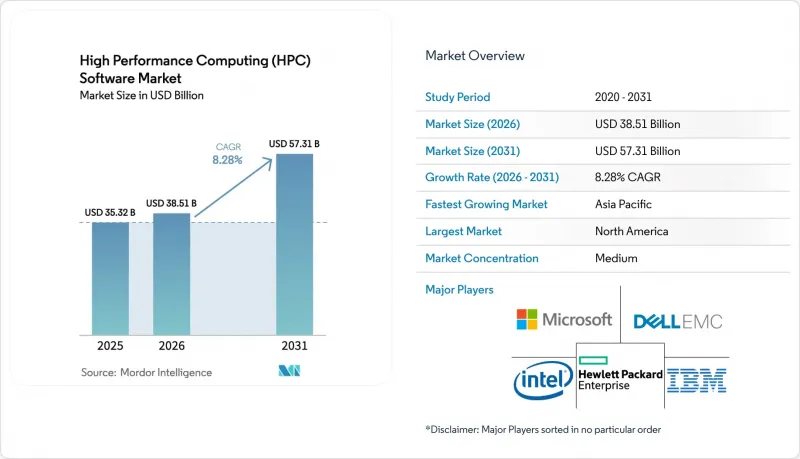
본 보고서는 도입 형태별(온프레미스, 클라우드, 하이브리드), 소프트웨어 카테고리별(워크로드 매니저 및 스케줄러 등), 서비스 모델별(HPC IaaS 등), 최종 사용자 산업별(항공우주 및 방위, 은행, 금융서비스 및 보험(BFSI), 에너지·유틸리티 등), 조직 규모(대기업 등), 지역별로 분류되어 있습니다. 시장 예측은 금액(달러) 기준으로 제시되어 있습니다.
세계의 고성능 컴퓨팅(HPC) 소프트웨어 시장 동향 및 인사이트
클라우드 기반 HPC 소프트웨어의 급속한 확산
클라우드 네이티브 클러스터를 통해 조직은 몇 시간 이내에 수천 개의 CPU 및 GPU 코어를 가동할 수 있으며, 자본 예산에 부담이 되는 수년 단위의 감가상각 주기를 피할 수 있습니다. 강화된 네트워크 패브릭은 인스턴스 간 처리량을 400 Gbps까지 향상시켜, 과거 밀접하게 결합된 CFD 작업을 온프레미스 시스템으로만 제한했던 지연 시간의 격차를 해소하고 있습니다. 이러한 서비스에 통합된 스케줄러는 스팟 용량과 온디맨드 용량을 자동으로 조합하여 활용함으로써, 납기 보장을 유지하면서 단가를 절감합니다. 오픈소스 이미지, 참조 아키텍처 및 관리형 설치 스크립트를 통해 도입 시간이 며칠에서 몇 분으로 단축되어, 연구개발 팀은 서버 설치 작업에 시간을 할애하지 않고 모델의 반복 개발에 전념할 수 있게 됩니다. 재무 및 거버넌스 측면에서도 이러한 전환은 바람직합니다. HPC 관련 지출을 자본 지출(CapEx)에서 운영 비용(OpEx)으로 전환함으로써 현금 흐름 전망이 개선되고, 비용을 프로젝트의 마일스톤에 맞추어 조정할 수 있습니다.
고급 스케줄러가 필요한 AI/ML 훈련의 복잡성
현재, 기반 모델 훈련에는 수만 대의 H100급 GPU가 사용되고 있어, GPU 토폴로지를 인식하지 못하는 레거시 큐 관리자에 큰 부하가 걸리고 있습니다. Slurm 24.05의 새로운 알고리즘은 패브릭 대역폭 메타데이터를 수집하고, 작업을 긴밀하게 연동된 NVLink 아일랜드에 할당함으로써 올 리듀스 오버헤드를 최대 35% 줄이고, 훈련 실행 시간을 며칠 단축합니다. 수 테라바이트에 달하는 체크포인트 크기로 인해 스케줄러는 클라우드 버스트 노드 전체에 걸쳐 병렬 I/O, 내결함성 및 선점 정책을 조정해야 합니다. Kubernetes 기반 오퍼레이터는 이러한 기능을 확장하지만, Fortran을 많이 사용하는 CFD 코드와 PyTorch 워크로드를 병렬로 실행하는 기업들은 여전히 배치 스크립트와 컨테이너를 연결하는 하이브리드 스케줄러에 의존하고 있습니다. 이러한 복잡성을 템플릿이나 블루프린트로 정리한 벤더의 솔루션은 특히 재시작 지연을 허용할 수 없는 제약 업계나 기후 모델링 연구소 등에서 빠르게 보급되고 있습니다.
멀티테넌트 클라우드에서의 데이터 보안 및 지적 재산권 문제
공유 GPU 메모리 계층에서 입증된 사이드 채널 공격은 모델 가중치를 독자적인 지적 재산으로 취급하는 제약 기업이나 반도체 기업에게 심각한 우려 사항이 되고 있습니다. 바젤 III 자본 모델을 관리하는 금융 기관은 하드웨어 기반의 테넌트 분리 기능이 없는 한, 공유 클러스터로의 전환을 주저하고 있습니다. 클라우드 공동 책임 계약에서 암호화 키 관리에 대한 모호함은 위험 평가를 더욱 복잡하게 만들고 있습니다. 그 결과, 기업들은 용도 계층에서의 암호화나 동형 암호화 기술을 채택하고 있지만, 이러한 조치들은 실행 비용과 지연 시간을 증가시켜 전환 속도를 늦추고 있습니다. 규제 당국은 산업별 클라우드 보증 프레임워크 수립을 시작했으나, 하드웨어 벤더가 기본 테넌트 분리 기능을 제공할 때까지는 이러한 소극적인 추세가 지속될 것입니다.
부문 분석
하이브리드 배포는 연평균 성장률(CAGR) 8.82%라는 가장 빠른 성장 궤적을 보이고 있으며, 지연 시간이 중요한 CFD에는 온프레미스 클러스터를, 몬테카를로 시뮬레이션에는 클라우드 버스트를 결합하고 있습니다. 기업들은 Slurm의 클라우드 버스트 플러그인과 Azure CycleCloud의 온프레미스 노드 페더레이션을 통합하여, 인프라 경계를 투명하게 하는 통합 큐를 구축하고 있습니다. AWS Direct Connect 및 Active Directory 페더레이션을 통해 일관된 인증 정보 처리가 가능해져, 인증 관련 장벽이 낮아지고 도입의 문턱이 낮아짐에 따라 도입에 따른 마찰이 완화됩니다. 조직은 보유한 하드웨어를 평균 이용률에 맞추어 규모를 조정하고, 피크 시간대의 부하를 클라우드로 분산함으로써 유휴 자본을 줄이고 운영 예산을 평준화하고 있습니다.
하이브리드 환경의 도입은 규정 준수 목표 달성에도 기여합니다. 기밀 데이터는 전용 랙에 보관되고, 일시적인 워크로드는 다른 장소에서 확장성을 활용하므로 ISO 27001 감사 요건을 충족할 수 있기 때문입니다. 밀접하게 결합된 I/O에서는 데이터 전송의 병목 현상이 여전히 존재하지만, 새롭게 등장한 캐시 일관성 파일 시스템 덕분에 지연 시간이 미치는 부정적인 영향이 완화되고 있습니다. 지역별 스팟 시장이 확대됨에 따라 스케줄러는 네트워크 아웃바운드 요금과 큐 대기 시간을 비교 검토하여, SLA를 충족하면서 가장 저렴한 지역으로 작업을 라우팅하게 됩니다. 그 결과, 고성능 컴퓨팅(HPC) 소프트웨어 시장에서는 동적 비용 예측 모듈이 작업 제출 대시보드에 직접 통합되어, 사용자가 실행 전에 비용을 미리 확인할 수 있게 됩니다.
스케줄러는 여전히 핵심적인 존재이지만, 오픈소스 버전에 따른 수익화 제한으로 인해 2025년 시장 점유율 28.41%는 완만한 성장에 그칠 전망입니다. 대조적으로, 유전체학 및 실시간 추론으로 인해 읽기/쓰기 처리량이 초당 수 테라바이트 규모로 증가함에 따라, 데이터 관리 및 파일 시스템 분야는 연평균 성장률(CAGR) 9.26%로 성장을 지속하고 있습니다. NVMe-over-Fabrics를 채택한 WekaFS는 SSD의 성능과 오브젝트 스토리지의 경제성을 융합하여, 기존 병렬 파일 시스템의 한계에 도달했던 극저온 전자 현미경(cryo-EM) 연구소에서 도입 계약을 따냈습니다.
클러스터가 클라우드 리전을 넘어 확장됨에 따라 세계 네임스페이스 파일 시스템과 라이선스 소비량 모니터링이 필수적이 되었으며, 각 벤더들은 비용과 성능을 연계하는 텔레메트리 엔진을 번들로 제공하기 시작했습니다. 미들웨어 라이브러리는 OpenMPI에 의해 상용화되었지만, 검증된 코드 스택을 통해 버전 드리프트가 배제된 분야에서는 여전히 유지보수 수익을 창출하고 있습니다. 수십 년에 걸친 검증된 시뮬레이션에 얽매여 있는 애플리케이션 소프트웨어는 클라우드 마켓플레이스의 과금 시스템과 통합된 구독 모델을 추구하고 있습니다. 모든 카테고리에서 벤더들은 차별화를 위해 에너지 절약 기능과 규정 준수 기능을 통합하고 있으며, 이는 HPC 소프트웨어 시장이 ‘순수한 성능’에서 ‘정책 주도형 가치’로 전환되고 있음을 여실히 보여줍니다.
지역별 분석
아시아태평양은 중국, 인도, 일본의 국가 자금 지원 AI 프로그램에 힘입어 2031년까지 연평균 성장률(CAGR) 9.06%라는 가장 가파른 성장 궤적을 기록하고 있습니다. 중국의 ‘제14차 5개년 계획’은 수출 규제를 회피하기 위해 국산 운영 체제와 MPI 라이브러리를 지원하고 있으며, 엑사스케일 구축에 직접 통합되는 지역 밀착형 소프트웨어 생태계를 창출하고 있습니다. 인도의 ‘국가 슈퍼컴퓨팅 미션’에서는 데이터 상주 규칙을 강제하는 미들웨어가 도입되어, 국내에서 유지 관리되는 스케줄러를 위한 안정적인 구매자 기반이 형성되고 있습니다. 일본의 ARM 기반 ‘후가쿠’의 성공은 컴파일러 및 라이브러리 벤더들이 비 x86 실리콘을 위한 최적화를 추진하도록 유도하여 플랫폼의 다양성을 넓히고 있습니다.
2025년에 38.92%의 점유율을 차지할 북미는 하이퍼스케일 규모의 경제와 국방 조달의 혜택을 받고 있지만, 기업들이 실적 확대보다 기존 예약 리소스의 최적화에 주력하고 있어 성장세는 둔화되는 추세입니다. 미국 내 주권 클라우드는 규정 준수를 중시하는 워크로드를 위한 새로운 틈새 시장을 개척하고 있지만, Neocloud와 같은 신규 진출기업들은 GPU 시간 단위 할인을 통해 넘쳐나는 수요를 흡수하고 있습니다. 유럽의 정책 환경에서는 감사 가능한 소프트웨어 계층과 탄소 배출을 고려한 운영이 의무화되어 있어, 각 벤더는 ‘사이버 복원력 법’과 ‘에너지 효율 지침’ 모두에 대한 준수 인증을 받아야 합니다.
중동 및 아프리카에서는 석유 달러를 자금원으로 하는 AI 클러스터를 활용해 경제 다각화를 꾀하고 있으며, 국내 데이터센터가 규모를 확대할 때까지 Neocloud 파트너에게 용량을 위탁하고 있습니다. 남미의 학술 컨소시엄은 오픈소스 도입을 주도하고 있지만, 자금 조달이 불안정하여 버스트 용량 확보에는 지역별 클라우드 크레딧에 의존하고 있습니다. 모든 지역의 고성능 컴퓨팅(HPC) 소프트웨어 시장에서는 각국 고유의 조달 조항을 충족하기 위해 언어 팩, 지역별 과금 시스템, 그리고 지역별 데이터 거주지 설정 기능이 통합되어 있습니다.
기타 혜택 :
- 엑셀 형식 시장 예측(ME) 시트
- 3개월간의 애널리스트 지원
자주 묻는 질문
목차
제1장 서론
제2장 조사 방법
제3장 주요 요약
제4장 시장 구도
제5장 시장 규모 및 성장 예측
제6장 경쟁 구도
제7장 시장 기회 및 향후 전망
AJY 26.09.07According to Mordor Intelligence, the high performance computing software market size is expected to increase from USD 35.32 billion in 2025 to USD 38.51 billion in 2026 and reach USD 57.31 billion by 2031, growing at a CAGR of 8.28% over 2026-2031.
This report is Segmented by Deployment Type (On-Premise, Cloud, and Hybrid), Software Category (Workload Managers and Schedulers, and More), Service Model (HPC IaaS, and More), End-User Industry (Aerospace and Defense, BFSI, Energy and Utilities, and More), Organization Size (Large Scale Enterprises, and More), and Geography. The Market Forecasts are Provided in Terms of Value (USD).
Global High Performance Computing (HPC) Software Market Trends and Insights
Rapid Adoption of Cloud-Based HPC Software
Cloud-native clusters let organizations spin up thousands of CPU and GPU cores within hours, bypassing multi-year depreciation cycles that burden capital budgets. Enhanced network fabrics now deliver 400 Gbps instance-to-instance throughput, closing the latency gap that once relegated tightly coupled CFD jobs to on-premises systems. Schedulers integrated into these services automatically mix spot and on-demand capacity, lowering unit costs while preserving deadline guarantees. Open-source images, reference architectures, and managed installer scripts shrink deployment time from days to minutes, freeing R&D teams to iterate on models instead of racking servers. Finance and governance functions also favour the switch: shifting HPC spend from capex to opex improves cash-flow optics and aligns expenses with project milestones.
Rising AI/ML Training Complexity Requiring Advanced Schedulers
Foundation-model training now spans tens of thousands of H100-class GPUs, stressing legacy queue managers that lack GPU topology awareness. New algorithms in Slurm 24.05 capture fabric bandwidth metadata, assign jobs to tightly knit NVLink islands, and cut all-reduce overheads by up to 35%, trimming training runs by days. Checkpoint sizes approaching multi-terabytes force schedulers to coordinate parallel I/O, fault tolerance, and pre-emption policies across cloud burst nodes. Kubernetes-based operators extend these capabilities, but enterprises running Fortran-heavy CFD codes alongside PyTorch workloads still rely on hybrid schedulers that bridge batch scripts and containers. Vendors that wrap these complexities into templates and blueprints see rapid uptake, particularly in pharmaceutical and climate-modelling labs that cannot tolerate restart delays.
Data Security and IP Concerns in Multi-Tenant Cloud
Side-channel exploits demonstrated on shared GPU memory hierarchies raise red flags for pharmaceutical and semiconductor firms that treat model weights as proprietary IP. Financial institutions managing Basel III capital models hesitate to move to shared clusters without hardware-rooted tenant isolation. Ambiguity around encryption-key custody under cloud shared-responsibility agreements further complicates risk assessments. Enterprises therefore add application-layer encryption or homomorphic techniques that inflate runtime costs and latencies, tempering the migration pace. Regulators have begun drafting sector-specific cloud assurance frameworks, but until hardware vendors ship default tenant-isolation features, the restraint persists.
Other drivers and restraints analyzed in the detailed report include:
- Expansion of GPU-Dense Neoclouds Creating New Software TAM
- Sovereignty-Focused Compliance Modules in HPC Stacks
- Shortage of Skilled HPC Software Administrators
For complete list of drivers and restraints, kindly check the Table Of Contents.
Segment Analysis
Hybrid deployments account for the fastest growth trajectory at a 8.82% CAGR, pairing on-premises clusters for latency-critical CFD with cloud bursts for Monte Carlo sweeps. Enterprises integrate Slurm cloud-burst plugins or Azure CycleCloud's on-premises node federation, creating a unified queue that masks infrastructure boundaries. Authentication hurdles lessen as AWS Direct Connect and Active Directory federation allow consistent credential handling, reducing deployment friction. Organizations size owned hardware to average utilization and burst peaks to cloud, shrinking idle capital and smoothing operating budgets.
Hybrid adoption also advances compliance goals because sensitive data reside on dedicated racks while transient workloads exploit elasticity elsewhere, satisfying ISO 27001 audits. Data-transfer bottlenecks persist for tightly coupled I/O, but emerging cache-coherent file systems mitigate latency penalties. As regional spot markets widen, schedulers weigh network egress fees against queue times, routing jobs to the cheapest geography that still meets SLAs. Consequently, the high performance computing (HPC) software market embeds dynamic cost-forecast modules directly in job submission dashboards, letting users preview spend before launch.
Schedulers remain foundational, yet their 28.41% share in 2025 grows modestly because open-source versions cap monetization. In contrast, data management and file systems post a 9.26% CAGR as genomics and real-time inference push read-write throughput toward multi-terabytes per second. WekaFS, with NVMe-over-Fabrics, marries SSD performance to object-store economics, securing deals at cryo-EM labs that previously maxed out traditional parallel file systems.
As clusters stretch across cloud regions, global-namespace file systems and license consumption monitors become indispensable, prompting vendors to bundle telemetry engines that correlate cost and performance. Middleware libraries, though commoditized by OpenMPI, still generate maintenance revenue where validated code stacks preclude version drift. Application software, locked into decades of validated simulations, pursues subscription models that integrate with cloud marketplace billing. Across categories, vendors weave energy-aware features and compliance hooks to differentiate, underscoring the HPC software market's shift from raw performance to policy-driven value.
Complete Report Scope:
- By Deployment Type
- On-Premise
- Cloud
- Hybrid
- By Software Category
- Workload Managers and Schedulers
- Middleware and Libraries
- Application Software
- Performance Monitoring and Analytics
- License and Cost Management
- Data Management and File Systems
- By Service Model
- HPC IaaS
- HPC PaaS
- HPC SaaS
- Managed Services
- By End-User Industry
- Aerospace and Defense
- BFSI
- Energy and Utilities
- Life Sciences and Healthcare
- Manufacturing
- Media and Entertainment
- Academic and Research Institutions
- Government
- By Organization Size
- Large Enterprises
- Medium Enterprises
- Small Enterprises
- By Geography
- North America
- United States
- Canada
- Mexico
- South America
- Brazil
- Argentina
- Rest of South America
- Europe
- Germany
- United Kingdom
- France
- Italy
- Spain
- Russia
- Benelux
- Nordics
- Rest of Europe
- Asia Pacific
- China
- Japan
- India
- South Korea
- ASEAN
- Rest of Asia Pacific
- Middle East
- Turkey
- Israel
- GCC
- Rest of Middle East
- Africa
- South Africa
- Rest of Africa
- North America
Geography Analysis
Asia Pacific records the steepest trajectory at a 9.06% CAGR through 2031, driven by state-funded sovereign AI programs in China, India, and Japan. China's 14th Five-Year Plan backs indigenous operating systems and MPI libraries to circumvent export controls, spawning a localized software ecosystem that plugs directly into exascale builds. India's National Supercomputing Mission deploys middleware that enforces data-residency rules, creating a captive buyer base for domestically maintained schedulers. Japan's ARM-based Fugaku success galvanizes compiler and library vendors to optimize for non-x86 silicon, broadening platform diversity.
North America, holding 38.92% share in 2025, benefits from hyperscale scale economies and defense procurement but shows moderating growth as enterprises optimize existing reservations rather than expanding footprints. Sovereign clouds within the United States carve new niches for compliance-centric workloads, yet Neocloud entrants siphon overflow demand via GPU-hour discounts. Europe's policy landscape mandates auditable software layers and carbon-aware operations, pushing vendors to certify compliance with both the Cyber Resilience Act and Energy Efficiency Directive.
The Middle East and Africa leverage petrodollar-funded AI clusters to diversify economies, contracting Neocloud partners for capacity until domestic data centers scale. South America's academic consortia pioneer open-source adoption but face intermittent funding, relying on regional cloud credits for burst capacity. Across all regions, the high performance computing (HPC) software market embeds language packs, localized billing, and regional data-residency toggles to meet country-specific procurement clauses.
- Amazon Web Services, Inc.
- Microsoft Corporation
- Google LLC
- International Business Machines Corporation
- Hewlett Packard Enterprise Company
- Altair Engineering Inc.
- ANSYS, Inc.
- Dassault Systemes SE
- Dell Technologies Inc.
- Intel Corporation
- Oracle Corporation
- NVIDIA Corporation
- Adaptive Computing Enterprises, Inc.
- SchedMD LLC
- Bright Computing B.V.
- Rescale, Inc.
- Atos SE
- Fujitsu Limited
- Lenovo Group Limited
- NEC Corporation
- CoreWeave, Inc.
Additional Benefits:
- The market estimate (ME) sheet in Excel format
- 3 months of analyst support
TABLE OF CONTENTS
1 INTRODUCTION
- 1.1 Study Assumptions and Market Definition
- 1.2 Scope of the Study
2 RESEARCH METHODOLOGY
3 EXECUTIVE SUMMARY
4 MARKET LANDSCAPE
- 4.1 Market Overview
- 4.2 Impact of Macroeconomic Factors on the Market
- 4.3 Market Drivers
- 4.3.1 Rapid Adoption of Cloud-Based HPC Software
- 4.3.2 Rising AI/ML Training Complexity Requiring Advanced Schedulers
- 4.3.3 Expansion of GPU-Dense "Neoclouds" Creating New Software TAM
- 4.3.4 Open-Source Ecosystem Lowers Entry Barriers for SMEs
- 4.3.5 Energy-Aware Scheduling to Optimize Power-Constrained Data Centers
- 4.3.6 Sovereignty-Focused Compliance Modules in HPC Stacks
- 4.4 Market Restraints
- 4.4.1 Data-Security & IP Concerns in Multi-Tenant Cloud
- 4.4.2 Shortage of Skilled HPC Software Administrators
- 4.4.3 Rising Software License & Support Costs
- 4.4.4 Fragmented Standards Impeding Interoperability
- 4.5 Industry Value-Chain Analysis
- 4.6 Regulatory Landscape
- 4.7 Technological Outlook
- 4.8 Porter's Five Forces Analysis
- 4.8.1 Bargaining Power of Buyers
- 4.8.2 Bargaining Power of Suppliers
- 4.8.3 Threat of New Entrants
- 4.8.4 Threat of Substitutes
- 4.8.5 Intensity of Competitive Rivalry
- 4.9 Investment Analysis
5 MARKET SIZE AND GROWTH FORECASTS (VALUE)
- 5.1 By Deployment Type
- 5.1.1 On-Premise
- 5.1.2 Cloud
- 5.1.3 Hybrid
- 5.2 By Software Category
- 5.2.1 Workload Managers and Schedulers
- 5.2.2 Middleware and Libraries
- 5.2.3 Application Software
- 5.2.4 Performance Monitoring and Analytics
- 5.2.5 License and Cost Management
- 5.2.6 Data Management and File Systems
- 5.3 By Service Model
- 5.3.1 HPC IaaS
- 5.3.2 HPC PaaS
- 5.3.3 HPC SaaS
- 5.3.4 Managed Services
- 5.4 By End-User Industry
- 5.4.1 Aerospace and Defense
- 5.4.2 BFSI
- 5.4.3 Energy and Utilities
- 5.4.4 Life Sciences and Healthcare
- 5.4.5 Manufacturing
- 5.4.6 Media and Entertainment
- 5.4.7 Academic and Research Institutions
- 5.4.8 Government
- 5.5 By Organization Size
- 5.5.1 Large Enterprises
- 5.5.2 Medium Enterprises
- 5.5.3 Small Enterprises
- 5.6 By Geography
- 5.6.1 North America
- 5.6.1.1 United States
- 5.6.1.2 Canada
- 5.6.1.3 Mexico
- 5.6.2 South America
- 5.6.2.1 Brazil
- 5.6.2.2 Argentina
- 5.6.2.3 Rest of South America
- 5.6.3 Europe
- 5.6.3.1 Germany
- 5.6.3.2 United Kingdom
- 5.6.3.3 France
- 5.6.3.4 Italy
- 5.6.3.5 Spain
- 5.6.3.6 Russia
- 5.6.3.7 Benelux
- 5.6.3.8 Nordics
- 5.6.3.9 Rest of Europe
- 5.6.4 Asia Pacific
- 5.6.4.1 China
- 5.6.4.2 Japan
- 5.6.4.3 India
- 5.6.4.4 South Korea
- 5.6.4.5 ASEAN
- 5.6.4.6 Rest of Asia Pacific
- 5.6.5 Middle East
- 5.6.5.1 Turkey
- 5.6.5.2 Israel
- 5.6.5.3 GCC
- 5.6.5.4 Rest of Middle East
- 5.6.6 Africa
- 5.6.6.1 South Africa
- 5.6.6.2 Rest of Africa
- 5.6.1 North America
6 COMPETITIVE LANDSCAPE
- 6.1 Market Concentration
- 6.2 Strategic Moves
- 6.3 Market Share Analysis
- 6.4 Company Profiles (includes Global Level Overview, Market Level Overview, Core Segments, Financials as available, Strategic Information, Market Rank/Share for key companies, Products AND Services, and Recent Developments)
- 6.4.1 Amazon Web Services, Inc.
- 6.4.2 Microsoft Corporation
- 6.4.3 Google LLC
- 6.4.4 International Business Machines Corporation
- 6.4.5 Hewlett Packard Enterprise Company
- 6.4.6 Altair Engineering Inc.
- 6.4.7 ANSYS, Inc.
- 6.4.8 Dassault Systemes SE
- 6.4.9 Dell Technologies Inc.
- 6.4.10 Intel Corporation
- 6.4.11 Oracle Corporation
- 6.4.12 NVIDIA Corporation
- 6.4.13 Adaptive Computing Enterprises, Inc.
- 6.4.14 SchedMD LLC
- 6.4.15 Bright Computing B.V.
- 6.4.16 Rescale, Inc.
- 6.4.17 Atos SE
- 6.4.18 Fujitsu Limited
- 6.4.19 Lenovo Group Limited
- 6.4.20 NEC Corporation
- 6.4.21 CoreWeave, Inc.
7 MARKET OPPORTUNITIES AND FUTURE OUTLOOK
- 7.1 White-Space and Unmet-Need Assessment

(주말 및 공휴일 제외)


