

|
시장보고서
상품코드
2122257
주관절 치환 시장 : 시장 점유율 분석, 업계 동향 및 통계, 성장 예측(2026-2031년)Elbow Replacement - Market Share Analysis, Industry Trends & Statistics, Growth Forecasts (2026 - 2031) |
||||||
 Mordor Intelligence
Mordor Intelligence에 의하면, 2026년 주관절 치환 시장 규모는 1억 9,679만 달러로 추정되고, 2025년 1억 8,485만 달러에서 확대해, 2031년에는 2억 6,921만 달러에 이를 것으로 예측됩니다.
2026-2031년 연평균 성장률(CAGR) 6.46%로 성장할 것으로 전망됩니다.
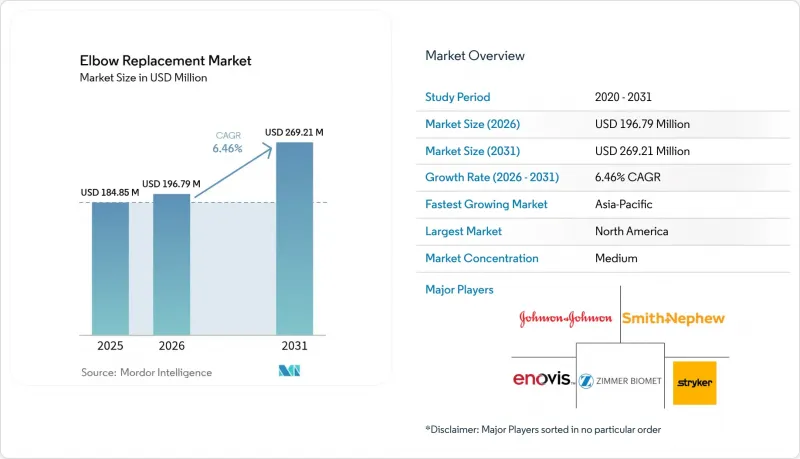
본 보고서는 제품 유형별(부분 주관절 치환술, 전체 주관절 치환술), 임플란트 소재별(티타늄 합금, 코발트·크롬 합금, 탄탈륨 및 기타), 고정 방식별(시멘트 고정식, 시멘트리스식), 최종 사용자별(병원 등), 지역별(북미, 유럽, 아시아태평양, 중동 및 아프리카, 남미)로 분류되어 있습니다. 시장 예측은 금액(달러) 기준으로 제시되어 있습니다.
세계의 주관절 치환 시장 동향 및 인사이트
관절염 부담 증가
퇴행성 관절염 및 류마티스 관절염의 확산으로 인해 팔꿈치 관절 재건 수술 대기자 수는 계속 증가하고 있습니다. 임상 등록 자료에 따르면, 인공 관절 전치환술 후 메이요 팔꿈치 기능 점수는 39점에서 95점으로 개선되었으며, 이 수술이 지속적인 통증 완화책임이 입증되었습니다. 인구 고령화와 고령층의 활동성에 대한 기대감 증가로 인해, 장기적으로 안정적인 수술 후보자 유입이 예상됩니다. 상완삼두근 설상부 접근법(안코네우스 근육 반전법)과 같은 새로운 최소 침습 수술법은 연부 조직 손상을 줄여 조기 재활을 가능하게 하고 있습니다. 이러한 발전이 맞물려 모든 주요 지역에서 수술 건수가 유지되고 있으며, 주관절 치환 시장의 성장 궤도가 더욱 견고해지고 있습니다.
링크 힌지 설계의 급속한 보급
세미컨스트레인드형 링크 힌지 인공관절은 기존의 언컨스트레인드형 기기에 비해, 특히 광범위한 골결손을 동반한 팔꿈치에서 더 뛰어난 내전·외전 안정성을 발휘합니다. 메타 분석에 따르면, 비링크식 시스템과 비교하여 염증성 관절염 사례에서 이완이 적고 10년 생존율이 높은 것으로 보고되었습니다. 임상 교육 과정에 이러한 수술법이 포함됨에 따라 외과의사의 선호도가 변화하고 있으며, 북미 및 서유럽의 각 의뢰 의료기관에서 임플란트 수요가 확대되고 있습니다. 각 제조업체는 수술 중 정렬을 용이하게 하면서도 본래의 운동학을 보호하는 모듈식 스템 및 테이퍼드 플랜지의 개량을 추진하고 있습니다.
대체 요법의 선택지
저침습 관절경 수술에서는 연골 데브리드먼트나 활막 절제가 가능하며, 이를 통해 최종적인 인공관절 치환술을 미룰 수 있으므로 특히 젊은 운동선수들에게 매력적인 선택지가 되고 있습니다. 팔꿈치 관절 고정술은 중증 불안정성이나 감염증에 대한 최후의 수단으로 여전히 사용되고 있으며, 일상생활 동작에 가장 적합한 고정 위치에서 90% 이상의 고정율을 달성하고 있습니다. 또한, 혈소판 농축 혈장(PRP)이나 줄기세포를 이용한 재생의학 주사도 퇴행성 변화의 초기 단계에서 일정한 위치를 확립하고 있습니다. 이러한 대체 치료법은 특정 적응증에만 유효하지만, 전반적으로 주관절 치환술의 적응증이 되는 환자 중 상당 부분을 주관절 치환 시장에서 분산시키고 있습니다.
부문 분석
팔꿈치 관절 전체 치환술은 2025년 매출의 67.73%를 차지했으며, 중증 관절 파괴에 대한 종합적인 해결책으로서의 역할을 부각시키고 있습니다. 이러한 압도적인 점유율은 수술 후 메이요 점수의 중앙값이 40대 초반에서 90대 중반으로 급등했음을 보여주는 수십 년에 걸친 치료 성과 데이터를 반영하고 있습니다. 반관절 치환술 및 요골두 보철물을 포함한 부분 치환 시스템은 젊은 연령대의 외상 환자에게 더 적합하기 때문에 2031년까지 연평균 성장률(CAGR) 6.67%로 성장하고 있습니다. 외과의사들은 염증성 질환이나 말기 퇴행성 질환에는 전체 치환 시스템을 우선적으로 적용하는 한편, 복잡한 골절의 경우에는 골 보존형 부분 치환 옵션을 선택하는 경향이 강해지고 있어, 이로 인해 주관절 치환 시장의 잠재 고객 기반이 확대되고 있습니다.
임상 레지스트리도 이러한 추세를 뒷받침하고 있으며, 수술 후 체중 제한을 준수한 경우 부분 치환용 임플란트의 재수술률은 17%에 그칩니다. 이는 팔꿈치 관절의 까다로운 생체역학적 조건을 고려할 때 허용 가능한 범위입니다. 두 범주 모두, 구성 요소의 정렬 정확도를 높이는 수술 중 3D 내비게이션의 이점을 누리고 있습니다. 이와 동시에, 모듈식 척골 스템을 통해 외과의는 골다공증으로 인한 골수강 협착에 직면한 경우에도 고정력을 강화할 수 있어, 조기 이완을 더욱 줄일 수 있습니다. 이러한 다용도성과 증거에 기반한 신뢰성의 결합으로, 주관절 치환 시장 내에서 두 제품 라인의 매출은 꾸준한 성장을 이루고 있습니다.
코발트-크롬은 입증된 내마모성 덕분에 51.10%의 시장 점유율을 유지하고 있지만, 티타늄 합금은 연평균 성장률(CAGR) 6.88%로 성장을 지속하고, 있습니다. 나사형 티타늄 스템은 해면골에 대한 고정력을 높이고 스트레스 실드를 감소시킵니다. 이러한 특성은 장기적인 골 보존을 중시하는 외과의사들의 공감을 얻고 있습니다. 새로운 다공성 탄탈륨 슬리브와 PEEK 복합 소재는 여전히 틈새 시장에서의 역할에 머물러 있지만, 골량이 부족한 재치환 사례에서 주목받고 있습니다.
레이저 텍스처링 처리된 표면이나 하이드록시아파타이트 코팅은 티타늄의 골전도성을 높여 조기 기능 부하를 가능하게 합니다. 동시에, 항균 필름의 증착은 주요 실패 요인인 인공관절 주변의 감염을 억제하는 것을 목적으로 합니다. 이러한 개선이 진행됨에 따라 재료 구성은 점차 티타늄 쪽으로 전환될 것으로 예상되지만, 수요가 높은 용도에서 코발트-크롬의 입지를 위협하지는 않을 것입니다. 따라서 예측 기간 동안 티타늄 기반 시스템을 이용한 주관절 치환술 시장 규모는 꾸준하고 단계적으로 확대될 것으로 전망됩니다.
지역별 분석
북미는 견실한 보험 환급 제도와 펠로우십 연수를 이수한 상지 외과 의사들의 긴밀한 네트워크 덕분에 2025년 매출의 39.42%를 차지하며 1위를 유지했습니다. 메디케어 진료비 지급의 안정성과 명확하게 정의된 CPT 코드가 수술 건수의 꾸준한 증가를 뒷받침하고 있습니다. 그 뒤를 이어 유럽이 자리 잡고 있으며, 엄격한 MDR 기준이 임상의에게 임플란트의 안전성을 보장하는 동시에 3D 프린팅에 대한 신속 승인을 통해 혁신을 촉진하고 있는 점이 호재로 작용하고 있습니다.
아시아태평양은 중국, 인도, 한국이 사회보험 적용 범위를 확대하고 국내 임플란트 제조를 촉진하고 있어 연평균 성장률(CAGR) 7.22%로 가장 빠른 성장이 예상됩니다. 국가 조달 정책에 따라 단가가 인하되고, 복잡한 재건 수술을 위한 병원 예산이 확대되고 있습니다. 라틴아메리카 및 중동 및 아프리카은 뒤처져 있지만, 도시 지역의 사립 병원이 첨단 영상 진단 장비나 층류 수술실을 도입하고 있는 지역에서는 큰 성장 여지가 보입니다. 이러한 추세가 맞물려, 주관절 치환 시장에서 지리적으로 분산된 성장을 뒷받침하고 있습니다.
기타 혜택 :
- 엑셀 형식 시장 예측(ME) 시트
- 3개월간의 애널리스트 지원
자주 묻는 질문
목차
제1장 서론
제2장 조사 방법
제3장 주요 요약
제4장 시장 구도
제5장 시장 규모 및 성장 예측
제6장 경쟁 구도
제7장 시장 기회 및 향후 전망
AJY 26.09.07According to Mordor Intelligence, elbow replacement market size in 2026 is estimated at USD 196.79 million, growing from 2025 value of USD 184.85 million with 2031 projections showing USD 269.21 million, growing at 6.46% CAGR over 2026-2031.
This report is Segmented by Product Type (Partial Elbow Replacement, Total Elbow Replacement), Implant Material (Titanium Alloys, Cobalt-chrome Alloys, Tantalum & Others), Fixation Technique (Cemented, Cement-Less), End User (Hospitals, and More), and Geography (North America, Europe, Asia-Pacific, Middle East and Africa, South America). The Market Forecasts are Provided in Terms of Value (USD).
Global Elbow Replacement Market Trends and Insights
Growing Burden of Arthritis
Widespread osteo- and rheumatoid arthritis continues to swell the surgical waitlist for elbow reconstruction. Clinical registries show Mayo Elbow Performance Scores improving from 39 to 95 after total arthroplasty, validating surgery as a durable pain-relief strategy. Population aging and higher activity expectations among seniors lock in a steady flow of candidates over the long term. New exposure-sparing techniques such as the anconeus-reflected triceps tongue approach lessen soft-tissue disruption, supporting faster rehabilitation. These advances collectively sustain procedure volumes in all key geographies and reinforce the elbow replacement market trajectory.
Rapid Adoption of Linked-Hinge Designs
Semi-constrained linked-hinge prostheses deliver greater varus-valgus stability than earlier unconstrained devices, especially for elbows with extensive bone loss. Meta-analyses report lower loosening and higher 10-year survivorship in inflammatory arthritis cases relative to non-linked systems. As clinical curricula integrate these techniques, surgeon preference is shifting, boosting implant demand across referral centers in North America and Western Europe. Manufacturers are refining modular stems and tapered flanges that ease intraoperative alignment while safeguarding native kinematics.
Availability of Alternatives
Minimally invasive arthroscopy offers cartilage debridement and synovectomy that defers definitive joint replacement, especially attractive to younger athletes. Elbow fusion remains a fallback for gross instability or infection, achieving fusion rates above 90% at set positions optimal for daily tasks. Regenerative injections using platelet-rich plasma and stem cells have also carved a niche in early-stage degeneration. These substitute pathways, though serving selected indications, collectively divert a measurable slice of surgical candidates away from the elbow replacement market.
Other drivers and restraints analyzed in the detailed report include:
- Technological Advances in 3-D Printed Implants
- Shift Toward Outpatient/ASC Settings
- High Procedure & Device Cost
For complete list of drivers and restraints, kindly check the Table Of Contents.
Segment Analysis
Total elbow replacement generated 67.73% of 2025 revenue, underlining its role as a comprehensive solution for severe articular destruction. This dominance reflects decades of outcome data showing median Mayo scores jumping from the low 40s to the mid-90s post-surgery. Partial systems, covering hemi-arthroplasty and radial head prostheses, are climbing at a 6.67% CAGR through 2031 as they better suit younger trauma patients. Surgeons increasingly reserve total systems for inflammatory or end-stage degenerative conditions while opting for bone-preserving partial options in complex fractures, expanding the elbow replacement market addressable base.
Clinical registries corroborate these trends, noting partial implants achieve 17% reoperation rates-acceptable given the elbow's demanding biomechanics-when postoperative weight limits are respected. Both categories benefit from intraoperative 3D navigation that sharpens component alignment. In parallel, modular ulnar stems let surgeons upsize fixation when encountering osteoporotic canals, further reducing early loosening. This blend of versatility and evidence retention secures steady volume growth across both product lines within the elbow replacement market.
Cobalt-chrome retained 51.10% share owing to its proven wear resistance, yet titanium alloys are notching a 6.88% CAGR. Threaded titanium stems boost cancellous purchase and reduce stress shielding, qualities that resonate with surgeons focused on long-term bone preservation. Novel porous tantalum sleeves and PEEK composites continue in niche roles but command interest for revision cases with compromised bone stock.
Laser-textured surfaces and hydroxyapatite coatings amplify titanium's osteoconductivity, enabling earlier functional loading. Concurrently, antimicrobial film deposition targets periprosthetic infection, a pivotal failure mode. As these enhancements mature, material mix is likely to tilt incrementally toward titanium without displacing chrome-cobalt's seat in high-demand applications. The elbow replacement market size for titanium-based systems is therefore expected to climb meaningfully yet progressively over the forecast horizon.
Complete Report Scope:
- By Product Type
- Partial Elbow Replacement
- Total Elbow Replacement
- By Implant Material
- Titanium Alloys
- Cobalt-Chrome Alloys
- Tantalum & Others
- By Fixation Technique
- Cemented
- Cement-less
- By End User
- Hospitals
- Orthopedic & Specialty Centers
- Ambulatory Surgical Centers
- By Geography
- North America
- United States
- Canada
- Mexico
- Europe
- Germany
- United Kingdom
- France
- Italy
- Spain
- Rest of Europe
- Asia-Pacific
- China
- Japan
- India
- Australia
- South Korea
- Rest of Asia-Pacific
- Middle East & Africa
- GCC
- South Africa
- Rest of Middle East & Africa
- South America
- Brazil
- Argentina
- Rest of South America
- North America
Geography Analysis
North America preserved leadership with 39.42% of 2025 turnover, thanks to robust reimbursement frameworks and a dense network of fellowship-trained upper-extremity surgeons. Medicare fee stability and clearly defined CPT codes underpin steady procedural uptake. Europe follows, buoyed by stringent MDR standards that reassure clinicians of implant safety while still encouraging innovation through fast-track 3D printing approvals.
Asia-Pacific is the fastest riser, projected at 7.22% CAGR, as China, India, and South Korea broaden social insurance and cultivate domestic implant fabrication. National procurement drives lower unit prices, expanding hospital budgets for complex reconstructions. Latin America and the Middle East & Africa trail but show meaningful upside where urban private hospitals install advanced imaging and laminar-flow theaters. Collectively, these patterns support geographically diversified growth for the elbow replacement market.
- Zimmer Biomet
- Stryker
- Smiths Group
- DJO Global / Enovis
- Johnson & Johnson
- Lima Corporate
- Corin Group
- Exactech
- Medacta Group
- Aesculap (B. Braun)
- Arthrex
- Evolutis
- Implantcast GmbH
- Acumed
- United Orthopedic Corp.
- Peter Brehm GmbH
- Biotechni
- An-Trauma
- Stryker
Additional Benefits:
- The market estimate (ME) sheet in Excel format
- 3 months of analyst support
TABLE OF CONTENTS
1 Introduction
- 1.1 Study Assumptions & Market Definition
- 1.2 Scope of the Study
2 Research Methodology
3 Executive Summary
4 Market Landscape
- 4.1 Market Overview
- 4.2 Market Drivers
- 4.2.1 Growing Burden of Arthritis
- 4.2.2 Rapid Adoption of Linked-Hinge Designs
- 4.2.3 Technological Advances in 3-D Printed Implants
- 4.2.4 Shift Toward Outpatient/ASC Settings
- 4.2.5 Expanding Reimbursement in Emerging Markets
- 4.2.6 Antimicrobial Coating Breakthroughs
- 4.3 Market Restraints
- 4.3.1 Availability of Alternatives (Arthroscopy, Fusion)
- 4.3.2 High Procedure & Device Cost
- 4.3.3 Post-Operative Complications and Implant Longevity
- 4.3.4 Limited Availability of Specialized Surgeons
- 4.4 Technological Outlook
- 4.5 Porter's Five Forces Analysis
- 4.5.1 Threat of New Entrants
- 4.5.2 Bargaining Power of Buyers
- 4.5.3 Bargaining Power of Suppliers
- 4.5.4 Threat of Substitutes
- 4.5.5 Competitive Rivalry
5 Market Size & Growth Forecasts (Value in USD)
- 5.1 By Product Type
- 5.1.1 Partial Elbow Replacement
- 5.1.2 Total Elbow Replacement
- 5.2 By Implant Material
- 5.2.1 Titanium Alloys
- 5.2.2 Cobalt-Chrome Alloys
- 5.2.3 Tantalum & Others
- 5.3 By Fixation Technique
- 5.3.1 Cemented
- 5.3.2 Cement-less
- 5.4 By End User
- 5.4.1 Hospitals
- 5.4.2 Orthopedic & Specialty Centers
- 5.4.3 Ambulatory Surgical Centers
- 5.5 By Geography
- 5.5.1 North America
- 5.5.1.1 United States
- 5.5.1.2 Canada
- 5.5.1.3 Mexico
- 5.5.2 Europe
- 5.5.2.1 Germany
- 5.5.2.2 United Kingdom
- 5.5.2.3 France
- 5.5.2.4 Italy
- 5.5.2.5 Spain
- 5.5.2.6 Rest of Europe
- 5.5.3 Asia-Pacific
- 5.5.3.1 China
- 5.5.3.2 Japan
- 5.5.3.3 India
- 5.5.3.4 Australia
- 5.5.3.5 South Korea
- 5.5.3.6 Rest of Asia-Pacific
- 5.5.4 Middle East & Africa
- 5.5.4.1 GCC
- 5.5.4.2 South Africa
- 5.5.4.3 Rest of Middle East & Africa
- 5.5.5 South America
- 5.5.5.1 Brazil
- 5.5.5.2 Argentina
- 5.5.5.3 Rest of South America
- 5.5.1 North America
6 Competitive Landscape
- 6.1 Market Concentration
- 6.2 Market Share Analysis
- 6.3 Company Profiles (includes Global level Overview, Market level overview, Core Segments, Financials as available, Strategic Information, Market Rank/Share for key companies, Products & Services, and Recent Developments)
- 6.3.1 Zimmer Biomet
- 6.3.2 Stryker Corp.
- 6.3.3 Smith & Nephew plc
- 6.3.4 DJO Global / Enovis
- 6.3.5 Johnson & Johnson (DePuy Synthes)
- 6.3.6 Lima Corporate
- 6.3.7 Corin Group
- 6.3.8 Exactech
- 6.3.9 Medacta Group
- 6.3.10 Aesculap (B. Braun)
- 6.3.11 Arthrex
- 6.3.12 Evolutis
- 6.3.13 Implantcast GmbH
- 6.3.14 Acumed LLC
- 6.3.15 United Orthopedic Corp.
- 6.3.16 Peter Brehm GmbH
- 6.3.17 Biotechni
- 6.3.18 An-Trauma
- 6.3.19 Stryker Corporation
7 Market Opportunities & Future Outlook
- 7.1 White-space & Unmet-Need Assessment


