

|
시장보고서
상품코드
2122260
플라스틱 첨가제 시장 : 시장 점유율 분석, 업계 동향 및 통계, 성장 예측(2026-2031년)Plastic Additives - Market Share Analysis, Industry Trends & Statistics, Growth Forecasts (2026 - 2031) |
||||||
 Mordor Intelligence
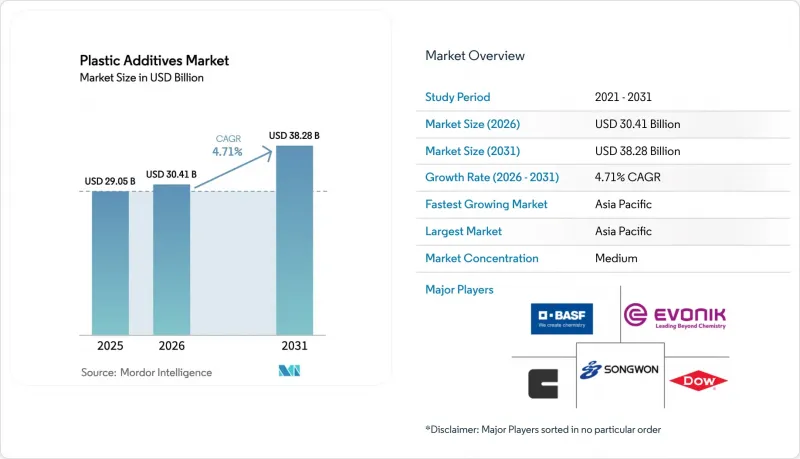
Mordor Intelligence에 의하면, 플라스틱 첨가제 시장 규모는 2025년에 290억 5,000만 달러로 평가되었고, 2026년에 304억 1,000만 달러로 추정되고, 2031년까지 382억 8,000만 달러에 이를 것으로 예측되며, 2026-2031년 CAGR 4.71%로 성장할 전망입니다.
본 보고서는 유형별(윤활제, 가공 보조제, 유동성 향상제 등), 플라스틱 유형별(폴리에틸렌(PE), 폴리프로필렌(PP) 등), 형태별(마스터배치, 분말, 액상 농축액), 용도별(포장, 소비재 등), 지역별(아시아태평양, 북미, 유럽, 남미, 중동 및 아프리카)로 분류되어 있습니다. 시장 예측은 금액(달러) 기준으로 제시되어 있습니다.
세계의 플라스틱 첨가제 시장 동향 및 인사이트
경량 전기차(EV) 부품이 고성능 첨가제 수요를 견인
배터리식 전기차(EV) 플랫폼에서는 무게를 늘리지 않으면서도 150°C 이상의 온도를 견딜 수 있는 폴리머 부품이 요구되고 있습니다. 전력 전자 장치용 폴리아미드 및 폴리카보네이트 하우징에는 현재 고온 사용 환경에서도 인장 강도와 난연성을 유지하는 열안정제 및 내충격 개질제가 필요합니다. 윤활유 배합 제조업체들은 표면 마감을 개선하면서 사출 성형 사이클 시간을 8%-12% 단축하는 불소계 및 실리콘계 화학 물질을 도입하고 있습니다. 테슬라의 2025년판 공급업체 규범에서는 무할로겐 솔루션을 활용한 UL 94 V-0 규격 준수가 의무화되어 있으며, 이로 인해 특수 패키지의 판매 가격이 최대 35% 상승했습니다. 그 결과, 연구개발 기능을 통합한 제조업체들은 장기 공급 계약을 확보하여 원자재 가격 변동으로부터 이익률을 보호하고 있습니다. 자동차 제조업체들이 더욱 엄격한 지속가능성 평가 기준을 발표함에 따라, 저VOC 및 재활용 가능성 인증을 획득할 수 있는 첨가제 공급업체는 플라스틱 첨가제 시장에서 증가하는 수요를 타사보다 더 큰 비중으로 확보할 수 있는 입장에 있습니다.
소비자용 및 산업용 분야에서의 금속에서 플라스틱으로의 대체
내식성, 경량화, 높은 형상 자유도로 인해 펌프 하우징, 밸브 본체, 가전 부품 분야에서 금속을 강화 플라스틱으로 대체하는 추세가 가속화되고 있습니다. 아연 다이캐스팅을 내충격성 ABS로 대체한 가전 제조업체는 40%의 비용 절감을 실현했으며, 인몰드 성형을 통한 설계 자유도를 활용하여 부품 수를 줄였습니다. 2025년에 발효될 유럽연합(EU)의 에코디자인 규정에서는 단일 소재 제품에 더 높은 순환성 점수가 부여되며, 기계적 강도를 확보하기 위해 첨단 패키징에 의존하는 단일 폴리머 조립체의 보급을 촉진하고 있습니다. 설계 엔지니어들이 점점 더 얇은 두께를 추구함에 따라, 핵형성제 및 장기 열안정제가 주목을 받고 있으며, 배합의 복잡성이 증가하고 있습니다. 이러한 추세로 인해 전 세계 배합 제조업체와 지역에 초점을 맞춘 블렌드 제조업체 간의 역량 격차가 확대되고, 플라스틱 첨가제 시장의 통합 경향이 더욱 강해지고 있습니다.
주석 및 인 원료 가격 변동이 이익률을 압박
인도네시아는 2025년에 주석 수출 할당량을 15% 감축했으며, 이로 인해 LME 현물 가격은 연말까지 톤당 2만 5,000달러에서 3만 500달러로 상승했습니다. 동시에 미얀마의 정세 불안으로 인해 오산화인 출하가 차질을 빚으면서, 유럽의 안정제 제조업체들은 모로코에서 22%의 프리미엄을 지불하고 조달할 수밖에 없게 되었습니다. 유기주석계 안정제는 경질 PVC 파이프에 여전히 필수적이지만, 칼슘·아연계 대체재는 사용량이 30% 더 많이 필요하기 때문에 가공업체의 수익성을 저해하고 있습니다. 이익률 압박은 장기 계약을 맺지 않은 중견 배합 제조업체에게 가장 심각하여, 이들은 시장 철수나 사업 다각화를 강요받고 있습니다. 따라서 플라스틱 첨가제 시장은 주석을 많이 사용하는 제품 라인에 대한 자본 투자를 주저하게 만드는 단기적인 비용 변동에 직면해 있습니다.
부문 분석
가공 보조제는 2026-2031년 4.78%라는 가장 높은 연평균 성장률(CAGR)을 보일 것으로 전망됩니다. 이는 가공업체들이 성형품 표면으로 이동하지 않는 용융 유동성 향상을 우선시하고 있기 때문입니다. 기존에 PVC 분야에서 확고한 입지를 다져온 불소수지계 가공 보조제는 현재 PFAS(퍼플루오로알킬 물질)에 대한 엄격한 감시를 받고 있으며, 이에 따라 동등한 성능의 90%를 발휘하는 아크릴계 및 실리콘계 대체재의 부상이 가속화되고 있습니다. ‘기타’로 분류되는 윤활제, 슬립제, 정전기 방지제로 구성된 플라스틱 첨가제 시장은 폴리에틸렌 필름 및 성형 포장재에 널리 사용되고 있어 2025년에 최대 시장 규모에 도달했습니다. 압출 성형 라인에서는 사이클 타임을 5%-8% 단축하는 것을 목표로 하고 있으며, 유동성 향상제는 특히 자동차 내장재용 폴리프로필렌 패널의 두께를 얇게 만드는 것을 가능하게 하여 OEM의 경량화 목표에 직접 기여하고 있습니다.
2025년, 착색제는 플라스틱 첨가제 시장에서 45.87%의 점유율을 차지했습니다. 이는 포장, 건설, 모빌리티 분야에서의 미적 차별화, 브랜딩 및 기능성 착색에 대한 수요에 힘입은 결과입니다. 재활용 폴리머와 호환되는 마스터배치의 채택과 내열성, 자외선 저항성, 식품 접촉 적합성을 갖춘 안료의 혁신이 그 사용을 뒷받침하고 있습니다. 재활용률이 높은 필름 및 성형 부품용 첨단 착색제는 그 용도를 더욱 확대하며 시장에서 중요한 역할을 확고히 하고 있습니다.
폴리에틸렌은 필름 외에도 농업용 랩이나 블로우 성형 용기에서 진열 안정성을 확보하기 위한 미끄럼제나 UV 시스템에 널리 의존하고 있기 때문에 2025년에는 전 세계 플라스틱 첨가제 시장 점유율의 17.87%를 차지했습니다. 재활용 소재 함유율 목표치가 상향됨에 따라 폴리에틸렌에 대한 수요는 계속해서 증가하고 있으며, 용융 점도 및 적외선(IR) 차단 성능을 회복시키는 첨가제 패키지가 필요해지고 있습니다. 폴리스티렌, 특히 발포 폴리스티렌의 경우, 난연 기술의 혁신으로 인해 건축용 단열재에서 규제를 준수하는 무할로겐화가 가능해짐에 따라 2031년까지 연평균 성장률(CAGR) 4.66%를 나타낼 것으로 예측됩니다.
폴리프로필렌은 전기차 인테리어 용도로 인해 수혜를 보고 있으며, 탈크 충전 등급의 경우 -20°C 이하에서도 연성을 유지하기 위해 커플링제가 필요하기 때문에 이것이 아시아태평양 전체 플라스틱 첨가제 시장 규모에서 한 자릿수 중반의 성장을 뒷받침하고 있습니다. 폴리염화비닐(PVC)의 열안정제에 대한 의존도는 프탈레이트 사용 중단이라는 역풍에 직면해 있지만, 인프라 프로젝트에서의 경질 파이프 수요가 기준선 공급량을 지탱하고 있습니다. 폴리에틸렌 테레프탈레이트(PET)는 높은 PCR(재활용 플라스틱) 함유 블렌드로의 전환이 진행되고 있으며, 기계적 특성을 회복하기 위해 사슬 연장제 및 아세트알데히드 스캐빈저가 사용되고 있습니다. 폴리카보네이트와 폴리아미드는 엔진룸 내 부품이나 산업기계와 같은 고부가가치 틈새 시장에서 활용되고 있으며, 이곳에서는 고품질 첨가제 패키지를 통해 150°C에서의 치수 안정성과 UL 94 V-0 규격 준수가 실현되어, 플라스틱 첨가제 시장 공급업체에게 우수한 수익률 기회를 보장하고 있습니다.
지역별 분석
아시아태평양은 2025년 플라스틱 첨가제 시장의 53.12% 점유율을 차지했으며, 2031년까지 연평균 성장률(CAGR) 5.27%로 확대될 것으로 예측됩니다. 중국의 ‘이중 순환’ 정책에 따라 컴파운더들은 현지 첨가제 공급업체를 이용하도록 유도되고 있으며, 이로 인해 산둥성과 절강성에서 생산 능력의 급속한 확대가 촉진되고 있습니다. 이 지역들에서는 2025년에 폴리프로필렌의 신규 처리량이 12% 증가했습니다. 인도의 ‘생산 연계 인센티브(PLI)’ 제도에 따라 첨단 화학 분야 투자자들에게 12억 달러가 지급되어, 2028년까지 첨가제 생산 능력을 연간 8만 5,000톤 증가시키는 프로젝트가 촉진되고 있습니다. 일본에서는 생산량이 정체되어 있으나, 엔지니어링 수지용 첨가제에 대한 특수 용도 수요가 지속되고 있습니다. 한편, 한국의 대형 전자 기업들은 무할로겐 난연 시스템을 지정하고 있어, 이에 따라 국내 소비량 증가율은 한 자릿수 중반에 달하고 있습니다.
북미에서는 생산의 국내 복귀(리쇼어링)와 ‘인플레이션 억제법(Inflation Reduction Act)’의 혜택을 받고 있으며, 이 법은 텍사스주 및 루이지애나주의 국내 특수 화학제품 생산 라인을 지원하고 있어 2026년까지 연간 총 4만 톤의 생산이 예상됩니다. 캐나다는 프탈레이트 금지 조치를 미국의 정책에 맞추어 시트르산염의 채택을 가속화하고 있습니다. 한편, 멕시코에서는 자동차 수출이 범퍼 페시아 및 대시보드에 폴리프로필렌 개질제의 사용을 촉진하고 있습니다. 유럽의 순환 경제 관련 법률에서는 단일 소재 설계가 우선시되고 있어, 금속과 플라스틱의 하이브리드 소재를 대체할 고기능 첨가제 패키지에 대한 수요가 증가하고 있습니다. 독일, 프랑스, 이탈리아에서는 퇴비화 가능한 포장재용 바이오 마스터배치의 보급이 진행되고 있는 반면, 스칸디나비아 국가들에서는 건축용 패널에 무할로겐 난연제 사용이 의무화되어 있어 전문 배합 제조업체들에게 유망한 비즈니스 기회가 확보되고 있습니다.
남미의 성장을 주도하고 있는 것은 브라질입니다. 이 나라에서는 2025년에 경작 면적이 450만 헥타르 확대됨에 따라, UV(자외선) 및 광확산 시스템을 채택한 농업용 필름 수요가 증가했습니다. 아르헨티나에서는 자동차 부품 수출이 폴리프로필렌 및 폴리아미드용 첨가제의 채택 확대를 뒷받침하고 있지만, 환율 변동으로 인해 설비 투자는 억제되고 있습니다. 중동에서는 사우디아라비아가 현지에서 컴파운딩을 추진함으로써 하류 분야에 대한 투자가 이루어지고 있으며, 새로 가동된 PE 및 PP 생산 라인을 위한 가공 보조제를 중심으로 신흥 플라스틱 첨가제 시장이 열리고 있습니다. 남아프리카의 소매업체들은 유통 기한 연장을 목적으로 항균성 포장을 지정하고 있으며, 콜드체인에 대한 제약이 여전히 남아 있는 이 지역에서 조기 도입이 진행되고 있습니다.
기타 혜택 :
- 엑셀 형식 시장 예측(ME) 시트
- 3개월간의 애널리스트 지원
자주 묻는 질문
목차
제1장 서론
제2장 조사 방법
제3장 주요 요약
제4장 시장 구도
제5장 시장 규모 및 성장 예측
제6장 경쟁 구도
제7장 시장 기회 및 향후 전망
AJY 26.09.07According to Mordor Intelligence, the plastic additives market size is projected to be USD 29.05 billion in 2025, USD 30.41 billion in 2026, and reach USD 38.28 billion by 2031, growing at a CAGR of 4.71% from 2026 to 2031.
This report is Segmented by Type (Lubricants, Processing Aids, Flow Improvers, and More), Plastic Type (Polyethylene (PE), Polypropylene (PP) and More), Form (Masterbatch, Powder, and Liquid Concentrate), Application (Packaging, Consumer Goods, and More), and Geography (Asia-Pacific, North America, Europe, South America, Middle East and Africa). The Market Forecasts are Provided in Terms of Value (USD).
Global Plastic Additives Market Trends and Insights
Lightweight-EV Components Boosting High-Performance Additives
Battery-electric platforms demand polymer parts that tolerate temperatures above 150 °C without adding weight. Polyamide and polycarbonate housings for power electronics now require heat stabilizers and impact modifiers that preserve tensile and flammability performance at elevated service temperatures. Lubricant formulators are introducing fluorinated and silicone chemistries that cut injection-molding cycle times by 8%-12% while improving surface finish. Tesla's 2025 supplier code mandates UL 94 V-0 compliance using halogen-free solutions, inflating specialty-package selling prices by up to 35%. Producers with integrated research and development are consequently securing long-term supply contracts, shielding margins from raw-material swings. As automakers publish stricter sustainability scorecards, additive suppliers that can certify low-VOC and recyclability credentials are positioned to capture a disproportionate share of incremental volume in the plastics additives market.
Plastics Replacing Metals Across Consumer and Industrial Uses
Corrosion resistance, lightweighting, and shape versatility are accelerating the substitution of metals with reinforced plastics in pump housings, valve bodies, and appliance components. Appliance OEMs that swapped zinc die-casts for impact-modified ABS achieved 40% cost savings and reduced component and part count through mold-in design freedom. The European Union's Ecodesign Regulation, effective 2025, assigns higher circularity scores to mono-material goods, catalyzing single-polymer assemblies that rely on advanced additive packages for mechanical strength. As design engineers pursue ever-thinner wall sections, nucleating agents and long-term heat stabilizers gain favor, elevating formulation complexity. This dynamic widens the capability gap between global formulators and regionally focused blenders, reinforcing consolidation trends inside the plastics additives market.
Tin and Phosphorus Feedstock Volatility Compressing Margins
Indonesia cut its tin export quota by 15% in 2025, driving LME spot prices from USD 25,000/ton to USD 30,500/ton by year-end. Concurrently, Myanmar's political turbulence disrupted phosphorus pentoxide shipments, forcing European stabilizer makers to source from Morocco at 22% premiums. Organotin stabilizers remain indispensable for rigid PVC pipe, yet calcium-zinc alternatives need 30% higher dosages, undermining converter economics. Margin squeeze is most acute for mid-tier formulators lacking long-term contracts, compelling exit or diversification. The plastics additives market, therefore, confronts short-run cost volatility that discourages capital deployment in tin-intensive product lines.
Other drivers and restraints analyzed in the detailed report include:
- Asia-Pacific Urbanisation Expanding Packaging Demand
- Mandatory Compostable-Packaging Laws Lifting Bio-Additive Masterbatch
- Phthalate Plasticiser Phase-Out in United States and Europe Shrinking Addressable Volume
For complete list of drivers and restraints, kindly check the Table Of Contents.
Segment Analysis
Processing aids captured the fastest 4.78% CAGR outlook between 2026 and 2031 as converters prioritize melt-flow improvements that do not migrate to part surfaces. Fluoropolymer-based aids, historically entrenched in PVC, now grapple with PFAS scrutiny that has accelerated the rise of acrylic and silicone replacements delivering 90% comparable performance. The plastics additives market size for lubricants, slip, and antistatic agents, collectively grouped under "other types," reached the largest value pool in 2025 due to their ubiquity in polyethylene film and molded packaging. As extrusion lines target 5%-8% shorter cycles, flow improvers specifically enable thinner polypropylene panels for vehicle interiors, a direct contribution to OEM lightweight targets.
In 2025, colorants held a 45.87% share of the plastic additives market, driven by demand for aesthetic differentiation, branding, and functional coloration in packaging, construction, and mobility. The adoption of recycled polymer-compatible masterbatches and innovations in heat-stable, UV-resistant, and food-contact-compliant pigments are boosting usage. Advanced colorants for high recycled-content films and molded parts further expand their applications, cementing their key role in the market.
Polyethylene commanded 17.87% of the global plastics additives market share in 2025 thanks to expansive use in films, agricultural wraps, and blow-molded containers that rely on slip and UV systems for shelf integrity. Demand for polyethylene continues to build as recycled content targets advance, necessitating additive packages that re-establish melt viscosity and IR barrier performance. Polystyrene, particularly in its expanded form, is expected to post a 4.66% CAGR through 2031 after flame-retardant innovations enabled code-compliant absence of halogens in building insulation.
Polypropylene benefits from electric-vehicle interior applications where talc-filled grades need coupling agents to maintain ductility below -20 °C, underpinning mid-single-digit growth in plastics additives market size across Asia-Pacific. Polyvinyl chloride's ongoing dependence on heat stabilizers faces headwinds from phthalate withdrawals, yet rigid-pipe demand in infrastructure projects supports baseline volume. Polyethylene terephthalate, transitioning toward high-PCR blends, uses chain extenders and acetaldehyde scavengers to restore mechanical properties. Polycarbonate and polyamide serve high-value niches in under-hood components and industrial machinery, where premium additive packages enable 150 °C dimensional stability and UL 94 V-0 compliance, locking in superior margin opportunities for suppliers in the plastics additives market.
Complete Report Scope:
- By Type
- Lubricants
- Processing Aids (Fluro-polymer-based)
- Flow Improvers
- Slip Additives
- Antistatic Additives
- Pigment Wetting Agents
- Colorants
- Antifog Additives
- Plasticizers
- Other Types (Filler Dispersants, Blowing Agent, Anti-blocking Agents, Coupling agents, etc.)
- By Plastic Type
- Polyethylene (PE)
- Polypropylene (PP)
- Polyvinyl Chloride (PVC)
- Polystyrene (PS)
- Polyethylene Terephthalate (PET)
- Polycarbonate (PC)
- Polyamides (PA)
- Other Plastic Types
- By Form
- Masterbatch
- Powder
- Liquid Concentrate
- By Application
- Packaging
- Consumer Goods
- Construction
- Automotive
- Others (Medical, 3D Printing)
- By Geography
- Asia-Pacific
- China
- India
- Japan
- South Korea
- Rest of Asia-Pacific
- North America
- United States
- Canada
- Mexico
- Europe
- Germany
- United Kingdom
- France
- Italy
- NORDIC Countries
- Rest of Europe
- South America
- Brazil
- Argentina
- Rest of South America
- Middle East and Africa
- Saudi Arabia
- South Africa
- Rest of Middle East and Africa
- Asia-Pacific
Geography Analysis
Asia-Pacific held 53.12% of the plastics additives market share in 2025 and is projected to expand at a 5.27% CAGR through 2031. China's dual-circulation agenda steers compounders toward local additive suppliers, supporting rapid capacity additions in Shandong and Zhejiang provinces that logged 12% new polypropylene throughput in 2025. India's Production-Linked Incentive disbursed USD 1.2 billion to advanced-chemistry investors, catalyzing projects that will add 85,000 ton/year of additive output by 2028. Japan sustains specialty demand for engineering resin additives despite flat volume, while South Korea's electronics majors specify halogen-free flame systems, lifting local consumption growth to the mid-single digits.
North America benefits from reshoring and the Inflation Reduction Act, which underwrites domestic specialty-chemical lines in Texas and Louisiana, slated to total 40,000 tons/year by 2026. Canada aligns its phthalate bans with U.S. policy, accelerating citrate adoption, whereas Mexico's vehicle exports stimulate polypropylene modifier use in bumper fascia and dashboards. Europe's circular-economy laws prioritize mono-material designs, pushing demand for high-function additive packages that replace metal-plastic hybrids. Germany, France, and Italy lead bio-masterbatch penetration for compostable packaging, while Scandinavia mandates halogen-free flame retardants in construction panels, securing premium opportunities for specialized formulators.
South America's growth is led by Brazil, where a 4.5 million-hectare expansion in planted area during 2025 increased agricultural-film demand that employs UV and light-diffusion systems. Argentina's auto-parts exports propel incremental polypropylene and polyamide additive uptake, although currency volatility tempers capital spending. The Middle East invests downstream via Saudi Arabia's local compounding push, opening a nascent plastics additives market centered on processing aids for newly commissioned PE and PP lines. South Africa's retailers specify antimicrobial packages for extended shelf life, marking early adoption in a region still constrained by cold-chain limitations.
- ADEKA CORPORATION
- Albemarle Corporation
- Arkema
- Avient Corporation
- Baerlocher GmbH
- BASF
- Clariant
- Croda International Plc
- Dow
- Emery Oleochemicals
- Evonik Industries AG
- Exxon Mobil Corporation
- KANEKA CORPORATION
- LANXESS
- Mitsui & Co.Plastics Ltd.
- Nouryon
- Peter Greven GmbH & Co. KG
- SABO S.p.A.
- Solvay
- Songwon Industrial Co. Ltd.
- Struktol Company of America, LLC
Additional Benefits:
- The market estimate (ME) sheet in Excel format
- 3 months of analyst support
TABLE OF CONTENTS
1 Introduction
- 1.1 Study Assumptions and Market Definition
- 1.2 Scope of the Study
2 Research Methodology
3 Executive Summary
4 Market Landscape
- 4.1 Market Overview
- 4.2 Market Drivers
- 4.2.1 Lightweight-EV Components Boosting High-Performance Additives
- 4.2.2 Plastics Replacing Metals Across Consumer and Industrial Uses
- 4.2.3 Asia-Pacific Urbanisation Expanding Packaging Demand
- 4.2.4 Mandatory Compostable-Packaging Laws Lifting Bio-Additive Masterbatch
- 4.2.5 Rapid Adoption of Antimicrobial Surfaces in Healthcare and Food and Beverage Plastics
- 4.3 Market Restraints
- 4.3.1 Tin and Phosphorus Feedstock Volatility Compressing Margins
- 4.3.2 Phthalate Plasticiser Phase-Out in the United States and Europe Shrinking Addressable Volume
- 4.3.3 PFAS-Based Processing-Aid Restrictions Curbing Adoption
- 4.4 Value Chain Analysis
- 4.5 Porter's Five Forces
- 4.5.1 Bargaining Power of Suppliers
- 4.5.2 Bargaining Power of Buyers
- 4.5.3 Threat of New Entrants
- 4.5.4 Threat of Substitutes
- 4.5.5 Degree of Competition
5 Market Size and Growth Forecasts (Value)
- 5.1 By Type
- 5.1.1 Lubricants
- 5.1.2 Processing Aids (Fluro-polymer-based)
- 5.1.3 Flow Improvers
- 5.1.4 Slip Additives
- 5.1.5 Antistatic Additives
- 5.1.6 Pigment Wetting Agents
- 5.1.7 Colorants
- 5.1.8 Antifog Additives
- 5.1.9 Plasticizers
- 5.1.10 Other Types (Filler Dispersants, Blowing Agent, Anti-blocking Agents, Coupling agents, etc.)
- 5.2 By Plastic Type
- 5.2.1 Polyethylene (PE)
- 5.2.2 Polypropylene (PP)
- 5.2.3 Polyvinyl Chloride (PVC)
- 5.2.4 Polystyrene (PS)
- 5.2.5 Polyethylene Terephthalate (PET)
- 5.2.6 Polycarbonate (PC)
- 5.2.7 Polyamides (PA)
- 5.2.8 Other Plastic Types
- 5.3 By Form
- 5.3.1 Masterbatch
- 5.3.2 Powder
- 5.3.3 Liquid Concentrate
- 5.4 By Application
- 5.4.1 Packaging
- 5.4.2 Consumer Goods
- 5.4.3 Construction
- 5.4.4 Automotive
- 5.4.5 Others (Medical, 3D Printing)
- 5.5 By Geography
- 5.5.1 Asia-Pacific
- 5.5.1.1 China
- 5.5.1.2 India
- 5.5.1.3 Japan
- 5.5.1.4 South Korea
- 5.5.1.5 Rest of Asia-Pacific
- 5.5.2 North America
- 5.5.2.1 United States
- 5.5.2.2 Canada
- 5.5.2.3 Mexico
- 5.5.3 Europe
- 5.5.3.1 Germany
- 5.5.3.2 United Kingdom
- 5.5.3.3 France
- 5.5.3.4 Italy
- 5.5.3.5 NORDIC Countries
- 5.5.3.6 Rest of Europe
- 5.5.4 South America
- 5.5.4.1 Brazil
- 5.5.4.2 Argentina
- 5.5.4.3 Rest of South America
- 5.5.5 Middle East and Africa
- 5.5.5.1 Saudi Arabia
- 5.5.5.2 South Africa
- 5.5.5.3 Rest of Middle East and Africa
- 5.5.1 Asia-Pacific
6 Competitive Landscape
- 6.1 Market Concentration
- 6.2 Strategic Moves
- 6.3 Market Share(%)/Ranking Analysis
- 6.4 Company Profiles {includes Global level Overview, Market level overview, Core Segments, Financials, Strategic Information, Market Rank/Share, Products and Services, Recent Developments}
- 6.4.1 ADEKA CORPORATION
- 6.4.2 Albemarle Corporation
- 6.4.3 Arkema
- 6.4.4 Avient Corporation
- 6.4.5 Baerlocher GmbH
- 6.4.6 BASF
- 6.4.7 Clariant
- 6.4.8 Croda International Plc
- 6.4.9 Dow
- 6.4.10 Emery Oleochemicals
- 6.4.11 Evonik Industries AG
- 6.4.12 Exxon Mobil Corporation
- 6.4.13 KANEKA CORPORATION
- 6.4.14 LANXESS
- 6.4.15 Mitsui & Co.Plastics Ltd.
- 6.4.16 Nouryon
- 6.4.17 Peter Greven GmbH & Co. KG
- 6.4.18 SABO S.p.A.
- 6.4.19 Solvay
- 6.4.20 Songwon Industrial Co. Ltd.
- 6.4.21 Struktol Company of America, LLC
7 Market Opportunities and Future Outlook
- 7.1 White-space and Unmet-need Assessment
- 7.2 Rising Research Activities Research to Develop Bio-based Plastics


