
|
시장보고서
상품코드
2122281
IP 멀티미디어 서브시스템(IMS) 서비스 : 시장 점유율 분석, 업계 동향과 통계, 성장 예측(2026-2031년)IP Multimedia Subsystem (IMS) Services - Market Share Analysis, Industry Trends & Statistics, Growth Forecasts (2026 - 2031) |
||||||
 Mordor Intelligence
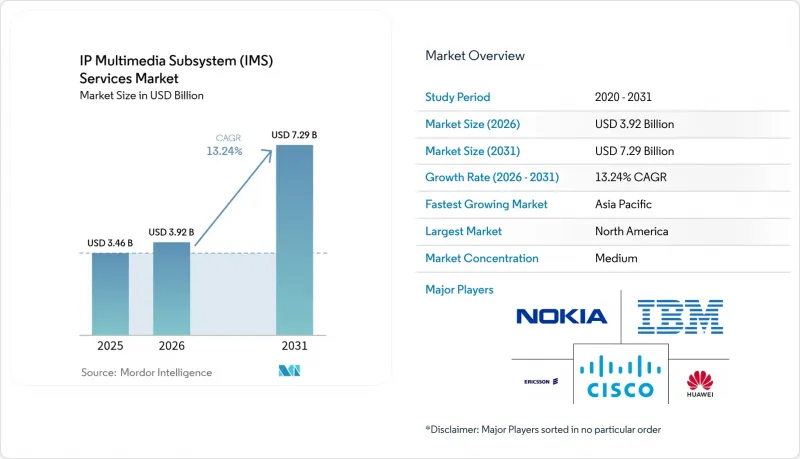
Mordor Intelligence에 의하면, IP 멀티미디어 서브시스템(IMS) 서비스 시장 규모는 2025년 34억 6,000만 달러에서 2026년에는 39억 2,000만 달러에 이르고, 2026-2031년 CAGR 13.24%로 성장을 지속하여 2031년에는 72억 9,000만 달러에 달할 것으로 예측됩니다.
본 보고서는 서비스별(인스턴트 메시징, VoIP, VoLTE, VoWiFi, 기타), 구성 요소별(제품 및 서비스), 배포 모델별(On-Premise·클라우드 기반), 사업자 유형별(이동통신 사업자·고정통신 사업자), 최종 사용자별(통신 사업자, 기업, 기타),지역별로 분류되어 있습니다. 시장 예측은 금액(달러) 기준으로 제시되어 있습니다.
전 세계 IP 멀티미디어 서브시스템(IMS) 서비스 시장 동향 및 인사이트
LTE 및 VoLTE의 인기 상승과 5G의 부상
스탠드얼론형 5G의 도입으로 음성 통신이 기존 LTE 앵커에서 분리됨에 따라, 통신 사업자들은 통화 설정, 코덱 협상, 서비스 품질(QoS) 확보를 위해 IMS 세션 제어를 활용하는 VoNR의 도입을 서두르고 있습니다. 프랑스의 Free Mobile, 베트남의 Viettel, 영국의 O2가 상용 서비스를 시작한 것은 VoNR이 실험 단계가 아니라 실제 운영 단계에 있음을 보여줍니다. IMS를 기반으로 하는 코어 네트워크는 네트워크 슬라이싱 및 저지연 이용 사례를 지원하며, 단순한 연결성을 넘어 5G를 수익화할 수 있기 때문에 통신 사업자들은 더 큰 이점을 발견하고 있습니다. 2024년 9월, 에릭슨(Ericsson)과 12개 주요 통신 사업자가 설립한 네트워크 API 벤처 기업은 CAMARA 표준을 준수하는 API를 공개했습니다. 이를 통해 개발자는 온디맨드 대역폭 및 위치 정보 서비스를 실행할 수 있게 되었으며, IMS를 타사용 프로그래밍 가능한 자산으로 전환하고 있습니다. 이러한 변화로 인해 음성은 IMS가 가진 수많은 수익원 중 하나에 불과한 위치로 자리매김하게 되었습니다.
비즈니스 메시징 분야에서 리치 커뮤니케이션 서비스(RCS) 수요 급증
RCS 트래픽은 2025년에 500억 건에 달하고, 수익은 2029년까지 42억 달러에 이를 것으로 예상되며, IMS 기반 메시징은 기존 SMS를 대체할 매력적인 대안으로서의 입지를 공고히 하고 있습니다. 애플이 iOS 18에 RCS를 추가하기로 결정함에 따라, 안드로이드와 아이폰 생태계 간의 마지막 큰 상호 운용성 장벽이 제거되었습니다. 읽음 알림, 발신자 ID 인증, 리치 미디어 기능을 통해 기업들은 이제 모든 기기 사용자를 대상으로 상호작용형 캠페인을 전개할 수 있게 되었으며, OTT 앱에서는 실현할 수 없는 높은 참여도와 신뢰할 수 있는 ID를 확립하고 있습니다. 통신 사업자들은 고객 관계 관리(CRM) 제품군과 통합된 RCS-as-a-Service 플랫폼을 출시하여 SMS 수익 감소를 상쇄하는 동시에, 지속성이 높은 정기적인 요금 수입을 창출하고 있습니다. 새로운 RCS 도입 기업이 늘어날수록 IMS의 프레즌스, 메시징, 보안 기능의 활용도가 향상되며, 시장은 음성에서 데이터 채널로 확대되고 있습니다.
숙련된 IMS 전문가 부족
클라우드 네이티브 IMS에는 마이크로서비스 오케스트레이션, CI/CD 파이프라인, 멀티 벤더 API 통합에 대한 전문 지식이 필요하지만, 대부분의 통신 엔지니어는 모놀리식 또는 가상화된 코어 환경에서 경험을 쌓아왔기 때문에 쿠버네티스 실무 경험이 부족합니다. 인재 부족에 직면한 통신 사업자들은 전환을 지연하거나 벤더 관리형 서비스에 지나치게 의존하는 경우가 많아, 그 결과 비용과 위험이 증가하고 있습니다. TM Forum의 인증 프로그램이나 벤더가 주최하는 부트캠프는 확대되고 있지만, 특히 인도나 사우디아라비아와 같은 고성장 시장에서는 교육 속도가 도입 일정을 따라가지 못하고 있습니다. 각 벤더는 AI를 활용한 설정 및 자동 복구 기능을 제품에 통합하여 더 적은 수의 엔지니어로 더 대규모의 네트워크를 관리할 수 있도록 하고 있지만, 인적 전문 지식은 여전히 병목 현상으로 남아 있습니다.
부문 분석
서비스 부문은 VoLTE에서 가장 큰 단일 수익원을 창출했으며, 2025년에는 IP 멀티미디어 서브시스템(IMS) 서비스 시장 점유율의 37.95%를 차지했습니다. 4G 커버리지가 성숙해짐에 따라 채택이 진행되었으며, VoLTE는 휴대폰 단말기가 보편적으로 지원하기 때문에 음성 서비스의 연속성을 위한 기반이 되고 있습니다. 그러나 기업의 마케팅 부서와 고객 관리 팀은 RCS 지원 인스턴트 메시징으로 무게 중심을 옮기고 있으며, 이 부문은 2031년까지 연평균 14.41%의 성장률을 보일 것으로 예측됩니다. 애플의 RCS 도입으로 인해 파편화가 해소됨에 따라, 브랜드는 모든 스마트폰 사용자를 대상으로 단일 캠페인을 전개할 수 있게 되었으며, 읽음 알림 및 리치 미디어 기능도 활용할 수 있게 되었습니다. 참여율 향상에 힘입어 통신 사업자들은 비즈니스용 메시징을 통해 직접적인 이익을 얻을 수 있는 수익 분배 모델을 구축하고 있습니다.
메시징의 성장은 IP 멀티미디어 서브시스템(IMS) 서비스 시장의 트래픽 패턴에 영향을 미치고 있습니다. RCS는 IMS 데이터 채널에서 작동하기 때문에 각 기업 고객은 프레즌스, 그룹 채팅, 파일 전송 기능의 이용률을 높이고 있습니다. 통신 사업자가 인증된 발신자 ID나 리치 카드용 API를 통해 수익을 창출함에 따라, 가치는 단순한 통화 시간에서 조정된 멀티미디어 세션으로 이동하고 있습니다. VoNR과 VoWiFi도 성장하고 있지만, 성숙한 시장에서는 이미 단말기 보급률이 포화 상태에 가까워지고 있어 증가율은 낮은 임베디드니다. 그 결과, 서비스 구성이 다양화되어 통신 사업자가 음성 수익의 정체 추세에서 벗어날 수 있게 되었습니다.
2025년에도 IMS 코어 장비는 여전히 총 수익의 71.88%를 차지하고 있으며, 이는 통신 산업의 조달에서 하드웨어와 영구 라이선스의 전통을 반영하고 있습니다. 세션 제어 기능, 미디어 게이트웨이, 시그널링 방화벽이 자본 지출의 대부분을 차지하고 있으며, 특히 아시아와 중동의 신규 구축 5G 코어 네트워크에서 두드러집니다. 그러나 가장 빠르게 성장하고 있는 분야는 관리형 서비스와 전문 서비스로, 통신 사업자들이 설계부터 운영에 이르는 전체 라이프사이클을 외부에 위탁함에 따라 연간 14.93%의 성장률이 예상됩니다. Telefonica 독일과 Mavenir 간에 체결된 5년간의 클라우드 네이티브 계약은 이러한 변화를 여실히 보여줍니다. 이 계약을 통해 해당 통신 사업자는 벤더가 업그레이드 위험을 부담하면서 성능을 보장하는 구독 모델로 전환하고 있습니다.
엔지니어링 팀이 소규모인 시장에서는 통신 사업자들이 쿠버네티스 클러스터, 지속적 통합(CI) 파이프라인, 인라인 보안을 묶은 턴키형 클라우드 스택을 선호합니다. 이러한 수요로 인해 시스템 통합사업자 및 소프트웨어 전문 기업의 수익 점유율은 확대되는 반면, 하드웨어의 이익률은 압박받고 있습니다. 향후에는 활성 가입자 수에 연동된 SaaS(Software-as-a-Service) 계약을 통해 서비스 부문의 매출 비중이 제품 부문과 거의 동등한 수준에 근접하게 되며, IP 멀티미디어 서브시스템(IMS) 서비스 시장의 매출 구성이 더욱 재편될 가능성이 있습니다.
지역별 분석
2025년, 북미는 41.26%라는 최대의 매출 점유율을 유지했습니다. AT&T는 자사 네트워크에 210억-220억 달러를 투자하여 2026년까지 전국 3억 명의 인구 커버리지(POPs)를 달성하는 미드밴드 5G 구축을 계획하고 있으며, 같은 해 Open RAN 트래픽의 70%를 목표로 하고 있습니다. T-Mobile의 6캐리어 어그리게이션은 3.6Gbps에 달했으며, Verizon은 13만 대의 Open RAN 지원 무선 장비를 도입했습니다. 이 모든 경우에서 음성 및 영상의 동기화를 보장하기 위해서는 IMS를 통한 모니터링이 필요합니다. FCC의 ‘우주에서의 보완적 커버리지(Supplemental Coverage from Space)’ 관련 결정에 따라, 위성을 이용한 기기로의 직접 음성 통신이 가능해졌으며, 통신 사업자와 LEO(저지구 궤도) 위성 군집간의 제휴를 통해 지방 지역에서의 IMS 기반 통화 서비스를 위한 새로운 수익원이 창출되고 있습니다.
아시아태평양에서는 5G의 급속한 보급에 힘입어 연평균 성장률(CAGR) 14.37%의 성장이 예상됩니다. 차이나모바일은 8억 1,000만 건의 5G 접속 건수를 자랑하며, IMS 데이터 채널을 활용한 증강현실(AR) 지원 ‘New Calling’ 기능을 시범 운영 중입니다. 인도에서는 릴라이언스 지오가 5G 기지국 수 100만 개를 돌파했으며, 게임 및 기업용 광대역 네트워크를 위한 네트워크 슬라이싱을 시험 중입니다. 바티 에어텔은 온디맨드 품질을 수익화하기 위해 네트워크 API 벤처 기업에 참여했습니다. 텔스트라는 독립형 5G에서 340Mbps의 업링크 속도를 달성했으며, 위성 음성 통신 제공을 위해 스타링크와 계약을 체결했습니다. 이러한 노력 덕분에 아시아태평양의 IP 멀티미디어 서브시스템(IMS) 서비스 시장 규모가 확대되고 있습니다. 이는 5G 사용자가 1명 늘어날 때마다 IMS 엔드포인트가 필요하기 때문입니다.
유럽에서는 클라우드 프로젝트를 통해 코어 네트워크의 현대화가 진행되고 있습니다. Telefonica 독일은 2025년 2월, Mavenir사와 5년간의 클라우드 네이티브 계약을 체결했으며, 독일텔레콤은 1년 전 1,700만 회선의 이전을 완료했습니다. 프리 모바일은 2024년 9월에 최초의 상용 VoNR 네트워크를 가동했으며, O2 UK는 2024년 2월에 14개 독립형(SA) 지원 도시에서 서비스를 시작했습니다. EU의 ‘디지털 디케이드(Digital Decade)’ 목표에 따르면 1,480억 유로의 새로운 연결 인프라 투자가 필요한 것으로 파악되며, 그 대부분은 5G 독립형(SA) 통신 트래픽을 처리할 수 있도록 확장 가능한 올-IP 코어에 할당되고 있습니다. 오렌지(Orange)사의 ‘실바(Sylva)’ 프로젝트는 텔레콤 클라우드 설계도를 표준화하고 있어, 통신 사업자는 대규모 재통합을 거치지 않고도 국가 간 IMS 워크로드를 이전할 수 있게 됩니다.
중동 및 아프리카에서는 급속한 클라우드화가 진행되고 있습니다. 사우디 텔레콤은 음성 가입자의 74%를 클라우드 IMS로 전환하고, 8,993곳에서 54.7%의 5G 커버리지를 달성했습니다. e&아랍에미리트는 음성이 시각화된 ‘New Calling’을 시연했고, du 아랍에미리트는 실내 속도에서 5.1Gbps를 달성하는 등, IMS 데이터 채널을 활용한 체험형 서비스가 주목을 받고 있습니다. GSMA는 이 지역의 모바일 매출이 2023년 660억 달러에서 2030년까지 880억 달러로 증가할 것이며, 그 결과 IMS에 대한 지출도 꾸준히 증가할 것으로 예측했습니다.
남미는 설비 투자(CAPEX) 측면에서 뒤처져 있지만, 클라우드 네이티브 접근 방식을 통해 그 격차를 좁혀가고 있습니다. Mavenir과 Whitestack은 2024년 8월, 한 대형 통신사(사명은 비공개)를 위해 IMS 코어를 구축하며, 멀티 벤더 기반의 베스트 오브 브リ?ド 스택이 도입 비용 절감과 시장 출시 기간 단축으로 이어진다는 사실을 입증했습니다. 브라질, 칠레, 콜롬비아에서 주파수 경매가 막바지에 접어든 가운데, 통신 사업자들은 개발 은행으로부터 자금을 조달하여 VoLTE 및 이후의 VoNR 도입을 지원하고 있으며, 이를 통해 IP 멀티미디어 서브시스템(IMS) 서비스의 점진적인 보급이 촉진되고 있습니다.
기타 혜택
- 엑셀 형식 시장 예측(ME) 시트
- 3개월간의 애널리스트 지원
자주 묻는 질문
목차
제1장 서론
제2장 조사 방법
제3장 주요 요약
제4장 시장 구도
제5장 시장 규모와 성장 예측
제6장 경쟁 구도
제7장 시장 기회와 향후 전망
LSH 26.09.04According to Mordor Intelligence, the IP multimedia subsystem (IMS) services market size is expected to grow from USD 3.46 billion in 2025 to USD 3.92 billion in 2026 and is forecast to reach USD 7.29 billion by 2031 at 13.24% CAGR over 2026-2031.
This report is Segmented by Service (Instant Messaging, Voip, Volte, Vowifi, and Other Services), Component (Products, and Services), Deployment Model (On-Premises, and Cloud-Based), Operator Type (Mobile Network Operators, and Fixed Network Operators), End User (Telecommunication Operators, Enterprises, and More), and Geography. The Market Forecasts are Provided in Terms of Value (USD).
Global IP Multimedia Subsystem (IMS) Services Market Trends and Insights
Increasing Popularity of LTE and VoLTE and Emergence of 5G
Standalone 5G deployments detach voice from legacy LTE anchors, prompting carriers to adopt VoNR, which relies on IMS session control for call setup, codec negotiation, and quality-of-service enforcement. Commercial launches by Free Mobile in France, Viettel in Vietnam, and O2 UK demonstrate that VoNR is production-ready rather than experimental. Operators see additional upside because an IMS-anchored core supports network slicing and low-latency use cases that monetize 5G beyond connectivity. A September 2024 network-API venture formed by Ericsson and 12 leading carriers exposes CAMARA-compliant APIs, allowing developers to trigger bandwidth on demand or location services, thereby turning IMS into a programmable asset for third-party applications. This shift positions voice as only one of many revenue-bearing IMS functions.
Soaring Demand for Rich Communication Services in Business Messaging
RCS traffic reached 50 billion messages in 2025, and revenue is on track to reach USD 4.2 billion by 2029, solidifying IMS-based messaging as a compelling alternative to legacy SMS. Apple's decision to add RCS to iOS 18 removed the last major interoperability barrier between Android and iPhone ecosystems. With read receipts, verified sender IDs, and rich media, enterprises can now push interactive campaigns across the entire handset base, generating higher engagement and trusted identities that over-the-top apps cannot match. Carriers are launching RCS-as-a-service platforms that integrate with customer relationship management suites, generating sticky recurring fees while offsetting SMS revenue erosion. Each new RCS tenant increases attachment rates for IMS presence, messaging, and security functions, and extends the market from voice into data channels.
Shortage of Skilled IMS Professionals
Cloud-native IMS requires expertise in microservices orchestration, CI/CD pipelines, and multi-vendor API integration, yet most telecom engineers grew up on monolithic or virtualized cores and lack hands-on Kubernetes experience. Operators facing talent gaps often delay migrations or over-rely on vendor-managed services, which drives up costs and risk. Certification programs from the TM Forum and vendor-sponsored boot camps are expanding, but the pace of training still lags behind deployment timelines, particularly in high-growth markets such as India and Saudi Arabia. Vendors are incorporating AI-assisted configuration and auto-healing into their products, enabling fewer engineers to manage larger networks; however, human expertise remains the bottleneck.
Other drivers and restraints analyzed in the detailed report include:
- Surging Operator Investments in Cloud-Native IMS Architectures
- Rapid Transition to Voice over New Radio in Standalone 5G Networks
- Complexity Integrating IMS with Legacy Circuit-Switched Networks
For complete list of drivers and restraints, kindly check the Table Of Contents.
Segment Analysis
The service segment generated the largest single-stream revenue from VoLTE, capturing 37.95% of the IP Multimedia Subsystem (IMS) Services market share in 2025. Adoption rose when 4G coverage matured, and VoLTE remains foundational for voice continuity because handsets universally support it. However, enterprise marketing and customer-care teams are pivoting to RCS-enabled Instant Messaging, projected to grow at a 14.41% annual rate through 2031. Apple's RCS adoption eliminates fragmentation, enabling brands to create a single campaign for the entire smartphone universe, complemented by read receipts and rich media. The higher engagement rate is prompting carriers to launch revenue-sharing models that give them a direct stake in business messaging.
Messaging growth influences traffic patterns on the IP Multimedia Subsystem (IMS) Services market. Because RCS runs over IMS data channels, each enterprise customer lifts the utilization of presence, group chat, and file-transfer functions. As carriers monetize APIs for verified sender IDs or rich cards, value migrates from simple voice minutes to orchestrated multimedia sessions. VoNR and VoWiFi also gain, but their incremental growth is lower because penetration already nears handset saturation in mature markets. The result is a diversified service mix that buffers operators against flat voice revenue.
IMS core equipment still accounted for 71.88% of overall revenue in 2025, reflecting the hardware and perpetual license heritage of telecom procurement. Session control functions, media gateways, and signaling firewalls dominate capital layouts, especially for greenfield 5G cores in Asia and the Middle East. Yet the fastest expansion is in managed and professional services, set to climb 14.93% annually as carriers outsource the entire lifecycle from design to operations. Telefonica Germany's five-year cloud-native agreement with Mavenir illustrates the pivot: the operator shifts to a subscription model where the vendor absorbs upgrade risk while guaranteeing performance.
In markets with lean engineering teams, operators prefer turnkey cloud stacks that bundle Kubernetes clusters, continuous-integration pipelines, and in-line security. This demand gives system integrators and software specialists a larger revenue slice while compressing hardware margins. Over time, software-as-a-service contracts linked to active subscriber counts could bring the services slice approach closer to parity with products, further reshaping the revenue mix within the IP Multimedia Subsystem (IMS) Services market.
Complete Report Scope:
- By Service
- Instant Messaging
- VoIP
- VoLTE
- VoWiFi
- Other Services
- By Component
- Products
- Services
- By Deployment Model
- On-Premises
- Cloud-Based
- By Operator Type
- Mobile Network Operators
- Fixed Network Operators
- By End User
- Telecommunication Operators
- Enterprises
- Emergency Services
- By Geography
- North America
- United States
- Canada
- Mexico
- South America
- Brazil
- Mexico
- Rest of South America
- Europe
- Germany
- United Kingdom
- France
- Spain
- Italy
- Rest of Europe
- Asia Pacific
- China
- India
- Japan
- Australia
- South Korea
- Rest of Asia Pacific
- Middle East and Africa
- Middle East
- Saudi Arabia
- United Arab Emirates
- Qatar
- Turkey
- Rest of Middle East
- Africa
- South Africa
- Nigeria
- Rest of Africa
- Middle East
- North America
Geography Analysis
North America retained the leading 41.26% revenue share in 2025. AT&T invested USD 21 billion to USD 22 billion in its network, plans nationwide mid-band 5G reaching 300 million POPs by 2026, and targets 70% Open RAN traffic the same year. T-Mobile's six-carrier aggregation reached 3.6 Gbps, while Verizon installed 130,000 Open RAN-ready radios, all of which require IMS supervision to ensure synchronized voice and video. The FCC's Supplemental Coverage from Space ruling enables satellite direct-to-device voice, with partnerships between operators and LEO constellations creating new revenue pools for IMS-anchored calling in rural areas.
The Asia Pacific is forecast to expand at a 14.37% CAGR due to massive 5G adoption. China Mobile counts 810 million 5G connections and is piloting augmented-reality New Calling features using IMS data channels. In India, Reliance Jio has surpassed 1 million 5G sites and is testing network slicing for gaming and enterprise broadband. Bharti Airtel has joined the network-API venture to monetize quality-on-demand. Telstra achieved 340 Mbps uplink on standalone 5G and signed with Starlink for satellite voice coverage. These initiatives enhance the IP Multimedia Subsystem (IMS) Services market size in the Asia Pacific, as every incremental 5G user requires an IMS endpoint.
Europe is modernizing its core through cloud projects. Telefonica Germany signed a five-year cloud-native contract with Mavenir in February 2025, and Deutsche Telekom completed a 17 million-line migration one year prior. Free Mobile launched the first commercial VoNR network in September 2024, while O2 UK lit 14 standalone cities in February 2024. The EU's Digital Decade targets require EUR 148 billion in new connectivity spending, with a significant portion earmarked for all-IP cores that can scale to support 5G standalone traffic. Orange's Sylva project standardizes telco-cloud blueprints, allowing operators to port IMS workloads across countries without extensive reintegration.
The Middle East and Africa show rapid cloudification. Saudi Telecom Company migrated 74% of voice subscribers to cloud IMS and achieved 54.7% 5G coverage across 8,993 sites. e& UAE demonstrated New Calling with visualized voice, while du UAE reached 5.1 Gbps indoor speeds, highlighting experiential services that rely on IMS data channels. GSMA expects mobile revenues in the region to rise from USD 66 billion in 2023 to USD 88 billion by 2030, resulting in a steady increase in IMS spend.
South America lags in capex but is catching up via cloud-native approaches. Mavenir and Whitestack rolled out an IMS core for an unnamed tier-one carrier in August 2024, demonstrating that multi-vendor best-of-breed stacks can reduce acquisition costs and shorten the time to market. As spectrum auctions finalize in Brazil, Chile, and Colombia, carriers are lining up funding from development banks to underwrite VoLTE and later VoNR, supporting the gradual penetration of IP Multimedia Subsystem (IMS) services.
- Telefonaktiebolaget LM Ericsson
- Cisco Systems, Inc.
- Nokia Corporation
- Huawei Technologies Co., Ltd.
- International Business Machines Corporation
- ZTE Corporation
- Ribbon Communications Inc.
- Samsung Electronics Co., Ltd. (Networks Division)
- Oracle Corporation
- NEC Corporation
- Mavenir Systems, Inc.
- Metaswitch Networks Ltd. (Microsoft Corp.)
- Athonet S.p.A.
- Cirpack SAS
- Italtel S.p.A.
- Mitel Networks Corporation
- Amdocs Ltd.
- Juniper Networks, Inc.
- Hewlett Packard Enterprise Company
- Fujitsu Ltd.
- Dialogic Corporation
- Enghouse Systems Ltd.
Additional Benefits:
- The market estimate (ME) sheet in Excel format
- 3 months of analyst support
TABLE OF CONTENTS
1 INTRODUCTION
- 1.1 Study Assumptions and Market Definition
- 1.2 Scope of the Study
2 RESEARCH METHODOLOGY
3 EXECUTIVE SUMMARY
4 MARKET LANDSCAPE
- 4.1 Market Overview
- 4.2 Market Drivers
- 4.2.1 Increasing Popularity of LTE and VoLTE and Emergence of 5G
- 4.2.2 Soaring Demand for Rich Communication Services (RCS) in Business Messaging
- 4.2.3 Surging Operator Investments in Cloud-Native IMS Architectures
- 4.2.4 Rapid Transition to Voice over New Radio (VoNR) in Stand-Alone 5G Networks
- 4.2.5 Emergence of Satellite Direct-to-Device Voice Services
- 4.2.6 Government-Backed Spectrum Refarming Initiatives Accelerating IMS Upgrades
- 4.3 Market Restraints
- 4.3.1 Shortage of Skilled IMS Professionals
- 4.3.2 Complexity Integrating IMS with Legacy Circuit-Switched Networks
- 4.3.3 Heightened Cyber-Security and Signalling Fraud Risks
- 4.3.4 Capital-Intensive Upfront Deployment Costs in Emerging Markets
- 4.4 Industry Value Chain Analysis
- 4.5 Regulatory Landscape
- 4.6 Technological Outlook
- 4.7 Porter's Five Forces Analysis
- 4.7.1 Bargaining Power of Buyers
- 4.7.2 Bargaining Power of Suppliers
- 4.7.3 Threat of New Entrants
- 4.7.4 Threat of Substitutes
- 4.7.5 Intensity of Competitive Rivalry
- 4.8 Impact of Macroeconomic Factors on the Market
5 MARKET SIZE AND GROWTH FORECASTS (VALUE)
- 5.1 By Service
- 5.1.1 Instant Messaging
- 5.1.2 VoIP
- 5.1.3 VoLTE
- 5.1.4 VoWiFi
- 5.1.5 Other Services
- 5.2 By Component
- 5.2.1 Products
- 5.2.2 Services
- 5.3 By Deployment Model
- 5.3.1 On-Premises
- 5.3.2 Cloud-Based
- 5.4 By Operator Type
- 5.4.1 Mobile Network Operators
- 5.4.2 Fixed Network Operators
- 5.5 By End User
- 5.5.1 Telecommunication Operators
- 5.5.2 Enterprises
- 5.5.3 Emergency Services
- 5.6 By Geography
- 5.6.1 North America
- 5.6.1.1 United States
- 5.6.1.2 Canada
- 5.6.1.3 Mexico
- 5.6.2 South America
- 5.6.2.1 Brazil
- 5.6.2.2 Mexico
- 5.6.2.3 Rest of South America
- 5.6.3 Europe
- 5.6.3.1 Germany
- 5.6.3.2 United Kingdom
- 5.6.3.3 France
- 5.6.3.4 Spain
- 5.6.3.5 Italy
- 5.6.3.6 Rest of Europe
- 5.6.4 Asia Pacific
- 5.6.4.1 China
- 5.6.4.2 India
- 5.6.4.3 Japan
- 5.6.4.4 Australia
- 5.6.4.5 South Korea
- 5.6.4.6 Rest of Asia Pacific
- 5.6.5 Middle East and Africa
- 5.6.5.1 Middle East
- 5.6.5.1.1 Saudi Arabia
- 5.6.5.1.2 United Arab Emirates
- 5.6.5.1.3 Qatar
- 5.6.5.1.4 Turkey
- 5.6.5.1.5 Rest of Middle East
- 5.6.5.2 Africa
- 5.6.5.2.1 South Africa
- 5.6.5.2.2 Nigeria
- 5.6.5.2.3 Rest of Africa
- 5.6.5.1 Middle East
- 5.6.1 North America
6 COMPETITIVE LANDSCAPE
- 6.1 Market Concentration
- 6.2 Strategic Moves
- 6.3 Market Share Analysis
- 6.4 Company Profiles (includes Global Level Overview, Market Level Overview, Core Segments, Financials as available, Strategic Information, Market Rank/Share for key companies, Products and Services, and Recent Developments)
- 6.4.1 Telefonaktiebolaget LM Ericsson
- 6.4.2 Cisco Systems, Inc.
- 6.4.3 Nokia Corporation
- 6.4.4 Huawei Technologies Co., Ltd.
- 6.4.5 International Business Machines Corporation
- 6.4.6 ZTE Corporation
- 6.4.7 Ribbon Communications Inc.
- 6.4.8 Samsung Electronics Co., Ltd. (Networks Division)
- 6.4.9 Oracle Corporation
- 6.4.10 NEC Corporation
- 6.4.11 Mavenir Systems, Inc.
- 6.4.12 Metaswitch Networks Ltd. (Microsoft Corp.)
- 6.4.13 Athonet S.p.A.
- 6.4.14 Cirpack SAS
- 6.4.15 Italtel S.p.A.
- 6.4.16 Mitel Networks Corporation
- 6.4.17 Amdocs Ltd.
- 6.4.18 Juniper Networks, Inc.
- 6.4.19 Hewlett Packard Enterprise Company
- 6.4.20 Fujitsu Ltd.
- 6.4.21 Dialogic Corporation
- 6.4.22 Enghouse Systems Ltd.
7 MARKET OPPORTUNITIES AND FUTURE OUTLOOK
- 7.1 White-Space and Unmet-Need Assessment