|
시장보고서
상품코드
2122283
OLED 마이크로디스플레이 : 시장 점유율 분석, 업계 동향과 통계, 성장 예측(2026-2031년)OLED Microdisplay - Market Share Analysis, Industry Trends & Statistics, Growth Forecasts (2026 - 2031) |
||||||
 Mordor Intelligence
Mordor Intelligence에 의하면, 2026년 OLED 마이크로디스플레이 시장 규모는 17억 6,000만 달러로 추정되며, 2025년 12억 7,000만 달러에서 2031년에는 88억 5,000만 달러에 달할 것으로 예측됩니다.
또한, 2026-2031년 연평균 성장률(CAGR)은 38.23%를 나타낼 전망입니다.
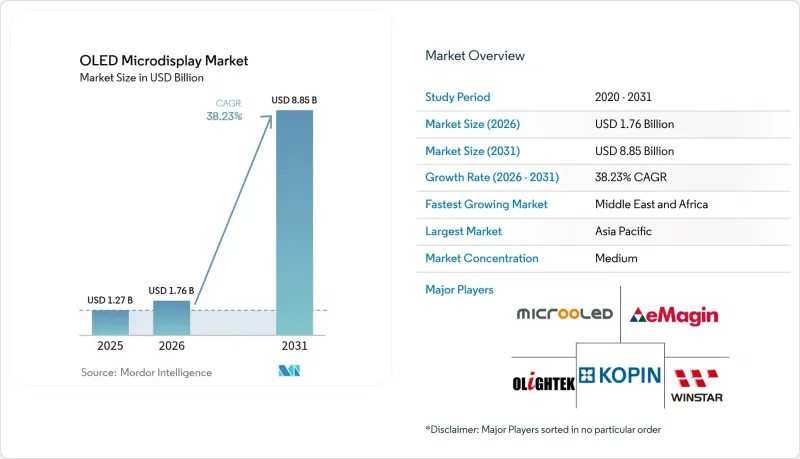
본 보고서는 유형(니어-투-아이, 프로젝션, 기타), 해상도(SVGA 이하(800×600 이하), XGA(1,024×768), 기타), 기술별(실리콘 기판 기반 RGB OLED, 기타), 패널 크기(대각선 길이)별(0.5인치 미만, 0.5-1.0인치, 기타), 최종 사용자 산업별(자동차, 의료, 기타), 지역별로 분류되어 있습니다. 시장 전망은 금액(달러) 기준으로 제시되어 있습니다.
세계 OLED 마이크로디스플레이 시장 동향 및 인사이트
중국 파운드리 업체들의 실리콘 상 OLED(OLEDoS) 생산 능력 확대
BOE, SeeYA, IRay Group의 생산 확대로 인해 OLED 마이크로디스플레이 시장에 대량이며 수율이 높은 공급이 이루어지고 있습니다. 각 파운드리 기업들은 고화소 밀도의 프론트 플레이트와 신설된 실리콘 백 플레이트 생산 라인을 결합함으로써 처리량 향상과 공정 관리의 엄격화를 도모하고 있습니다. IRay의 백플레인 전용 설비 투자는 외부 위탁 공정을 줄이고 비용 경쟁력을 높이는 수직 통합 전략을 보여줍니다. 이러한 움직임으로 인해 아시아태평양은 지역적 공급 거점에서 세계 공급의 핵심으로 위상이 변화했으며, 규모와 기술적 리더십 양면에서 일본과 한국의 기존 기업들에 도전하고 있습니다. 생산 능력 확대는 가격 안정화로도 이어져, 소비자용 디바이스 OEM 업체들이 OLED 마이크로디스플레이 시장에 장기적인 주문을 하도록 뒷받침하고 있습니다.
북미 전역에서 군용 헬멧 장착형 디스플레이에 MicroOLED 도입 가속화
북미의 방위 프로그램에서는 조종사용, 지상군용, 야간 투시 광학 기기용 디스플레이로서 AMLCD에서 OLED 마이크로디스플레이로의 전환이 급속히 진행되고 있습니다. 2025년 4월 코핀(Kopin)이 수주한 750만 달러 규모의 주문은 뛰어난 명암비, 모션 블러 제로, 경량화를 실현한 견고한 니어아이 모듈에 대한 수요가 증가하고 있음을 입증합니다. F-35 플랫폼 내 검증을 통해 임무 수행에 필수적인 신뢰성이 입증됨에 따라, 다른 프로그램에서도 유사한 디스플레이 아키텍처가 지정되고 있습니다. 조준기 및 지휘통제용 아이웨어로의 사업 다각화를 통해 조달 리스크가 분산되었으며, 군사 수요는 OLED 마이크로디스플레이 시장의 안정적인 기반이 되고 있습니다.
OLEDoS의 수분 침투 방지용 밀봉 관련 과제
습기 침투라는 오랜 과제는 특히 자동차나 군사 용도와 같은 가혹한 작동 환경에서 OLED 마이크로디스플레이의 보급을 가로막는 중대한 기술적 장벽이 되고 있습니다. 기존 디스플레이와 달리 마이크로디스플레이의 초소형 폼 팩터에서는 기존 밀봉 방법에 할당할 수 있는 공간이 극히 제한적이기 때문에 제조 수율과 장기적인 신뢰성 모두에 영향을 미치는 근본적인 기술적 과제가 발생하고 있습니다. 한국 대학의 최근 혁신을 통해, 광섬유 기반 웨어러블 OLED용 다기능 밀봉 기술이 도입되어, 보다 견고한 솔루션으로의 길이 열릴 가능성이 있습니다. 이 과제의 기술적 복잡성은 광학적 투명성을 유지하면서 기밀성을 확보하는 밀봉 솔루션이 요구됨에 따라 더욱 가중되고 있습니다. 픽셀 밀도가 3,000ppi를 초과하면 이러한 균형을 유지하기가 점점 더 어려워집니다. 이러한 제약은 10년 이상의 사용이 요구되는 자동차용 디스플레이 등 장기간의 가동이 예상되는 용도에 특히 영향을 미치고 있으며, 독자적인 밀봉 기술을 개발할 수 있는 기업에게는 경쟁상의 호기가 되고 있습니다.
부문 분석
2025년 니어-투-아이(Near-to-Eye) 기기용 OLED 마이크로디스플레이 시장 규모는 8억 1,000만 달러로, 총 매출의 63.78%를 차지했습니다. 혼합현실(MR) 헤드셋, 훈련용 고글, 스마트 헬멧에 대한 지속적인 출하가 수요의 기반을 형성하고 있습니다. 플랫폼 소유자의 생태계 투자가 해상도와 밝기의 연간 업그레이드를 뒷받침하고 있으며, 이는 평균 판매 가격과 매출 총이익률의 향상으로 이어지고 있습니다.
전자식 뷰파인더(EVF)는 2025년 시점에서 시장 규모가 비교적 작았지만, 2031년까지 연평균 성장률(CAGR)이 40.15%를 나타낼 것으로 예측되어 충분한 성장 여력이 있음을 보여주고 있습니다. 소니, 니콘, 캐논의 전문가용 미러리스 카메라 본체에서는 지연 없는 프레임 구성 및 HDR 미리보기를 실현하기 위해 OLED EVF의 채택이 표준화되고 있습니다. 카메라 제조업체들이 모델 주기를 합리화함에 따라 패널 출하량은 3년 이내에 두 배로 증가할 가능성이 있으며, OLED 마이크로디스플레이 시장에서 EVF는 전략적 성장 부문으로서의 입지를 확고히할 것으로 보입니다.
HD 720p 부문은 2025년에 OLED 마이크로디스플레이 시장 점유율의 35.42%를 차지할 것으로 예상되며, 주류 AR 뷰어를 위해 허용 가능한 선명도와 엄격한 전력 예산의 균형을 실현하고 있습니다. 그러나 성장의 원동력은 픽셀 밀도가 3,000ppi를 초과하는 ‘FHD 이상’ 부문입니다. 삼성디스플레이가 2025년 초에 발표한 샘플은 5,000ppi와 20,000니트의 최고 밝기를 달성했으며, 이러한 패널은 기업용 VR 및 군용 정찰 고글에 채택될 것으로 예측됩니다.
2031년까지 ‘Above-FHD’ 출하 대수의 연평균 성장률(CAGR)은 40.7%로 예측되며, 이는 OLED 마이크로디스플레이 시장 규모 확대분의 대부분을 차지하게 될 것입니다. 이러한 패널에는 고대역폭 인터페이스와 저지연 드라이버가 결합되어 있어, 이에 따른 부수적인 반도체 수요가 발생함으로써 통합형 공급업체에 혜택을 가져다줄 것입니다.
지역별 분석
2025년, 아시아태평양은 전 세계 매출의 56.64%를 차지했습니다. 이는 해당 지역에 백플레인 제조 공장, 이미터 공급업체, 소비자용 기기 조립 제조업체가 밀집해 있음을 반영합니다. 삼성디스플레이와 중국의 주요 파운드리 업체들이 생산 능력을 지속적으로 확대하여 공급 안정성을 확보하는 한편, 국경을 초월한 합작 투자가 기술 이전을 원활하게 진행하고 있습니다. 한국과 중국의 정부 지원 정책으로 생산 비용이 더욱 낮아져 이 지역의 리더십이 유지되고 있습니다.
북미는 특히 견고하고 고휘도의 모듈이 필요한 방위 부문이나 기업용 XR(증강현실) 도입 분야에서 고사양에 대한 수요를 뒷받침하고 있습니다. 실리콘밸리와 보스턴의 벤처 캐피털 자금 지원은 광학 시스템 및 드라이버 IC를 개발하는 스타트업 기업을 뒷받침하고 있으며, 그 결과 프로토타입용 디스플레이의 현지 조달이 증가하고 있습니다. F-35 헬멧 업그레이드 등의 프로그램으로 대표되는 방위 조달 또한 북미 OLED 마이크로디스플레이 시장의 구매에 안정적인 수요층을 형성하고 있습니다.
유럽에서는 자동차 부문으로의 진출과 수익성이 높은 의료용 시각화 기술에 주력하고 있습니다. 독일과 프랑스의 Tier 1 공급업체들은 패널 제조업체와 협력하여 자동차용 헤드업 디스플레이(HUD) 구현을 위한 저지연 인터페이스를 공동 설계하고 있습니다. 중동 및 아프리카는 규모는 작지만, 국방 현대화 예산과 첨단 AR-HUD를 탑재한 고급차 수입에 힘입어 연평균 성장률(CAGR) 40.6%로 성장하고 있습니다. 남미는 여전히 주로 소비자 시장이 중심이지만, 현지 카메라 생산과 급성장 중인 게이밍 커뮤니티를 통해 점차 비즈니스 기회가 창출되고 있습니다.
기타 혜택
- 엑셀 형식 시장 예측(ME) 시트
- 3개월간의 애널리스트 지원
자주 묻는 질문
목차
제1장 서론
제2장 조사 방법
제3장 주요 요약
제4장 시장 구도
제5장 시장 규모와 성장 예측
제6장 경쟁 구도
제7장 시장 기회와 향후 전망
LSH 26.09.04According to Mordor Intelligence, OLED microdisplay market size in 2026 is estimated at USD 1.76 billion, growing from 2025 value of USD 1.27 billion with 2031 projections showing USD 8.85 billion, growing at 38.23% CAGR over 2026-2031.
This report is Segmented by Type (Near-To-Eye, Projections, and More), Resolution (SVGA and Below (<=800 X 600), XGA (1, 024 X 768), and More), Technology (RGB OLED-On-Silicon, and More), Panel Size (Diagonal) ( Less Than 0. 5 Inch, 0. 5-1. 0 Inch, and More), End-User Industry (Automotive, Healthcare, and More), and Geography. The Market Forecasts are Provided in Terms of Value (USD).
Global OLED Microdisplay Market Trends and Insights
Expansion of OLED-on-Silicon Capacity by Chinese Foundries
Production ramp-ups at BOE, SeeYA and IRay Group are injecting high-volume, high-yield supply into the oled microdisplay market. Foundries are pairing pixel-dense front-planes with newly built silicon backplane lines to raise throughput and tighten process control. IRay's dedicated backplane investment illustrates a vertical-integration push that reduces outsourcing steps, enhancing cost competitiveness.These moves reposition Asia Pacific from a regional to a global supply anchor, challenging Japanese and Korean incumbents on both scale and technology leadership. Wider capacity also stabilizes pricing, encouraging consumer device OEMs to commit to long-term oled microdisplay market orders.
Accelerated Adoption in Military Helmet-Mounted Displays
North American defense programs are rapidly shifting from AMLCD to OLED microdisplays for pilot, ground-troop and night-vision optics. Kopin's USD 7.5 million award in April 2025 underscores rising demand for ruggedized near-eye modules with superior contrast, zero-motion blur and reduced weight.Validation within the F-35 platform demonstrates mission-critical reliability, prompting other programs to specify similar display architectures. Diversification into weapon sights and command-control eyewear spreads procurement risk, making military demand a stable cornerstone of the oled microdisplay market.
Moisture-Ingress Encapsulation Challenges for OLEDoS
The persistent challenge of moisture ingress represents a significant technical barrier to widespread OLED microdisplay adoption, particularly in harsh operating environments like automotive and military applications. Unlike conventional displays, the ultra-compact form factor of microdisplays leaves minimal space for traditional encapsulation methods, creating a fundamental engineering challenge that impacts both manufacturing yield and long-term reliability. Recent innovations from Korean universities have introduced multi-functional encapsulation for fiber-based wearable OLEDs, potentially offering pathways to more robust solutions. The technical complexity of this challenge is compounded by the need for encapsulation solutions that maintain optical clarity while providing hermetic sealing-a balance that becomes increasingly difficult as pixel densities exceed 3,000 ppi. This constraint particularly impacts applications where extended operational lifetimes are expected, such as automotive displays with 10+ year service requirements, creating a competitive opportunity for companies that can develop proprietary encapsulation technologies.
Other drivers and restraints analyzed in the detailed report include:
- Automotive OEM Integration of AR Head-Up Displays
- Surge in High-End Mirrorless Camera EVFs
- Sub-1,000 cd/m2 Brightness Ceiling versus MicroLED
For complete list of drivers and restraints, kindly check the Table Of Contents.
Segment Analysis
The oled microdisplay market size for Near-to-Eye devices stood at USD 0.81 billion in 2025, equal to 63.78% of total revenue. Sustained shipments to mixed-reality headsets, training goggles and smart helmets anchor demand. Ecosystem investment from platform owners supports annual resolution and brightness upgrades, which in turn lift average selling prices and gross margins.
Electronic Viewfinders contributed a smaller base in 2025, yet their 40.15% CAGR prospect through 2031 signals ample headroom. Professional mirrorless bodies from Sony, Nikon and Canon are standardizing OLED EVFs to deliver lag-free framing and HDR previews. As camera makers streamline model cycles, panel volumes could double within three years, establishing EVFs as a strategic hedge within the oled microdisplay market.
The HD 720p tier held 35.42% of oled microdisplay market share in 2025, balancing acceptable clarity with tight power budgets for mainstream AR viewers. Growth momentum, however, lies in the Above-FHD tier where pixel densities exceed 3,000 ppi. Early 2025 samples from Samsung Display achieve 5,000 ppi and 20,000 nits peak luminance, positioning these panels for enterprise VR and military recon goggles.
A 40.7% CAGR forecast to 2031 for Above-FHD shipments will absorb much of the incremental oled microdisplay market size expansion. Higher bandwidth interfaces and low-latency drivers accompany these panels, creating ancillary silicon demand that benefits integrated suppliers.
Complete Report Scope:
- By Type
- Near-to-Eye (NTE)
- Projection
- Electronic Viewfinder (EVF)
- By Resolution
- SVGA and Below (<=800 X 600)
- XGA (1,024 X 768)
- HD (720p)
- Full HD (1080p)
- Above FHD (2K-4K-Plus)
- By Technology
- RGB OLED-on-Silicon
- White OLED + Color Filter
- AMOLED on Glass
- Top-Emitting OLED
- By Panel Size (Diagonal)
- <0.5 inch
- 0.5-1.0 inch
- >1.0 inch
- By End-User Industry
- Consumer Electronics
- AR/VR Headsets
- Digital Cameras and Camcorders
- Smart Wearables
- Automotive
- AR Head-Up Displays
- Side-Mirror Replacement Displays
- Healthcare
- Surgical and Diagnostic Wearables
- Medical Imaging Devices
- Industrial and Enterprise
- Smart Glasses
- Machine Vision Systems
- Aerospace and Defense
- Helmet-Mounted Displays
- Weapon and Thermal Sights
- Law Enforcement and Security
- Night-Vision Goggles
- Body-Worn Cameras
- Others (Research and Education)
- Consumer Electronics
- By Geography
- North America
- United States
- Canada
- Mexico
- Europe
- Germany
- United Kingdom
- France
- Italy
- Spain
- Rest of Europe
- Asia-Pacific
- China
- Japan
- South Korea
- India
- South East Asia
- Australia
- Rest of Asia-Pacific
- South America
- Brazil
- Rest of South America
- Middle East and Africa
- Middle East
- United Arab Emirates
- Saudi Arabia
- Rest of Middle East
- Africa
- South Africa
- Rest of Africa
- Middle East
- North America
Geography Analysis
Asia Pacific commanded 56.64% of global revenue in 2025, reflecting the region's dense network of backplane fabs, emitter suppliers and consumer-device assemblers. Ongoing capacity expansions by Samsung Display and leading Chinese foundries ensure supply continuity, while cross-border joint ventures smooth technology transfer. Government incentives in South Korea and China further lower production costs, sustaining regional leadership.
North America anchors high-specification demand, especially for defense and enterprise-XR deployments that demand ruggedized, high-brightness modules. Venture-capital funding in Silicon Valley and Boston fuels start-ups developing optics and driver ICs, which in turn elevates local sourcing of prototype displays. Defense procurement, led by programs such as the F-35 helmet upgrade, adds a stable layer to North American oled microdisplay market purchases.
Europe focuses on automotive rollouts and high-margin medical visualization. German and French tier-one suppliers work with panel makers to co-design low-latency interfaces for automotive head-up implementations. The Middle East & Africa region, although starting from a small base, is pacing at a 40.6% CAGR due to defense-modernization budgets and luxury-vehicle imports that include advanced AR-HUDs. South America remains largely consumer-oriented, with gradual opportunities arising from local camera production and burgeoning gaming communities.
- Sony Semiconductor Solutions Corp.
- Seiko Epson Corporation
- Kopin Corporation
- eMagin Corporation
- Yunnan Olightek Opto-Electronic Technology
- Microoled SA
- WiseChip Semiconductor Inc.
- Fraunhofer FEP
- Sunlike Display Technology
- BOE Technology Group Co., Ltd.
- Raysolve Technology
- SeeYA Technology
- AUO Corporation
- Dresden Microdisplay GmbH
- Jasper Display Corp.
- Himax Technologies, Inc.
- United Microdisplay Partners
- HC SemiTek Corporation
- Plessey Semiconductors
- OLiGHTEK Optoelectronics Kunming Co.
- Truly Semiconductors Ltd.
Additional Benefits:
- The market estimate (ME) sheet in Excel format
- 3 months of analyst support
TABLE OF CONTENTS
1 INTRODUCTION
- 1.1 Study Assumptions and Market Definition
- 1.2 Scope of the Study
2 RESEARCH METHODOLOGY
3 EXECUTIVE SUMMARY
4 MARKET LANDSCAPE
- 4.1 Market Overview
- 4.2 Market Drivers
- 4.2.1 Expansion of OLED-on-Silicon (OLEDoS) capacity by Chinese Foundries
- 4.2.2 Accelerated Adoption of MicroOLED in Military Helmet-Mounted Displays across North America
- 4.2.3 Automotive OEM Integration of AR Head-Up Displays Using MicroOLED Panels in Europe
- 4.2.4 Surge in High-End Mirrorless Camera EVFs in Japan and South Korea
- 4.2.5 Growing VC Funding for AR/VR Start-ups Focused on OLED Microdisplays in the United States and Israel
- 4.2.6 Cost-Performance Advantage over MicroLED in <0.7-inch, >3,000 ppi Range
- 4.3 Market Restraints
- 4.3.1 Moisture-Ingress Encapsulation Challenges for OLEDoS
- 4.3.2 Sub-1,000 cd/m2 Brightness Ceiling versus MicroLED
- 4.3.3 Supply-Chain Concentration in Japan-China Creating Geopolitical Risk
- 4.3.4 Rapid Product Obsolescence Increasing OEM Inventory Risk
- 4.4 Industry Ecosystem Analysis
- 4.5 Technological Outlook
- 4.6 Porter's Five Forces Analysis
- 4.6.1 Bargaining Power of Suppliers
- 4.6.2 Bargaining Power of Buyers
- 4.6.3 Threat of New Entrants
- 4.6.4 Threat of Substitute Products
- 4.6.5 Degree of Competition
5 MARKET SIZE AND GROWTH FORECASTS (VALUES)
- 5.1 By Type
- 5.1.1 Near-to-Eye (NTE)
- 5.1.2 Projection
- 5.1.3 Electronic Viewfinder (EVF)
- 5.2 By Resolution
- 5.2.1 SVGA and Below (<=800 X 600)
- 5.2.2 XGA (1,024 X 768)
- 5.2.3 HD (720p)
- 5.2.4 Full HD (1080p)
- 5.2.5 Above FHD (2K-4K-Plus)
- 5.3 By Technology
- 5.3.1 RGB OLED-on-Silicon
- 5.3.2 White OLED + Color Filter
- 5.3.3 AMOLED on Glass
- 5.3.4 Top-Emitting OLED
- 5.4 By Panel Size (Diagonal)
- 5.4.1 <0.5 inch
- 5.4.2 0.5-1.0 inch
- 5.4.3 >1.0 inch
- 5.5 By End-User Industry
- 5.5.1 Consumer Electronics
- 5.5.1.1 AR/VR Headsets
- 5.5.1.2 Digital Cameras and Camcorders
- 5.5.1.3 Smart Wearables
- 5.5.2 Automotive
- 5.5.2.1 AR Head-Up Displays
- 5.5.2.2 Side-Mirror Replacement Displays
- 5.5.3 Healthcare
- 5.5.3.1 Surgical and Diagnostic Wearables
- 5.5.3.2 Medical Imaging Devices
- 5.5.4 Industrial and Enterprise
- 5.5.4.1 Smart Glasses
- 5.5.4.2 Machine Vision Systems
- 5.5.5 Aerospace and Defense
- 5.5.5.1 Helmet-Mounted Displays
- 5.5.5.2 Weapon and Thermal Sights
- 5.5.6 Law Enforcement and Security
- 5.5.6.1 Night-Vision Goggles
- 5.5.6.2 Body-Worn Cameras
- 5.5.7 Others (Research and Education)
- 5.5.1 Consumer Electronics
- 5.6 By Geography
- 5.6.1 North America
- 5.6.1.1 United States
- 5.6.1.2 Canada
- 5.6.1.3 Mexico
- 5.6.2 Europe
- 5.6.2.1 Germany
- 5.6.2.2 United Kingdom
- 5.6.2.3 France
- 5.6.2.4 Italy
- 5.6.2.5 Spain
- 5.6.2.6 Rest of Europe
- 5.6.3 Asia-Pacific
- 5.6.3.1 China
- 5.6.3.2 Japan
- 5.6.3.3 South Korea
- 5.6.3.4 India
- 5.6.3.5 South East Asia
- 5.6.3.6 Australia
- 5.6.3.7 Rest of Asia-Pacific
- 5.6.4 South America
- 5.6.4.1 Brazil
- 5.6.4.2 Rest of South America
- 5.6.5 Middle East and Africa
- 5.6.5.1 Middle East
- 5.6.5.1.1 United Arab Emirates
- 5.6.5.1.2 Saudi Arabia
- 5.6.5.1.3 Rest of Middle East
- 5.6.5.2 Africa
- 5.6.5.2.1 South Africa
- 5.6.5.2.2 Rest of Africa
- 5.6.5.1 Middle East
- 5.6.1 North America
6 COMPETITIVE LANDSCAPE
- 6.1 Market Concentration
- 6.2 Strategic Moves
- 6.3 Market Share Analysis
- 6.4 Company Profiles (includes Global level Overview, Market level overview, Core Segments, Financials as available, Strategic Information, Market Rank/Share for key companies, Products and Services, and Recent Developments)
- 6.4.1 Sony Semiconductor Solutions Corp.
- 6.4.2 Seiko Epson Corporation
- 6.4.3 Kopin Corporation
- 6.4.4 eMagin Corporation
- 6.4.5 Yunnan Olightek Opto-Electronic Technology
- 6.4.6 Microoled SA
- 6.4.7 WiseChip Semiconductor Inc.
- 6.4.8 Fraunhofer FEP
- 6.4.9 Sunlike Display Technology
- 6.4.10 BOE Technology Group Co., Ltd.
- 6.4.11 Raysolve Technology
- 6.4.12 SeeYA Technology
- 6.4.13 AUO Corporation
- 6.4.14 Dresden Microdisplay GmbH
- 6.4.15 Jasper Display Corp.
- 6.4.16 Himax Technologies, Inc.
- 6.4.17 United Microdisplay Partners
- 6.4.18 HC SemiTek Corporation
- 6.4.19 Plessey Semiconductors
- 6.4.20 OLiGHTEK Optoelectronics Kunming Co.
- 6.4.21 Truly Semiconductors Ltd.
7 MARKET OPPORTUNITIES AND FUTURE OUTLOOK
- 7.1 White-Space and Unmet-Need Assessment