

|
시장보고서
상품코드
2122287
디스플레이 패널 : 시장 점유율 분석, 업계 동향과 통계, 성장 예측(2026-2031년)Display Panel - Market Share Analysis, Industry Trends & Statistics, Growth Forecasts (2026 - 2031) |
||||||
 Mordor Intelligence
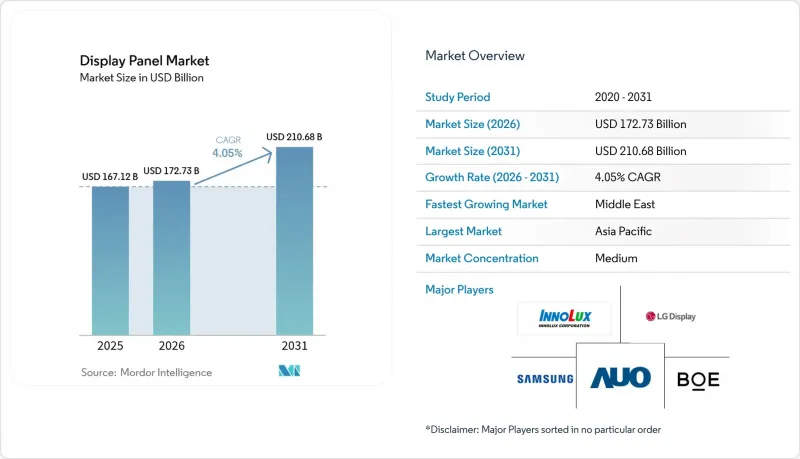
Mordor Intelligence에 의하면, 디스플레이 패널 시장 규모는 2025년 1,671억 2,000만 달러, 2026년 1,727억 3,000만 달러에서 2031년에는 2,106억 8,000만 달러에 이르고, 2026-2031년 CAGR 4.05%를 나타낼 것으로 예측됩니다.
본 보고서는 디스플레이 유형(LCD, OLED, 마이크로 LED, AMOLED, 기타), 해상도(HD, 4K, 8K 이상), 용도별(스마트폰·태블릿, PC·노트북, TV, 자동차 및 운송 산업, 기타),패널 크기(6인치 이하, 6.1-13인치, 13.1-32인치, 33-65인치, 66인치 이상), 그리고 지역(유럽, 아시아태평양, 기타)별로 분류되어 있습니다. 시장 예측은 금액(달러) 기준으로 제시되어 있습니다.
세계 디스플레이 패널 시장 동향 및 인사이트
UHD(4K 이상) TV에 대한 수요 급증
2025년, 인도와 동남아시아에서 55인치 TV의 소매 가격이 400달러 아래로 떨어지면서 4K TV 보급률은 계속 상승했고, 첫 구매를 고려하는 소비자들의 구매 심리를 자극했습니다. 한편, 북미와 유럽에서는 교체 주기가 지속되었습니다. 각 패널 제조업체들은 65인치 4K 패널 생산을 위해 10.5세대 LCD 생산 라인을 최적화하여, 단위 면적당 비용을 기존 8.5세대 생산 라인 수준보다 낮췄습니다. 8K 패널의 생산 비용은 전년 대비 18-20% 하락했으나, 2025년 말 시점에서 스트리밍 플랫폼이 제공하는 네이티브 8K 컨텐츠가 100편 이하에 그쳤기 때문에 이 형태는 여전히 틈새 시장에 머물렀고 소비자 수요는 저조한 상태를 유지했습니다. 이에 따라 각 브랜드는 수요 변동에 대비하기 위해 4K와 8K 유리 절단을 번갈아 수행할 수 있는 새로운 생산 라인을 구축했습니다. 이러한 듀얼 형식 대응의 유연성 덕분에 컨텐츠 생태계가 성숙해지면 신속하게 생산 체제를 전환할 수 있게 됩니다.
스마트폰 OEM 각사의 OLED·마이크로 LED 전환
2025년, 주류 플래그십 스마트폰은 전체 모델 라인업에서 LTPO OLED를 채택하여 디스플레이 전력 소비를 5분의 1 가까이 줄이는 동시에, 주요 OLED 공급업체 시장 점유율 확대를 공고히 했습니다. 한국과 중국에 위치한 6세대 팹에서는 6-7인치 패널의 수율이 95%를 넘어, 하이엔드 LCD와의 비용 격차가 축소되었습니다. 상용 마이크로 LED 시범 프로젝트는 스마트 워치 및 AR 글래스 부문에서 연구개발 단계에서 한정 생산 단계로 전환되었으나, 2인치를 초과하는 패널의 수율이 70% 미만에 그치고 비용이 4-6배 더 높기 때문에 생산량은 소폭 수준에 머물렀습니다. 소재 공급업체들은 OLED 발광 화합물에 대해 견조한 수주 잔고를 기록하고 있으며, 이는 2027년까지 설비 투자가 지속될 것임을 시사합니다.
10.5세대 팹의 높은 설비 투자액
2025년 시점에서 10.5세대 LCD 생산 라인 1기당 건설 비용은 30억-40억 달러가 소요되었으며, 이는 8.5세대 라인보다 약 30% 높은 수준이었습니다. 중국의 주요 기업들은 총액 120억 달러를 넘는 여러 프로젝트에 동시에 자금을 투입했으나, 회수 기간이 수년에 달하고 감가상각비가 높다는 점이 신규 진입을 가로막았습니다. 감가상각이 진행된 8.5세대 자산을 보유한 기업들은 가격에 민감한 부문에서 20-30%의 비용 우위를 유지하며 양극화된 시장 구조를 강화하는 한편, 2025년에는 상위 5개 LCD 제조업체의 합계 시장 점유율을 78%까지 끌어올렸습니다.
부문 분석
OLED는 2025년에 40.74%의 시장 점유율을 확보했습니다. 이는 프리미엄 스마트폰, 태블릿, 자동차용 디스플레이에서 OLED가 정착된 것을 반영한 것으로, 이러한 부문에서는 높은 전력 효율과 명암비가 LCD 제품에 비해 높은 가격을 정당화하고 있습니다. 2025년, 삼성디스플레이와 LG디스플레이는 플래그십 스마트폰용 OLED 패널의 85% 이상을 공급했습니다. 두 회사는 6.1-6.7인치 크기에 최적화된 6세대 팹을 활용하고 LTPO 기술을 채택함으로써, 이전 세대의 LTPS 패널에 비해 전력 소비를 18-22% 줄였습니다.
마이크로 LED는 2031년까지 연평균 성장률(CAGR) 4.35%로 발전하고 있으며, 실험실의 프로토타입 단계에서 상용 파일럿 단계로 전환되고 있습니다. 이는 PlayNitride와 Porotech가 2025년에 스마트 워치 및 AR 글래스 용도로 Tier 1 OEM 업체들에 평가 키트를 출하한 데 기인합니다. 물질 이동의 수율률은 여전히 제약 요인으로 작용하고 있으며, 대각선 2인치를 초과하는 패널에서는 현재 70% 미만을 기록하고 있는 반면, 성숙한 OLED 라인에서는 95% 이상을 기록하고 있습니다. 이로 인해 4-6배의 비용 프리미엄이 유지되고 있어, 당분간 마이크로 LED는 초고급 부문으로 한정될 전망입니다.
HD에서 초고해상도 형태로의 전환에 따라 시장은 양극화가 진행되고 있습니다. 4K는 이미 주류로 자리 잡은 반면, 8K는 생태계의 미비로 인해 여전히 보급이 제한되고 있습니다. 4K 해상도는 2025년에 45.36%의 시장 점유율을 차지할 것이며,설치 대수가 1억 5,000만 대를 넘는 선진국 시장의 교체 주기와, 2025년 후반 55인치 모델 가격이 400달러 아래로 떨어진 신흥국 시장의 보급 확대에 힘입고 있습니다.
8K 패널의 생산 비용은 수율 향상과 Gen-10.5 팹의 효율화로 인해 2024-2025년에 걸쳐 15-20% 하락했으나, 소매 가격은 동급 4K 모델에 비해 여전히 2-3배 높아,보급은 얼리 어답터나 업무용 설치로 한정되어 있습니다. 방송 인프라 업그레이드는 대부분 시장에서 3-5년 뒤처져 있으며, 2025년 시점에서 8K 지상파 방송을 펼치고 있는 곳은 일본과 한국뿐입니다. 이로 인해 컨텐츠 공급이 더욱 제약받게 되어, 일반 시장으로의 보급이 지연될 것입니다. HD 형태는 전 세계적으로 10억 대를 넘는 확고한 설치 대수의 혜택을 받고 있으며, 고해상도로의 전환이 진행되는 가운데서도 예측 기간 동안 교체용 패널 및 애프터마켓 수리에 대한 지속적인 수요가 확보될 전망입니다.
지역별 분석
아시아태평양은 중국의 Gen-8.6 및 Gen-10.5 생산 능력 확충으로 연간 생산량이 1,500만 제곱미터 확대됨에 따라, 2025년 매출의 49.72%에 해당하는 831억 달러를 차지했습니다. 중국의 우위는 국가 지원을 받은 자금 조달에 기인하며, 이를 통해 BOE 테크놀로지 그룹과 TCL CSOT는 2024년부터 2025년에 걸쳐 Gen-10.5 생산 능력 확대에 총 120억 달러 이상을 투자할 수 있게 되었습니다. 그 결과, 신규 시장 진출기업을 저지하는 비용 구조가 형성되어, 보조금이 지원되는 자금에 접근할 수 있는 기존 기업들이 유리한 입지를 점하고 있습니다. 인도에서는 생산 연계형 인센티브(PLI) 제도 하에, 2025년 디스플레이 제조 부문에 대한 투자액이 30억 달러를 넘어섰습니다. 삼성디스플레이와 딕슨 테크놀로지스는 국내 스마트폰 및 TV 시장을 대상으로 한 디스플레이 모듈 조립 시설을 설립하기 위한 제휴를 발표했습니다.
북미는 고급 TV 및 자동차용 디스플레이 수요를 통해 큰 시장 점유율을 유지하고 있지만, 국내 패널 생산이 제한적이어서 아시아로부터의 수입에 의존하고 있으며, 공급망은 지정학적 위험과 물류 위험에 노출되어 있습니다. 유럽도 유사한 제약에 직면해 있으며, 전문 의료 산업 부문을 제외하면 국내 패널 생산 능력은 극히 미미합니다. 게다가 2026년 1월부터 시행되는 편광 필름에 대한 PFAS 규제로 인해, 아시아 제조업체들이 시장 접근성을 유지하기 위해서는 복잡한 규제 대응을 해야만 합니다. 남미는 인프라 제약에 직면해 있으며, 브라질의 디스플레이 패널 수입 관세는 20-25%에 달할 전망입니다. 이는 현지 조립을 촉진하는 한편, TFT 및 컬러 필터 생산과 같은 업스트림 공정 투자를 저해하고 있습니다.
아프리카는 여전히 신흥 시장이며, 남아프리카공화국과 이집트가 지역 유통 허브 역할을 하고 있지만, 현지 생산이 제한적이고 수입에 의존하는 밸류체인로 인해 다른 개발도상 지역에 비해 성장이 제약받고 있습니다. 중동의 성장은 사우디아라비아의 NEOM 프로젝트와 아랍에미리트의 두바이 실리콘 오아시스에 집중되어 있으며, 이 지역에서는 디스플레이 검사 및 품질 보증 기능을 포함한 전자제품 제조 클러스터가 개발되고 있습니다. 이로 인해 업스트림 단계인 패널 제조가 아시아에 머물러 있음에도 불구하고, 해당 지역은 조립 및 모듈 통합을 통해 부가가치를 창출할 수 있는 위치에 있습니다.
기타 혜택
- 엑셀 형식 시장 예측(ME) 시트
- 3개월간의 애널리스트 지원
자주 묻는 질문
목차
제1장 서론
제2장 조사 방법
제3장 주요 요약
제4장 시장 구도
제5장 시장 규모와 성장 예측
제6장 경쟁 구도
제7장 시장 기회와 향후 전망
LSH 26.09.04According to Mordor Intelligence, the display panel market size is projected to expand from USD 167.12 billion in 2025 and USD 172.73 billion in 2026 to USD 210.68 billion by 2031, registering a 4.05% CAGR between 2026 and 2031.
This report is Segmented by Type of Display (LCD, OLED, Micro-LED, AMOLED, and More), Resolution (HD, 4K, and 8K and Above), Application (Smartphones and Tablets, PC and Laptop, Television, Automotive and Transportation, and More), Panel Size (<=6-Inch, 6. 1-13-Inch, 13. 1-32-Inch, 33-65-Inch, and >=66-Inch), and Geography (Europe, Asia-Pacific, and More). The Market Forecasts are Provided in Terms of Value (USD).
Global Display Panel Market Trends and Insights
Surging Demand for UHD (4K) Televisions
4K television penetration continued to rise in 2025 as retail pricing for 55-inch sets dipped below USD 400 in India and Southeast Asia, stimulating first-time purchases while replacement cycles persisted in North America and Europe. Panel makers optimized Gen-10.5 LCD lines for 65-inch 4K cuts, driving cost per area below legacy Gen-8.5 output. Although 8K panel production costs fell 18-20% year-over-year, the format remained a niche because streaming platforms offered under 100 native 8K titles as of late 2025, keeping consumer pull subdued. Brands therefore configured new production lines to alternate between 4K and 8K glass cuts to hedge demand swings. This dual-format flexibility permits rapid output shifts once content ecosystems mature.
Smartphone Pivot to OLED and Micro-LED
Mainstream flagship phones adopted LTPO OLED across entire model line-ups during 2025, trimming display power draw by nearly one-fifth and consolidating share gains for leading OLED suppliers. Gen-6 fabs in South Korea and China achieved yields above 95% on 6-7 inch panels, narrowing cost gaps with high-end LCD. Commercial Micro-LED pilots moved from R&D to limited production in the smartwatch and AR-glasses categories, yet yield rates below 70% for panels larger than 2 inches and a 4-6X cost premium kept volumes modest. Material suppliers logged strong order books for OLED emitter compounds, signaling sustained capital spending through 2027.
High Capex for Gen-10.5 Fabs
Gen-10.5 LCD lines required USD 3-4 billion per build-out in 2025, roughly 30% above Gen-8.5 equivalents. Chinese leaders financed simultaneous projects valued at over USD 12 billion, but multiyear payback horizons and elevated depreciation discouraged new entrants. Owners of depreciated Gen-8.5 assets maintained 20-30% cost advantages serving price-sensitive segments, reinforcing a two-tier market and lifting the combined share of the five largest LCD producers to 78% in 2025.
Other drivers and restraints analyzed in the detailed report include:
- Automotive Cockpit Digitization Wave
- Foldable and Rollable Form-Factor Innovation
- Persistent Glass Substrate Supply Bottlenecks
For complete list of drivers and restraints, kindly check the Table Of Contents.
Segment Analysis
OLED secured 40.74% market share in 2025, reflecting its entrenchment in premium smartphones, tablets, and automotive displays, where power efficiency and contrast ratios justify cost premiums over LCD alternatives. Samsung Display and LG Display supplied over 85% of OLED panels for flagship smartphones in 2025, leveraging Gen-6 fabs optimized for 6.1-6.7-inch formats that enable LTPO, reducing power consumption by 18-22% versus prior-generation LTPS panels.
Micro-LED is advancing at a 4.35% CAGR through 2031, transitioning from laboratory prototypes to commercial pilots as PlayNitride and Porotech shipped evaluation kits to tier-1 OEMs in 2025 for smartwatch and AR glasses applications. Mass transfer yield rates remain the binding constraint, currently below 70% for panels exceeding 2 inches diagonal versus 95%+ for mature OLED lines, sustaining a 4-6x cost premium that confines Micro-LED to ultra-premium segments in the near term.
The transition from HD to ultra-high-definition formats reveals a bifurcated market where 4K has achieved mainstream penetration while 8K remains constrained by ecosystem gaps. 4K resolution commanded 45.36% market share in 2025, sustained by replacement cycles in developed markets where installed bases exceed 150 million units and by penetration gains in emerging economies where 4K pricing fell below USD 400 for 55-inch models in late 2025.
8K panel production costs declined 15-20% between 2024 and 2025 due to yield improvements and Gen-10.5 fab efficiencies, yet retail pricing remains 2-3x higher than comparable 4K models, limiting adoption to early adopters and commercial installations. Broadcast infrastructure upgrades lag by 3-5 years in most markets, with only Japan and South Korea deploying 8K terrestrial broadcasts as of 2025, further constraining content supply and delaying mass-market adoption. HD formats benefit from entrenched installed bases exceeding 1 billion units globally, ensuring sustained demand for replacement panels and aftermarket repairs through the forecast period despite migration toward higher resolutions.
Complete Report Scope:
- Display Type
- LCD
- OLED
- Micro-LED
- AMOLED
- Other Display types
- By Resolution
- HD (HD/WQHD/FHD)
- 4K
- 8K and Above
- By Application
- Smartphones and Tablets
- PC and Laptop
- Television
- Automotive and Transportation
- Wearables and AR/VR
- Industrial, Medical and Others
- By Panel Size
- <=6-inch
- 6.1-13-inch
- 13.1-32-inch
- 33-65-inch
- >=66-inch
- By Geography
- North America
- United States
- Canada
- Mexico
- South America
- Brazil
- Argentina
- Rest of South America
- Europe
- Germany
- United Kingdom
- France
- Russia
- Rest of Europe
- Asia Pacific
- China
- Japan
- India
- South Korea
- South-East Asia
- Rest of Asia Pacific
- Middle East
- Saudi Arabia
- United Arab Emirates
- Rest of Middle East
- Africa
- South Africa
- Egypt
- Rest of Africa
- North America
Geography Analysis
Asia Pacific captured USD 83.1 billion, or 49.72% of 2025 revenue, as Chinese Gen-8.6 and Gen-10.5 capacity additions expanded annual output by 15 million square meters. China's dominance reflects state-backed financing that enabled BOE Technology Group and TCL CSOT to commit over USD 12 billion combined between 2024 and 2025 for Gen-10.5 capacity, creating cost structures that deter new entrants and favor incumbents with access to subsidized capital. India attracted over USD 3 billion in display manufacturing investments during 2025 under the Production-Linked Incentive (PLI) scheme, with Samsung Display and Dixon Technologies announcing partnerships to establish display module assembly facilities targeting domestic smartphone and television markets.
North America sustains a substantial share through premium television and automotive display demand, yet limited domestic panel production creates dependence on Asian imports that expose supply chains to geopolitical and logistics risks. Europe faces similar constraints with minimal domestic panel manufacturing capacity outside specialized medical and industrial segments, while PFAS restrictions on polarizer films, effective January 2026, add regulatory complexity that Asian manufacturers must navigate to maintain market access. South America confronts infrastructure limitations, with Brazil's import tariffs on display panels reaching 20-25% that incentivize local assembly but deter upstream investments in TFT and color filter production.
Africa remains an emerging market with South Africa and Egypt serving as regional distribution hubs, yet limited local manufacturing and import-dependent supply chains constrain growth relative to other developing regions. Middle East growth concentrates in Saudi Arabia's NEOM project and UAE's Dubai Silicon Oasis, which are developing electronics manufacturing clusters that include display testing and quality assurance capabilities, positioning the region to capture assembly and module integration value even as upstream panel fabrication remains in Asia.
- Samsung Display Co., Ltd.
- LG Display Co., Ltd.
- BOE Technology Group Co., Ltd.
- AUO Corporation
- Innolux Corporation
- Japan Display Inc.
- Sharp Corporation
- TCL China Star Optoelectronics Technology Co., Ltd.
- Tianma Micro-electronics Co., Ltd.
- Visionox Technology Inc.
- Hisense Visual Technology Co., Ltd.
- Shenzhen Royole Technologies Co., Ltd.
- PlayNitride Inc.
- Kyocera Display Corporation
- Panasonic Holdings Corporation (Display Business)
- E Ink Holdings Inc.
- Universal Display Corporation
- Kopin Corporation
- Lumus Ltd.
- Tianma Japan, Ltd.
- Truly International Holdings Ltd.
- Giantplus Technology Co., Ltd.
- Ortustech Co., Ltd.
- EverDisplay Optronics (EDO)
- Microtips Technology, Inc.
Additional Benefits:
- The market estimate (ME) sheet in Excel format
- 3 months of analyst support
TABLE OF CONTENTS
1 INTRODUCTION
- 1.1 Study Assumptions and Market Definition
- 1.2 Scope of the Study
2 RESEARCH METHODOLOGY
3 EXECUTIVE SUMMARY
4 MARKET LANDSCAPE
- 4.1 Market Overview
- 4.2 Market Drivers
- 4.2.1 Surging Demand for UHD (4K and Above) TVs
- 4.2.2 Smartphone OEM Pivot to OLED and Micro-LED
- 4.2.3 Automotive Cockpit Digitisation Wave
- 4.2.4 Foldable and Rollable Form-Factor Innovation
- 4.2.5 Substrate-Free Holographic Waveguide Displays for Defence Avionics
- 4.2.6 Localised EU Incentives for Clean-Room Glass Recycling
- 4.3 Market Restraints
- 4.3.1 High Capex for Gen-10.5 Fabs
- 4.3.2 Persistent Glass Substrate Supply Bottlenecks
- 4.3.3 Talent Scarcity in Oxide and LTPO Backplane Engineering
- 4.3.4 Environmental Regulation Risk on PFAS-Based Polariser Films
- 4.4 Industry Value Chain Analysis
- 4.5 Regulatory Landscape
- 4.6 Impact of Macroeconomic Factors
- 4.7 Porter's Five Forces Analysis
- 4.7.1 Bargaining Power of Suppliers
- 4.7.2 Bargaining Power of Consumers
- 4.7.3 Threat of New Entrants
- 4.7.4 Threat of Substitutes
- 4.7.5 Intensity of Competitive Rivalry
5 MARKET SIZE AND GROWTH FORECASTS (VALUE)
- 5.1 Display Type
- 5.1.1 LCD
- 5.1.2 OLED
- 5.1.3 Micro-LED
- 5.1.4 AMOLED
- 5.1.5 Other Display types
- 5.2 By Resolution
- 5.2.1 HD (HD/WQHD/FHD)
- 5.2.2 4K
- 5.2.3 8K and Above
- 5.3 By Application
- 5.3.1 Smartphones and Tablets
- 5.3.2 PC and Laptop
- 5.3.3 Television
- 5.3.4 Automotive and Transportation
- 5.3.5 Wearables and AR/VR
- 5.3.6 Industrial, Medical and Others
- 5.4 By Panel Size
- 5.4.1 <=6-inch
- 5.4.2 6.1-13-inch
- 5.4.3 13.1-32-inch
- 5.4.4 33-65-inch
- 5.4.5 >=66-inch
- 5.5 By Geography
- 5.5.1 North America
- 5.5.1.1 United States
- 5.5.1.2 Canada
- 5.5.1.3 Mexico
- 5.5.2 South America
- 5.5.2.1 Brazil
- 5.5.2.2 Argentina
- 5.5.2.3 Rest of South America
- 5.5.3 Europe
- 5.5.3.1 Germany
- 5.5.3.2 United Kingdom
- 5.5.3.3 France
- 5.5.3.4 Russia
- 5.5.3.5 Rest of Europe
- 5.5.4 Asia Pacific
- 5.5.4.1 China
- 5.5.4.2 Japan
- 5.5.4.3 India
- 5.5.4.4 South Korea
- 5.5.4.5 South-East Asia
- 5.5.4.6 Rest of Asia Pacific
- 5.5.5 Middle East
- 5.5.5.1 Saudi Arabia
- 5.5.5.2 United Arab Emirates
- 5.5.5.3 Rest of Middle East
- 5.5.6 Africa
- 5.5.6.1 South Africa
- 5.5.6.2 Egypt
- 5.5.6.3 Rest of Africa
- 5.5.1 North America
6 COMPETITIVE LANDSCAPE
- 6.1 Market Concentration
- 6.2 Strategic Moves
- 6.3 Market Share Analysis
- 6.4 Company Profiles (includes Global Level Overview, Market Level Overview, Core Segments, Financials as Available, Strategic Information, Market Rank/Share for Key Companies, Products and Services, and Recent Developments)
- 6.4.1 Samsung Display Co., Ltd.
- 6.4.2 LG Display Co., Ltd.
- 6.4.3 BOE Technology Group Co., Ltd.
- 6.4.4 AUO Corporation
- 6.4.5 Innolux Corporation
- 6.4.6 Japan Display Inc.
- 6.4.7 Sharp Corporation
- 6.4.8 TCL China Star Optoelectronics Technology Co., Ltd.
- 6.4.9 Tianma Micro-electronics Co., Ltd.
- 6.4.10 Visionox Technology Inc.
- 6.4.11 Hisense Visual Technology Co., Ltd.
- 6.4.12 Shenzhen Royole Technologies Co., Ltd.
- 6.4.13 PlayNitride Inc.
- 6.4.14 Kyocera Display Corporation
- 6.4.15 Panasonic Holdings Corporation (Display Business)
- 6.4.16 E Ink Holdings Inc.
- 6.4.17 Universal Display Corporation
- 6.4.18 Kopin Corporation
- 6.4.19 Lumus Ltd.
- 6.4.20 Tianma Japan, Ltd.
- 6.4.21 Truly International Holdings Ltd.
- 6.4.22 Giantplus Technology Co., Ltd.
- 6.4.23 Ortustech Co., Ltd.
- 6.4.24 EverDisplay Optronics (EDO)
- 6.4.25 Microtips Technology, Inc.
7 MARKET OPPORTUNITIES AND FUTURE OUTLOOK
- 7.1 White-Space and Unmet-Need Assessment


