|
시장보고서
상품코드
2122302
옵토커플러 시장 : 시장 점유율 분석, 업계 동향 및 통계, 성장 예측(2026-2031년)Optocouplers - Market Share Analysis, Industry Trends & Statistics, Growth Forecasts (2026 - 2031) |
||||||
 Mordor Intelligence
Mordor Intelligence에 의하면, 옵토커플러 시장 규모는 2025년에 29억 8,000만 달러로 평가되었고, 2026년 32억 6,000만 달러에서 2031년까지 50억 8,000만 달러에 이를 것으로 예측되며, 예측 기간(2026-2031년) CAGR은 9.29%를 나타낼 전망입니다.
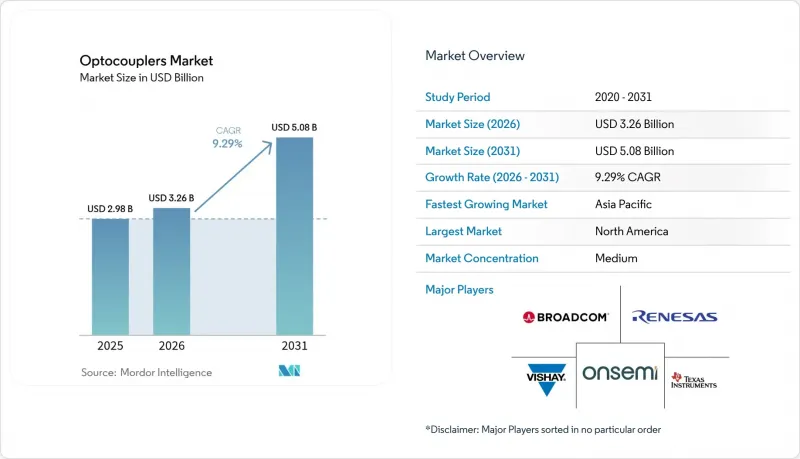
본 보고서는 제품 유형별(포토트랜지스터, 포토달링턴 등), 채널 수별(1채널, 2채널, 4채널, 6채널, 8채널), 절연 전압 정격별(2.5 kVrms 이하, 기타), 최종 사용자 산업별(자동차·e-모빌리티, 산업용 자동화·모션 제어, 기타), 지역별로 분류되어 있습니다. 시장 예측은 금액(달러) 기준으로 제시되어 있습니다.
세계의 옵토커플러 시장 동향 및 인사이트
하이브리드 및 배터리 구동 전기 구동 시스템에서의 채택 급증
전기자동차의 경우, 800 V 배터리 팩과 12 V 제어 도메인 간의 전기적 절연이 필요하기 때문에 EV 아키텍처에서는 IEC 60747-5-5를 준수하는 고전압 옵토커플러가 더욱 많이 채택되고 있습니다. 배터리 차단 장치에서는 고장 해결 시간을 단축하기 위해 SiC JFET와 로직 게이트용 옵토커플러의 조합이 점점 더 늘어나고 있으며, 급속 충전소에서는 파워 모듈마다 여러 개의 절연 게이트 구동 채널이 필요합니다. 현재 자동차 OEM의 조달 지침에서는 20 kV/µs를 초과하는 최소 공통 모드 과도 내성이 규정되어 있으며, 이 성능 대역에서는 내부 차폐 구조가 최적화된 옵토커플러가 유리합니다. 2030년까지 전 세계 BEV 판매 대수가 2,000만 대에 육박하는 가운데, 옵토커플러 시장에서는 정격 5 kVrms 이상의 디바이스 출하량이 증가할 것으로 예측됩니다.
공장 자동화의 진전과 인더스트리 4.0으로의 전환
기존의 프로그래머블 로직 컨트롤러(PLC)나 모터 드라이브의 경우, 인버터와 서보가 밀집된 시설에서 LED와 포토트랜지스터의 조합이 뛰어난 노이즈 제거 성능을 발휘하기 때문에 여전히 옵토커플러가 채택되고 있습니다. 스마트 센서나 클라우드 연결형 엣지 컨트롤러로의 업그레이드에서도 대부분의 경우 기존의 절연 토폴로지가 유지되기 때문에 현대화 작업에서는 기존 설비 위에 새로운 채널이 추가되는 형태가 됩니다. 현재 각 공급업체들은 PCB 면적을 40% 줄여주는 멀티 채널 표면 실장 패키지를 제공하고 있으며, 이는 제어반의 공간이 제한된 환경에서 필수적인 기능입니다. 아시아 제조업체들은 정부의 인센티브로 인해 섬유, 금속, 개별 생산 분야의 생산성 향상이 우선시되고 있기 때문에 이러한 개조 흐름을 주도하고 있습니다.
LED의 노후화와 CTR 저하
광 전송은 이미터의 효율에 의존합니다. LED가 노후화되면 전류 전송비(CTR)가 데이터 시트의 최저값 아래로 떨어지게 되어, 정격 하향 조정이나 정기적인 교체가 불가피해집니다. 가속 열화 시험에 따르면, 125°C에서 10,000시간 가동 후 CTR이 25% 저하되는 것으로 나타났으며, 이는 자동차용 트랙션 인버터에서 약 4년간의 사용에 해당합니다. 따라서 설계자는 LED 용량을 늘리거나 구동 전류를 증가시켜야 하지만, 두 경우 모두 전력 손실을 증가시켜 시스템 전체의 효율을 저하시키는 결과를 초래합니다.
부문 분석
포토트랜지스터 부문은 2025년 옵토커플러 시장 매출의 31.85%를 차지했습니다. 산업용 로직 입력 및 전원 피드백 루프용 출하량은 여전히 높은 수준을 유지하고 있지만, 성장률은 완만합니다. 고속 로직 게이트 유형은 연평균 성장률(CAGR) 10.31%로 성장을 지속하고, 있으며, 5G, 전기차, 재생 에너지용 인버터 OEM 업체들이 전파 지연 100ns 미만으로의 전환을 추진함에 따라 2031년까지 옵토커플러 시장 규모에서 현저히 큰 점유율을 차지하게 될 것입니다. IGBT 및 MOSFET의 게이트 구동용 포토커플러에는 현재 미러 클램프 회로와 탈포화 감지 기능이 통합되어 있어, 디스크리트 비교기를 대체함으로써 BOM 품목을 줄이고 있습니다.
새롭게 등장한 포토 SCR 및 포토 TRIAC은 가전 및 HVAC 시장의 솔리드 스테이트 릴레이에 대응하는 반면, 태양광 발전용 옵토커플러는 보조 바이어스 전원을 필요로 하지 않고 게이트 구동 전압을 생성합니다. 이는 태양광 발전용 마이크로 인버터의 절연형 하이사이드 스위치에 매력적인 기능입니다. EN IEC 60747-5-5 인증을 획득한 도시바의 TLP3640A는 규정 준수 인증이 기능 안전 분야에서의 채택을 얼마나 촉진하고 있는지를 보여줍니다. 각 공급업체들은 동일한 구동 전류에서 광 출력을 두 배로 늘리고, 수명을 연장하며, CTR 열화를 완화하는 독자적인 LED 화학 기술에 대한 투자를 계속하고 있습니다.
2025년에도 싱글 채널 제품은 옵토커플러 시장에서 41.05%의 점유율을 유지했습니다. 이는 기존의 PLC I/O 카드나 오프라인 전원 공급 장치의 플라이백 컨트롤러가 1대 1 절연에 크게 의존하고 있기 때문입니다. 그럼에도 불구하고, 4채널 디바이스는 2031년까지 연평균 10.52%의 성장률이 예상되며, 이는 다축 서보 드라이브 및 배터리 관리 모듈에서 설계자들이 기판 실적 축소를 추진하고 있음을 반영합니다. 듀얼 채널 패키지는 RS-485 트랜시버에서 양방향 통신 링크를 가능하게 하는 반면, 6채널 및 8채널 어레이는 3상 모터 인버터에 채택되어 상별로 하이사이드와 로우사이드 게이트를 동시에 제어할 수 있게 합니다.
밀도 향상에는 상충 관계가 따릅니다. 채널 간의 열 결합으로 인해 내부 LED 접합부 온도가 상승하기 때문에 패키지 설계자들은 열을 방출하기 위해 구리 리드 프레임이나 성형 캐비티를 채택하고 있습니다. 옵토커플러 업계에서는 독립적인 이네이블 핀과 오픈 컬렉터 방식의 오류 출력을 갖춘 핀 호환 멀티 채널 제품이 점점 더 많이 제공되고 있어 전환이 용이해지고 있습니다. 더 높은 채널 밀도를 활용하는 시스템 통합사업자들은 대부분의 경우 PCB 면적을 최대 18%까지 줄이고 있으며, 이는 고출력 전기차(EV) 차량용 충전기에서 매우 중요합니다.
지역별 분석
북미는 자동차 전동화 프로그램, 항공우주 분야의 업그레이드, 반도체 제조 장비 증설로 인해 수요가 견조하게 유지됨에 따라, 2025년 옵토커플러 시장 매출에서 44.25%의 점유율을 차지하며 시장을 주도했습니다. 각 OEM 업체들은 애리조나주의 LED 웨이퍼 성장부터 멕시코 바하 회랑의 조립에 이르기까지, 지역에 뿌리를 둔 생태계의 혜택을 누리고 있습니다. 미국의 CHIPS 법과 같은 경제적 인센티브는 국내 광전자 생산 능력을 더욱 강화하고, 지역 고객들에게 리드 타임을 단축시킬 가능성이 있습니다.
그 뒤를 이어 유럽이 자리 잡았으며, 엄격한 기능 안전 규제와 독일, 이탈리아, 프랑스에 집중된 산업용 자동화 기업들이 성장을 주도하고 있습니다. EU의 기후 목표는 800V 전기차 플랫폼과 재생에너지 저장 시스템을 촉진하고 있으며, 이 둘 모두 수 kVrms의 절연이 필요합니다. 이 지역의 탄소 중립 제조 노력은 전기 기계식 릴레이를 광절연형 솔리드 스테이트 대체품으로 교체하는 것을 뒷받침하고 있습니다. 그러나 GDP 성장세가 완만하여 총 출하량 확대는 제한되고 있습니다.
아시아태평양은 연평균 성장률(CAGR) 12.25%의 궤도에 올라 시장 점유율 격차를 빠르게 좁혀갈 전망입니다. 중국의 적극적인 5G 전개, 광범위한 가전제품 공급망, 그리고 급증하는 전기차 생산 대수가 막대한 수요를 창출하고 있는 반면, 일본의 기존 기업들은 그 공정 노하우를 활용하여 공장 자동화용 수출 제품으로 고신뢰성 옵토커플러를 공급하고 있습니다. 한국의 메모리 공장에서는 엄격한 설비 갱신 주기가 시행되고 있으며, 새로운 EUV 스테퍼 1대당 수십 개의 절연 채널이 탑재되어 있습니다. 인도의 생산 연계형 인센티브 프로그램은 LED 웨이퍼 슬라이싱 및 백엔드 조립 라인을 유치하기 시작했으며, 이 지역공급 기반 다각화가 진행되고 있습니다.
기타 혜택 :
- 엑셀 형식 시장 예측(ME) 시트
- 3개월간의 애널리스트 지원
자주 묻는 질문
목차
제1장 서론
제2장 조사 방법
제3장 주요 요약
제4장 시장 구도
제5장 시장 규모 및 성장 예측
제6장 경쟁 구도
제7장 시장 기회 및 향후 전망
AJY 26.09.07According to Mordor Intelligence, the optocouplers market size was valued at USD 2.98 billion in 2025 and estimated to grow from USD 3.26 billion in 2026 to reach USD 5.08 billion by 2031, at a CAGR of 9.29% during the forecast period (2026-2031).
This report is Segmented by Product Type (Phototransistor, Photodarlington, and More), Channel Count (1-Channel, 2-Channel, 4-Channel, 6-Channel, and 8-Channel), Isolation Voltage Rating (Less Than or Equal To 2. 5 KVrms, and More), End-User Industry (Automotive and E-Mobility, Industrial Automation and Motion Control, and More), and Geography. The Market Forecasts are Provided in Terms of Value (USD).
Global Optocouplers Market Trends and Insights
Surging adoption in hybrid and battery-electric drivetrains
Electric vehicles require galvanic isolation between 800 V battery packs and 12 V control domains, so EV architectures pull in larger numbers of high-voltage optocouplers certified to IEC 60747-5-5. Battery-disconnect units increasingly pair SiC JFETs with logic-gate optocouplers to shorten fault-clearing times, and fast-charging stations need several isolated gate-drive channels per power module. Automotive OEM sourcing guidelines now stipulate minimum common-mode transient immunity above 20 kV/µs, a performance band that favors optocouplers with optimized internal shield structures. As global BEV sales climb toward 20 million units by 2030, the optocouplers market is expected to ship higher volumes of devices rated above 5 kVrms.
Rising factory automation and Industry 4.0 retrofits
Legacy programmable-logic controllers and motor drives stay with optocouplers because LED-phototransistor pairs exhibit excellent noise rejection in facilities packed with inverters and servos. Upgrades to smart sensors and cloud-connected edge controllers often retain the original isolation topology, so modernization activity layers new channels on top of the installed base. Suppliers now offer multi-channel surface-mount packages that reduce PCB area by 40%, an essential feature for densely packed control cabinets. Asian manufacturers spearhead this retrofitting wave as government incentives prioritize productivity improvements across textiles, metals, and discrete manufacturing.
LED wear-out and CTR degradation over lifetime
Photonic transfer relies on emitter efficiency; as LEDs age, current transfer ratio falls below datasheet minima, forcing derating or scheduled replacement. Accelerated-aging studies show 25% CTR loss after 10,000 operating hours at 125 °C, which in automotive traction inverters equates to roughly four years of service. Designers therefore oversize LEDs or increase drive current, both raising power dissipation and reducing overall system efficiency.
Other drivers and restraints analyzed in the detailed report include:
- 5G-enabled base-station roll-outs driving power isolation demand
- Proliferation of GaN/SiC power devices boosting high-speed optocouplers
- Competition from digital isolators (capacitive and magnetic)
For complete list of drivers and restraints, kindly check the Table Of Contents.
Segment Analysis
The phototransistor class controlled 31.85% of 2025 revenue within the optocouplers market. Although volume remains high for industrial logic inputs and power-supply feedback loops, its growth is modest. High-speed logic-gate types are tracking a 10.31% CAGR and, by 2031, will account for a markedly larger slice of the optocouplers market size as 5G, electric-vehicle, and renewable-inverter OEMs pivot toward sub-100 ns propagation delays. IGBT and MOSFET gate-drive optocouplers now integrate Miller-clamp circuits and desaturation detection, displacing discrete comparators and reducing BOM count.
Emerging photo-SCR and photo-TRIAC options address solid-state relays in appliance and HVAC markets, while photovoltaic optocouplers produce gate-drive voltages without ancillary bias supplies, a compelling feature for isolated high-side switches in solar micro-inverters. Toshiba's TLP3640A, certified to EN IEC 60747-5-5, demonstrates how compliance credentials buttress adoption in functional-safety landscapes. Suppliers continue to invest in proprietary LED chemistries that double luminous output for the same drive current, prolonging lifespan and mitigating CTR degradation.
Single-channel units kept 41.05% share of the optocouplers market in 2025 as legacy PLC I/O cards and off-line power-supply flyback controllers rely heavily on one-for-one isolation. Nevertheless, 4-channel devices are predicted to grow 10.52% annually through 2031, reflecting designers' push to shrink board footprints in multi-axis servo drives and battery-management modules. Dual-channel packages facilitate bidirectional communication links in RS-485 transceivers, while six- and eight-channel arrays serve three-phase motor inverters, enabling simultaneous high-side and low-side gating per phase.
Density gains do not come without trade-offs; thermal coupling between channels elevates internal LED junction temperature, so package designers employ copper lead-frames and molded cavities to dissipate heat. The optocouplers industry increasingly offers pin-compatible multi-channel options featuring independent enable pins plus open-collector fault outputs, making migration straightforward. System integrators leveraging higher channel densities often achieve up to 18% PCB area savings, crucial in high-power EV on-board chargers.
Complete Report Scope:
- By Product Type
- Phototransistor
- Photodarlington
- Photo-SCR
- Photo-TRIAC
- High-speed Logic-gate Optocoupler
- IGBT/Power MOSFET Gate-drive Optocoupler
- Other Product Types (Photovoltaic, Analog, etc.)
- By Channel Count
- 1-Channel
- 2-Channel
- 4-Channel
- 6-Channel and 8-Channel
- By Isolation Voltage Rating
- Less than or Equal to 2.5 kVrms
- 2.5 - 5 kVrms
- Greater than 5 kVrms
- By End-user Industry
- Automotive and E-Mobility
- Industrial Automation and Motion Control
- Power and Energy (Renewables, Grid)
- Consumer Electronics and Home Appliances
- Telecom and Datacom
- Healthcare Equipment
- Other End-user Industries (Aerospace, Defense, etc.)
- By Geography
- North America
- United States
- Canada
- Mexico
- South America
- Brazil
- Argentina
- Colombia
- Rest of South America
- Europe
- United Kingdom
- Germany
- France
- Italy
- Spain
- Rest of Europe
- Asia-Pacific
- China
- Japan
- South Korea
- India
- Rest of Asia-Pacific
- Middle East and Africa
- Middle East
- Saudi Arabia
- United Arab Emirates
- Rest of Middle East
- Africa
- South Africa
- Egypt
- Rest of Africa
- Middle East
- North America
Geography Analysis
North America dominated 2025 revenue with a 44.25% stake in the optocouplers market share as vehicle electrification programs, aerospace upgrades, and semiconductor equipment builds kept demand vibrant. OEMs benefit from a local ecosystem spanning LED wafer growth in Arizona through to assembly in Mexico's Baja corridor. Economic incentives such as the U.S. CHIPS Act will further bolster domestic optoelectronics capacity, potentially tightening lead times for regional customers.
Europe follows, propelled by stringent functional-safety mandates and a strong concentration of industrial-automation firms in Germany, Italy, and France. EU climate targets incentivize 800 V EV platforms and renewable-energy storage systems, each requiring multi-kVrms isolation. The region's commitment to carbon-neutral manufacturing supports the replacement of electromechanical relays with optically isolated solid-state alternatives. However, moderate GDP growth tempers total unit expansion.
Asia-Pacific is on a 12.25% CAGR trajectory and will close the share gap quickly. China's aggressive 5G rollout, sprawling consumer-electronics supply chains, and surging EV output drive huge volume requirements, while Japanese incumbents leverage their process know-how to supply high-reliability optocouplers for factory-automation exports. South Korea's memory fabs execute stringent equipment upgrade cycles, each new EUV stepper containing dozens of isolation channels. India's production-linked incentive programs have begun to lure LED wafer slicing and backend assembly lines, diversifying the region's supply base.
- Broadcom Inc.
- ON Semiconductor Corporation
- Texas Instruments Incorporated
- Vishay Intertechnology Inc.
- Renesas Electronics Corporation
- Toshiba Electronic Devices and Storage Corporation
- Panasonic Holdings Corporation
- Skyworks Solutions Inc.
- LITE-ON Technology Corporation
- Isocom Components 2004 Ltd
- Standex Electronics Inc.
- Everlight Electronics Co., Ltd.
- Shenzhen Kento Electronic Co., Ltd.
- Senba Sensing Technology Co., Ltd.
- Sharp Devices Europe GmbH
- NXP Semiconductors N.V.
- Infineon Technologies AG
- ROHM Semiconductor GmbH
- Tamura Corporation
- CT Micro International Corporation
Additional Benefits:
- The market estimate (ME) sheet in Excel format
- 3 months of analyst support
TABLE OF CONTENTS
1 INTRODUCTION
- 1.1 Study Assumptions and Market Definition
- 1.2 Scope of the Study
2 RESEARCH METHODOLOGY
3 EXECUTIVE SUMMARY
4 MARKET LANDSCAPE
- 4.1 Market Overview
- 4.2 Market Drivers
- 4.2.1 Surging adoption in hybrid and battery-electric drivetrains
- 4.2.2 Rising factory automation and Industry 4.0 retrofits
- 4.2.3 5G-enabled base-station roll-outs driving power isolation demand
- 4.2.4 Proliferation of GaN/SiC power devices boosting high-speed optocouplers
- 4.2.5 Regulatory push for functional safety (ISO 26262, IEC 60747-5-5)
- 4.2.6 Emerging solid-state circuit-breaker architectures
- 4.3 Market Restraints
- 4.3.1 LED wear-out and CTR degradation over lifetime
- 4.3.2 Thermal-management challenges above 150 °C junction
- 4.3.3 Competition from digital isolators (capacitive and magnetic)
- 4.3.4 Supply-chain concentration in Asia for LED die
- 4.4 Industry Supply Chain Analysis
- 4.5 Regulatory Landscape
- 4.6 Technological Outlook
- 4.7 Porter's Five Forces Analysis
- 4.7.1 Bargaining Power of Suppliers
- 4.7.2 Bargaining Power of Buyers
- 4.7.3 Threat of New Entrants
- 4.7.4 Threat of Substitute Products
- 4.7.5 Intensity of Competitive Rivalry
5 MARKET SIZE AND GROWTH FORECASTS (VALUE)
- 5.1 By Product Type
- 5.1.1 Phototransistor
- 5.1.2 Photodarlington
- 5.1.3 Photo-SCR
- 5.1.4 Photo-TRIAC
- 5.1.5 High-speed Logic-gate Optocoupler
- 5.1.6 IGBT/Power MOSFET Gate-drive Optocoupler
- 5.1.7 Other Product Types (Photovoltaic, Analog, etc.)
- 5.2 By Channel Count
- 5.2.1 1-Channel
- 5.2.2 2-Channel
- 5.2.3 4-Channel
- 5.2.4 6-Channel and 8-Channel
- 5.3 By Isolation Voltage Rating
- 5.3.1 Less than or Equal to 2.5 kVrms
- 5.3.2 2.5 - 5 kVrms
- 5.3.3 Greater than 5 kVrms
- 5.4 By End-user Industry
- 5.4.1 Automotive and E-Mobility
- 5.4.2 Industrial Automation and Motion Control
- 5.4.3 Power and Energy (Renewables, Grid)
- 5.4.4 Consumer Electronics and Home Appliances
- 5.4.5 Telecom and Datacom
- 5.4.6 Healthcare Equipment
- 5.4.7 Other End-user Industries (Aerospace, Defense, etc.)
- 5.5 By Geography
- 5.5.1 North America
- 5.5.1.1 United States
- 5.5.1.2 Canada
- 5.5.1.3 Mexico
- 5.5.2 South America
- 5.5.2.1 Brazil
- 5.5.2.2 Argentina
- 5.5.2.3 Colombia
- 5.5.2.4 Rest of South America
- 5.5.3 Europe
- 5.5.3.1 United Kingdom
- 5.5.3.2 Germany
- 5.5.3.3 France
- 5.5.3.4 Italy
- 5.5.3.5 Spain
- 5.5.3.6 Rest of Europe
- 5.5.4 Asia-Pacific
- 5.5.4.1 China
- 5.5.4.2 Japan
- 5.5.4.3 South Korea
- 5.5.4.4 India
- 5.5.4.5 Rest of Asia-Pacific
- 5.5.5 Middle East and Africa
- 5.5.5.1 Middle East
- 5.5.5.1.1 Saudi Arabia
- 5.5.5.1.2 United Arab Emirates
- 5.5.5.1.3 Rest of Middle East
- 5.5.5.2 Africa
- 5.5.5.2.1 South Africa
- 5.5.5.2.2 Egypt
- 5.5.5.2.3 Rest of Africa
- 5.5.5.1 Middle East
- 5.5.1 North America
6 COMPETITIVE LANDSCAPE
- 6.1 Market Concentration
- 6.2 Strategic Moves
- 6.3 Market Share Analysis
- 6.4 Company Profiles {(includes Global level Overview, Market level overview, Core Segments, Financials as available, Strategic Information, Market Rank/Share, Products and Services, Recent Developments)}
- 6.4.1 Broadcom Inc.
- 6.4.2 ON Semiconductor Corporation
- 6.4.3 Texas Instruments Incorporated
- 6.4.4 Vishay Intertechnology Inc.
- 6.4.5 Renesas Electronics Corporation
- 6.4.6 Toshiba Electronic Devices and Storage Corporation
- 6.4.7 Panasonic Holdings Corporation
- 6.4.8 Skyworks Solutions Inc.
- 6.4.9 LITE-ON Technology Corporation
- 6.4.10 Isocom Components 2004 Ltd
- 6.4.11 Standex Electronics Inc.
- 6.4.12 Everlight Electronics Co., Ltd.
- 6.4.13 Shenzhen Kento Electronic Co., Ltd.
- 6.4.14 Senba Sensing Technology Co., Ltd.
- 6.4.15 Sharp Devices Europe GmbH
- 6.4.16 NXP Semiconductors N.V.
- 6.4.17 Infineon Technologies AG
- 6.4.18 ROHM Semiconductor GmbH
- 6.4.19 Tamura Corporation
- 6.4.20 CT Micro International Corporation
7 MARKET OPPORTUNITIES AND FUTURE OUTLOOK
- 7.1 White-space and Unmet-need Assessment