

|
시장보고서
상품코드
2122319
팽창성 도료 : 시장 점유율 분석, 업계 동향과 통계, 성장 예측(2026-2031년)Intumescent Coatings - Market Share Analysis, Industry Trends & Statistics, Growth Forecasts (2026 - 2031) |
||||||
 Mordor Intelligence
Mordor Intelligence에 의하면, 팽창성 도료 시장 규모는 2025년에 13억 7,000만 달러, 2026년에 14억 2,000만 달러에 이르고, 2031년까지 17억 4,000만 달러에 이를 것으로 예측되며, 2026-2031년 CAGR 4.14%를 기록할 전망입니다.
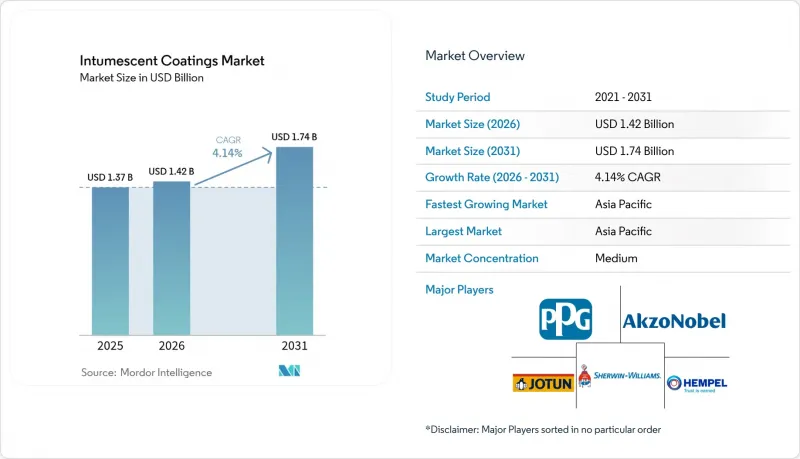
본 보고서는 용도별(셀룰로오스계, 탄화수소계), 기술별(용제계, 수성, 에폭시계), 수지 유형별(에폭시, 아크릴, 기타), 최종 사용자 산업별(건설, 석유 및 가스,자동차 및 운송, 기타), 지역별(아시아태평양, 북미, 유럽, 남미, 중동 및 아프리카)로 분류되어 있습니다. 시장 예측은 금액(달러) 기준으로 제시되어 있습니다.
전 세계 팽창성 도료 시장 동향 및 인사이트
아시아태평양 고층 건축물의 방화 기준 강화
중국과 인도에서는 현재 높이 15미터를 초과하는 구조용 강재에 대해 팽창성 방화 보호가 의무화되어 있으며, 이 규제는 도시 지역의 신축 고층 빌딩 대부분과 많은 개보수 공사에 적용됩니다. 싱가포르와 호주의 규격도 이를 따랐기 때문에 개발업자들은 EN 13381 또는 AS 1530 인증을 취득한 공급업체만을 사전 심사 대상으로 삼고 있으며, 이로 인해 지역 내 중소 제조업체 시장 진입 장벽이 높아지고 있습니다. 따라서 대형 다국적 기업들은 세계 인증과 현지 기술 서비스를 결합하여 시장 점유율을 공고히 하고 있습니다. 또한, 유지보수 관련 규제로 인해 리모델링 중인 기존 건물에도 의무가 확대되면 시장 규모도 혜택을 받게 되어, 신축 공사가 없더라도 리모델링 수요가 두 배로 증가하게 됩니다.
석유 및 가스 탐사 활동의 확대
사우디아라비아 및 동남아시아 전역의 액화천연가스(LNG) 터미널과 석유화학 단지에서는 4시간의 탄화수소 내성을 사양으로 요구하고 있으며, 이에 대응할 수 있는 것은 에폭시계 시스템뿐입니다. 에너지·유틸리티 부문의 설비 투자가 증가함에 따라, 배합 제조업체는 탄화수소계와 셀룰로오스계 모두 수요에 대응하는 이중 제품 라인을 유지하고 있습니다. 이러한 ‘양극화’ 경향으로 인해, 다른 부문에서는 수성 제품의 점유율이 확대되는 반면, 업스트림 시설에서는 높은 이익률이 확보되고 있습니다. 공정 플랜트에서는 안전 기준이 친환경 건축의 우선순위보다 우선시되므로, 사양 결정자들은 더 높은 휘발성 유기 화합물(VOC) 함유 수준을 용인하고 있습니다.
에폭시 수지 가격 변동
2025년, 비스페놀 A와 에피클로로히드린의 현물 가격은 상반된 움직임을 보이며 비용 예측을 불안정하게 만들고 고정 가격 입찰을 복잡하게 만들었습니다. 중국산 에폭시에 대한 유럽의 반덤핑 관세로 인해 현지 조달 비용이 더욱 상승하고 있어, 공급 계약을 체결했거나 부분적인 후방 통합을 진행하고 있는 대형 제조업체만이 이익률을 유지할 수 있습니다. 소규모 배합 제조업체들은 연구개발비 지출을 미루고 있으며, 이는 기술 격차를 확대하고 산업 재편을 가속화하고 있습니다.
부문 분석
2025년, 셀룰로오스계 도료 시장 점유율은 53.27%를 차지할 것으로 보이며, 상업용 건물 내에서는 미관과 낮은 휘발성 유기 화합물(VOC) 함량 측면에서 셀룰로오스계 제품이 경쟁력을 발휘하고 있습니다. UL 1709 및 EN 13381 이중 인증을 유지하고 있는 공급업체는 복합 용도의 산업 단지에서 계약을 수주하여 일괄 보증을 확보하는 동시에 조달 프로세스를 간소화하고 있습니다. 탄화수소계 시스템은 액화천연가스(LNG) 터미널 및 석유화학 플랜트에서 셀룰로오스계 도료로는 제공할 수 없는 4시간의 내화 성능이 요구되기 때문에 연평균 성장률(CAGR) 5.18%로 더 빠른 속도로 성장했습니다. 사우디아라비아의 에너지 건설 프로젝트만으로도 465억 달러에 달하는 만큼, 탄화수소 프로젝트용 팽창성 도료 시장 규모는 2031년까지 꾸준히 확대될 것으로 예측됩니다.
2차적 영향으로 인해 이러한 격차는 더욱 심화되고 있습니다. 탄화수소용 도료는 특수 수지나 첨가제로 인해 배합 비용이 높아 더 높은 이익률을 확보할 수 있지만, 조달량은 불안정하며 설비 투자 주기에 좌우됩니다. 반면, 셀룰로오스계 도료 수요량은 주택 및 사무실 건설에 따라 보다 안정적으로 추이하지만, 가격에 대한 압박은 심합니다. 이러한 동향이 맞물리면서 다각화를 추진한 제조업체에게는 균형 잡힌 포트폴리오 구성이 형성되어, 어느 부문에서 경기 침체가 발생하더라도 그 영향을 완화할 수 있습니다.
수성 도료는 이미 매출의 40.36%를 차지하고 있으며, 저용제 규제가 유럽 이외의 지역으로도 확대됨에 따라 연평균 성장률(CAGR) 5.44%의 궤도에 올라 있습니다. 건물 소유주가 그린 빌딩 인증을 취득하려고 할 경우, 무용제 에폭시 팽창성 도료 시장 점유율은 확대되지만, 저온이나 다습한 기후에서는 상온 시공 제한으로 인해 여전히 용제계 제품이 유리합니다. 한 번의 도포로 4mm의 건조 막 두께에 도달하는 무용제 에폭시 싱글코트 도료는 시공 공정을 단축시켜 주며, 이는 오프사이트 제조에서 중요한 이점입니다. 따라서 기술 선택은 방화 성능보다는 현장 물류, 기후, 지속가능성 평가에 중점을 두게 되었습니다.
각 공급업체는 수성, 용제계, 무용제계 등 3가지 화학 계열을 모두 제공함으로써 위험을 분산하고 있으며, 프로젝트 고유의 열전달 모델을 기반으로 최적의 도막 두께를 계산하는 디지털 도구를 활용하고 있습니다. 이에 반해 시공업체는 공사 기간, 환경 목표, 수명 주기 비용의 균형이 잡힌 배합을 선택합니다. 이러한 접근 방식을 통해 특정 기술에 대한 의존도를 낮추고, 부문 간 건전한 경쟁을 유지하고 있습니다.
지역별 분석
아시아태평양은 2025년에 전 세계 매출의 35.55%를 차지하며, 2031년까지 연평균 성장률(CAGR) 5.86%로 성장을 주도하고 있습니다. 이는 건축 기준이 엄격해짐에 따라 현재 대부분의 고층 건축 프로젝트에서 팽창성 방화 보호가 의무화되었기 때문입니다. 중국에서 수출용 모듈식 건축물의 공장 도장은 국내 주택 시장의 경기 순환과는 별개로 새로운 수요원을 창출하고 있습니다. 또한, 인도의 SP 73(2023년판)에 따른 개보수 의무화로 인해 수성 셀룰로오스계 제품의 잠재 시장이 더욱 확대되고 있습니다.
북미의 2025년 매출액은 데이터센터 건설이 34% 증가하고, 전력 부문의 설비 투자가 5-6%의 꾸준한 성장세를 보임에 따라 상승했습니다. 가공업체들은 대량 구매 할인 및 통합된 디지털 문서화를 기대하는 주요 구매자로 성장하고 있으며, 이에 따라 공급업체들은 공장 현장의 기술 팀 및 빌딩 정보 모델링(BIM) 플러그인에 대한 투자를 추진하고 있습니다.
나머지 시장 규모는 유럽, 중동, 남미가 나눠 가지고 있습니다. 유럽에서는 PFAS 규제 및 휘발성 유기 화합물(VOC) 상한 규제로 인해 수성 및 무용제 에폭시 수지가 선호되고 있습니다. 한편, 아시아산 에폭시 수지에 대한 반덤핑 관세로 인해 현지 비용 상승이 더욱 가속화되고 있습니다. 1조 달러가 넘는 가치를 지닌 중동의 메가 프로젝트에서는 40℃의 사막 환경에서도 경화되는 초저용제 시스템이 요구되고 있으며, 자격을 갖춘 공급업체는 극소수의 다국적 기업으로 한정되어 있습니다. 남미 시장은 여전히 규모가 작고 경기 변동의 영향을 받기 쉬운 편이지만, 브라질의 해양 투자로 인해 틈새 시장인 탄화수소 부문은 견조한 추세를 보이고 있습니다.
기타 혜택
- 엑셀 형식 시장 예측(ME) 시트
- 3개월간의 애널리스트 지원
자주 묻는 질문
목차
제1장 서론
제2장 조사 방법
제3장 주요 요약
제4장 시장 구도
제5장 시장 규모와 성장 예측
제6장 경쟁 구도
제7장 시장 기회와 향후 전망
LSH 26.09.04According to Mordor Intelligence, the intumescent coatings market size is projected to be USD 1.37 billion in 2025, USD 1.42 billion in 2026, and reach USD 1.74 billion by 2031, growing at a CAGR of 4.14% from 2026 to 2031.
This report is Segmented by Application (Cellulosic and Hydrocarbon), Technology (Solvent-Based, Water-Based, and Epoxy-Based), Resin Type (Epoxy, Acrylic, and More), End-User Industry (Construction, Oil and Gas, Automotive and Transportation, and More), Geography (Asia-Pacific, North America, Europe, South America, and Middle East and Africa). The Market Forecasts are Provided in Terms of Value (USD).
Global Intumescent Coatings Market Trends and Insights
Accelerated High-Rise Fire Codes in Asia-Pacific
China and India now require intumescent protection for structural steel above 15 meters, a rule that covers most new urban towers and many retrofits. Singaporean and Australian standards have followed, so developers pre-qualify only suppliers that hold EN 13381 or AS 1530 approvals, raising entry barriers for smaller regional formulators. Large multinationals, therefore, consolidate shares by combining global certificates with local technical service. Market volumes also benefit when maintenance codes extend obligations to existing buildings under renovation, doubling retrofit demand without new construction.
Growth in Oil & Gas Exploration Activities
Liquefied-natural-gas terminals and petrochemical complexes across Saudi Arabia and Southeast Asia specify four-hour hydrocarbon ratings that only epoxy-based systems can meet. Capital expenditure in energy and utilities is rising, so formulators keep dual product lines for both hydrocarbon and cellulosic needs. This two-speed pattern locks high margins in upstream installations even as water-borne products gain share elsewhere. Specifiers accept higher volatile-organic-compound levels because safety codes override green-building priorities in process plants.
Epoxy Resin Price Volatility
Spot prices for bisphenol-A and epichlorohydrin moved in opposite directions during 2025, unsettling cost forecasts and complicating fixed-price bids. European anti-dumping duties on Chinese epoxy raise local procurement costs further, so only large producers with supply contracts or partial backward integration can defend margins. Smaller formulators delay R&D spending, which widens the technology gap and hastens consolidation.
Other drivers and restraints analyzed in the detailed report include:
- EU Low-VOC Mandate Boosting Water-Borne Formulations
- Modular Off-Site Steel Fabrication in North America
- Competition from Alternative Fire-Protection Methods
For complete list of drivers and restraints, kindly check the Table Of Contents.
Segment Analysis
Cellulosic application had a share of 53.27% in 2025, and cellulosic products compete on aesthetics and low volatile-organic-compound profiles inside commercial buildings. Suppliers that maintain dual certification for UL 1709 and EN 13381 win contracts in mixed-use industrial campuses, securing bundled warranties and simplifying procurement. Hydrocarbon systems grew faster at 5.18% CAGR because liquefied-natural-gas terminals and petrochemical plants demand four-hour protection that cellulosic coatings cannot deliver. The intumescent coatings market size for hydrocarbon projects is projected to expand steadily through 2031 as Saudi Arabia's energy construction alone reaches USD 46.5 billion.
Second-order effects reinforce divergence. Hydrocarbon coatings command higher margins because specialized resins and additives raise formulation cost, but procurement volumes are lumpy and tied to capital-expenditure cycles. Cellulosic volumes flow more consistently with residential and office construction, yet price pressure is intense. Together, these dynamics create balanced portfolio exposure for diversified producers, cushioning downturns in either sector.
Water-based coatings already control 40.36% revenue and are on a 5.44% CAGR trajectory as low-solvent mandates spread beyond Europe. The intumescent coatings market share for solvent-free epoxies increases when owners pursue green-building credits, although ambient-temperature limits still favor solvent products in cold or humid climates. Single-coat solvent-free epoxies that reach 4 millimeters dry film in one pass now reduce application steps, a key advantage in off-site fabrication. Technology choice thus hinges less on fire performance and more on job-site logistics, climate, and sustainability scoring.
Suppliers hedge by offering all three chemistries, water, solvent, and solvent-free, backed by digital tools that calculate optimal film build under project-specific heat-transfer models. Contractors then select formulations that balance schedule, environmental targets, and life-cycle cost, an approach that limits technology lock-in and keeps cross-segment competition healthy.
Complete Report Scope:
- By Application
- Cellulosic
- Hydrocarbon
- By Technology
- Solvent-Based
- Water-Based
- Epoxy Based
- By Resin Type
- Epoxy
- Acrylic
- Polyurethane
- Alkyd
- Other Resins
- By End-user Industry
- Construction
- Oil & Gas
- Automotive & Transportation
- Other End-user Industries
- By Geography
- Asia-Pacific
- China
- India
- Japan
- South Korea
- Rest of Asia-Pacific
- North America
- United States
- Canada
- Mexico
- Europe
- Germany
- United Kingdom
- France
- Italy
- Russia
- Rest of Europe
- South America
- Brazil
- Argentina
- Rest of South America
- Middle East and Africa
- Saudi Arabia
- South Africa
- Rest of Middle East and Africa
- Asia-Pacific
Geography Analysis
Asia-Pacific generated 35.55% of global revenue in 2025 and leads growth at 5.86% CAGR through 2031 because tighter building codes now mandate intumescent protection in most high-rise projects. Factory-applied coatings in China's modular construction exports add a new demand stream independent of domestic housing cycles. India's retrofit obligation under SP 73:2023 further enlarges the addressable base for water-based cellulosic products.
North America's 2025 sales were lifted by a 34% surge in data-center construction and steady 5-6% gains in power-sector capital spending. Fabricators have grown into dominant buyers who expect bulk discounts and integrated digital documentation, prompting suppliers to invest in plant-floor technical teams and Building Information Modeling plugins.
Europe, the Middle East, and South America share the remaining market value. European sales favor water-borne and solvent-free epoxies because of PFAS restrictions and volatile-organic-compound caps, while anti-dumping tariffs on Asian epoxy intensify local cost inflation. Middle Eastern megaprojects valued at more than USD 1 trillion require ultra-low-solvent systems that cure in 40°C desert environments, restricting qualified suppliers to a handful of multinationals. South America remains smaller and cyclical, but Brazilian offshore investments keep a niche hydrocarbon segment intact.
- Akzo Nobel N.V.
- Albi Protective Coatings
- BASF
- Contego International Inc.
- Etex Group
- Flame-Stop Inc.
- Hempel A/S
- Hexion Inc.
- Isolatek International
- Jotun
- No-Burn, Inc.
- PPG Industries, Inc.
- RPM International Inc.
- Teknos Group
- The Sherwin-Williams Co.
- Tremco Incorporated
Additional Benefits:
- The market estimate (ME) sheet in Excel format
- 3 months of analyst support
TABLE OF CONTENTS
1 Introduction
- 1.1 Study Assumptions & Market Definition
- 1.2 Scope of the Study
2 Research Methodology
3 Executive Summary
4 Market Landscape
- 4.1 Market Overview
- 4.2 Market Drivers
- 4.2.1 Accelerated High-Rise Fire Codes in Asia-Pacific
- 4.2.2 Growth in Oil & Gas Exploration Activities
- 4.2.3 EU Low-VOC Mandate Boosting Water-Borne Formulations
- 4.2.4 Modular Off-Site Steel Fabrication in North America
- 4.2.5 Advent of Nano-Engineered Char-Formers for Ultra-Thin Films
- 4.3 Market Restraints
- 4.3.1 Epoxy Resin Price Volatility
- 4.3.2 Competition from Alternative Fire-Protection Methods
- 4.3.3 Skilled-Applicator Shortage in Emerging Markets
- 4.4 Value Chain Analysis
- 4.5 Porter's Five Forces
- 4.5.1 Bargaining Power of Suppliers
- 4.5.2 Bargaining Power of Buyers
- 4.5.3 Threat of New Entrants
- 4.5.4 Threat of Substitutes
- 4.5.5 Degree of Rivalry
5 Market Size & Growth Forecasts (Value)
- 5.1 By Application
- 5.1.1 Cellulosic
- 5.1.2 Hydrocarbon
- 5.2 By Technology
- 5.2.1 Solvent-Based
- 5.2.2 Water-Based
- 5.2.3 Epoxy Based
- 5.3 By Resin Type
- 5.3.1 Epoxy
- 5.3.2 Acrylic
- 5.3.3 Polyurethane
- 5.3.4 Alkyd
- 5.3.5 Other Resins
- 5.4 By End-user Industry
- 5.4.1 Construction
- 5.4.2 Oil & Gas
- 5.4.3 Automotive & Transportation
- 5.4.4 Other End-user Industries
- 5.5 By Geography
- 5.5.1 Asia-Pacific
- 5.5.1.1 China
- 5.5.1.2 India
- 5.5.1.3 Japan
- 5.5.1.4 South Korea
- 5.5.1.5 Rest of Asia-Pacific
- 5.5.2 North America
- 5.5.2.1 United States
- 5.5.2.2 Canada
- 5.5.2.3 Mexico
- 5.5.3 Europe
- 5.5.3.1 Germany
- 5.5.3.2 United Kingdom
- 5.5.3.3 France
- 5.5.3.4 Italy
- 5.5.3.5 Russia
- 5.5.3.6 Rest of Europe
- 5.5.4 South America
- 5.5.4.1 Brazil
- 5.5.4.2 Argentina
- 5.5.4.3 Rest of South America
- 5.5.5 Middle East and Africa
- 5.5.5.1 Saudi Arabia
- 5.5.5.2 South Africa
- 5.5.5.3 Rest of Middle East and Africa
- 5.5.1 Asia-Pacific
6 Competitive Landscape
- 6.1 Market Concentration
- 6.2 Strategic Moves
- 6.3 Market Share(%)/Ranking Analysis
- 6.4 Company Profiles (includes Global level Overview, Market level overview, Core Segments, Financials as available, Strategic Information, Products & Services, Recent Developments)
- 6.4.1 Akzo Nobel N.V.
- 6.4.2 Albi Protective Coatings
- 6.4.3 BASF
- 6.4.4 Contego International Inc.
- 6.4.5 Etex Group
- 6.4.6 Flame-Stop Inc.
- 6.4.7 Hempel A/S
- 6.4.8 Hexion Inc.
- 6.4.9 Isolatek International
- 6.4.10 Jotun
- 6.4.11 No-Burn, Inc.
- 6.4.12 PPG Industries, Inc.
- 6.4.13 RPM International Inc.
- 6.4.14 Teknos Group
- 6.4.15 The Sherwin-Williams Co.
- 6.4.16 Tremco Incorporated
7 Market Opportunities & Future Outlook
- 7.1 White-Space & Unmet-Need Assessment


