

|
시장보고서
상품코드
2122321
AI 영상 인식 시장 : 시장 점유율 분석, 업계 동향 및 통계, 성장 예측(2026-2031년)AI Image Recognition - Market Share Analysis, Industry Trends & Statistics, Growth Forecasts (2026 - 2031) |
||||||
 Mordor Intelligence
Mordor Intelligence에 의하면, AI 영상 인식 시장 규모는 2025년에 49억 7,000만 달러로 평가되었고, 2026년 56억 8,000만 달러에서 2031년까지 110억 7,000만 달러에 이를 것으로 예측되며, 예측 기간(2026-2031년) CAGR은 14.31%를 나타낼 전망입니다.
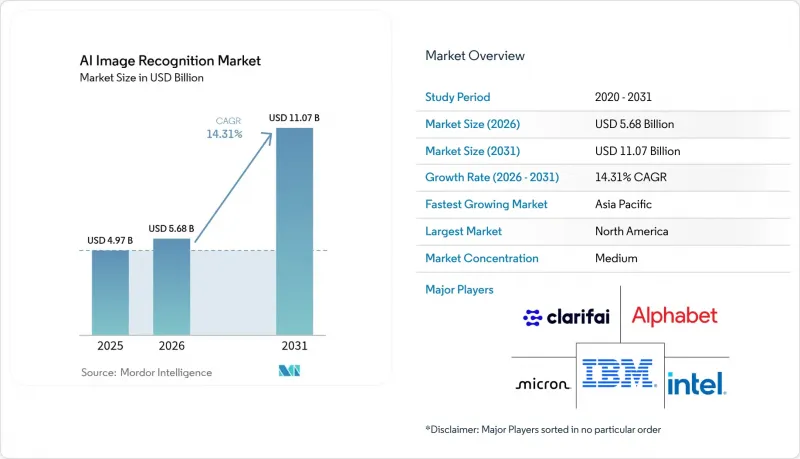
본 보고서는 유형별(하드웨어, 소프트웨어, 서비스), 도입 모델별(클라우드, 온프레미스), 용도별(영상 분류, 물체 감지·추적, 얼굴 인식 등), 최종 사용자 산업별(자동차, BFSI 등), 지역별로 분류되어 있습니다. 시장 예측은 금액(달러)으로 표시되어 있습니다.
세계의 AI 영상 인식 시장 동향 및 인사이트
클라우드 네이티브 AI 도입 붐
하이퍼스케일 제공업체들은 컨테이너화된 비전 파이프라인을 제공하여, 모델을 몇 주 이내에 프로토타입 단계에서 프로덕션 환경으로 전환함으로써 제조업체 및 소매업체의 가치 실현 시간을 단축하고 있습니다. Microsoft Azure와 Google Cloud는 ML 담당자가 제한적인 기업의 진입 장벽을 낮추는 패키지화된 결함 감지용 청사진을 제공합니다. Kubernetes에 의해 오케스트레이션되는 추론 엔드포인트는 영상가 도착했을 때만 연산 리소스를 할당하기 때문에 고정형 온프레미스 클러스터에 비해 15-40%의 비용 절감을 실현합니다. 그 결과, AI 영상 인식 시장은 조달 주기 단축과 사용자층의 다양화라는 혜택을 누리고 있습니다.
고해상도 카메라의 보급
5세대 자동차용 ADAS 장치와 8K 산업용 센서는 현재 네트워크 왕복 통신 없이 50밀리초 미만의 추론을 실현하는 온디바이스 AI 가속기와 결합되어 있습니다. 콘티넨탈(Continental)의 MFC525 카메라는 110도의 시야각을 가지면서 로컬에서 물체 분류를 수행하며, 삼성(Samsung)의 최신 뉴럴 엔진은 소비자용 스마트폰 내에서 38 TOPS를 달성하고 있습니다. 이러한 기능 덕분에 실시간 품질 관리 및 몰입형 AR 기능이 실현되면서 AI 영상 인식 시장의 잠재 고객 기반이 확대되고 있습니다.
데이터 개인정보 보호 및 규정 준수 장벽
EU의 AI 법 및 캘리포니아주 법령에서는 엄격한 감사 추적이 의무화되어 있어, 의료 영상 진단 시스템에 도입할 경우 검증 비용이 최대 30% 증가하고 있습니다. 데이터 보관 장소에 관한 상충되는 규제로 인해 듀얼 스택 아키텍처의 채택이 불가피해졌으며, 전담 개인정보 보호 팀을 보유하지 않은 중규모 병원에서는 도입이 주춤하고 있습니다. 이러한 마찰이 AI 영상 인식 시장의 성장세를 둔화시키고 있습니다.
부문 분석
2025년 매출 중 하드웨어가 45.12%를 차지했으나, 서비스 부문은 14.67%의 연평균 성장률(CAGR)을 기록하며 다른 모든 카테고리를 앞질렀습니다. NVIDIA와 Intel의 엣지 지원 카메라 및 추론 칩은 지연 시간을 50밀리초 미만으로 줄여, 제조 공장의 기존 설비 개조를 촉진하고 있습니다. 소프트웨어, 특히 로우코드 모델 운영 플랫폼은 데이터 사이언스 전문 인력을 충분히 확보하지 못한 기업에서도 맞춤형 파이프라인 구축을 용이하게 합니다. 한편, 전문 서비스 제공업체들은 특정 분야에 특화된 데이터셋과 지속적인 학습 워크플로를 구축하여 초기 검증 단계를 넘어 생산 정확도를 향상시키고 있습니다. 개별 제품이 아닌 종합적인 성과를 지향하는 이러한 변화로 인해, AI 영상 인식 시장에서 통합업체 시장 점유율이 확대되고 있습니다.
2025년에는 병원, 은행, 국방 기관이 영상 데이터를 로컬 방화벽 내에 보관해야 하기 때문에 온프레미스 시스템의 매출이 67.95%를 계속 차지했습니다. 광산, 선박, 외딴 지역의 공장에서 발생하는 엣지 시나리오도 유사한 경향을 보이며, 이러한 장소에서는 통신이 간헐적이어서 클라우드로의 왕복 통신이 불가능합니다. 그럼에도 불구하고, 탄력적인 GPU 풀이 계절적 변동이나 버스트 부하가 큰 영상 파이프라인을 흡수함에 따라 클라우드 워크로드는 연평균 성장률(CAGR) 16.37%로 확대되고 있습니다. 하이브리드 토폴로지는 엣지에서의 전처리와 클라우드에서의 재학습을 결합한 것으로, 기업은 엣지 측에서 추론을 최적화하면서 중앙에서 페타스케일 규모의 데이터 세트를 활용할 수 있게 됩니다. 이 융합형 패러다임은 규정 준수를 확보하면서 하이퍼스케일러의 비용 이점을 누릴 수 있게 해주므로, AI 영상 인식 시장의 장기적인 성장을 뒷받침합니다.
지역별 분석
북미는 2025년에 매출의 27.35%를 차지한 것으로 평가되었으며, 탄탄한 자금 조달 생태계와 TSMC의 1,650억 달러 규모의 애리조나 캠퍼스 등 국내 칩 제조 이니셔티브에 힘입고 있습니다. Meta의 Scale AI에 대한 148억 달러 투자로 대표되는 기업의 M&A는 해당 지역의 연구 개발 속도를 가속화하고 있습니다. 반도체의 회복탄력성을 높이기 위한 정부의 인센티브는 미국 및 캐나다의 AI 영상 인식 시장을 더욱 공고히 하고 있습니다.
유럽에서는 EU의 엄격한 ‘AI법’을 배경으로, 완만하긴 하지만 착실한 도입이 진행되고 있습니다. 독일의 대형 중공업 기업들은 자동 조립 공정에 비전 기술을 접목하고 있으며, 프랑스의 스타트업 기업들은 GDPR(EU 개인정보보호규정)의 보호 조치 하에 임상 의사결정 지원 시스템을 정교화하고 있습니다. 투자는 체계적이고 목표가 명확하게 이루어지고 있으며, 투명성과 편향 완화를 입증할 수 있는 공급업체가 우대받고 있습니다. 이러한 엄격한 태도가 AI 영상 인식 시장 전체의 솔루션 설계를 형성하고 있습니다.
아시아태평양은 연평균 성장률(CAGR) 15.61%로 가장 높은 성장 궤도를 보이고 있습니다. 중국은 스마트 시티 및 감시 네트워크를 위해 700억 달러가 넘는 다년간의 예산을 배정하고 있습니다. 일본의 650억 달러 규모 반도체 프로그램과 HBM 메모리 분야에서 한국의 리더십이 수직 통합형 공급망 기반을 구축하고 있습니다. 인도의 개발자층은 경쟁력 있는 가격으로 전 세계 모델 튜닝 서비스를 뒷받침하고 있으며, 이들이 힘을 합쳐 AI 영상 인식 시장의 성장을 가속화하고 있습니다.
기타 혜택 :
- 엑셀 형식 시장 예측(ME) 시트
- 3개월간의 애널리스트 지원
자주 묻는 질문
목차
제1장 서론
제2장 조사 방법
제3장 주요 요약
제4장 시장 구도
제5장 시장 규모 및 성장 예측
제6장 경쟁 구도
제7장 시장 기회 및 향후 전망
AJY 26.09.07According to Mordor Intelligence, the AI image recognition market size was valued at USD 4.97 billion in 2025 and estimated to grow from USD 5.68 billion in 2026 to reach USD 11.07 billion by 2031, at a CAGR of 14.31% during the forecast period (2026-2031).
This report is Segmented by Type (Hardware, Software, and Services), Deployment Model (Cloud, On-Premises), Application (Image Classification, Object Detection and Tracking, Facial Recognition, and More), End-User Industry (Automotive, BFSI, and More), and by Geography. The Market Forecasts are Provided in Terms of Value (USD).
Global AI Image Recognition Market Trends and Insights
Cloud-Native AI Adoption Boom
Hyperscale providers deliver containerized vision pipelines that push models from prototype to production inside weeks, trimming time-to-value for manufacturers and retailers. Microsoft Azure and Google Cloud showcase packaged defect-detection blueprints that lower entry barriers for firms with limited ML staff. Kubernetes-orchestrated inference endpoints allocate compute only when imagery arrives, enabling 15-40% cost savings versus fixed on-premise clusters. As a result, the AI image recognition market benefits from faster procurement cycles and broader user diversity.
Proliferation of High-Resolution Cameras
Fifth-generation automotive ADAS units and 8K industrial sensors now pair with on-device AI accelerators that deliver sub-50 ms inference without network round-trips. Continental's MFC525 camera offers a 110-degree field of view while performing object classification locally, and Samsung's latest neural engines hit 38 TOPS inside consumer smartphones. These capabilities unlock real-time quality control and immersive AR functions, widening the addressable base of the AI image recognition market.
Data-Privacy and Compliance Hurdles
The EU AI Act and California statutes impose robust audit trails, inflating validation costs by up to 30% for medical-imaging deployments. Conflicting data-residency mandates compel dual-stack architectures, slowing rollouts among mid-size hospitals that lack dedicated privacy teams. Such friction tempers growth momentum in the AI image recognition market.
Other drivers and restraints analyzed in the detailed report include:
- Retail Loss-Prevention Initiatives
- Synthetic Data Pipelines Slashing Labelling Cost
- GPU Supply Chain Geopolitics Elevating Capex Risk
For complete list of drivers and restraints, kindly check the Table Of Contents.
Segment Analysis
Hardware controlled 45.12% of 2025 revenue, yet services post a 14.67% CAGR that outpaces all other categories. Edge-ready cameras and inference chips from NVIDIA and Intel lower latency below 50 ms, energizing brownfield retrofits in manufacturing plants. Software, especially low-code model-ops platforms, eases custom pipeline creation for firms without deep data-science benches. Meanwhile, professional services providers craft domain-tuned datasets and continuous-learning workflows that elevate production accuracy beyond initial proof points. This shift toward holistic outcomes rather than discrete products broadens wallet share for integrators inside the AI image recognition market.
On-premises systems retained 67.95% revenue in 2025 because hospitals, banks, and defense agencies must keep imagery within local firewalls. Edge scenarios in mines, ships, and remote factories mirror this preference, where intermittent connectivity precludes cloud round-trips. Even so, cloud workloads grow at 16.37% CAGR as elastic GPU pools absorb seasonal or burst-heavy image pipelines. Hybrid topologies marry edge preprocessing with cloud retraining, letting enterprises tune inference at the edge while leveraging petascale datasets centrally. This blended paradigm safeguards compliance yet benefits from hyperscaler economics, reinforcing long-run expansion of the AI image recognition market.
Complete Report Scope:
- By Component
- Hardware
- Software
- Services
- By Deployment Model
- Cloud
- On-premises
- By Application
- Image Classification
- Object Detection and Tracking
- Facial Recognition
- Industrial Inspection
- Medical Imaging
- Other Niche Applications
- By End-user Industry
- Automotive
- BFSI
- Healthcare Providers and Med-tech
- Retail and E-commerce
- Security and Surveillance Integrators
- Manufacturing
- Others (Agriculture, Energy, etc.)
- By Geography
- North America
- United States
- Canada
- Mexico
- South America
- Brazil
- Argentina
- Rest of South America
- Europe
- Germany
- United Kingdom
- France
- Italy
- Spain
- Rest of Europe
- Asia-Pacific
- China
- Japan
- India
- South Korea
- Australia
- Rest of Asia-Pacific
- Middle East and Africa
- Middle East
- Saudi Arabia
- United Arab Emirates
- Turkey
- Rest of Middle East
- Africa
- South Africa
- Nigeria
- Egypt
- Rest of Africa
- Middle East
- North America
Geography Analysis
North America held 27.35% revenue in 2025, buoyed by a dense funding ecosystem and domestic chip fabrication initiatives such as TSMC's USD 165 billion Arizona campus. Corporate M&A, evidenced by Meta's USD 14.8 billion stake in Scale AI, intensifies regional R&D velocity. Government incentives for semiconductor resilience further anchor the AI image recognition market in the United States and Canada.
Europe exhibits moderated yet steady adoption, framed by the bloc's stringent AI Act. German heavy-industry leaders weave vision into automated assembly, while French startups refine clinical decision support under GDPR safeguards. Investment remains disciplined but targeted, favoring vendors able to certify transparency and bias mitigation. Such rigor shapes solution design across the AI image recognition market.
Asia-Pacific shows the highest trajectory at 15.61% CAGR. China allocates multiyear budgets topping USD 70 billion for smart-city and surveillance grids. Japan's USD 65 billion semiconductor program and South Korea's leadership in HBM memory create a vertically integrated supply base. India's developer pool sustains global model-tuning services at competitive rates, collectively accelerating the AI image recognition market.
- Google (Alphabet)
- Clarifai
- IBM
- Intel
- Micron Technology
- Microsoft
- NVIDIA
- Qualcomm
- Samsung Electronics
- AMD/Xilinx
- Apple
- SenseTime
- Hikvision
- Megvii
- NEC Corporation
- Cognex
- Zebra Technologies
- Huawei Technologies
- Palantir
Additional Benefits:
- The market estimate (ME) sheet in Excel format
- 3 months of analyst support
TABLE OF CONTENTS
1 INTRODUCTION
- 1.1 Study Assumptions and Market Definition
- 1.2 Scope of the Study
2 RESEARCH METHODOLOGY
3 EXECUTIVE SUMMARY
4 MARKET LANDSCAPE
- 4.1 Market Overview
- 4.2 Market Drivers
- 4.2.1 Cloud-native AI adoption boom
- 4.2.2 Proliferation of high-resolution cameras
- 4.2.3 Retail loss-prevention initiatives
- 4.2.4 Expansion of Smart Cities and Surveillance Infrastructure
- 4.2.5 Synthetic data pipelines slashing labeling cost
- 4.2.6 Satellite imagery firms open-sourcing labeled sets
- 4.3 Market Restraints
- 4.3.1 Data-privacy and compliance hurdles
- 4.3.2 Shortage of domain-specific talent
- 4.3.3 GPU supply chain geopolitics elevating capex risk
- 4.3.4 Rising legal exposure from biased algorithms
- 4.4 Supply-Chain Analysis
- 4.5 Regulatory Landscape
- 4.6 Technological Outlook (Edge vs Cloud inference)
- 4.7 Porter's Five Forces
- 4.7.1 Bargaining Power of Buyers
- 4.7.2 Bargaining Power of Suppliers
- 4.7.3 Threat of New Entrants
- 4.7.4 Threat of Substitutes
- 4.7.5 Degree of Competition
- 4.8 Assessment of Macroeconomic Factors
5 MARKET SIZE AND GROWTH FORECASTS (VALUE)
- 5.1 By Component
- 5.1.1 Hardware
- 5.1.2 Software
- 5.1.3 Services
- 5.2 By Deployment Model
- 5.2.1 Cloud
- 5.2.2 On-premises
- 5.3 By Application
- 5.3.1 Image Classification
- 5.3.2 Object Detection and Tracking
- 5.3.3 Facial Recognition
- 5.3.4 Industrial Inspection
- 5.3.5 Medical Imaging
- 5.3.6 Other Niche Applications
- 5.4 By End-user Industry
- 5.4.1 Automotive
- 5.4.2 BFSI
- 5.4.3 Healthcare Providers and Med-tech
- 5.4.4 Retail and E-commerce
- 5.4.5 Security and Surveillance Integrators
- 5.4.6 Manufacturing
- 5.4.7 Others (Agriculture, Energy, etc.)
- 5.5 By Geography
- 5.5.1 North America
- 5.5.1.1 United States
- 5.5.1.2 Canada
- 5.5.1.3 Mexico
- 5.5.2 South America
- 5.5.2.1 Brazil
- 5.5.2.2 Argentina
- 5.5.2.3 Rest of South America
- 5.5.3 Europe
- 5.5.3.1 Germany
- 5.5.3.2 United Kingdom
- 5.5.3.3 France
- 5.5.3.4 Italy
- 5.5.3.5 Spain
- 5.5.3.6 Rest of Europe
- 5.5.4 Asia-Pacific
- 5.5.4.1 China
- 5.5.4.2 Japan
- 5.5.4.3 India
- 5.5.4.4 South Korea
- 5.5.4.5 Australia
- 5.5.4.6 Rest of Asia-Pacific
- 5.5.5 Middle East and Africa
- 5.5.5.1 Middle East
- 5.5.5.1.1 Saudi Arabia
- 5.5.5.1.2 United Arab Emirates
- 5.5.5.1.3 Turkey
- 5.5.5.1.4 Rest of Middle East
- 5.5.5.2 Africa
- 5.5.5.2.1 South Africa
- 5.5.5.2.2 Nigeria
- 5.5.5.2.3 Egypt
- 5.5.5.2.4 Rest of Africa
- 5.5.5.1 Middle East
- 5.5.1 North America
6 COMPETITIVE LANDSCAPE
- 6.1 Market Concentration
- 6.2 Strategic Moves
- 6.3 Market Share Analysis
- 6.4 Company Profiles (includes Global level Overview, Market level overview, Core Segments, Financials as available, Strategic Information, Market Rank/Share for key companies, Products and Services, and Recent Developments)
- 6.4.1 Google (Alphabet)
- 6.4.2 Clarifai
- 6.4.3 IBM
- 6.4.4 Intel
- 6.4.5 Micron Technology
- 6.4.6 Microsoft
- 6.4.7 NVIDIA
- 6.4.8 Qualcomm
- 6.4.9 Samsung Electronics
- 6.4.10 AMD/Xilinx
- 6.4.11 Apple
- 6.4.12 SenseTime
- 6.4.13 Hikvision
- 6.4.14 Megvii
- 6.4.15 NEC Corporation
- 6.4.16 Cognex
- 6.4.17 Zebra Technologies
- 6.4.18 Huawei Technologies
- 6.4.19 Palantir
7 MARKET OPPORTUNITIES AND FUTURE OUTLOOK
- 7.1 White-space and Unmet-need Assessment


