

|
시장보고서
상품코드
2122332
은행 산업 IoT : 시장 점유율 분석, 업계 동향과 통계, 성장 예측(2026-2031년)Internet Of Things In Banking - Market Share Analysis, Industry Trends & Statistics, Growth Forecasts (2026 - 2031) |
||||||
 Mordor Intelligence
Mordor Intelligence에 의하면, 은행 산업 IoT 시장 규모는 2025년에 391억 6,000만 달러로 평가되었고, 2026년 514억 달러에서 2031년까지 2,001억 8,000만 달러에 달할 것으로 예측됩니다.
또한, 예측 기간(2026-2031년) 동안 연평균 성장률(CAGR)은 31.25%를 나타낼 것으로 전망됩니다.
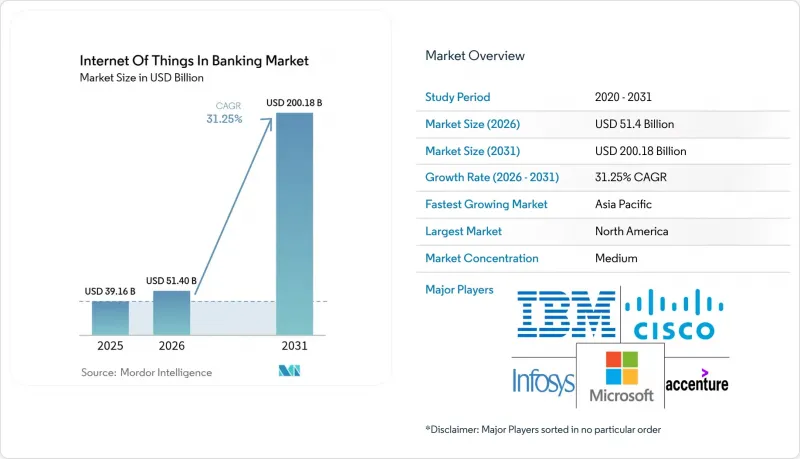
본 보고서는 구성 요소별(솔루션, 서비스), 용도별(보안, 모니터링, 기타), 조직 규모별(대기업, 중소기업), 최종 사용자별(소매 은행, 기업 은행, 투자 은행 업무, 기타), 지역별로 분류되어 있습니다.
전 세계 은행 산업의 IoT 시장 동향 및 인사이트
옴니채널을 통한 고객 경험 증진
각 은행은 ATM, 모바일 앱, 웨어러블 기기에 센서를 탑재하여 물리적 환경과 디지털 환경을 매끄럽게 오갈 수 있는 고객 경험을 창출하고 있습니다. NatWest는 5,500대의 ATM을 19인치 터치스크린과 다운타임이 발생하기 전에 이를 감지하는 실시간 텔레메트리 기능으로 업그레이드했습니다. 또한, 이 은행은 Apple Vision Pro용 소매 뱅킹 앱을 출시하여 고객이 시선이나 제스처를 통해 자금을 이체할 수 있도록 했습니다. 이러한 통합을 통해 금융 기관은 위치 정보, 기기 상태, 구매 패턴을 결합하여 고객의 요구를 예측할 수 있게 되었으며, 도입이 정착된 사례에서는 교차 판매 정확도가 3분의 1 향상되었습니다. 센서 분석을 활용함으로써, 방문 전 지점 인력 배치, 대기 줄 알림, 동적이며 개인화된 제안이 가능해져 고객 만족도 점수를 두 자릿수만큼 향상시켰습니다. 따라서 은행 산업의 IoT 시장은 사용자 유지율 향상과 운영 비용 절감이라는 혜택을 누리고 있습니다.
실시간 부정 행위 감지 및 보안
분산형 센서에서 이상 감지 엔진으로 데이터가 전송되어, 의심스러운 패턴을 밀리초 단위로 표시합니다. 기기의 텔레메트리 데이터와 거래 스트림을 결합한 연합 학습 모델은 개인정보 보호를 위해 데이터를 로컬에 보관하면서도 현재 96.3%의 부정 감지 정확도를 달성하고 있습니다. 스마트 카메라와 환경 센서가 ATM 및 현금 자동 입출금기를 모니터링하여, 스키밍 장치나 조작을 암시하는 비정상적인 온도 상승을 감지합니다. 엣지 측에서 적용되는 블록체인 해시는 분쟁 해결을 위한 위변조 불가능한 로그를 생성하며, 디바이스상의 AI는 과거 고객을 괴롭혔던 오탐을 줄여줍니다. 조기 도입 기업들로부터는 도입 첫해에 사기로 인한 손실이 20% 이상 감소했다는 보고가 접수되고 있습니다. 보안에 대한 시급성이 높아지는 가운데 지속적인 투자가 진행되고 있으며, 사이버 범죄에 대한 우려를 배경으로 은행 산업에서 IoT의 견고화가 도모되고 있습니다.
데이터 개인정보 보호 및 사이버 보안에 대한 우려
EU의 ‘사이버 복원력 법’은 제조업체에 자동 보안 업데이트 기능을 갖춘 기기의 출하를 의무화하고 있어, 무선 패치 적용을 유지하지 못하는 벤더는 그 취약점이 드러나게 됩니다. 은행은 캘리포니아주의 ‘소비자 개인정보 보호법’부터 인도의 ‘디지털 개인 데이터 보호법’에 이르기까지 다양해지는 규제를 추적해야 하므로, 규정 준수 부담이 증가하고 있습니다. 세분화가 불충분할 경우, 단일 센서에서의 침해로 인해 은행의 핵심 시스템이 손상될 가능성이 있습니다. 연방 학습(Federated Learning) 시범 프로젝트에서는 원시 데이터를 내보내지 않고도 99.94%의 모델 정확도를 보여주었으나, 많은 금융 기관은 여전히 기기군의 보안을 확보하는 데 있어 기술 격차에 직면해 있습니다. 사이버 보험료의 상승은 프로젝트 비용을 끌어올려 은행 업계의 IoT 도입을 지연시킬 가능성이 있습니다.
부문 분석
서비스 부문은 2025년 매출의 57.40%를 차지하며, 복잡한 도입 과정에서 부문별 전문 지식, 규제에 대한 인사이트력, 24시간 지원이 성과를 좌우한다는 점을 여실히 보여줍니다. 은행 산업의 IoT 시장 내 서비스 부문 규모는 연평균 성장률(CAGR) 30.40%로 확대될 것으로 예상되며, 이는 센서를 레거시 핵심 시스템 및 클라우드 패브릭에 통합하는 통합 업체에 대한 수요를 반영합니다. 은행은 위험을 완화하기 위해 위협 모델링, 규정 준수 매핑, 기기 수명 주기 거버넌스를 외부에 위탁하는 경우가 많습니다. 솔루션에는 하드웨어 키트, 소프트웨어 플랫폼, 연결 번들 등이 포함되어 있으며, 금융 기관이 On-Premise 데이터센터를 폐지할 수 있도록 지원하는 클라우드 네이티브로의 전환 혜택을 받고 있습니다. IBM과 Wipro의 AI 탑재 플랫폼과 같은 공동 제품은 분석 기능과 사이버 보안 강화 기능을 결합한 것으로, 솔루션 제공업체 간의 경쟁을 심화시키고 있습니다.
2세대 도입에서는 ‘성장에 따른 과금(pay-as-you-grow)’ 방식의 매니지드 서비스가 선호되며, 소규모 은행들은 자본 지출 부담이 큰 사내 구축 대신 턴키형 번들을 채택하고 있습니다. 각 벤더는 오픈 뱅킹 API용 사전 인증된 커넥터를 갖춘 엣지 컴퓨팅 노드를 패키지화하여 가치 실현까지 걸리는 시간을 단축하고 있습니다. 하드웨어의 이익률은 여전히 낮기 때문에 공급업체들은 디바이스 모니터링 및 예측 유지보수를 중심으로 한 지속적 수익 모델로 무게중심을 옮기고 있습니다. 클라우드 벤더들이 금융 등급의 엣지 스택을 출시함에 따라, 은행 산업의 IoT 시장은 서비스 중심의 비즈니스 모델로 더욱 전환되고 있습니다.
보안 용도는 2025년 매출의 35.80%를 차지하며, 규제 요건 및 공격 경로의 확대를 배경으로 연평균 성장률(CAGR) 33.80%로 성장하고 있습니다. 은행 산업의 IoT 시장 내 보안 부문 규모는 2026년에 187억 6,000만 달러에 달할 것으로 예상되며, 2031년까지 802억 9,000만 달러를 넘어설 것으로 전망됩니다. 스마트 ATM은 온도 이상, 충격 또는 변조 패턴을 감지하여 현금 배출구를 자동으로 잠글 수 있습니다. 디바이스 수준의 암호화 및 RoT(Root of Trust) 칩은 현재 프리미엄 단말기에 표준으로 탑재되어 있어 규정 준수 감사 시간을 단축하고 있습니다.
모니터링, 데이터 관리, 고객 경험 각 모듈은 인프라를 공유하고 있지만, 분석 기능의 충실도에는 차이가 있습니다. 은행은 텔레메트리 기술을 활용하여 지점의 에너지 사용을 최적화하고, 전력 비용을 전년 대비 최대 12% 절감하고 있습니다. 고객 경험 엔진은 방문객 수 센서와 CRM 이력을 연동하여 지점 내에서 개인화된 인사를 자동으로 표시합니다. 동일한 센서 그리드 상에서 여러 용도를 호스팅하는 통합 플랫폼은 총 소유 비용(TCO) 절감에 기여하며, 은행 산업의 IoT 시장 전반에 걸친 매력을 높이고 있습니다.
지역별 분석
북미는 견고한 사이버 보안 법규와 핀테크 기업과 은행 간의 조기 제휴에 힘입어 2025년 매출의 37.90%를 차지하며 계속해서 주도적인 위치를 유지하고 있습니다. 센서를 도입한 지점에서는 생산성이 30-40% 향상되었으며, 양자 시뮬레이션 알고리즘은 기존 최적화 알고리즘에 비해 1,000배 빠른 속도로 처리를 수행합니다. 캐나다에서는 지역 사회와 연결된 ATM을 통해 현금 순환의 포용성을 추진하고 있는 반면, 멕시코에서는 거래 수수료를 절감하는 IoT 기반 송금 키오스크를 활용하고 있습니다. 은행 산업의 IoT 시장에서는 서비스가 미치지 못하는 지역에 대한 5G 구축에 대한 연방 정부의 지원으로 대륙 전체의 지연 격차가 해소되고 있습니다.
아시아태평양은 성장의 원동력이며, 연평균 성장률(CAGR) 32.70%로 급성장하고 있습니다. 중국의 AIBank는 IoT 데이터를 통합하여 대출을 개인화하는 마이크로서비스 코어를 활용해 1억 명 이상의 고객에게 서비스를 제공합니다. 인도에서는 광섬유 인프라가 미비한 농촌 지역으로 모바일 뱅킹을 확대하기 위해 엣지형 미니 데이터센터를 도입하고 있습니다. 동남아시아의 슈퍼앱은 차량 호출 서비스, 음식 배달, 즉시 대출을 융합하고 있으며, IoT 센서가 운전자의 주행 성능을 추적함으로써 동적인 보험료 책정을 실현하고 있습니다. 지역 규제 당국은 샌드박스 승인을 신속히 처리하고 있으며, 이를 통해 은행 산업의 IoT 시장은 높아지는 스마트폰 보급률을 확실히 포착하고 있습니다.
유럽에서는 개인정보 보호와 ESG가 발전의 전제조건이 되고 있습니다. PSD3와 심의 중인 PSR에 따라 인증 의무화와 API 표준화가 부과되어, 안전한 기기 온보딩이 촉진되고 있습니다. 금융 기관은 에너지 모니터링 센서를 통합하여 탄소 발자국을 측정하고, 넷제로 로드맵 추진과 일관성을 맞추고 있습니다. 기기 제조업체들은 IoT의 전력 소비에 대한 비판에 대응하기 위해 저전력 칩을 탑재하고 있습니다. 라틴아메리카나 중동 및 아프리카와 같은 신흥 지역에서는 결제 현대화 프로그램과 모바일 머니 제도가 도약적인 도입을 위한 비옥한 토양을 조성하고 있습니다. 예를 들어, 브라질의 PIX나 나이지리아의 eNaira와 같은 결제 인프라를 통해 IoT 엔드포인트가 실시간 결제를 시작할 수 있게 됨에 따라, 은행용 IoT 시장의 수익원 다각화가 진행되고 있습니다.
기타 혜택
- 엑셀 형식 시장 예측(ME) 시트
- 3개월간의 애널리스트 지원
자주 묻는 질문
목차
제1장 서론
제2장 조사 방법
제3장 주요 요약
제4장 시장 구도
제5장 시장 규모와 성장 예측
제6장 경쟁 구도
제7장 시장 기회와 향후 전망
LSH 26.09.04According to Mordor Intelligence, the internet of things in banking market size was valued at USD 39.16 billion in 2025 and estimated to grow from USD 51.4 billion in 2026 to reach USD 200.18 billion by 2031, at a CAGR of 31.25% during the forecast period (2026-2031).
This report is Segmented by Component (Solutions and Services), Application (Security, Monitoring, and More), Organization Size (Large Enterprises and Small and Medium Enterprises), End User (Retail Banking, Corporate Banking, Investment Banking, and More), and Geography.
Global Internet Of Things In Banking Market Trends and Insights
Omnichannel Customer-Experience Push
Banks wire sensors into ATMs, mobile apps, and wearables to create journeys that pivot seamlessly across physical and digital environments. NatWest upgraded 5,500 ATMs with 19-inch touchscreens and live telemetry that flags downtime before it occurs. The bank also released a retail-banking app for Apple Vision Pro so clients can move funds using gaze and gesture. Such integrations let institutions blend geolocation, device health, and purchase patterns to anticipate needs, lifting cross-sell accuracy by one-third on mature rollouts. Sensor analytics enable pre-visit branch staffing, queue alerts, and dynamic personalized offers that raise customer satisfaction scores by double digits. The Internet of Things in Banking market, therefore, benefits from higher user stickiness and reduced operating costs.
Real-Time Fraud Detection and Security
Distributed sensors feed anomaly engines that flag suspicious patterns in milliseconds. A federated-learning model combining device telemetry with transaction streams now achieves 96.3% fraud-detection accuracy while keeping data local for privacy. Smart cameras and environmental sensors guard ATMs and cash machines, detecting skimming devices or abnormal temperature spikes that hint at tampering. Blockchain hashes applied at the edge create immutable logs for dispute resolution, and on-device AI reduces false positives that once annoyed customers. Early adopters report fraud-loss reductions of more than 20% in the first implementation year. Security urgency propels continual investment, fortifying the Internet of Things in the Banking market against cybercrime-related hesitancy.
Data-Privacy and Cybersecurity Concerns
The EU Cyber Resilience Act obliges manufacturers to ship devices with automatic security updates, exposing vendors that cannot maintain over-the-air patching. Banks must track diverging rules from California's Consumer Privacy Act to India's Digital Personal Data Protection law, adding compliance overhead. Breaches at a single sensor can undermine banking cores if segmentation is weak. Federated-learning pilots show 99.94% model accuracy without exporting raw data, but most lenders still face skills gaps in securing device fleets. Rising insurance premiums for cyber coverage inflate project costs and can slow adoption within the Internet of Things in Banking market.
Other drivers and restraints analyzed in the detailed report include:
- Regulatory Open-Banking Mandates
- IoT-Enabled Embedded Payments (Cars and Appliances)
- Device / Platform Interoperability Gaps
For complete list of drivers and restraints, kindly check the Table Of Contents.
Segment Analysis
Services hold 57.40% of 2025 revenue, underscoring that domain expertise, regulatory insight, and 24-hour support tilt outcomes in complex rollouts. The Internet of Things in Banking market size for services is projected to expand at 30.40% CAGR, reflecting demand for integrators who stitch sensors into legacy cores and cloud fabrics. Banks often outsource threat modeling, compliance mapping, and device-life-cycle governance to reduce risk. Solutions cover hardware kits, software platforms, and connectivity bundles, and they benefit from cloud-native shifts that let lenders retire on-premises data centers. Joint offers, such as IBM-Wipro's AI-enabled platform, bundle analytics and cyber hardening, amplifying competition among solution providers.
Second-generation deployments favor pay-as-you-grow managed services, pushing smaller banks to embrace turnkey bundles rather than capex-heavy in-house builds. Vendors are packaging edge-compute nodes with pre-certified connectors for open-banking APIs, trimming time to value. Hardware margins remain thin, so suppliers pivot to annuity models around device monitoring and predictive maintenance. As cloud vendors release financial-grade edge stacks, the Internet of Things in Banking market further tilts toward service-centric economics.
Security applications captured 35.80% of 2025 revenue and expand at 33.80% CAGR, riding regulatory imperatives and growing attack vectors. The Internet of Things in Banking market size for security reached USD 18.76 billion in 2026 and is forecast to exceed USD 80.29 billion by 2031. Smart ATMs detect temperature anomalies, shock events, or tampering patterns and can lock dispensers automatically. Device-level encryption and root-of-trust chips now ship by default in premium terminals, reducing compliance audit time.
Monitoring, data management, and customer experience modules share infrastructure but vary in analytics heft. Banks leverage telemetry to optimize branch energy use, cutting power costs by up to 12% year over year. Customer-experience engines marry foot-traffic sensors with CRM histories to trigger in-branch personalized greetings. Integrated platforms that host multiple applications on the same sensor grid help reduce overall TCO, broadening appeal across the Internet of Things in the Banking market.
Complete Report Scope:
- By Component
- Solutions
- Services
- By Application
- Security
- Monitoring
- Data Management
- Customer Experience Management
- Other Applications
- By Organization Size
- Large Enterprises
- Small and Medium Enterprises
- By End User
- Retail Banking
- Corporate Banking
- Investment Banking
- Non-Banking Financial Companies
- Insurance
- By Geography
- North America
- United States
- Canada
- Mexico
- South America
- Brazil
- Argentina
- Rest of South America
- Europe
- Germany
- United Kingdom
- France
- Russia
- Rest of Europe
- Asia Pacific
- China
- India
- Japan
- South Korea
- Rest of Asia Pacific
- Middle East and Africa
- Middle East
- Saudi Arabia
- United Arab Emirates
- Turkey
- Rest of Middle East
- Africa
- South Africa
- Nigeria
- Rest of Africa
- Middle East
- North America
Geography Analysis
North America retains leadership with 37.90% of 2025 revenue, buoyed by solid cyber legislation and early fintech-bank partnerships. Sensor-enabled branches post 30-40% productivity uplifts, and quantum-trial algorithms run 1,000 times faster than legacy optimizers. Canada advances cash-circle inclusion through connected community ATMs, while Mexico leverages IoT-based remittance kiosks that cut transaction fees. The Internet of Things in Banking market sees federal support for 5G expansion into underserved zones, flattening latency disparities across the continent.
Asia-Pacific is the growth engine, charging ahead at 32.70% CAGR. China's AIBank serves more than 100 million customers on microservices cores that ingest IoT data to personalize lending. India deploys edge mini-data centers to extend mobile banking into rural districts where fiber remains sparse. Southeast Asian super-apps fuse ride-hailing, food delivery, and instant credit, with IoT sensors tracking driver performance for dynamic insurance pricing. Regional regulators fast-track sandbox approvals, ensuring the Internet of Things in Banking market captures rising smartphone penetration.
Europe predicates progress on privacy and ESG. PSD3 and the pending PSR impose mandatory authentication and harmonized APIs, fostering secure device onboarding. Institutions integrate energy-monitoring sensors to gauge carbon footprints, aligning with commitments to net-zero roadmaps. Device makers embed power-thrifty chips, addressing scrutiny over IoT electricity draw. In emerging regions of Latin America and the Middle East and Africa, payments modernization programs and mobile-money regimes create fertile ground for leapfrogging deployments. For instance, Brazil's PIX and Nigeria's eNaira rails allow IoT endpoints to initiate real-time payments, diversifying revenue sources within the Internet of Things in Banking market.
- IBM Corporation
- Microsoft Corporation
- Cisco Systems Inc.
- Oracle Corporation
- Accenture plc
- Temenos AG
- Infosys Limited
- Software AG
- Vodafone Group plc
- Tibbo Systems
- SAP SE
- Capgemini SE
- Intel Corporation
- Amazon Web Services
- FIS Global
- NCR Atleos
- Thales Group
- Diebold Nixdorf
- HPE (Aruba)
- Huawei Technologies
Additional Benefits:
- The market estimate (ME) sheet in Excel format
- 3 months of analyst support
TABLE OF CONTENTS
1 INTRODUCTION
- 1.1 Study Assumptions and Market Definition
- 1.2 Scope of the Study
2 RESEARCH METHODOLOGY
3 EXECUTIVE SUMMARY
4 MARKET LANDSCAPE
- 4.1 Market Overview
- 4.2 Market Drivers
- 4.2.1 Omnichannel customer-experience push
- 4.2.2 Real-time fraud detection and security
- 4.2.3 Regulatory open-banking mandates
- 4.2.4 Branch/ATM cost-optimization via sensors
- 4.2.5 IoT-enabled embedded payments (cars and appliances)
- 4.2.6 Edge-analytics-driven hyper-personalized microlending
- 4.3 Market Restraints
- 4.3.1 Data-privacy and cybersecurity concerns
- 4.3.2 Device / platform interoperability gaps
- 4.3.3 Rural 5G latency bottlenecks
- 4.3.4 ESG scrutiny on IoT energy consumption
- 4.4 Value Chain Analysis
- 4.5 Regulatory Landscape
- 4.6 Technological Outlook
- 4.7 Porter's Five Forces Analysis
- 4.7.1 Bargaining Power of Suppliers
- 4.7.2 Bargaining Power of Buyers
- 4.7.3 Threat of New Entrants
- 4.7.4 Threat of Substitute Products
- 4.7.5 Intensity of Competitive Rivalry
- 4.8 Key Use-cases and Case Studies
- 4.8.1 Tracking raw-material inventory for loan underwriting
- 4.8.2 Farm-output analytics for flexible lending terms
- 4.8.3 IoT-driven cyber-attack prevention systems
- 4.9 Retail Banking Landscape
- 4.9.1 Beacon-enabled ATM pre-announce (JPM Chase)
- 4.9.2 In-branch navigation for disabled customers (Barclays)
- 4.9.3 Beacon revival of under-used branches (US Bank and Citi)
5 MARKET SIZE AND GROWTH FORECASTS (VALUE)
- 5.1 By Component
- 5.1.1 Solutions
- 5.1.2 Services
- 5.2 By Application
- 5.2.1 Security
- 5.2.2 Monitoring
- 5.2.3 Data Management
- 5.2.4 Customer Experience Management
- 5.2.5 Other Applications
- 5.3 By Organization Size
- 5.3.1 Large Enterprises
- 5.3.2 Small and Medium Enterprises
- 5.4 By End User
- 5.4.1 Retail Banking
- 5.4.2 Corporate Banking
- 5.4.3 Investment Banking
- 5.4.4 Non-Banking Financial Companies
- 5.4.5 Insurance
- 5.5 By Geography
- 5.5.1 North America
- 5.5.1.1 United States
- 5.5.1.2 Canada
- 5.5.1.3 Mexico
- 5.5.2 South America
- 5.5.2.1 Brazil
- 5.5.2.2 Argentina
- 5.5.2.3 Rest of South America
- 5.5.3 Europe
- 5.5.3.1 Germany
- 5.5.3.2 United Kingdom
- 5.5.3.3 France
- 5.5.3.4 Russia
- 5.5.3.5 Rest of Europe
- 5.5.4 Asia Pacific
- 5.5.4.1 China
- 5.5.4.2 India
- 5.5.4.3 Japan
- 5.5.4.4 South Korea
- 5.5.4.5 Rest of Asia Pacific
- 5.5.5 Middle East and Africa
- 5.5.5.1 Middle East
- 5.5.5.1.1 Saudi Arabia
- 5.5.5.1.2 United Arab Emirates
- 5.5.5.1.3 Turkey
- 5.5.5.1.4 Rest of Middle East
- 5.5.5.2 Africa
- 5.5.5.2.1 South Africa
- 5.5.5.2.2 Nigeria
- 5.5.5.2.3 Rest of Africa
- 5.5.5.1 Middle East
- 5.5.1 North America
6 COMPETITIVE LANDSCAPE
- 6.1 Market Concentration
- 6.2 Strategic Moves
- 6.3 Market Share Analysis
- 6.4 Company Profiles (includes Global level Overview, Market level overview, Core Segments, Financials as available, Strategic Information, Market Rank/Share for key companies, Products and Services, and Recent Developments)
- 6.4.1 IBM Corporation
- 6.4.2 Microsoft Corporation
- 6.4.3 Cisco Systems Inc.
- 6.4.4 Oracle Corporation
- 6.4.5 Accenture plc
- 6.4.6 Temenos AG
- 6.4.7 Infosys Limited
- 6.4.8 Software AG
- 6.4.9 Vodafone Group plc
- 6.4.10 Tibbo Systems
- 6.4.11 SAP SE
- 6.4.12 Capgemini SE
- 6.4.13 Intel Corporation
- 6.4.14 Amazon Web Services
- 6.4.15 FIS Global
- 6.4.16 NCR Atleos
- 6.4.17 Thales Group
- 6.4.18 Diebold Nixdorf
- 6.4.19 HPE (Aruba)
- 6.4.20 Huawei Technologies
7 MARKET OPPORTUNITIES AND FUTURE OUTLOOK
- 7.1 White-space and Unmet-need Assessment


