|
시장보고서
상품코드
2122346
신경 내시경 시장 : 시장 점유율 분석, 업계 동향 및 통계, 성장 예측(2026-2031년)Neuroendoscopy - Market Share Analysis, Industry Trends & Statistics, Growth Forecasts (2026 - 2031) |
||||||
 Mordor Intelligence
Mordor Intelligence에 의하면, 신경 내시경 시장 규모는 2025년 34억 5,000만 달러로 평가되었고, 2026년에는 36억 3,000만 달러로 추정되고, 2026-2031년 CAGR 5.30%로 성장을 지속할 전망이며, 2031년에는 47억 달러에 이를 것으로 예측됩니다.
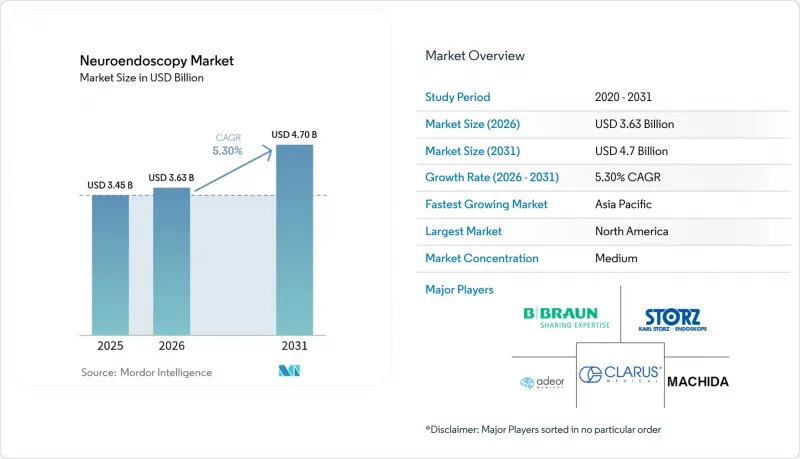
본 보고서는 제품 유형별(경성 신경내시경 및 연성 신경내시경), 사용 방법별(재사용형 신경내시경 및 일회용 신경내시경), 용도별(비강 신경내시경 검사 등), 최종 사용자(병원 등), 환자층별(성인 및 소아), 지역별(북미, 유럽 등)로 분류되어 있습니다. 시장 예측은 금액(달러) 기준으로 제시되어 있습니다.
세계의 신경 내시경 시장 동향 및 인사이트
뇌 및 두개저 종양으로 인한 전 세계적 부담이 증가함에 따라, 저침습 신경 내시경 검사에 대한 수요가 증가하고 있습니다.
세계적으로 신경계 질환 유병률은 38억 명에 달하며, 중추신경계 종양으로 인한 발병률은 계속 증가하고 있습니다. 다형성 교모세포종의 치료는 여전히 어려우며, 외과의사들은 피질 손상을 최소화하면서 최대한 안전하고 효과적인 절제를 실현하는 접근법을 채택하고 있습니다. 2024년에 발표된 임상 연구에 따르면, 신경내시경 하 절제술은 기존의 현미경 수술에 비해 개두 범위를 최대 70%까지 줄일 수 있는 반면, 동등한 수준의 높은 절제율을 유지하며 합병증 발생률도 낮은 것으로 나타났습니다. 증례 수가 증가함에 따라 이러한 성과는 저침습 기술로의 전환을 뒷받침하고 있습니다.
광학, 시각화, 내비게이션 기술의 발전이 임상 결과를 개선한다.
신경 내시경과 결합된 실시간 3D 재구성을 통해 수두증에 대한 션트 삽입의 정확도가 향상되었으며, 최근 다기관 공동 연구에서는 위치 이상으로 인한 합병증이 감소했습니다. 전용으로 설계된 로봇 팔은 좁은 통로 내에서 기구의 안정성을 확보하고, 서브mm 단위의 떨림을 보정함으로써, 지금까지 도달할 수 없었던 병변에 접근할 수 있게 해줍니다. 이러한 발전들이 결합되어 외과의사의 자신감을 높이고, 조기 도입 기관에서 수술 시간 단축으로 이어지고 있습니다.
첨단 시스템 도입을 가로막는 고액의 초기 비용과 유지비
저소득 국가에서는 신경 내비게이션 지원 타워, 고해상도 카메라, 경성 내시경의 조달 비용이 진료과의 연간 장비 예산을 초과하는 경우가 종종 있습니다. 지속적인 교정 및 유지보수 계약은 재정적 부담을 가중시키며, 뇌신경외과 수요가 급증하고 있는 중소득국과 고소득국 의료기관 간의 격차를 더욱 벌리고 있습니다.
부문 분석
2025년 매출 중 리지드 스코프가 67.20%를 차지했으며, 뇌실 내 및 두개저 통로에 적합한 매우 선명한 광학 성능을 갖춘 시스템이 신경 내시경 시장에서의 점유율 우위를 뒷받침하고 있습니다. 플렉서블 내시경은 2026-2031년 연평균 성장률(CAGR) 8.06%로 성장을 가속화하고 있습니다. 각 제조업체는 선단부의 직경을 4mm 미만으로 축소하는 동시에, 해상도 면에서 재사용 가능한 내시경에 필적하는 ‘팁 온 더 팁(Tip-on-the-Tip)’ 카메라를 통합하고 있습니다. 또한, 증강현실(AR) 오버레이를 통해 해부학적 랜드마크가 외과의사의 디스플레이에 직접 투영되도록 했으며, 이 기능은 현재 다기관 공동 임상시험을 통해 평가되고 있습니다.
고분자 광학 기술 및 재활용 가능한 포장의 발전은 병원 지속가능성 위원회가 지적한 환경적 우려를 완화하는 것을 목표로 합니다. 초기 수명 주기 평가에 따르면, 재생에너지 사용량이 총 제조 소비량의 60%를 초과할 경우 특정 일회용 모델의 탄소 중립 생산이 가능할 것으로 나타났습니다. 고급 재사용 키트와 턴키형 일회용 세트의 가격 차이가 좁혀지는 가운데, 각 병원들은 내시경 파손이나 멸균 처리 지연으로 인한 가동 중단 시간을 고려한 가치 분석을 재검토하고 있습니다.
재사용 가능한 유닛은 수백 건의 수술에 걸친 상각 효과로 인해 2025년 신경 내시경 시장 규모의 66.25%를 차지했습니다. 그러나 오염 제거 프로토콜에는 다단계 워크플로가 필요하여 인건비와 약품비를 상승시키는 한편, 시설을 규정 위반 위험에 노출시키고 있습니다. NICE는 처리 능력이 높은 재처리 인프라가 존재할 경우 일회용 내시경이 비용 대비 효과가 낮을 수 있다고 경고하고 있지만, 한편으로는 재처리 실패가 소송의 불씨가 될 수 있다는 점도 인정하고 있습니다.
산업 설계상의 변경(탈부착 가능한 조명 케이블, 내스크래치성 사파이어 창, 강화된 굴곡 메커니즘 등) 덕분에 재사용 가능한 내시경의 수명은 2,000 사이클을 초과하며, 비용 곡선을 재사용 지속에 유리한 방향으로 바꾸고 있습니다. 한편, 일회용 채널용 생분해성 폴리머에 대한 병행 연구는 임상적, 경제적, 환경적 지표를 동시에 충족할 수 있으며, 향후 수렴될 것임을 시사하고 있습니다.
지역별 분석
2025년에는 북미가 매출의 37.40%를 차지하며 1위를 차지했습니다. 이는 선진적인 병원 네트워크, 신속한 FDA 승인 절차, 그리고 신경외과 훈련의 높은 밀도에 힘입은 결과입니다. AI를 활용한 계획 플랫폼은 내비게이션 시스템과의 통합이 진행되고 있어, 절제 마진의 정확도를 높이고 첫 수술의 성공률을 향상시키고 있습니다.
아시아태평양은 2031년까지 연평균 성장률(CAGR) 8.83%를 기록하며 가장 빠르게 성장하는 지역입니다. 일본에서는 고령화와 국민건강보험 제도가 맞물려 의료기기 교체 주기가 활발해지고 있습니다. 중국에서는 Scivita Medical Technology와 같은 국내 제조업체들이 해외 대기업에 도전하고 있어, 공급업체 구도의 변화가 예상됩니다. 인도에서는 관민을 불문하고 병원 확장이 진행되며 내시경 수술실 이용이 확대되는 한편, 전 세계 의료 센터와의 연수 교류를 통해 시술 숙련도도 향상되고 있습니다.
유럽에서는 각국의 의료 제도가 입원 기간 단축을 목적으로 저침습 치료를 권장하고 있어 여전히 큰 시장 점유율을 유지하고 있습니다. 중동 및 아프리카에서는 걸프협력회의(GCC) 회원국과 남아프리카공화국의 3차 의료 센터를 대상으로 한 투자가 진행되고 있습니다. 라틴아메리카에서는 학술 기관과의 제휴 및 자선 활동의 지원에 힘입어 브라질과 아르헨티나가 도입을 주도하고 있습니다. 신경외과 아웃리치 재단(Neurosurgery Outreach Foundation)은 자원이 부족한 지역에서 1,985건의 수술을 시행하며 그 영향력의 확대를 입증하고 있습니다.
기타 혜택 :
- 엑셀 형식 시장 예측(ME) 시트
- 3개월간의 애널리스트 지원
자주 묻는 질문
목차
제1장 서론
제2장 조사 방법
제3장 주요 요약
제4장 시장 구도
제5장 시장 규모 및 성장 예측
제6장 경쟁 구도
제7장 시장 기회 및 향후 전망
AJY 26.09.07According to Mordor Intelligence, the neuroendoscopy market size is expected to grow from USD 3.45 billion in 2025 to USD 3.63 billion in 2026 and is forecast to reach USD 4.7 billion by 2031 at 5.30% CAGR over 2026-2031.
This report is Segmented by Product Type (Rigid Neuroendoscopes and Flexible Neuroendoscopes), Usability (Reusable Neuroendoscopes and Single-Use Neuroendoscopes), Application (Transnasal Neuroendoscopy, and More), End User (Hospitals, and More), Patient Demographics (Adult and Pediatric) and Geography (North America, Europe, and More). The Market Forecasts are Provided in Terms of Value (USD).
Global Neuroendoscopy Market Trends and Insights
Rising Global Burden of Brain & Skull-Base Tumors Increasing Demand for Minimally Invasive Neuroendoscopy
The global prevalence of nervous-system disorders affects 3.8 billion people, and central-nervous-system tumors impose growing morbidity. Glioblastoma multiforme remains difficult to manage, spurring surgeons to adopt approaches that reduce cortical disruption while achieving maximal safe resection. Clinical studies published in 2024 show neuroendoscopic resections require craniotomy areas up to 70% smaller than conventional microsurgery, with comparably high extirpation rates and lower complication incidence. These outcomes reinforce the shift toward minimally invasive techniques as caseloads climb.
Technological Advancements in Optics, Visualization, and Navigation Enhancing Clinical Outcomes
Real-time 3D reconstruction paired with neuroendoscopy has improved shunt placement accuracy for hydrocephalus, cutting malposition complications in recent multicenter trials. Purpose-built robotic arms stabilize instrumentation in narrow corridors and provide sub-millimetric tremor filtration, extending reach to previously inaccessible lesions. Together, these advances lift surgeon confidence and are shortening operating times in early adopter sites.
High Capital & Maintenance Costs of Advanced Systems Restricting Uptake
Procurement of neuronavigation-ready towers, high-resolution cameras and rigid scopes often exceeds a department's annual equipment budget in low-income settings. Ongoing calibration and service contracts further strain finances, widening the gap between high-income and middle-income facilities where neurosurgical needs are surging.
Other drivers and restraints analyzed in the detailed report include:
- Expanding Healthcare Infrastructure and Neurosurgery Capacity in Emerging Economies
- Favorable Regulatory and Reimbursement Policies Supporting Adoption of Neuroendoscopic Devices
- Steep Learning Curve and Limited Surgeon Training Affecting Adoption Rates
For complete list of drivers and restraints, kindly check the Table Of Contents.
Segment Analysis
Rigid scopes captured 67.20% of 2025 revenue, underpinning the neuroendoscopy market share advantage of systems offering crystal-clear optics suited to intraventricular and skull-base corridors. Flexible scopes are accelerating at an 8.06% CAGR from 2026 to 2031. Manufacturers are shrinking distal tip diameters below 4 mm and integrating chip-on-the-tip cameras that rival reusable counterparts in resolution. Augmented-reality overlays now project anatomic landmarks directly onto surgeon displays, a capability under evaluation in multicenter trials.
Advances in polymer optics and recyclable packaging aim to mitigate environmental concerns cited by hospital sustainability boards. Early lifecycle assessments suggest carbon-neutral production of selected single-use models is achievable if renewable-energy inputs exceed 60% of total manufacturing consumption. As pricing narrows between premium reusable kits and turnkey disposable sets, hospitals are recalibrating value analyses that consider downtime due to scope damage or decontamination backlog.
Reusable units comprise 66.25% of the 2025 neuroendoscopy market size thanks to amortization over hundreds of procedures. Decontamination protocols, however, require multistep workflows that raise labor and chemical costs while exposing facilities to compliance lapses. NICE has cautioned that single-use scopes can be cost-ineffective when high-throughput reprocessing infrastructure exists, yet it also acknowledges reprocessing failures as a litigatory flashpoint.
Industrial design changes-detachable light cables, scratch-resistant sapphire windows and reinforced angulation mechanisms-are extending reusable scope lifespans beyond 2,000 cycles, bending cost curves in favor of retention. Parallel work on biodegradable polymers for single-use channels signals an eventual convergence where clinical, economic and environmental metrics can be met simultaneously.
Complete Report Scope:
- By Product Type
- Rigid Neuroendoscopes
- Videoscopes
- Fiberscopes
- Flexible Neuroendoscopes
- Rigid Neuroendoscopes
- By Usability
- Reusable Neuroendoscopes
- Disposable / Single-Use Neuroendoscopes
- By Application (Surgery Type)
- Transnasal Neuroendoscopy
- Intraventricular Neuroendoscopy
- Transcranial Neuroendoscopy
- By End User
- Hospitals
- Ambulatory Surgical Centers
- Specialty Clinics
- Research & Academic Institutes
- By Patient Demographics
- Adult
- Pediatric
- Geography
- North America
- United States
- Canada
- Mexico
- Europe
- Germany
- United Kingdom
- France
- Italy
- Spain
- Rest of Europe
- Asia-Pacific
- China
- Japan
- India
- South Korea
- Australia
- Rest of Asia-Pacific
- Middle East and Africa
- GCC
- South Africa
- Rest of Middle East and Africa
- South America
- Brazil
- Argentina
- Rest of South America
- North America
Geography Analysis
North America led with 37.40% revenue in 2025, supported by advanced hospital networks, rapid FDA clearance pathways and high neurosurgical training density. AI-augmented planning platforms are increasingly integrated with navigation systems, sharpening resection margins and bolstering first-pass success rates.
Asia-Pacific is the fastest-growing region at 8.83% CAGR to 2031. Japan's aging population, coupled with universal coverage, drives robust equipment refresh cycles. China's domestic producers, such as Scivita Medical Technology, are challenging foreign incumbents, signaling a shift in vendor mix. India's public-private hospital expansion is widening access to endoscopic suites, while training exchanges with global centers raise procedural competency levels.
Europe maintains meaningful share as national health systems encourage minimally invasive strategies to trim lengths of stay. The Middle East and Africa are witnessing targeted investments in tertiary centers within the Gulf Cooperation Council and South Africa. In Latin America, Brazil and Argentina lead adoption, underpinned by academic partnerships and charitable outreach; the Neurosurgery Outreach Foundation has demonstrated scalable impact through 1,985 surgeries conducted across low-resource settings.
- Adeor Medical
- B. Braun
- Karl Storz
- Medtronic
- Olympus
- Stryker
- FUJIFILM
- Carl Zeiss
- Pentax Medical (HOYA Corp.)
- Ackermann Instrumente
- Clarus Medical
- Machida Endoscope
- Schindler Endoskopie Technologie
- Tonglu Wanhe Medical Instrument
- Visionsense
- Locamed
- Richard Wolf
- XION Medical GmbH
- Rudolf Medical GmbH
Additional Benefits:
- The market estimate (ME) sheet in Excel format
- 3 months of analyst support
TABLE OF CONTENTS
1 Introduction
- 1.1 Study Assumptions & Market Definition
- 1.2 Scope of the Study
2 Research Methodology
3 Executive Summary
4 Market Landscape
- 4.1 Market Overview
- 4.2 Market Drivers
- 4.2.1 Rising Global Burden of Brain & Skull-Base Tumors Increasing Demand for Minimally Invasive Neuroendoscopy
- 4.2.2 Technological Advancements in Optics, Visualization, and Navigation Enhancing Clinical Outcomes
- 4.2.3 Expanding Healthcare Infrastructure and Neurosurgery Capacity in Emerging Economies
- 4.2.4 Favorable Regulatory and Reimbursement Policies Supporting Adoption of Neuroendoscopic Devices
- 4.2.5 Aging Population Susceptibility to Neurological Disorders Stimulating Procedure Volumes
- 4.3 Market Restraints
- 4.3.1 High Capital & Maintenance Costs of Advanced Neuroendoscopic Systems Restricting Uptake in Resource-Constrained Settings
- 4.3.2 Steep Learning Curve and Limited Surgeon Training Affecting Procedure Adoption Rates
- 4.3.3 Concerns Over Device Reprocessing, Sterility, and Associated Litigation
- 4.4 Innovation & Patent Landscape
- 4.5 Porter's Five Forces
- 4.5.1 Threat of New Entrants
- 4.5.2 Bargaining Power of Buyers
- 4.5.3 Bargaining Power of Suppliers
- 4.5.4 Threat of Substitutes
- 4.5.5 Competitive Rivalry
5 Market Size & Growth Forecasts (Value, USD)
- 5.1 By Product Type
- 5.1.1 Rigid Neuroendoscopes
- 5.1.1.1 Videoscopes
- 5.1.1.2 Fiberscopes
- 5.1.2 Flexible Neuroendoscopes
- 5.1.1 Rigid Neuroendoscopes
- 5.2 By Usability
- 5.2.1 Reusable Neuroendoscopes
- 5.2.2 Disposable / Single-Use Neuroendoscopes
- 5.3 By Application (Surgery Type)
- 5.3.1 Transnasal Neuroendoscopy
- 5.3.2 Intraventricular Neuroendoscopy
- 5.3.3 Transcranial Neuroendoscopy
- 5.4 By End User
- 5.4.1 Hospitals
- 5.4.2 Ambulatory Surgical Centers
- 5.4.3 Specialty Clinics
- 5.4.4 Research & Academic Institutes
- 5.5 By Patient Demographics
- 5.5.1 Adult
- 5.5.2 Pediatric
- 5.6 Geography
- 5.6.1 North America
- 5.6.1.1 United States
- 5.6.1.2 Canada
- 5.6.1.3 Mexico
- 5.6.2 Europe
- 5.6.2.1 Germany
- 5.6.2.2 United Kingdom
- 5.6.2.3 France
- 5.6.2.4 Italy
- 5.6.2.5 Spain
- 5.6.2.6 Rest of Europe
- 5.6.3 Asia-Pacific
- 5.6.3.1 China
- 5.6.3.2 Japan
- 5.6.3.3 India
- 5.6.3.4 South Korea
- 5.6.3.5 Australia
- 5.6.3.6 Rest of Asia-Pacific
- 5.6.4 Middle East and Africa
- 5.6.4.1 GCC
- 5.6.4.2 South Africa
- 5.6.4.3 Rest of Middle East and Africa
- 5.6.5 South America
- 5.6.5.1 Brazil
- 5.6.5.2 Argentina
- 5.6.5.3 Rest of South America
- 5.6.1 North America
6 Competitive Landscape
- 6.1 Market Concentration
- 6.2 Market Share Analysis
- 6.3 Company Profiles (includes Global level Overview, Market level overview, Core Business Segments, Financials, Headcount, Key Information, Market Rank, Market Share, Products and Services, and analysis of Recent Developments)
- 6.3.1 Adeor Medical AG
- 6.3.2 B. Braun Melsungen AG
- 6.3.3 KARL STORZ SE & Co. KG
- 6.3.4 Medtronic plc
- 6.3.5 Olympus Corporation
- 6.3.6 Stryker Corporation
- 6.3.7 FUJIFILM Holdings Corporation
- 6.3.8 Carl Zeiss Meditec AG
- 6.3.9 Pentax Medical (HOYA Corp.)
- 6.3.10 Ackermann Instrumente GmbH
- 6.3.11 Clarus Medical
- 6.3.12 Machida Endoscope Co. Ltd
- 6.3.13 Schindler Endoskopie Technologie GmbH
- 6.3.14 Tonglu Wanhe Medical Instrument Co. Ltd
- 6.3.15 Visionsense Corporation
- 6.3.16 Locamed Ltd
- 6.3.17 Richard Wolf GmbH
- 6.3.18 XION Medical GmbH
- 6.3.19 Rudolf Medical GmbH
7 Market Opportunities & Future Outlook
- 7.1 White-space & Unmet-Need Assessment