|
시장보고서
상품코드
2122357
자동차 안전 시스템 시장 : 시장 점유율 분석, 업계 동향 및 통계, 성장 예측(2026-2031년)Automotive Safety Systems - Market Share Analysis, Industry Trends & Statistics, Growth Forecasts (2026 - 2031) |
||||||
 Mordor Intelligence
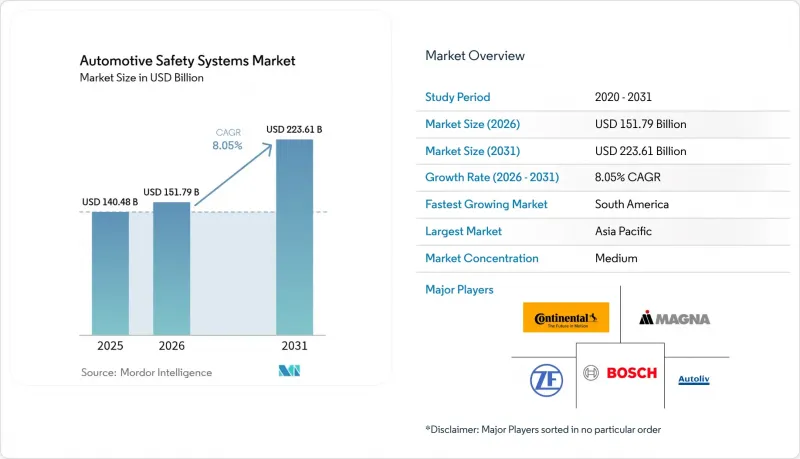
Mordor Intelligence에 의하면, 자동차 안전 시스템 시장 규모는 2025년 1,404억 8,000만 달러로 평가되었고, 2026년에는 1,517억 9,000만 달러로 추정되고, 2026-2031년 CAGR 8.05%로 성장을 지속할 전망이며, 2031년에는 2,236억 1,000만 달러에 이를 것으로 예측됩니다.
본 보고서는 시스템 유형별(능동 안전 시스템 및 수동 안전 시스템), 기술 구성 요소별(센서, 레이더, 카메라 등), 최종 사용자별(OEM 및 애프터마켓), 차종별(승용차, 소형 상용차 등), 구동 방식별(내연기관 차량, 배터리식 전기차 등), 지역별(북미 등)로 분류되어 있습니다. 시장 예측은 금액(달러) 기준으로 제시되어 있습니다.
세계의 자동차 안전 시스템 시장 동향 및 인사이트
전 세계 각국의 NCAP 및 UNECE에 의한 안전 기준 강화
2026년 Euro NCAP 프로토콜에서는 모든 모델 등급에 대해 보행자용 자동 긴급 제동 및 운전자 모니터링 기능이 의무화되며, 공통된 준수 기준이 확립됩니다. 중국 공업정보화부는 2025년, 안전 기능과 관련된 모든 소프트웨어 업데이트에 대해 형식 인증을 의무화하는 규정을 도입했습니다. 2024년 7월부터 시행되고 있는 EU의 ‘일반 안전 규정 II’에서는 모든 신차에 지능형 속도 지원 기능 및 긴급 차선 유지 기능이 의무화되어 있습니다. NHTSA(미국 도로교통안전국)는 2026년형 모델을 대상으로 ‘신차 평가 프로그램(NCAP)’을 업데이트하여 사각지대 경고, 차선 유지 보조 및 보행자용 AEB를 추가했습니다. 이는 능동 안전 기술을 향한 10년에 걸친 노력을 보여주는 것입니다. 세계적인 기준의 통합을 통해 제조업체는 개발 비용을 더 많은 판매 대수에 분산시킬 수 있게 되어, 첨단 기능의 보급을 가속화하는 데 기여할 것입니다.
ADAS 표준화를 가능하게 하는 센서 가격의 급격한 하락
자동차용 레이더 가격은 현재 연간 약 18% 하락하고 있는 반면, 프로세서 성능은 18개월마다 두 배로 증가하고 있어, 엔트리 부문 가격대에서도 고성능 환경 인식이 가능해졌습니다. 4차원 이미징 레이더는 기존 3차원 장치와 비슷한 비용 수준에서 센티미터 단위의 감지 정밀도를 실현하며, 그 용도는 어댑티브 크루즈 컨트롤(ACC)의 범위를 넘어 확장되고 있습니다. 이미지 센서는 스마트폰 밸류체인의 혜택을 받고 있어, HDR 기능을 갖춘 8메가픽셀 자동차용 칩을 10달러 미만으로 구입할 수 있습니다. NITI Aayog는 ADAS의 탑재율 확대를 견인력으로 삼아, 2030년까지 차량 1대당 반도체 가치가 2배인 1,200달러에 달할 것으로 예측했습니다. 비용 하락 추세에 힘입어, 자동차 안전 시스템 시장에서는 아시아와 라틴아메리카에서 판매되는 소형차에도 레벨 1 및 레벨 2 기능이 탑재되고 있습니다.
여러 국가의 규제 준수에 따른 높은 검증 및 인증 비용
각 제조업체는 중국의 C-NCAP 2024 시험 매트릭스와 Euro NCAP 2026의 요건을 조화시켜야 하므로, 유사한 시나리오에서 충돌 시험 및 소프트웨어 검증을 반복적으로 수행하는 경우가 늘고 있습니다. TUV SUD는 현재 EU 규정에 따른 필수 침입 테스트를 실시하고 있으며, 시장 출시 전에 수개월에 걸친 사이버 보안 심사가 추가되고 있습니다. ISO/SAE 21434에서는 차량의 전체 수명 주기에 걸친 위협 분석이 요구되고 있어, 이로 인해 개발 일정이 장기화되고 중소 자동차 제조업체의 비용 증가로 이어지고 있습니다. 이러한 요인들로 인해 비용에 민감한 시장에서 최첨단 기능의 보급이 지연되고 있으며, 표준 조화가 이루어질 때까지는 자동차 안전 시스템 시장의 일부가 위축될 것입니다.
부문 분석
2025년 기준, 능동형 안전 시스템은 자동차 안전 시스템 시장 규모의 66.62%를 차지하며 가장 큰 점유율을 기록했습니다. Euro NCAP 및 NHTSA의 기준이 엄격해짐에 따라, 자동 긴급 제동, 어댑티브 크루즈 컨트롤, 차선 유지 보조, 운전자 모니터링과 같은 기능이 중급 트림에도 탑재되고 있습니다. 각 공급업체들이 머신러닝 모델을 실시간으로 실행하는 도메인 컨트롤러를 통해 레이더, 카메라, 라이다(LiDAR) 데이터를 통합함에 따라 경쟁이 치열해지고 있습니다. 또한, 이 부문은 차량 대여 수요의 혜택도 받고 있으며, 보험사들은 충돌 회피 기술이 탑재된 트럭에 대해 보험료 할인을 제공합니다.
차량 내 생체 인식 플랫폼은 가장 빠르게 성장하는 하위 부문으로 두각을 나타내고 있으며, 2031년까지 연평균 성장률(CAGR) 8.27%로 성장할 전망입니다. 이러한 솔루션은 운전자의 각성도, 심박수, 나아가 혈중 산소 포화도를 추적하여 위험한 상황이 발생하기 전에 선제적으로 경고를 발령합니다. 차량 내 센서가 능동형 제동 제어 장치와 연동됨으로써, 탑승자는 외부 및 내부 위협을 모두 예측하는 폐쇄형 안전 환경을 누릴 수 있습니다. 수동 안전은 자율주행차의 새로운 시트 레이아웃에 대응하는 스마트 에어백과 어댑티브 안전벨트를 통해 여전히 중요하지만, 그 성장세는 완만합니다.
2025년, 자동차 안전 시스템 시장에서 레이더 모듈은 34.08%를 차지했으며, 비, 눈, 안개 속에서도 확실하게 작동하는 비용 효율적인 77GHz 칩셋이 그 기반이 될 것입니다. 4D 이미징 레이더로의 전환으로 각도 분해능이 향상되고 물체 분류가 가능해짐에 따라, 더 낮은 부품 원가(BOM)로 LiDAR와의 성능 격차가 좁혀지고 있습니다. 카메라 시스템은 계속해서 스마트폰의 비용 효율성을 활용하고 있으며, 각 OEM 업체들은 주차 및 저속 주행 시 360도 비전 기능을 추가할 수 있게 되었습니다.
LiDAR는 가동 부품을 줄이고 센서 단가를 낮추는 솔리드 스테이트 아키텍처에 힘입어 연평균 성장률(CAGR) 8.49%라는 가장 빠른 성장세를 기록하고 있습니다. 프리미엄 세단에 레벨 3 고속도로 자율주행 기능이 도입되면서, 중복적인 깊이 인식 및 도로 위 이물질 감지를 위해 전방 LiDAR에 의존하게 되어 그 보급이 가속화되고 있습니다. 제어 장치는 브레이크, 스티어링 및 인식 데이터를 단일 칩에 통합함으로써 배선과 무게를 줄이고 있습니다. 자동차 안전 시스템 시장이 예측형 안전으로 전환되는 가운데, 엣지 프로세서에 자기 학습 알고리즘을 적용하는 소프트웨어 혁신이 공급업체의 차별화 요소로 작용하고 있습니다.
지역별 분석
2025년, 아시아태평양은 자동차 안전 시스템 시장에서 39.42%의 점유율을 차지하며 지역별 최대 시장 지위를 유지했습니다. 중국 공업정보화부(MIIT)가 모든 ADAS 소프트웨어 업데이트에 대해 승인을 의무화하는 규정을 제정함에 따라, 기능 배포를 가속화하는 견고한 규정 준수 생태계가 조성되고 있습니다. 기술 측면에서는 화웨이(Huawei)와 Xpeng과 같은 파트너십을 통해 자동차 기술의 융합이 진행되고 있으며, 양사는 공통 소프트웨어 스택 위에 레이더, 카메라, 라이다(LiDAR)를 통합한 도메인 컨트롤러를 공동 개발하고 있습니다. 일본에서는 도시 지역에서 자율주행 셔틀을 시범 운영하는 AI 주도 스타트업이 육성되고 있는 반면, 인도에서는 충돌 안전 규제가 강화됨에 따라 소형차용 비용 최적화된 에어백 및 AEB에 대한 수요가 증가하고 있습니다.
남미는 가장 높은 성장률을 보이고 있으며, 2031년까지 연평균 성장률(CAGR) 8.51%로 확대될 전망입니다. 스텔란티스는 2025-2030년 56억 유로를 투자하여 현지 공장에서 40종 이상의 모델을 출시할 계획이며, 각 모델은 유로 NCAP의 시험 프로토콜을 준수하고 있습니다. 브라질,아르헨티나 및 인근 시장에서는 안전 규정이 통일되어 있어, 세계 공급업체는 별도의 조정 없이 검증된 센서 세트를 그대로 채택할 수 있습니다. 에탄올 엔진과 배터리 팩을 결합한 바이오 하이브리드 파워트레인은 열 안전 시스템과 전기 안전 시스템의 통합에 있어 새로운 과제를 제기하고 있습니다.
북미와 유럽은 차량당 탑재 부품 수가 많고, 소프트웨어 정의 차량에 관한 규제가 잘 정비되어 있어 성숙한 시장으로서의 지위를 유지하고 있습니다. 이 지역들의 자동차 안전 시스템 시장 점유율은 안정적이지만, UNECE 규정 155에 따라 완벽한 사이버 보안이 의무화되고 모든 안전용 ECU가 해킹 방지 기준을 충족해야 함에 따라 차량당 가치는 상승하고 있습니다. 중동 및 아프리카은 인프라 확충에 힘입어 낮은 수준에서 성장을 이루고 있지만, 현지의 혹독한 기후 조건으로 인해 견고한 센서 하우징과 방진형 레이더 인클로저에 대한 수요가 증가하고 있습니다.
기타 혜택 :
- 엑셀 형식 시장 예측(ME) 시트
- 3개월간의 애널리스트 지원
자주 묻는 질문
목차
제1장 서론
제2장 조사 방법
제3장 주요 요약
제4장 시장 구도
제5장 시장 규모 및 성장 예측
제6장 경쟁 구도
제7장 시장 기회 및 향후 전망
AJY 26.09.07According to Mordor Intelligence, the automotive safety systems market size is expected to grow from USD 140.48 billion in 2025 to USD 151.79 billion in 2026 and is forecast to reach USD 223.61 billion by 2031 at 8.05% CAGR over 2026-2031.
This report is Segmented by System Type (Active Safety Systems and Passive Safety Systems), Technology Component (Sensors, Radar, Camera, and More), End User (OEM and Aftermarket), Vehicle Type (Passenger Car, Light Commercial Vehicle, and More), Propulsion (ICE, Battery-Electric Vehicles, and More), and Geography (North America, and More). The Market Forecasts are Provided in Terms of Value (USD).
Global Automotive Safety Systems Market Trends and Insights
Tightening Global NCAP & UNECE Safety Mandates
Euro NCAP protocols for 2026 require pedestrian automatic emergency braking and driver monitoring across all model classes, creating a common compliance baseline. China's Ministry of Industry and Information Technology introduced rules in 2025 that obligate type approval for every software update touching safety functions. The EU General Safety Regulation II, in force since July 2024, obliges intelligent speed assistance and emergency lane keeping on every new vehicle. NHTSA updated its New Car Assessment Program to add blind-spot warning, lane keeping assistance, and pedestrian AEB for 2026 models, signaling a decade-long push for active safety. Global alignment lets manufacturers spread development cost across larger volumes and catalyzes faster diffusion of advanced functions.
Rapid Sensor-Cost Deflation Enabling ADAS Standardisation
Automotive radar prices now fall nearly 18% each year, while processor capability doubles every 18 months, permitting high-performance perception at entry-segment price points. Four-dimensional imaging radar brings centimeter-grade detection accuracy at cost levels close to legacy 3-D units, broadening use beyond adaptive cruise control. Image sensors benefit from smartphone supply chains: 8-megapixel automotive chips with HDR are available below USD 10. NITI Aayog projects semiconductor value per vehicle to double to USD 1,200 by 2030, led by ADAS content. The declining cost curve allows the automotive safety system market to extend Level-1 and Level-2 features to compact cars sold in Asia and Latin America.
High Validation & Homologation Cost for Multicountry Compliance
Manufacturers must reconcile China's C-NCAP 2024 test matrix with Euro NCAP 2026 requirements, often repeating crash and software validation for similar scenarios. TUV SUD now runs mandatory penetration testing under EU rules, adding months of cybersecurity reviews before market release. ISO/SAE 21434 demands threat analysis across the full vehicle lifecycle, lengthening development schedules and raising costs for small automakers. These factors slow the spread of cutting-edge features in cost-sensitive markets, restraining part of the automotive safety system market until harmonisation improves.
Other drivers and restraints analyzed in the detailed report include:
- Boom in Software-Defined Vehicles (OTA Safety Feature Upgrades)
- Shift Toward Level-2+ Autonomy in Commercial Vehicles (Fleet TCO Play)
- Chip-Set Supply Volatility Delaying OEM Safety Roll-Outs
For complete list of drivers and restraints, kindly check the Table Of Contents.
Segment Analysis
Active Safety Systems generated the largest slice of the automotive safety system market size at 66.62% in 2025. Automated emergency braking, adaptive cruise, lane keeping, and driver monitoring now appear in mid-range trims as Euro NCAP and NHTSA protocols grow stricter. Competitive intensity rises as suppliers integrate radar, camera, and LiDAR data through domain controllers that run machine-learning models in real time. The segment also benefits from fleet demand, with insurers offering premium discounts for trucks equipped with crash-avoidance technology.
In-cabin biometric platforms stand out as the fastest subsegment, advancing at an 8.27% CAGR to 2031. These solutions track driver alertness, heart rate, and even oxygen saturation, issuing proactive warnings before dangerous conditions emerge. As cabin sensors link with active braking controllers, occupants receive a closed-loop safety envelope that anticipates both external and internal threats. Passive safety remains relevant through smart airbags and adaptive seat belts that fit new seat layouts in autonomous vehicles, yet growth stays moderate.
Radar modules accounted for 34.08% of the automotive safety system market in 2025, underpinned by cost-effective 77-GHz chipsets that function reliably in rain, snow, and fog. The move to 4-D imaging radar sharpens angle resolution and permits object classification, narrowing the performance gap with LiDAR at a lower bill of materials. Camera systems continue to leverage smartphone economics, letting OEMs add 360-degree vision for parking and low-speed manoeuvres.
LiDAR registers the quickest expansion at an 8.49% CAGR, supported by solid-state architectures that trim moving parts and cut price per sensor. Level-3 highway-pilot launches in premium sedans rely on forward-facing LiDAR for redundant depth perception and road debris detection, accelerating adoption. Control units merge braking, steering, and perception data into single chips, reducing wiring and weight. Software innovations that apply self-learning algorithms on edge processors differentiate suppliers as the automotive safety system market transitions toward predictive safety.
Complete Report Scope:
- By System Type
- Active Safety Systems
- Collision-Avoidance (AEB, FCW)
- Driver Monitoring & HMI Alerts
- Chassis Control (ESC, ABS)
- Passive Safety Systems
- Airbags (Frontal, Side, Curtain, Far-side)
- Seat-belt & Pretensioners
- Active Safety Systems
- By Technology Component
- Sensors
- Radar
- Camera
- LiDAR/Ultrasonic
- Control Units and Domain Controllers
- Software & Algorithms
- By End-User
- OEM Factory-Fit
- Aftermarket / Retrofit
- By Vehicle Type
- Passenger Cars
- Light Commercial Vehicles
- Heavy Commercial Vehicles & Buses
- By Propulsion
- Internal Combustion Engine (ICE)
- Battery-Electric Vehicles (BEV)
- Hybrid Electric Vehicle (HEV)
- Fuel-Cell Electric Vehicle (FCEV)
- By Geography
- North America
- United States
- Canada
- Rest of North America
- South America
- Brazil
- Argentina
- Rest of South America
- Europe
- Germany
- United Kingdom
- France
- Italy
- Russia
- Rest of Europe
- Asia-Pacific
- China
- Japan
- India
- South Korea
- Rest of Asia-Pacific
- Middle East and Africa
- Saudi Arabia
- United Arab Emirates
- Turkey
- South Africa
- Rest of Middle East and Africa
- North America
Geography Analysis
Asia Pacific retained the largest regional position with 39.42% share of the automotive safety system market in 2025. China's MIIT rules compelling approval for every ADAS software update foster a robust compliance ecosystem that speeds feature rollout. Technology - auto convergence appears in partnerships such as Huawei and Xpeng, which co-develop domain controllers integrating radar, camera, and LiDAR on a common software stack. Japan nurtures AI-driven start-ups that pilot autonomous shuttles for urban centres, while India's tighter crash regulations boost demand for cost-optimised airbags and AEB in compact cars.
South America posts the highest growth, advancing at an 8.51% CAGR through 2031. Stellantis committed EUR 5.6 billion between 2025 and 2030 to launch more than 40 models from local plants, each aligned with Euro NCAP test protocols. Brazil, Argentina, and neighbouring markets harmonise safety laws, letting global suppliers replicate validated sensor suites without custom tuning. Bio-hybrid powertrains that blend ethanol engines with battery packs open fresh integration tasks for thermal and electrical safety systems.
North America and Europe uphold mature positions with high per-vehicle content and software-defined vehicle regulations. The automotive safety system market share in these regions remains stable, yet value per unit rises as UNECE Regulation 155 enforces full cybersecurity, obliging every safety ECU to meet anti-hacking standards. The Middle East and Africa progress from low baselines, stimulated by infrastructure expansion, yet local climate extremes drive demand for robust sensor housings and dust-proof radar enclosures.
- Robert Bosch GmbH
- Continental AG
- ZF Friedrichshafen AG
- Autoliv Inc.
- Denso Corporation
- Aptiv PLC
- Magna International Inc.
- Joyson Safety Systems
- Mobileye N.V.
- Valeo SA
- Hitachi Astemo
- Hyundai Mobis
- NXP Semiconductors
- Infineon Technologies AG
- Texas Instruments Inc.
- Renesas Electronics Corp.
- Veoneer AB
- WABCO (ZF CV Systems)
- Bendix Commercial Vehicle Systems
- Lear Corporation (E-Systems)
Additional Benefits:
- The market estimate (ME) sheet in Excel format
- 3 months of analyst support
TABLE OF CONTENTS
1 Introduction
- 1.1 Study Assumptions & Market Definition
- 1.2 Scope of the Study
2 Research Methodology
3 Executive Summary
4 Market Landscape
- 4.1 Market Overview
- 4.2 Market Drivers
- 4.2.1 Tightening global NCAP & UNECE safety mandates
- 4.2.2 Rapid sensor-cost deflation enabling ADAS standardisation
- 4.2.3 Boom in software-defined vehicles (OTA safety feature upgrades)
- 4.2.4 Shift toward Level-2+ autonomy in commercial vehicles (fleet TCO play)
- 4.2.5 Rise of AI-based in-cabin biometric safety analytics (fatigue, vitals)
- 4.2.6 Bundling of vehicle-safety data into Usage
- 4.3 Market Restraints
- 4.3.1 High validation & homologation cost for multicountry compliance
- 4.3.2 Chip-set supply volatility delaying OEM safety roll-outs
- 4.3.3 Cyber-physical attack risk on safety ECUs & sensor buses
- 4.3.4 High-voltage electromagnetic interference (EMI) and thermal loads in 800-V battery-electric
- 4.4 Value/Supply-Chain Analysis
- 4.5 Regulatory Landscape
- 4.6 Technological Outlook
- 4.7 Porter's Five Forces
- 4.7.1 Threat of New Entrants
- 4.7.2 Bargaining Power of Buyers
- 4.7.3 Bargaining Power of Suppliers
- 4.7.4 Threat of Substitutes
- 4.7.5 Intensity of Competitive Rivalry
5 Market Size & Growth Forecasts (Value (USD))
- 5.1 By System Type
- 5.1.1 Active Safety Systems
- 5.1.1.1 Collision-Avoidance (AEB, FCW)
- 5.1.1.2 Driver Monitoring & HMI Alerts
- 5.1.1.3 Chassis Control (ESC, ABS)
- 5.1.2 Passive Safety Systems
- 5.1.2.1 Airbags (Frontal, Side, Curtain, Far-side)
- 5.1.2.2 Seat-belt & Pretensioners
- 5.1.1 Active Safety Systems
- 5.2 By Technology Component
- 5.2.1 Sensors
- 5.2.2 Radar
- 5.2.3 Camera
- 5.2.4 LiDAR/Ultrasonic
- 5.2.5 Control Units and Domain Controllers
- 5.2.6 Software & Algorithms
- 5.3 By End-User
- 5.3.1 OEM Factory-Fit
- 5.3.2 Aftermarket / Retrofit
- 5.4 By Vehicle Type
- 5.4.1 Passenger Cars
- 5.4.2 Light Commercial Vehicles
- 5.4.3 Heavy Commercial Vehicles & Buses
- 5.5 By Propulsion
- 5.5.1 Internal Combustion Engine (ICE)
- 5.5.2 Battery-Electric Vehicles (BEV)
- 5.5.3 Hybrid Electric Vehicle (HEV)
- 5.5.4 Fuel-Cell Electric Vehicle (FCEV)
- 5.6 By Geography
- 5.6.1 North America
- 5.6.1.1 United States
- 5.6.1.2 Canada
- 5.6.1.3 Rest of North America
- 5.6.2 South America
- 5.6.2.1 Brazil
- 5.6.2.2 Argentina
- 5.6.2.3 Rest of South America
- 5.6.3 Europe
- 5.6.3.1 Germany
- 5.6.3.2 United Kingdom
- 5.6.3.3 France
- 5.6.3.4 Italy
- 5.6.3.5 Russia
- 5.6.3.6 Rest of Europe
- 5.6.4 Asia-Pacific
- 5.6.4.1 China
- 5.6.4.2 Japan
- 5.6.4.3 India
- 5.6.4.4 South Korea
- 5.6.4.5 Rest of Asia-Pacific
- 5.6.5 Middle East and Africa
- 5.6.5.1 Saudi Arabia
- 5.6.5.2 United Arab Emirates
- 5.6.5.3 Turkey
- 5.6.5.4 South Africa
- 5.6.5.5 Rest of Middle East and Africa
- 5.6.1 North America
6 Competitive Landscape
- 6.1 Market Concentration
- 6.2 Strategic Moves
- 6.3 Market Share Analysis
- 6.4 Company Profiles (Includes Global Level Overview, Market Level Overview, Core Segments, Financials as Available, Strategic Information, Market Rank/Share for Key Companies, Products and Services, SWOT Analysis, and Recent Developments)
- 6.4.1 Robert Bosch GmbH
- 6.4.2 Continental AG
- 6.4.3 ZF Friedrichshafen AG
- 6.4.4 Autoliv Inc.
- 6.4.5 Denso Corporation
- 6.4.6 Aptiv PLC
- 6.4.7 Magna International Inc.
- 6.4.8 Joyson Safety Systems
- 6.4.9 Mobileye N.V.
- 6.4.10 Valeo SA
- 6.4.11 Hitachi Astemo
- 6.4.12 Hyundai Mobis
- 6.4.13 NXP Semiconductors
- 6.4.14 Infineon Technologies AG
- 6.4.15 Texas Instruments Inc.
- 6.4.16 Renesas Electronics Corp.
- 6.4.17 Veoneer AB
- 6.4.18 WABCO (ZF CV Systems)
- 6.4.19 Bendix Commercial Vehicle Systems
- 6.4.20 Lear Corporation (E-Systems)
7 Market Opportunities & Future Outlook
- 7.1 White-space & Unmet-Need Assessment