
|
시장보고서
상품코드
2122372
박리지 시장 : 시장 점유율 분석, 업계 동향 및 통계, 성장 예측(2026-2031년)Release Liners - Market Share Analysis, Industry Trends & Statistics, Growth Forecasts (2026 - 2031) |
||||||
 Mordor Intelligence
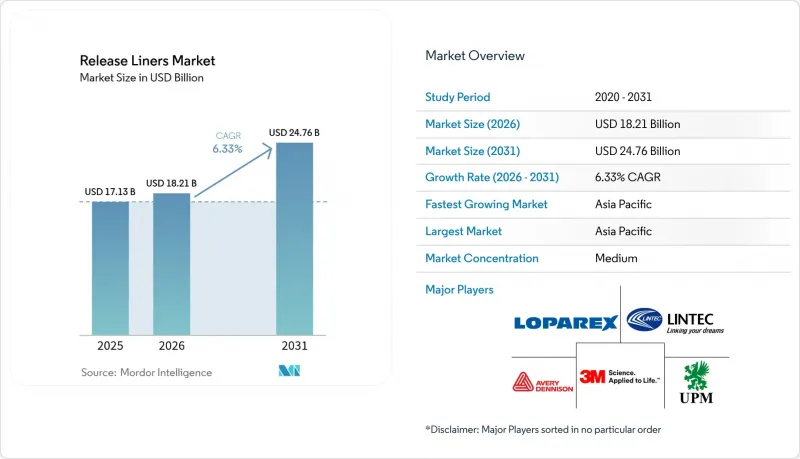
Mordor Intelligence에 의하면, 박리지 시장 규모는 2025년에 171억 3,000만 달러로 평가되었고, 2026년 182억 1,000만 달러에서 2031년까지 247억 6,000만 달러에 이를 것으로 예측되며, 예측 기간(2026-2031년) CAGR은 6.33%를 나타낼 전망입니다.
본 보고서는 기판별(점토 코팅 크라프트지, 필름 라이너 등), 이형제별(실리콘, 불소수지 등), 용도별(라벨, 그래픽 등),최종 이용 산업별(식품 및 음료, 헬스케어 및 의약품 등), 지역별(아시아태평양, 북미, 유럽, 남미, 중동 및 아프리카)로 분류되어 있습니다. 시장 예측은 금액(달러) 기준으로 제시되어 있습니다.
세계의 박리지 시장 동향 및 인사이트
식품 및 음료 업계에서 클린 라벨 포장에 대한 수요 증가
식품 및 음료 브랜드 소유주들은 표백된 기판이나 용제계 코팅을 미표백 글라신지, 수성 실리콘, 그리고 식품 직접 접촉 규정을 충족하는 퇴비화 가능한 화학 물질로 대체하고 있습니다. 린텍의 ‘내추럴 톤’ 글라신지는 형광 증백제를 배제하면서도 그라비아 인쇄의 재현성을 실현하는 최소한의 가공만 거친 종이로의 전환을 보여주는 좋은 예입니다. 기능적 성능은 현재 유분 및 습기에 대한 차단 보호 기능까지 확대되어, 접착제의 이동을 유발하지 않으면서 원재료의 투명성을 명확하게 보여줄 수 있게 되었습니다. 소매업체들이 지속가능성 평가 기준을 강화함에 따라, 추적성을 문서화할 수 있는 변환업체들은 가격 프리미엄을 확보하고 있습니다. PFAS 프리 시스템에 대한 수요는 EU에서 북미로 확대되고 있으며, 공급업체들은 고속 도포 시에도 깨끗하게 박리되는 불소 무함유 대체재를 확대해야 하는 압박을 받고 있습니다. 2024년에 식품 및 음료 부문이 29.26%의 점유율을 차지하는 가운데, 소재의 단계적 업그레이드는 전 세계 생산량에 빠르게 파급되어 공급업체의 인증 기준을 더욱 엄격하게 만들고 있습니다.
전자상거래의 급성장이 라벨 수요를 가속화
클릭 앤 콜렉트, 정기 구독, 당일 배송과 같은 모델의 보급에 따라 소포 처리량은 계속 증가하고 있습니다. 박리지는 분당 150미터를 초과하는 자동 인쇄 및 부착 라인에서 안정적인 성능을 발휘하고, 가변 데이터 바코드를 지원하며, -20℃에서 40℃에 이르는 콜드체인의 온도 변동을 견뎌야 합니다. 일관된 박리력과 웹의 평탄성은 가동 중단 시간과 부착 오류를 최소화하며, 패키지당 주문 처리 비용에 직접적인 영향을 미칩니다. 고급스러운 ‘언박싱’ 경험을 추구하는 추세는 현재 옴니채널을 통한 식료품 및 퍼스널케어 제품 배송으로도 확대되고 있으며, 촉감이 뛰어난 니스나 메탈릭 액센트를 더한 다층 라벨에 대한 수요를 높이고 있습니다. 이러한 구조의 라벨에서는 사용 시점까지 잉크의 품질을 보호하기 위해 정밀 코팅이 적용된 라이너가 필수적입니다. 따라서 박리지 시장에서는 판매량 증가와 더불어, 로봇 및 비전 검사 장비에 최적화된 고사양 종이 및 필름 기판으로의 가치 전환이 나타나고 있습니다.
박리지 폐기물 처리 과제
사용 후 라이너는 실리콘 잔류물이 표준 재활용을 방해하기 때문에 그 대부분이 매립 처분되고 있습니다. FINAT의 CELAB-Europe 컨소시엄은 2025년까지 75%의 재활용률 달성을 목표로 했지만, 그 진전은 회수 물류와 재생 섬유에 대한 최종 시장 수요에 달려 있습니다. 웨스턴 미시간 대학이 개발한 수용성 배리어층을 통해 펄프화 공정에서 실리콘 제거가 가능하지만, 공정 개조 및 베일 운송 비용 문제로 인해 상업적 도입은 여전히 제한적입니다. 사스타나 그룹의 위스콘신주 공장은 기술적 실현 가능성을 보여주고 있으나, 그 지리적 커버리지 범위는 제한적입니다. 확대 생산자 책임(EPR) 제도가 확산됨에 따라 가공업체들은 비용 증가에 직면하고 있으며, 라이너가 없는 제품이나 재사용 가능한 형태와 비교했을 때 가격 경쟁력이 약화되고 있습니다.
부문 분석
글라신은 2025년 박리지 시장 규모에서 36.74%의 점유율을 유지했으며, 비용 효율성, 표면의 매끄러움, 그리고 FDA의 식품 접촉 승인 덕분에 대량 생산되는 라벨 및 테이프 프로그램을 계속해서 뒷받침하고 있습니다. 그러나 브랜드 소유주들이 운송 시 배출량을 줄이기 위해 저평량 라이너를 지정함에 따라 성장은 둔화되고 있으며, 평방미터당 수요가 증가하는 분야에서도 총 톤수는 감소 추세를 보이고 있습니다. 폴리에틸렌 코팅 크라프트지는 내습성이 무코팅 제품보다 뛰어나기 때문에 냉장 식품 및 실외용 라벨 분야에서 점유율을 확대되고 있습니다. BO-PET 및 BOPP 필름 라이너는 셀룰로오스계 종이의 유리 전이점을 초과하는 온도에서 경화되는 전자, 항공우주, 자동차용 라미네이트 소재 분야에서 급속히 확대되고 있습니다.
‘기타’ 범주에 포함된 대체 기재가 시장을 주도하고 있습니다. 이축 연신 폴리아미드, PTFE 코팅 유리 섬유, 마이크로피브리화 셀룰로오스 복합재는 정전기 방지·박리성, 260°C 이상의 열안정성, 재펄프화성 등 다기능성을 갖추고 있습니다. 이 소재의 채택은 여전히 틈새 분야에 국한되어 있지만, 컨버터들이 이형제를 고정시키기 위해 멀티패스 코팅 라인이나 인라인 플라즈마 처리를 도입함에 따라 평균 판매 가격은 상승하고 있습니다. 글라신 공급업체들은 클린 라벨 포장을 목적으로 배리어성을 높인 다양한 제품(무표백, 메탈라이즈 가공, 탄산칼슘 충전 등)으로 이에 대응하고 있습니다. 이러한 점진적인 변화로 인해 글라신은 여전히 중요한 위치를 차지하고 있지만, 가장 빠르게 성장하는 분야는 엔지니어링 필름으로 넘어가고 있습니다.
2025년 박리지 시장에서는 실리콘계 제품이 80.65%의 점유율을 차지했습니다. 이는 범용성이 높은 경화 화학, 낮은 표면 에너지, 그리고 기반이 되는 실록산의 풍부한 공급에 힘입은 것입니다. 백금 촉매를 사용한 UV 경화형 실리콘은 경화 시간을 단축하고 1,000 m/min이라는 고속 코팅이 가능하게 함으로써 가격 경쟁력을 유지하고 있습니다. 불소수지계 이형제 시장 규모는 작지만 연평균 성장률(CAGR) 7.42%로 확대되고 있습니다. 이는 퍼플루오로화 사슬이 고온 복합재 금형이나 부식성이 강한 접착 테이프에서 필수적인 화학적 비활성 및 극히 낮은 이형력을 제공하기 때문입니다.
PFAS 화학 물질에 대한 규제 압력으로 인해 시장은 양극화가 진행되고 있습니다. 항공우주 분야용 기존의 플루오로실리콘은 수요를 유지하고 있는 반면, 포장 및 위생 분야에서는 아크릴계 또는 폴리올레핀계 박리 바니스로의 전환이 진행되고 있습니다. Hightower Products와 같은 공급업체들은 현재 점도나 앵커 수지에 따라 맞춤화된 PFAS 프리 배합을 판매하며, 깨끗한 박리와 재활용성의 균형을 맞추고 있습니다. 이에 대해 실리콘 제조업체들은 광학 필름 및 반도체 웨이퍼로의 실록산 이동을 최소화하는 ‘이동 제어 등급’ 제품으로 대응하고 있습니다. 경쟁 우위는 ppm 미만의 이동을 검증하고, 고객의 인증 절차를 신속하게 진행할 수 있는 분석 능력에 달려 있습니다.
지역별 분석
아시아태평양은 2025년에 42.40%의 시장 점유율을 차지하며 선도적인 위치를 차지했으며, 이 지역의 펄프에서 코팅에 이르는 수직 통합형 공급망과 확대되는 중산층의 소비에 힘입어 2031년까지 연평균 성장률(CAGR) 7.31%를 나타낼 것으로 예측됩니다. 중국은 전자상거래 주문 처리 센터 주변에서 포장 가공업체들이 생산 능력을 확대하고 있어 증가분의 대부분을 차지하고 있습니다. 한편, 일본과 한국은 반도체 팹 및 배터리 셀 조립용 고정밀 라이너를 전문으로 하고 있습니다. 또한, 재생에너지에 대한 정부의 지원책으로 인해 풍력 발전용 블레이드 제조에 사용되는 프리프레그 라이너에 대한 수요도 증가하고 있습니다.
북미에서는 항공우주, 의료기기 및 패스트푸드점 포장 분야에서 여전히 대규모 도입 기반이 유지되고 있습니다. 미국은 FDA 승인을 받은 의료용 테이프 개발의 거점이며, 미네소타주, 매사추세츠주, 캘리포니아주 주변의 산업 집적지의 혜택을 받고 있습니다. 캐나다는 풍부한 산림 자원을 활용하여 소매업체의 지속가능성 요건에 부합하는 FSC 인증 글라신지 및 클레이코트 크라프트지의 보급을 추진하고 있습니다. 멕시코의 니어쇼어링 붐에 힘입어 다국적 기업들은 자동차 및 가전제품 공장 근처에 RFID, 라벨, 필름 코팅 시설을 함께 설치하고 있습니다. 에이버리 데니슨의 1억 달러 투자도 이러한 추세를 뒷받침합니다.
유럽은 여전히 규제 면에서 선구자적 역할을 하고 있으며, 사용 후 라이너의 재활용률을 입증할 수 있는 공급업체에 보상을 제공하는 순환 경제 목표를 추진하고 있습니다. 독일은 자동차 경량화와 관련된 산업용 테이프 혁신을 주도하는 한편, 이탈리아와 프랑스는 소량 생산이지만 고품질 마감이 요구되는 라벨에 고급 라이너가 필요한 명품 포장 시장을 활용하고 있습니다. 북유럽 국가들은 PFAS의 단계적 폐지를 의무화하고 바이오 대체재를 장려함으로써 전 세계 소재 기준에 영향을 미치고 있습니다. 동유럽은 EU 단일 시장에 공급하는 비용 효율적인 생산 회랑 역할을 하고 있지만, 지정학적 긴장으로 인해 원자재 물류가 때때로 혼란을 겪기도 합니다.
기타 혜택 :
- 엑셀 형식 시장 예측(ME) 시트
- 3개월간 애널리스트 지원
자주 묻는 질문
목차
제1장 서론
제2장 조사 방법
제3장 주요 요약
제4장 시장 구도
제5장 시장 규모 및 성장 예측
제6장 경쟁 구도
제7장 시장 기회 및 향후 전망
AJY 26.09.07According to Mordor Intelligence, the release liners market size was valued at USD 17.13 billion in 2025 and estimated to grow from USD 18.21 billion in 2026 to reach USD 24.76 billion by 2031, at a CAGR of 6.33% during the forecast period (2026-2031).
This report is Segmented by Substrate (Clay-Coated Kraft Paper, Filmic Liners, and, More), Release Agent (Silicone, Fluoropolymer, and More), Application (Labels, Graphics, and More), End-Use Industry (Food and Beverage, Healthcare and Pharmaceuticals, and More), and Geography (Asia-Pacific, North America, Europe, South America, Middle East and Africa). The Market Forecasts are Provided in Terms of Value (USD).
Global Release Liners Market Trends and Insights
Growing Demand for Clean-Label Packaging in Food and Beverage
Food and beverage brand owners are replacing bleached substrates and solvent-based coatings with unbleached glassine, water-borne silicones, and compostable chemistries that meet direct-food-contact rules. LINTEC's natural-tone glassine illustrates the pivot toward minimally processed papers that enable gravure print fidelity while eliminating optical brighteners . Functional performance now extends to barrier protection against grease and moisture, permitting clear ingredient transparency without adhesive migration. Converters able to document traceability capture price premiums as retailers tighten sustainability scorecards. Demand for PFAS-free systems is spreading from the EU to North America, pushing suppliers to scale fluorine-free alternatives that still release cleanly at high application speeds. With food and beverage holding 29.26% share in 2024, iterative material upgrades ripple quickly across global volumes and reinforce supplier qualification hurdles.
E-commerce Boom Accelerating Label Demand
Parcel volumes continue rising with click-and-collect, subscription, and same-day delivery models. Release liners must perform across automated print-apply lines that exceed 150 m/min, handle variable-data barcoding, and endure cold-chain swings from -20 °C to 40 °C. Consistent release force and web flatness minimize downtime and misapplies, directly influencing fulfillment cost per package. Premium unboxing trends now extend to omnichannel grocery and personal-care shipments, boosting demand for multi-layer labels with tactile varnishes and metallic accents. These constructions rely on precision-coated liners to protect ink integrity until point-of-use. The release liner market, therefore, sees volume gains plus a value shift toward high-spec paper and film backings optimized for robotics and vision inspection equipment.
Release-Liner Waste Disposal Challenges
Used liner is largely landfilled because silicone residues impede standard recycling. FINAT's CELAB-Europe consortium aims for 75% recycling by 2025, but progress hinges on collection logistics and end-market demand for recovered fibers. Western Michigan University's water-soluble barrier layer enables silicone removal during pulping, yet commercial adoption remains limited by process retrofits and bale transport costs. Sustana Group's Wisconsin plant shows technical feasibility, but its geographic reach is narrow. As Extended Producer Responsibility schemes spread, converters face escalating fees that erode price competitiveness versus linerless or reusable formats.
Other drivers and restraints analyzed in the detailed report include:
- Uptake of Premium Hygiene and Medical Tapes
- Aerospace and Wind Prepregs Needing Specialty Liners
- Volatile Pulp and Silicone Raw-Material Prices
For complete list of drivers and restraints, kindly check the Table Of Contents.
Segment Analysis
Glassine retained 36.74% share of release liner market size in 2025 and continues to anchor high-volume label and tape programs thanks to cost efficiency, surface smoothness, and FDA food-contact clearances. Yet growth moderates as brand owners specify lower-grammage liners to cut freight emissions, eroding tonnage even where square-meter demand rises. Polyethylene-coated kraft papers are gaining in chilled-food and outdoor labeling where moisture resistance outperforms uncoated grades. Filmic liners made from BO-PET and BOPP are expanding quickly in electronics, aerospace, and automotive laminates that cure at temperatures beyond the glass-transition point of cellulosic papers.
Alternative substrates inside the "Others" category are setting the pace: bi-axially oriented polyamide, PTFE-coated glass cloth, and micro-fibrillated cellulose composites deliver multi-functional properties such as anti-static release, thermal stability above 260 °C, and repulpability. Adoption remains niche yet lifts average selling price because converters implement multi-pass coating lines and inline plasma treatments to anchor release agents. Glassine suppliers are responding with barrier-enhanced variations-unbleached, metallized, or calcium-carbonate-filled-aimed at clean-label packaging. These iterative shifts ensure glassine stays relevant while ceding the fastest growth slices to engineered films.
Silicone systems controlled 80.65% of the 2025 release liner market, supported by versatile cure chemistries, low surface energy, and abundant supply of base siloxanes. Platinum-catalyzed UV silicones shorten cure windows, enabling high-speed 1,000 m/min coating that sustains price competitiveness. The release liner market size for fluoropolymer-based agents is smaller yet advancing at 7.42% CAGR because perfluorinated chains deliver chemical inertness and ultra-low release force vital in high-temperature composite molds and aggressive adhesive tapes.
Regulatory pressure on PFAS chemicals is fostering a split: legacy fluoro-silicones for aerospace retain demand, while packaging and hygiene sectors shift toward acrylic or polyolefin release varnishes. Suppliers such as Hightower Products now market PFAS-free formulations customized by viscosity and anchorage resins, balancing clean release with recyclability. Silicone producers answer with controlled-migration grades that minimize siloxane transfer onto optical films and semiconductor wafers. Competitive advantage hinges on analytical capability to verify sub-ppm migration and accelerate customer qualification.
Complete Report Scope:
- By Substrate
- Glassine / Super-calendered Paper
- Polyethylene-coated Paper
- Filmic Liners
- Clay-coated Kraft Paper
- Others (Poly-coated Biaxially Oriented Polyethylene Terephthalate (BO-PET) film, etc.)
- By Release Agent
- Silicone
- Fluoropolymer
- Non-silicone (Acrylic, Others)
- By Application
- Labels
- Graphics
- Tapes
- Medical
- Industrial
- Other Applications (Hydiene Products, etc.)
- By End-use Industry
- Food and Beverage
- Healthcare and Pharmaceuticals
- Personal Care and Cosmetics
- Automotive and Transportation
- Electronics
- Building and Construction
- Other End-user Industries (Agriculture, etc.)
- By Geography
- Asia-Pacific
- China
- Japan
- India
- South Korea
- ASEAN Countries
- Rest of Asia-Pacific
- North America
- United States
- Canada
- Mexico
- Europe
- Germany
- United Kingdom
- France
- Italy
- Spain
- Russia
- NORDIC Countries
- Rest of Europe
- South America
- Brazil
- Argentina
- Rest of South America
- Middle East and Africa
- Saudi Arabia
- South Africa
- Rest of Middle East and Africa
- Asia-Pacific
Geography Analysis
Asia-Pacific dominated with 42.40% market share in 2025 and is projected to grow at a 7.31% CAGR through 2031, underpinned by the region's vertically integrated pulp-to-coating supply chain and expanding middle-class consumption. China accounts for the bulk of incremental tonnage as packaging converters ramp capacity near e-commerce fulfilment hubs, while Japan and South Korea specialize in high-precision liners for semiconductor fabs and battery cell assembly. Government incentives for renewable energy also lift demand for prepreg liners in wind-blade production.
North America preserves a sizeable installed base in aerospace, medical device, and quick-service restaurant packaging. The United States is the hub for FDA-cleared medical tape development, benefiting from clusters around Minnesota, Massachusetts, and California. Canada leverages abundant forest resources to promote FSC-certified glassine and clay-coated kraft, aligning with retailer sustainability mandates. Mexico's near-shoring boom encourages multinationals to co-locate RFID, label, and filmic coating facilities close to automotive and consumer-electronics plants; Avery Dennison's USD 100 million investment testifies to this momentum.
Europe remains the regulatory vanguard, driving circularity targets that reward suppliers able to certify post-consumer liner recycling rates. Germany spearheads industrial tape innovation linked to automotive lightweighting, whereas Italy and France capitalize on luxury packaging where small-batch, high-finish labels command premium liners. Nordic countries influence global material standards by mandating PFAS phase-outs and promoting bio-based alternatives. Eastern Europe serves as a cost-effective production corridor supplying the EU single market, though geopolitical tensions occasionally disrupt feedstock logistics.
- 3M
- Ahlstrom
- Avery Dennison Corporation
- Dow
- Eastman Chemical Company
- Elkem ASA
- Felix Schoeller
- Gascogne Group
- Laufenberg GmbH
- LINTEC Corporation
- Loparex
- Mativ Holdings, Inc.
- Mitsubishi Chemical Group Corporation.
- Mondi
- Polyplex
- Sappi Ltd
- SJA Film Technologies Ltd.
- Techlan
- The Griff Network
- UPM
Additional Benefits:
- The market estimate (ME) sheet in Excel format
- 3 months of analyst support
TABLE OF CONTENTS
1 Introduction
- 1.1 Study Assumptions and Market Definition
- 1.2 Scope of the Study
2 Research Methodology
3 Executive Summary
4 Market Landscape
- 4.1 Market Overview
- 4.2 Market Drivers
- 4.2.1 Growing Demand for Clean-label Packaging in Food and Beverage
- 4.2.2 E-commerce Boom Accelerating Label Demand
- 4.2.3 Uptake of Premium Hygiene and Medical Tapes
- 4.2.4 Aerospace and Wind Prepregs Needing Specialty Liners
- 4.2.5 Electric Vehicles Battery Cell Electrode Tapes Adoption
- 4.3 Market Restraints
- 4.3.1 Release-liner Waste Disposal Challenges
- 4.3.2 Volatile Pulp and Silicone Raw-material Prices
- 4.3.3 Shift Toward Liner-less Labelling Systems
- 4.4 Value Chain Analysis
- 4.5 Porter's Five Forces
- 4.5.1 Bargaining Power of Suppliers
- 4.5.2 Bargaining Power of Buyers
- 4.5.3 Threat of New Entrants
- 4.5.4 Threat of Substitutes
- 4.5.5 Degree of Competition
5 Market Size and Growth Forecasts (Value)
- 5.1 By Substrate
- 5.1.1 Glassine / Super-calendered Paper
- 5.1.2 Polyethylene-coated Paper
- 5.1.3 Filmic Liners
- 5.1.4 Clay-coated Kraft Paper
- 5.1.5 Others (Poly-coated Biaxially Oriented Polyethylene Terephthalate (BO-PET) film, etc.)
- 5.2 By Release Agent
- 5.2.1 Silicone
- 5.2.2 Fluoropolymer
- 5.2.3 Non-silicone (Acrylic, Others)
- 5.3 By Application
- 5.3.1 Labels
- 5.3.2 Graphics
- 5.3.3 Tapes
- 5.3.4 Medical
- 5.3.5 Industrial
- 5.3.6 Other Applications (Hydiene Products, etc.)
- 5.4 By End-use Industry
- 5.4.1 Food and Beverage
- 5.4.2 Healthcare and Pharmaceuticals
- 5.4.3 Personal Care and Cosmetics
- 5.4.4 Automotive and Transportation
- 5.4.5 Electronics
- 5.4.6 Building and Construction
- 5.4.7 Other End-user Industries (Agriculture, etc.)
- 5.5 By Geography
- 5.5.1 Asia-Pacific
- 5.5.1.1 China
- 5.5.1.2 Japan
- 5.5.1.3 India
- 5.5.1.4 South Korea
- 5.5.1.5 ASEAN Countries
- 5.5.1.6 Rest of Asia-Pacific
- 5.5.2 North America
- 5.5.2.1 United States
- 5.5.2.2 Canada
- 5.5.2.3 Mexico
- 5.5.3 Europe
- 5.5.3.1 Germany
- 5.5.3.2 United Kingdom
- 5.5.3.3 France
- 5.5.3.4 Italy
- 5.5.3.5 Spain
- 5.5.3.6 Russia
- 5.5.3.7 NORDIC Countries
- 5.5.3.8 Rest of Europe
- 5.5.4 South America
- 5.5.4.1 Brazil
- 5.5.4.2 Argentina
- 5.5.4.3 Rest of South America
- 5.5.5 Middle East and Africa
- 5.5.5.1 Saudi Arabia
- 5.5.5.2 South Africa
- 5.5.5.3 Rest of Middle East and Africa
- 5.5.1 Asia-Pacific
6 Competitive Landscape
- 6.1 Market Concentration
- 6.2 Strategic Moves
- 6.3 Market Share(%)/Ranking Analysis
- 6.4 Company Profiles (includes Global level Overview, Market level overview, Core Segments, Financials as available, Strategic Information, Market Rank/Share for key companies, Products and Services, and Recent Developments)
- 6.4.1 3M
- 6.4.2 Ahlstrom
- 6.4.3 Avery Dennison Corporation
- 6.4.4 Dow
- 6.4.5 Eastman Chemical Company
- 6.4.6 Elkem ASA
- 6.4.7 Felix Schoeller
- 6.4.8 Gascogne Group
- 6.4.9 Laufenberg GmbH
- 6.4.10 LINTEC Corporation
- 6.4.11 Loparex
- 6.4.12 Mativ Holdings, Inc.
- 6.4.13 Mitsubishi Chemical Group Corporation.
- 6.4.14 Mondi
- 6.4.15 Polyplex
- 6.4.16 Sappi Ltd
- 6.4.17 SJA Film Technologies Ltd.
- 6.4.18 Techlan
- 6.4.19 The Griff Network
- 6.4.20 UPM
7 Market Opportunities and Future Outlook
- 7.1 White-space and Unmet-need Assessment
- 7.2 Incorporation of Nano-coatings into Release Liners for Enhanced Release Properties