

|
시장보고서
상품코드
2122373
첨단 기능성 소재 : 시장 점유율 분석, 업계 동향과 통계, 성장 예측(2026-2031년)Advanced Functional Materials - Market Share Analysis, Industry Trends & Statistics, Growth Forecasts (2026 - 2031) |
||||||
 Mordor Intelligence
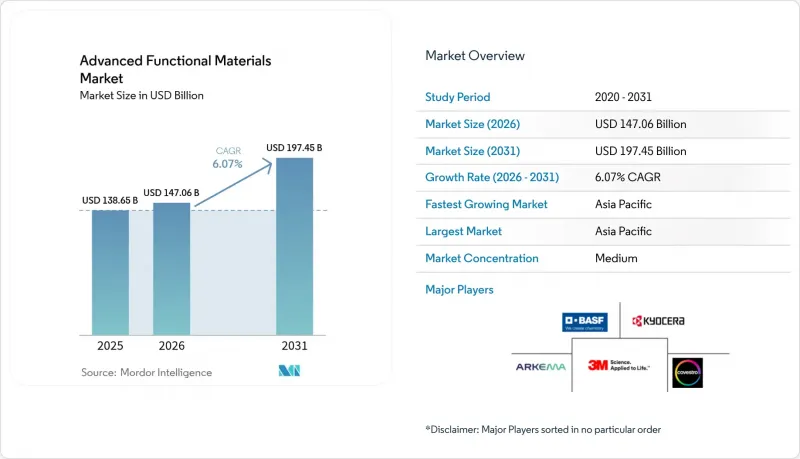
Mordor Intelligence에 의하면, 2026년 첨단 기능성 소재 시장 규모는 1,470억 6,000만 달러로 추정되며, 2025년 1,386억 5,000만 달러에서 2031년에는 1,974억 5,000만 달러에 달할 것으로 예측됩니다.
또한, 2026-2031년 연평균 성장률(CAGR) 6.07%를 기록할 전망입니다.
본 보고서에서는 산업을 소재 유형별(세라믹, 복합재료, 전도성 폴리머, 나노 소재, 기타), 최종 사용자 산업별(전기 및 전자기기, 자동차, 헬스케어, 항공우주 및 방위, 기타), 지역별(아시아태평양, 북미, 유럽, 남미, 중동 및 아프리카)로 분류하고 있습니다. 시장 전망은 금액(달러) 기준으로 제시되어 있습니다.
세계 첨단 기능성 소재 시장 동향 및 인사이트
가전제품의 소형화에 대한 수요 증가
스마트폰, 노트북, 웨어러블 기기, AI 엣지 디바이스는 모두 더 얇은 상호 연결, 저손실 기판, 열 손상 없이 높은 전력 밀도를 견딜 수 있는 전도성 페이스트를 필요로 합니다. 미네소타 대학에서 개발 중인 투명 전도성 산화물은 전자 이동도를 높이는 동시에 가시광선의 90%를 투과할 수 있어 차세대 OLED 및 마이크로 LED 디스플레이에 매우 중요합니다. 홍콩대학교가 개발한 유기 전기화학 트랜지스터는 머신러닝 기능을 텍스타일 등급 센서에 통합하고 전력 소비를 80% 줄임으로써 의료용 웨어러블 기기의 배터리 수명을 연장하고 있습니다. MXene 시트는 현재 35,000S/cm의 전도도를 보이며, 고주파 전자기 노이즈의 99.9%를 차단함으로써 5G 휴대폰 및 전기자동차 내부의 신호 무결성 문제를 해결하고 있습니다. 이러한 획기적인 기술 발전은 OEM의 설계 폭을 넓히고, 첨단 기능성 소재 시장에서의 조달 지출을 촉진하고 있습니다.
경량화를 목표로 한 자동차 및 항공우주 부문에서의 활용 확대
자동차 및 항공기 제조업체들은 중량 감소를 목표로 하고 있으며, 이는 항속 거리 연장 및 수명 주기 동안의 배출량 감소로 직결됩니다. 오크리지 국립연구소의 나노파이버 주입 공정을 통해 탄소섬유의 인장 강도가 50% 향상되고 인성도 2배로 증가하여, 부품은 충돌 하중이나 낙뢰를 견딜 수 있습니다. 현대자동차그룹과 토레이(Toray Industries Inc.)는 전기 SUV 배터리 팩의 무게를 40kg 줄이는 탄소섬유 강화 폴리머 하우징을 공동 개발하여, 실제 주행 거리 500km라는 목표 달성에 기여하고 있습니다. 한국과학기술연구원(KIST)의 고결정성 탄소나노튜브는 구리 코일 권선을 대체함으로써 모터의 출력 밀도를 20% 향상시킵니다. 형상 기억 합금과 압전 액추에이터는 공기역학적 제어면을 개선하여 좁은 동체 항공기의 연료 소비량을 줄입니다. 미국 에너지부의 로드맵에서는 2030년까지 소형 승용차의 경량화를 25% 달성할 것을 요구하고 있으며, 이는 첨단 기능성 소재 시장공급업체들에게 지속적인 수요를 견인할 것임을 시사합니다.
높은 생산 비용과 핵심 원료 부족
국제에너지기구(IEA)의 모델에 따르면, 희토류 산화물 수요는 2040년까지 169kt로 증가할 것으로 예측되지만, 정제 능력의 77%가 한 국가에 집중되어 있어 가격 급등을 초래하고, 자석, 형광체, 배터리 첨가제의 이익률 목표에 부정적인 영향을 미치고 있습니다. 미국 국토안보부는 규제 중복으로 인해 신규 광산 개발이 최대 8년 지연되고 있다고 지적하고 있으며, 이로 인해 판매 계약과 원료 공급량 사이에 불일치가 발생하고 있습니다. 유럽의 ‘중요 원료법’은 34가지 유형의 원소를 대상으로 하고 있으며, 많은 제련소가 아직 달성할 수 없는 재활용 할당량을 부과하고 있어 생산자들은 배합을 재설계하거나 벌금을 납부해야 하는 상황에 처해 있습니다. 또한, 일부 OECD 회원국에서 에너지 현물 가격이 80달러/MWh를 초과하고 있는 점도 소성 공정에 1,600°C가 필요한 세라믹 가마 운영자들을 압박하여 비용 부담을 가중시키고 있습니다.
부문별 분석
세라믹은 항공우주용 엔진 라이닝, 5G 필터, 이식형 바이오세라믹을 배경으로 2025년 첨단 기능성 소재 시장 매출의 31.78%를 차지했습니다. 한편, 나노 소재는 MXene, 그래핀,탄소나노튜브 제조 시설에 대한 지속적인 설비 투자 확대에 힘입어 7.18%라는 높은 성장률을 기록하고 있습니다. 하프늄 카바이드 등의 초고온 세라믹은 4,000°C의 재진입 열을 견딜 수 있어, 지금까지 실현 불가능했던 극초음속 글라이더의 개발을 가능하게 하고 있습니다. GE 에어로스페이스사의 세라믹 매트릭스 복합재료는 니켈 합금보다 300°C 높은 온도에서 작동하며, 제트 엔진의 연료 효율을 2% 향상시켜 수명 주기 전반에 걸쳐 항공사에 트윈 아일 항공기 1대당 100만 달러의 비용 절감을 가져다줍니다.
복합재료 및 전도성 폴리머 부문에서도 유망한 개발 프로젝트가 계속되고 있습니다. 츠쿠바 대학이 개발한 ‘골든 폴리아닐린’ 필름은 금속과 같은 광택을 가지면서도 폴리머의 유연성을 유지하고 있어, 폴더블 디스플레이에 큰 이점이 됩니다. 면내 전도율이 10S/cm인 2차원 폴리머 시트는 데이터센터 랙 내부에서 전자기 차폐막으로 기능합니다. 이러한 전개로 제품 포트폴리오가 다양화되며, 고주파 용도용 첨단 기능성 소재 시장에서 공급 기업의 협상력이 강화됩니다.
지역별 분석
아시아태평양은 2025년 매출의 47.62%를 차지하고 있으며, 정책적 인센티브, 잘 갖춰진 제조 클러스터, 원료 접근성 등에 힘입어 연평균 성장률(CAGR) 7.03%로 확대되고 있습니다. 중국의 ‘제14차 5개년 계획’에서는 특수 소재에 280억 달러가 투입되는 한편, 일본에서는 ‘GX 경제 전환 채권’을 발행하여 탄소 중립을 향한 공정 개선을 지원하고 있습니다. 이러한 정책으로 인해 규모 확대 주기가 단축되어 현지 기업들이 첨단 기능성 소재 시장의 중심적인 존재로 부상하고 있습니다.
북미에서는 ‘CHIPS and Science Act’를 활용하고 있습니다. 이는 527억 달러 규모의 지원책으로, 중요한 기판 및 봉지재에 대해 국내 조달 비율 기준을 의무화하고 있습니다. 캐나다는 양극용 니켈과 코발트의 정제 기술을 추진하고 있으며, 멕시코는 전기차 조립의 니어쇼어링을 유치하여 지역 공급망의 기반을 다지고 있습니다.
유럽에서는 ‘넷 제로 산업법’과 PFAS 규제를 결합하여 기존 기업들이 불소 엘라스토머를 실리콘이나 열가소성 올레핀 혼합물로 대체하도록 장려하고 있습니다.
기타 혜택
- 엑셀 형식 시장 예측(ME) 시트
- 3개월간의 애널리스트 지원
자주 묻는 질문
목차
제1장 서론
제2장 조사 방법
제3장 주요 요약
제4장 시장 구도
제5장 시장 규모와 성장 예측
제6장 경쟁 구도
제7장 시장 기회와 향후 전망
LSH 26.09.04According to Mordor Intelligence, advanced functional materials market size in 2026 is estimated at USD 147.06 billion, growing from 2025 value of USD 138.65 billion with 2031 projections showing USD 197.45 billion, growing at 6.07% CAGR over 2026-2031.
This report Segments the Industry by Material Type (Ceramics, Composites, Conductive Polymers, Nanomaterials, and More), End-User Industry (Electrical and Electronics, Automotive, Healthcare, Aerospace and Defense, and More), and Geography (Asia-Pacific, North America, Europe, South America, and Middle-East and Africa). The Market Forecasts are Provided in Terms of Value (USD).
Global Advanced Functional Materials Market Trends and Insights
Rising Demand for Miniaturisation in Consumer Electronics
Smartphones, laptops, wearables, and AI edge devices all need thinner interconnects, lower-loss substrates, and conductive pastes that tolerate higher power densities without heat damage. Transparent conducting oxides under development at the University of Minnesota boost electron mobility while letting 90% of visible light pass, pivotal for next-generation OLED and micro-LED displays. Organic electrochemical transistors engineered by the University of Hong Kong integrate machine-learning capability into textile-grade sensors and cut power draw by 80%, which lengthens battery life in medical wearables. MXene sheets now register 35,000 S/cm conductivity and block 99.9% of high-frequency electromagnetic noise, resolving signal-integrity problems inside 5 G handsets and electric vehicles. Collectively, these breakthroughs enlarge design windows for OEMs and reinforce procurement spending on the advanced functional materials market.
Increasing Usage in Automotive and Aerospace for Lightweighting
Automakers and aircraft OEMs target weight cuts that translate directly into range extension and lower lifecycle emissions. Oak Ridge National Laboratory's nanofiber infusion process lifts carbon-fiber tensile strength by 50% while doubling toughness so that components withstand crash loads and lightning strikes. Hyundai Motor Group and Toray Industries co-develop carbon-fiber-reinforced polymer housings that shed 40 kg from an electric SUV's battery pack, helping meet a 500 km real-world range goal. Korea Institute of Science and Technology's high-crystallinity carbon nanotubes replace copper coil windings to raise motor power density by 20%. Shape-memory alloys and piezoelectric actuators improve aerodynamic control surfaces, lowering fuel burn in narrow-body aircraft. United States Department of Energy roadmaps call for 25% lightweighting of light-duty vehicles by 2030, signaling a durable pull for advanced functional materials market suppliers.
High Production Costs and Critical Raw Material Scarcity
International Energy Agency models show demand for rare-earth oxides rising to 169 kt by 2040 while 77% of refining capacity remains in one country, prompting price jumps that hurt margin targets for magnets, phosphors, and battery additives. The United States Department of Homeland Security flags regulatory overlap that delays new mines by up to eight years, creating a mismatch between offtake agreements and feedstock availability. Europe's Critical Raw Materials Act covers 34 elements and imposes recycling quotas many smelters cannot yet meet, compelling producers to redesign formulations or pay penalties. Spot energy prices above USD 80/MWh in several OECD economies also squeeze ceramic-kiln operators whose firing steps need 1,600 °C, adding cost pressures.
Other drivers and restraints analyzed in the detailed report include:
- Growth of Renewable-Energy Storage and Conversion Solutions
- Expanding Healthcare and Biomedical Applications
- Complex, Evolving Regulatory Compliance
For complete list of drivers and restraints, kindly check the Table Of Contents.
Segment Analysis
Ceramics commanded 31.78% of 2025 revenue within the advanced functional materials market on the back of aerospace engine linings, 5 G filters, and implantable bioceramics. Nanomaterials, however, headline growth at 7.18%, supported by ongoing capital expansion at MXene, graphene, and carbon-nanotube fabs. Ultra-high-temperature ceramics such as hafnium carbide tolerate 4,000 °C re-entry heat, enabling hypersonic gliders that were previously infeasible. Ceramic-matrix composites from GE Aerospace run 300 °C hotter than nickel alloys, raising jet-engine fuel efficiency by 2% and saving airlines USD 1 million per twin-aisle unit over the life cycle.
Composites and conductive polymers maintain respectable pipelines. Golden polyaniline films from the University of Tsukuba reach metal-like luster yet keep polymer flexibility, a boon for foldable screens. Two-dimensional polymer sheets with 10 S/cm in-plane conductivity supply electromagnetic shielding inside data-center racks. These expansions diversify the portfolio and strengthen supplier bargaining power in the advanced functional materials market size for high-frequency applications.
Complete Report Scope:
- By Material Type
- Ceramics
- Composites
- Conductive Polymers
- Nanomaterials
- Energy Materials
- Other Types
- By End-user Industry
- Electrical and Electronics
- Automotive
- Healthcare
- Aerospace and Defence
- Energy and Power (incl. Chemical)
- Other End-user Industries
- By Geography
- Asia-Pacific
- China
- India
- Japan
- South Korea
- Rest of Asia-Pacific
- North America
- United States
- Canada
- Mexico
- Europe
- Germany
- United Kingdom
- France
- Italy
- Rest of Europe
- South America
- Brazil
- Argentina
- Rest of South America
- Middle-East and Africa
- Saudi Arabia
- South Africa
- Rest of Middle-East and Africa
- Asia-Pacific
Geography Analysis
Asia-Pacific generated 47.62% of 2025 turnover and is expanding at 7.03% CAGR thanks to policy incentives, deep manufacturing clusters, and raw-material access. China's 14th Five-Year Plan funnels USD 28 billion into specialty materials, while Japan issues GX Economy Transition Bonds to subsidize net-zero process upgrades. These programs shorten scale-up cycles and place local firms at the center of the advanced functional materials market.
North America leverages the CHIPS and Science Act, a USD 52.7 billion package that mandates domestic content thresholds for critical substrates and encapsulants. Canada advances cathode-grade nickel and cobalt refining, while Mexico attracts EV assembly nearshoring, anchoring regional supply chains.
Europe couples the Net-Zero Industry Act with PFAS curbs, motivating incumbents to substitute fluoro-elastomers with silicone and thermoplastic olefin blends.
- 3M
- Arkema
- BASF
- CeramTec GmbH
- Covestro AG
- Dow
- Evonik Industries AG
- Hexcel Corporation
- Huntsman International LLC
- JCBL Group
- Kyocera Corporation
- LG Chem
- Morgan Advanced Materials
- Resonac Holdings Corporation
- SGL Carbon
- Sumitomo Chemical Co., Ltd.
- Mitsubishi Chemical Group Corporation
- TORAY INDUSTRIES, INC.
Additional Benefits:
- The market estimate (ME) sheet in Excel format
- 3 months of analyst support
TABLE OF CONTENTS
1 Introduction
- 1.1 Study Assumptions and Market Definition
- 1.2 Scope of the Study
2 Research Methodology
3 Executive Summary
4 Market Landscape
- 4.1 Market Overview
- 4.2 Market Drivers
- 4.2.1 Rising Demand for Miniaturisation in Consumer Electronics
- 4.2.2 Increasing Usage in Automotive and Aerospace for Lightweighting
- 4.2.3 Growth of Renewable-Energy Storage and Conversion Solutions
- 4.2.4 Expanding Healthcare and Biomedical Applications
- 4.2.5 Green Public Procurement Mandates for Low-Carbon Materials
- 4.3 Market Restraints
- 4.3.1 High Production Costs and Critical Raw Material Scarcity
- 4.3.2 Complex, Evolving Regulatory Compliance
- 4.3.3 Skilled-Labour Bottlenecks in Advanced-Materials Processing
- 4.4 Value Chain Analysis
- 4.5 Porter's Five Forces
- 4.5.1 Bargaining Power of Suppliers
- 4.5.2 Bargaining Power of Buyers
- 4.5.3 Threat of New Entrants
- 4.5.4 Threat of Substitutes
- 4.5.5 Degree of Competition
5 Market Size and Growth Forecasts (Value)
- 5.1 By Material Type
- 5.1.1 Ceramics
- 5.1.2 Composites
- 5.1.3 Conductive Polymers
- 5.1.4 Nanomaterials
- 5.1.5 Energy Materials
- 5.1.6 Other Types
- 5.2 By End-user Industry
- 5.2.1 Electrical and Electronics
- 5.2.2 Automotive
- 5.2.3 Healthcare
- 5.2.4 Aerospace and Defence
- 5.2.5 Energy and Power (incl. Chemical)
- 5.2.6 Other End-user Industries
- 5.3 By Geography
- 5.3.1 Asia-Pacific
- 5.3.1.1 China
- 5.3.1.2 India
- 5.3.1.3 Japan
- 5.3.1.4 South Korea
- 5.3.1.5 Rest of Asia-Pacific
- 5.3.2 North America
- 5.3.2.1 United States
- 5.3.2.2 Canada
- 5.3.2.3 Mexico
- 5.3.3 Europe
- 5.3.3.1 Germany
- 5.3.3.2 United Kingdom
- 5.3.3.3 France
- 5.3.3.4 Italy
- 5.3.3.5 Rest of Europe
- 5.3.4 South America
- 5.3.4.1 Brazil
- 5.3.4.2 Argentina
- 5.3.4.3 Rest of South America
- 5.3.5 Middle-East and Africa
- 5.3.5.1 Saudi Arabia
- 5.3.5.2 South Africa
- 5.3.5.3 Rest of Middle-East and Africa
- 5.3.1 Asia-Pacific
6 Competitive Landscape
- 6.1 Market Concentration
- 6.2 Strategic Moves
- 6.3 Market Share(%)/Ranking Analysis
- 6.4 Company Profiles (includes Global-level Overview, Market-level Overview, Core Segments, Financials, Strategic Information, Market Rank/Share, Products and Services, Recent Developments)
- 6.4.1 3M
- 6.4.2 Arkema
- 6.4.3 BASF
- 6.4.4 CeramTec GmbH
- 6.4.5 Covestro AG
- 6.4.6 Dow
- 6.4.7 Evonik Industries AG
- 6.4.8 Hexcel Corporation
- 6.4.9 Huntsman International LLC
- 6.4.10 JCBL Group
- 6.4.11 Kyocera Corporation
- 6.4.12 LG Chem
- 6.4.13 Morgan Advanced Materials
- 6.4.14 Resonac Holdings Corporation
- 6.4.15 SGL Carbon
- 6.4.16 Sumitomo Chemical Co., Ltd.
- 6.4.17 Mitsubishi Chemical Group Corporation
- 6.4.18 TORAY INDUSTRIES, INC.
7 Market Opportunities and Future Outlook
- 7.1 White-space and Unmet-need Assessment


