|
시장보고서
상품코드
2122375
유기산 : 시장 점유율 분석, 업계 동향과 통계, 성장 예측(2026-2031년)Organic Acids - Market Share Analysis, Industry Trends & Statistics, Growth Forecasts (2026 - 2031) |
||||||
 Mordor Intelligence
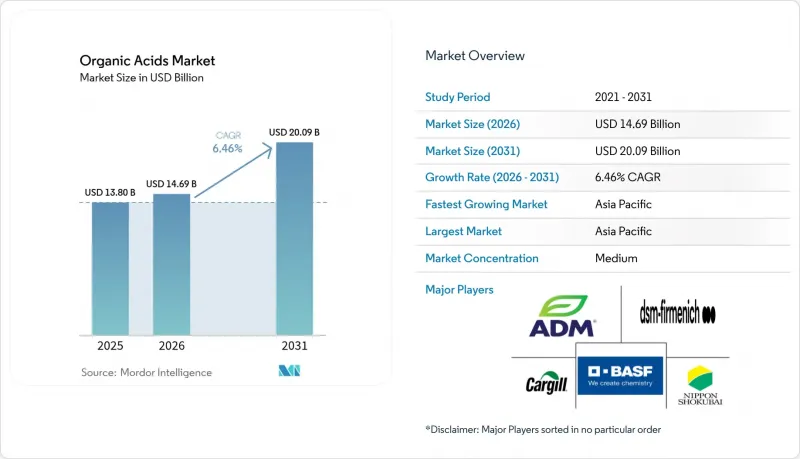
Mordor Intelligence에 의하면, 2026년 유기산 시장 규모는 146억 9,000만 달러로 추정되며, 2025년 138억 달러에서 2031년에는 200억 9,000만 달러에 달할 것으로 예측됩니다.
또한, 2026-2031년 연평균 성장률(CAGR)은 6.46%를 나타낼 전망입니다. 이러한 성장은 주로 석유화학 방식에서 바이오 발효 공정으로의 현저한 전환과 더불어, 식품, 폴리머, 제약 각 부문에서 클린 라벨 제품에 대한 수요 증가에 의해 주도되고 있습니다.
본 보고서는 유형별(아세트산, 구연산, 기타), 원료별(바이오 유래, 석유화학 유래, 하이브리드·부산물 유래), 용도별(식음료, 동물사료·영양, 기타), 형태별(액체, 건조/결정/분말),지역별(북미, 남미, 유럽, 중동 및 아프리카, 아시아태평양)로 분류되어 있습니다. 시장 전망은 금액(달러)과 수량(개)으로 제시되어 있습니다.
세계 유기산 시장 동향 및 인사이트
태양전지용 EVA 필름용 비닐아세테이트 모노머(VAM) 제조에 사용되는 아세트산의 급속한 보급
태양광 발전 산업의 급속한 성장에 따라, 비닐 아세테이트 모노머(VAM) 제조에 사용되는 아세트산 수요가 크게 증가하고 있습니다. 이러한 수요를 주도하고 있는 것은 태양전지 패널의 내구성과 효율을 향상시키는 데 필수적인 EVA 밀봉 필름입니다. 현재 생산자들은 대두유의 비촉매 분해를 활용하여 재생 가능한 원료로부터 상업용 등급의 VAM을 제조할 수 있게 되었습니다. 이 혁신적인 공정에서는 태양광 발전 산업의 엄격한 품질 요건을 충족하는 가치 있는 부산물로 아세트산이 생성됩니다. 이 바이오 생산 경로를 채택함으로써 제조업체는 지속가능성 요건을 충족하는 동시에 공급망을 다각화하고, 석유화학 유래 VAM에 대한 의존도를 낮출 수 있습니다. 또한, 재생 가능 에탄올 유래 에틸렌과 바이오 아세트산을 결합함으로써 완전히 지속 가능한 VAM 생산 경로가 확립됩니다. 이러한 진전을 통해 유기산 제조업체는 급속히 확대되는 태양광 발전 시장에서 고가 판매 기회를 활용할 수 있게 됩니다.
주사용 제제에서의 의약품 등급 젖산 수요
의약품 등급 젖산에 대한 수요는 유기산 시장의 중요한 성장 동력이 되고 있으며, 특히 주사제 제제로의 용도 확대가 주된 원인입니다. 생체 적합성과 생분해성으로 알려진 젖산은 약물 전달 시스템을 강화하기 위해 제약 산업에서 널리 사용되고 있습니다. 미국 식품의약국(FDA)에 따르면, 제제에 젖산을 사용하는 것은 엄격한 안전성 및 유효성 기준을 충족하며, 주사제에서 바람직한 선택지로 자리 잡고 있습니다. 또한, 세계보건기구(WHO)는 특히 중환자 치료용 의약품에서 환자의 예후를 개선하는 데 있어 이러한 생체적합성 화합물의 중요성을 강조하고 있습니다. 또한, 당뇨병 및 심혈관 질환과 같은 만성 질환의 유병률 증가에 따라 주사제 수요가 급증하고 있으며, 이로 인해 의약품 등급 젖산에 대한 수요가 더욱 높아지고 있습니다. 미국 질병통제예방센터(CDC)에 따르면, 2023년 미국 전체 성인의 당뇨병 유병률은 15.8%로, 이는 효과적인 약물 전달 시스템에 대한 필요성이 높아지고 있음을 나타냅니다. 이러한 증가는 의약품 용도의 젖산에 대한 수요에 직접적인 영향을 미칠 것으로 예측됩니다.
석유 유래 아크릴산·아디핀산 생산을 제한하는 엄격한 VOC 규제
유기산 시장은 석유 유래 아크릴산과 아디핀산에 부과된 엄격한 휘발성 유기 화합물(VOC) 규제로 인해 큰 제약을 받고 있습니다. 이러한 규제는 VOC 배출의 원인이 되는 석유화학 파생 제품의 사용을 제한함으로써 환경 오염을 줄이고 지속가능성을 증진하는 것을 목적으로 합니다. VOC는 지표 오존 생성 및 대기질 악화에 기여하는 등, 인간의 건강과 환경 모두에 악영향을 미치는 것으로 알려져 있습니다. 그 결과, 북미, 유럽, 아시아태평양을 포함한 각 지역의 규제 당국은 VOC 배출을 억제하기 위한 엄격한 지침을 시행하고 있으며, 이는 석유 유래 아크릴산과 아디핀산의 생산 및 사용에 직접적인 영향을 미치고 있습니다. 유기산 시장의 제조업체들은 이러한 규제를 준수해야 하는 과제에 직면해 있으며, 규정 준수 기준을 충족하기 위해 첨단 기술과 공정이 필요하기 때문에 생산 비용 증가로 이어질 가능성이 있습니다. 또한, 이러한 규제로 인해 산업계는 바이오 원료 등 보다 친환경적인 대체 원료를 모색하고 도입해야 하는 상황에 놓여 있지만, 이러한 원료들은 대개 비용이 높고 규모 확대에 따른 과제도 수반합니다.
부문 분석
2025년, 아세트산은 유기산 시장에서 33.72%라는 압도적인 시장 점유율을 차지하며 주도적인 위치를 유지하고 있습니다. 이러한 우위는 섬유, 식음료, 의약품 등 다양한 산업 분야에서 폭넓게 사용되고 있기 때문입니다. 아세트산은 접착제, 도료, 코팅제 제조에 중요한 전구체인 비닐아세테이트 모노머(VAM) 생산에서 매우 중요한 역할을 하고 있습니다. 또한, 무수 아세트산, 테레프탈산, 아세트산 에스테르 제조에서의 용도 역시 수요를 더욱 높이고 있습니다. 이 화합물의 다용도성과 최종 사용자 산업 전반에 걸친 광범위한 수요가 성장을 지속적으로 견인하며, 시장 리더로서의 입지를 공고히 하고 있습니다. 산업용도에 대한 관심이 높아지고 있으며, 신흥 경제국에서 VAM 수요가 증가함에 따라 향후 몇 년 동안 아세트산의 성장은 더욱 가속화될 것으로 예측됩니다.
한편, 숙신산은 유기산 시장에서 가장 빠르게 성장하는 부문으로 부상하고 있습니다. 2026년부터 2031년까지의 예측 기간 동안 9.52%라는 견실한 연평균 성장률(CAGR)을 보일 것으로 전망됩니다. 이러한 성장은 주로 환경 문제에 대한 관심 증가와 지속 가능한 소재에 대한 규제적 지원으로 주목받고 있는 생분해성 폴리머의 구성 성분으로서 채택이 확대되고 있는 데 힘입은 것입니다. 숙신산은 수지, 코팅제, 퍼스널케어 제품 제조에도 사용되어 시장 내 입지를 더욱 공고히 하고 있습니다. 또한, 바이오 생산 기술의 발전으로 숙신산은 석유 유래 화학 물질을 대체하는 비용 효율성이 뛰어나고 재생 가능한 대안이 되고 있습니다.
2025년, 석유화학 유래 원료가 유기산 시장을 독점하며 60.98%라는 큰 점유율을 차지했습니다. 이러한 원료는 식음료, 의약품, 화학제품 등 다양한 산업 분야에서 유기산에 대한 높은 수요를 충족시키는 데 있어 계속해서 중요한 역할을 하고 있습니다. 석유화학제품 생산을 위한 확립된 인프라와 비교적 낮은 생산 비용이 그 견고한 시장 지위를 뒷받침하고 있습니다. 그러나 환경 지속가능성에 대한 우려와 원유 가격 변동은 향후 몇 년간 석유화학 유래 유기산의 성장에 걸림돌이 될 가능성이 있습니다.
한편, 바이오 유래 유기산은 예측 기간 동안 연평균 성장률(CAGR) 10.93%라는 눈부신 성장이 예상됩니다. 이러한 성장은 지속 가능하고 친환경적인 제품에 대한 소비자의 선호도 증가와 더불어, 재생 가능 자원의 채택을 촉진하는 엄격한 환경 규제에 의해 주도되고 있습니다. 바이오 유래 유기산은 옥수수, 사탕수수 및 기타 바이오매스와 같은 재생 가능한 원료로 제조되므로, 석유화학 유래 유기산을 대체할 수 있는 보다 지속 가능한 대안이 되고 있습니다. 생명공학 및 발효 공정의 발전으로 인해 바이오 유래 유기산 생산의 효율성과 확장성이 더욱 향상되고 있으며, 이 부문은 시장에서 주요 성장 동력으로서의 입지를 확고히 다지고 있습니다.
지역별 분석
2025년, 아시아태평양은 세계 유기산 시장을 독점하며 30.08%라는 가장 규모가 큰 지역 시장 점유율을 차지했고, 2031년까지 연평균 성장률(CAGR) 9.29%로 가장 빠른 성장세를 기록했습니다. 이러한 이중 우위는 해당 지역의 견고한 제조 생태계와 확대되는 중산층 인구에 따른 소비 패턴의 변화에 기인합니다. 유기산 수요는 도시화의 진전과 소비자 기호의 변화에 힘입어, 특히 식품, 의약품, 산업용 분야에서 견조한 모습을 보이고 있습니다. 이 지역의 주요 생산국인 중국은 과잉 생산 능력과 지속적인 무역 분쟁과 같은 과제에 직면해 있으며, 이러한 요인들이 시장 역학에 영향을 미칠 가능성이 있습니다. 그러나 인도와 동남아시아 국가들은 급속한 경제 발전, 우호적인 정부 정책, 세계 지속가능성 기준 준수에 힘입어 중요한 성장 동력으로 부상하고 있습니다.
북미는 바이오 생산 분야의 기술적 진보와 지속가능성 및 고품질 기준을 우선시하는 규제 체계에 힘입어 유기산 시장에서 계속해서 견고한 입지를 유지하고 있습니다. 이 지역에서는 발효 능력에 대한 대규모 투자가 이루어져 기존 인프라의 부족이 해소되고, 보다 효율적인 제조 공정이 가능해졌습니다. 북미의 유기산 수요는 식음료, 의약품, 농업을 포함한 다양한 산업 분야에서 바이오 대체재의 채택이 확대되고 있는 점에 힘입어 더욱 촉진되고 있습니다. 이 지역은 혁신과 지속가능성에 중점을 두고 있어, 국내외 시장을 모두 아우르는 첨단 유기산 솔루션 개발 분야에서 선도적인 입지를 확고히 하고 있습니다. 이러한 요인들로 인해 북미는 세계 시장 동향에서 계속해서 주도적인 위치를 유지할 것입니다.
유기산 시장이 성숙기에 접어든 유럽에서는 고급 용도와 엄격한 규제 준수가 중시되고 있습니다. 산업이 지속 가능하고 친환경적인 솔루션으로 점점 더 전환됨에 따라, 이 지역의 엄격한 환경 기준은 바이오 생산자들에게 기회를 창출하고 있습니다. 유럽의 유기산 수요는 품질과 지속가능성이 최우선으로 고려되는 식품 보존, 의약품, 산업 공정 분야의 용도에 의해 주도되고 있습니다. 한편, 남미와 중동 및 아프리카는 세계 유기산 시장에서 새로운 기회를 품고 있습니다. 이 지역들은 경제 발전과 풍부한 농업 자원의 혜택을 누리고 있으며, 이것이 유기산 생산과 소비의 견고한 기반이 되고 있습니다.
기타 혜택
- 엑셀 형식 시장 예측(ME) 시트
- 3개월간의 애널리스트 지원
자주 묻는 질문
목차
제1장 서론
제2장 조사 방법
제3장 주요 요약
제4장 시장 구도
제5장 시장 규모와 성장 예측
제6장 경쟁 구도
제7장 시장 기회와 향후 전망
LSH 26.09.04According to Mordor Intelligence, the organic acids market size in 2026 is estimated at USD 14.69 billion, growing from 2025 value of USD 13.80 billion with 2031 projections showing USD 20.09 billion, growing at 6.46% CAGR over 2026-2031.This growth is largely driven by a notable transition from petrochemical methods to bio-based fermentation processes, alongside an increasing demand for clean-label products across food, polymer, and pharmaceutical sectors.
This report is Segmented by Type (Acetic Acid, Citric Acid, and More), Source (Bio-Based, Petro-Chemical, Hybrid/Co-product Streams), Application (Food and Beverages, Animal Feed and Nutrition, and More ), Form (Liquid, Dry/Crystal/Powder), and Geography (North America, South America, Europe, Middle East and Africa, Asia-Pacific). The Market Forecasts are Provided in Terms of Value (USD) and Volume (Units).
Global Organic Acids Market Trends and Insights
Rapid Uptake of Acetic Acid in Vinyl-Acetate-Monomer for Solar-EVA Films
The rapid growth of the photovoltaic industry has significantly increased the demand for acetic acid in the production of vinyl acetate monomers (VAM). EVA encapsulant films, which are essential for improving the durability and efficiency of solar panels, drive this demand. Producers can now manufacture commercial-grade VAM from renewable feedstocks by utilizing the non-catalytic cracking of soybean oil. This innovative process generates acetic acid as a valuable co-product that complies with the stringent quality requirements of the solar industry. By adopting this bio-based production pathway, manufacturers address sustainability mandates while diversifying supply chains to reduce reliance on petrochemical-derived VAM. Additionally, integrating ethylene derived from renewable ethanol with bio-based acetic acid establishes a fully sustainable VAM production route. This advancement enables organic acid producers to capitalize on premium pricing opportunities in the rapidly expanding solar market.
Pharmaceutical-grade Lactic Acid Demand for Injectable Drug Formulations
The demand for pharmaceutical-grade lactic acid is a significant driver in the organic acids market, particularly due to its increasing application in injectable drug formulations. Lactic acid, known for its biocompatibility and biodegradability, is widely used in the pharmaceutical industry to enhance drug delivery systems. According to the U.S. Food and Drug Administration (FDA), the adoption of lactic acid in drug formulations aligns with stringent safety and efficacy standards, making it a preferred choice for injectable drugs . Additionally, the World Health Organization emphasizes the importance of such biocompatible compounds in improving patient outcomes, especially in critical care medications. Moreover, the increasing prevalence of chronic diseases such as diabetes and cardiovascular disorders has led to a surge in demand for injectable drugs, further driving the need for pharmaceutical-grade lactic acid. According to the Centers for Disease Control and Prevention (CDC), the prevalence of total diabetes was 15.8% in all adults in the United States in 2023, highlighting the growing need for effective drug delivery systems. This growth is expected to directly impact the demand for lactic acid in pharmaceutical applications.
Stringent VOC Directives Limiting Petro-based Acrylic and Adipic Acids
The organic acid market is experiencing significant restraint due to stringent Volatile Organic Compound (VOC) directives imposed on petro-based acrylic and adipic acids. These directives aim to reduce environmental pollution and promote sustainability by limiting the use of petrochemical derivatives that contribute to VOC emissions. VOCs are known to have adverse effects on both human health and the environment, including contributing to ground-level ozone formation and air quality degradation. As a result, regulatory bodies across various regions, including North America, Europe, and Asia-Pacific, have implemented strict guidelines to curb VOC emissions, directly impacting the production and usage of petro-based acrylic and adipic acids. Manufacturers in the organic acid market are facing challenges in complying with these regulations, which may lead to increased production costs due to the need for advanced technologies and processes to meet compliance standards. Additionally, the restrictions are driving the industry to explore and adopt alternative raw materials, such as bio-based feedstocks, which are more environmentally friendly but often come with higher costs and scalability issues.
Other drivers and restraints analyzed in the detailed report include:
- Expansion of Citric-acid-based Natural Preservatives in Clean-Label Beverages
- Growth of Succinic Acid as a Building Block for Bio-PBS and Bio-BDO
- Environmental Concerns with Synthetic Acids Hindering the Market Growth
For complete list of drivers and restraints, kindly check the Table Of Contents.
Segment Analysis
In 2025, acetic acid holds a dominant 33.72% market share in the organic acids market, maintaining its leadership position. This dominance is attributed to its extensive applications across various industries, including textiles, food and beverages, and pharmaceuticals. Acetic acid plays a critical role in the production of vinyl acetate monomer (VAM), which is a key precursor for manufacturing adhesives, paints, and coatings. Additionally, its use in the production of acetic anhydride, terephthalic acid, and acetate esters further enhances its demand. The compound's versatility and widespread demand across end-user industries continue to drive its growth and solidify its position as a market leader. The increasing focus on industrial applications and the rising demand for VAM in emerging economies are expected to further bolster the growth of acetic acid in the coming years.
Succinic acid, on the other hand, is emerging as the fastest-growing segment in the organic acids market. It is projected to register a robust CAGR of 9.52% during the forecast period of 2026 to 2031. This growth is primarily fueled by its increasing adoption as a building block for biodegradable polymers, which are gaining traction due to rising environmental concerns and regulatory support for sustainable materials. Succinic acid is also used in the production of resins, coatings, and personal care products, further contributing to its expanding market presence. Moreover, advancements in bio-based production technologies have made succinic acid a cost-effective and renewable alternative to petroleum-based chemicals.
In 2025, petrochemical sources dominated the organic acids market, holding a significant 60.98% share. These sources continue to play a crucial role in meeting the high demand for organic acids across various industries, including food and beverages, pharmaceuticals, and chemicals. The established infrastructure for petrochemical production and the relatively lower production costs contribute to their strong market position. However, concerns regarding environmental sustainability and fluctuating crude oil prices may pose challenges to the growth of petrochemical-based organic acids in the coming years.
On the other hand, bio-based sources of organic acids are expected to grow at an impressive CAGR of 10.93% during the forecast period. This growth is driven by increasing consumer preference for sustainable and eco-friendly products, along with stringent environmental regulations encouraging the adoption of renewable resources. Bio-based organic acids are derived from renewable feedstocks such as corn, sugarcane, and other biomass, making them a more sustainable alternative to petrochemical sources. Advancements in biotechnology and fermentation processes are further enhancing the efficiency and scalability of bio-based organic acid production, positioning this segment as a key growth driver in the market.
Complete Report Scope:
- By Type
- Acetic Acid
- Citric Acid
- Lactic Acid
- Succinic Acid
- Malic Acid
- Propionic Acid
- Formic Acid
- Fumaric and Maleic Acids
- Others (Benzoic, Gluconic, Adipic, etc.)
- By Source
- Bio-based
- Petro-chemical
- Hybrid/Co-product Streams
- By Application
- Food and Beverages
- Animal Feed and Nutrition
- Pharmaceuticals and Healthcare
- Personal Care and Cosmetics
- Industrial Chemicals and Intermediates (VAM, PTA, Acrylates, etc.)
- Polymers and Bioplastics (PLA, PBS, PHA)
- Others (Textiles, Lubricants, Electronics)
- By Form
- Liquid
- Dry/Crystal/Powder
- Geographic Analysis
- North America
- United States
- Canada
- Mexico
- Rest of North America
- South America
- Brazil
- Argentina
- Rest of South America
- Europe
- Germany
- United Kingdom
- France
- Italy
- Spain
- Russia
- Rest of Europe
- Middle East and Africa
- Saudi Arabia
- South Africa
- Rest of Middle East and Africa
- Asia-Pacific
- China
- India
- Japan
- Australia
- Rest of Asia-Pacific
- North America
Geography Analysis
In 2025, Asia-Pacific dominated the global organic acids market, holding the largest regional market share of 30.08% and registering the fastest growth with a projected CAGR of 9.29% through 2031. This dual leadership stems from the region's robust manufacturing ecosystem and the rising consumption patterns of its expanding middle-class population. The demand for organic acids is particularly strong in food, pharmaceutical, and industrial applications, driven by increasing urbanization and changing consumer preferences. China, as a key producer in the region, faces challenges such as overcapacity and ongoing trade disputes, which could impact its market dynamics. However, India and Southeast Asian countries are emerging as significant growth contributors, supported by rapid economic development, favorable government policies, and alignment with global sustainability standards.
North America continues to maintain a strong foothold in the organic acids market, underpinned by its technological advancements in bio-based production and a regulatory framework that prioritizes sustainability and high-quality standards. The region has witnessed substantial investments in fermentation capacity, addressing previous infrastructure gaps and enabling more efficient production processes. The demand for organic acids in North America is further bolstered by the growing adoption of bio-based alternatives across various industries, including food and beverages, pharmaceuticals, and agriculture. The region's focus on innovation and sustainability has positioned it as a leader in the development of advanced organic acid solutions, catering to both domestic and international markets. These factors ensure North America's continued prominence in the global market landscape.
Europe, with its mature organic acids market, emphasizes premium applications and strict regulatory compliance. The region's stringent environmental standards create opportunities for bio-based producers, as industries increasingly shift towards sustainable and eco-friendly solutions.The demand for organic acids in Europe is driven by their applications in food preservation, pharmaceuticals, and industrial processes, where quality and sustainability are paramount. Meanwhile, South America and the Middle East & Africa represent emerging opportunities in the global organic acids market. These regions benefit from economic development and abundant agricultural resources, which provide a strong foundation for organic acid production and consumption.
- BASF SE
- Cargill, Incorporated
- Archer Daniels Midland Company
- Royal DSM (Reverdia)
- Nippon Shokubai Co., Ltd.
- DSM-Firmenich AG
- Roquette Freres
- Celanese Corporation
- Corbion N.V.
- Thermo Fisher Scientific
- Bartek Ingredients Inc.
- Fuso Chemical Co., Ltd.
- Inner Mongolia
- Mitsubishi Chemical Group
- Fengchen Group Co.,Ltd
- RZBC GROUP CO., LTD
- TINNAKORN CHEMICAL & SUPPLY
- Shandong Feiyang Chemical
- Jinan Finer Chemical Co., Ltd
- Anhui BBCA Biochemical
Additional Benefits:
- The market estimate (ME) sheet in Excel format
- 3 months of analyst support
TABLE OF CONTENTS
1 INTRODUCTION
- 1.1 Study Assumptions and Market Definition
- 1.2 Scope of the Study
2 RESEARCH METHODOLOGY
3 EXECUTIVE SUMMARY
4 MARKET LANDSCAPE
- 4.1 Market Overview
- 4.2 Market Drivers
- 4.2.1 Rapid Uptake of Acetic Acid in Vinyl-Acetate-Monomer for Solar-EVA Films
- 4.2.2 Pharmaceutical-grade Lactic Acid Demand for Injectable Drug Formulations
- 4.2.3 Expansion of Citric-acid-based Natural Preservatives in Clean-Label Beverages
- 4.2.4 Growth of Succinic Acid as a Building Block for Bio-PBS and Bio-BDO
- 4.2.5 Feed-grade Formic & Propionic Acids Adoption for ASF-Free Swine Diets
- 4.2.6 Use in Animal Feed as Antibiotic Alternatives
- 4.3 Market Restraints
- 4.3.1 Stringent VOC Directives Limiting Petro-based Acrylic and Adipic Acids
- 4.3.2 Over-capacity and Price Compression in Chinese Low-purity Citric Acid
- 4.3.3 Environmental Concerns with Synthetic Acids Hindering the Market Growth
- 4.3.4 Technological and Infrastructural Barriers Hampering the Market Growth
- 4.4 Supply-Chain Analysis
- 4.5 Regulatory Outlook
- 4.6 Porter's Five Forces
- 4.6.1 Threat of New Entrants
- 4.6.2 Bargaining Power of Buyers
- 4.6.3 Bargaining Power of Suppliers
- 4.6.4 Threat of Substitutes
- 4.6.5 Intensity of Competitive Rivalry
5 MARKET SIZE AND GROWTH FORECASTS (VALUE AND VOLUME)
- 5.1 By Type
- 5.1.1 Acetic Acid
- 5.1.2 Citric Acid
- 5.1.3 Lactic Acid
- 5.1.4 Succinic Acid
- 5.1.5 Malic Acid
- 5.1.6 Propionic Acid
- 5.1.7 Formic Acid
- 5.1.8 Fumaric and Maleic Acids
- 5.1.9 Others (Benzoic, Gluconic, Adipic, etc.)
- 5.2 By Source
- 5.2.1 Bio-based
- 5.2.2 Petro-chemical
- 5.2.3 Hybrid/Co-product Streams
- 5.3 By Application
- 5.3.1 Food and Beverages
- 5.3.2 Animal Feed and Nutrition
- 5.3.3 Pharmaceuticals and Healthcare
- 5.3.4 Personal Care and Cosmetics
- 5.3.5 Industrial Chemicals and Intermediates (VAM, PTA, Acrylates, etc.)
- 5.3.6 Polymers and Bioplastics (PLA, PBS, PHA)
- 5.3.7 Others (Textiles, Lubricants, Electronics)
- 5.4 By Form
- 5.4.1 Liquid
- 5.4.2 Dry/Crystal/Powder
- 5.5 Geographic Analysis
- 5.5.1 North America
- 5.5.1.1 United States
- 5.5.1.2 Canada
- 5.5.1.3 Mexico
- 5.5.1.4 Rest of North America
- 5.5.2 South America
- 5.5.2.1 Brazil
- 5.5.2.2 Argentina
- 5.5.2.3 Rest of South America
- 5.5.3 Europe
- 5.5.3.1 Germany
- 5.5.3.2 United Kingdom
- 5.5.3.3 France
- 5.5.3.4 Italy
- 5.5.3.5 Spain
- 5.5.3.6 Russia
- 5.5.3.7 Rest of Europe
- 5.5.4 Middle East and Africa
- 5.5.4.1 Saudi Arabia
- 5.5.4.2 South Africa
- 5.5.4.3 Rest of Middle East and Africa
- 5.5.5 Asia-Pacific
- 5.5.5.1 China
- 5.5.5.2 India
- 5.5.5.3 Japan
- 5.5.5.4 Australia
- 5.5.5.5 Rest of Asia-Pacific
- 5.5.1 North America
6 COMPETITIVE LANDSCAPE
- 6.1 Market Concentration
- 6.2 Strategic Moves
- 6.3 Market Ranking Analysis
- 6.4 Company Profiles (includes Global level Overview, Market level overview, Core Segments, Financials as available, Strategic Information, Market Rank/Share, Products & Services, and Recent Developments)
- 6.4.1 BASF SE
- 6.4.2 Cargill, Incorporated
- 6.4.3 Archer Daniels Midland Company
- 6.4.4 Royal DSM (Reverdia)
- 6.4.5 Nippon Shokubai Co., Ltd.
- 6.4.6 DSM-Firmenich AG
- 6.4.7 Roquette Freres
- 6.4.8 Celanese Corporation
- 6.4.9 Corbion N.V.
- 6.4.10 Thermo Fisher Scientific
- 6.4.11 Bartek Ingredients Inc.
- 6.4.12 Fuso Chemical Co., Ltd.
- 6.4.13 Inner Mongolia
- 6.4.14 Mitsubishi Chemical Group
- 6.4.15 Fengchen Group Co.,Ltd
- 6.4.16 RZBC GROUP CO., LTD
- 6.4.17 TINNAKORN CHEMICAL & SUPPLY
- 6.4.18 Shandong Feiyang Chemical
- 6.4.19 Jinan Finer Chemical Co., Ltd
- 6.4.20 Anhui BBCA Biochemical