

|
시장보고서
상품코드
2122378
단열 코팅 : 시장 점유율 분석, 업계 동향과 통계, 성장 예측(2026-2031년)Thermal Insulation Coatings - Market Share Analysis, Industry Trends & Statistics, Growth Forecasts (2026 - 2031) |
||||||
 Mordor Intelligence
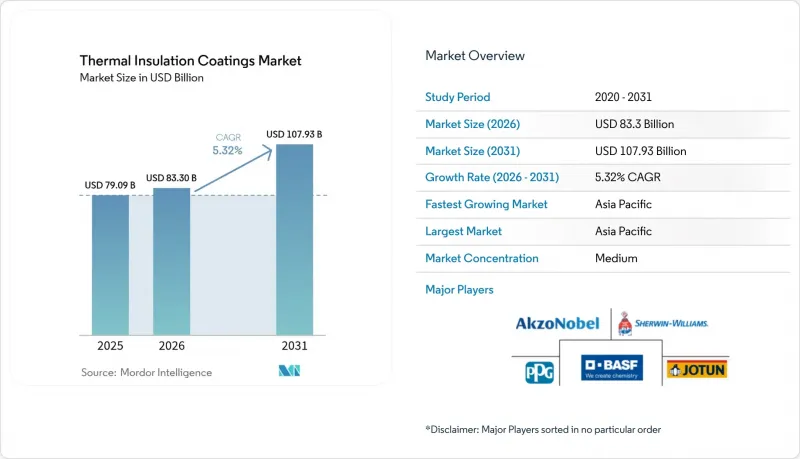
Mordor Intelligence에 의하면, 단열 코팅 시장 규모는 2025년에 790억 9,000만 달러로 평가되었고, 2026년 833억 달러에서 2031년까지 1,079억 3,000만 달러에 이를 것으로 추정되고 있어 예측 기간(2026-2031년) CAGR은 5.32%를 기록할 전망입니다.

본 보고서는 수지 유형별(아크릴, 에폭시, 폴리우레탄, 기타), 코팅 형태별(액체 스프레이, 분말, 진공 증착),용도별(건축 외피, 산업용 기기·파이프라인, 저장 탱크·용기, 기타), 최종 사용자 산업별(건축 및 건설, 산업 및 제조, 자동차, 기타), 지역별(아시아태평양, 북미, 유럽, 기타)로 분류되어 있습니다.
세계 단열 코팅 시장 동향 및 인사이트
신규 정유시설 건설
세계 정유시설의 증설은 계속해서 단열 코팅 시장의 성장 동력이 되고 있습니다. 인도, 중국, 아라비아만 지역의 신규 복합 시설에서는 200°C에서 800°C 범위에서 가동되는 증류탑 및 열교환기 쉘용으로 다층 에폭시 배리어가 지정되고 있습니다. 프로젝트 소유주들은 예기치 않은 가동 중단을 억제하고 자산의 수명을 연장하기 위해, 내식성과 디지털 두께 모니터링 기능을 동일한 코팅 패키지에 통합하는 사례가 늘고 있습니다. 정상 및 주기적인 온도 환경 모두에 대응하는 시스템 인증을 획득할 수 있는 공급업체는 최대 규모의 자본 프로젝트에 참여할 기회를 얻을 수 있습니다.
지역 냉난방 네트워크의 확대
4세대 지역 냉난방 네트워크는 더 낮은 공급 온도로 가동되기 때문에 반복되는 열 사이클을 견디면서 배관 손실을 줄일 수 있는 코팅이 요구되고 있습니다. 덴마크 지방 자치단체 에너지 협동조합의 사례에서는 첨단 단열 기술을 통해 연간 열 손실을 수% 포인트 절감하고 히트 펌프의 효율을 향상시킨 것이 입증되었습니다. 독일과 스웨덴에서 진행 중인 유사한 개보수 공사에서는 더 엄격한 보온 목표를 달성하기 위해 에어로겔이 배합된 프라이머가 지정되고 있습니다.
막대한 자본 요건
플라즈마 분사 부스, 자동 갠트리, 제어된 환경의 경화로 비용은 수백만 달러에 달할 수 있어 신규 진출기업의 생산 능력을 제한하고 있습니다. 그 결과, 대규모 종합 제조업체가 장기 공급 계약을 장악하고 있는 반면, 소규모 시공업체는 자금 조달의 난관에 직면해 있습니다. 다각화를 추진하고 있는 화학 그룹 내에서 최근 진행되고 있는 사업 매각 논의에서 볼 수 있듯이, 포트폴리오 재편은 자본 집약적인 사업 환경으로 인한 압박을 여실히 드러내고 있습니다.
부문별 분석
에폭시계 시스템은 정유시설 배관, 선박 데크 플레이트, 해양 플랫폼에 적합한 뛰어난 접착력과 내화학성에 힘입어 2025년 단열 코팅 시장에서 35.74%의 점유율을 유지했습니다. 이 제품들은 아시아태평양 및 중동에서 예정된 보호 라이닝 프로젝트에서 단열 코팅 시장 규모의 상당 부분을 차지하고 있습니다. 개량된 배합에는 중공 유리 마이크로비즈가 포함되어 있어, 필름의 인성을 저해하지 않으면서 열전도율을 0.180W m-1K-1 이하로 억제하고 있습니다.
실리카-에어로겔 계열 코팅은 현재 매출액이 한 자릿수에 그치고 있지만, 2031년까지 연평균 성장률(CAGR) 5.74%를 나타낼 것으로 예측됩니다. 0.015W m?¹K?¹이라는 극히 낮은 열전도율 덕분에, 과거에는 진공 단열 패널이 필요했던 상압 용도도 가능해집니다. 각 제조업체는 에어로겔 분말을 에폭시 매트릭스에 공분산시킴으로써 기계적 강도와 초단열에 가까운 성능을 양립시키고 있으며, 이 부문은 향후 사양 수립에 있어 매우 큰 영향력을 행사하게 될 것입니다. 항공우주 부문의 최첨단 분야에서는 엔트로피 안정화 산화물과 YSZ 플랫폼이 1,200°C 이상에서 작동하는 터빈 블레이드의 표피를 대상으로 하고 있어, 향후 기술 간 융합의 기회를 시사하고 있습니다.
액체 스프레이 라인은 2025년에 단열 코팅 시장의 44.72% 점유율을 차지하며, 연평균 성장률(CAGR) 6.21%로 다른 형태를 계속해서 앞지르고 있습니다. 주요 장점으로는 용접 이음매나 반경 곡면에 대한 매끄러운 코팅은 물론, 로봇과 통합된 스프레이 헤드를 통한 생산성 향상을 들 수 있습니다. 현재 제조 현장에서는 비전 분석 기술을 활용하여 습식 필름의 두께를 측정하고, 건 속도를 자동으로 보정함으로써 오버스프레이를 최소화하고 수율을 향상시키고 있습니다. 분체 도장 라인은 그리드 쉘 구조나 정전기에 의한 부착을 통해 균일한 피막 형성이 보장되는 특정 파이프라인 외장 분야에서 여전히 중요한 역할을 하고 있습니다.
지역별 분석
아시아태평양은 2025년 매출의 39.62%를 차지하고 있으며, 이는 중국, 인도, 한국의 메가 프로젝트 파이프라인을 반영한 것입니다. 각 지역 정부는 정유시설의 자급자족을 우선시하고 있으며, 이는 단열 코팅 시장을 직접적으로 확대시키고 있습니다. 또한, 일본의 LNG 콜드체인 터미널과 동남아시아 섬들에 공급하는 부유식 저장 재기화 설비(FSRU)(FSRU)도 시장의 성장세를 뒷받침하고 있습니다.
북미에서는 항공우주 추진 프로그램과 중공업 지대의 공정 열 전기화 시범 사업이 시장을 견인하고 있습니다. 연방 정부의 경제 부양책은 지역 열 공급 시스템의 개조를 촉진하고 있으며, 이에 따라 지방 자치단체의 유틸리티자들은 배전 손실을 줄이는 첨단 코팅재 도입을 추진하고 있습니다. 캐나다의 ‘2020년 건축물 국가 에너지 코드’와 같이, 벽체 조립의 열저항 요건을 높이는 규제는 스프레이 도포형 세라믹 마이크로스피어 제품에 대한 지속적인 수요를 뒷받침하고 있습니다.
유럽은 정책 주도형 탈탄소화에서 선도적인 위치를 유지하고 있으며, 가장 밀집된 지역 난방 시장을 보유하고 있어, 실제 환경 외에서 열 사이클 내구성이 입증된 도료의 사양 향상을 지속적으로 촉진하고 있습니다. 신규 중공업 시설 건설이 감소함에 따라, 초점은 노후화된 산업단지에 고온 히트펌프 시스템을 도입하는 것으로 옮겨가고 있으며, 이곳에서 도료는 열유 루프의 전도 손실을 줄여주고 있습니다. 한편, 중동 및 아프리카에서는 석유 관련 설비 투자 프로그램을 활용하여 석유화학 산업단지에 대한 도입을 확대하고 있으며, 남미의 광업 지역에서는 강력한 산이나 하루 종일 발생하는 큰 온도 변동으로부터 공정 용기를 보호하기 위해 코팅이 채택되고 있습니다.
기타 혜택
- 엑셀 형식 시장 예측(ME) 시트
- 3개월간의 애널리스트 지원
자주 묻는 질문
목차
제1장 서론
제2장 조사 방법
제3장 주요 요약
제4장 시장 구도
제5장 시장 규모와 성장 예측
제6장 경쟁 구도
제7장 시장 기회와 향후 전망
LSH 26.09.04According to Mordor Intelligence, the thermal insulation coatings market size was valued at USD 79.09 billion in 2025 and estimated to grow from USD 83.3 billion in 2026 to reach USD 107.93 billion by 2031, at a CAGR of 5.32% during the forecast period (2026-2031).
This report is Segmented by Resin Type (Acrylic, Epoxy, Polyurethane, and More), Coating Form (Liquid Spray, Powder, Vacuum-Deposited), Application (Building Envelope, Industrial Equipment and Pipelines, Storage Tanks and Vessels, and More), End-User Industry (Building and Construction, Industrial/Manufacturing, Automotive, and More), and Geography (Asia Pacific, North America, Europe, and More).
Global Thermal Insulation Coatings Market Trends and Insights
Construction of New Refineries
Global refinery buildouts continue to anchor the thermal insulation coatings market. New complexes in India, China, and the Arabian Gulf specify multilayer epoxy barriers for distillation towers and heat-exchanger shells that run between 200 °C and 800 °C. Project owners increasingly bundle corrosion resistance and digital thickness monitoring into the same coating package to curb unplanned outages and extend asset life. Suppliers that can certify systems for both normal and cyclic temperature environments gain access to the largest capital projects pipeline.
Expansion of District Heating and Cooling Networks
Fourth-generation district-heating grids operate at lower supply temperatures, demanding coatings capable of reducing distribution losses while surviving repetitive thermal cycling. Denmark's municipal energy cooperatives demonstrate that advanced insulation can shave multiple percentage points from annual heat losses, thereby improving heat-pump efficiency. Similar retrofits across Germany and Sweden specify aerogel-infused primers to meet the stricter heat-retention targets.
High Capital Requirement
Plasma-spray booths, automated gantries, and controlled-atmosphere curing ovens can cost several million USD, limiting new-entrant capacity. Large integrated producers therefore dominate long-run supply contracts, while smaller applicators face financing hurdles. Portfolio restructuring, as seen in recent divestiture discussions inside diversified chemistry groups, underscores capital intensity pressures.
Other drivers and restraints analyzed in the detailed report include:
- Increasing Demand for Construction Industry
- Electrification of Process-Heat in Heavy Industry
- Volatile Raw-Material (Epoxy and PU) Prices
For complete list of drivers and restraints, kindly check the Table Of Contents.
Segment Analysis
Epoxy systems retained a 35.74% share of the thermal insulation coatings market in 2025, buoyed by strong adhesion and chemical resistance that suit refinery piping, marine deck plates, and offshore platforms. They underpin a significant portion of the thermal insulation coatings market size for protective-lining projects scheduled across APAC and the Middle East. Enhanced formulations embed hollow-glass microspheres to bring thermal conductivity below 0.180 W m-1 K-1 without sacrificing film toughness.
Silica-aerogel coatings, while holding only single-digit revenue today, record a 5.74% CAGR to 2031. Ultra-low conductivity readings of 0.015 W m-1 K-1 unlock ambient-pressure applications that once demanded vacuum-insulated panels. Manufacturers co-disperse aerogel powder into epoxy matrices to combine mechanical strength with near-super-insulating performance, giving the segment outsized influence on future specifications. At the aerospace frontier, entropy-stabilized oxide and YSZ platforms target turbine-blade skins running above 1,200 °C, suggesting further technology crossover opportunities.
Liquid spray lines captured 44.72% of thermal insulation coatings market share in 2025 and continue to outpace other forms at a 6.21% CAGR. Their chief advantages include seamless coverage on weld seams and radius bends, plus production-rate gains from robot-integrated spray heads. Process yards now deploy vision analytics to gauge wet-film thickness and self-correct gun speed, minimizing overspray and improving yield. Powder lines remain relevant in gridshell architecture and certain pipeline externals where electrostatic attraction ensures uniform film builds.
Complete Report Scope:
- By Resin Type
- Acrylic
- Epoxy
- Polyurethane
- Yttria-Stabilised Zirconia (YSZ)
- Other Resin Types (Silica Aerogel-Based, etc.)
- By Coating Form
- Liquid Spray
- Powder
- Vacuum-Deposited
- By Application
- Building Envelope (Walls, Roofs)
- Industrial Equipment and Pipelines
- Storage Tanks and Vessels
- Automotive Components
- Marine Hull and Deck Structures
- Aerospace and Turbine Parts
- By End-user Industry
- Building and Construction
- Industrial/Manufacturing
- Automotive
- Marine
- Others (Food Processing, Pharma)
- By Geography
- Asia Pacific
- China
- India
- Japan
- South Korea
- Rest of Asia Pacific
- North America
- United States
- Canada
- Mexico
- Europe
- Germany
- United Kingdom
- France
- Italy
- Rest of Europe
- South America
- Brazil
- Argentina
- Rest of South America
- Middle-East and Africa
- Saudi Arabia
- South Africa
- Rest of Middle-East and Africa
- Asia Pacific
Geography Analysis
Asia-Pacific holds 39.62% of 2025 revenue, reflecting megaproject pipelines in China, India, and South Korea. Regional governments prioritize refinery self-sufficiency, which directly inflates the thermal insulation coatings market. Added momentum comes from LNG cold-chain terminals in Japan and floating storage regasification units serving Southeast Asian islands.
North America is assisted by aerospace propulsion programs and process-heat electrification pilots in heavy industry alleys. Federal stimulus packages encourage district-energy retrofits, steering municipal utilities toward advanced coating overlays that lower distribution losses. Regulations like Canada's National Energy Code for Buildings 2020, which lifts thermal-resistance requirements for wall assemblies, anchor recurrent demand for spray-applied ceramic microsphere products.
Europe maintains leadership in policy-driven decarbonization and commands the densest district-heating market, fostering continuous specification upgrades for coatings with validated ex-situ thermal-cycling endurance. Scarcity of new-build heavy industry shifts focus to retrofitting aging industrial parks with high-temperature heat-pump systems, where coatings moderate conductive losses on hot-oil loops. Meanwhile, the Middle-East and Africa leverages oil-capex programs to expand adoption in petrochemical parks, whereas South America's mining belts employ coatings to buffer process vessels against aggressive acids and wide daily temperature swings.
- AkzoNobel N.V.
- BASF
- Behr Process LLC
- DAW SE
- Dow
- Evonik Industries AG
- Hempel A/S
- Jotun
- Kansai Paint Co., Ltd
- Mascoat
- Nippon Paint Holdings Co., Ltd
- OC Oerlikon Management AG
- PPG Industries, Inc.
- RPM International
- Sharpshell Engineering
- Sika AG
- Synavax
- The Sherwin-Williams Company
Additional Benefits:
- The market estimate (ME) sheet in Excel format
- 3 months of analyst support
TABLE OF CONTENTS
1 Introduction
- 1.1 Study Assumptions and Market Definition
- 1.2 Scope of the Study
2 Research Methodology
3 Executive Summary
4 Market Landscape
- 4.1 Market Overview
- 4.2 Market Drivers
- 4.2.1 Construction of New Refineries
- 4.2.2 Expansion of District Heating and Cooling Networks
- 4.2.3 Increasing demand for the construction industry
- 4.2.4 Electrification of Process-Heat in Heavy Industry
- 4.2.5 Surge in LNG Cold-Chain Logistics
- 4.3 Market Restraints
- 4.3.1 High Capital Requirement
- 4.3.2 Volatile Raw-Material (Epoxy and PU) Prices
- 4.3.3 Limited Applicability in Ultra High Temperature Assets
- 4.4 Supply Chain Analysis
- 4.5 Porter's Five Forces
- 4.5.1 Bargaining Power of Suppliers
- 4.5.2 Bargaining Power of Buyers
- 4.5.3 Threat of New Entrants
- 4.5.4 Threat of Substitutes
- 4.5.5 Competitive Rivalry
5 Market Size and Growth Forecasts (Value)
- 5.1 By Resin Type
- 5.1.1 Acrylic
- 5.1.2 Epoxy
- 5.1.3 Polyurethane
- 5.1.4 Yttria-Stabilised Zirconia (YSZ)
- 5.1.5 Other Resin Types (Silica Aerogel-Based, etc.)
- 5.2 By Coating Form
- 5.2.1 Liquid Spray
- 5.2.2 Powder
- 5.2.3 Vacuum-Deposited
- 5.3 By Application
- 5.3.1 Building Envelope (Walls, Roofs)
- 5.3.2 Industrial Equipment and Pipelines
- 5.3.3 Storage Tanks and Vessels
- 5.3.4 Automotive Components
- 5.3.5 Marine Hull and Deck Structures
- 5.3.6 Aerospace and Turbine Parts
- 5.4 By End-user Industry
- 5.4.1 Building and Construction
- 5.4.2 Industrial/Manufacturing
- 5.4.3 Automotive
- 5.4.4 Marine
- 5.4.5 Others (Food Processing, Pharma)
- 5.5 By Geography
- 5.5.1 Asia Pacific
- 5.5.1.1 China
- 5.5.1.2 India
- 5.5.1.3 Japan
- 5.5.1.4 South Korea
- 5.5.1.5 Rest of Asia Pacific
- 5.5.2 North America
- 5.5.2.1 United States
- 5.5.2.2 Canada
- 5.5.2.3 Mexico
- 5.5.3 Europe
- 5.5.3.1 Germany
- 5.5.3.2 United Kingdom
- 5.5.3.3 France
- 5.5.3.4 Italy
- 5.5.3.5 Rest of Europe
- 5.5.4 South America
- 5.5.4.1 Brazil
- 5.5.4.2 Argentina
- 5.5.4.3 Rest of South America
- 5.5.5 Middle-East and Africa
- 5.5.5.1 Saudi Arabia
- 5.5.5.2 South Africa
- 5.5.5.3 Rest of Middle-East and Africa
- 5.5.1 Asia Pacific
6 Competitive Landscape
- 6.1 Market Concentration
- 6.2 Strategic Moves
- 6.3 Market Share(%)/Ranking Analysis
- 6.4 Company Profiles (includes Global level Overview, Market level overview, Core Segments, Financials as available, Strategic Information, Market Rank/Share for key companies, Products and Services, and Recent Developments)
- 6.4.1 AkzoNobel N.V.
- 6.4.2 BASF
- 6.4.3 Behr Process LLC
- 6.4.4 DAW SE
- 6.4.5 Dow
- 6.4.6 Evonik Industries AG
- 6.4.7 Hempel A/S
- 6.4.8 Jotun
- 6.4.9 Kansai Paint Co., Ltd
- 6.4.10 Mascoat
- 6.4.11 Nippon Paint Holdings Co., Ltd
- 6.4.12 OC Oerlikon Management AG
- 6.4.13 PPG Industries, Inc.
- 6.4.14 RPM International
- 6.4.15 Sharpshell Engineering
- 6.4.16 Sika AG
- 6.4.17 Synavax
- 6.4.18 The Sherwin-Williams Company
7 Market Opportunities and Future Outlook
- 7.1 White-space and Unmet-Need Assessment


