

|
시장보고서
상품코드
2122395
적외선 카메라 시장 : 시장 점유율 분석, 산업 동향 및 통계 데이터, 성장 예측(2026-2031년)IR (Infrared) Camera - Market Share Analysis, Industry Trends & Statistics, Growth Forecasts (2026 - 2031) |
||||||
 Mordor Intelligence
Mordor Intelligence에 의하면, 적외선 카메라 시장 규모는 2026년에 107억 2,000만 달러로 추정되고, 2031년까지 157억 2,000만 달러로 확대될 것으로 예측되며, 이 기간 CAGR은 7.96%로 성장이 전망됩니다.
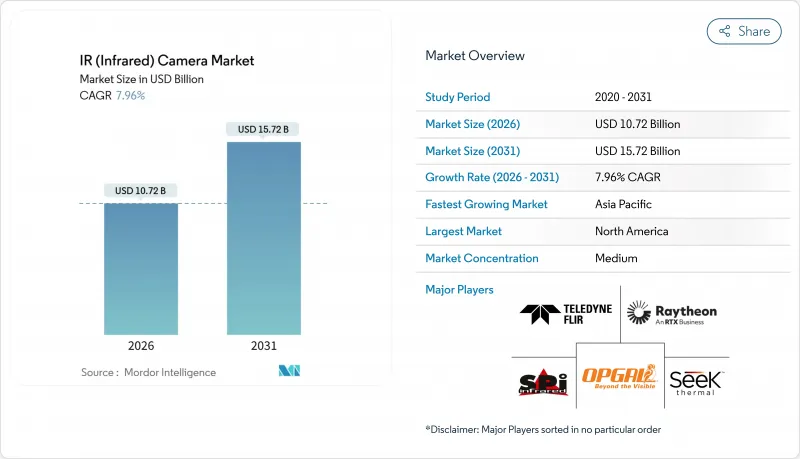
본 보고서는 검출기별(냉각식, 비냉각식), 소재별(게르마늄, 실리콘,사파이어, 기타 소재), 파장 유형별(근적외선·단파장 적외선, 중파장 적외선, 장파장 적외선), 최종 사용자 분야별(군 및 방위, 자동차, 산업, 상업·공공, 기타) 및 지역별로 분류되어 있습니다. 시장 전망은 금액(달러) 기준으로 제시되어 있습니다.
세계의 적외선 카메라 시장 동향 및 인사이트
다양한 부문에서 증가하는 감시 수요
적외선 카메라는 사후 감지에서 사전 위협 평가로 전환되어, 멀티 센서 보안망의 첫 번째 계층을 형성하고 있습니다. 바이스펙트럼 모델은 열화상 영상과 가시광선 영상을 중첩시켜 오경보를 줄입니다. 이는 성가신 경보가 운영자의 부담이 되고 있는 중요 인프라 시설에 있어 중요한 이점입니다. 미국의 보안 지침에서는 화학 시설에 대한 열화상 기반 주변 경비를 권장하고 있으며, 이는 석유화학 산업 집적지에서 수요를 촉진하고 있습니다. 상업용 부동산 소유주들은 현재 열화상 데이터를 건물 관리 시스템과 통합하여 냉난방 부하를 최적화하고 있습니다. 이러한 노력은 2024년 에너지 가격 급등을 계기로 확대되었습니다. 기업들이 기존의 수동형 적외선 센서를 분석 기능을 지원하는 열화상 카메라로 교체함에 따라, 각 벤더들은 두 자릿수의 매출 성장을 보고하고 있습니다.
AI 기반 영상 분석과의 통합을 통한 활용 사례 확대
카메라에 신경망 프로세서를 탑재함으로써 열화상 이미지는 진단 도구로 기능하게 됩니다. 엣지 추론을 통해 초당 30프레임의 속도로 전기적 고장, 증기 누출, 정상 가동을 구분할 수 있어 클라우드에 의한 지연을 없앨 수 있습니다. 자동차 시스템에서는 어둠 속의 긴급 제동 제어에 이 100밀리초 미만의 의사결정 루프가 필수적이며, 유럽의 OEM 업체들에 의한 도입이 더욱 확대되고 있습니다. 산업 분야 사용자들은 열 패턴을 활용하여 몇 주 앞까지 베어링 고장을 예측함으로써 예상치 못한 가동 중지 시간을 줄이고 있습니다. GPU 공급업체들은 열화상 처리 파이프라인에 대한 지원을 확대하고 있으며, 이를 통해 시스템 통합사업자들은 가시광선과 적외선 스트림 모두에 걸쳐 통합적인 분석을 수행할 수 있게 되었습니다.
이중 용도 적외선 검출기에 관한 수출 관리 규제
ITAR(국제무기거래규정)의 제한에 따라, 고사양 냉각형 검출기는 방위 품목으로 분류되어 수출 허가 심사 기간이 6-12개월로 연장될 뿐만 아니라, 수출 금지 국가로의 판매가 금지되고 있습니다. 2024년 바세나 협정 개정으로 고감도 비냉각형 어레이가 규제 목록에 추가됨에 따라, 기업들은 규정을 준수하기 위해 성능을 낮춘 변형 제품을 출하할 수밖에 없게 되었습니다. 이에 대해 중국 바이어들은 국내 조달로 전환하고 있지만, 미국 당국은 지정 사업자 목록을 더욱 엄격하게 적용하여 광학 기기 및 검출기의 유통에 차질을 빚고 있습니다. 규정 준수 비용은 출하 건당 평균 1만 5,000달러에 달하고, 중소 제조업체에 압박을 가하고 있으며, 업계 재편을 촉진하고 있습니다.
부문 분석
2025년, 비냉각 기술은 적외선 카메라 시장에서 74.72%라는 압도적인 점유율을 차지했습니다. 이는 800달러 미만의 가격대와 상업용 감시 및 휴대용 검사에 적합한 즉시 사용 가능한 작동 방식에 힘입은 결과입니다. 픽셀 피치의 축소와 판독 회로의 개량을 통해 잡음 등가 온도 차가 40 mK 미만으로 낮아졌으며, 이러한 검출기는 예측 유지보수 및 건물 진단에도 활용될 수 있게 되었습니다. 그럼에도 불구하고, 국방 프로그램에서는 20km의 식별 거리가 요구되고, 과학 분야의 사용자들로부터는 광자가 극히 적은 용도를 위해 20mK 미만의 감도가 요구되고 있기 때문에 냉각형 센서는 2031년까지 연평균 성장률(CAGR) 9.21%라는 견조한 성장세를 보일 것으로 예측됩니다. 최근 무인 항공기 시스템을 위한 4,250만 달러 규모의 계약이 체결된 것은 장거리에서 선명한 영상을 얻기 위해 높은 가격을 지불할 의사가 여전히 존재함을 보여줍니다.
성능 격차는 점차 좁혀지고 있지만, 광자가 극히 적은 미사일 추적이나 천문학 분야에서는 여전히 냉각식 카메라가 주류를 차지하고 있습니다. 각 벤더들은 스털링 쿨러의 수명을 15,000시간 이상으로 연장하고, 크기, 무게, 전력 소비 제한을 줄임으로써 신뢰성을 향상시켜 항공기 및 우주 탑재의 적용 범위를 넓히고 있습니다. 한편, 비냉각형 검출기는 웨이퍼 수율 향상으로 인한 추가적인 비용 절감의 혜택을 받고 있으며, 적외선 카메라 시장의 양산 주력 제품으로서의 역할을 강화하고 있습니다.
2025년에는 게르마늄 광학 소자가 매출의 41.62%를 차지했습니다. 이는 8-14µm 대역에서 63%라는 타의 추종을 불허하는 투과율을 반영한 것으로, 이를 통해 주변 경비 및 건물 점검용 소형 렌즈 스택이 가능해졌습니다. 그러나 제련 능력의 집중으로 인한 게르마늄의 취성 및 가격 변동성으로 인해, 사용자들은 사파이어로 제작된 대체품을 시험적으로 도입하고 있습니다. 사파이어 시장은 연평균 성장률(CAGR) 8.44%로 성장하고 있습니다. 사파이어의 모스 경도는 9로, 가혹한 산업 환경에서 렌즈의 수명을 연장합니다. 또한 0.2-5.5µm의 넓은 투과 대역폭 덕분에 석유화학 플랜트에서 가스 누출을 감지하는 듀얼 밴드 이미징에 대응할 수 있습니다.
2025년 로드맵에 따르면, 하이브리드 렌즈 어셈블리는 전면 요소에 게르마늄을, 후면 요소에 폴리머를 조합함으로써 광학 성능의 85%를 유지하면서도 비용을 22% 절감하고 있습니다. 아연 셀레나이드나 칼코겐화물 유리는 높은 비용과 취성 때문에 여전히 틈새 시장 소재로 남아 있지만, 수출 규제와 가격 변동으로 인해 단일 공급원에 대한 의존이 위험 요인으로 대두되는 가운데, 소재 다각화 전략의 중요성이 커지고 있습니다. 따라서 적외선 카메라 업계에서는 광학 성능 요건과 내장애성, 총 소유 비용 간의 균형을 모색하고 있습니다.
지역별 분석
2025년, 북미는 전 세계 매출의 38.73%를 차지했습니다. 이는 8,500억 달러가 넘는 국방 예산으로 인해 장거리 시스템의 도입 기반이 유지되었기 때문입니다. 전기 설비 유지보수 기준의 개정에 따라 데이터센터의 개폐 장치에 대해 분기별 열 화상 스캔이 권장됨에 따라, 클라우드 분석에 연결된 고정형 네트워크 카메라 수요가 증가하고 있습니다. 캐나다의 추운 주에서는 공인 주택 검사관이 설치하는 카메라 비용의 최대 50%를 유틸리티자의 리베이트로 지원받기 때문에 주택 분야에서의 도입이 진행되고 있습니다. 또한 멕시코의 자동차 공장에서는 최종 품질 보증(QA) 스테이션에 열화상 검사가 통합되어 있어 지역적 성장세를 뒷받침하고 있습니다.
아시아태평양은 2031년까지 연평균 성장률(CAGR) 8.55%를 나타낼 것으로 예측됩니다. 이는 중국의 스마트 시티 계획에 따라 2024년 한 해에만 40만 대 이상의 적외선 카메라가 도입된 데 기인합니다. 수직 통합형 기업들은 30-40%의 비용 우위를 실현하고 있으며, 공공 안전, 교통 및 건물 화재 감지 네트워크에서의 솔루션 도입을 촉진하고 있습니다. 인도는 국방용 감지기 생산을 현지화하기 위해 2억 달러 규모의 연구개발(R&D) 이니셔티브를 시작한 반면, 일본에서는 건축된 지 50년 이상 된 구조물에 대해 열교 검사가 의무화되어 있습니다. 한국의 반도체 제조 공장에서는 서브미크론 수준의 결함 감지를 위해 수천 대의 단파장 적외선(SWIR) 스테이션이 가동되고 있으며, 호주의 광산에서는 컨베이어 화재를 방지하기 위해 적외선 카메라가 활용되고 있습니다. 이를 통해 해당 지역의 활용 사례가 정부, 산업, 자원 등 다양한 부문에 걸쳐 있음을 알 수 있습니다.
유럽에서의 성장은 엄격한 에너지 효율 및 자동차 안전 규제에 힘입고 있습니다. ‘건축물의 에너지 성능에 관한 지침’에서는 2030년까지 대규모 상업용 부동산에 대한 열화상 감사를 의무화하고 있습니다. 독일의 자동차 제조업체들은 이미 2024년 유로 NCAP 5성급 평가를 획득한 14개 차종에 열 센서를 탑재하고 있습니다. 프랑스의 원자력 발전소에서는 증기 누출을 감지하기 위해 수천 대의 카메라가 가동되고 있으며, 이를 통해 유지보수による 가동 중단 시간이 단축되고 있습니다. 한편, 중동의 주요 석유 기업들은 메탄 배출 보고 기준을 충족하기 위해 열화상 기술을 활용하고 있습니다. 아프리카에서의 도입은 여전히 광업 및 전력 부문에 집중되어 있지만, 장비 비용의 제약이 있는 경우 지역 시스템 통합사업자가 합리적인 가격의 유지보수 서비스를 패키지로 제공함으로써 그 범위가 서서히 확대되고 있습니다.
기타 혜택 :
- Excel 형식 시장 예측(ME) 시트
- 3개월간의 애널리스트 지원
자주 묻는 질문
목차
제1장 서론
제2장 분석 방법
제3장 주요 요약
제4장 시장 구도
제5장 시장 규모 및 성장 예측
제6장 경쟁 구도
제7장 시장 기회 및 향후 전망
AJY 26.09.09According to Mordor Intelligence, the infrared camera market size reached USD 10.72 billion in 2026 and is projected to advance to USD 15.72 billion by 2031, reflecting a 7.96% CAGR across the period.
This report is Segmented by Detector (Cooled and Uncooled), Material (Germanium, Silicon, Sapphire, and Rest of Materials), Wavelength Type (Near and Short-Wavelength IR, Medium-Wavelength IR, and Long-Wavelength IR), End-User Vertical (Military and Defense, Automotive, Industrial, Commercial and Public, and More), and Geography. The Market Forecasts are Provided in Terms of Value (USD).
Global IR (Infrared) Camera Market Trends and Insights
Rising Demand for Surveillance Across Multiple Sectors
Thermal cameras have shifted from reactive detection to proactive threat assessment, forming the first layer in multi-sensor security grids. Bi-spectrum models overlay thermal and visible feeds to cut false alarms, a key benefit for critical-infrastructure sites where nuisance alerts burden operators. U.S. security guidance recommends thermal perimeters for chemical facilities, driving procurement in petrochemical corridors. Commercial real-estate owners now integrate thermal feeds with building-management systems to optimize HVAC loads, a practice that expanded after 2024 energy-price spikes. Vendors report double-digit revenue growth as enterprises replace legacy passive-infrared sensors with analytics-ready thermal units.
Integration with AI-Based Video Analytics Enhancing Use Cases
Embedding neural processors in cameras enables thermal imaging to serve as a diagnostic tool. Edge inference distinguishes between electrical faults, steam leaks, and normal operation at 30 frames per second, eliminating cloud latency. Automotive systems rely on this sub-100 millisecond decision loop for emergency braking in darkness, reinforcing adoption by European OEMs. Industrial users apply thermal patterns to forecast bearing failures weeks ahead, reducing unplanned downtime. GPU suppliers expanded their support for thermal pipelines, enabling integrators to run unified analytics across both visible and infrared streams.
Export Control Regulations on Dual-Use Infrared Detectors
ITAR restrictions classify high-spec cooled detectors as defense articles, extending export-license cycles to 6-12 months and blocking sales to embargoed nations. The 2024 Wassenaar amendments added high-sensitivity uncooled arrays to control lists, causing firms to ship detuned variants to remain compliant. Chinese buyers respond by sourcing domestically, while U.S. authorities have tightened entity listings, disrupting optic and detector flows. Compliance costs average USD 15,000 per shipment, pressuring small manufacturers and encouraging industry consolidation.
Other drivers and restraints analyzed in the detailed report include:
- Adoption in Electric Vehicle Battery Thermal Management
- Falling Average Selling Prices of Infrared Sensors
- Supply Chain Constraints for Germanium and Other IR-Grade Materials
For complete list of drivers and restraints, kindly check the Table Of Contents.
Segment Analysis
Uncooled technology held a dominant 74.72% share of the infrared camera market in 2025, buoyed by sub-USD 800 price points and instant-on operation that suits commercial surveillance and handheld inspections. Pixel-pitch reductions and improved readout circuits pushed noise-equivalent temperature differences below 40 mK, making these detectors viable for predictive maintenance and building diagnostics. Nevertheless, cooled sensors are projected to post a robust 9.21% CAGR through 2031 as defense programs pursue 20 km identification ranges and scientific users demand sub-20 mK sensitivity for photon-starved applications. A recent USD 42.5 million contract for unmanned aerial systems highlights continued willingness to pay premiums for long-range clarity.
The performance gap is narrowing, yet cooled cameras still dominate missile-tracking and astronomy scenarios where photon counts are minimal. Vendors have enhanced reliability by extending Stirling-cooler lifetimes beyond 15,000 hours and reducing the size, weight, and power envelopes, thereby broadening airborne and space-borne deployment options. Meanwhile, uncooled detectors are benefitting from higher wafer yields that further depress costs, reinforcing their role as the volume engine of the infrared camera market.
Germanium optics owned 41.62% revenue in 2025, reflecting unrivaled 63% transmission across the 8-14 µm band, which enables compact lens stacks for perimeter security and building audits. Yet germanium's brittleness and price volatility, driven by concentrated refining capacity, are prompting users to trial sapphire alternatives, which are growing at an 8.44% CAGR. Sapphire's Mohs hardness of 9 boosts lens life in harsh industrial settings and its broad 0.2-5.5 µm transmission window supports dual-band imaging that detects gas leaks in petrochemical plants.
Hybrid lens assemblies mix germanium front elements with polymer rears to reduce costs by 22% while retaining 85% optical performance, according to a 2025 roadmap. Zinc selenide and chalcogenide glass remain niche due to high cost or brittleness, but material diversification strategies are gaining importance as export controls and price swings make single-source reliance risky. The infrared camera industry is therefore balancing optical performance requirements against resilience and total cost of ownership.
Complete Report Scope:
- By Detector
- Cooled
- Uncooled
- By Material
- Germanium
- Silicon
- Sapphire
- Rest of Materials
- By Wavelength Type
- Near and Short-wavelength IR (SWIR)
- Medium-wavelength IR (MWIR)
- Long-wavelength IR (LWIR)
- By End-user Vertical
- Military and Defense
- Automotive
- Industrial
- Commercial and Public
- Residential
- Rest of End-user Verticals
- By Geography
- North America
- United States
- Canada
- Mexico
- South America
- Brazil
- Argentina
- Rest of South America
- Europe
- United Kingdom
- Germany
- France
- Italy
- Spain
- Rest of Europe
- Asia-Pacific
- China
- Japan
- India
- South Korea
- Australia and New Zealand
- Rest of Asia Pacific
- Middle East and Africa
- Middle East
- Saudi Arabia
- United Arab Emirates
- Turkey
- Rest of Middle East
- Africa
- South Africa
- Nigeria
- Rest of Africa
- Middle East
- North America
Geography Analysis
North America held 38.73% of global revenue in 2025 as defense budgets above USD 850 billion sustained a large installed base of long-range systems. Updated electrical-maintenance codes now recommend quarterly thermal scans of data-center switchgear, driving demand for fixed networked cameras connected to cloud analytics. Residential adoption is rising in Canada's cold provinces, where utility rebates cover up to 50% of camera costs for certified home inspectors, and Mexico's automotive plants incorporate thermal inspection at final QA stations, reinforcing regional growth momentum.
The Asia-Pacific region is forecast to post an 8.55% CAGR through 2031, as Chinese smart-city programs deployed more than 400,000 thermal cameras in 2024 alone. Vertically integrated players achieve 30-40% cost advantages, catalyzing the adoption of solutions across public-safety, traffic, and building-fire detection networks. India launched a USD 200 million R&D initiative to localize detector production for defense, while Japan mandates thermal bridge inspections on structures older than 50 years. South Korea's fabs operate thousands of SWIR stations for sub-micron defect detection, and Australia's mines utilize thermal cameras to prevent conveyor fires, demonstrating that regional use cases span the government, industrial, and resource sectors.
Europe's growth is anchored by stringent energy-efficiency and automotive safety regulations. The Energy Performance of Buildings Directive mandates thermal audits for large commercial properties by 2030. German OEMs have already integrated thermal sensors into 14 vehicle models that achieved 5-star Euro NCAP ratings in 2024. France's nuclear fleet operates thousands of cameras for steam-leak detection, reducing maintenance downtime, while the Middle East's oil majors deploy thermal imaging to meet methane-emission reporting standards. Africa's uptake remains focused on mining and power sectors, constrained by equipment costs but gradually widening as regional integrators bundle affordable maintenance services.
- Teledyne FLIR LLC
- Raytheon Technologies Corporation
- Hangzhou Hikvision Digital Technology Co., Ltd
- Axis Communications AB
- Zhejiang Dahua Technology Co., Ltd
- Opgal Optronic Industries Ltd
- Leonardo DRS, Inc.
- Guide Sensmart Tech Co., Ltd
- Seek Thermal, Inc.
- Fluke Corporation
- Testo SE & Co. KGaA
- InfraTec GmbH Infrarotsensorik und Messtechnik
- SPI Corp.
- Bosch Security Systems GmbH
- Honeywell International Inc.
- L3Harris Technologies, Inc.
- Princeton Infrared Technologies, Inc.
- Excelitas Technologies Corp.
- Xenics nv
- Workswell s.r.o.
Additional Benefits:
- The market estimate (ME) sheet in Excel format
- 3 months of analyst support
TABLE OF CONTENTS
1 INTRODUCTION
- 1.1 Study Assumptions and Market Definition
- 1.2 Scope of the Study
2 RESEARCH METHODOLOGY
3 EXECUTIVE SUMMARY
4 MARKET LANDSCAPE
- 4.1 Market Overview
- 4.2 Market Drivers
- 4.2.1 Rising Demand for Surveillance Across Multiple Sectors
- 4.2.2 Falling Average Selling Prices of Infrared Sensors
- 4.2.3 Integration with AI-based Video Analytics Enhancing Use Cases
- 4.2.4 Adoption in Electric Vehicle Battery Thermal Management
- 4.2.5 Mandatory Fire Safety Codes Requiring Thermal Inspection
- 4.2.6 Growth of Space-Based Infrared Imaging for Smallsats
- 4.3 Market Restraints
- 4.3.1 Export Control Regulations on Dual-Use Infrared Detectors
- 4.3.2 Competition from Low-cost CMOS Visible Cameras with AI Upscaling
- 4.3.3 Supply Chain Constraints for Germanium and Other IR-grade Materials
- 4.3.4 Lack of Standardized Calibration for Long-range Thermal Accuracy
- 4.4 Industry Value Chain Analysis
- 4.5 Regulatory Landscape
- 4.6 Technological Outlook
- 4.7 Impact of Macroeconomic Factors on the Market
- 4.8 Porter's Five Forces Analysis
- 4.8.1 Threat of New Entrants
- 4.8.2 Bargaining Power of Buyers
- 4.8.3 Bargaining Power of Suppliers
- 4.8.4 Threat of Substitutes
- 4.8.5 Intensity of Competitive Rivalry
- 4.9 Impact of Macroeconomic Factors on the Market
5 MARKET SIZE AND GROWTH FORECASTS (VALUE)
- 5.1 By Detector
- 5.1.1 Cooled
- 5.1.2 Uncooled
- 5.2 By Material
- 5.2.1 Germanium
- 5.2.2 Silicon
- 5.2.3 Sapphire
- 5.2.4 Rest of Materials
- 5.3 By Wavelength Type
- 5.3.1 Near and Short-wavelength IR (SWIR)
- 5.3.2 Medium-wavelength IR (MWIR)
- 5.3.3 Long-wavelength IR (LWIR)
- 5.4 By End-user Vertical
- 5.4.1 Military and Defense
- 5.4.2 Automotive
- 5.4.3 Industrial
- 5.4.4 Commercial and Public
- 5.4.5 Residential
- 5.4.6 Rest of End-user Verticals
- 5.5 By Geography
- 5.5.1 North America
- 5.5.1.1 United States
- 5.5.1.2 Canada
- 5.5.1.3 Mexico
- 5.5.2 South America
- 5.5.2.1 Brazil
- 5.5.2.2 Argentina
- 5.5.2.3 Rest of South America
- 5.5.3 Europe
- 5.5.3.1 United Kingdom
- 5.5.3.2 Germany
- 5.5.3.3 France
- 5.5.3.4 Italy
- 5.5.3.5 Spain
- 5.5.3.6 Rest of Europe
- 5.5.4 Asia-Pacific
- 5.5.4.1 China
- 5.5.4.2 Japan
- 5.5.4.3 India
- 5.5.4.4 South Korea
- 5.5.4.5 Australia and New Zealand
- 5.5.4.6 Rest of Asia Pacific
- 5.5.5 Middle East and Africa
- 5.5.5.1 Middle East
- 5.5.5.1.1 Saudi Arabia
- 5.5.5.1.2 United Arab Emirates
- 5.5.5.1.3 Turkey
- 5.5.5.1.4 Rest of Middle East
- 5.5.5.2 Africa
- 5.5.5.2.1 South Africa
- 5.5.5.2.2 Nigeria
- 5.5.5.2.3 Rest of Africa
- 5.5.5.1 Middle East
- 5.5.1 North America
6 COMPETITIVE LANDSCAPE
- 6.1 Market Concentration
- 6.2 Strategic Moves
- 6.3 Market Share Analysis
- 6.4 Company Profiles (includes Global Level Overview, Market Level Overview, Core Segments, Financials as available, Strategic Information, Market Rank/Share for key companies, Products and Services, and Recent Developments)
- 6.4.1 Teledyne FLIR LLC
- 6.4.2 Raytheon Technologies Corporation
- 6.4.3 Hangzhou Hikvision Digital Technology Co., Ltd
- 6.4.4 Axis Communications AB
- 6.4.5 Zhejiang Dahua Technology Co., Ltd
- 6.4.6 Opgal Optronic Industries Ltd
- 6.4.7 Leonardo DRS, Inc.
- 6.4.8 Guide Sensmart Tech Co., Ltd
- 6.4.9 Seek Thermal, Inc.
- 6.4.10 Fluke Corporation
- 6.4.11 Testo SE & Co. KGaA
- 6.4.12 InfraTec GmbH Infrarotsensorik und Messtechnik
- 6.4.13 SPI Corp.
- 6.4.14 Bosch Security Systems GmbH
- 6.4.15 Honeywell International Inc.
- 6.4.16 L3Harris Technologies, Inc.
- 6.4.17 Princeton Infrared Technologies, Inc.
- 6.4.18 Excelitas Technologies Corp.
- 6.4.19 Xenics nv
- 6.4.20 Workswell s.r.o.
7 MARKET OPPORTUNITIES AND FUTURE OUTLOOK
- 7.1 White-Space and Unmet-Need Assessment


