|
시장보고서
상품코드
2122417
매시브 MIMO : 시장 점유율 분석, 업계 동향과 통계, 성장 예측(2026-2031년)Massive MIMO - Market Share Analysis, Industry Trends & Statistics, Growth Forecasts (2026 - 2031) |
||||||
 Mordor Intelligence
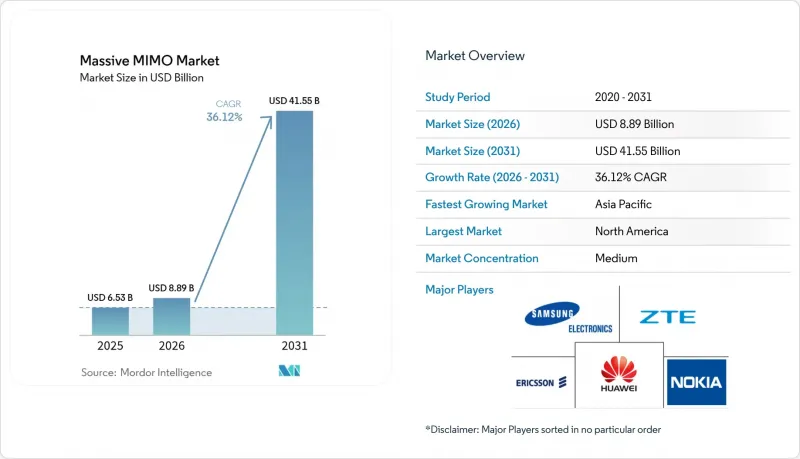
Mordor Intelligence에 의하면, 매시브 MIMO 시장 규모는 2025년 65억 3,000만 달러에서 2026년에는 88억 9,000만 달러로 성장하고, 2026-2031년 CAGR 36.12%로 성장을 지속하여 2031년에는 415억 5,000만 달러에 달할 것으로 예측됩니다.
(1) Fredrik Jejdling,「Ericsson Mobility Report 2025」, ericsson.com 통신 사업자들이 광범위한 지역을 커버하는 구축에서 용량 중심의 도시 지역 구축으로 착실하게 전환하고 있는 것이 수요를 확대시키고 있습니다. 이는 빔포밍을 통해 스펙트럼 효율이 향상되고, 사용자 1인당 평균 수익(ARPU)이 증가하기 때문입니다. 본 보고서는 기술별(LTE(4G), 5G NR Sub-6GHz 등), 안테나 유형별(16T16R, 32T32R 등),도입 형태(집중형(C-RAN), 분산형 RAN 등), 아키텍처(시분할 다중 접속(TDD), 주파수 분할 다중 접속(FDD) 등), 최종 사용자용도(모바일 네트워크 사업자, 기업 및 사설 네트워크 등), 지역별로 분류되어 있습니다.
전 세계 매시브 MIMO 시장 동향 및 인사이트
급증하는 모바일 데이터 트래픽과 단말 밀도
중국에서는 2030년까지 모바일 데이터 트래픽이 4배로 증가할 것으로 예상되며, 기존의 셀 분할 전략으로는 비용 효율적으로 관리할 수 없는 수준의 밀도가 발생하게 될 것입니다. 고정 무선 접속 회선은 2024년 1억 6,000만 회선에서 2030년까지 3억 5,000만 회선으로 증가할 것으로 예측되며, 그 중 80%는 매시브 MIMO 무선 어레이를 핵심으로 하는 5G-Advanced 네트워크를 통해 제공될 전망입니다(ZTE). 산업용 IoT(IIoT)가 부하를 더욱 가중시키고 있습니다. 중국은 2027년까지 1만 곳의 무선 지원 공장을 목표로 하고 있으며, 각 공장은 네트워크 용량에 대해 엄격한 성능 요건을 부과하고 있습니다. 주요 시장에서 5G 보급률이 75.9%를 넘어섬에 따라 셀 에지에서의 혼잡이 심화되고 있으며, 일관된 사용자 경험을 유지하기 위해서는 빔포밍이 필수적입니다. 따라서 대규모 MIMO 시장은 트래픽 증가와 직접적으로 연동되며, 통신 사업자는 기지국 확장을 비례적으로 늘리지 않고도 처리량 요구 사항을 충족할 수 있게 됩니다.
전 세계적으로 급속히 전개되는 5G NR(Sub-6GHz 및 mmWave)
에릭슨에 따르면, 독립형 5G 가입자 수는 2024년 말까지 전 세계적으로 12억 건에 달하고, 2030년까지 36억 건에 이를 것으로 예측됩니다. 중국은 2025년까지 450만 기의 5G 기지국을 신설할 계획이며, 신규 사이트의 기본 안테나 시스템으로 매시브 MIMO의 채택을 의무화하고 있습니다. 인도는 2024년 10월까지 전국적인 5G 커버리지를 달성할 예정이며, 백홀 업그레이드에 따라 고차 어레이에 대한 수요가 가속화되고 있습니다. 에릭슨에 따르면, 2025년에 에릭슨, NBN Co, 퀄컴이 첨단 빔포밍을 활용한 14km 기가비트 링크를 시연함으로써 mm파의 경제성이 향상되었습니다. 프라이빗 5G의 경우, 2024년에 RAN 매출이 40% 이상 성장할 것으로 예상되며, 서비스 수준 계약(SLA)을 확실하게 이행하기 위해서는 간섭 관리 기능을 갖춘 무선 장비가 필수적입니다.
RF 프런트엔드의 높은 단가와 높은 전력 소비
중국은 갈륨 질화물 웨이퍼 생산량의 98%를 장악하고 있어, 고차 어레이에 필수적인 RF 프런트엔드 모듈에 대해 공급 안정성과 가격 면에서의 우려가 커지고 있습니다. 부품 제조업체인 Qorvo는 휴대전화 수요 둔화에 따라 2025년 3분기에 12.4%의 매출 감소를 기록했습니다. 이는 비용 밀어올림형 인플레이션으로 인해 공급업체의 이익률이 이미 압박받고 있음을 시사합니다. AI를 활용한 저전력 알고리즘을 통해 무선 기기의 전력 소비를 최대 80%까지 줄일 수 있지만, 이를 위해서는 추가적인 반도체 칩이 필요하기 때문에 생산 규모가 확대되기 전까지는 부품 원가(BOM)가 증가합니다. 미국 국방부는 국내 갈륨 가공 시범 사업에 자금을 지원하고 있지만, 상업적 규모의 생산은 2027년 이후로 미뤄질 전망이며, 통신 사업자들은 환율 변동이나 수출 규제의 영향을 받기 쉬운 상황에 놓여 있습니다. 이러한 요인으로 인해 비용에 민감한 지역에서는 단기적인 도입이 억제되고, 업그레이드가 미뤄지고 있습니다.
부문 분석
5G NR Sub-6GHz 기술은 그 전파 특성이 광역 커버리지와 실내 침투를 지원하기 때문에 2025년에는 매출의 57.30%를 차지하며, 초기 5G 도입에 있어 기본 선택지가 되었습니다. 이 부문은 여러 지역에 걸친 미드밴드 주파수 대역의 조화로운 할당으로 혜택을 받았으며, 이를 통해 디바이스 생태계가 합리화되고 무선 비용이 절감되었습니다. 대조적으로, 5G NR mmWave는 현재 프리미엄 이용 사례로 제한되어 있지만, 39.05%의 연평균 성장률(CAGR)은 고정 무선 액세스 및 경기장 핫스팟에서의 도입이 가속화되고 있음을 보여줍니다. 통신 사업자들이 호주에서 14km에 달하는 농촌 지역 링크의 성공 사례를 재현하고, 비도시 지역의 광대역용 고주파 대역의 경제성을 입증함에 따라, mmWave용 매시브 MIMO 시장 규모는 크게 확대될 것으로 예측됩니다.
그렇지만 Sub-6 대역은 여전히 제어 플레인의 기반으로서 필수적이며, 통신 사업자에게 커버리지와 용량을 모두 확보할 수 있는 균형 잡힌 주파수 전략을 제공합니다. Reliance Geo의 AirFiber 시험에서는 mm파 FWA가 광섬유에 비해 라스트 마일 구축 기간을 단축할 수 있음이 입증되었습니다. 일본의 민간 5G 라이선싱 현황은 여전히 Sub-6을 중시하고 있지만, 창고에서 진행된 초기 mm파 프로젝트는 향후 다양화를 예고하고 있습니다. 단말기 비용이 낮아지고, 5G-Advanced 하에서 전파 특성의 개선이 성숙해지면 밀리파의 점유율은 상승하여 2031년에 걸쳐 매시브 MIMO 시장 수익에서 차지하는 비중을 확대해 나갈 것입니다.
64T64R 패널은 셀 에지에서 높은 처리량과 허용 범위 내의 무게 및 전력 소비 간의 균형을 맞추어, 2025년에는 수량 점유율의 38.25%를 차지했습니다. 밀집된 대도시권에서 매크로 사이트를 업그레이드할 때, 통신 사업자들은 이 형식을 선호하여 채택하고 있습니다. 이는 설치에 필요한 구조 보강을 최소화할 수 있기 때문입니다. 128T128R 및 그 이상 등급에 대해서는 벤더들의 방열판 효율 개선과 AI 도구를 통한 빔 보정 오버헤드 감소에 힘입어 연평균 성장률(CAGR) 40.15%를 기록할 전망입니다. 조지아 공과대학의 연구에 따르면, 27-41GHz 대역에서 방대한 수의 엘리먼트를 지원하는 수신기 아키텍처가 입증되어, 초대형 어레이의 실질적인 실현 가능성을 시사하고 있습니다.
용도이 XR 및 산업용 로봇으로 전환됨에 따라 안정적인 멀티 기가비트급 처리량에 대한 수요가 증가하고 있으며, 통신 사업자들은 256개 엘리먼트로 구성된 프로토타입 테스트를 시작했습니다. 128T128R 시스템의 매시브 MIMO 시장 규모는 2031년까지 148억 8,000만 달러에 달하고, 총 매출의 35.80%를 차지할 것으로 예측됩니다. 퀄컴의 4,096소자 Giga-MIMO 컨셉은 용량의 비약적인 향상 가능성을 보여주고 있지만, 상용화는 파워 앰프의 효율이 향상되는 2028년 이후가 될 전망입니다. 단기적으로는 32T32R 어레이가 타워의 하중 제한으로 인해 무거운 패널 설치가 어려운 지방이나 비용을 중시하는 도입 현장에서 계속해서 활용되어, 다층적인 시장 구조가 유지될 전망입니다.
지역별 분석
북미는 C-밴드의 적극적인 전개, 기업용 FWA 도입, 그리고 Open RAN에 대한 우호적인 정책을 배경으로 2025년 전 세계 매출의 39.50%를 차지했습니다. 버라이즌은 2025년에 175억-185억 달러의 설비 투자를 계획하고 있으며, 그 상당 부분이 가입자당 처리량을 경쟁력 있는 수준으로 유지하기 위한 64T64R 섹터로의 업그레이드에 할당되고 있습니다. 캐나다의 TELUS는 삼성과 제휴하여 국내 최초의 전국적 규모의 가상화 RAN을 구축하고 있으며, 이는 소프트웨어 정의 무선에 대한 지역적 수요가 높음을 뒷받침하고 있습니다. 70/80/90GHz 대역의 백홀 및 37GHz 대역의 공유에 관한 FCC의 규제 개혁으로 인해, 지방 광대역용 mm파(mmWave)의 비즈니스 사례가 더욱 확대되고 있습니다.
아시아태평양은 가장 빠르게 성장하는 지역으로, 2031년까지 연평균 성장률(CAGR)이 36.95%를 나타낼 것으로 예측됩니다. 중국에서는 2025년 3월까지 5G 기지국 수가 440만 개를 돌파할 전망이며, 같은 해 말까지 450만 개를 추가로 설치할 계획입니다. 인도는 2024년 말에 전국적인 5G 커버리지를 달성할 전망이며, Reliance Jio가 가동 중인 셀 수의 85%를 차지하고 있어 32T32R 및 64T64R 무선 기기에 대한 대규모 조달 수요가 발생하고 있습니다. ‘Bharat 6G’와 같은 정부 프로그램에서는 국산 기술의 연구 개발이 중시되고 있어, 지역 내 벤더의 시장 점유율 구도에 변화를 가져올 가능성이 있습니다. 차이나 유니콤이 2025년 말까지 300개 도시에서 ‘5G-Advanced’ 커버리지를 확대함에 따라 안테나 수주량은 더욱 증가할 것이며, 규모의 경제가 실현됨에 따라 전 세계적으로 가격 하락 압력이 높아지고 있습니다.
유럽에서는 통신 사업자들이 자본 효율성과 공급업체 다각화에 대한 규제 당국의 감시 사이에서 균형을 맞추고 있어 신중한 확장이 이루어지고 있습니다. Samsung Electronics와 O2 텔레포니카는 2024년, 64T64R 무선 장비를 활용한 독일 최초의 상용 vRAN 사이트를 가동하며, 시장이 분산형 스택의 시범 도입에 긍정적인 태도를 보이고 있음을 보여주었습니다. 에릭슨과 MasOrange는 스페인에서 개방형 프로그래밍 가능 네트워크 실증 실험을 진행하며, 단순한 용량 확대가 아닌 자동화와 에너지 최적화에 중점을 두었습니다. 프랑스와 이탈리아의 주파수 경매에서는 연속된 3.4-3.8GHz 대역 블록이 우선적으로 배정되어 TDD 방식의 우위가 더욱 공고해졌습니다. 그 결과, 유럽의 매시브 MIMO 시장에서는 와트당 성능과 공급망의 회복력이 중요시되고 있으며, 완만하지만 꾸준한 성장을 뒷받침하고 있습니다.
기타 혜택:
- 엑셀 형식 시장 예측(ME) 시트
- 3개월간의 애널리스트 지원
자주 묻는 질문
목차
제1장 서론
제2장 조사 방법
제3장 주요 요약
제4장 시장 구도
제5장 시장 규모와 성장 예측
제6장 경쟁 구도
제7장 시장 기회와 향후 전망
LSH 26.09.03According to Mordor Intelligence, the massive MIMO market size is expected to grow from USD 6.53 billion in 2025 to USD 8.89 billion in 2026 and is forecast to reach USD 41.55 billion by 2031 at 36.12% CAGR over 2026-2031.
[1] Fredrik Jejdling, "Ericsson Mobility Report 2025," ericsson.com Steady operator migration from broad-coverage roll-outs toward capacity-oriented urban deployments is amplifying demand, because beamforming increases spectral efficiency and lifts average revenue per user. This report is Segmented by Technology (LTE (4G), 5G NR Sub-6 GHz, and More), Antenna Type (16T16R, 32T32R, and More), Deployment Type (Centralised (C-RAN), Distributed RAN, and More), Architecture (Time-Division Duplex (TDD), Frequency-Division Duplex (FDD), and More), End-User Application (Mobile Network Operators, Enterprises and Private Networks, and More), and Geography.
Global Massive MIMO Market Trends and Insights
Surging Mobile-Data Traffic and Device Density
China expects mobile data traffic to quadruple by 2030, creating density levels that legacy cell-splitting strategies cannot manage cost-effectively. Fixed-wireless-access lines are forecast to climb from 160 million in 2024 to 350 million by 2030, with 80% serviced by 5 G-Advanced networks anchored by massive MIMO radio arrays, ZTE. Industrial IoT adds further load; China targets 10,000 wireless-enabled factories by 2027, each placing tight performance constraints on network capacity. As 5G penetration exceeds 75.9% in leading markets, congestion at the cell edge intensifies, making beamforming vital for sustaining a consistent user experience. The massive MIMO market, therefore, aligns directly with traffic growth, positioning operators to meet throughput needs without proportional site expansion.
Rapid Global Roll-out of 5G NR (Sub-6 GHz and mmWave)
Standalone 5G subscriptions reached 1.2 billion worldwide by end-2024 and are forecast to touch 3.6 billion by 2030, according to Ericsson. China plans to add 4.5 million new 5G base stations by 2025, mandating massive MIMO as the default antenna system for fresh sites. India achieved nationwide 5G coverage by October 2024, accelerating demand for high-order arrays during back-haul upgrades. mmWave economics improved in 2025 when Ericsson, NBN Co, and Qualcomm demonstrated 14 km gigabit links that rely on advanced beamforming, according to Ericsson. Private 5G saw over 40% RAN revenue growth in 2024, and interference-managed radios are indispensable for guaranteed service-level agreements.
High Unit Cost and Power-Consumption of RF Front-end
China controls 98% of gallium nitride wafer output, raising supply-security and pricing concerns for RF front-end modules essential in high-order arrays. Component maker Qorvo recorded a 12.4% sales decline in Q3 2025 as handset demand softened, hinting that vendor margins already feel pressure from cost-push inflation. AI-enabled power-saving algorithms can trim radio energy draw by up to 80%, but they require additional silicon, raising bill-of-materials until volume scales. The U.S. Defense Department has funded domestic gallium processing pilots, yet commercial volumes will lag beyond 2027, leaving operators exposed to currency swings and export controls. These factors restrain near-term adoption in cost-sensitive geographies and encourage deferred upgrades.
Other drivers and restraints analyzed in the detailed report include:
- Operator CAPEX Savings via Beamforming Efficiency
- Open RAN Catalysts Enabling Multi-vendor Massive MIMO
- Complex Site-level Deployment and Maintenance
For complete list of drivers and restraints, kindly check the Table Of Contents.
Segment Analysis
5G NR Sub-6 GHz technology commanded 57.30% revenue in 2025 because its propagation traits support wide-area coverage and indoor penetration, making it the default option for early 5G launches. The segment benefited from harmonized mid-band allocations across several regions, which streamlined device ecosystems and reduced radio costs. In contrast, 5G NR mmWave occupies only premium use cases today, but its 39.05% CAGR indicates accelerating take-up in fixed wireless access and stadium hotspots. The massive MIMO market size for mmWave is projected to widen significantly as operators replicate the 14 km rural link success in Australia, proving high-frequency economics for non-urban broadband.
The Sub-6 layer nevertheless remains essential for control-plane anchoring, giving carriers a balanced spectrum strategy that marries coverage and capacity. Reliance Jio's AirFiber trials show mmWave FWA cutting last-mile rollout times compared with fiber. Japan's private 5G licensing landscape still favors Sub-6, but early mmWave projects in warehouses hint at forthcoming diversification. Once device costs fall and propagation enhancements mature under 5G-Advanced, the mmWave share should climb, contributing a rising portion of the massive MIMO market revenue through 2031.
64T64R panels held 38.25% volume share in 2025 by balancing high cell-edge throughput with manageable weight and power draw. Operators favor this format when upgrading macro sites in dense metros because installation requires minimal structural reinforcement. The 128T128R and larger class will register a 40.15% CAGR as vendors improve heat-sink efficiency and as AI tools mitigate beam calibration overhead. Research at Georgia Tech demonstrates receiver architectures that support substantial element counts across 27-41 GHz bands, signaling practical viability for extremely large-scale arrays.
As applications migrate toward XR and industrial robotics, demand for consistent multi-gigabit throughput climbs, prompting carriers to test 256-element prototypes. The massive MIMO market size for 128T128R systems is projected to reach USD 14.88 billion by 2031, equal to 35.80% of overall sales. Qualcomm's 4,096-element Giga-MIMO concept underlines the runway for step-function capacity gains, although commercial adoption is likely after 2028 when power-amplifier efficiency improves. Near-term, 32T32R arrays still serve rural and cost-sensitive deployments where tower loading limits preclude heavier panels, preserving a multi-tier market structure.
Complete Report Scope:
- By Technology
- LTE (4G)
- 5G NR Sub-6 GHz
- 5G NR mmWave
- By Antenna Type
- 16T16R
- 32T32R
- 64T64R
- 128T128R and Above
- By Deployment Type
- Centralised (C-RAN)
- Distributed RAN
- Open RAN
- By Architecture
- Time-Division Duplex (TDD)
- Frequency-Division Duplex (FDD)
- Hybrid Duplex
- By End-user Application
- Mobile Network Operators
- Enterprises and Private Networks
- Public Safety and Defence
- Fixed Wireless Access (FWA)
- By Geography
- North America
- United States
- Canada
- Mexico
- South America
- Brazil
- Rest of South America
- Europe
- Germany
- United Kingdom
- France
- Russia
- Rest of Europe
- Asia Pacific
- China
- India
- Japan
- South Korea
- ASEAN
- Rest of Asia Pacific
- Middle East and Africa
- Middle East
- Saudi Arabia
- UAE
- Turkey
- Rest of Middle East
- Africa
- South Africa
- Nigeria
- Rest of Africa
- Middle East
- North America
Geography Analysis
North America generated 39.50% of global revenue in 2025 on the back of aggressive C-band roll-outs, enterprise FWA adoption, and favorable policy toward Open RAN. Verizon plans USD 17.5-18.5 billion in 2025 capital outlays, a sizable share earmarked for 64T64R sector upgrades that keep per-subscriber throughput competitive. Canada's TELUS is partnering with Samsung to deploy the first nationwide virtualized RAN, underscoring regional appetite for software-defined radios. FCC reforms around 70/80/90 GHz backhaul and 37 GHz sharing further broaden mmWave business cases for rural broadband.
Asia Pacific is the fastest-growing territory, forecast at 36.95% CAGR to 2031 as China surpasses 4.4 million 5G sites by March 2025 and commits to 4.5 million additional base stations within the year. India reached nationwide 5G coverage in late 2024, with Reliance Jio responsible for 85% of active cells, creating a sizable procurement funnel for 32T32R and 64T64R radios. Government programs such as Bharat 6G emphasize indigenous R&D, potentially reshaping regional vendor shares. China Unicom's 5G-Advanced coverage across 300 cities by end-2025 further raises antenna order volumes, providing economies of scale that exert downward price pressure globally.
Europe shows measured expansion as operators juggle capital efficiency and regulatory scrutiny over vendor diversification. Samsung and O2 Telefonica activated Germany's first commercial vRAN site with 64T64R radios in 2024, signaling market willingness to test disaggregated stacks. Ericsson and MasOrange demonstrated an open programmable network in Spain, focusing on automation and energy optimization rather than raw capacity. Spectrum auctions in France and Italy favored contiguous 3.4-3.8 GHz blocks, reinforcing TDD dominance. The European massive MIMO market therefore emphasizes performance per watt and supply-chain resilience, supporting gradual but firm growth.
- Samsung Electronics
- Ericsson
- Huawei
- Nokia
- ZTE
- Qualcomm
- Intel
- Texas Instruments
- Qorvo
- NEC
- Fujitsu
- CommScope
- Airspan Networks
- Mavenir
- Parallel Wireless
- Keysight Technologies
- Rohde and Schwarz
- Viavi Solutions
- Analog Devices
- Renesas
Additional Benefits:
- The market estimate (ME) sheet in Excel format
- 3 months of analyst support
TABLE OF CONTENTS
1 INTRODUCTION
- 1.1 Study Assumptions and Market Definition
- 1.2 Scope of the Study
2 RESEARCH METHODOLOGY
3 EXECUTIVE SUMMARY
4 MARKET LANDSCAPE
- 4.1 Market Overview
- 4.2 Market Drivers
- 4.2.1 Surging mobile-data traffic and device density
- 4.2.2 Rapid global roll-out of 5G NR (Sub-6 GHz and mmWave)
- 4.2.3 Operator CAPEX savings via beam-forming efficiency
- 4.2.4 Open-RAN catalysts enabling multi-vendor mMIMO
- 4.2.5 AI-assisted cell-edge beam-optimization
- 4.3 Market Restraints
- 4.3.1 High unit cost and power-consumption of RF front-end
- 4.3.2 Complex site-level deployment and maintenance
- 4.3.3 Semiconductor-grade gallium nitride (GaN) supply risk
- 4.3.4 EMF-exposure and urban footprint opposition
- 4.4 Value Chain Analysis
- 4.5 Regulatory Landscape
- 4.6 Technological Outlook
- 4.7 Porter's Five Forces Analysis
- 4.7.1 Bargaining Power of Suppliers
- 4.7.2 Bargaining Power of Consumers
- 4.7.3 Threat of New Entrants
- 4.7.4 Threat of Substitutes
- 4.7.5 Intensity of Competitive Rivalry
5 MARKET SIZE AND GROWTH FORECASTS (VALUE)
- 5.1 By Technology
- 5.1.1 LTE (4G)
- 5.1.2 5G NR Sub-6 GHz
- 5.1.3 5G NR mmWave
- 5.2 By Antenna Type
- 5.2.1 16T16R
- 5.2.2 32T32R
- 5.2.3 64T64R
- 5.2.4 128T128R and Above
- 5.3 By Deployment Type
- 5.3.1 Centralised (C-RAN)
- 5.3.2 Distributed RAN
- 5.3.3 Open RAN
- 5.4 By Architecture
- 5.4.1 Time-Division Duplex (TDD)
- 5.4.2 Frequency-Division Duplex (FDD)
- 5.4.3 Hybrid Duplex
- 5.5 By End-user Application
- 5.5.1 Mobile Network Operators
- 5.5.2 Enterprises and Private Networks
- 5.5.3 Public Safety and Defence
- 5.5.4 Fixed Wireless Access (FWA)
- 5.6 By Geography
- 5.6.1 North America
- 5.6.1.1 United States
- 5.6.1.2 Canada
- 5.6.1.3 Mexico
- 5.6.2 South America
- 5.6.2.1 Brazil
- 5.6.2.2 Rest of South America
- 5.6.3 Europe
- 5.6.3.1 Germany
- 5.6.3.2 United Kingdom
- 5.6.3.3 France
- 5.6.3.4 Russia
- 5.6.3.5 Rest of Europe
- 5.6.4 Asia Pacific
- 5.6.4.1 China
- 5.6.4.2 India
- 5.6.4.3 Japan
- 5.6.4.4 South Korea
- 5.6.4.5 ASEAN
- 5.6.4.6 Rest of Asia Pacific
- 5.6.5 Middle East and Africa
- 5.6.5.1 Middle East
- 5.6.5.1.1 Saudi Arabia
- 5.6.5.1.2 UAE
- 5.6.5.1.3 Turkey
- 5.6.5.1.4 Rest of Middle East
- 5.6.5.2 Africa
- 5.6.5.2.1 South Africa
- 5.6.5.2.2 Nigeria
- 5.6.5.2.3 Rest of Africa
- 5.6.5.1 Middle East
- 5.6.1 North America
6 COMPETITIVE LANDSCAPE
- 6.1 Market Concentration
- 6.2 Strategic Moves
- 6.3 Market Share Analysis
- 6.4 Company Profiles (includes Global level Overview, Market level overview, Core Segments, Financials as available, Strategic Information, Market Rank/Share for key companies, Products and Services, and Recent Developments)
- 6.4.1 Samsung Electronics
- 6.4.2 Ericsson
- 6.4.3 Huawei
- 6.4.4 Nokia
- 6.4.5 ZTE
- 6.4.6 Qualcomm
- 6.4.7 Intel
- 6.4.8 Texas Instruments
- 6.4.9 Qorvo
- 6.4.10 NEC
- 6.4.11 Fujitsu
- 6.4.12 CommScope
- 6.4.13 Airspan Networks
- 6.4.14 Mavenir
- 6.4.15 Parallel Wireless
- 6.4.16 Keysight Technologies
- 6.4.17 Rohde and Schwarz
- 6.4.18 Viavi Solutions
- 6.4.19 Analog Devices
- 6.4.20 Renesas
7 MARKET OPPORTUNITIES AND FUTURE OUTLOOK
- 7.1 White-space and Unmet-need Assessment