|
시장보고서
상품코드
2122422
고속도강 : 시장 점유율 분석, 업계 동향과 통계, 성장 예측(2026-2031년)High Speed Steel - Market Share Analysis, Industry Trends & Statistics, Growth Forecasts (2026 - 2031) |
||||||
 Mordor Intelligence
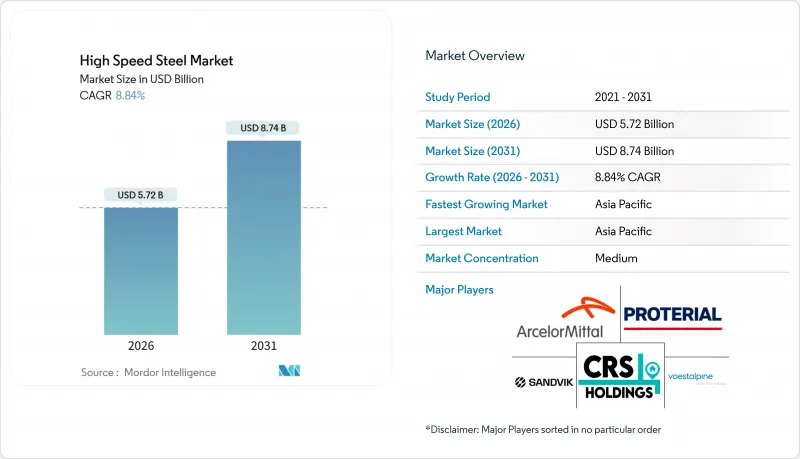
Mordor Intelligence에 의하면, 고속도강 시장 규모는 2026년에 57억 2,000만 달러로 추정되며, 예측 기간(2026-2031년)에 CAGR 8.84%로 성장을 지속하여 2031년까지 87억 4,000만 달러에 이를 전망입니다.
본 보고서는 유형별(텅스텐계 고속강, 몰리브덴계 고속강, 기타), 제품 유형별(금속 절삭 공구, 냉간 가공 공구, 기타), 최종 사용자 산업별(자동차, 항공우주, 플라스틱, 기타), 지역별(아시아태평양, 북미, 유럽, 기타)로 분류되어 있습니다. 시장 예측은 금액(달러) 기준으로 제시됩니다.
전 세계 고속강 시장 동향 및 인사이트
전기차(EV) 보급에 따른 자동차용 절삭 가공 수요 증가
배터리식 전기차의 생산이 급증함에 따라 공차 범위는 50µm 미만으로 더욱 엄격해지고 있습니다. 이러한 변화로 인해 공구의 마모가 빨라지고, 드릴 및 엔드밀의 교체 빈도가 크게 증가하고 있습니다. 이에 따라 테슬라는 텍사스주 및 베를린에서의 공장 확장에 따라 절삭 공구 조달을 확대했습니다. 한편, 중국 공업정보화부는 신에너지차 생산 대수가 증가했다고 보고했습니다. 이러한 생산량 증가로 인해 코발트의 추가 비용 부담 없이 550-600°C에서 경도를 유지할 수 있는 몰리브덴계 강재를 선호하는 경향이 나타나고 있습니다. 이러한 추세가 고속강 시장의 지속적인 성장을 뒷받침하고 있습니다.
항공우주용 엔진 및 기체용 공구 수요 증가
보잉은 2025년 제출 서류에서 민항기 부문의 수주 잔고를 보고했으며, 에어버스도 납품 대기 중인 수주가 있음을 발표했습니다. 티타늄 쉘에 대한 2차 드릴링 및 리머 가공은 여전히 고속강의 인성에 의존하고 있기 때문에 고속강 시장은 초경합금으로의 완전한 전환에도 불구하고 견조한 모습을 유지하고 있습니다. 플랫 앤 휘트니(Pratt & Whitney)는 진동 하중 하에서 초경합금의 파단 위험이 높아지고 있다는 점을 이유로, 파츠리 슬롯의 마무리 가공에 고속강 성형 공구를 계속 사용하고 있습니다.
초경합금 및 세라믹 대체재로의 급속한 전환
2024년 시험에서 인코넬 718의 밀링 가공 시, 세라믹 인서트가 코팅된 고속강보다 세라믹 인서트의 수명이 더 긴 것으로 확인되었습니다. GE 에어로스페이스의 2025년판 공급업체 가이드에서는 많은 항공우주 관련 작업에서 고속강이 제외되었으며, 모든 1차 절삭에 초경합금 또는 CBN의 사용이 의무화되었습니다. 산드빅은 2024년 초경 인서트 판매 증가세를 밝히며 시장 점유율에서 현저한 변화를 부각시켰습니다.
부문 분석
몰리브덴계 합금은 2025년 매출의 37.16%를 차지하며, 2031년까지 연평균 성장률(CAGR)은 9.43%로 예상됩니다. 이에 따라 몰리브덴계 합금은 고속강 시장에서 가장 빠르게 성장하는 부문이 되어, 다른 모든 경쟁 합금을 앞지르고 있습니다. 구매자들은 텅스텐계 합금에 비해 비용 면에서의 우위와 600°C까지의 안정적인 성능에 매력을 느껴 계속해서 몰리브덴계 합금을 선택하고 있습니다. 미세한 탄화물을 분산시키는 분말 야금 가공 기술로 인해 인성과 연마성이 향상되었습니다. 텅스텐계 합금은 650°C를 초과하는 온도 범위에서 틈새 수요를 유지하고 있지만, 가격 급등으로 인해 더 광범위한 채택에는 한계가 있습니다. 한편, 코발트를 풍부하게 함유한 합금은 고속 기어의 호빙 및 브로치 가공에서 간헐적인 하중에 대해 높은 적열 경도를 발휘하기 때문에 그 입지를 확고히 하고 있습니다.
2024년부터 2025년에 걸친 텅스텐의 가격 변동에 따라, 각 OEM 업체들은 몰리브덴계 합금에 주력하게 되었습니다. Proterial사의 M42 코발트-몰리브덴 제품은 높은 로크웰 C 경도를 달성하며, 텅스텐 함량이 높은 T15에 비해 비용 면에서 상당한 우위를 자랑합니다. 한편, 중국 제조업체인 Tiangong사는 2024년에 몰리브덴계 고속강 판매에서 눈부신 성장을 기록했으며, 주로 중국 및 인도의 자동차 티어 기업에 공급함으로써 고속강 분야에서 주도적인 입지를 확고히 다졌습니다.
지역별 분석
아시아태평양은 2025년에 전 세계 매출의 64.28%를 차지할 것으로 예상되며, 2031년까지 연평균 성장률(CAGR) 9.34%로 성장할 것으로 전망됩니다. 그 결과, 아시아태평양의 고속강 시장은 다른 모든 지역을 능가하는 성장률을 보일 것으로 예측됩니다. 2024년, 중국은 주로 장쑤성과 저장성의 거점을 통해 전 세계 절삭 공구 생산의 상당 부분을 차지했습니다. 한편, 인도는 2025년에 해외로부터 제조 분야에 상당한 규모의 투자를 유치했으며, 이러한 수주의 대부분을 현지 공구 공급업체에 배정하고 있습니다. 일본은 정밀 분야에서 계속해서 주도적인 위치를 유지하고 있으며, 한국에서는 반도체 및 자동차 분야에 대한 투자를 바탕으로 2025년에 공작기계 생산량이 급증하여 해당 지역의 우위를 더욱 공고히 하고 있습니다.
북미와 유럽은 합쳐서 2025년 시장 가치에서 상당한 점유율을 차지했습니다. 보잉사의 막대한 수주 잔고에 더해, 프랫 앤 휘트니사의 터빈 관련 사업도 맞물리면서, 항공우주 분야의 2차 용도에서 고속강의 확고한 입지가 부각되었습니다. 2025년, 독일은 견조한 공작기계 생산량을 자랑했으며, 절삭 공구 소비량도 현저히 증가했습니다. 텅스텐 재활용을 촉진하기 위한 EU의 ‘중요 원자재법’에 따라, 포에스트알파인(Voestalpine)은 2024년에 스크랩에서 상당한 양의 텅스텐을 회수하는 데 성공하여 해당 지역공급망을 강화했습니다.
남미는 중동 및 아프리카와 함께 시장의 나머지 점유율을 차지했습니다. 2025년, 발레(Vale)사는 광산 설비의 현대화에 막대한 투자를 단행했으며, 그 중심에는 고속강 공구를 사용한 머시닝 센터가 자리 잡았습니다. 사우디아라비아 공공투자기금은 2025년, 국내 고속강 생산을 목표로 하는 합작 사업을 포함한 첨단 제조 프로젝트에 막대한 자금을 배정했습니다. 수입품과의 경쟁에 직면했음에도 불구하고, 2025년 남아프리카공화국의 자동차 생산은 현지 절삭 공구에 대한 수요를 끌어올렸습니다.
기타 혜택:
- 엑셀 형식 시장 예측(ME) 시트
- 3개월간의 애널리스트 지원
자주 묻는 질문
목차
제1장 서론
제2장 조사 방법
제3장 주요 요약
제4장 시장 구도
제5장 시장 규모와 성장 예측
제6장 경쟁 구도
제7장 시장 기회와 향후 전망
LSH 26.09.03According to Mordor Intelligence, the high speed steel market size is estimated at USD 5.72 billion in 2026, and is expected to reach USD 8.74 billion by 2031, at a CAGR of 8.84% during the forecast period (2026-2031).
This report is Segmented by Type (Tungsten High Speed Steel, Molybdenum High Speed Steel, and Other Types), Product Type (Metal Cutting Tools, Cold Working Tools, and Other Product Types), End-User Industry (Automotive, Aerospace, Plastics, and Other End-User Industries), and Geography (Asia-Pacific, North America, Europe, and More). The Market Forecasts are Provided in Terms of Value (USD).
Global High Speed Steel Market Trends and Insights
Expansion of EV Driven Automotive Machining Demand
As battery-electric vehicle production surges, tolerance bands are tightening below 50 µm. This shift leads to quicker tool wear and a significant uptick in drill and end-mill turnover. In tandem, Tesla ramped up its cutting tool procurement during its plant expansions in Texas and Berlin. Meanwhile, the Chinese Ministry of Industry and Information Technology reported an increase in new-energy vehicle production. Such production volumes favor molybdenum grades, which maintain hardness at 550-600 °C without incurring the cobalt premium. This preference bolsters the continuous growth of the high-speed steel market.
Rising Aerospace Engine and Air Frame Tooling Needs
Boeing reported a commercial backlog in its 2025 filing, while Airbus announced it has orders pending delivery. The high-speed steel market remains resilient against a complete shift to carbide, as secondary drilling and reaming on titanium shells still depend on the toughness of high-speed steel. Pratt & Whitney, citing the heightened risk of carbide fractures under vibratory loads, continues to use high-speed steel form tools for finishing fir-tree slots.
Rapid Shift Toward Carbide and Ceramic Substitutes
In 2024 trials, ceramic inserts outlasted coated high-speed steel when milling Inconel 718. GE Aerospace's 2025 supplier guide has eliminated high-speed steel from many aerospace operations, mandating carbide or CBN for all primary cuts. Sandvik revealed growth in carbide insert sales in 2024, underscoring a notable shift in market share.
Other drivers and restraints analyzed in the detailed report include:
- Automation and Industry 4.0 Boosting Tool Change Frequency
- Powder Metallurgy High Speed Steel Grades Extending Tool Life
- Volatile Tungsten and Molybdenum Input Prices
For complete list of drivers and restraints, kindly check the Table Of Contents.
Segment Analysis
Molybdenum compositions held 37.16% of 2025 revenue, and the cohort is set for a 9.43% CAGR through 2031. This positions molybdenum grades as the fastest-growing segment in the high-speed steel market, outpacing all rival alloys. Buyers remain loyal, drawn by cost advantages over tungsten blends and consistent performance up to 600 °C. The powder-metallurgy processing technique, which disperses fine carbides, enhances toughness and grindability. While tungsten grades maintain a niche for temperatures exceeding 650 °C, their rising prices limit broader adoption. Meanwhile, cobalt-enriched alloys find their place in high-speed gear hobbing and broaching, where they offer added red-hardness for intermittent loads.
In response to price fluctuations in tungsten during 2024-2025, OEMs shifted their focus to molybdenum variants. Proterial's M42 cobalt-molybdenum product achieved high Rockwell C hardness, boasting a significant cost advantage over the tungsten-rich T15. Meanwhile, Chinese producer Tiangong recorded notable sales growth in molybdenum high-speed steel in 2024, predominantly catering to automotive tiers in China and India, solidifying its leadership in the high-speed steel arena.
Complete Report Scope:
- By Type
- Tungsten High Speed Steel
- Molybdenum High Speed Steel
- Other Types (Cobalt High-Speed Steel, Chromium High-Speed Steel, and Vanadium High-Speed Steel)
- By Product Type
- Metal Cutting Tools
- Cold Working Tools
- Other Product Types (Milling Tools, Drilling Tools, etc.)
- By End-user Industry
- Automotive
- Aerospace
- Plastics
- Other End-user Industries (Mining, Manufacturing, Tool Making, etc)
- Geography
- Asia-Pacific
- China
- India
- Japan
- South Korea
- Malaysia
- Thailand
- Indonesia
- Vietnam
- Rest of Asia-Pacific
- North America
- United States
- Canada
- Mexico
- Europe
- Germany
- United Kingdom
- France
- Italy
- Spain
- NORDIC Countries
- Turkey
- Russia
- Rest of Europe
- South America
- Brazil
- Argentina
- Colombia
- Rest of South America
- Middle-East and Africa
- Saudi Arabia
- South Africa
- Nigeria
- Qatar
- Egypt
- United Arab Emirates
- Rest of Middle-East and Africa
- Asia-Pacific
Geography Analysis
Asia-Pacific generated 64.28% of global revenue in 2025 and is forecast to grow at a 9.34% CAGR to 2031. As a result, the high-speed steel market in Asia-Pacific is set to outpace all other regions in growth. In 2024, China, primarily from its Jiangsu and Zhejiang hubs, was responsible for a substantial portion of global cutting tool production. Meanwhile, India drew in considerable foreign manufacturing investments in 2025, directing a significant portion of these orders to local tool suppliers. Japan continues to lead in precision, and South Korea's machine-tool output surged in 2025, driven by investments in semiconductors and automotive sectors, further solidifying the region's dominance.
North America and Europe together accounted for a notable share of the 2025 market value. Boeing's substantial backlog, alongside Pratt & Whitney's turbine initiatives, underscores the stronghold of high-speed steel in secondary aerospace applications. In 2025, Germany boasted a robust machine-tool output, with a notable uptick in cutting-tool consumption. The EU's Critical Raw Materials Act, aimed at boosting tungsten recycling, saw voestalpine successfully recover a significant amount from scrap in 2024, bolstering the region's supply chains.
South America, along with the Middle East and Africa, accounted for the remaining share of the market. In 2025, Vale invested heavily in upgrading mine equipment, which prominently featured machining centers utilizing high-speed steel tooling. Saudi Arabia's Public Investment Fund, in 2025, allocated substantial resources towards advanced manufacturing projects, including a joint venture eyeing domestic high-speed steel production. Despite facing import competition, South Africa's vehicle production in 2025 bolstered the demand for local cutting tools.
- ArcelorMittal
- CRS Holdings, LLC
- ERASTEEL
- Friedr. Lohmann GmbH
- Graphite India Limited
- Hudson Tool Steel
- Jiangsu Tiangong Tools Co., Ltd.
- NIPPON KOSHUHA STEEL CO,. LTD.
- Proterial, Ltd.
- Sandvik AB
- voestalpine BOHLER Edelstahl GmbH & Co KG
Additional Benefits:
- The market estimate (ME) sheet in Excel format
- 3 months of analyst support
TABLE OF CONTENTS
1 Introduction
- 1.1 Study Assumptions and Market Definition
- 1.2 Scope of the Study
2 Research Methodology
3 Executive Summary
4 Market Landscape
- 4.1 Market Overview
- 4.2 Market Drivers
- 4.2.1 Expansion of EV-driven automotive machining demand
- 4.2.2 Rising aerospace engine and air-frame tooling needs
- 4.2.3 Automation and Industry 4.0 boosting tool-change frequency
- 4.2.4 Powder-metallurgy HSS grades extending tool life
- 4.2.5 Circular-economy push for tungsten recycling
- 4.3 Market Restraints
- 4.3.1 Rapid shift toward carbide and ceramic substitutes
- 4.3.2 Volatile tungsten and molybdenum input prices
- 4.3.3 3-D-printed carbide tools shortening HSS life-cycle
- 4.4 Value Chain Analysis
- 4.5 Porter's Five Forces
- 4.5.1 Bargaining Power of Suppliers
- 4.5.2 Bargaining Power of Buyers
- 4.5.3 Threat of New Entrants
- 4.5.4 Threat of Substitutes
- 4.5.5 Degree of Competition
5 Market Size and Growth Forecasts (Value)
- 5.1 By Type
- 5.1.1 Tungsten High Speed Steel
- 5.1.2 Molybdenum High Speed Steel
- 5.1.3 Other Types (Cobalt High-Speed Steel, Chromium High-Speed Steel, and Vanadium High-Speed Steel)
- 5.2 By Product Type
- 5.2.1 Metal Cutting Tools
- 5.2.2 Cold Working Tools
- 5.2.3 Other Product Types (Milling Tools, Drilling Tools, etc.)
- 5.3 By End-user Industry
- 5.3.1 Automotive
- 5.3.2 Aerospace
- 5.3.3 Plastics
- 5.3.4 Other End-user Industries (Mining, Manufacturing, Tool Making, etc)
- 5.4 Geography
- 5.4.1 Asia-Pacific
- 5.4.1.1 China
- 5.4.1.2 India
- 5.4.1.3 Japan
- 5.4.1.4 South Korea
- 5.4.1.5 Malaysia
- 5.4.1.6 Thailand
- 5.4.1.7 Indonesia
- 5.4.1.8 Vietnam
- 5.4.1.9 Rest of Asia-Pacific
- 5.4.2 North America
- 5.4.2.1 United States
- 5.4.2.2 Canada
- 5.4.2.3 Mexico
- 5.4.3 Europe
- 5.4.3.1 Germany
- 5.4.3.2 United Kingdom
- 5.4.3.3 France
- 5.4.3.4 Italy
- 5.4.3.5 Spain
- 5.4.3.6 NORDIC Countries
- 5.4.3.7 Turkey
- 5.4.3.8 Russia
- 5.4.3.9 Rest of Europe
- 5.4.4 South America
- 5.4.4.1 Brazil
- 5.4.4.2 Argentina
- 5.4.4.3 Colombia
- 5.4.4.4 Rest of South America
- 5.4.5 Middle-East and Africa
- 5.4.5.1 Saudi Arabia
- 5.4.5.2 South Africa
- 5.4.5.3 Nigeria
- 5.4.5.4 Qatar
- 5.4.5.5 Egypt
- 5.4.5.6 United Arab Emirates
- 5.4.5.7 Rest of Middle-East and Africa
- 5.4.1 Asia-Pacific
6 Competitive Landscape
- 6.1 Market Concentration
- 6.2 Strategic Moves
- 6.3 Market Share/Ranking Analysis
- 6.4 Company Profiles (includes Global level Overview, Market level overview, Core Segments, Financials as available, Strategic Information, Products and Services, Recent Developments)
- 6.4.1 ArcelorMittal
- 6.4.2 CRS Holdings, LLC
- 6.4.3 ERASTEEL
- 6.4.4 Friedr. Lohmann GmbH
- 6.4.5 Graphite India Limited
- 6.4.6 Hudson Tool Steel
- 6.4.7 Jiangsu Tiangong Tools Co., Ltd.
- 6.4.8 NIPPON KOSHUHA STEEL CO,. LTD.
- 6.4.9 Proterial, Ltd.
- 6.4.10 Sandvik AB
- 6.4.11 voestalpine BOHLER Edelstahl GmbH & Co KG
7 Market Opportunities and Future Outlook
- 7.1 White-space and Unmet-Need Assessment